CPT Seminar Welcome to Seminar
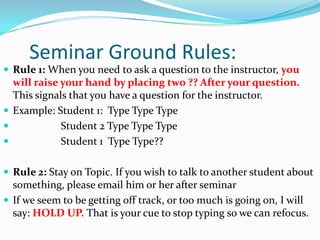
Seminar Ground Rules:Rule 1: When you need to ask a question to the instructor, you will raise your hand by placing two ?? After your question. This signals that you have a question for the instructor.Example: Student 1:  Type Type Type                  Student 2 Type Type Type                  Student 1  Type Type??Rule 2: Stay on Topic. If you wish to talk to another student about something, please email him or her after seminarIf we seem to be getting off track, or too much is going on, I will say: HOLD UP. That is your cue to stop typing so we can refocus.
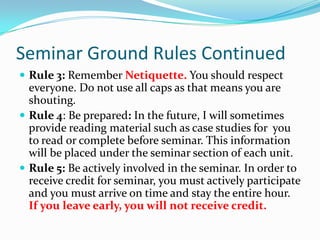
Seminar Ground Rules ContinuedRule 3: Remember Netiquette. You should respect everyone. Do not use all caps as that means you are shouting. Rule 4: Be prepared: In the future, I will sometimes provide reading material such as case studies for  you to read or complete before seminar. This information will be placed under the seminar section of each unit. Rule 5: Be actively involved in the seminar. In order to receive credit for seminar, you must actively participate and you must arrive on time and stay the entire hour. If you leave early, you will not receive credit.
Seminar Option 2:If you cannot attend seminar, you may choose the Seminar Option 2This option is harder and will be graded harderThis option requires you to write an essayEssay must use proper English grammarResponses provide detailed examplesMust meet length requirementsNo credit will be given for late option two assignments.
Surgery Section is the Third Section of the CPT ManualCodes begin with 1, 2, 3, 4, 5, or 6These are invasive proceduresNon-invasive procedures would not be in this section. They would be found under the E/M SectionMajority of Surgery Section is arranged from outside to inside of the body5
Surgical PackageSurgical package includes specific details that cannot be coded as separate proceduresIf you code them separately, you would be overcoding and it could be deemed as fraudCPT and Medicare have different rules for what is contained in the Surgical Package6
Separate Procedure ContinuedAppears in parentheses after code descriptionAsk yourself if the separate procedure code is an integral part of another procedureA modifier such as -59 distinct services should be added to explain7
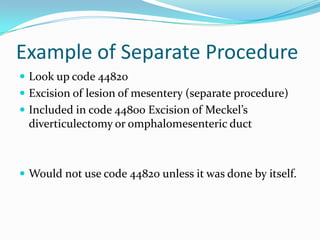
Example of Separate ProcedureLook up code 44820Excision of lesion of mesentery (separate procedure)Included in code 44800 Excision of Meckel’s diverticulectomy or omphalomesenteric ductWould not use code 44820 unless it was done by itself.
Integumentary System
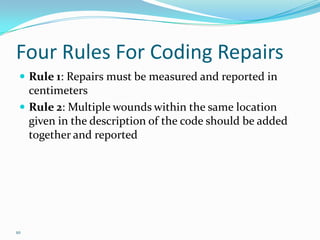
Four Rules For Coding RepairsRule 1: Repairs must be measured and reported in centimetersRule 2: Multiple wounds within the same location given in the description of the code should be added together and reported10
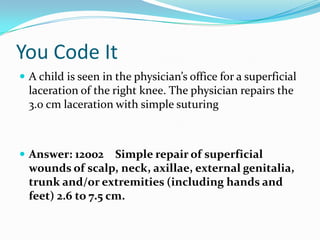
You Code ItA child is seen in the physician’s office for a superficial laceration of the right knee. The physician repairs the 3.0 cm laceration with simple suturingAnswer: 12002	Simple repair of superficial wounds of scalp, neck, axillae, external genitalia, trunk and/or extremities (including hands and feet) 2.6 to 7.5 cm.
Rule Three:Debridement and Contamination  are a part of the global service. Can’t code separately except:Prolonged cleansingAbove average tissue amount is removedCarried out separately12
Rule 4: Involvement of Nerves, Blood Vessels and TendonsWhen any nerve, blood vessel, or tendon is repaired, the code from the Nervous, Cardiovascular, or Musoskeletal System should be used instead of the Integumentary.One exception: When the physician performs a complex repair in addition  to repairing the nerve ect., You can code repair13
Coding ExampleRepair of cardiac wound would be:33300 Repair of cardiac wound; without bypassThis code is found under Cardiovascular System and not Integumentary  System
Musculoskeletal System
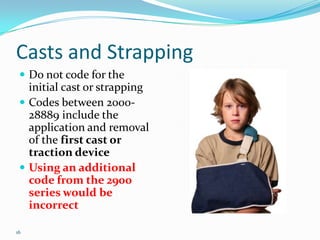
Casts and StrappingDo not code for the initial cast or strappingCodes between 2000-28889 include the application and removal of the first cast or traction deviceUsing an additional code from the 2900 series would be incorrect16
Coding ExampleClosed reduction of proximal humerus fracture, right23605 Closed treatment of proximal humeral (surgical  or anatomical neck) fracture; with manipulation with or without skeletal traction
EndoscopyEndoscopy means “looking within”.Codes are categorized by body part and then by type of endoscopy: surgical or diagnosticSurgical always includes diagnostic and should not be coded separately
Respiratory System
Bilateral versus Unilateral ProceduresProcedures are unilateral. When the services are not meant to be unilateral, the code will tell you.If you are using a code that does not say anything about being bilateral, and you provide a service that is done on both sides, you will use a modifier -50 Bilateral Services on the second side20
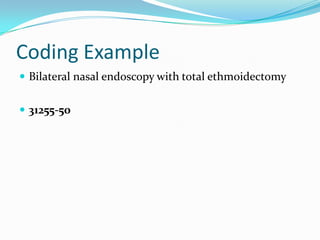
Coding ExampleBilateral nasal endoscopy with total ethmoidectomy31255-50
ModifiersAdd details to codesA list can be found in Appendix ASome apply only to hospitalsOthers apply to physician servicesYou must learn these-memorize them!
This Week: Sept 13- Sept 19Proctor Form is DueDrop in Proctor Drop Box on Course Home. Instructions and Form can be found under doc sharingKaren Kuharic is the proctor at SCCC/ATS. She is in Room 102 and her number is 620 417 1105Assignment DiscussionNo Seminar on Sept 20th
Questions???Copyright ©2005 by Thomson Delmar Learning.  ALL RIGHTS RESERVED.2-24

Sherryf 17dc663c 835f-46e2-8975-e35223807510

  • 1.
  • 2.
    Seminar Ground Rules:Rule1: When you need to ask a question to the instructor, you will raise your hand by placing two ?? After your question. This signals that you have a question for the instructor.Example: Student 1: Type Type Type Student 2 Type Type Type Student 1 Type Type??Rule 2: Stay on Topic. If you wish to talk to another student about something, please email him or her after seminarIf we seem to be getting off track, or too much is going on, I will say: HOLD UP. That is your cue to stop typing so we can refocus.
  • 3.
    Seminar Ground RulesContinuedRule 3: Remember Netiquette. You should respect everyone. Do not use all caps as that means you are shouting. Rule 4: Be prepared: In the future, I will sometimes provide reading material such as case studies for you to read or complete before seminar. This information will be placed under the seminar section of each unit. Rule 5: Be actively involved in the seminar. In order to receive credit for seminar, you must actively participate and you must arrive on time and stay the entire hour. If you leave early, you will not receive credit.
  • 4.
    Seminar Option 2:Ifyou cannot attend seminar, you may choose the Seminar Option 2This option is harder and will be graded harderThis option requires you to write an essayEssay must use proper English grammarResponses provide detailed examplesMust meet length requirementsNo credit will be given for late option two assignments.
  • 5.
    Surgery Section isthe Third Section of the CPT ManualCodes begin with 1, 2, 3, 4, 5, or 6These are invasive proceduresNon-invasive procedures would not be in this section. They would be found under the E/M SectionMajority of Surgery Section is arranged from outside to inside of the body5
  • 6.
    Surgical PackageSurgical packageincludes specific details that cannot be coded as separate proceduresIf you code them separately, you would be overcoding and it could be deemed as fraudCPT and Medicare have different rules for what is contained in the Surgical Package6
  • 7.
    Separate Procedure ContinuedAppearsin parentheses after code descriptionAsk yourself if the separate procedure code is an integral part of another procedureA modifier such as -59 distinct services should be added to explain7
  • 8.
    Example of SeparateProcedureLook up code 44820Excision of lesion of mesentery (separate procedure)Included in code 44800 Excision of Meckel’s diverticulectomy or omphalomesenteric ductWould not use code 44820 unless it was done by itself.
  • 9.
  • 10.
    Four Rules ForCoding RepairsRule 1: Repairs must be measured and reported in centimetersRule 2: Multiple wounds within the same location given in the description of the code should be added together and reported10
  • 11.
    You Code ItAchild is seen in the physician’s office for a superficial laceration of the right knee. The physician repairs the 3.0 cm laceration with simple suturingAnswer: 12002 Simple repair of superficial wounds of scalp, neck, axillae, external genitalia, trunk and/or extremities (including hands and feet) 2.6 to 7.5 cm.
  • 12.
    Rule Three:Debridement andContamination are a part of the global service. Can’t code separately except:Prolonged cleansingAbove average tissue amount is removedCarried out separately12
  • 13.
    Rule 4: Involvementof Nerves, Blood Vessels and TendonsWhen any nerve, blood vessel, or tendon is repaired, the code from the Nervous, Cardiovascular, or Musoskeletal System should be used instead of the Integumentary.One exception: When the physician performs a complex repair in addition to repairing the nerve ect., You can code repair13
  • 14.
    Coding ExampleRepair ofcardiac wound would be:33300 Repair of cardiac wound; without bypassThis code is found under Cardiovascular System and not Integumentary System
  • 15.
  • 16.
    Casts and StrappingDonot code for the initial cast or strappingCodes between 2000-28889 include the application and removal of the first cast or traction deviceUsing an additional code from the 2900 series would be incorrect16
  • 17.
    Coding ExampleClosed reductionof proximal humerus fracture, right23605 Closed treatment of proximal humeral (surgical or anatomical neck) fracture; with manipulation with or without skeletal traction
  • 18.
    EndoscopyEndoscopy means “lookingwithin”.Codes are categorized by body part and then by type of endoscopy: surgical or diagnosticSurgical always includes diagnostic and should not be coded separately
  • 19.
  • 20.
    Bilateral versus UnilateralProceduresProcedures are unilateral. When the services are not meant to be unilateral, the code will tell you.If you are using a code that does not say anything about being bilateral, and you provide a service that is done on both sides, you will use a modifier -50 Bilateral Services on the second side20
  • 21.
    Coding ExampleBilateral nasalendoscopy with total ethmoidectomy31255-50
  • 22.
    ModifiersAdd details tocodesA list can be found in Appendix ASome apply only to hospitalsOthers apply to physician servicesYou must learn these-memorize them!
  • 23.
    This Week: Sept13- Sept 19Proctor Form is DueDrop in Proctor Drop Box on Course Home. Instructions and Form can be found under doc sharingKaren Kuharic is the proctor at SCCC/ATS. She is in Room 102 and her number is 620 417 1105Assignment DiscussionNo Seminar on Sept 20th
  • 24.
    Questions???Copyright ©2005 byThomson Delmar Learning. ALL RIGHTS RESERVED.2-24