Presented by
Jerome A. Pueblos
HOW TO CONDUCT SEMINARS
• The term "seminar" can be applied to a variety of sessions. On the
whole it is used to describe an activity involving a smaller number of
students than one might find in a lecture, during which the students are
more actively involved. It may be structured as a task which has been
set in advance, and agreed between students and lecturers, it may
involve a student or students taking a pro-active lead in the session, or
it may be a "hands on" workshop or case study activity.
SEMINAR DEFINITION
• is a lecture or presentation delivered to an audience on a particular
topic or set of topics that are educational in nature. It is usually held for
groups of 10-50 individuals.
• is frequently held at a hotel meeting space or within an office
conference room.
SEMINAR DEFINITION
• To get the students to present material orally
• To get the students to present material visually
• To get the students to lead a discussion
• To expand on material introduced in large lectures, but to reach more depth
• To provide a forum for students to ask questions
• To encourage the students to partake in a discussion and express their own points of view
• To engage in a more formal debate
• Set the students problems to be solved
• Ask the students to undertake case study work
• Involve the students in group or team work
• Ask the students to undertake peer assessment of each others' work (oral presentation or
written work)
• Use a role play exercise
PURPOSE OF A SEMINAR
Sometimes seminars do not achieve as much as one hope. The difficulties are most likely to be with
discussion sessions rather than workshops which ask the students to undertake much defined tasks.
• Students do not speak out in a seminar, so the session is dominated by the lecturer
• Only one or two students speak and dominate the session
• The discussion drifts a long way "off the point" and the major topic is not covered adequately
• Students have been involved in the session, but leave with a rather hazy view of the outcomes
• Students in different seminar groups (in the same module) complain of different learning
experiences
• A group of staff providing the same seminars, within a module, on the same topic can deliver a very
different experience if the purposes, outcomes and approaches are not clear
• Students who prepare work to be marked by their seminar teacher collude with another student in a
different group and assume this "cheating" will not be spotted
• Students arrive at the seminar unprepared for the discussion
PROBLEMS THAT MAY ARISE IN SEMINARS
Conducting a seminar is a great way to communicate
your ideas or introduce new technologies. It is useful to
know some guidelines when you have to conduct a
seminar. I understood the importance of this both as an
attendee and a presenter myself.
How to conduct seminar?
A successful seminar is the result of careful preparation of your speech
and your presentation material.
• Research your subject
If you are called to speak on a topic, probably that is because you are
already having some knowledge of it. Even so, you need to reference from
at least 2 different books. This helps you address and include points you
have not thought about. It also helps you determine a flow for the
seminar.
I. Preparing your presentation
• Preparing the presentation
Include a presentation. Presentations help the audience to understand
the underlying points that the speaker has to say especially if the subject
is rather vague.
The presentation should have an Introduction and a conclusion. The
introduction can include a summary of the topic and a brief overview of
what the speaker will be saying for the rest of the duration of the seminar.
I. Preparing your presentation
The speaker should prepare handouts as well, especially if the audience is
small. Handouts will contain all main points of the seminar as well as
those detailed points which cannot be included in the seminar slides but
are useful for reference later. Include within the handout, a list of any
reference books used to prepare for the seminar. This helps the audience
to read or follow-up on the same topic later.
II. Handouts
The speaker should listen to his seminar using a Dictaphone (or tape
recorder) and play it back. It is possible to immediately detect the parts of
the seminar that could be corrected or which don't sound right. If the
seminar sounds interesting to the speaker, chances are that others would
also feel so.
III. Listen to your voice
The speaker should make sure that the audience knows how long this is
going to take. Give a brief idea on the important aspects of your speech
so that the audience is aware where they are during the seminar. Then
start with an introduction.
IV. List out your seminar itinerary
Finally ensure that seminars are always conducted in an organization.
Besides drastically improving knowledge levels, it brings about an
understanding of the immensity of the vast unknowns in our profession
or for that matter any profession. This in turn eradicates complacency.
V. Conclusion
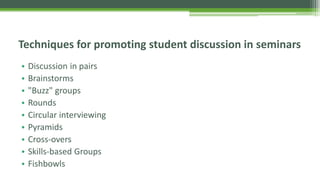
• Discussion in pairs
• Brainstorms
• "Buzz" groups
• Rounds
• Circular interviewing
• Pyramids
• Cross-overs
• Skills-based Groups
• Fishbowls
Techniques for promoting student discussion in seminars
END

How to conduct seminars

  • 1.
    Presented by Jerome A.Pueblos HOW TO CONDUCT SEMINARS
  • 2.
    • The term"seminar" can be applied to a variety of sessions. On the whole it is used to describe an activity involving a smaller number of students than one might find in a lecture, during which the students are more actively involved. It may be structured as a task which has been set in advance, and agreed between students and lecturers, it may involve a student or students taking a pro-active lead in the session, or it may be a "hands on" workshop or case study activity. SEMINAR DEFINITION
  • 3.
    • is alecture or presentation delivered to an audience on a particular topic or set of topics that are educational in nature. It is usually held for groups of 10-50 individuals. • is frequently held at a hotel meeting space or within an office conference room. SEMINAR DEFINITION
  • 4.
    • To getthe students to present material orally • To get the students to present material visually • To get the students to lead a discussion • To expand on material introduced in large lectures, but to reach more depth • To provide a forum for students to ask questions • To encourage the students to partake in a discussion and express their own points of view • To engage in a more formal debate • Set the students problems to be solved • Ask the students to undertake case study work • Involve the students in group or team work • Ask the students to undertake peer assessment of each others' work (oral presentation or written work) • Use a role play exercise PURPOSE OF A SEMINAR
  • 5.
    Sometimes seminars donot achieve as much as one hope. The difficulties are most likely to be with discussion sessions rather than workshops which ask the students to undertake much defined tasks. • Students do not speak out in a seminar, so the session is dominated by the lecturer • Only one or two students speak and dominate the session • The discussion drifts a long way "off the point" and the major topic is not covered adequately • Students have been involved in the session, but leave with a rather hazy view of the outcomes • Students in different seminar groups (in the same module) complain of different learning experiences • A group of staff providing the same seminars, within a module, on the same topic can deliver a very different experience if the purposes, outcomes and approaches are not clear • Students who prepare work to be marked by their seminar teacher collude with another student in a different group and assume this "cheating" will not be spotted • Students arrive at the seminar unprepared for the discussion PROBLEMS THAT MAY ARISE IN SEMINARS
  • 6.
    Conducting a seminaris a great way to communicate your ideas or introduce new technologies. It is useful to know some guidelines when you have to conduct a seminar. I understood the importance of this both as an attendee and a presenter myself. How to conduct seminar?
  • 7.
    A successful seminaris the result of careful preparation of your speech and your presentation material. • Research your subject If you are called to speak on a topic, probably that is because you are already having some knowledge of it. Even so, you need to reference from at least 2 different books. This helps you address and include points you have not thought about. It also helps you determine a flow for the seminar. I. Preparing your presentation
  • 8.
    • Preparing thepresentation Include a presentation. Presentations help the audience to understand the underlying points that the speaker has to say especially if the subject is rather vague. The presentation should have an Introduction and a conclusion. The introduction can include a summary of the topic and a brief overview of what the speaker will be saying for the rest of the duration of the seminar. I. Preparing your presentation
  • 9.
    The speaker shouldprepare handouts as well, especially if the audience is small. Handouts will contain all main points of the seminar as well as those detailed points which cannot be included in the seminar slides but are useful for reference later. Include within the handout, a list of any reference books used to prepare for the seminar. This helps the audience to read or follow-up on the same topic later. II. Handouts
  • 10.
    The speaker shouldlisten to his seminar using a Dictaphone (or tape recorder) and play it back. It is possible to immediately detect the parts of the seminar that could be corrected or which don't sound right. If the seminar sounds interesting to the speaker, chances are that others would also feel so. III. Listen to your voice
  • 11.
    The speaker shouldmake sure that the audience knows how long this is going to take. Give a brief idea on the important aspects of your speech so that the audience is aware where they are during the seminar. Then start with an introduction. IV. List out your seminar itinerary
  • 12.
    Finally ensure thatseminars are always conducted in an organization. Besides drastically improving knowledge levels, it brings about an understanding of the immensity of the vast unknowns in our profession or for that matter any profession. This in turn eradicates complacency. V. Conclusion
  • 13.
    • Discussion inpairs • Brainstorms • "Buzz" groups • Rounds • Circular interviewing • Pyramids • Cross-overs • Skills-based Groups • Fishbowls Techniques for promoting student discussion in seminars
  • 14.