
Seminar
PREPARED BY-
NISHA YADAV
M.Sc. NURSING 1ST YEAR
NINE, PGIMER
CHANDIGARH
Learning Objectives
At the end of class students will
be able to-
 Define seminar
 Explain the objectives of
seminar
 Describe the types of
seminar
 Describe about seminar
committee
 Explain the roles of
members of seminar
committee
 Enlist the steps involved in
seminar
 Explain the steps of seminar
 Explain the evaluation of
seminar
 Enlist the advantages of
seminar
 Enlist the disadvantages of
seminar
Introduction
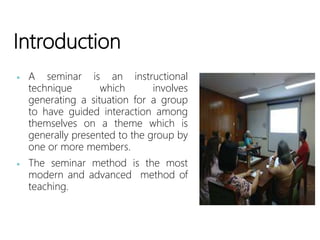
 A seminar is an instructional
technique which involves
generating a situation for a group
to have guided interaction among
themselves on a theme which is
generally presented to the group by
one or more members.
 The seminar method is the most
modern and advanced method of
teaching.
Introduction cont…
 Seminar is a common form of discussion
employed in teaching nursing. Seminars are
used usually for teaching higher level students
like postgraduates , research scholars, etc.
 The skills such as reading, writing and talking are
essential for the personality development of a
person. The seminar method integrates such
skills of reading and writing with presentation
skills.
History
 Seminarium: plot where
plants are raised from seeds
Or “plant nursery” from
Latin word.
 1580 first recorded: used to
describe "school for training
priests".
Definition
 Seminar is an instructional technique of higher learning
which involves paper reading on a theme and followed
by the group discussion to clarify the complex aspects
of the theme.
 Seminar is a form of a class organization that utilizes a
scientific approach for the analysis of a problem chosen
for discussion.
 Seminar is a discussion based on information presented
by experts under the guidance of an eminent resource
person for the benefit of group members.
Objectives of the Seminar
 Objectives are mainly divided into
two types:
1. Cognitive objectives
2. Affective objectives
Cognitive objectives
 To develops the higher cognitive abilities that is
analysis, synthesis and evaluation.
 To develop the ability of responding that is valuing,
organizing etc.
 To develop the ability of keen observation, experience,
feeling and to present them effectively.
 To develop the ability to seek clarification and defend
the ideas of other effectively.
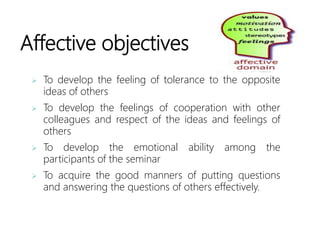
Affective objectives
 To develop the feeling of tolerance to the opposite
ideas of others
 To develop the feelings of cooperation with other
colleagues and respect of the ideas and feelings of
others
 To develop the emotional ability among the
participants of the seminar
 To acquire the good manners of putting questions
and answering the questions of others effectively.
TYPES OF SEMINAR
 Based on the level of organization, the seminar can be
classified into four types namely:
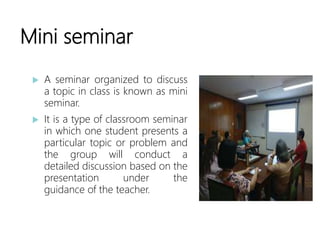
Mini seminar
 A seminar organized to discuss
a topic in class is known as mini
seminar.
 It is a type of classroom seminar
in which one student presents a
particular topic or problem and
the group will conduct a
detailed discussion based on the
presentation under the
guidance of the teacher.
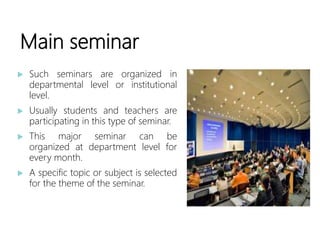
Main seminar
 Such seminars are organized in
departmental level or institutional
level.
 Usually students and teachers are
participating in this type of seminar.
 This major seminar can be
organized at department level for
every month.
 A specific topic or subject is selected
for the theme of the seminar.
National seminar
 It is organized by an association at
national level. An association of
any kind particularly with
academic or professional interest
conducts the seminar at national
level.
 The subject experts are invited to
the seminar for discussion. The
secretary of the seminar prepares
the schedule and functionaries of
the seminar
International seminar
 Such seminars are organized by
UNESCO and other international
organizations. Theme of this
seminar has wider aspects.
 Globalization, renovation, atomic
energy agreements, policies
implementation and modification
are examples for themes of
international seminar.
SEMINAR COMMITTEE
Seminar is conducted or organised by the committee
proposed for this purpose only. This committee constitutes
a chairperson, organizing secretary and subject experts in
the theme proposed for seminar. Usually seminar has been
conducted with the following team of organising body-
 Organiser- He is the key person of the seminar and
responsible for the planning and executing the functions
of the seminar. She/ he must be a good administrator
and subject expert in the filed proposed theme of
seminar.
 Chairperson- She/ he must be the person with
expertise in the theme proposed for the seminar.
She/ he should have a good experience to
perform all the activities which is vital to the
seminar.
 Speaker- She/ he is the active participant of
seminar presenting his/ her paper among the
other participants in the presence of chairperson
of seminar
 Participant- The people who are presenting
papers and observing the paper presentation by
participating in the seminar
Role of organizer
 It is the organizers who decide the topic of the seminar.
Usually topics are related to the current trends or recent
developments in the clinical practice or nursing education
 Once the topic is selected and objectives are formulated,
organizers start searching for a suitable chairperson and
select an eminent person who is well versed in the
concerned topic as the chairperson
Role of organizer cont…
 In consultation with the chairperson, organizer
modifies the objectives if needed finalize the
various aspects of the topic and select speakers
 In case of national or international seminars,
large scale preparation is needed and organizers
have to form various committees like invitation
committee, finance committee, etc and
coordinate effectively for the successful
conduction of the seminar.
Role of chairperson
 Direct the whole program and keeps the discussion on
the theme of seminar
 Chairperson should possess in-depth knowledge
regarding the topic and his duty is to guide the seminar in
a fruitful manner
 Seminar begins with an introductory speech by the
chairperson. In introductory talk, he justifies the topic
selection by stating its relevance and importance and
introduces the speakers by highlighting their
achievements.
Role of chairperson cont…
 After introductory speech, chairperson invites
speaker according to their order
 When one speaker completes his speech, he
gives a brief summary of it and invites the next
speaker to present his viewpoints.
 Once all speakers completes their speech,
chairperson calls for open discussion by inviting
participants to come out with their doubts,
clarifications and contributions.
Role of speaker
 The quality and quantity of the information presented by
the speakers have a direct role in preparing the
participants for the discussion session.
 Speakers are expected to present the relevant
information in an interesting and comprehensible
manner with the help of suitable audio-visual aids.
Role of speaker cont…
 They prepare the topic thoroughly and Xerox
copies of papers are prepared and distributed
among the participants before the
commencement of the topic so the participants
should also prepare themselves for the topic.
 The speaker should be ready to define the
questions
Role of participants
 The objectives of the seminars are framed in accordance
with the learning needs of the participants
 Participants make the seminar very live and interesting.
Participants should be well acquainted with theme.
 They should appreciate the performance of the speaker.
They should be able to put questions and seek
clarification
Role of participants cont…
 There are 25 -30 participants in seminar.
 They have to utilize the discussion to enrich their
knowledge rather than testing the knowledge of
the speakers or the chairperson
Steps involved in seminar
 The seminar process which allows the persons to
discuss a theme in a peer group with subject
experts in an objective method.
 The steps of the seminar method are classified
into following 3 steps-
o Pre seminar phase
o Seminar phase
o Post seminar phase
Pre seminar phase
 Selection of theme and its sub themes
 Venue, date and time are must be finalized well in
advance
 The panel of specialist, subject experts, chief guests,
observers for seminar must be prepared and
obtaining the concurrence from the president of the
seminar
Pre seminar phase cont…
 The permission must be requested from the
persons listed in the panel and from their head
offices to utilize their services for seminar
 A circular regarding the seminar and its
information must be prepared without ambiguity.
 The selection of the paper presenter must be
based on the article submitted by them and their
professional excellence.
Seminar phase
 Ensure the physical facilities
 Welcome the chief guests, chair persons,
observers and participants of seminar and
encourage their active participation in the seminar
 The compendium must be distributed to the
participants before the beginning of seminar
 The seminar theme and its sub theme need to be
explained
 Guide the paper presenters for their location and
time of seminar session before the beginning of
seminar
Seminar phase cont…
 Proper assistance must be ensure for every
speaker to facilitate their paper presentation by
providing appropriate audio, video equipments
such as public address system, overhead
projector, LCD projector, etc.
 At the end of seminar session, the seminar
events be briefed by the chairman of the
seminar.
Seminar phase cont…
 The chairman or organizing secretary will
announce the concept derived by the seminar.
 Deliver of vote of thanks to the participants,
seminar committees and all people who
engaged in the seminar activities either directly
or indirectly
Post seminar phase
 Correction of the presented papers from the
authors must be done by themselves
 The restructuring of paper submitted is essential,
because the clarifications received during the
discussion must be incorporated
 A compilation of the restructured papers will be
done by a panel of experts
Post seminar phase cont…
 The prepared compilation must be
sent to the concerned firms,
institutions, agencies, government
for further follow up activities
 Finalization of accounts must be
done. A clear budget report must be
prepared and sent to the auditing
committee for approval are essential
Evaluation of seminar
 The seminar can be evaluated using formal and
informal evaluation methods
 The evaluation must be made to get the immediate
feedback from the speaker and participants
regarding the seminar paper and other seminar
details
 The objectivity of the paper presented, the view of
audience also need be evaluated
Evaluation of seminar cont…
 The observation schedule, questionnaire can be
used as evaluation tools for seminar.
 The information obtained through the evaluation
tools must be a feedback for the paper research.
 The evaluation of overall seminar process can be
used for the study and feasibility of forth coming
seminars and its arrangements.
Advantages of seminar
 Stimulation of thinking
 Tolerance of other views develops
 Cooperation with others develops
 Openness of ideas occurs
 Represents the norms of behaviours
 It has great instructional values
 Natural way of learning
 Develops open mindness, suppress the
subjective ideas from the learners
Disadvantages
 Seminar cannot be organized on all the content
of subject matter.
 Technique cannot be used in all levels of
education.
 Seminar is a time consuming process.
 It cannot be applied to new students.
 Timid students may initially feel nervous.
 If subject knowledge is poor, unnecessary
discussions arise.
 The approach to problem solving extends to
student's professional and personal activities.
Summary
 Definition of seminar
 Objectives of seminar
 Types of seminar
 Seminar committee
 Roles of members of seminar committee
 Steps involved in seminar
 Steps of seminar
 Evaluation of seminar
 Advantages of seminar
 Disadvantages of seminar
Conclusion
 Seminar is a method of teaching mostly used for
higher education. It is an instructional technique
which involves paper reading on a theme. It
includes the group discussion to clarify the
complex aspect of theme. The student learns to
develop the ability of keen observation of
experience and feelings of tolerance to the
opposite ideas of others.
References
1. Basheer PS. Textbook of Nursing Education. 1st ed. India:
EMMESS Medical Publishers; 2018. p 130-134
2. Sodhi KJ. Comprehensive Textbook of Nursing Education. 1st
ed. New Delhi: Jaypee Brothers Medical Publishers (P) Ltd;
2017. p 83-84
Thankyou

Seminar

  • 1.
    Seminar PREPARED BY- NISHA YADAV M.Sc.NURSING 1ST YEAR NINE, PGIMER CHANDIGARH
  • 2.
    Learning Objectives At theend of class students will be able to-  Define seminar  Explain the objectives of seminar  Describe the types of seminar  Describe about seminar committee  Explain the roles of members of seminar committee  Enlist the steps involved in seminar  Explain the steps of seminar  Explain the evaluation of seminar  Enlist the advantages of seminar  Enlist the disadvantages of seminar
  • 3.
    Introduction  A seminaris an instructional technique which involves generating a situation for a group to have guided interaction among themselves on a theme which is generally presented to the group by one or more members.  The seminar method is the most modern and advanced method of teaching.
  • 4.
    Introduction cont…  Seminaris a common form of discussion employed in teaching nursing. Seminars are used usually for teaching higher level students like postgraduates , research scholars, etc.  The skills such as reading, writing and talking are essential for the personality development of a person. The seminar method integrates such skills of reading and writing with presentation skills.
  • 5.
    History  Seminarium: plotwhere plants are raised from seeds Or “plant nursery” from Latin word.  1580 first recorded: used to describe "school for training priests".
  • 6.
    Definition  Seminar isan instructional technique of higher learning which involves paper reading on a theme and followed by the group discussion to clarify the complex aspects of the theme.  Seminar is a form of a class organization that utilizes a scientific approach for the analysis of a problem chosen for discussion.  Seminar is a discussion based on information presented by experts under the guidance of an eminent resource person for the benefit of group members.
  • 7.
    Objectives of theSeminar  Objectives are mainly divided into two types: 1. Cognitive objectives 2. Affective objectives
  • 8.
    Cognitive objectives  Todevelops the higher cognitive abilities that is analysis, synthesis and evaluation.  To develop the ability of responding that is valuing, organizing etc.  To develop the ability of keen observation, experience, feeling and to present them effectively.  To develop the ability to seek clarification and defend the ideas of other effectively.
  • 9.
    Affective objectives  Todevelop the feeling of tolerance to the opposite ideas of others  To develop the feelings of cooperation with other colleagues and respect of the ideas and feelings of others  To develop the emotional ability among the participants of the seminar  To acquire the good manners of putting questions and answering the questions of others effectively.
  • 10.
    TYPES OF SEMINAR Based on the level of organization, the seminar can be classified into four types namely:
  • 11.
    Mini seminar  Aseminar organized to discuss a topic in class is known as mini seminar.  It is a type of classroom seminar in which one student presents a particular topic or problem and the group will conduct a detailed discussion based on the presentation under the guidance of the teacher.
  • 12.
    Main seminar  Suchseminars are organized in departmental level or institutional level.  Usually students and teachers are participating in this type of seminar.  This major seminar can be organized at department level for every month.  A specific topic or subject is selected for the theme of the seminar.
  • 13.
    National seminar  Itis organized by an association at national level. An association of any kind particularly with academic or professional interest conducts the seminar at national level.  The subject experts are invited to the seminar for discussion. The secretary of the seminar prepares the schedule and functionaries of the seminar
  • 14.
    International seminar  Suchseminars are organized by UNESCO and other international organizations. Theme of this seminar has wider aspects.  Globalization, renovation, atomic energy agreements, policies implementation and modification are examples for themes of international seminar.
  • 15.
    SEMINAR COMMITTEE Seminar isconducted or organised by the committee proposed for this purpose only. This committee constitutes a chairperson, organizing secretary and subject experts in the theme proposed for seminar. Usually seminar has been conducted with the following team of organising body-  Organiser- He is the key person of the seminar and responsible for the planning and executing the functions of the seminar. She/ he must be a good administrator and subject expert in the filed proposed theme of seminar.
  • 16.
     Chairperson- She/he must be the person with expertise in the theme proposed for the seminar. She/ he should have a good experience to perform all the activities which is vital to the seminar.  Speaker- She/ he is the active participant of seminar presenting his/ her paper among the other participants in the presence of chairperson of seminar  Participant- The people who are presenting papers and observing the paper presentation by participating in the seminar
  • 17.
    Role of organizer It is the organizers who decide the topic of the seminar. Usually topics are related to the current trends or recent developments in the clinical practice or nursing education  Once the topic is selected and objectives are formulated, organizers start searching for a suitable chairperson and select an eminent person who is well versed in the concerned topic as the chairperson
  • 18.
    Role of organizercont…  In consultation with the chairperson, organizer modifies the objectives if needed finalize the various aspects of the topic and select speakers  In case of national or international seminars, large scale preparation is needed and organizers have to form various committees like invitation committee, finance committee, etc and coordinate effectively for the successful conduction of the seminar.
  • 19.
    Role of chairperson Direct the whole program and keeps the discussion on the theme of seminar  Chairperson should possess in-depth knowledge regarding the topic and his duty is to guide the seminar in a fruitful manner  Seminar begins with an introductory speech by the chairperson. In introductory talk, he justifies the topic selection by stating its relevance and importance and introduces the speakers by highlighting their achievements.
  • 20.
    Role of chairpersoncont…  After introductory speech, chairperson invites speaker according to their order  When one speaker completes his speech, he gives a brief summary of it and invites the next speaker to present his viewpoints.  Once all speakers completes their speech, chairperson calls for open discussion by inviting participants to come out with their doubts, clarifications and contributions.
  • 21.
    Role of speaker The quality and quantity of the information presented by the speakers have a direct role in preparing the participants for the discussion session.  Speakers are expected to present the relevant information in an interesting and comprehensible manner with the help of suitable audio-visual aids.
  • 22.
    Role of speakercont…  They prepare the topic thoroughly and Xerox copies of papers are prepared and distributed among the participants before the commencement of the topic so the participants should also prepare themselves for the topic.  The speaker should be ready to define the questions
  • 23.
    Role of participants The objectives of the seminars are framed in accordance with the learning needs of the participants  Participants make the seminar very live and interesting. Participants should be well acquainted with theme.  They should appreciate the performance of the speaker. They should be able to put questions and seek clarification
  • 24.
    Role of participantscont…  There are 25 -30 participants in seminar.  They have to utilize the discussion to enrich their knowledge rather than testing the knowledge of the speakers or the chairperson
  • 25.
    Steps involved inseminar  The seminar process which allows the persons to discuss a theme in a peer group with subject experts in an objective method.  The steps of the seminar method are classified into following 3 steps- o Pre seminar phase o Seminar phase o Post seminar phase
  • 26.
    Pre seminar phase Selection of theme and its sub themes  Venue, date and time are must be finalized well in advance  The panel of specialist, subject experts, chief guests, observers for seminar must be prepared and obtaining the concurrence from the president of the seminar
  • 27.
    Pre seminar phasecont…  The permission must be requested from the persons listed in the panel and from their head offices to utilize their services for seminar  A circular regarding the seminar and its information must be prepared without ambiguity.  The selection of the paper presenter must be based on the article submitted by them and their professional excellence.
  • 28.
    Seminar phase  Ensurethe physical facilities  Welcome the chief guests, chair persons, observers and participants of seminar and encourage their active participation in the seminar  The compendium must be distributed to the participants before the beginning of seminar  The seminar theme and its sub theme need to be explained  Guide the paper presenters for their location and time of seminar session before the beginning of seminar
  • 29.
    Seminar phase cont… Proper assistance must be ensure for every speaker to facilitate their paper presentation by providing appropriate audio, video equipments such as public address system, overhead projector, LCD projector, etc.  At the end of seminar session, the seminar events be briefed by the chairman of the seminar.
  • 30.
    Seminar phase cont… The chairman or organizing secretary will announce the concept derived by the seminar.  Deliver of vote of thanks to the participants, seminar committees and all people who engaged in the seminar activities either directly or indirectly
  • 31.
    Post seminar phase Correction of the presented papers from the authors must be done by themselves  The restructuring of paper submitted is essential, because the clarifications received during the discussion must be incorporated  A compilation of the restructured papers will be done by a panel of experts
  • 32.
    Post seminar phasecont…  The prepared compilation must be sent to the concerned firms, institutions, agencies, government for further follow up activities  Finalization of accounts must be done. A clear budget report must be prepared and sent to the auditing committee for approval are essential
  • 33.
    Evaluation of seminar The seminar can be evaluated using formal and informal evaluation methods  The evaluation must be made to get the immediate feedback from the speaker and participants regarding the seminar paper and other seminar details  The objectivity of the paper presented, the view of audience also need be evaluated
  • 34.
    Evaluation of seminarcont…  The observation schedule, questionnaire can be used as evaluation tools for seminar.  The information obtained through the evaluation tools must be a feedback for the paper research.  The evaluation of overall seminar process can be used for the study and feasibility of forth coming seminars and its arrangements.
  • 35.
    Advantages of seminar Stimulation of thinking  Tolerance of other views develops  Cooperation with others develops  Openness of ideas occurs  Represents the norms of behaviours  It has great instructional values  Natural way of learning  Develops open mindness, suppress the subjective ideas from the learners
  • 36.
    Disadvantages  Seminar cannotbe organized on all the content of subject matter.  Technique cannot be used in all levels of education.  Seminar is a time consuming process.  It cannot be applied to new students.  Timid students may initially feel nervous.  If subject knowledge is poor, unnecessary discussions arise.  The approach to problem solving extends to student's professional and personal activities.
  • 37.
    Summary  Definition ofseminar  Objectives of seminar  Types of seminar  Seminar committee  Roles of members of seminar committee  Steps involved in seminar  Steps of seminar  Evaluation of seminar  Advantages of seminar  Disadvantages of seminar
  • 38.
    Conclusion  Seminar isa method of teaching mostly used for higher education. It is an instructional technique which involves paper reading on a theme. It includes the group discussion to clarify the complex aspect of theme. The student learns to develop the ability of keen observation of experience and feelings of tolerance to the opposite ideas of others.
  • 39.
    References 1. Basheer PS.Textbook of Nursing Education. 1st ed. India: EMMESS Medical Publishers; 2018. p 130-134 2. Sodhi KJ. Comprehensive Textbook of Nursing Education. 1st ed. New Delhi: Jaypee Brothers Medical Publishers (P) Ltd; 2017. p 83-84
  • 40.