BY
THE BIRTH OF INTERNET
 Seeds of internet were planted way back in
  1979 ,when U.S military forces used it to
  communicate in better, organized and safer way
  at ARPA (Advanced research project agency).
 President of U.S was the first citizen to share
  this sophiciticated network to manage and
  share all important information.
 Gates of internet were open to general public
  by early 90’s.
INTRODUCTION
 With the introduction of
  internet, world changed
  quickly.
 We can experience world
  coming closer day by day
  by use of internet.
 ISP (internet service
  provider ) provides us with this internet facility.
 MODEM is a most important hardware that
  connects us and ISP and helps us to access
  this valuable gift ‘INTERNET’.
WHAT IS MODEM ???


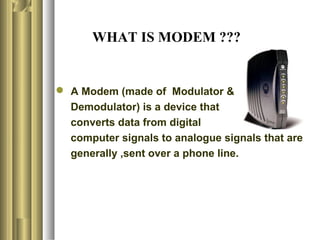
 A Modem (made of Modulator &
  Demodulator) is a device that
  converts data from digital
  computer signals to analogue signals that are
  generally ,sent over a phone line.
CONNECTING WORLD
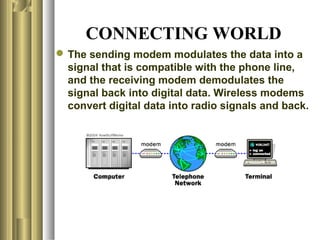
 The sending modem modulates the data into a
  signal that is compatible with the phone line,
  and the receiving modem demodulates the
  signal back into digital data. Wireless modems
  convert digital data into radio signals and back.
WORKING OF MODEM


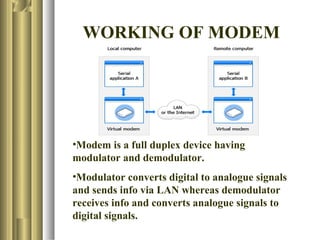
•Modem is a full duplex device having
modulator and demodulator.
•Modulator converts digital to analogue signals
and sends info via LAN whereas demodulator
receives info and converts analogue signals to
digital signals.
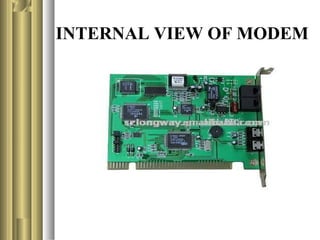
INTERNAL VIEW OF MODEM
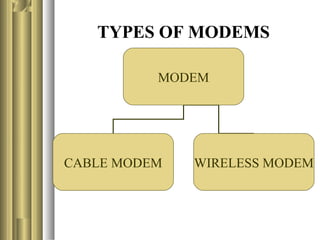
TYPES OF MODEMS

          MODEM


CABLE MODEM   WIRELESS MODEM
1.       Cable Modem


 A cable modem is basically used for the one-one
  basis or to connect multiple computers inside a
  building as the signals degrade as more users come
  online.
 Cable modem uses broadband Internet connection
  that is designed to operate over cable TV lines
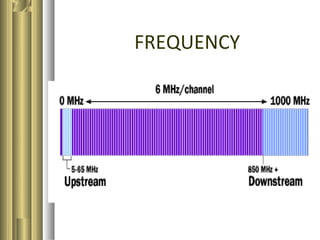
FREQUENCY
STREAM
 Downstream data -- data sent from the Internet to
  an individual computer -- into a 6-MHz channel.

 Upstream data -- information sent from an
  individual back to the Internet
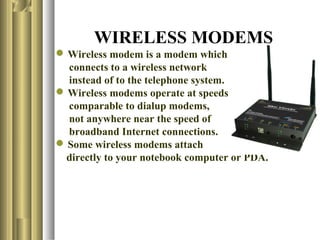
WIRELESS MODEMS
 Wireless modem is a modem which
  connects to a wireless network
  instead of to the telephone system.
 Wireless modems operate at speeds
  comparable to dialup modems,
  not anywhere near the speed of
  broadband Internet connections.
 Some wireless modems attach
 directly to your notebook computer or PDA.
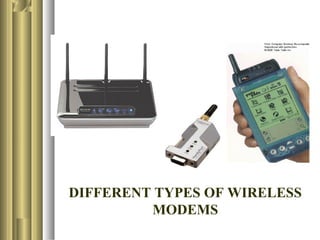
DIFFERENT TYPES OF WIRELESS
         MODEMS
Types of connections

 DSL connection

 Dialup connection

 Broadband connection
DIAL-UP


 Data is transmitted through an analog phone
 connection. An analog connection is the slowest type
 of connection available, and will not permit you to
 use your telephone for a voice connection at the same
 time that you are connected to the Internet. Dial-up
 connections allow only one computer at a time, per
 line, to be connected.
FEATURES

 Slow and Economical
 Connection to network is established by dialing a
  number provided by ISP
 Quality not so good because of telephone lines
 Phone modems only travel at speeds of 28.8k and 56k
  and less.
DSL
 DSL means Digital Subscribers Line
 This is a method of transmitting data over telephone
  lines prevalent in many countries.
 DSL connection uses existing 2-wire copper
  telephone line connected to the premise and will not
  tie up your phone as a dial-up connection does.
 DSL uses a sophisticated modulation scheme to pack
  data onto copper wires.
TYPES OF DSL
 All types of DSL technologies are collectively
  referred to as xDSL.
 xDSL connection speeds range from 128 Kbps to 8
  Mbps.
 Two other types of DSL technologies are High-
  data-rate DSL (HDSL),Very high DSL
  (VDSL),Asymmetric Digital Subscriber
  Line(ADSL) and Symmetric Digital Subscriber
  Line (SDSL)
Advantages of DSL


 The speed is much higher than a regular modem (1.5
  Mps vs. 56 kps)
 DSL doesn't necessarily require new wiring; it can
  use the phone line you already have.
 Modem generally comes with company.
Disadvantages of DSL :

 Service is better ,when you are near service provider.
 Sending data slower compared to receiving.
 The service is not available everywhere.
BROADBAND

 Cable Internet works by using TV channel space for
  data transmission, with certain channels used for
  downstream transmission, and other channels for
  upstream transmission.
 Coaxial cables are used by Broadband connection
  provides much greater bandwidth than telephone
  lines
 Broadband connection can be used to achieve
  extremely fast access.
 Its speed ranges from 512 Kbps to 20 Mbps.
Broadband connection
FEATURES
 Broadband connection use complex waveforms to
  carry digital data.
 They are more advanced devices than traditional
  dial-up modems as they are capable of
  modulating/demodulating hundreds of channels
  simultaneously.
 New types of broadband modems are beginning to
  appear, such as doubleway satellite and powerline
  modems.
 Transfer rates are affected by the number of
 subscribers online simultaneously.
Broadband connections can be used by
 individual subscribers to connect one
 computer to one line, or can be used to
 connect multiple computers in a building to
 the Internet.
DSL vs CABLE
 Cable modem speeds are upto two times faster
  compared to DSL modem.
 Speeds in cable modem fluctuates depending on the
  number of subscribers on the network.but this is not
  the case in DSL.
 DSL boasts a bit better security compared to cable
  modem.
Thank you
Prepared by:-jigar.p.patel
Roll no:-20
Class:-sybba(itm)sem-4
Collage:-cppatel&fhshah
 commerce collage

Seminar

  • 1.
  • 2.
    THE BIRTH OFINTERNET  Seeds of internet were planted way back in 1979 ,when U.S military forces used it to communicate in better, organized and safer way at ARPA (Advanced research project agency).  President of U.S was the first citizen to share this sophiciticated network to manage and share all important information.  Gates of internet were open to general public by early 90’s.
  • 3.
    INTRODUCTION  With theintroduction of internet, world changed quickly.  We can experience world coming closer day by day by use of internet.  ISP (internet service provider ) provides us with this internet facility.  MODEM is a most important hardware that connects us and ISP and helps us to access this valuable gift ‘INTERNET’.
  • 4.
    WHAT IS MODEM???  A Modem (made of Modulator & Demodulator) is a device that converts data from digital computer signals to analogue signals that are generally ,sent over a phone line.
  • 5.
    CONNECTING WORLD  Thesending modem modulates the data into a signal that is compatible with the phone line, and the receiving modem demodulates the signal back into digital data. Wireless modems convert digital data into radio signals and back.
  • 6.
    WORKING OF MODEM •Modemis a full duplex device having modulator and demodulator. •Modulator converts digital to analogue signals and sends info via LAN whereas demodulator receives info and converts analogue signals to digital signals.
  • 7.
  • 8.
    TYPES OF MODEMS MODEM CABLE MODEM WIRELESS MODEM
  • 9.
    1. Cable Modem  A cable modem is basically used for the one-one basis or to connect multiple computers inside a building as the signals degrade as more users come online.  Cable modem uses broadband Internet connection that is designed to operate over cable TV lines
  • 10.
  • 11.
    STREAM  Downstream data-- data sent from the Internet to an individual computer -- into a 6-MHz channel.  Upstream data -- information sent from an individual back to the Internet
  • 12.
    WIRELESS MODEMS  Wirelessmodem is a modem which connects to a wireless network instead of to the telephone system.  Wireless modems operate at speeds comparable to dialup modems, not anywhere near the speed of broadband Internet connections.  Some wireless modems attach directly to your notebook computer or PDA.
  • 13.
    DIFFERENT TYPES OFWIRELESS MODEMS
  • 14.
    Types of connections DSL connection  Dialup connection  Broadband connection
  • 15.
    DIAL-UP  Data istransmitted through an analog phone connection. An analog connection is the slowest type of connection available, and will not permit you to use your telephone for a voice connection at the same time that you are connected to the Internet. Dial-up connections allow only one computer at a time, per line, to be connected.
  • 16.
    FEATURES  Slow andEconomical  Connection to network is established by dialing a number provided by ISP  Quality not so good because of telephone lines  Phone modems only travel at speeds of 28.8k and 56k and less.
  • 17.
    DSL  DSL meansDigital Subscribers Line  This is a method of transmitting data over telephone lines prevalent in many countries.  DSL connection uses existing 2-wire copper telephone line connected to the premise and will not tie up your phone as a dial-up connection does.  DSL uses a sophisticated modulation scheme to pack data onto copper wires.
  • 18.
    TYPES OF DSL All types of DSL technologies are collectively referred to as xDSL.  xDSL connection speeds range from 128 Kbps to 8 Mbps.  Two other types of DSL technologies are High- data-rate DSL (HDSL),Very high DSL (VDSL),Asymmetric Digital Subscriber Line(ADSL) and Symmetric Digital Subscriber Line (SDSL)
  • 19.
    Advantages of DSL The speed is much higher than a regular modem (1.5 Mps vs. 56 kps)  DSL doesn't necessarily require new wiring; it can use the phone line you already have.  Modem generally comes with company.
  • 20.
    Disadvantages of DSL:  Service is better ,when you are near service provider.  Sending data slower compared to receiving.  The service is not available everywhere.
  • 21.
    BROADBAND  Cable Internetworks by using TV channel space for data transmission, with certain channels used for downstream transmission, and other channels for upstream transmission.  Coaxial cables are used by Broadband connection provides much greater bandwidth than telephone lines  Broadband connection can be used to achieve extremely fast access.  Its speed ranges from 512 Kbps to 20 Mbps.
  • 22.
  • 23.
    FEATURES  Broadband connectionuse complex waveforms to carry digital data.  They are more advanced devices than traditional dial-up modems as they are capable of modulating/demodulating hundreds of channels simultaneously.  New types of broadband modems are beginning to appear, such as doubleway satellite and powerline modems.
  • 24.
     Transfer ratesare affected by the number of subscribers online simultaneously. Broadband connections can be used by individual subscribers to connect one computer to one line, or can be used to connect multiple computers in a building to the Internet.
  • 25.
    DSL vs CABLE Cable modem speeds are upto two times faster compared to DSL modem.  Speeds in cable modem fluctuates depending on the number of subscribers on the network.but this is not the case in DSL.  DSL boasts a bit better security compared to cable modem.
  • 26.
    Thank you Prepared by:-jigar.p.patel Rollno:-20 Class:-sybba(itm)sem-4 Collage:-cppatel&fhshah commerce collage