Broadband-ISDN
Presented by:-
Shiva Krishna
Murali Krishnan
Rohit Mundra
Varun Kumar
H V S K DORA
INTRODUCTION
• ISDN is an acronym, which means Integrated
Services Digital Network.
• BISDN is an extension of ISDN in terms of
capabilities, i.e. it not only has the narrowband
capability of ISDN but also the broadband
capability.
• It is a set of CCITT / ITU standards for digital
transmission over ordinary telephone copper
wire as well as over other media.
• ISDN is the integration of both analogue or
voice data, together with digital data over the
same network.
DEFINITION
• “A service requiring transmission channels
capable of supporting rates greater than the
primary rate.” ITU-T.
• Any service inquiry with a speed greater
than 1.544 Mbps is defined as broad
band,and any communications based on this
speed are called broadband
communications.
BROWNY POINTS
• BISDN is an extension of ISDN only in term of the name.
Everything is different including
protocol, architecture, transmission, and switching technology.
• Designed to exploit the advances in technology.
• Provides for integration of wide range of communications
facilities and the support of universal communications with the
following characteristics.
3Worldwide exchange between any two subscribers in any
medium.
3Retrieval and sharing of information from multiple
sources, in multiple media.
3Distribution of a wide variety of materials to home or
office, on demand.
GOAL
“The Goal of BISDN is to achieve
complete integration of
services, ranging from low-bit--rate
bursty signals to high-bit-rate
continuous real-time signals”.
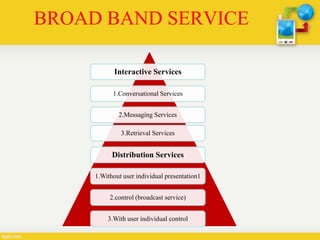
BROAD BAND SERVICE
Interactive Services
1.Conversational Services
2.Messaging Services
3.Retrieval Services
Distribution Services
1.Without user individual presentation1
2.control (broadcast service)
3.With user individual control
BROAD BAND SERVICE
Interactive Services
• Two-way exchange of information (other than
control signaling (information) between two
subscribers or between a subscriber and a
service provider.
Distribution Services
• Primarily one way transfer of
information, from service provider to B-ISDN
subscriber.
BROAD BAND SERVICES
• Distribution Services Without User
Presentation Control
• Referred also as broadcast services
• Provide a continuos flow of information, which is
distributed from a central source to an unlimited
number of authorized receivers connected to the
network.
• User can access this flow of information but has
no control over it.
• Example: High definition television (HDTV)
BROAD BAND SERVICES
• Distribution Services With User Presentation
Control
• Distribute information from a central source to a
large number of users.
• Information is provided as a sequence of
information entities (e.g. , frames) with cyclical
repetition.
• User has the ability of individual access to the
cyclical distributed information and can control
start and order of presentation.
• Example: cable text
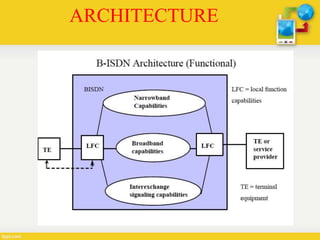
ARCHITECTURE
TRANSMISSION STRUCTURE
Three new transmission services
»Full-duplex 155 Mbps
»Asymmetrical 155 Mbps
(subscriber to the
network), and 622 Mbps
(network to subscriber)
»Full duplex 622 Mbps - for
multiple video
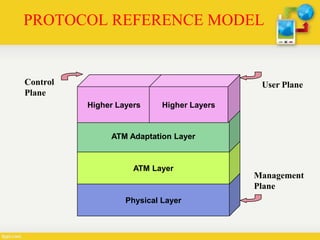
PROTOCOL REFERENCE MODEL
Control
Plane
Physical Layer
ATM Layer
ATM Adaptation Layer
Higher Layers Higher Layers
User Plane
Management
Plane
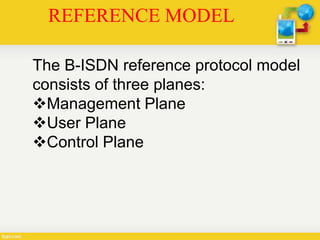
REFERENCE MODEL
The B-ISDN reference protocol model
consists of three planes:
Management Plane
User Plane
Control Plane
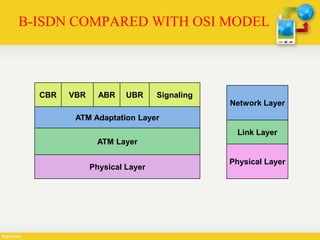
B-ISDN COMPARED WITH OSI MODEL
CBR VBR ABR UBR Signaling
ATM Adaptation Layer
ATM Layer
Physical Layer
Network Layer
Link Layer
Physical Layer
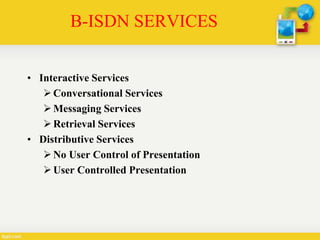
B-ISDN SERVICES
• Interactive Services
Conversational Services
Messaging Services
Retrieval Services
• Distributive Services
No User Control of Presentation
User Controlled Presentation
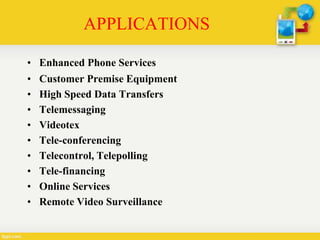
APPLICATIONS
• Enhanced Phone Services
• Customer Premise Equipment
• High Speed Data Transfers
• Telemessaging
• Videotex
• Tele-conferencing
• Telecontrol, Telepolling
• Tele-financing
• Online Services
• Remote Video Surveillance
CONCLUSION
• ISDN is an underlying technology, which provides cost-
effective networking through the public telephone
networks.
• ISDN is an important step forward in the adaptation of
the network to handle the increasing global demand for
computer-to computer data communications.
• ISDN brings us closer to the goal of a ubiquitous multi-
service network, integrating voice, data, video and image.
THANK YOU

Broadband isdn

  • 1.
    Broadband-ISDN Presented by:- Shiva Krishna MuraliKrishnan Rohit Mundra Varun Kumar H V S K DORA
  • 2.
    INTRODUCTION • ISDN isan acronym, which means Integrated Services Digital Network. • BISDN is an extension of ISDN in terms of capabilities, i.e. it not only has the narrowband capability of ISDN but also the broadband capability. • It is a set of CCITT / ITU standards for digital transmission over ordinary telephone copper wire as well as over other media. • ISDN is the integration of both analogue or voice data, together with digital data over the same network.
  • 3.
    DEFINITION • “A servicerequiring transmission channels capable of supporting rates greater than the primary rate.” ITU-T. • Any service inquiry with a speed greater than 1.544 Mbps is defined as broad band,and any communications based on this speed are called broadband communications.
  • 4.
    BROWNY POINTS • BISDNis an extension of ISDN only in term of the name. Everything is different including protocol, architecture, transmission, and switching technology. • Designed to exploit the advances in technology. • Provides for integration of wide range of communications facilities and the support of universal communications with the following characteristics. 3Worldwide exchange between any two subscribers in any medium. 3Retrieval and sharing of information from multiple sources, in multiple media. 3Distribution of a wide variety of materials to home or office, on demand.
  • 5.
    GOAL “The Goal ofBISDN is to achieve complete integration of services, ranging from low-bit--rate bursty signals to high-bit-rate continuous real-time signals”.
  • 6.
    BROAD BAND SERVICE InteractiveServices 1.Conversational Services 2.Messaging Services 3.Retrieval Services Distribution Services 1.Without user individual presentation1 2.control (broadcast service) 3.With user individual control
  • 7.
    BROAD BAND SERVICE InteractiveServices • Two-way exchange of information (other than control signaling (information) between two subscribers or between a subscriber and a service provider. Distribution Services • Primarily one way transfer of information, from service provider to B-ISDN subscriber.
  • 8.
    BROAD BAND SERVICES •Distribution Services Without User Presentation Control • Referred also as broadcast services • Provide a continuos flow of information, which is distributed from a central source to an unlimited number of authorized receivers connected to the network. • User can access this flow of information but has no control over it. • Example: High definition television (HDTV)
  • 9.
    BROAD BAND SERVICES •Distribution Services With User Presentation Control • Distribute information from a central source to a large number of users. • Information is provided as a sequence of information entities (e.g. , frames) with cyclical repetition. • User has the ability of individual access to the cyclical distributed information and can control start and order of presentation. • Example: cable text
  • 10.
  • 11.
    TRANSMISSION STRUCTURE Three newtransmission services »Full-duplex 155 Mbps »Asymmetrical 155 Mbps (subscriber to the network), and 622 Mbps (network to subscriber) »Full duplex 622 Mbps - for multiple video
  • 12.
    PROTOCOL REFERENCE MODEL Control Plane PhysicalLayer ATM Layer ATM Adaptation Layer Higher Layers Higher Layers User Plane Management Plane
  • 13.
    REFERENCE MODEL The B-ISDNreference protocol model consists of three planes: Management Plane User Plane Control Plane
  • 14.
    B-ISDN COMPARED WITHOSI MODEL CBR VBR ABR UBR Signaling ATM Adaptation Layer ATM Layer Physical Layer Network Layer Link Layer Physical Layer
  • 15.
    B-ISDN SERVICES • InteractiveServices Conversational Services Messaging Services Retrieval Services • Distributive Services No User Control of Presentation User Controlled Presentation
  • 16.
    APPLICATIONS • Enhanced PhoneServices • Customer Premise Equipment • High Speed Data Transfers • Telemessaging • Videotex • Tele-conferencing • Telecontrol, Telepolling • Tele-financing • Online Services • Remote Video Surveillance
  • 17.
    CONCLUSION • ISDN isan underlying technology, which provides cost- effective networking through the public telephone networks. • ISDN is an important step forward in the adaptation of the network to handle the increasing global demand for computer-to computer data communications. • ISDN brings us closer to the goal of a ubiquitous multi- service network, integrating voice, data, video and image.
  • 18.