BAIT1003 IT
Fundamentals
Chapter 8
Telecommunications
Objectives
Discuss the purpose of the
components required for
successful communications
and identify various sending
and receiving devices

Describe various types of
lines for communications
over the telephone network

Describe commonly used
communications devices

Describe various physical
and wireless transmission
media
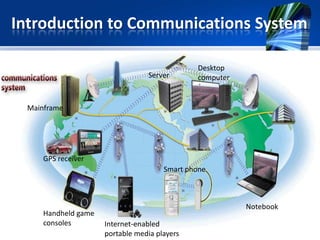
Introduction to Communications System
Server

Desktop
computer

Mainframe

GPS receiver
Smart phone

Handheld game
consoles

Notebook
Internet-enabled
portable media players
Introduction to Communications System
• Computer communications describes a process
in which two or more computers or devices
transfer data, instructions, and information.
• For successful communication, you need the
following:
Sending device

Communications
channel

Receiving device
Introduction to Communications System
• A sending device initiates an instruction to
transmit data, instructions, or information.
• A communication channel is the medium on
which the data, instructions, or information
travel.
• A communication device connects the sending
or receiving device to a communication channel.
• A receiving device accepts the transmission of
data, instructions, or information.
Introduction to Communications System
transmit
data, instruction
s, or information

Communication channel or
transmission media :telephone
line, cable, airwave

Sending device:
computer, fax
machine

medium on which the
data, instructions, or
information travel
modem

connects the sending or
receiving device to a
communication channel
Communication device:
modem

accepts the
transmission
of
data, instructi
ons, or
information

Receiving device :
computer, fax
machine
Servers
• Sometimes called the host computer
• Support from two to several thousands connected
computers at the same time.
Purpose of Servers
• The purpose of
server is to control
access to the
hardware, software,
and other resources
on the network .
• Provides a
centralized storage
area for
programs, data, and
information.
Types of Servers
• Some servers, called dedicated servers, perform
a specific task.
• Examples:
1. File server stores and manages files.
2. Print server manages printers and documents being
printed.
3. Network server manage network traffic (activity).
4. Web server delivers requested Web pages to your
computer.
Types of Servers (Examples)
Communication Devices
• A communications device is any type of
hardware capable of transmitting
data, instructions, and information between a
sending device and a receiving device
• Examples:
1.
2.
3.
4.
5.

Modem
Network cards
Wireless access point
Routers
Hubs and switches
Communication Devices
- Modem
• One type of communication device that connects a
communications channel to a sending or receiving
device is a MODEM.
• The function of MODEM is to convert digital signals to
analog signal and analog signal to digital, so that data
can travel along an analog telephone line.

• Types of MODEMs:
1. Dial up modems
2. Digital modem
3. Wireless modem
Communication Devices
- Modem
• A dial-up modem converts signals between
analog and digital, so that data can travel along
an analog telephone line. Usually is in the form of
adapter card.
Communication Devices
- Modem
• A digital modem sends and receives data and
information to and from a digital line.
– Three types of digital modems are:
1. ISDN (Integrated Services Digital Network)
modem – use ISDN line
2. DSL (Digital Subscriber Line) – use DSL line
3. Cable modem – called broadband modem, over
the cable television network.
Communication Devices
- Modem
Communication Devices
- Modem
• A wireless modem uses the cell phone network to
connect to the Internet wirelessly from a notebook
computer, a smart phone, or other mobile device
• Wireless modem have an external or build-in
antenna, are available as USB flash drive.
Communication Devices
- Network Cards
• A network card enables a
computer or device that does not
have build in networking capability
to access a network.
• Available in a variety of styles:
– Desktop computer: is an adapter card
that has a port to which a cable
connects.
– Mobile computer: USB network
adapter, ExpressCard module, or PC
Card.
Communication Devices
- Wireless Access Points
• A wireless access point is a central
communications device that allows
computers and devices to transfer
data wirelessly among themselves
or to a wired network.
• It has high quality antennas for
optimal signals and suggest
positioning at the highest possible
location.
Communication Devices
- Routers
• A router connects multiple computers or
other routers together and transmits data to
its correct destination on a network.
– Example:
– Home network – router allows multiple
computers to share a single high speed
Internet connection such as through a
cable modem/DSL modem.
• To prevent unauthorized users from accessing
files and computer, many are protected by a
build-in firewall.
Communication Devices
- Hubs & Switches
• A hub/ switch is a device that provides a central point for
cables in a network.
• Larger networks typically use a hub, while smaller networks
use a switch.
• Some hubs/switches include routers. That is, the hub/
switch receives data from many directions and then forward
it to one or more destinations.
Communication Over Telephone
Network
• The public switched telephone network (PSTN) is
the worldwide telephone system that handles
voice oriented telephone calls.
• The telephone network is an integral part of
computer communication.
• Data, instructions, and information are
transmitted over the telephone network using
dial up lines or dedicated lines.
Communication Over Telephone
Network
Communication Over Telephone
Network
• Various types of lines that use the
telephone
• network for data communications.

Dial-up
lines

Dedicated
line
FTTP

ISDN line

T-carrier
line

ATM

DSL
Dial-up Lines vs. Dedicated Lines
• A dial-up line is a temporary connection that
uses analog telephone lines for communications.
• A dedicated line is a type of always-on
connection that uses analog or digital lines.
• A dedicated line are better than dial up because
dedicated lines provide a constant connection.
• Five types of digital dedicated lines are ISDN
lines, DSL, FTTP, T-carrier lines, and ATM.
ISDN vs. DSL
• ISDN (Integrated Services Digital Network) lines
is a set of standards for digital transmission of
data over standard telephone lines.
• DSL (Digital Subscriber Line) transmit at fast
speeds on standard telephone lines with both
voice and data communications.
ADSL
• ADSL (Asymmetric DSL) is a type of DSL that supports
faster transfer rates when receiving data (download)
than when sending data (upload).
• ADSL connections transmit data downstream at a much
faster rate than upstream
SDSL
• SDSL (Symmetric DSL) is a type of DSL that offers
symmetric bandwidth upstream and downstream
• SDSL connections transmit data only and does not
support analog calls.
FTTP
• FTTP (Fiber to
the Premises)
uses fiberoptic cable to
provide
extremely
high-speed
Internet
access.
FTTP
T-Carrier Lines vs. ATM
• T-carrier line is a long-distance digital telephone
line that carry multiple signals over a single
communications line.
• ATM (Asynchronous Transfer Mode) is a service
that carries voice, data, video, and multimedia
at very high speeds.
Various Internet Connections
Communication Channel
• It is the transmission media on which
data, instructions travel in a communications
system.
• Common terms:
– The amount of data that can travel over a
communications channel sometimes is called the
bandwidth
– Latency is the time it takes a signal to travel from
one location to another on a network
– Transmission media consists of materials capable of
carrying one or more signals
– Broadband media transmit multiple signals
simultaneously
Communication Channel
• Transmission media are one of two types:
1. Physical transmission media
• Use wire, cable, and other tangible materials to send
communication signal.
• Examples:
1.
2.
3.

Twisted pair cable
Coaxial cable
Fiber optic cable

2. Wireless transmission media
• Send communications signals through the air or space
using radio, microwave, and infrared signal.
Physical Transmission Media
-Twisted-Pair Cable
• Widely used in network cabling and telephone
systems.
• Twisted-pair cable consists of one or more twistedpair wires bundled together.
• Each twisted pair wire consists of two separate
insulated copper wires that are twisted together.
• The wires are twisted together to reduce noise.
Noise is an electrical disturbance that can degrade
communications.
• Commonly used for telephone lines
• Speed: 1 – 128 Mbps
Physical Transmission Media
-Twisted-Pair Cable
Twisted-pair cable
Physical Transmission Media
-Coaxial Cable
• Coaxial cable consists of a
single copper wire surrounded
by three layers:
- insulating material
- woven or braided metal
- plastic outer coating.
• Commonly used for cable
television network wiring
• Speed: Up to 200 Mbps

Coaxial cable
Physical Transmission Media
-Fiber-Optic Cable
• Fiber-optic cable
consists of strands
of glass (called
optical fibers) that
use light to
transmit signals.
• Speed:100 Mbps
to 2 Gbps

Fiber-optic cable
Physical Transmission Media
-Fiber-Optic Cable
• Advantages:
– Carry more signals than wire cables
– Faster data transmission
– Less susceptible to noise, hence better security
– Smaller size
• Disadvantages:
– Costs more than twisted-pair and coaxial cable
– Difficult to install and modify
Wireless Transmission Media
-Infrared & Broadcast Radio
• Infrared (IR) is a wireless transmission medium that
sends signals using infrared light waves.
– Communicate over short distance.
– Use in mouse, printers, digital cameras, and hand
phone.

• Broadcast radio is a wireless transmission medium
that distributes radio signals through the air over a
long distances.
– Example: Bluetooth
Wireless Transmission Media
-Cellular Radio
• Cellular radio is a form of broadcast radio that is
used widely for mobile communications.
specifically wireless modems and cell phones.
– Several categories of cellular transmission:
•
•
•
•

1G transmit analog data
2G transmit digital data at speeds from 9.6kbps to 19.2kbps
3G transmit digital data at speeds from 144kbps to 2.4Mbps
4G transmit digital data at speeds up to 15Mbps
Wireless Transmission Media
-Cellular Radio
Wireless Transmission Media
-Microwaves
Line-of-sight
transmission- must
transmit in straight
line with no
obstructions

• Microwaves are radio
waves that provide a
high-speed signal
transmission.
• Often called fixed
wireless, involves
sending signals from one
Microwave
microwave station to
station /
another.
earth-based
station

Microwave stations
need to be placed
within 25-30 miles of
each other
Wireless Transmission Media
-Communication Satellite
• A communications satellite
is a space station that
receives microwave signals
from an earth-based
station, amplifies it, and
broadcasts the signal over a
wide area
Applications such as air
navigating, television and radio
broadcast, weather
forecasting, video
conferencing, paging, global
positioning systems, and Internet
connections use communications
satellite.
Summary

Overview of
communications
terminology and
applications

Various
communications
devices, media, and
procedures

BAIT1003 Chapter 8

  • 1.
  • 2.
    Objectives Discuss the purposeof the components required for successful communications and identify various sending and receiving devices Describe various types of lines for communications over the telephone network Describe commonly used communications devices Describe various physical and wireless transmission media
  • 3.
    Introduction to CommunicationsSystem Server Desktop computer Mainframe GPS receiver Smart phone Handheld game consoles Notebook Internet-enabled portable media players
  • 4.
    Introduction to CommunicationsSystem • Computer communications describes a process in which two or more computers or devices transfer data, instructions, and information. • For successful communication, you need the following: Sending device Communications channel Receiving device
  • 5.
    Introduction to CommunicationsSystem • A sending device initiates an instruction to transmit data, instructions, or information. • A communication channel is the medium on which the data, instructions, or information travel. • A communication device connects the sending or receiving device to a communication channel. • A receiving device accepts the transmission of data, instructions, or information.
  • 6.
    Introduction to CommunicationsSystem transmit data, instruction s, or information Communication channel or transmission media :telephone line, cable, airwave Sending device: computer, fax machine medium on which the data, instructions, or information travel modem connects the sending or receiving device to a communication channel Communication device: modem accepts the transmission of data, instructi ons, or information Receiving device : computer, fax machine
  • 7.
    Servers • Sometimes calledthe host computer • Support from two to several thousands connected computers at the same time.
  • 8.
    Purpose of Servers •The purpose of server is to control access to the hardware, software, and other resources on the network . • Provides a centralized storage area for programs, data, and information.
  • 9.
    Types of Servers •Some servers, called dedicated servers, perform a specific task. • Examples: 1. File server stores and manages files. 2. Print server manages printers and documents being printed. 3. Network server manage network traffic (activity). 4. Web server delivers requested Web pages to your computer.
  • 10.
    Types of Servers(Examples)
  • 11.
    Types of Servers(Examples)
  • 12.
    Communication Devices • Acommunications device is any type of hardware capable of transmitting data, instructions, and information between a sending device and a receiving device • Examples: 1. 2. 3. 4. 5. Modem Network cards Wireless access point Routers Hubs and switches
  • 13.
  • 14.
    Communication Devices - Modem •One type of communication device that connects a communications channel to a sending or receiving device is a MODEM. • The function of MODEM is to convert digital signals to analog signal and analog signal to digital, so that data can travel along an analog telephone line. • Types of MODEMs: 1. Dial up modems 2. Digital modem 3. Wireless modem
  • 15.
    Communication Devices - Modem •A dial-up modem converts signals between analog and digital, so that data can travel along an analog telephone line. Usually is in the form of adapter card.
  • 16.
    Communication Devices - Modem •A digital modem sends and receives data and information to and from a digital line. – Three types of digital modems are: 1. ISDN (Integrated Services Digital Network) modem – use ISDN line 2. DSL (Digital Subscriber Line) – use DSL line 3. Cable modem – called broadband modem, over the cable television network.
  • 17.
  • 18.
    Communication Devices - Modem •A wireless modem uses the cell phone network to connect to the Internet wirelessly from a notebook computer, a smart phone, or other mobile device • Wireless modem have an external or build-in antenna, are available as USB flash drive.
  • 19.
    Communication Devices - NetworkCards • A network card enables a computer or device that does not have build in networking capability to access a network. • Available in a variety of styles: – Desktop computer: is an adapter card that has a port to which a cable connects. – Mobile computer: USB network adapter, ExpressCard module, or PC Card.
  • 20.
    Communication Devices - WirelessAccess Points • A wireless access point is a central communications device that allows computers and devices to transfer data wirelessly among themselves or to a wired network. • It has high quality antennas for optimal signals and suggest positioning at the highest possible location.
  • 21.
    Communication Devices - Routers •A router connects multiple computers or other routers together and transmits data to its correct destination on a network. – Example: – Home network – router allows multiple computers to share a single high speed Internet connection such as through a cable modem/DSL modem. • To prevent unauthorized users from accessing files and computer, many are protected by a build-in firewall.
  • 22.
    Communication Devices - Hubs& Switches • A hub/ switch is a device that provides a central point for cables in a network. • Larger networks typically use a hub, while smaller networks use a switch. • Some hubs/switches include routers. That is, the hub/ switch receives data from many directions and then forward it to one or more destinations.
  • 23.
    Communication Over Telephone Network •The public switched telephone network (PSTN) is the worldwide telephone system that handles voice oriented telephone calls. • The telephone network is an integral part of computer communication. • Data, instructions, and information are transmitted over the telephone network using dial up lines or dedicated lines.
  • 24.
  • 25.
    Communication Over Telephone Network •Various types of lines that use the telephone • network for data communications. Dial-up lines Dedicated line FTTP ISDN line T-carrier line ATM DSL
  • 26.
    Dial-up Lines vs.Dedicated Lines • A dial-up line is a temporary connection that uses analog telephone lines for communications. • A dedicated line is a type of always-on connection that uses analog or digital lines. • A dedicated line are better than dial up because dedicated lines provide a constant connection. • Five types of digital dedicated lines are ISDN lines, DSL, FTTP, T-carrier lines, and ATM.
  • 27.
    ISDN vs. DSL •ISDN (Integrated Services Digital Network) lines is a set of standards for digital transmission of data over standard telephone lines. • DSL (Digital Subscriber Line) transmit at fast speeds on standard telephone lines with both voice and data communications.
  • 28.
    ADSL • ADSL (AsymmetricDSL) is a type of DSL that supports faster transfer rates when receiving data (download) than when sending data (upload). • ADSL connections transmit data downstream at a much faster rate than upstream
  • 29.
    SDSL • SDSL (SymmetricDSL) is a type of DSL that offers symmetric bandwidth upstream and downstream • SDSL connections transmit data only and does not support analog calls.
  • 30.
    FTTP • FTTP (Fiberto the Premises) uses fiberoptic cable to provide extremely high-speed Internet access.
  • 31.
  • 32.
    T-Carrier Lines vs.ATM • T-carrier line is a long-distance digital telephone line that carry multiple signals over a single communications line. • ATM (Asynchronous Transfer Mode) is a service that carries voice, data, video, and multimedia at very high speeds.
  • 33.
  • 34.
    Communication Channel • Itis the transmission media on which data, instructions travel in a communications system. • Common terms: – The amount of data that can travel over a communications channel sometimes is called the bandwidth – Latency is the time it takes a signal to travel from one location to another on a network – Transmission media consists of materials capable of carrying one or more signals – Broadband media transmit multiple signals simultaneously
  • 35.
  • 36.
    Communication Channel • Transmissionmedia are one of two types: 1. Physical transmission media • Use wire, cable, and other tangible materials to send communication signal. • Examples: 1. 2. 3. Twisted pair cable Coaxial cable Fiber optic cable 2. Wireless transmission media • Send communications signals through the air or space using radio, microwave, and infrared signal.
  • 37.
  • 38.
    Physical Transmission Media -Twisted-PairCable • Widely used in network cabling and telephone systems. • Twisted-pair cable consists of one or more twistedpair wires bundled together. • Each twisted pair wire consists of two separate insulated copper wires that are twisted together. • The wires are twisted together to reduce noise. Noise is an electrical disturbance that can degrade communications. • Commonly used for telephone lines • Speed: 1 – 128 Mbps
  • 39.
  • 40.
    Physical Transmission Media -CoaxialCable • Coaxial cable consists of a single copper wire surrounded by three layers: - insulating material - woven or braided metal - plastic outer coating. • Commonly used for cable television network wiring • Speed: Up to 200 Mbps Coaxial cable
  • 41.
    Physical Transmission Media -Fiber-OpticCable • Fiber-optic cable consists of strands of glass (called optical fibers) that use light to transmit signals. • Speed:100 Mbps to 2 Gbps Fiber-optic cable
  • 42.
    Physical Transmission Media -Fiber-OpticCable • Advantages: – Carry more signals than wire cables – Faster data transmission – Less susceptible to noise, hence better security – Smaller size • Disadvantages: – Costs more than twisted-pair and coaxial cable – Difficult to install and modify
  • 43.
  • 44.
    Wireless Transmission Media -Infrared& Broadcast Radio • Infrared (IR) is a wireless transmission medium that sends signals using infrared light waves. – Communicate over short distance. – Use in mouse, printers, digital cameras, and hand phone. • Broadcast radio is a wireless transmission medium that distributes radio signals through the air over a long distances. – Example: Bluetooth
  • 45.
    Wireless Transmission Media -CellularRadio • Cellular radio is a form of broadcast radio that is used widely for mobile communications. specifically wireless modems and cell phones. – Several categories of cellular transmission: • • • • 1G transmit analog data 2G transmit digital data at speeds from 9.6kbps to 19.2kbps 3G transmit digital data at speeds from 144kbps to 2.4Mbps 4G transmit digital data at speeds up to 15Mbps
  • 46.
  • 47.
    Wireless Transmission Media -Microwaves Line-of-sight transmission-must transmit in straight line with no obstructions • Microwaves are radio waves that provide a high-speed signal transmission. • Often called fixed wireless, involves sending signals from one Microwave microwave station to station / another. earth-based station Microwave stations need to be placed within 25-30 miles of each other
  • 48.
    Wireless Transmission Media -CommunicationSatellite • A communications satellite is a space station that receives microwave signals from an earth-based station, amplifies it, and broadcasts the signal over a wide area Applications such as air navigating, television and radio broadcast, weather forecasting, video conferencing, paging, global positioning systems, and Internet connections use communications satellite.
  • 49.

Editor's Notes

  • #4 An example of a communication system. Some devices that serve as sending devices and receiving devices are mainframe computers, servers, desktop computers, notebook computers, smart phones, Internet-enabled portable media players, handheld game consoles, and GPS receivers. The communication channel consists of telephone and power lines, cable television and other underground lines, microwave stations, and satellites.