Apple Computer, Inc.
                    Economics 101-01

                             Group IV

Mark Bender, Mike Rush, Alicia Sutton, Angelo Granata, Zack Klingensmith
Topics for Discussion
Zack Klingensmith           Alicia Sutton
• History/Background        • Monopoly
• Advertising               • Transition
• Wage Discrimination       • Oligopoly

Mike Rush                   Mark Bender
• Economic Questions        • Government Intervention
• Ceterus Paribus           • The Stock Market
                            • Summary
Angelo Granata
• Substitutes/Complements   Questions and Answers
• Elasticity
History
•Founded in 1976 by
                           Current Apple Products
Steve Jobs, Steve
                           •Personal Computers
Wozniak, and Ronald
                           •Laptops/Notebooks
Wayne.
                           •iTunes/Music Downloads
•Company started by
                           •Servers
selling handmade
                           •Much More…
computers that were
manufactured in
a garage.
•Has since expanded its
market into a wide range
of computer associated
materials.
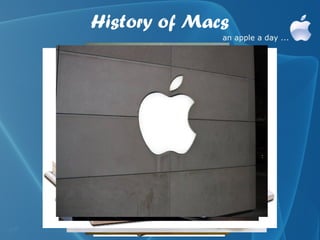
History of Macs
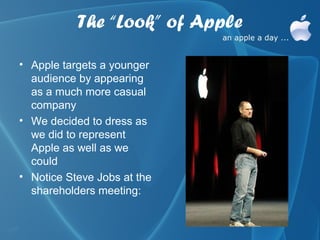
The “Look” of Apple

• Apple targets a younger
  audience by appearing
  as a much more casual
  company
• We decided to dress as
  we did to represent
  Apple as well as we
  could
• Notice Steve Jobs at the
  shareholders meeting:
Consumer Choice

• Scarcity is the reason the study of
  economics exists.
• If everyone had unlimited time and money,
  everyone would own the best computer
  possible.
• Apple must try to convince consumers that
  they should spend money on their product
  and not on Dells or Compaqs or Sonys…
• The most popular way…
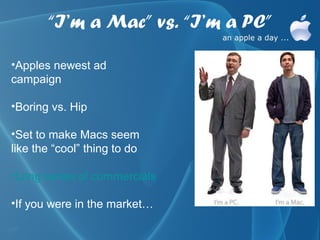
“I’m a Mac” vs. “I’m a PC”

•Apples newest ad
campaign

•Boring vs. Hip

•Set to make Macs seem
like the “cool” thing to do

•Long series of commercials

•If you were in the market…
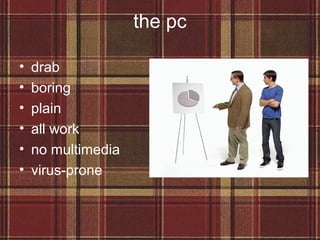
the pc

•   drab
•   boring
•   plain
•   all work
•   no multimedia
•   virus-prone
Wage Discrimination

Q: Who is this?
  – Born to Unmarried Syrian Father and
    American Mother
  – Put up for Adoption
  – Dropped out of College
  – Now makes $1/year salary


A: Steve Jobs
Wage Discrimination

•   Steve Job’s Salary…
•   $1/year
•   Sweatshop Worker’s Salary
•   $50/month ($600/year)
•   Steve Job’s Stock Option
•   $381,000,000.00
•   Sweatshop Worker’s Stock Option
•   Non-existent
Topics for Discussion
Zack Klingensmith           Alicia Sutton
• History/Background        • Monopoly
• Advertising               • Transition
• Wage Discrimination       • Oligopoly

Mike Rush                   Mark Bender
• Economic Questions        • Government Intervention
• Ceterus Paribus           • The Stock Market
                            • Summary
Angelo Granata
• Substitutes/Complements   Questions and Answers
• Elasticity
The Three Basic Economic Questions

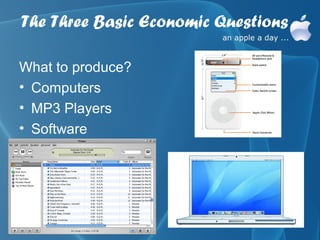
What to produce?
• Computers
• MP3 Players
• Software
The Three Basic Economic Questions

How to produce?
• Assembly Lines
• Robots
• Sweatshops
The Three Basic Economic Questions

For whom to produce?
• Small Businesses
• Big Businesses
• Individuals
The Three Basic Economic Questions

          The Basic Rule:
        If you can afford it,

APPLE WILL SELL IT!
The Ceteris Paribus Factors of
               Demand
• INCOME- Economy is doing well and as a result
  buyers are having more money to spend
• NUMBER OF CONSUMERS- More and more
  people are now becoming interested in Apple computers,
  iPod and software
• EXPECTATIONS OF BUYERS- Buyers of Apple’s
  products hope and expect that the iPod and other
  products will become more inexpensive as more are
  bought and produced. Additionally, consumers also
  expect Apple to be able to produce to their demand.
The Ceteris Paribus Factors of
                Demand
• PRICES OF RELATED GOODS- There are many
  substitutes in both the computer and MP3 player
  industries. The substitutes in the computer industry are
  very comparable, but the substitutes in the MP3 are not
  at all close to the iPod, which was the pioneer in the
  field.
• TASTES- Apple has been able to figure out its
  customers tastes and adapt its products to fit those
  tastes.
The Ceteris Paribus Factors of
                Supply
• INPUT PRICES- The prices to make Apple’s products
  have been becoming less and less due to foreign
  countries and foreign companies making the products at
  much less of a cost.
• NUMBERS OF SELLERS- In the computer field
  there are many other sellers; however, in the field of
  MP3 players, Apple is the pioneer and holds the majority
  of the market share in that industry.
The Ceteris Paribus Factors of
                  Supply
• EXPECTATIONS OF SELLERS- Apple is always
  updating its equipment and software. As a result, it is
  also finding ways to become more efficient and thus
  lowering the price of its goods.
• PRICES OF ALTERNATIVE GOODS- Apple
  computers are slightly more expensive than its
  competitors. Its MP3 player, the iPod, can also be
  slightly more expensive; however, it is also more
  technologically advanced than its rival players.
• TECHNOLOGY- Because Apple is involved in the
  technology industry, it must be constantly updating itself
  if it wants to compete with its adversaries
Topics for Discussion
Zack Klingensmith           Alicia Sutton
• History/Background        • Monopoly
• Advertising               • Transition
• Wage Discrimination       • Oligopoly

Mike Rush                   Mark Bender
• Economic Questions        • Government Intervention
• Ceterus Paribus           • The Stock Market
                            • Summary
Angelo Granata
• Substitutes/Complements   Questions and Answers
• Elasticity
Substitutes

• A good that can be        • Apple has a large
  used in place of            selection in their iPod
  another good that is        line covering the
  used for the same           ranges of gigabyte
  purpose.                    sizes, operating
• They are related such       functions and price.
  that an increase in the   • There are many other
  price of one will cause     media players on the
  an increase in the          market that could be
  demand for the other.       substitutes to the
                              iPod.
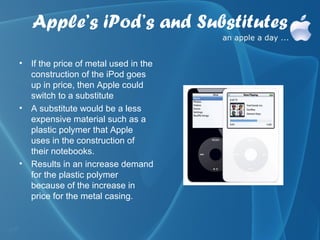
Apple’s iPod’s and Substitutes
• If the price of metal used in the
  construction of the iPod goes
  up in price, then Apple could
  switch to a substitute
• A substitute would be a less
  expensive material such as a
  plastic polymer that Apple
  uses in the construction of
  their notebooks.
• Results in an increase demand
  for the plastic polymer
  because of the increase in
  price for the metal casing.
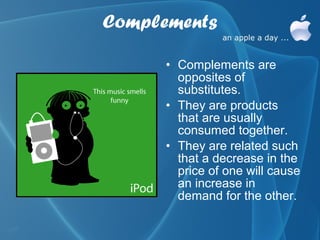
Complements

      • Complements are
        opposites of
        substitutes.
      • They are products
        that are usually
        consumed together.
      • They are related such
        that a decrease in the
        price of one will cause
        an increase in
        demand for the other.
Apple iPod’s and Complements

    If the price of Apple’s iPods went down,
    then the demand for the complements
    would increase. Some examples would
    be
•   Car application
•   iTunes Song Downloads
•   iPod Docking Stations
•   Protective Sleeves
•   Radio Transmitters
Elasticity
• Elasticity is the
  degree to which
  consumers respond
  to price changes
• A measure of
  sensitivity of one
  variable to another
• Formula: absolute
  value of percent
  change in quantity
  demanded divided by
  the percent change in
  price
Elasticity

• A value greater than 1 is an elastic good
• A value less than 1 is an inelastic good
• Factors that affect elasticity are the
  availability of substitutes, consumer’s
  budget and time restraint
Apple’s iTune’s and Elasticity

• Substitute for price elasticity of iTunes is to go
  out and buy the CD
• Average price of an online album is $9.99
• Research firm Ipsos-Insight conducted a survey:
  $7.99 was the best price for digital-music albums
• Consumers are still willing to pay between $10
  and $12 for an actual CD
• Labels, artists and music publishers will make
  more money with lower prices—finding the right
  price elasticity
Apple’s iTune’s and Elasticity
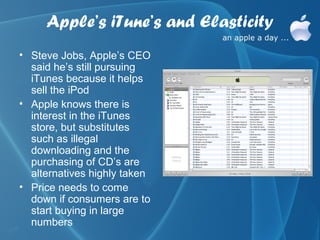
• Steve Jobs, Apple’s CEO
  said he’s still pursuing
  iTunes because it helps
  sell the iPod
• Apple knows there is
  interest in the iTunes
  store, but substitutes
  such as illegal
  downloading and the
  purchasing of CD’s are
  alternatives highly taken
• Price needs to come
  down if consumers are to
  start buying in large
  numbers
Topics for Discussion
Zack Klingensmith           Alicia Sutton
• History/Background        • Monopoly
• Advertising               • Transition
• Wage Discrimination       • Oligopoly

Mike Rush                   Mark Bender
• Economic Questions        • Government Intervention
• Ceterus Paribus           • The Stock Market
                            • Summary
Angelo Granata
• Substitutes/Complements   Questions and Answers
• Elasticity
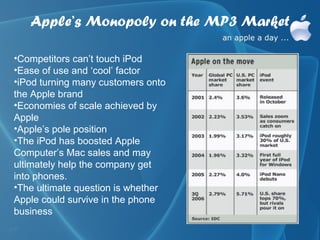
Apple’s Monopoly on the MP3 Market

•Competitors can’t touch iPod
•Ease of use and ‘cool’ factor
•iPod turning many customers onto
the Apple brand
•Economies of scale achieved by
Apple
•Apple’s pole position
•The iPod has boosted Apple
Computer’s Mac sales and may
ultimately help the company get
into phones.
•The ultimate question is whether
Apple could survive in the phone
business
Transition From Monopoly

• The music industry is very profitable
• This means that MP3 players are also a
  hot commodity as more and more music is
  made available through pay-sites
• Other companies want to cash in on this
  gold rush
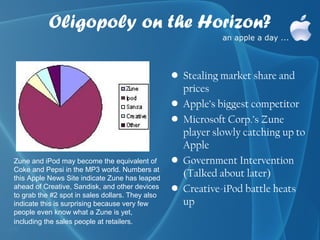
Oligopoly on the Horizon?

                                                  • Stealing market share and
                                                    prices
                                                  • Apple’s biggest competitor
                                                  • Microsoft Corp.’s Zune
                                                    player slowly catching up to
                                                    Apple
Zune and iPod may become the equivalent of        • Government Intervention
Coke and Pepsi in the MP3 world. Numbers at
this Apple News Site indicate Zune has leaped
                                                    (Talked about later)
ahead of Creative, Sandisk, and other devices     • Creative-iPod battle heats
to grab the #2 spot in sales dollars. They also
indicate this is surprising because very few        up
people even know what a Zune is yet,
including the sales people at retailers.
Topics for Discussion
Zack Klingensmith           Alicia Sutton
• History/Background        • Monopoly
• Advertising               • Transition
• Wage Discrimination       • Oligopoly

Mike Rush                   Mark Bender
• Economic Questions        • Government Intervention
• Ceterus Paribus           • The Stock Market
                            • Summary
Angelo Granata
• Substitutes/Complements   Questions and Answers
• Elasticity
Apple and Government Intervention
• Government intervention in music downloading
  industry created a demand for Apple’s iTunes
  – Most successful pay music download application
    (70% of market)
• US and French government legislation that
  makes music downloads universal
  – iPod’s and iTunes’ .DRV format will become released
    to all downloading companies
  – .AAC to .WMA files (Apple would have to switch)
  – Could loosen Apple’s control of the music download
    market allowing other competitors to sell music for the
    iPod
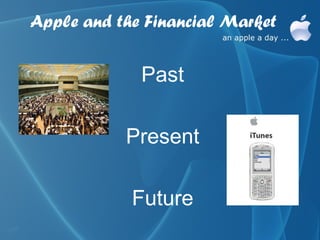
Apple and the Financial Market


             Past

           Present

            Future
Apple and the Financial Market
             - Past -
• 1976 – Steve Jobs and Stephen Wozniak found
  Apple. Third co-founder, Ronald Wayne drops
  out 2 weeks later.

• 1980 – Apple goes public in the largest IPO
  since Ford went public in 1956.
  – The valuation is over $1.8 billion
  – Over 40 of the 1,000 employees become millionaires
Apple and the Financial Market
             - Present -
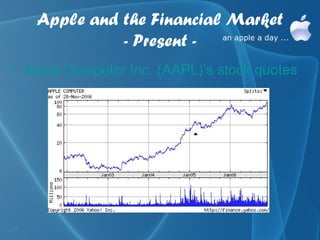
• Apple Computer Inc. (AAPL)’s stock quotes
Apple and the Financial Market
             - Future -
• Fundamental analysis – a method of
  predicting a stock’s price based on the
  fundamental forces driving the firm’s future
  earnings.
Apple and the Financial Market
           - Future -
– Low-priced iPods and Mac computers using
  Intel chips are expected to boost Apple sales
  over the holiday
– The Microsoft Zune is expected to steal some
  of the market-share away from Apple.
– Next year, Apple’s stock is expected to rise
  with the release of iTV and an iPod cell-phone
– 2006 leaves Apple with share-gain potential.
  Estimates for share are expected to rise in
  2007 and again in 2008 due to a projected
  increase in revenue (forbes.com).
Summary

Zack Klingensmith           Alicia Sutton
• History/Background        • Monopoly
• Advertising               • Oligopoly
• Wage Discrimination
                            Mark Bender
Mike Rush                   • Government Intervention
• Economic Questions        • The Stock Market
• Ceterus Paribus

Angelo Granata
• Substitutes/Complements
• Elasticity
Questions and Answers…

Do you have any questions…?
Thank You For Your
     Support!
     ECN 101-01
      Group IV
      Fall 2006

Apple computer l

  • 1.
    Apple Computer, Inc. Economics 101-01 Group IV Mark Bender, Mike Rush, Alicia Sutton, Angelo Granata, Zack Klingensmith
  • 2.
    Topics for Discussion ZackKlingensmith Alicia Sutton • History/Background • Monopoly • Advertising • Transition • Wage Discrimination • Oligopoly Mike Rush Mark Bender • Economic Questions • Government Intervention • Ceterus Paribus • The Stock Market • Summary Angelo Granata • Substitutes/Complements Questions and Answers • Elasticity
  • 3.
    History •Founded in 1976by Current Apple Products Steve Jobs, Steve •Personal Computers Wozniak, and Ronald •Laptops/Notebooks Wayne. •iTunes/Music Downloads •Company started by •Servers selling handmade •Much More… computers that were manufactured in a garage. •Has since expanded its market into a wide range of computer associated materials.
  • 4.
  • 5.
    The “Look” ofApple • Apple targets a younger audience by appearing as a much more casual company • We decided to dress as we did to represent Apple as well as we could • Notice Steve Jobs at the shareholders meeting:
  • 6.
    Consumer Choice • Scarcityis the reason the study of economics exists. • If everyone had unlimited time and money, everyone would own the best computer possible. • Apple must try to convince consumers that they should spend money on their product and not on Dells or Compaqs or Sonys… • The most popular way…
  • 8.
    “I’m a Mac”vs. “I’m a PC” •Apples newest ad campaign •Boring vs. Hip •Set to make Macs seem like the “cool” thing to do •Long series of commercials •If you were in the market…
  • 9.
    the pc • drab • boring • plain • all work • no multimedia • virus-prone
  • 11.
    Wage Discrimination Q: Whois this? – Born to Unmarried Syrian Father and American Mother – Put up for Adoption – Dropped out of College – Now makes $1/year salary A: Steve Jobs
  • 12.
    Wage Discrimination • Steve Job’s Salary… • $1/year • Sweatshop Worker’s Salary • $50/month ($600/year) • Steve Job’s Stock Option • $381,000,000.00 • Sweatshop Worker’s Stock Option • Non-existent
  • 13.
    Topics for Discussion ZackKlingensmith Alicia Sutton • History/Background • Monopoly • Advertising • Transition • Wage Discrimination • Oligopoly Mike Rush Mark Bender • Economic Questions • Government Intervention • Ceterus Paribus • The Stock Market • Summary Angelo Granata • Substitutes/Complements Questions and Answers • Elasticity
  • 14.
    The Three BasicEconomic Questions What to produce? • Computers • MP3 Players • Software
  • 15.
    The Three BasicEconomic Questions How to produce? • Assembly Lines • Robots • Sweatshops
  • 16.
    The Three BasicEconomic Questions For whom to produce? • Small Businesses • Big Businesses • Individuals
  • 17.
    The Three BasicEconomic Questions The Basic Rule: If you can afford it, APPLE WILL SELL IT!
  • 18.
    The Ceteris ParibusFactors of Demand • INCOME- Economy is doing well and as a result buyers are having more money to spend • NUMBER OF CONSUMERS- More and more people are now becoming interested in Apple computers, iPod and software • EXPECTATIONS OF BUYERS- Buyers of Apple’s products hope and expect that the iPod and other products will become more inexpensive as more are bought and produced. Additionally, consumers also expect Apple to be able to produce to their demand.
  • 19.
    The Ceteris ParibusFactors of Demand • PRICES OF RELATED GOODS- There are many substitutes in both the computer and MP3 player industries. The substitutes in the computer industry are very comparable, but the substitutes in the MP3 are not at all close to the iPod, which was the pioneer in the field. • TASTES- Apple has been able to figure out its customers tastes and adapt its products to fit those tastes.
  • 20.
    The Ceteris ParibusFactors of Supply • INPUT PRICES- The prices to make Apple’s products have been becoming less and less due to foreign countries and foreign companies making the products at much less of a cost. • NUMBERS OF SELLERS- In the computer field there are many other sellers; however, in the field of MP3 players, Apple is the pioneer and holds the majority of the market share in that industry.
  • 21.
    The Ceteris ParibusFactors of Supply • EXPECTATIONS OF SELLERS- Apple is always updating its equipment and software. As a result, it is also finding ways to become more efficient and thus lowering the price of its goods. • PRICES OF ALTERNATIVE GOODS- Apple computers are slightly more expensive than its competitors. Its MP3 player, the iPod, can also be slightly more expensive; however, it is also more technologically advanced than its rival players. • TECHNOLOGY- Because Apple is involved in the technology industry, it must be constantly updating itself if it wants to compete with its adversaries
  • 22.
    Topics for Discussion ZackKlingensmith Alicia Sutton • History/Background • Monopoly • Advertising • Transition • Wage Discrimination • Oligopoly Mike Rush Mark Bender • Economic Questions • Government Intervention • Ceterus Paribus • The Stock Market • Summary Angelo Granata • Substitutes/Complements Questions and Answers • Elasticity
  • 23.
    Substitutes • A goodthat can be • Apple has a large used in place of selection in their iPod another good that is line covering the used for the same ranges of gigabyte purpose. sizes, operating • They are related such functions and price. that an increase in the • There are many other price of one will cause media players on the an increase in the market that could be demand for the other. substitutes to the iPod.
  • 24.
    Apple’s iPod’s andSubstitutes • If the price of metal used in the construction of the iPod goes up in price, then Apple could switch to a substitute • A substitute would be a less expensive material such as a plastic polymer that Apple uses in the construction of their notebooks. • Results in an increase demand for the plastic polymer because of the increase in price for the metal casing.
  • 25.
    Complements • Complements are opposites of substitutes. • They are products that are usually consumed together. • They are related such that a decrease in the price of one will cause an increase in demand for the other.
  • 26.
    Apple iPod’s andComplements If the price of Apple’s iPods went down, then the demand for the complements would increase. Some examples would be • Car application • iTunes Song Downloads • iPod Docking Stations • Protective Sleeves • Radio Transmitters
  • 27.
    Elasticity • Elasticity isthe degree to which consumers respond to price changes • A measure of sensitivity of one variable to another • Formula: absolute value of percent change in quantity demanded divided by the percent change in price
  • 28.
    Elasticity • A valuegreater than 1 is an elastic good • A value less than 1 is an inelastic good • Factors that affect elasticity are the availability of substitutes, consumer’s budget and time restraint
  • 29.
    Apple’s iTune’s andElasticity • Substitute for price elasticity of iTunes is to go out and buy the CD • Average price of an online album is $9.99 • Research firm Ipsos-Insight conducted a survey: $7.99 was the best price for digital-music albums • Consumers are still willing to pay between $10 and $12 for an actual CD • Labels, artists and music publishers will make more money with lower prices—finding the right price elasticity
  • 30.
    Apple’s iTune’s andElasticity • Steve Jobs, Apple’s CEO said he’s still pursuing iTunes because it helps sell the iPod • Apple knows there is interest in the iTunes store, but substitutes such as illegal downloading and the purchasing of CD’s are alternatives highly taken • Price needs to come down if consumers are to start buying in large numbers
  • 31.
    Topics for Discussion ZackKlingensmith Alicia Sutton • History/Background • Monopoly • Advertising • Transition • Wage Discrimination • Oligopoly Mike Rush Mark Bender • Economic Questions • Government Intervention • Ceterus Paribus • The Stock Market • Summary Angelo Granata • Substitutes/Complements Questions and Answers • Elasticity
  • 32.
    Apple’s Monopoly onthe MP3 Market •Competitors can’t touch iPod •Ease of use and ‘cool’ factor •iPod turning many customers onto the Apple brand •Economies of scale achieved by Apple •Apple’s pole position •The iPod has boosted Apple Computer’s Mac sales and may ultimately help the company get into phones. •The ultimate question is whether Apple could survive in the phone business
  • 33.
    Transition From Monopoly •The music industry is very profitable • This means that MP3 players are also a hot commodity as more and more music is made available through pay-sites • Other companies want to cash in on this gold rush
  • 34.
    Oligopoly on theHorizon? • Stealing market share and prices • Apple’s biggest competitor • Microsoft Corp.’s Zune player slowly catching up to Apple Zune and iPod may become the equivalent of • Government Intervention Coke and Pepsi in the MP3 world. Numbers at this Apple News Site indicate Zune has leaped (Talked about later) ahead of Creative, Sandisk, and other devices • Creative-iPod battle heats to grab the #2 spot in sales dollars. They also indicate this is surprising because very few up people even know what a Zune is yet, including the sales people at retailers.
  • 35.
    Topics for Discussion ZackKlingensmith Alicia Sutton • History/Background • Monopoly • Advertising • Transition • Wage Discrimination • Oligopoly Mike Rush Mark Bender • Economic Questions • Government Intervention • Ceterus Paribus • The Stock Market • Summary Angelo Granata • Substitutes/Complements Questions and Answers • Elasticity
  • 36.
    Apple and GovernmentIntervention • Government intervention in music downloading industry created a demand for Apple’s iTunes – Most successful pay music download application (70% of market) • US and French government legislation that makes music downloads universal – iPod’s and iTunes’ .DRV format will become released to all downloading companies – .AAC to .WMA files (Apple would have to switch) – Could loosen Apple’s control of the music download market allowing other competitors to sell music for the iPod
  • 37.
    Apple and theFinancial Market Past Present Future
  • 38.
    Apple and theFinancial Market - Past - • 1976 – Steve Jobs and Stephen Wozniak found Apple. Third co-founder, Ronald Wayne drops out 2 weeks later. • 1980 – Apple goes public in the largest IPO since Ford went public in 1956. – The valuation is over $1.8 billion – Over 40 of the 1,000 employees become millionaires
  • 39.
    Apple and theFinancial Market - Present - • Apple Computer Inc. (AAPL)’s stock quotes
  • 40.
    Apple and theFinancial Market - Future - • Fundamental analysis – a method of predicting a stock’s price based on the fundamental forces driving the firm’s future earnings.
  • 41.
    Apple and theFinancial Market - Future - – Low-priced iPods and Mac computers using Intel chips are expected to boost Apple sales over the holiday – The Microsoft Zune is expected to steal some of the market-share away from Apple. – Next year, Apple’s stock is expected to rise with the release of iTV and an iPod cell-phone – 2006 leaves Apple with share-gain potential. Estimates for share are expected to rise in 2007 and again in 2008 due to a projected increase in revenue (forbes.com).
  • 42.
    Summary Zack Klingensmith Alicia Sutton • History/Background • Monopoly • Advertising • Oligopoly • Wage Discrimination Mark Bender Mike Rush • Government Intervention • Economic Questions • The Stock Market • Ceterus Paribus Angelo Granata • Substitutes/Complements • Elasticity
  • 43.
    Questions and Answers… Doyou have any questions…?
  • 44.
    Thank You ForYour Support! ECN 101-01 Group IV Fall 2006