Libro de gramatica
Liliana
smoot
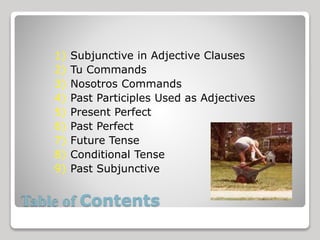
Table of Contents
1) Subjunctive in Adjective Clauses
2) Tu Commands
3) Nosotros Commands
4) Past Participles Used as Adjectives
5) Present Perfect
6) Past Perfect
7) Future Tense
8) Conditional Tense
9) Past Subjunctive
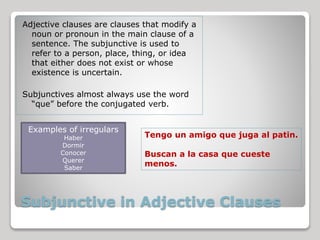
Subjunctive in Adjective Clauses
Adjective clauses are clauses that modify a
noun or pronoun in the main clause of a
sentence. The subjunctive is used to
refer to a person, place, thing, or idea
that either does not exist or whose
existence is uncertain.
Subjunctives almost always use the word
“que” before the conjugated verb.
Examples of irregulars
Haber
Dormir
Conocer
Querer
Saber
Tengo un amigo que juga al patin.
Buscan a la casa que cueste
menos.
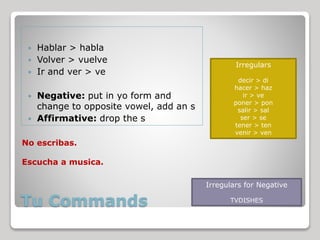
Tu Commands
 Hablar > habla
 Volver > vuelve
 Ir and ver > ve
 Negative: put in yo form and
change to opposite vowel, add an s
 Affirmative: drop the s
Irregulars
decir > di
hacer > haz
ir > ve
poner > pon
salir > sal
ser > se
tener > ten
venir > ven
Irregulars for Negative
TVDISHES
No escribas.
Escucha a musica.
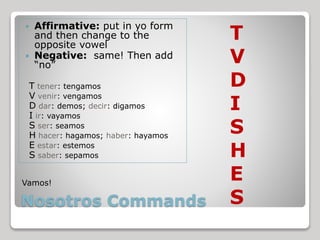
Nosotros Commands
 Affirmative: put in yo form
and then change to the
opposite vowel
 Negative: same! Then add
“no”
T tener: tengamos
V venir: vengamos
D dar: demos; decir: digamos
I ir: vayamos
S ser: seamos
H hacer: hagamos; haber: hayamos
E estar: estemos
S saber: sepamos
T
V
D
I
S
H
E
S
Vamos!
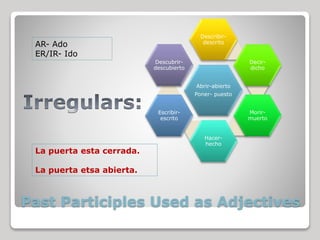
Past Participles Used as Adjectives
Abrir-abierto
Poner- puesto
Describir-
descrito
Decir-
dicho
Morir-
muerto
Hacer-
hecho
Escribir-
escrito
Descubrir-
descubierto
AR- Ado
ER/IR- Ido
La puerta esta cerrada.
La puerta etsa abierta.
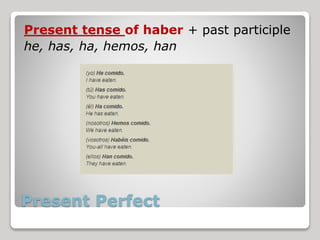
Present Perfect
Present tense of haber + past participle
he, has, ha, hemos, han
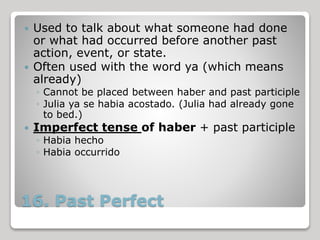
16. Past Perfect
 Used to talk about what someone had done
or what had occurred before another past
action, event, or state.
 Often used with the word ya (which means
already)
◦ Cannot be placed between haber and past participle
◦ Julia ya se habia acostado. (Julia had already gone
to bed.)
 Imperfect tense of haber + past participle
◦ Habia hecho
◦ Habia occurrido
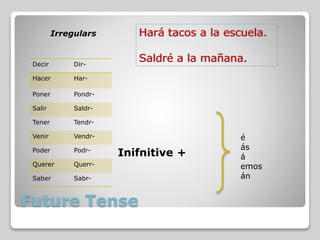
Future Tense
é
ás
á
emos
án
Irregulars
Decir Dir-
Hacer Har-
Poner Pondr-
Salir Saldr-
Tener Tendr-
Venir Vendr-
Poder Podr-
Querer Querr-
Saber Sabr-
Inifnitive +
Hará tacos a la escuela.
Saldré a la mañana.
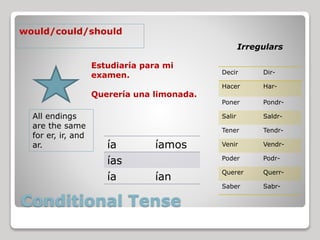
Conditional Tense
ía íamos
ías
ía ían
All endings
are the same
for er, ir, and
ar.
Decir Dir-
Hacer Har-
Poner Pondr-
Salir Saldr-
Tener Tendr-
Venir Vendr-
Poder Podr-
Querer Querr-
Saber Sabr-
Irregulars
would/could/should
Estudiaría para mi
examen.
Querería una limonada.
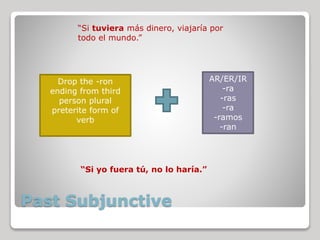
Past Subjunctive
Drop the -ron
ending from third
person plural
preterite form of
verb
AR/ER/IR
-ra
-ras
-ra
-ramos
-ran
“Si tuviera más dinero, viajaría por
todo el mundo.”
“Si yo fuera tú, no lo haría.”
Fin 

grammar book

  • 1.
  • 2.
    Table of Contents 1)Subjunctive in Adjective Clauses 2) Tu Commands 3) Nosotros Commands 4) Past Participles Used as Adjectives 5) Present Perfect 6) Past Perfect 7) Future Tense 8) Conditional Tense 9) Past Subjunctive
  • 3.
    Subjunctive in AdjectiveClauses Adjective clauses are clauses that modify a noun or pronoun in the main clause of a sentence. The subjunctive is used to refer to a person, place, thing, or idea that either does not exist or whose existence is uncertain. Subjunctives almost always use the word “que” before the conjugated verb. Examples of irregulars Haber Dormir Conocer Querer Saber Tengo un amigo que juga al patin. Buscan a la casa que cueste menos.
  • 4.
    Tu Commands  Hablar> habla  Volver > vuelve  Ir and ver > ve  Negative: put in yo form and change to opposite vowel, add an s  Affirmative: drop the s Irregulars decir > di hacer > haz ir > ve poner > pon salir > sal ser > se tener > ten venir > ven Irregulars for Negative TVDISHES No escribas. Escucha a musica.
  • 5.
    Nosotros Commands  Affirmative:put in yo form and then change to the opposite vowel  Negative: same! Then add “no” T tener: tengamos V venir: vengamos D dar: demos; decir: digamos I ir: vayamos S ser: seamos H hacer: hagamos; haber: hayamos E estar: estemos S saber: sepamos T V D I S H E S Vamos!
  • 6.
    Past Participles Usedas Adjectives Abrir-abierto Poner- puesto Describir- descrito Decir- dicho Morir- muerto Hacer- hecho Escribir- escrito Descubrir- descubierto AR- Ado ER/IR- Ido La puerta esta cerrada. La puerta etsa abierta.
  • 7.
    Present Perfect Present tenseof haber + past participle he, has, ha, hemos, han
  • 8.
    16. Past Perfect Used to talk about what someone had done or what had occurred before another past action, event, or state.  Often used with the word ya (which means already) ◦ Cannot be placed between haber and past participle ◦ Julia ya se habia acostado. (Julia had already gone to bed.)  Imperfect tense of haber + past participle ◦ Habia hecho ◦ Habia occurrido
  • 9.
    Future Tense é ás á emos án Irregulars Decir Dir- HacerHar- Poner Pondr- Salir Saldr- Tener Tendr- Venir Vendr- Poder Podr- Querer Querr- Saber Sabr- Inifnitive + Hará tacos a la escuela. Saldré a la mañana.
  • 10.
    Conditional Tense ía íamos ías íaían All endings are the same for er, ir, and ar. Decir Dir- Hacer Har- Poner Pondr- Salir Saldr- Tener Tendr- Venir Vendr- Poder Podr- Querer Querr- Saber Sabr- Irregulars would/could/should Estudiaría para mi examen. Querería una limonada.
  • 11.
    Past Subjunctive Drop the-ron ending from third person plural preterite form of verb AR/ER/IR -ra -ras -ra -ramos -ran “Si tuviera más dinero, viajaría por todo el mundo.” “Si yo fuera tú, no lo haría.”
  • 12.