OP-AMP
ABOUT ME
CONTACT INFO
Tel: (+92) 322 7967172
E-Mail: abubakarmehmood786@yahoo.com
SKILLS & LANGUAGE
ORIGIN LAB, VIRTUAL LAB, ENDNOTE
SOFTWARE, EMATHHELP SOFTWARE ,
MICROSOFT OFFICE, ADBOBE
(PHOTOSHOP & ILUUSTRATOR),
ARDUINO SOFTWARE, AMAZON VITUAL
ASSISTAN, VIDEO EDITTING, SOCIAL
MEDIA ACCOUNT MANAGEMENT
URDU, PUNJABI, ENGLISH, ARABIC
FOUNDER
UCQxAo-GBHUI2l9_LBYicsRw
THE CREATOR ACADEMY
thecreatorsacademyofficial
The Creators Academy
ABU BAKAR
NATIONALITY : PAKISTAN
CITY : SIALKOT, PUNJAB
MARITAL STATUS : SINGLE
PERSONAL PROFILE
BS(HONS) PHYSICS
UNIVERSITY OF SIALKOT
EDUCATION
SOCIAL MEDIA
Abubakar Bhutta
@_abubakar786
ABU BAKAR
@abubakar786786
ABUBAKAR692909
PRESENTATION OUTLINE
• Introduction ( History + What is an Op-Amp?)
• Characteristics of Ideal and Real Op-Amps
• Applications
• Advantages/disadvantages
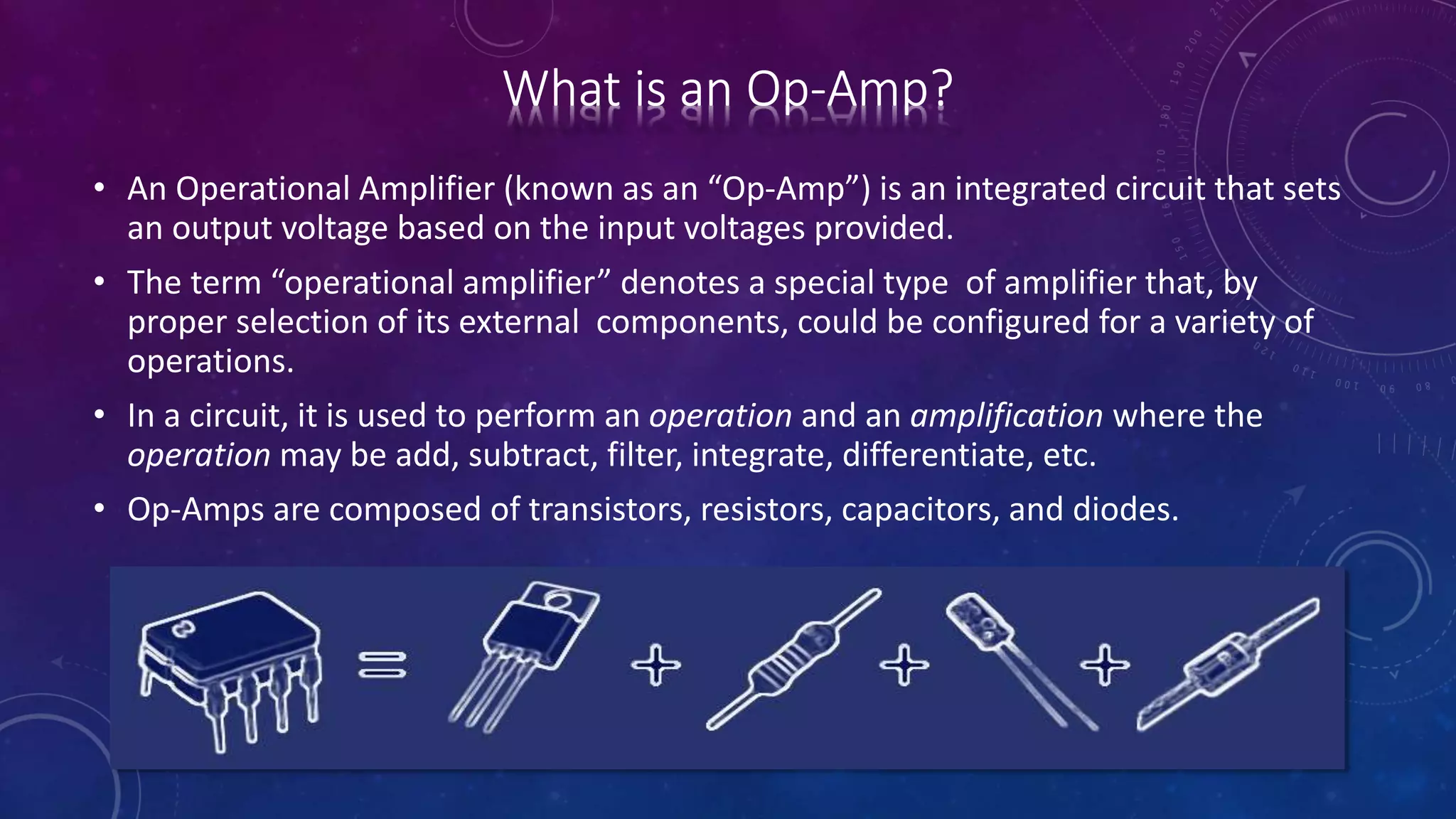
• An Operational Amplifier (known as an “Op-Amp”) is an integrated circuit that sets
an output voltage based on the input voltages provided.
• The term “operational amplifier” denotes a special type of amplifier that, by
proper selection of its external components, could be configured for a variety of
operations.
• In a circuit, it is used to perform an operation and an amplification where the
operation may be add, subtract, filter, integrate, differentiate, etc.
• Op-Amps are composed of transistors, resistors, capacitors, and diodes.
BRIEF HISTORY
• 1941: Karl Swartzel of Bell Labs developed the first Op-Amp.
• Used 3 vacuum tubes, only one input (inverting), and operated on + 350 V to achieve 90 dB
gain.
• 1947: Loebe Julie developed the Op-Amp as it is known today, with two inputs – inverting and non-
inverting.
• The differential input made a whole range of new functionality possible.
• 1953: First commercially available Op-Amp.
• George A. Philbrick Researches (GAP-R). GAP-R pioneered the first reasonable-cost, mass-
produced operational amplifier
• 1961: Advent of solid-state, discrete Op-Amps.
• Made possible by the invention of the silicon transistor, which led to the concept of Integrated
Circuits (IC)
• Reduced power input to ±15V to ±10V
• 1962: Op-Amp in a potted module.
• Packaging in small black boxes allowed for integration with a circuit
BRIEF HISTORY
• 1963: First monolithic IC Op-Amp, the μA702, designed by Bob Widlar at
Fairchild Semiconductor.
• Monolithic ICs consist of a single chip
• 1968: Release of the μA741
• The μA741 became the canonical Op-Amp, from which many modern op-amps base
their pinout from, and is still in production today.
Note : The latest generation op amps cover the frequency spectrum from 5-
kHz GBW to beyond 1-GHz GBW. The supply voltage ranges from guaranteed
operation at 0.9 V to absolute maximum voltage ratings of 1000 V. The input
current and input offset voltage has fallen so low that customers have
problems verifying the specifications during incoming inspection. The op
amp has truly become the universal analog IC because it performs all analog
tasks.
Parameter Range
Frequency
Spectrum
5-kHz to beyond 1-GHz
GBW
Supply Voltage 0.9 V to a maximum 1000 V
Input Offsets Approximately Zero
Fig.. Ckt symbol for general purpose op-
amp
Figure shows the symbol of op-amp &
the power supply connections to make it
work. The input terminal identified by the
‘-’ and “+” symbols are designated inverting
& non- inverting. Their voltage w.r.t
ground are denoted as VN & VP and
output voltage as VO. Op- amp do not
have a zero volt ground terminal Ground
reference is established externally by the
power supply common.
Op-amp pin diagram
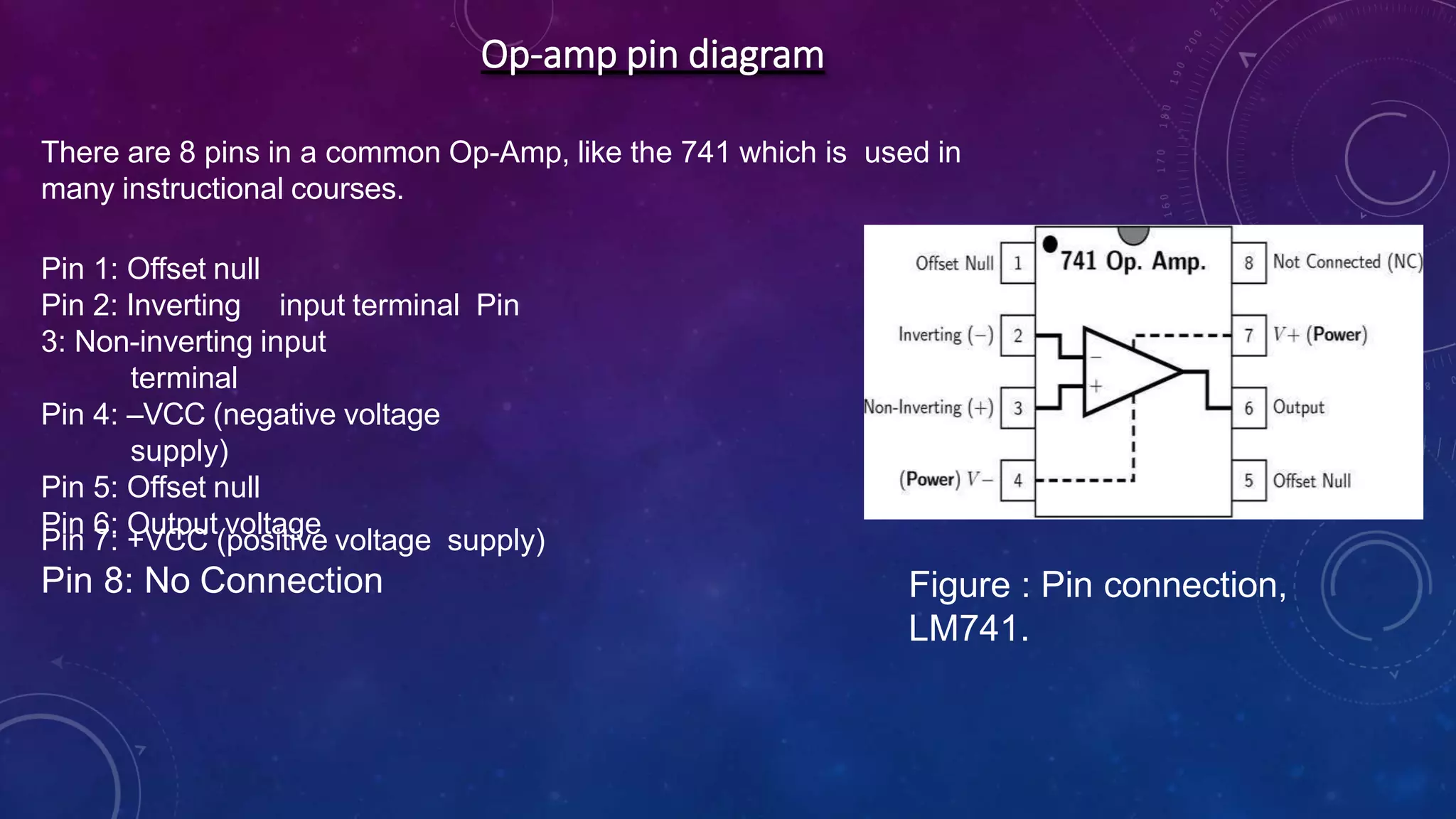
There are 8 pins in a common Op-Amp, like the 741 which is used in
many instructional courses.
Pin 1: Offset null
Pin 2: Inverting input terminal Pin
3: Non-inverting input
terminal
Pin 4: –VCC (negative voltage
supply)
Pin 5: Offset null
Pin 6: Output voltage
Pin 7: +VCC (positive voltage supply)
Pin 8: No Connection Figure : Pin connection,
LM741.
V
d
V
N
V
p
V
0
a = gain of amplifiers.
Vd= difference between the voltage.
V0= gain of voltage.
The equation :
V0 = a (VP -VN)
Electrical parameter :
1.Input bias current(Ib): average of current that flows into the
inverting and non-inverting input terminal of op-amp.
2.I/p and o/p impedance: It is the resistance offered by the inputs and the
output terminals to varying voltages. The quantity is expressed in Ohms.
3. Open Loop Gain: It is the overall voltage gain or the amplification.
4. Input offset voltage : It is a voltage that must be applied between the two
terminal of an
op-amp to null the o/p.
5.Input offset current (Ii): The algebraic different between the current in to the
inverting and Non-inverting terminal.
IMPORTANT TERMS AND EQUATION
PRESENTATION OUTLINE
• Introduction (Op-Amp + History)
• Characteristics of Ideal and Real Op-Amps
• Applications
• Advantages/disadvantages
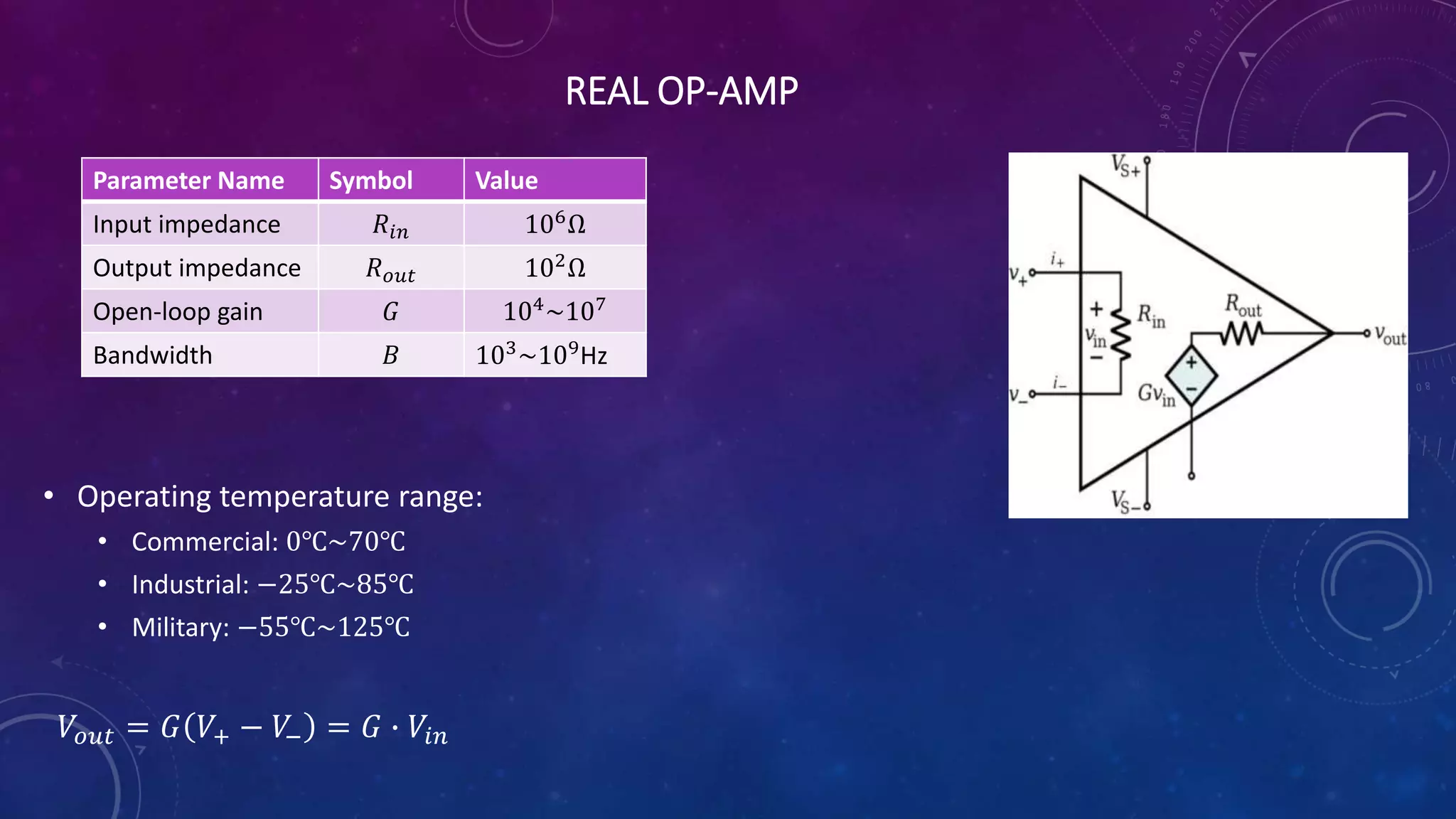
BASIC OP-AMP (OPEN-LOOP)
• 𝑉𝑆+ : positive power supply
• 𝑉𝑆− : negative power supply
• 𝑉+: non-inverting input terminal
• 𝑉
−: inverting input terminal
• 𝑉𝑜𝑢𝑡 : output terminal
• 𝑉+, 𝑉
− , 𝑉𝑜𝑢𝑡 are all referenced to ground
IDEAL OP-AMP
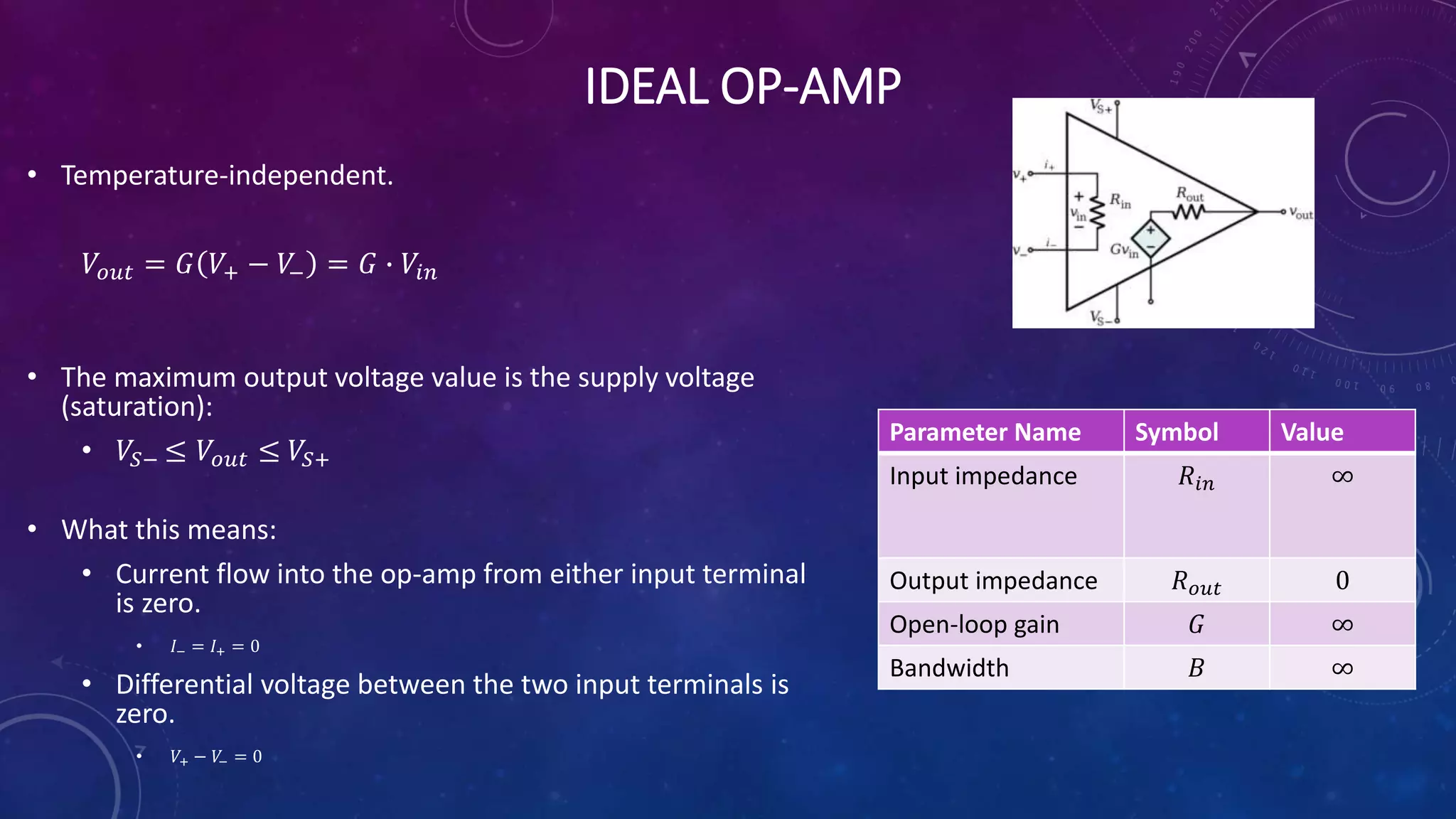
Parameter Name Symbol Value
Input impedance 𝑅𝑖𝑛 ∞
Output impedance 𝑅𝑜𝑢𝑡 0
Open-loop gain 𝐺 ∞
Bandwidth 𝐵 ∞
• Temperature-independent.
𝑉𝑜𝑢𝑡 = 𝐺 𝑉+ − 𝑉
− = 𝐺 ∙ 𝑉𝑖𝑛
• The maximum output voltage value is the supply voltage
(saturation):
• 𝑉𝑆− ≤ 𝑉𝑜𝑢𝑡 ≤ 𝑉𝑆+
• What this means:
• Current flow into the op-amp from either input terminal
is zero.
• 𝐼− = 𝐼+ = 0
• Differential voltage between the two input terminals is
zero.
• 𝑉+ − 𝑉
− = 0
REAL OP-AMP
• Operating temperature range:
• Commercial: 0℃~70℃
• Industrial: −25℃~85℃
• Military: −55℃~125℃
𝑉𝑜𝑢𝑡 = 𝐺 𝑉+ − 𝑉
− = 𝐺 ∙ 𝑉𝑖𝑛
Parameter Name Symbol Value
Input impedance 𝑅𝑖𝑛 106
Ω
Output impedance 𝑅𝑜𝑢𝑡 102Ω
Open-loop gain 𝐺 104
~107
Bandwidth 𝐵 103
~109
Hz
CHARACTERISTICS OF IDEAL OP-AMP
• Infinite input impedance(about 2Mohm)
• Low output impedance(about 200 ohm)
• Very large voltage gain at low frequency
• Thus, small changes in voltages can be amplified byusing an op-amp
• Infinite bandwidth(all frequencies are amplified by same factor
• Infinite Common-mode rejection ratio
• Infinite Power supply rejection ratio.
• Finite open-loop gain that causes gain error
• Finite input impedance
• Non zero output impedance
• Finite CMRR
• Common-mode input resistance
• Finite bandwidth
• Finite power supply rejection ratio.
PRESENTATION OUTLINE
• Introduction (Op-Amp + History)
• Characteristics of Ideal and Real Op-Amps
• Applications
• Advantages/disadvantages
APPLICATIONS
 A to D Converters
 Power source
 Zero Crossing Detector (ZCD)
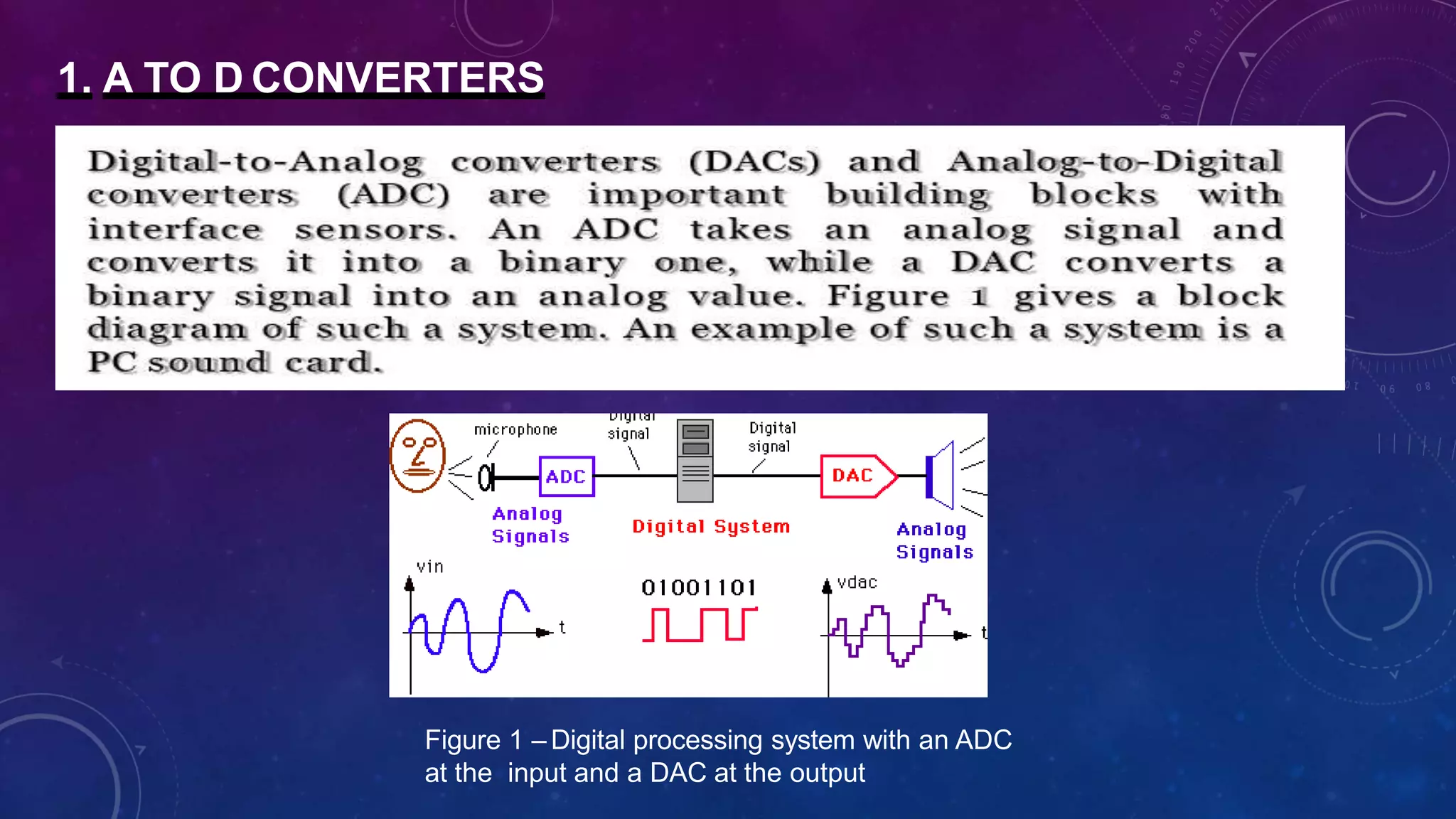
1. A TO D CONVERTERS
Figure 1 – Digital processing system with an ADC
at the input and a DAC at the output
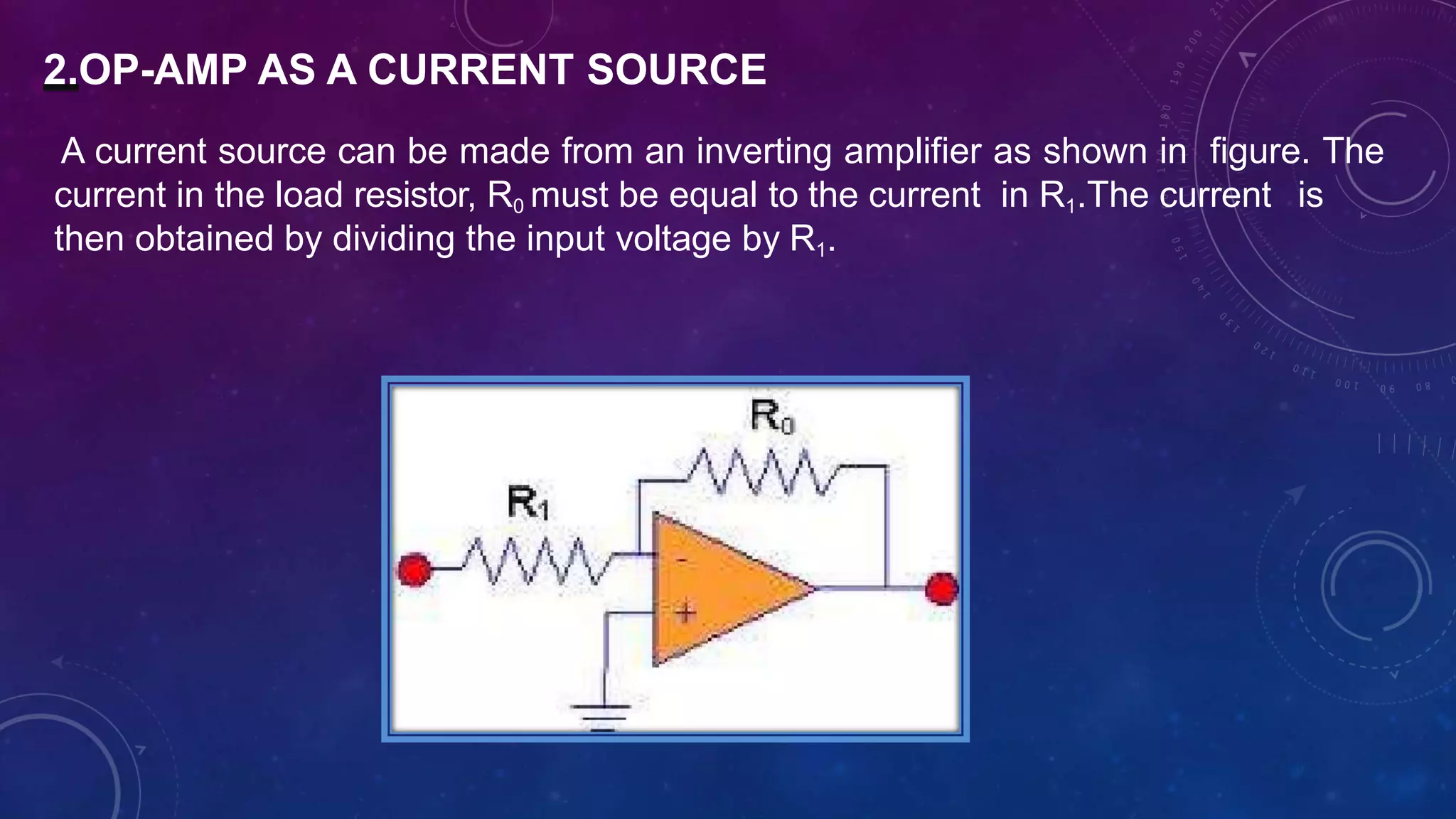
2.OP-AMP AS A CURRENT SOURCE
A current source can be made from an inverting amplifier as shown in figure. The
current in the load resistor, R0 must be equal to the current in R1.The current is
then obtained by dividing the input voltage by R1.
3. Zero crossing detector applications
ZCD circuit can be used to check whether the op-amp is in good
condition. Zero crossing detectors can be used as frequency counters
and for switching purposes in power electronics circuits. ZCD is a
basic op amp circuit.
ADVANTAGES OF AN OP-
AM:-
• OPAM IS AN UNIVERSAL AMPLIFIER.
• VOLTAGE COMPARATORS.
• PRECISION RECTIFIERS.
• ANOLOGUE TO DIGITAL CONVERTERS.
• DIGITAL TO ANALOGUE CONVERTERS.
• FILTERS
• DIFFRENTIATORS AND INTEGRATORS.
• VOLTAGE AND CURRENT REGULATOR.
• ANALOGUE TO COMPUTERS.
DISADVANTAGES OF AN OPAM:-
• 1. MOST OPAM ARE DESIGNED TO FOR
LOWER POWER OPERATION.
• 2.FOR HIGH OUTPUT IS DESIRED THEN THE
OPAM SPECIFICALLY DESIGNED FOR THAT
PURPOSE MUST BE SEEN.
• 3.MOST COMMERCIAL OPAM SHUTS OFF WHEN
THE LOAD RESISTANCE IS BELOW A SPECIFIC
LEVEL.

Operational Amplifier

  • 1.
  • 2.
    ABOUT ME CONTACT INFO Tel:(+92) 322 7967172 E-Mail: abubakarmehmood786@yahoo.com SKILLS & LANGUAGE ORIGIN LAB, VIRTUAL LAB, ENDNOTE SOFTWARE, EMATHHELP SOFTWARE , MICROSOFT OFFICE, ADBOBE (PHOTOSHOP & ILUUSTRATOR), ARDUINO SOFTWARE, AMAZON VITUAL ASSISTAN, VIDEO EDITTING, SOCIAL MEDIA ACCOUNT MANAGEMENT URDU, PUNJABI, ENGLISH, ARABIC FOUNDER UCQxAo-GBHUI2l9_LBYicsRw THE CREATOR ACADEMY thecreatorsacademyofficial thecreatorsacademyofficial The Creators Academy ABU BAKAR NATIONALITY : PAKISTAN CITY : SIALKOT, PUNJAB MARITAL STATUS : SINGLE PERSONAL PROFILE BS(HONS) PHYSICS UNIVERSITY OF SIALKOT EDUCATION SOCIAL MEDIA Abubakar Bhutta @_abubakar786 ABU BAKAR @abubakar786786 ABUBAKAR692909
  • 3.
    PRESENTATION OUTLINE • Introduction( History + What is an Op-Amp?) • Characteristics of Ideal and Real Op-Amps • Applications • Advantages/disadvantages
  • 4.
    • An OperationalAmplifier (known as an “Op-Amp”) is an integrated circuit that sets an output voltage based on the input voltages provided. • The term “operational amplifier” denotes a special type of amplifier that, by proper selection of its external components, could be configured for a variety of operations. • In a circuit, it is used to perform an operation and an amplification where the operation may be add, subtract, filter, integrate, differentiate, etc. • Op-Amps are composed of transistors, resistors, capacitors, and diodes.
  • 5.
    BRIEF HISTORY • 1941:Karl Swartzel of Bell Labs developed the first Op-Amp. • Used 3 vacuum tubes, only one input (inverting), and operated on + 350 V to achieve 90 dB gain. • 1947: Loebe Julie developed the Op-Amp as it is known today, with two inputs – inverting and non- inverting. • The differential input made a whole range of new functionality possible. • 1953: First commercially available Op-Amp. • George A. Philbrick Researches (GAP-R). GAP-R pioneered the first reasonable-cost, mass- produced operational amplifier • 1961: Advent of solid-state, discrete Op-Amps. • Made possible by the invention of the silicon transistor, which led to the concept of Integrated Circuits (IC) • Reduced power input to ±15V to ±10V • 1962: Op-Amp in a potted module. • Packaging in small black boxes allowed for integration with a circuit
  • 6.
    BRIEF HISTORY • 1963:First monolithic IC Op-Amp, the μA702, designed by Bob Widlar at Fairchild Semiconductor. • Monolithic ICs consist of a single chip • 1968: Release of the μA741 • The μA741 became the canonical Op-Amp, from which many modern op-amps base their pinout from, and is still in production today. Note : The latest generation op amps cover the frequency spectrum from 5- kHz GBW to beyond 1-GHz GBW. The supply voltage ranges from guaranteed operation at 0.9 V to absolute maximum voltage ratings of 1000 V. The input current and input offset voltage has fallen so low that customers have problems verifying the specifications during incoming inspection. The op amp has truly become the universal analog IC because it performs all analog tasks. Parameter Range Frequency Spectrum 5-kHz to beyond 1-GHz GBW Supply Voltage 0.9 V to a maximum 1000 V Input Offsets Approximately Zero
  • 7.
    Fig.. Ckt symbolfor general purpose op- amp Figure shows the symbol of op-amp & the power supply connections to make it work. The input terminal identified by the ‘-’ and “+” symbols are designated inverting & non- inverting. Their voltage w.r.t ground are denoted as VN & VP and output voltage as VO. Op- amp do not have a zero volt ground terminal Ground reference is established externally by the power supply common.
  • 8.
    Op-amp pin diagram Thereare 8 pins in a common Op-Amp, like the 741 which is used in many instructional courses. Pin 1: Offset null Pin 2: Inverting input terminal Pin 3: Non-inverting input terminal Pin 4: –VCC (negative voltage supply) Pin 5: Offset null Pin 6: Output voltage Pin 7: +VCC (positive voltage supply) Pin 8: No Connection Figure : Pin connection, LM741.
  • 9.
    V d V N V p V 0 a = gainof amplifiers. Vd= difference between the voltage. V0= gain of voltage. The equation : V0 = a (VP -VN) Electrical parameter : 1.Input bias current(Ib): average of current that flows into the inverting and non-inverting input terminal of op-amp. 2.I/p and o/p impedance: It is the resistance offered by the inputs and the output terminals to varying voltages. The quantity is expressed in Ohms. 3. Open Loop Gain: It is the overall voltage gain or the amplification. 4. Input offset voltage : It is a voltage that must be applied between the two terminal of an op-amp to null the o/p. 5.Input offset current (Ii): The algebraic different between the current in to the inverting and Non-inverting terminal. IMPORTANT TERMS AND EQUATION
  • 10.
    PRESENTATION OUTLINE • Introduction(Op-Amp + History) • Characteristics of Ideal and Real Op-Amps • Applications • Advantages/disadvantages
  • 11.
    BASIC OP-AMP (OPEN-LOOP) •𝑉𝑆+ : positive power supply • 𝑉𝑆− : negative power supply • 𝑉+: non-inverting input terminal • 𝑉 −: inverting input terminal • 𝑉𝑜𝑢𝑡 : output terminal • 𝑉+, 𝑉 − , 𝑉𝑜𝑢𝑡 are all referenced to ground
  • 12.
    IDEAL OP-AMP Parameter NameSymbol Value Input impedance 𝑅𝑖𝑛 ∞ Output impedance 𝑅𝑜𝑢𝑡 0 Open-loop gain 𝐺 ∞ Bandwidth 𝐵 ∞ • Temperature-independent. 𝑉𝑜𝑢𝑡 = 𝐺 𝑉+ − 𝑉 − = 𝐺 ∙ 𝑉𝑖𝑛 • The maximum output voltage value is the supply voltage (saturation): • 𝑉𝑆− ≤ 𝑉𝑜𝑢𝑡 ≤ 𝑉𝑆+ • What this means: • Current flow into the op-amp from either input terminal is zero. • 𝐼− = 𝐼+ = 0 • Differential voltage between the two input terminals is zero. • 𝑉+ − 𝑉 − = 0
  • 13.
    REAL OP-AMP • Operatingtemperature range: • Commercial: 0℃~70℃ • Industrial: −25℃~85℃ • Military: −55℃~125℃ 𝑉𝑜𝑢𝑡 = 𝐺 𝑉+ − 𝑉 − = 𝐺 ∙ 𝑉𝑖𝑛 Parameter Name Symbol Value Input impedance 𝑅𝑖𝑛 106 Ω Output impedance 𝑅𝑜𝑢𝑡 102Ω Open-loop gain 𝐺 104 ~107 Bandwidth 𝐵 103 ~109 Hz
  • 14.
    CHARACTERISTICS OF IDEALOP-AMP • Infinite input impedance(about 2Mohm) • Low output impedance(about 200 ohm) • Very large voltage gain at low frequency • Thus, small changes in voltages can be amplified byusing an op-amp • Infinite bandwidth(all frequencies are amplified by same factor • Infinite Common-mode rejection ratio • Infinite Power supply rejection ratio. • Finite open-loop gain that causes gain error • Finite input impedance • Non zero output impedance • Finite CMRR • Common-mode input resistance • Finite bandwidth • Finite power supply rejection ratio.
  • 15.
    PRESENTATION OUTLINE • Introduction(Op-Amp + History) • Characteristics of Ideal and Real Op-Amps • Applications • Advantages/disadvantages
  • 16.
    APPLICATIONS  A toD Converters  Power source  Zero Crossing Detector (ZCD)
  • 17.
    1. A TOD CONVERTERS Figure 1 – Digital processing system with an ADC at the input and a DAC at the output
  • 18.
    2.OP-AMP AS ACURRENT SOURCE A current source can be made from an inverting amplifier as shown in figure. The current in the load resistor, R0 must be equal to the current in R1.The current is then obtained by dividing the input voltage by R1.
  • 19.
    3. Zero crossingdetector applications ZCD circuit can be used to check whether the op-amp is in good condition. Zero crossing detectors can be used as frequency counters and for switching purposes in power electronics circuits. ZCD is a basic op amp circuit.
  • 20.
    ADVANTAGES OF ANOP- AM:- • OPAM IS AN UNIVERSAL AMPLIFIER. • VOLTAGE COMPARATORS. • PRECISION RECTIFIERS. • ANOLOGUE TO DIGITAL CONVERTERS. • DIGITAL TO ANALOGUE CONVERTERS. • FILTERS • DIFFRENTIATORS AND INTEGRATORS. • VOLTAGE AND CURRENT REGULATOR. • ANALOGUE TO COMPUTERS.
  • 21.
    DISADVANTAGES OF ANOPAM:- • 1. MOST OPAM ARE DESIGNED TO FOR LOWER POWER OPERATION. • 2.FOR HIGH OUTPUT IS DESIRED THEN THE OPAM SPECIFICALLY DESIGNED FOR THAT PURPOSE MUST BE SEEN. • 3.MOST COMMERCIAL OPAM SHUTS OFF WHEN THE LOAD RESISTANCE IS BELOW A SPECIFIC LEVEL.

Editor's Notes

  • #6 The heart of the analog computer was a device called an operational amplifier because it could be configured to perform many mathematical operations such as multiplication, addition, subtraction, division, integration, and differentiation on the input signals. The name was shortened to the familiar op amp, as we have come to know and love them. The op amp used an amplifier with a large open loop gain, and when the loop was closed, the amplifier performed the mathematical operations dictated by the external passive components.