Difference between Sem and Tem:
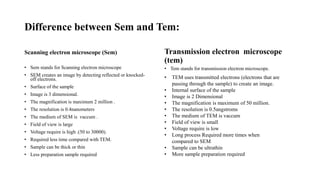
Scanning electron microscope (Sem)
• Sem stands for Scanning electron microscope
• SEM creates an image by detecting reflected or knocked-
off electrons.
• Surface of the sample
• Image is 3 dimensional.
• The magnification is maximum 2 million .
• The resolution is 0.4nanometers
• The medium of SEM is vaccum .
• Field of view is large
• Voltage require is high .(50 to 30000).
• Required less time compared with TEM.
• Sample can be thick or thin
• Less preparation sample required
Transmission electron microscope
(tem)
• Tem stands for transmission electron microscope.
• TEM uses transmitted electrons (electrons that are
passing through the sample) to create an image.
• Internal surface of the sample
• Image is 2 Dimensional
• The magnification is maximum of 50 million.
• The resolution is 0.5angstroms
• The medium of TEM is vaccum
• Field of view is small
• Voltage require is low
• Long process Required more times when
compared to SEM
• Sample can be ultrathin
• More sample preparation required
SEM and TEM:
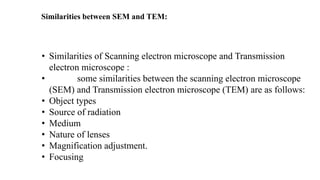
• Similarities of Scanning electron microscope and Transmission
electron microscope :
• some similarities between the scanning electron microscope
(SEM) and Transmission electron microscope (TEM) are as follows:
• Object types
• Source of radiation
• Medium
• Nature of lenses
• Magnification adjustment.
• Focusing
Similarities between SEM and TEM:
SEM vs TEM summary of advantages :
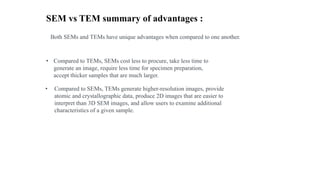
Both SEMs and TEMs have unique advantages when compared to one another.
• Compared to TEMs, SEMs cost less to procure, take less time to
generate an image, require less time for specimen preparation,
accept thicker samples that are much larger.
• Compared to SEMs, TEMs generate higher-resolution images, provide
atomic and crystallographic data, produce 2D images that are easier to
interpret than 3D SEM images, and allow users to examine additional
characteristics of a given sample.
Difference between XRD and SEM
XRD
• XRD stands for X-ray diffraction
• XRD is limited to small samples, and works best
with flat things.
SEM
• SEM stands for Scanning electron microscope
• SEM-EDS can produce structural information or
material composition information. It additionally
provides images of the surface of an object at
extremely high magnifications.
• XRD shows particle size of 40 nm • SEM reveals particle size of 20 nm
• SEM is used for particle size. Both are
different.
• XRD is used for crystalline size
Difference between XRD and TEM
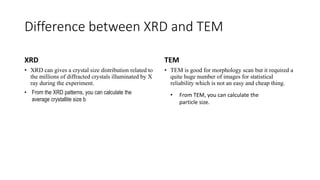
XRD
• XRD can gives a crystal size distribution related to
the millions of diffracted crystals illuminated by X
ray during the experiment.
TEM
• TEM is good for morphology scan but it required a
quite huge number of images for statistical
reliability which is not an easy and cheap thing.
• From the XRD patterns, you can calculate the
average crystallite size b
• From TEM, you can calculate the
particle size.

sem vs tem.pptx

  • 1.
    Difference between Semand Tem: Scanning electron microscope (Sem) • Sem stands for Scanning electron microscope • SEM creates an image by detecting reflected or knocked- off electrons. • Surface of the sample • Image is 3 dimensional. • The magnification is maximum 2 million . • The resolution is 0.4nanometers • The medium of SEM is vaccum . • Field of view is large • Voltage require is high .(50 to 30000). • Required less time compared with TEM. • Sample can be thick or thin • Less preparation sample required Transmission electron microscope (tem) • Tem stands for transmission electron microscope. • TEM uses transmitted electrons (electrons that are passing through the sample) to create an image. • Internal surface of the sample • Image is 2 Dimensional • The magnification is maximum of 50 million. • The resolution is 0.5angstroms • The medium of TEM is vaccum • Field of view is small • Voltage require is low • Long process Required more times when compared to SEM • Sample can be ultrathin • More sample preparation required
  • 2.
  • 3.
    • Similarities ofScanning electron microscope and Transmission electron microscope : • some similarities between the scanning electron microscope (SEM) and Transmission electron microscope (TEM) are as follows: • Object types • Source of radiation • Medium • Nature of lenses • Magnification adjustment. • Focusing Similarities between SEM and TEM:
  • 4.
    SEM vs TEMsummary of advantages : Both SEMs and TEMs have unique advantages when compared to one another. • Compared to TEMs, SEMs cost less to procure, take less time to generate an image, require less time for specimen preparation, accept thicker samples that are much larger. • Compared to SEMs, TEMs generate higher-resolution images, provide atomic and crystallographic data, produce 2D images that are easier to interpret than 3D SEM images, and allow users to examine additional characteristics of a given sample.
  • 5.
    Difference between XRDand SEM XRD • XRD stands for X-ray diffraction • XRD is limited to small samples, and works best with flat things. SEM • SEM stands for Scanning electron microscope • SEM-EDS can produce structural information or material composition information. It additionally provides images of the surface of an object at extremely high magnifications. • XRD shows particle size of 40 nm • SEM reveals particle size of 20 nm • SEM is used for particle size. Both are different. • XRD is used for crystalline size
  • 6.
    Difference between XRDand TEM XRD • XRD can gives a crystal size distribution related to the millions of diffracted crystals illuminated by X ray during the experiment. TEM • TEM is good for morphology scan but it required a quite huge number of images for statistical reliability which is not an easy and cheap thing. • From the XRD patterns, you can calculate the average crystallite size b • From TEM, you can calculate the particle size.