SELF CONCEPT: Concept and Significance in Organizational
Communication
Write five attribute about yourself, your colleagues/friends and me
( how do you view about yourself, your friend and your teacher etc.)
B. P. Singh, Principal Scientist
Division of Extension Education
ICAR-Indian Veterinary Research Institute
Izatnagar- 243 122
Your VIEW of yourself - -
The ENTIRE picture...
S L O W L Y
It changes
Self-Concept
• Self-concept is an individual’s perception of self and is what
helps make each individual unique.
• Self concept refers to the way a person thinks about their
abilities in a variety of facets of life, including academics ,
athletics and social interactions. In other
words, self concept refers to a broader understanding
of self than self esteem.
• Positive and negative self-assessments in the physical,
emotional, intellectual, and functional dimensions change
over time.
• Self-concept affects the ability to function and greatly
influences health status.
What is self concept?
 Self concept means understanding ourselves ( eg.
intellectually, socially, culturally, politically,
technologically etc.). To understand ourselves we
must first of all have developed self-awareness,
but how do we do this?
 To develop self-awareness we need to build up a
picture of ourselves, using:
 The knowledge we have about ourselves
 The feedback we receive from other people
 Self-concept is part of our emotional and
social development.
• The view we have of ourselves changes as a result
of:
a) the experiences we have
b) life events/incidents happens
c) the life stage we are in ( as academician, extension
functionnaries, researchers, administrator etc.)
This can affect how we see ourselves.
And whether we have high or low self-concept?
Self concept
involves:
How clever we are
How physically
attractive we are
How popular we are
with other people
How we compare with other
people we know
How fit and strong
we are
How good we are
at various work or
sporting activities
How likely we are to be
successful at coping with
problems
Looking at the
statements shown
, comment on how
you see yourself.
Be honest!
S e l f C o n c e p t
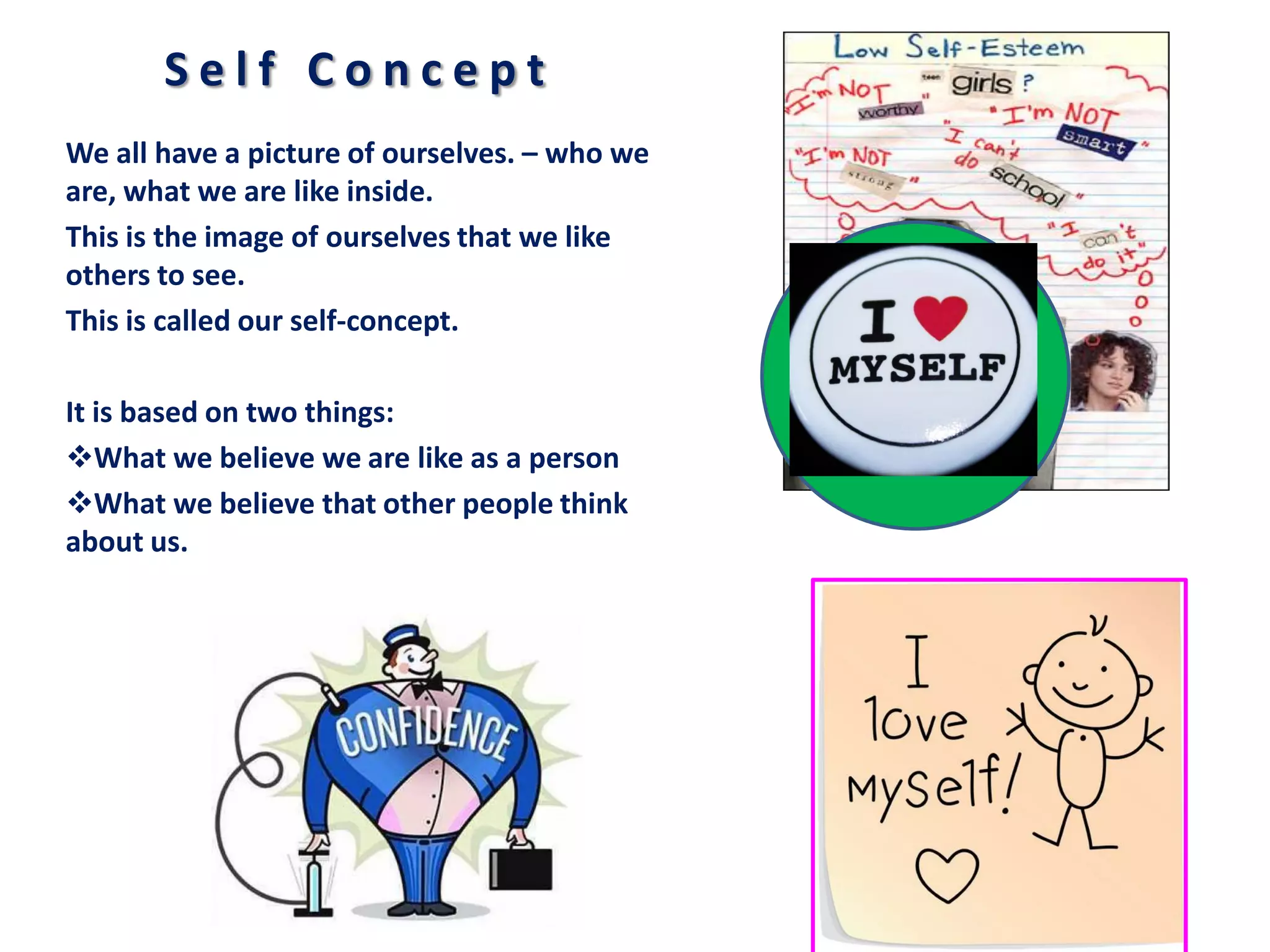
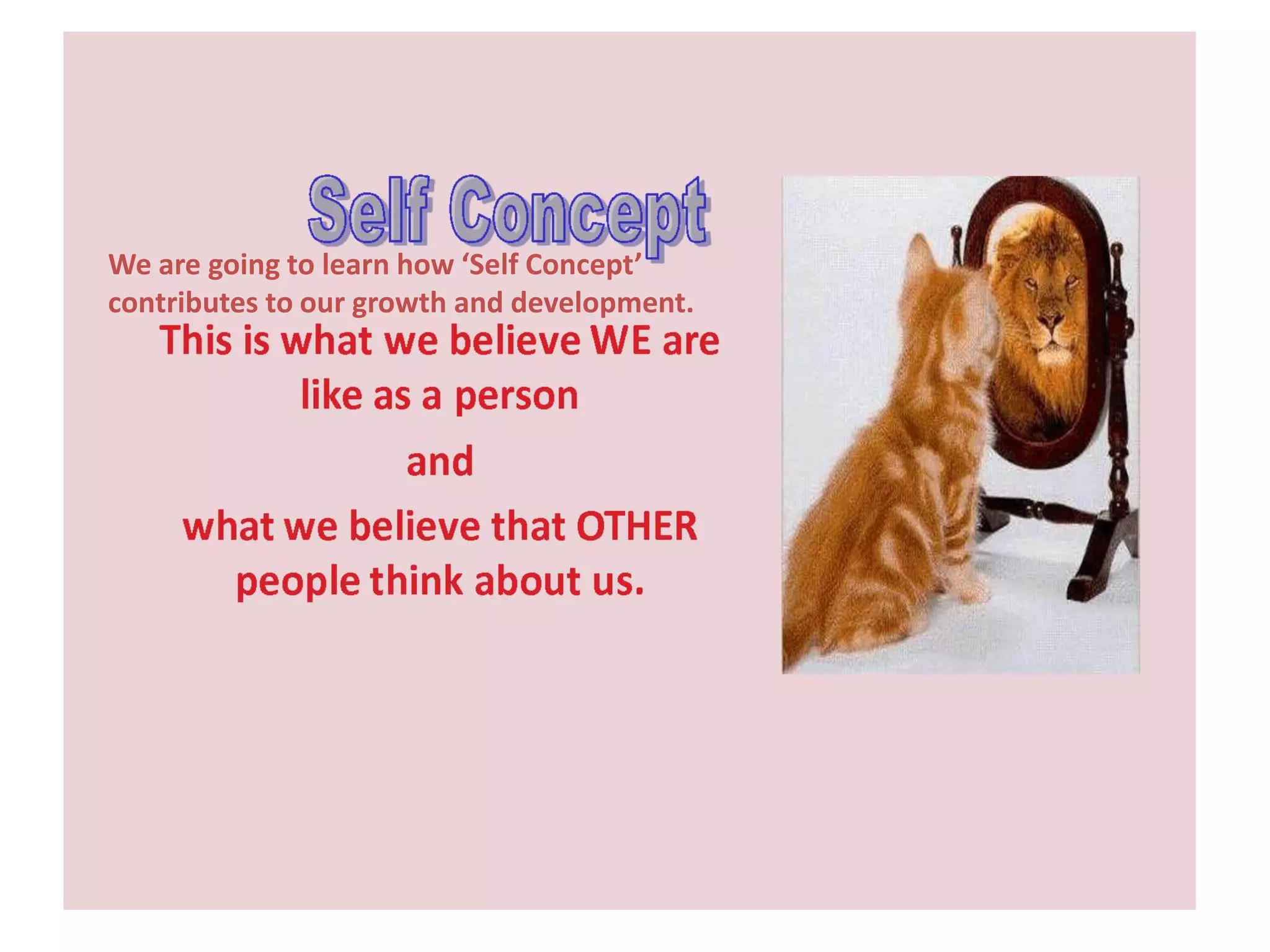
We all have a picture of ourselves. – who we
are, what we are like inside.
This is the image of ourselves that we like
others to see.
This is called our self-concept.
It is based on two things:
What we believe we are like as a person
What we believe that other people think
about us.
Dimensions of Self-Concept
• Self-knowledge — “Who am I?”
• Self-expectation — “what I want to
be?”
• Social self – How person perceived
by others?
• Self-evaluation — “How well do I
like myself?”
Self knowledge
• Global self: is the term used to describe the
composite of all basic facts, qualities, traits, images
and feelings one holds about oneself.
It includes:
1. Basic facts: sex, age, race, occupation, cultural
background, sexual orientation
2. Person’s position with social groups
3. Qualities or traits that describe typical behaviours,
feelings, moods and other characteristics (generous,
hot-headed , ambitious, intelligent, etc.
Self expectations
• Expectations for self flow from various
sources.
• Self expectations develop unconsciously early
in childhood and are based on image of role
models such as parents
Self evaluation
• Self esteem is the evaluative and affective
component of self concept
• Maslow’s Subsets of Esteem Needs:
1. Self-esteem (strength, achievement, mastery,
competence, ..)
2. Respect needs or the need for esteem from
others
A ( Actual self Concept & Private Self): an arrogant
B ( Ideal self concept & & Private Self) : But I would like to see myself as sober person
C ( Actual self Concept & Social Self): Other people see me as Arrogant
D ( Ideal self Concept & Social Self): again a sober person
Components of Self-Concept
• Identity
• Body image
• Self-esteem
• Role
performance
Interrelationship of Components of
Self-Concept
Components of Self-Concept
• A sense of personal identity is what sets one
person apart as a unique individual.
• Identity includes a person’s name, gender,
ethnic identity, family status, occupation, and
roles.
• One’s personal identity begins to develop
during childhood and is constantly reinforced
and modified throughout life.
Components of Self-Concept
• Body image is an attitude about one’s
physical attributes and characteristics,
appearance, and performance.
• Body image is dynamic because any
change in body structure or function,
including the normal changes of growth
and development, can affect it.
Components of Self-Concept
• Self-Ideal is the perception of
behavior based on personal
standards and self-expectations.
• Self-ideal serves as an internal
regulator to support self-respect
and self-esteem.
Components of Self-Concept
• Self-esteem is the judgment of personal
performance compared with the self-ideal.
• Self-esteem is derived from a sense of giving
and receiving love, and being respected by
others.
Components of Self-Concept
• Role refers to a set of expected behaviors
determined by familial, cultural, and social
norms.
• The level of self-esteem is dependent upon the
self-perception of adequate role performance in
these various social roles.
Self concept is a process which is
dynamic by its nature. Therefore, it is
inaccurate to say that at some point
our self-concept is formed and remain
with us throughout life.
In our life we learn, that in relation to
ourselves certain bahviour are good
and certain behaviour are bad
You see yourself
as a
LOVEABLE and
WORTHWHILE
person…
POSITIVE
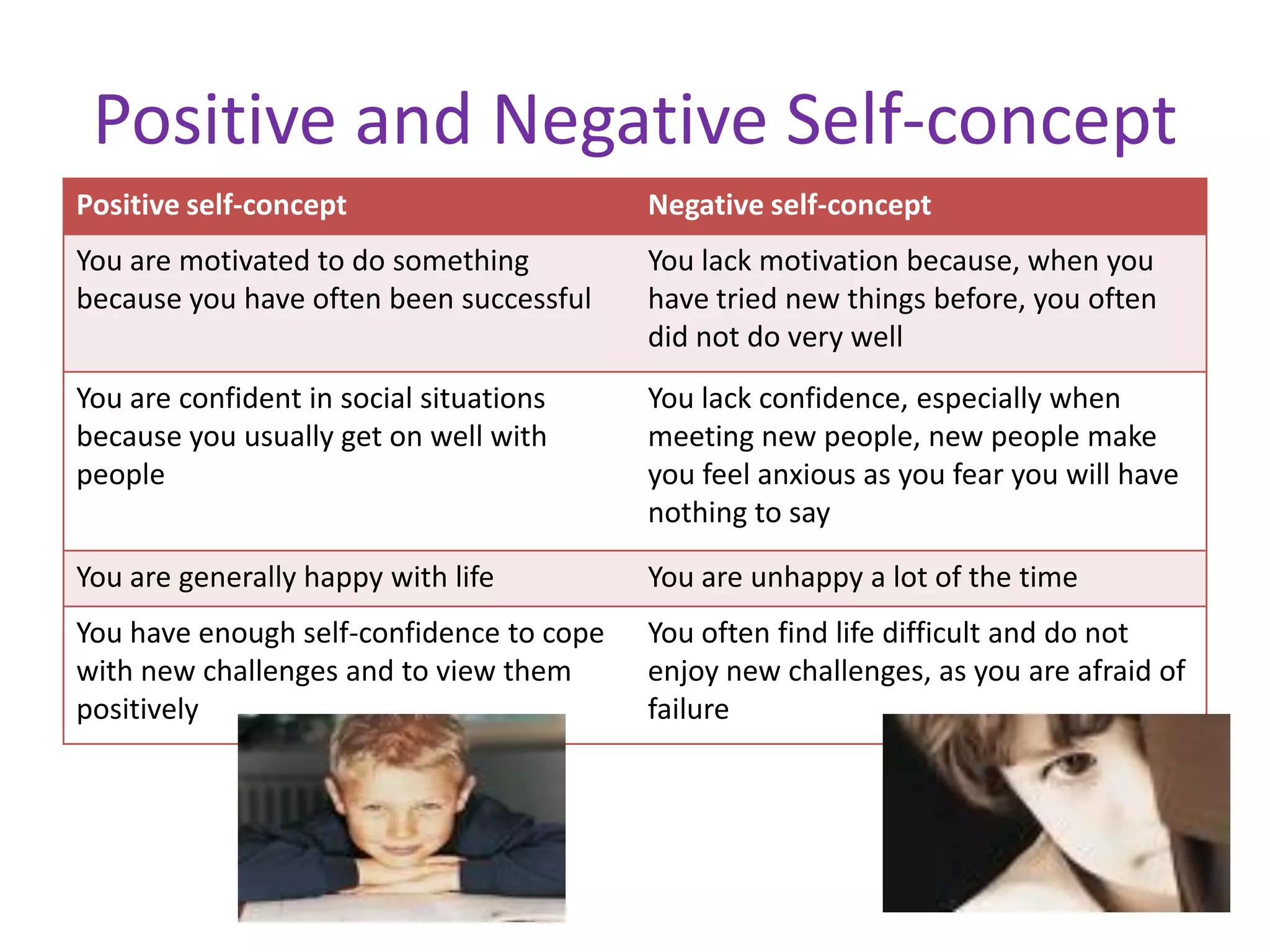
Positive and Negative Self-concept
Positive self-concept Negative self-concept
You are motivated to do something
because you have often been successful
You lack motivation because, when you
have tried new things before, you often
did not do very well
You are confident in social situations
because you usually get on well with
people
You lack confidence, especially when
meeting new people, new people make
you feel anxious as you fear you will have
nothing to say
You are generally happy with life You are unhappy a lot of the time
You have enough self-confidence to cope
with new challenges and to view them
positively
You often find life difficult and do not
enjoy new challenges, as you are afraid of
failure
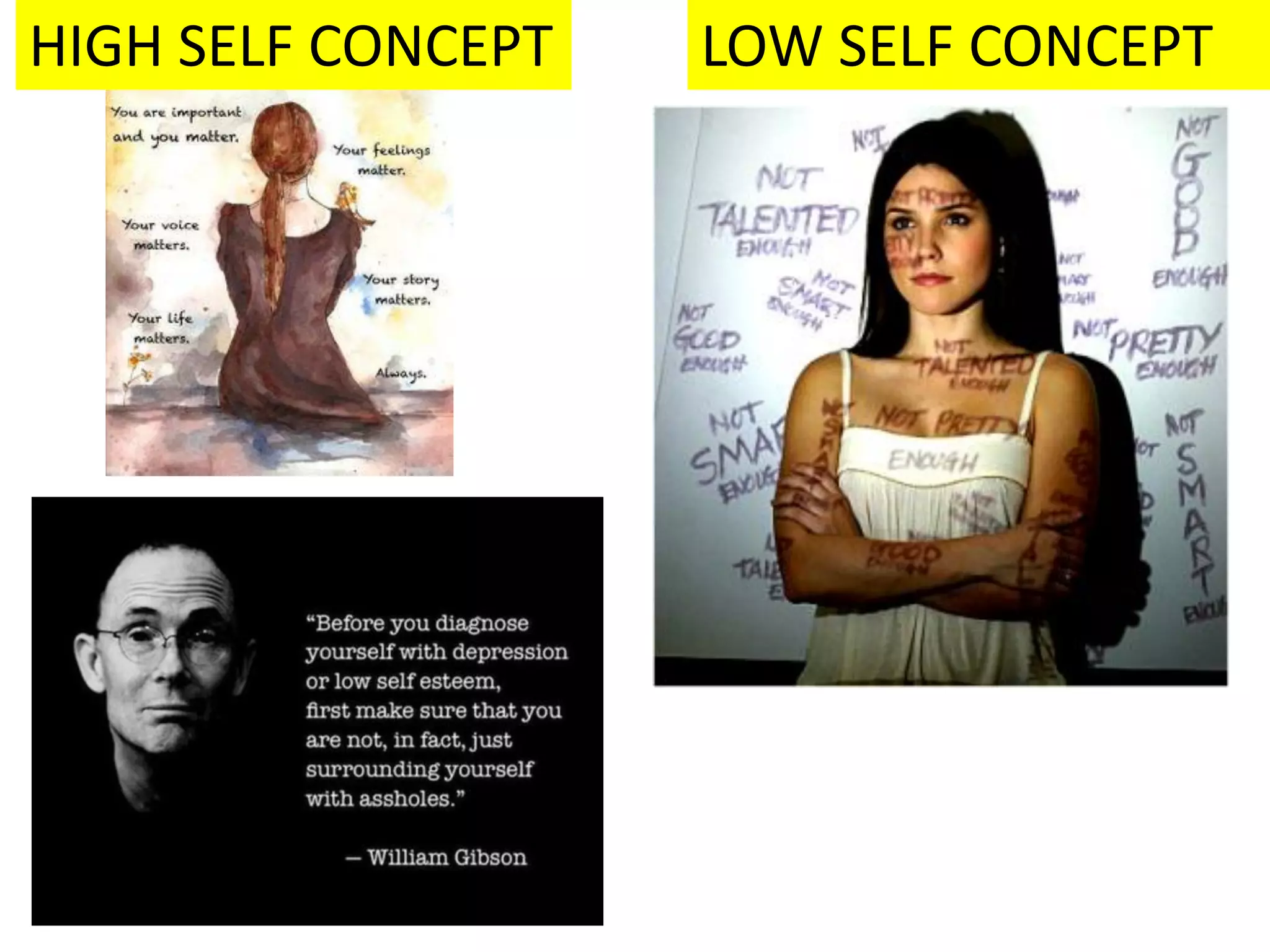
HIGH SELF CONCEPT LOW SELF CONCEPT
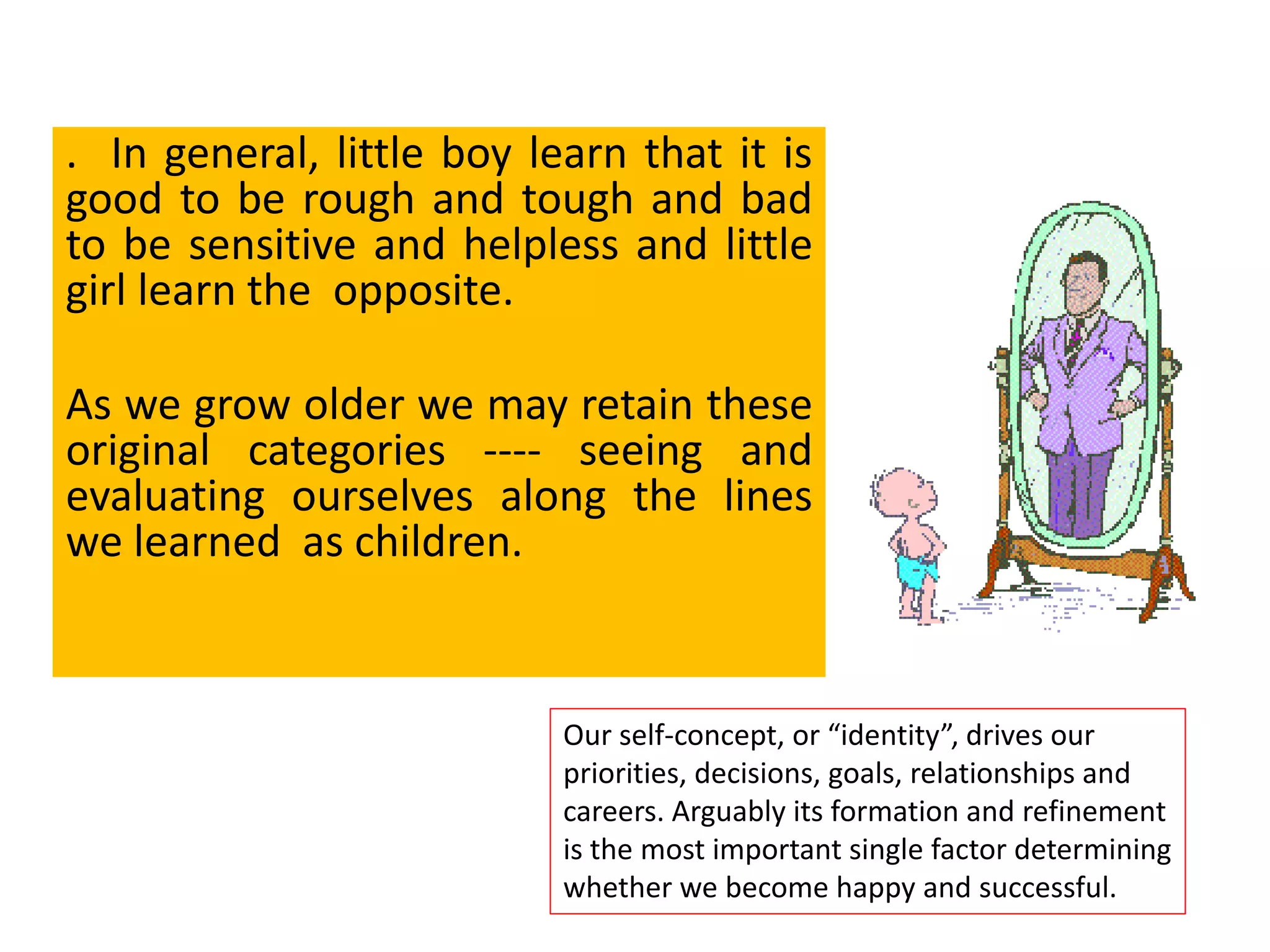
. In general, little boy learn that it is
good to be rough and tough and bad
to be sensitive and helpless and little
girl learn the opposite.
As we grow older we may retain these
original categories ---- seeing and
evaluating ourselves along the lines
we learned as children.
Our self-concept, or “identity”, drives our
priorities, decisions, goals, relationships and
careers. Arguably its formation and refinement
is the most important single factor determining
whether we become happy and successful.
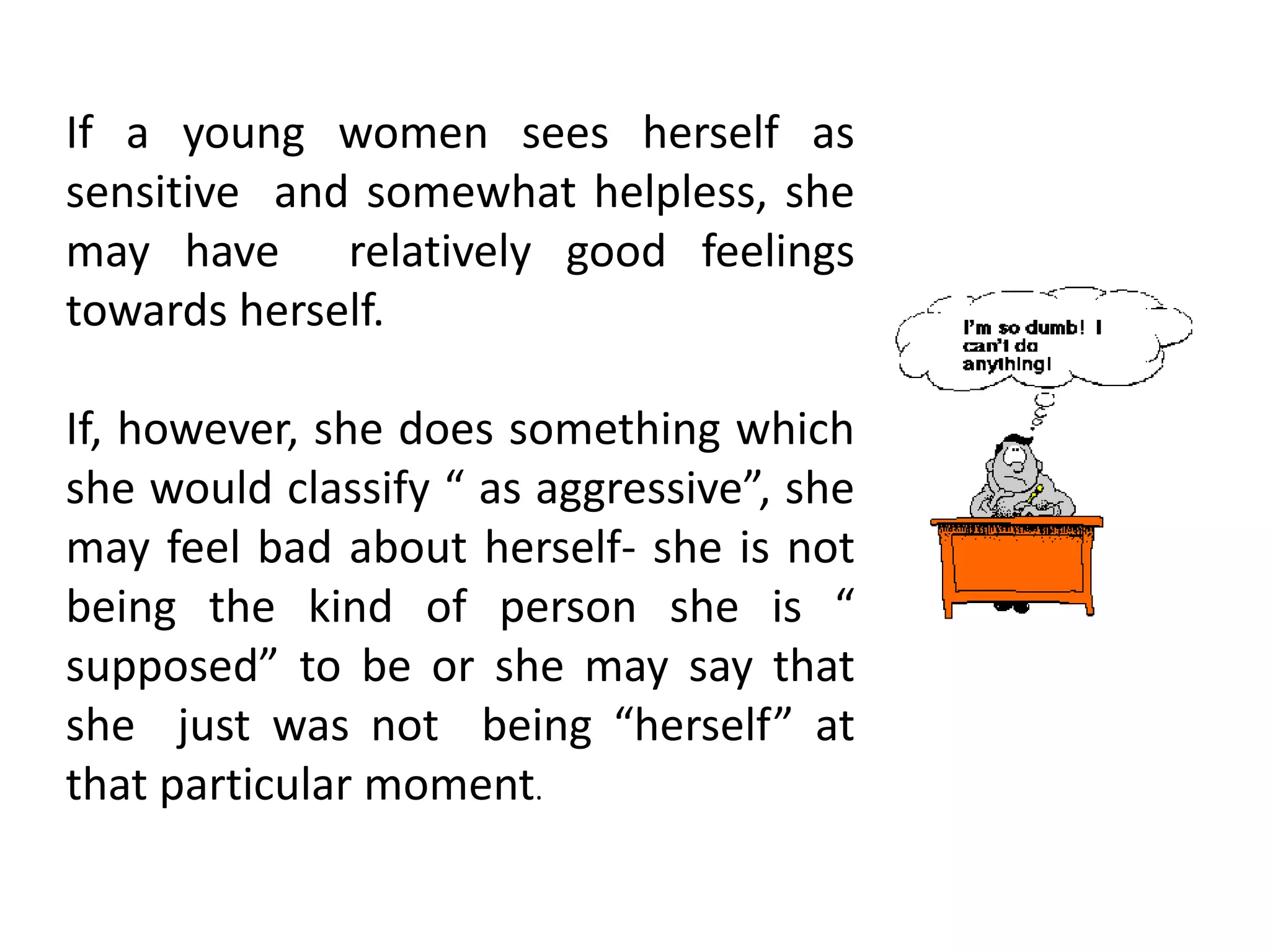
If a young women sees herself as
sensitive and somewhat helpless, she
may have relatively good feelings
towards herself.
If, however, she does something which
she would classify “ as aggressive”, she
may feel bad about herself- she is not
being the kind of person she is “
supposed” to be or she may say that
she just was not being “herself” at
that particular moment.
We are going to learn how ‘Self Concept’
contributes to our growth and development.
Our need to maintain the images and feelings we have for
ourselves is often closely related to choice of groups to
relate to.
We choose the group that will lend support to our existing
view of ourselves; the similarity between their standards
and our own help us to feel comfortable and very much
“ourselves”. We may think of this process as being one of
self-conformation. Since we use other to evaluate
ourselves, we tend to select associates who will confirm
the views we have of ourselves.
Recognize what YOU
have accomplished
each step of the way
Set ATTAINABLE goals
based on your
WANTS and NEEDS
List and develop YOUR
personal strengths
and abilities
LOOK FOR
positive relationships
with others
Our desire to see ourselves in a certain way
affects not only what kinds of information
we can take in from others but also the
kinds of things others are permitted to
know about us. We can understand by
various examples.
Think about a group of friends you are
often with.
You probably choose this group partly because you
agree on many things, partly because the members see
you the way you like to see yourself.
For whatever the reasons you originally choose to be
part of the group, by now your friends probably expect
you to act in a “certain way”.
This “certain way” includes not only behaviour which is
in line with the standards of the group, for example,
preferring a “ free” lifestyle, but also behaviour which is
specifically yours.
Perhaps you are thought of as “always happy” or
“always joking”. In order for you to continue to feel
confirmed by this group, it may be necessary for you to
hide ‘ the fact that you are sometimes sad, or
sometimes serious or sometimes happy.
Although hiding these feeling from other may not
change completely the ways you see yourself, it is
difficult to feel totally accepted by, or confirmed by,
other people when compelled to hide important aspect
of yourself from them.
Our desire to see ourselves and to have other people see
us in a certain way can thus hinder open communication
with others and perhaps even with ourselves.
Trying to maintain a consistent image or role by adhering
to a set of specific prescribed behaviours can result in the
same kind of alienation.
Imagine that you want to become a teacher. Even though
not yet a member of that group, you may begin to use the
standards of that group to evaluate yourself. You thereby
begin to copy some of the behaviour you see as befitting
the “teacher role”—behaviour may or may not be alien
to you.
Pertaining to the self concept we have talked so far about
how we begin to develop images of and feelings for
ourselves.
We also have seen how, although our concept about
ourselves changes our life, we attempt to maintain an
image consistent with what we consider ourselves to be.
We have seen that both the development and the
maintenance of our self-concept is influenced by our
interpersonal communication and that how we see
ourselves influences how we communicate with others.
We are expected and expect ourselves to behave in
different ways. Each of us also has many different ways of
behaving and has many different and often conflicting
feelings.
Sometimes we feel happy, sometimes bad, sometimes
loving, sometimes hateful, kind and cruel, giving and
selfish, gorgeous and ugly.
All these feelings we experience as part of our life. There
is no consistence to the feelings we have or to the
bahviours engaged in.
In society, it seems to be a “ good” thing to be consistent
and a “bad” thing to be inconsistent.
We are expected and expect ourselves to
behave in different ways (feel happy, bad,
loving, sometimes hateful, kind and cruel,
giving and selfish, gorgeous and ugly).
All these feelings we experience as part of
our life.
There is no consistence to the feelings we
have or to the bahviours engaged in.
In society, it seems to be a “ good” thing
to be consistent and a “bad” thing to be
inconsistent.
EXPANDING AND CHANGING THE SELF CONCEPT
Discovering one’s own classification and labeling system is an
extremely difficult process. In trying to learn more about how we
see ourselves, making any changes in our images which might be
helpful, several theorist have suggested that the process can be
facilitated through communication with others.
Sidney Jourard has gone so far as to say…. “No man can come to
know himself except as an outcome of disclosing himself to
another person”.
When the person begin learning about himself, he is in position
to select information that is accurate and reject what is not.
Whatever his parents originally told him about himself he had not
only to accept but in many ways try to incorporate into his
behaviour. He was , after all, totally dependent upon them for
everything he needed.
EXPANDING AND CHANGING THE SELF CONCEPT
By disclosing to a trusted friend one’s basic feelings towards oneself, a
person can at least begin to examine how he classifies and evaluates
himself.
The idea of being completely open with others is very scary for many
people. It might be helpful to disclose oneself fully to atleast one
trusted person, but be completely open with everyone certainly creates
as many problems as being open with no one.
In a society, it is better to select carefully those with whom we will work
at developing an open relationship.
In organization, when we speak of self-disclosure within the context of
an open relationship, it is obvious that the disclosure is reciprocal.
This process of disclosure of one self to other has been explained by
Joseph Luft and Harry Ingram by developing a model which is known as
Johari Window.
EXPANDING AND CHANGING THE SELF CONCEPT
This model is highly useful in analyzing the causes for interpersonal conflict.
The window is shown with four quadrants representing four distinct
aspects of every personality.
The Johari Window is a communication model that can be used to improve
understanding between individuals within a team or in a group setting.
Based on disclosure, self-disclosure and feedback, the Johari Window can
also be used to improve a group's relationship with other groups.
This window can help people to build more trusting relationships with one
another, solve issues and work more effectively as a team.
This window represent the personality of an individual in four number of
quadrant as depicted in figure.
JOHARI WINDOW MODEL
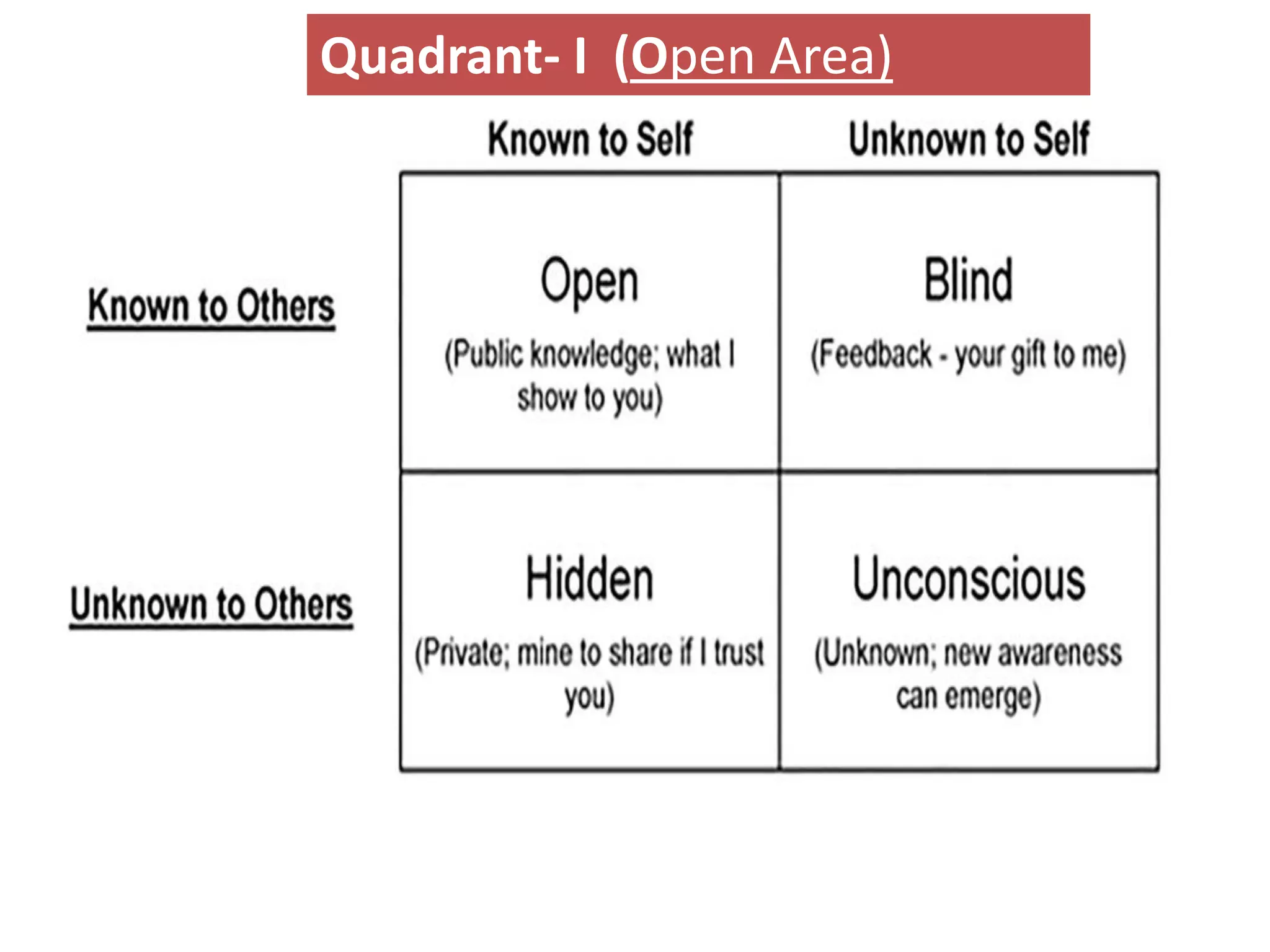
Quadrant- I (Open Area)
 It represent an open area, which describes person’s
thought , feelings and behaviours which are known
both to himself and to another person.
 The larger this quadrant in any particular relationship,
the free the communication.

 Mutual understanding and friendship between people
are the highest in this space.
 Naturally there is no scope for any conflict.
 The aim in any group should always be to develop the
'open area' for every person, because when we work
in this area with others we are at our most effective
and productive phase of work.
 The open free area can be seen as the space where
good communication and cooperation occur, free from
distractions, mistrust, confusion, conflict and
misunderstanding.
Quadrant- I (Open Area)
IV. Unknown AreaIII. Hidden Area
II. Blind AreaI. Open Area
IV. Unknown AreaIII. Hidden Area
II. Blind AreaI. Open Area
IV. Unknown AreaIII.
Hidden
Area
II. Blind Area
I. Open
Area
IV. Unknown AreaIII.
Hidden
Area
II. Blind Area
I. Open
Area
Fig. 16: The Johari Window Overall Model
Fig.18: Beginning interaction in a
new group
I. Open Area
II. Blind
Area
III. Hidden
Area
Fig.17: An Open Window
IV. Unknown
Area
Known to self
Known to others
Unknown to self
Unknown to
others
FEEDBACK
D
D
I
S
C
L
O
S
U
R
E
Established team members logically tend to have
larger open areas than new team members.
The size of the open area can be expanded horizontally
into the blind space, by seeking and actively listening
to feedback from other group members. This process
is known as 'feedback solicitation'.
Also, other group members can help a team member
to expand their open area by offering feedback.
The size of the open area can also be expanded
vertically downwards into the hidden space by the
person's disclosure of information
Managers and team leaders can play an important role
in facilitating feedback and disclosure among group
members, and in directly giving feedback to individuals
about their own blind areas.
JOHARI WINDOW MODEL
Implication of Quadrant –I
IV. Unknown AreaIII. Hidden Area
II. Blind AreaI. Open Area
IV. Unknown AreaIII. Hidden Area
II. Blind AreaI. Open Area
IV. Unknown AreaIII.
Hidden
Area
II. Blind Area
I. Open
Area
IV. Unknown AreaIII.
Hidden
Area
II. Blind Area
I. Open
Area
Fig. 16: The Johari Window Overall Model
Fig.18: Beginning interaction in a
new group
I. Open Area
II. Blind
Area
III. Hidden
Area
Fig.17: An Open Window
IV. Unknown
Area
Known to self
Known to others
Unknown to self
Unknown to
others
FEEDBACK
D
D
I
S
C
L
O
S
U
R
E
Top performing groups, departments, companies and
organizations always tend to have a culture of open
positive communication. Encouraging the positive
development of the 'open area' or 'open self' for everyone
is a simple yet fundamental aspect of effective leadership.
One should use following tips for self disclosure:
 Don’t be rash in your self-disclosure. Disclosing harmless
items builds trust. However, disclosing information
which could damage people’s respect for you can put
you in a position of weakness.
 Be careful in the way you give feedback. Some cultures
have a very open and accepting approach to feedback.
Others don’t. You can cause incredible offence if you
offer personal feedback to someone who’s not used to
it. Be sensitive, and start gradually.
JOHARI WINDOW MODEL
Implication of Quadrant –I
IV. Unknown AreaIII. Hidden Area
II. Blind AreaI. Open Area
IV. Unknown AreaIII. Hidden Area
II. Blind AreaI. Open Area
IV. Unknown AreaIII.
Hidden
Area
II. Blind Area
I. Open
Area
IV. Unknown AreaIII.
Hidden
Area
II. Blind Area
I. Open
Area
Fig. 16: The Johari Window Overall Model
Fig.18: Beginning interaction in a
new group
I. Open Area
II. Blind
Area
III. Hidden
Area
Fig.17: An Open Window
IV. Unknown
Area
Known to self
Known to others
Unknown to self
Unknown to
others
FEEDBACK
D
D
I
S
C
L
O
S
U
R
E
It represent blind area, which describe person’s
thought , feelings and behaviours which are
unknown to oneself but known to others.
feelings of inadequacy, incompetence,
unworthiness, rejection are difficult for
individuals to face directly, and yet can be seen by
others.
There is potential for conflict in this quadrant.
This area is also known as breath area.
This area is not an effective or productive space
for individuals or groups.
This blind area could also be referred to as
ignorance about oneself, or issues in which one is
deluded .
JOHARI WINDOW MODEL
Quadrant –II (Blind Area)
IV. Unknown AreaIII. Hidden Area
II. Blind AreaI. Open Area
IV. Unknown AreaIII. Hidden Area
II. Blind AreaI. Open Area
IV. Unknown AreaIII.
Hidden
Area
II. Blind Area
I. Open
Area
IV. Unknown AreaIII.
Hidden
Area
II. Blind Area
I. Open
Area
Fig. 16: The Johari Window Overall Model
Fig.18: Beginning interaction in a
new group
I. Open Area
II. Blind
Area
III. Hidden
Area
Fig.17: An Open Window
IV. Unknown
Area
Known to self
Known to others
Unknown to self
Unknown to
others
FEEDBACK
D
D
I
S
C
L
O
S
U
R
E
 Group members and managers can take some
responsibility for helping an individual to reduce
their blind area - in turn increasing the open area
- by giving sensitive feedback and encouraging
disclosure.
 Managers should promote a climate of non-
judgmental feedback, and group response to
individual disclosure, which reduces fear and
therefore encourages both processes to happen.
 The extent to which an individual seeks feedback,
and the issues on which feedback is sought, must
always be at the individual's own discretion.
 Some people are more resilient than others, in
this situation care needs to be taken to avoid
causing emotional upset.
Implication of Quadrant –II
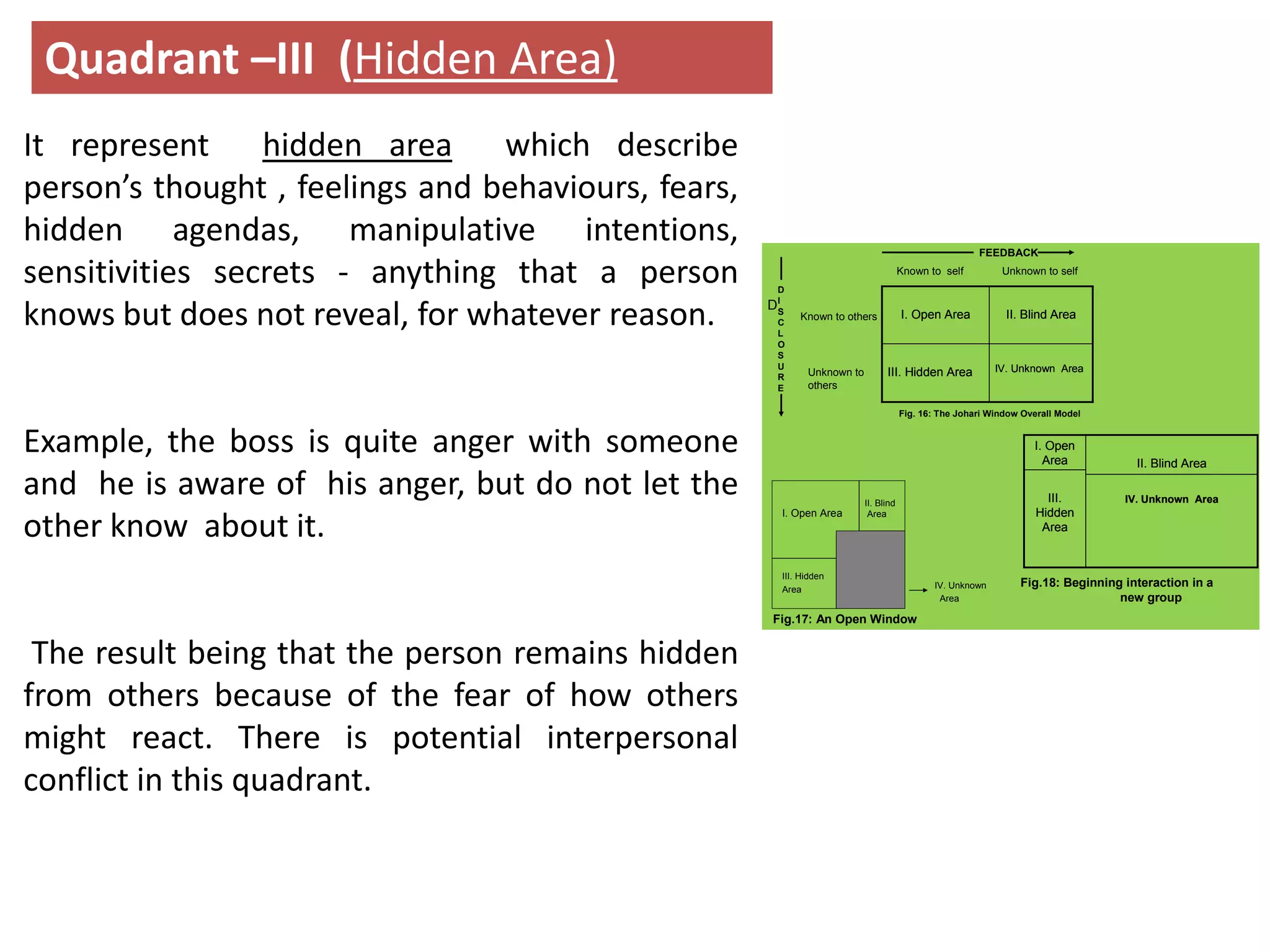
It represent hidden area which describe
person’s thought , feelings and behaviours, fears,
hidden agendas, manipulative intentions,
sensitivities secrets - anything that a person
knows but does not reveal, for whatever reason.
Example, the boss is quite anger with someone
and he is aware of his anger, but do not let the
other know about it.
The result being that the person remains hidden
from others because of the fear of how others
might react. There is potential interpersonal
conflict in this quadrant.
Quadrant –III (Hidden Area)
IV. Unknown AreaIII. Hidden Area
II. Blind AreaI. Open Area
IV. Unknown AreaIII. Hidden Area
II. Blind AreaI. Open Area
IV. Unknown AreaIII.
Hidden
Area
II. Blind Area
I. Open
Area
IV. Unknown AreaIII.
Hidden
Area
II. Blind Area
I. Open
Area
Fig. 16: The Johari Window Overall Model
Fig.18: Beginning interaction in a
new group
I. Open Area
II. Blind
Area
III. Hidden
Area
Fig.17: An Open Window
IV. Unknown
Area
Known to self
Known to others
Unknown to self
Unknown to
others
FEEDBACK
D
D
I
S
C
L
O
S
U
R
E
By telling others how we feel and other
information about ourselves we reduce the hidden
area, by increasing the open area, which enables
better understanding, cooperation, trust, team-
working effectiveness and productivity.
Reducing hidden areas also reduces the potential
for confusion, misunderstanding, poor
communication, etc,
The extent to which an individual discloses
personal feelings and information, and the issues
which are disclosed, and to whom, must always be
at the individual's own discretion. Some people are
more keen and able than others to disclose. People
should disclose at a pace and depth that they find
personally comfortable.
Implications of Quadrant –III
 It is called as unknown area and takes into
account all those feelings and motivations
which are unknown to both ourselves and to
others. This area is also referred as the
subconscious and dark area.
 This is potentially the most explosive situation.
 There is a misunderstanding, which leads to
interpersonal conflict.
 Unknown issues take a variety of forms: they
can be feelings, behaviors, attitudes,
capabilities, aptitudes, which can be quite
close to the surface, and which can be positive
and useful, or they can be deeper aspects of a
person's personality, influencing his/her
behavior to various degrees.
Quadrant –IV
IV. Unknown AreaIII. Hidden Area
II. Blind AreaI. Open Area
IV. Unknown AreaIII. Hidden Area
II. Blind AreaI. Open Area
IV. Unknown AreaIII.
Hidden
Area
II. Blind Area
I. Open
Area
IV. Unknown AreaIII.
Hidden
Area
II. Blind Area
I. Open
Area
Fig. 16: The Johari Window Overall Model
Fig.18: Beginning interaction in a
new group
I. Open Area
II. Blind
Area
III. Hidden
Area
Fig.17: An Open Window
IV. Unknown
Area
Known to self
Known to others
Unknown to self
Unknown to
others
FEEDBACK
D
D
I
S
C
L
O
S
U
R
E
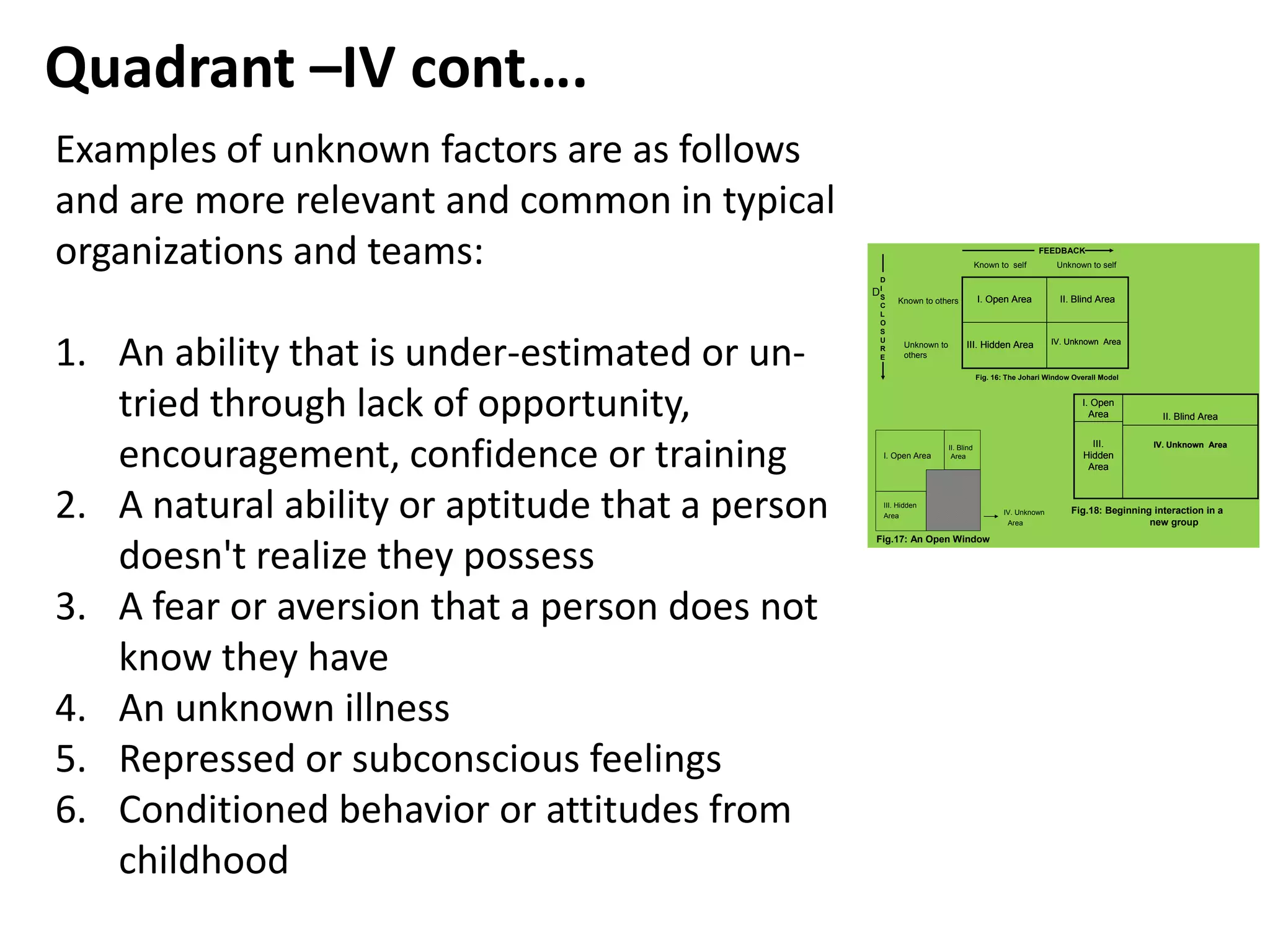
Examples of unknown factors are as follows
and are more relevant and common in typical
organizations and teams:
1. An ability that is under-estimated or un-
tried through lack of opportunity,
encouragement, confidence or training
2. A natural ability or aptitude that a person
doesn't realize they possess
3. A fear or aversion that a person does not
know they have
4. An unknown illness
5. Repressed or subconscious feelings
6. Conditioned behavior or attitudes from
childhood
Quadrant –IV cont….
IV. Unknown AreaIII. Hidden Area
II. Blind AreaI. Open Area
IV. Unknown AreaIII. Hidden Area
II. Blind AreaI. Open Area
IV. Unknown AreaIII.
Hidden
Area
II. Blind Area
I. Open
Area
IV. Unknown AreaIII.
Hidden
Area
II. Blind Area
I. Open
Area
Fig. 16: The Johari Window Overall Model
Fig.18: Beginning interaction in a
new group
I. Open Area
II. Blind
Area
III. Hidden
Area
Fig.17: An Open Window
IV. Unknown
Area
Known to self
Known to others
Unknown to self
Unknown to
others
FEEDBACK
D
D
I
S
C
L
O
S
U
R
E
The processes by unknown area can be
uncovered and can be prompted through
self-discovery or observation by others, or in
certain situations through collective or
mutual discovery and by intensive group
work.
Counseling can also uncover unknown issues,
but this would then be known to the person
and by one other, rather than by a group.
Active listening and experience will reduce
the unknown area, to the person and by one
other, rather than by a group.
A person has many Johari Window and it
depend upon with how many person he
relates and also depend upon degree of
openness within any one relationship.
Implications of Quadrant –IV
IV. Unknown AreaIII. Hidden Area
II. Blind AreaI. Open Area
IV. Unknown AreaIII. Hidden Area
II. Blind AreaI. Open Area
IV. Unknown AreaIII.
Hidden
Area
II. Blind Area
I. Open
Area
IV. Unknown AreaIII.
Hidden
Area
II. Blind Area
I. Open
Area
Fig. 16: The Johari Window Overall Model
Fig.18: Beginning interaction in a
new group
I. Open Area
II. Blind
Area
III. Hidden
Area
Fig.17: An Open Window
IV. Unknown
Area
Known to self
Known to others
Unknown to self
Unknown to
others
FEEDBACK
D
D
I
S
C
L
O
S
U
R
E
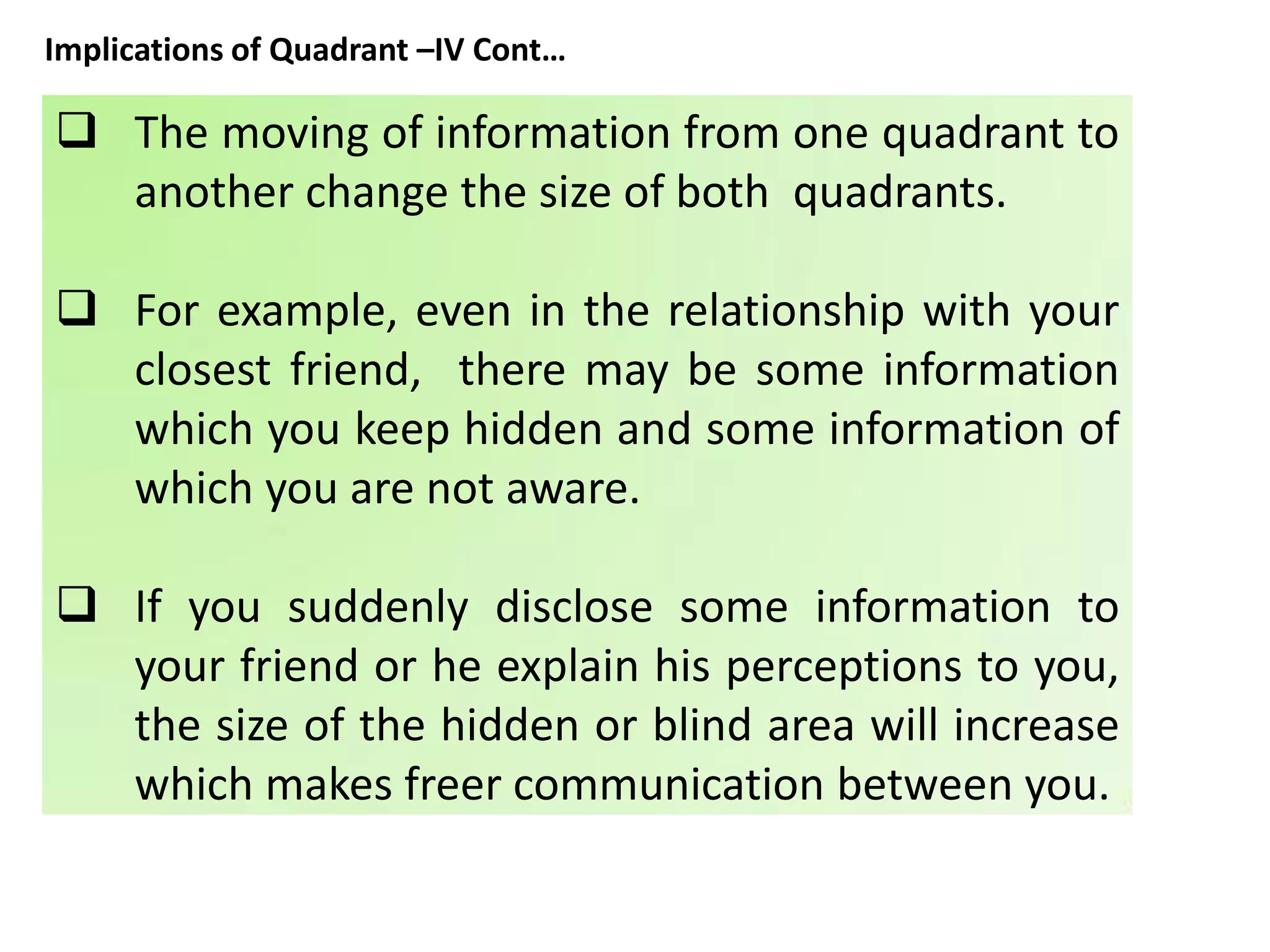
 The moving of information from one quadrant to
another change the size of both quadrants.
 For example, even in the relationship with your
closest friend, there may be some information
which you keep hidden and some information of
which you are not aware.
 If you suddenly disclose some information to
your friend or he explain his perceptions to you,
the size of the hidden or blind area will increase
which makes freer communication between you.
Implications of Quadrant –IV Cont…
Figure ( Johari Window) In initially phase of group interaction in
a meeting the size of quadrant –I, II and III are smaller since in
beginning the interaction between the members of a group in
meeting is relatively superficial, anxiety is large, interchange is
silted and spontaneous.
The idea and suggestions are not followed through and are
usually left undeveloped and individual seem to hear and see
relatively little of what is really going.
As the interaction takes place frequently between the members
of group, the size of smaller quadrant tend to increase. (Figure:
Beginning interaction in a new group)
Implications of Quadrant –IV Cont…
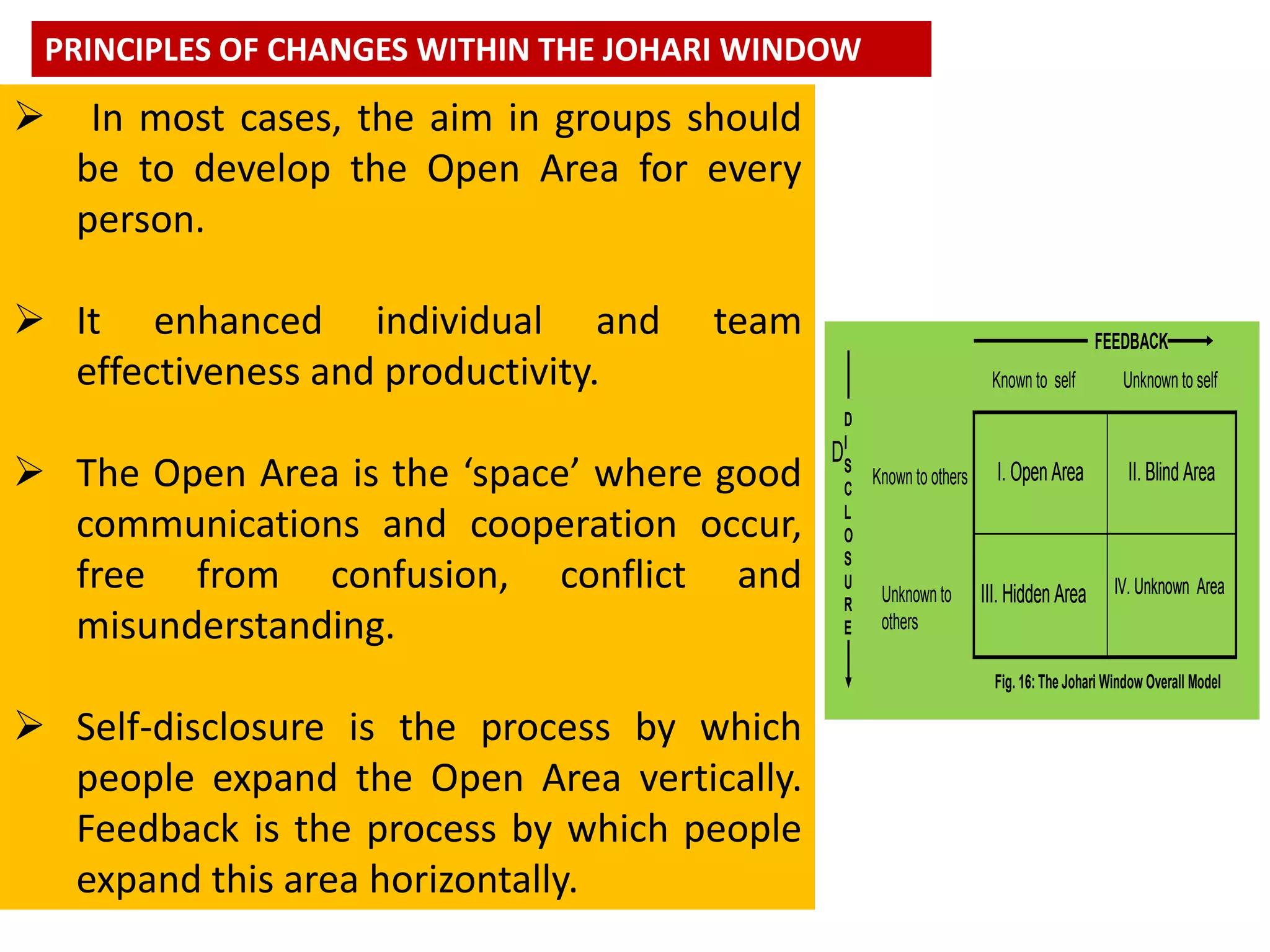
 In most cases, the aim in groups should
be to develop the Open Area for every
person.
 It enhanced individual and team
effectiveness and productivity.
 The Open Area is the ‘space’ where good
communications and cooperation occur,
free from confusion, conflict and
misunderstanding.
 Self-disclosure is the process by which
people expand the Open Area vertically.
Feedback is the process by which people
expand this area horizontally.
PRINCIPLES OF CHANGES WITHIN THE JOHARI WINDOW
IV. Unknown AreaIII. Hidden Area
II. Blind AreaI. Open Area
IV. Unknown AreaIII. Hidden Area
II. Blind AreaI. Open Area
III.
Hidden
Area
I. Open
Area
III.
Hidden
Area
I. Open
Area
Fig. 16: The Johari Window Overall Model
I. Open Area
II. Blind
Area
Known to self
Known to others
Unknown to self
Unknown to
others
FEEDBACK
D
D
I
S
C
L
O
S
U
R
E
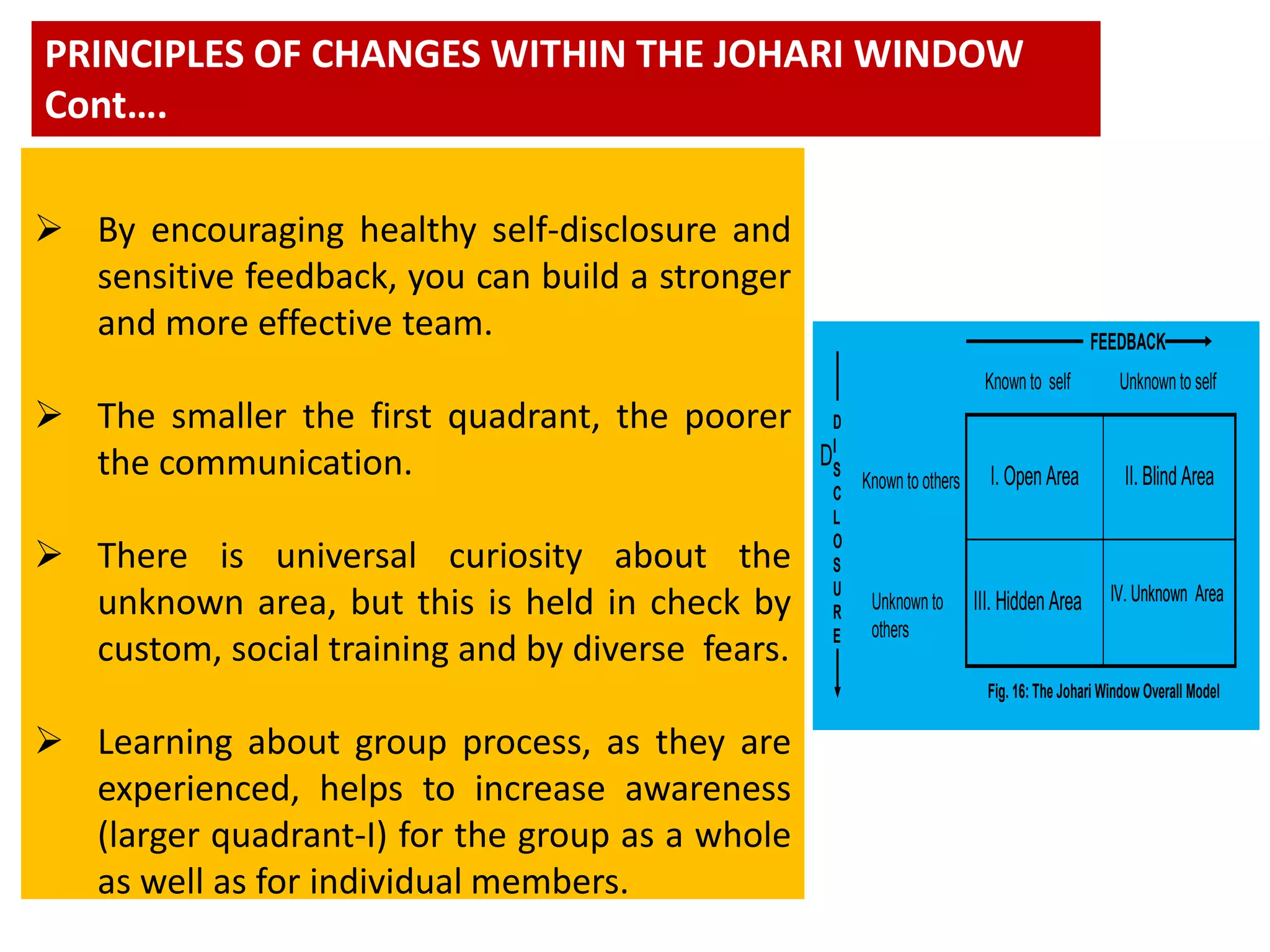
 By encouraging healthy self-disclosure and
sensitive feedback, you can build a stronger
and more effective team.
 The smaller the first quadrant, the poorer
the communication.
 There is universal curiosity about the
unknown area, but this is held in check by
custom, social training and by diverse fears.
 Learning about group process, as they are
experienced, helps to increase awareness
(larger quadrant-I) for the group as a whole
as well as for individual members.
PRINCIPLES OF CHANGES WITHIN THE JOHARI WINDOW
Cont….
IV. Unknown AreaIII. Hidden Area
II. Blind AreaI. Open Area
IV. Unknown AreaIII. Hidden Area
II. Blind AreaI. Open Area
III.
Hidden
Area
I. Open
Area
III.
Hidden
Area
I. Open
Area
Fig. 16: The Johari Window Overall Model
I. Open Area
II. Blind
Area
Known to self
Known to others
Unknown to self
Unknown to
others
FEEDBACK
D
D
I
S
C
L
O
S
U
R
E
 The main objective of group dynamic
laboratory is to increase the area of free
activity in Quadrant-1 so that a free and
open communication can take place within
a group.
 This laboratory follow the principle of
increasing the area of Quadrant-I and
reducing the area of Quadrant –II,III and
IV.
 The largest reduction in area should be in
Quadrant III, then Quadrant II and the
smallest reduction in Quadrant IV.
Johari Window in Group Dynamic
Laboratory
II. Blind
Area
III. Hidden Area
IV.
Unknown
Area
II. Blind
Area
III. Hidden Area
IV.
Unknown
Area
I. Open Area
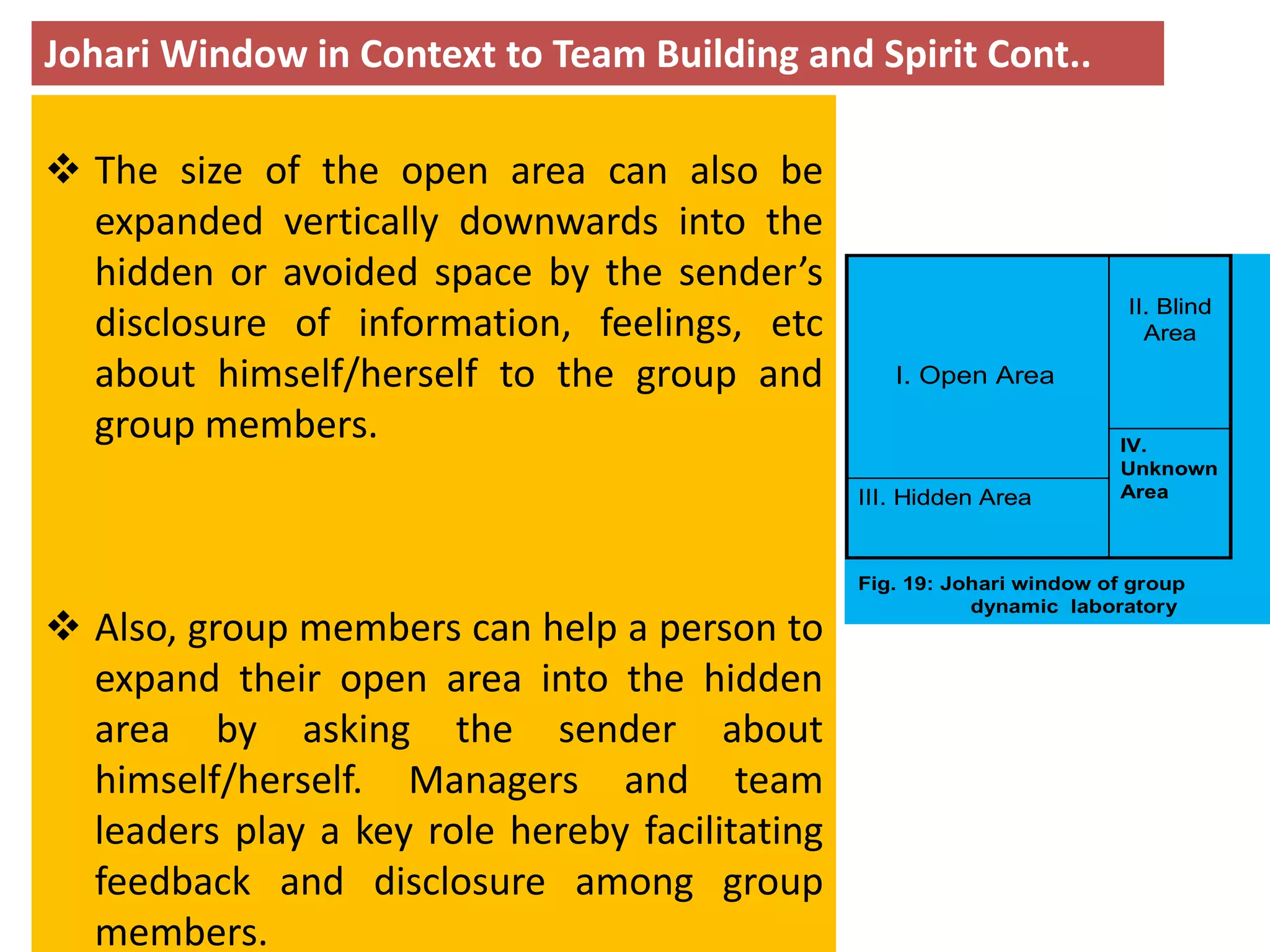
Fig. 19: Johari window of group
dynamic laboratory
An enlarged area of free communication
among the group members would
immediately imply less threat or fear and
greater probability that the skills and
resources of group members could be brought
to bear on the work of the group.
 It suggests greater openness to information,
opinions and new ideas about oneself as well
as about specific group processes, since the
hidden or avoided area, Quadrant III, is
reduced.
 It implies that less energy is tied up in
defending this area.
 There is greater likelihood of satisfaction with
work and more involvement with what the
group is doing.
Johari Window in Group Dynamic Laboratory. Cont….
II. Blind
Area
III. Hidden Area
IV.
Unknown
Area
II. Blind
Area
III. Hidden Area
IV.
Unknown
Area
I. Open Area
Fig. 19: Johari window of group
dynamic laboratory
 Keeping in mind that established team
members will have larger open areas than
new team members.
 New team members start with smaller
open areas because little knowledge
about the new team member has yet
been shared.
 The size of the open area can be
expanded horizontally into the blind
space, by seeking and actively listening to
feedback from other group members.
 Group members should strive to assist a
team member in expanding their open
area by offering constructive feedback.
Johari Window in Context to Team Building and Spirit
II. Blind
Area
III. Hidden Area
IV.
Unknown
Area
II. Blind
Area
III. Hidden Area
IV.
Unknown
Area
I. Open Area
Fig. 19: Johari window of group
dynamic laboratory
 The size of the open area can also be
expanded vertically downwards into the
hidden or avoided space by the sender’s
disclosure of information, feelings, etc
about himself/herself to the group and
group members.
 Also, group members can help a person to
expand their open area into the hidden
area by asking the sender about
himself/herself. Managers and team
leaders play a key role hereby facilitating
feedback and disclosure among group
members.
Johari Window in Context to Team Building and Spirit Cont..
II. Blind
Area
III. Hidden Area
IV.
Unknown
Area
II. Blind
Area
III. Hidden Area
IV.
Unknown
Area
I. Open Area
Fig. 19: Johari window of group
dynamic laboratory
Factors Affecting Self-Concept
• Altered Health Status
• Experience
• Developmental considerations
• Culture
• Internal and external resources
• History of success and failure
• Crisis or life stressors
• Aging, illness, or trauma
Self concept  concept and significant in organizational communication

Self concept concept and significant in organizational communication

  • 1.
    SELF CONCEPT: Conceptand Significance in Organizational Communication Write five attribute about yourself, your colleagues/friends and me ( how do you view about yourself, your friend and your teacher etc.) B. P. Singh, Principal Scientist Division of Extension Education ICAR-Indian Veterinary Research Institute Izatnagar- 243 122
  • 2.
    Your VIEW ofyourself - - The ENTIRE picture... S L O W L Y It changes
  • 3.
    Self-Concept • Self-concept isan individual’s perception of self and is what helps make each individual unique. • Self concept refers to the way a person thinks about their abilities in a variety of facets of life, including academics , athletics and social interactions. In other words, self concept refers to a broader understanding of self than self esteem. • Positive and negative self-assessments in the physical, emotional, intellectual, and functional dimensions change over time. • Self-concept affects the ability to function and greatly influences health status.
  • 4.
    What is selfconcept?  Self concept means understanding ourselves ( eg. intellectually, socially, culturally, politically, technologically etc.). To understand ourselves we must first of all have developed self-awareness, but how do we do this?  To develop self-awareness we need to build up a picture of ourselves, using:  The knowledge we have about ourselves  The feedback we receive from other people  Self-concept is part of our emotional and social development. • The view we have of ourselves changes as a result of: a) the experiences we have b) life events/incidents happens c) the life stage we are in ( as academician, extension functionnaries, researchers, administrator etc.) This can affect how we see ourselves. And whether we have high or low self-concept?
  • 5.
    Self concept involves: How cleverwe are How physically attractive we are How popular we are with other people How we compare with other people we know How fit and strong we are How good we are at various work or sporting activities How likely we are to be successful at coping with problems Looking at the statements shown , comment on how you see yourself. Be honest!
  • 6.
    S e lf C o n c e p t We all have a picture of ourselves. – who we are, what we are like inside. This is the image of ourselves that we like others to see. This is called our self-concept. It is based on two things: What we believe we are like as a person What we believe that other people think about us.
  • 7.
    Dimensions of Self-Concept •Self-knowledge — “Who am I?” • Self-expectation — “what I want to be?” • Social self – How person perceived by others? • Self-evaluation — “How well do I like myself?”
  • 8.
    Self knowledge • Globalself: is the term used to describe the composite of all basic facts, qualities, traits, images and feelings one holds about oneself. It includes: 1. Basic facts: sex, age, race, occupation, cultural background, sexual orientation 2. Person’s position with social groups 3. Qualities or traits that describe typical behaviours, feelings, moods and other characteristics (generous, hot-headed , ambitious, intelligent, etc.
  • 9.
    Self expectations • Expectationsfor self flow from various sources. • Self expectations develop unconsciously early in childhood and are based on image of role models such as parents
  • 10.
    Self evaluation • Selfesteem is the evaluative and affective component of self concept • Maslow’s Subsets of Esteem Needs: 1. Self-esteem (strength, achievement, mastery, competence, ..) 2. Respect needs or the need for esteem from others
  • 11.
    A ( Actualself Concept & Private Self): an arrogant B ( Ideal self concept & & Private Self) : But I would like to see myself as sober person C ( Actual self Concept & Social Self): Other people see me as Arrogant D ( Ideal self Concept & Social Self): again a sober person
  • 12.
    Components of Self-Concept •Identity • Body image • Self-esteem • Role performance
  • 13.
  • 14.
    Components of Self-Concept •A sense of personal identity is what sets one person apart as a unique individual. • Identity includes a person’s name, gender, ethnic identity, family status, occupation, and roles. • One’s personal identity begins to develop during childhood and is constantly reinforced and modified throughout life.
  • 15.
    Components of Self-Concept •Body image is an attitude about one’s physical attributes and characteristics, appearance, and performance. • Body image is dynamic because any change in body structure or function, including the normal changes of growth and development, can affect it.
  • 16.
    Components of Self-Concept •Self-Ideal is the perception of behavior based on personal standards and self-expectations. • Self-ideal serves as an internal regulator to support self-respect and self-esteem.
  • 17.
    Components of Self-Concept •Self-esteem is the judgment of personal performance compared with the self-ideal. • Self-esteem is derived from a sense of giving and receiving love, and being respected by others.
  • 18.
    Components of Self-Concept •Role refers to a set of expected behaviors determined by familial, cultural, and social norms. • The level of self-esteem is dependent upon the self-perception of adequate role performance in these various social roles.
  • 19.
    Self concept isa process which is dynamic by its nature. Therefore, it is inaccurate to say that at some point our self-concept is formed and remain with us throughout life. In our life we learn, that in relation to ourselves certain bahviour are good and certain behaviour are bad
  • 20.
    You see yourself asa LOVEABLE and WORTHWHILE person… POSITIVE
  • 21.
    Positive and NegativeSelf-concept Positive self-concept Negative self-concept You are motivated to do something because you have often been successful You lack motivation because, when you have tried new things before, you often did not do very well You are confident in social situations because you usually get on well with people You lack confidence, especially when meeting new people, new people make you feel anxious as you fear you will have nothing to say You are generally happy with life You are unhappy a lot of the time You have enough self-confidence to cope with new challenges and to view them positively You often find life difficult and do not enjoy new challenges, as you are afraid of failure
  • 22.
    HIGH SELF CONCEPTLOW SELF CONCEPT
  • 23.
    . In general,little boy learn that it is good to be rough and tough and bad to be sensitive and helpless and little girl learn the opposite. As we grow older we may retain these original categories ---- seeing and evaluating ourselves along the lines we learned as children. Our self-concept, or “identity”, drives our priorities, decisions, goals, relationships and careers. Arguably its formation and refinement is the most important single factor determining whether we become happy and successful.
  • 24.
    If a youngwomen sees herself as sensitive and somewhat helpless, she may have relatively good feelings towards herself. If, however, she does something which she would classify “ as aggressive”, she may feel bad about herself- she is not being the kind of person she is “ supposed” to be or she may say that she just was not being “herself” at that particular moment.
  • 25.
    We are goingto learn how ‘Self Concept’ contributes to our growth and development.
  • 26.
    Our need tomaintain the images and feelings we have for ourselves is often closely related to choice of groups to relate to. We choose the group that will lend support to our existing view of ourselves; the similarity between their standards and our own help us to feel comfortable and very much “ourselves”. We may think of this process as being one of self-conformation. Since we use other to evaluate ourselves, we tend to select associates who will confirm the views we have of ourselves.
  • 28.
    Recognize what YOU haveaccomplished each step of the way Set ATTAINABLE goals based on your WANTS and NEEDS List and develop YOUR personal strengths and abilities LOOK FOR positive relationships with others
  • 29.
    Our desire tosee ourselves in a certain way affects not only what kinds of information we can take in from others but also the kinds of things others are permitted to know about us. We can understand by various examples. Think about a group of friends you are often with.
  • 30.
    You probably choosethis group partly because you agree on many things, partly because the members see you the way you like to see yourself. For whatever the reasons you originally choose to be part of the group, by now your friends probably expect you to act in a “certain way”. This “certain way” includes not only behaviour which is in line with the standards of the group, for example, preferring a “ free” lifestyle, but also behaviour which is specifically yours.
  • 31.
    Perhaps you arethought of as “always happy” or “always joking”. In order for you to continue to feel confirmed by this group, it may be necessary for you to hide ‘ the fact that you are sometimes sad, or sometimes serious or sometimes happy. Although hiding these feeling from other may not change completely the ways you see yourself, it is difficult to feel totally accepted by, or confirmed by, other people when compelled to hide important aspect of yourself from them.
  • 32.
    Our desire tosee ourselves and to have other people see us in a certain way can thus hinder open communication with others and perhaps even with ourselves. Trying to maintain a consistent image or role by adhering to a set of specific prescribed behaviours can result in the same kind of alienation. Imagine that you want to become a teacher. Even though not yet a member of that group, you may begin to use the standards of that group to evaluate yourself. You thereby begin to copy some of the behaviour you see as befitting the “teacher role”—behaviour may or may not be alien to you.
  • 33.
    Pertaining to theself concept we have talked so far about how we begin to develop images of and feelings for ourselves. We also have seen how, although our concept about ourselves changes our life, we attempt to maintain an image consistent with what we consider ourselves to be. We have seen that both the development and the maintenance of our self-concept is influenced by our interpersonal communication and that how we see ourselves influences how we communicate with others.
  • 34.
    We are expectedand expect ourselves to behave in different ways. Each of us also has many different ways of behaving and has many different and often conflicting feelings. Sometimes we feel happy, sometimes bad, sometimes loving, sometimes hateful, kind and cruel, giving and selfish, gorgeous and ugly. All these feelings we experience as part of our life. There is no consistence to the feelings we have or to the bahviours engaged in. In society, it seems to be a “ good” thing to be consistent and a “bad” thing to be inconsistent.
  • 35.
    We are expectedand expect ourselves to behave in different ways (feel happy, bad, loving, sometimes hateful, kind and cruel, giving and selfish, gorgeous and ugly). All these feelings we experience as part of our life. There is no consistence to the feelings we have or to the bahviours engaged in. In society, it seems to be a “ good” thing to be consistent and a “bad” thing to be inconsistent. EXPANDING AND CHANGING THE SELF CONCEPT
  • 36.
    Discovering one’s ownclassification and labeling system is an extremely difficult process. In trying to learn more about how we see ourselves, making any changes in our images which might be helpful, several theorist have suggested that the process can be facilitated through communication with others. Sidney Jourard has gone so far as to say…. “No man can come to know himself except as an outcome of disclosing himself to another person”. When the person begin learning about himself, he is in position to select information that is accurate and reject what is not. Whatever his parents originally told him about himself he had not only to accept but in many ways try to incorporate into his behaviour. He was , after all, totally dependent upon them for everything he needed. EXPANDING AND CHANGING THE SELF CONCEPT
  • 37.
    By disclosing toa trusted friend one’s basic feelings towards oneself, a person can at least begin to examine how he classifies and evaluates himself. The idea of being completely open with others is very scary for many people. It might be helpful to disclose oneself fully to atleast one trusted person, but be completely open with everyone certainly creates as many problems as being open with no one. In a society, it is better to select carefully those with whom we will work at developing an open relationship. In organization, when we speak of self-disclosure within the context of an open relationship, it is obvious that the disclosure is reciprocal. This process of disclosure of one self to other has been explained by Joseph Luft and Harry Ingram by developing a model which is known as Johari Window. EXPANDING AND CHANGING THE SELF CONCEPT
  • 38.
    This model ishighly useful in analyzing the causes for interpersonal conflict. The window is shown with four quadrants representing four distinct aspects of every personality. The Johari Window is a communication model that can be used to improve understanding between individuals within a team or in a group setting. Based on disclosure, self-disclosure and feedback, the Johari Window can also be used to improve a group's relationship with other groups. This window can help people to build more trusting relationships with one another, solve issues and work more effectively as a team. This window represent the personality of an individual in four number of quadrant as depicted in figure. JOHARI WINDOW MODEL
  • 41.
  • 42.
     It representan open area, which describes person’s thought , feelings and behaviours which are known both to himself and to another person.  The larger this quadrant in any particular relationship, the free the communication.   Mutual understanding and friendship between people are the highest in this space.  Naturally there is no scope for any conflict.  The aim in any group should always be to develop the 'open area' for every person, because when we work in this area with others we are at our most effective and productive phase of work.  The open free area can be seen as the space where good communication and cooperation occur, free from distractions, mistrust, confusion, conflict and misunderstanding. Quadrant- I (Open Area) IV. Unknown AreaIII. Hidden Area II. Blind AreaI. Open Area IV. Unknown AreaIII. Hidden Area II. Blind AreaI. Open Area IV. Unknown AreaIII. Hidden Area II. Blind Area I. Open Area IV. Unknown AreaIII. Hidden Area II. Blind Area I. Open Area Fig. 16: The Johari Window Overall Model Fig.18: Beginning interaction in a new group I. Open Area II. Blind Area III. Hidden Area Fig.17: An Open Window IV. Unknown Area Known to self Known to others Unknown to self Unknown to others FEEDBACK D D I S C L O S U R E
  • 43.
    Established team memberslogically tend to have larger open areas than new team members. The size of the open area can be expanded horizontally into the blind space, by seeking and actively listening to feedback from other group members. This process is known as 'feedback solicitation'. Also, other group members can help a team member to expand their open area by offering feedback. The size of the open area can also be expanded vertically downwards into the hidden space by the person's disclosure of information Managers and team leaders can play an important role in facilitating feedback and disclosure among group members, and in directly giving feedback to individuals about their own blind areas. JOHARI WINDOW MODEL Implication of Quadrant –I IV. Unknown AreaIII. Hidden Area II. Blind AreaI. Open Area IV. Unknown AreaIII. Hidden Area II. Blind AreaI. Open Area IV. Unknown AreaIII. Hidden Area II. Blind Area I. Open Area IV. Unknown AreaIII. Hidden Area II. Blind Area I. Open Area Fig. 16: The Johari Window Overall Model Fig.18: Beginning interaction in a new group I. Open Area II. Blind Area III. Hidden Area Fig.17: An Open Window IV. Unknown Area Known to self Known to others Unknown to self Unknown to others FEEDBACK D D I S C L O S U R E
  • 44.
    Top performing groups,departments, companies and organizations always tend to have a culture of open positive communication. Encouraging the positive development of the 'open area' or 'open self' for everyone is a simple yet fundamental aspect of effective leadership. One should use following tips for self disclosure:  Don’t be rash in your self-disclosure. Disclosing harmless items builds trust. However, disclosing information which could damage people’s respect for you can put you in a position of weakness.  Be careful in the way you give feedback. Some cultures have a very open and accepting approach to feedback. Others don’t. You can cause incredible offence if you offer personal feedback to someone who’s not used to it. Be sensitive, and start gradually. JOHARI WINDOW MODEL Implication of Quadrant –I IV. Unknown AreaIII. Hidden Area II. Blind AreaI. Open Area IV. Unknown AreaIII. Hidden Area II. Blind AreaI. Open Area IV. Unknown AreaIII. Hidden Area II. Blind Area I. Open Area IV. Unknown AreaIII. Hidden Area II. Blind Area I. Open Area Fig. 16: The Johari Window Overall Model Fig.18: Beginning interaction in a new group I. Open Area II. Blind Area III. Hidden Area Fig.17: An Open Window IV. Unknown Area Known to self Known to others Unknown to self Unknown to others FEEDBACK D D I S C L O S U R E
  • 45.
    It represent blindarea, which describe person’s thought , feelings and behaviours which are unknown to oneself but known to others. feelings of inadequacy, incompetence, unworthiness, rejection are difficult for individuals to face directly, and yet can be seen by others. There is potential for conflict in this quadrant. This area is also known as breath area. This area is not an effective or productive space for individuals or groups. This blind area could also be referred to as ignorance about oneself, or issues in which one is deluded . JOHARI WINDOW MODEL Quadrant –II (Blind Area) IV. Unknown AreaIII. Hidden Area II. Blind AreaI. Open Area IV. Unknown AreaIII. Hidden Area II. Blind AreaI. Open Area IV. Unknown AreaIII. Hidden Area II. Blind Area I. Open Area IV. Unknown AreaIII. Hidden Area II. Blind Area I. Open Area Fig. 16: The Johari Window Overall Model Fig.18: Beginning interaction in a new group I. Open Area II. Blind Area III. Hidden Area Fig.17: An Open Window IV. Unknown Area Known to self Known to others Unknown to self Unknown to others FEEDBACK D D I S C L O S U R E
  • 46.
     Group membersand managers can take some responsibility for helping an individual to reduce their blind area - in turn increasing the open area - by giving sensitive feedback and encouraging disclosure.  Managers should promote a climate of non- judgmental feedback, and group response to individual disclosure, which reduces fear and therefore encourages both processes to happen.  The extent to which an individual seeks feedback, and the issues on which feedback is sought, must always be at the individual's own discretion.  Some people are more resilient than others, in this situation care needs to be taken to avoid causing emotional upset. Implication of Quadrant –II
  • 47.
    It represent hiddenarea which describe person’s thought , feelings and behaviours, fears, hidden agendas, manipulative intentions, sensitivities secrets - anything that a person knows but does not reveal, for whatever reason. Example, the boss is quite anger with someone and he is aware of his anger, but do not let the other know about it. The result being that the person remains hidden from others because of the fear of how others might react. There is potential interpersonal conflict in this quadrant. Quadrant –III (Hidden Area) IV. Unknown AreaIII. Hidden Area II. Blind AreaI. Open Area IV. Unknown AreaIII. Hidden Area II. Blind AreaI. Open Area IV. Unknown AreaIII. Hidden Area II. Blind Area I. Open Area IV. Unknown AreaIII. Hidden Area II. Blind Area I. Open Area Fig. 16: The Johari Window Overall Model Fig.18: Beginning interaction in a new group I. Open Area II. Blind Area III. Hidden Area Fig.17: An Open Window IV. Unknown Area Known to self Known to others Unknown to self Unknown to others FEEDBACK D D I S C L O S U R E
  • 48.
    By telling othershow we feel and other information about ourselves we reduce the hidden area, by increasing the open area, which enables better understanding, cooperation, trust, team- working effectiveness and productivity. Reducing hidden areas also reduces the potential for confusion, misunderstanding, poor communication, etc, The extent to which an individual discloses personal feelings and information, and the issues which are disclosed, and to whom, must always be at the individual's own discretion. Some people are more keen and able than others to disclose. People should disclose at a pace and depth that they find personally comfortable. Implications of Quadrant –III
  • 49.
     It iscalled as unknown area and takes into account all those feelings and motivations which are unknown to both ourselves and to others. This area is also referred as the subconscious and dark area.  This is potentially the most explosive situation.  There is a misunderstanding, which leads to interpersonal conflict.  Unknown issues take a variety of forms: they can be feelings, behaviors, attitudes, capabilities, aptitudes, which can be quite close to the surface, and which can be positive and useful, or they can be deeper aspects of a person's personality, influencing his/her behavior to various degrees. Quadrant –IV IV. Unknown AreaIII. Hidden Area II. Blind AreaI. Open Area IV. Unknown AreaIII. Hidden Area II. Blind AreaI. Open Area IV. Unknown AreaIII. Hidden Area II. Blind Area I. Open Area IV. Unknown AreaIII. Hidden Area II. Blind Area I. Open Area Fig. 16: The Johari Window Overall Model Fig.18: Beginning interaction in a new group I. Open Area II. Blind Area III. Hidden Area Fig.17: An Open Window IV. Unknown Area Known to self Known to others Unknown to self Unknown to others FEEDBACK D D I S C L O S U R E
  • 50.
    Examples of unknownfactors are as follows and are more relevant and common in typical organizations and teams: 1. An ability that is under-estimated or un- tried through lack of opportunity, encouragement, confidence or training 2. A natural ability or aptitude that a person doesn't realize they possess 3. A fear or aversion that a person does not know they have 4. An unknown illness 5. Repressed or subconscious feelings 6. Conditioned behavior or attitudes from childhood Quadrant –IV cont…. IV. Unknown AreaIII. Hidden Area II. Blind AreaI. Open Area IV. Unknown AreaIII. Hidden Area II. Blind AreaI. Open Area IV. Unknown AreaIII. Hidden Area II. Blind Area I. Open Area IV. Unknown AreaIII. Hidden Area II. Blind Area I. Open Area Fig. 16: The Johari Window Overall Model Fig.18: Beginning interaction in a new group I. Open Area II. Blind Area III. Hidden Area Fig.17: An Open Window IV. Unknown Area Known to self Known to others Unknown to self Unknown to others FEEDBACK D D I S C L O S U R E
  • 51.
    The processes byunknown area can be uncovered and can be prompted through self-discovery or observation by others, or in certain situations through collective or mutual discovery and by intensive group work. Counseling can also uncover unknown issues, but this would then be known to the person and by one other, rather than by a group. Active listening and experience will reduce the unknown area, to the person and by one other, rather than by a group. A person has many Johari Window and it depend upon with how many person he relates and also depend upon degree of openness within any one relationship. Implications of Quadrant –IV IV. Unknown AreaIII. Hidden Area II. Blind AreaI. Open Area IV. Unknown AreaIII. Hidden Area II. Blind AreaI. Open Area IV. Unknown AreaIII. Hidden Area II. Blind Area I. Open Area IV. Unknown AreaIII. Hidden Area II. Blind Area I. Open Area Fig. 16: The Johari Window Overall Model Fig.18: Beginning interaction in a new group I. Open Area II. Blind Area III. Hidden Area Fig.17: An Open Window IV. Unknown Area Known to self Known to others Unknown to self Unknown to others FEEDBACK D D I S C L O S U R E
  • 52.
     The movingof information from one quadrant to another change the size of both quadrants.  For example, even in the relationship with your closest friend, there may be some information which you keep hidden and some information of which you are not aware.  If you suddenly disclose some information to your friend or he explain his perceptions to you, the size of the hidden or blind area will increase which makes freer communication between you. Implications of Quadrant –IV Cont…
  • 53.
    Figure ( JohariWindow) In initially phase of group interaction in a meeting the size of quadrant –I, II and III are smaller since in beginning the interaction between the members of a group in meeting is relatively superficial, anxiety is large, interchange is silted and spontaneous. The idea and suggestions are not followed through and are usually left undeveloped and individual seem to hear and see relatively little of what is really going. As the interaction takes place frequently between the members of group, the size of smaller quadrant tend to increase. (Figure: Beginning interaction in a new group) Implications of Quadrant –IV Cont…
  • 54.
     In mostcases, the aim in groups should be to develop the Open Area for every person.  It enhanced individual and team effectiveness and productivity.  The Open Area is the ‘space’ where good communications and cooperation occur, free from confusion, conflict and misunderstanding.  Self-disclosure is the process by which people expand the Open Area vertically. Feedback is the process by which people expand this area horizontally. PRINCIPLES OF CHANGES WITHIN THE JOHARI WINDOW IV. Unknown AreaIII. Hidden Area II. Blind AreaI. Open Area IV. Unknown AreaIII. Hidden Area II. Blind AreaI. Open Area III. Hidden Area I. Open Area III. Hidden Area I. Open Area Fig. 16: The Johari Window Overall Model I. Open Area II. Blind Area Known to self Known to others Unknown to self Unknown to others FEEDBACK D D I S C L O S U R E
  • 55.
     By encouraginghealthy self-disclosure and sensitive feedback, you can build a stronger and more effective team.  The smaller the first quadrant, the poorer the communication.  There is universal curiosity about the unknown area, but this is held in check by custom, social training and by diverse fears.  Learning about group process, as they are experienced, helps to increase awareness (larger quadrant-I) for the group as a whole as well as for individual members. PRINCIPLES OF CHANGES WITHIN THE JOHARI WINDOW Cont…. IV. Unknown AreaIII. Hidden Area II. Blind AreaI. Open Area IV. Unknown AreaIII. Hidden Area II. Blind AreaI. Open Area III. Hidden Area I. Open Area III. Hidden Area I. Open Area Fig. 16: The Johari Window Overall Model I. Open Area II. Blind Area Known to self Known to others Unknown to self Unknown to others FEEDBACK D D I S C L O S U R E
  • 56.
     The mainobjective of group dynamic laboratory is to increase the area of free activity in Quadrant-1 so that a free and open communication can take place within a group.  This laboratory follow the principle of increasing the area of Quadrant-I and reducing the area of Quadrant –II,III and IV.  The largest reduction in area should be in Quadrant III, then Quadrant II and the smallest reduction in Quadrant IV. Johari Window in Group Dynamic Laboratory II. Blind Area III. Hidden Area IV. Unknown Area II. Blind Area III. Hidden Area IV. Unknown Area I. Open Area Fig. 19: Johari window of group dynamic laboratory
  • 57.
    An enlarged areaof free communication among the group members would immediately imply less threat or fear and greater probability that the skills and resources of group members could be brought to bear on the work of the group.  It suggests greater openness to information, opinions and new ideas about oneself as well as about specific group processes, since the hidden or avoided area, Quadrant III, is reduced.  It implies that less energy is tied up in defending this area.  There is greater likelihood of satisfaction with work and more involvement with what the group is doing. Johari Window in Group Dynamic Laboratory. Cont…. II. Blind Area III. Hidden Area IV. Unknown Area II. Blind Area III. Hidden Area IV. Unknown Area I. Open Area Fig. 19: Johari window of group dynamic laboratory
  • 58.
     Keeping inmind that established team members will have larger open areas than new team members.  New team members start with smaller open areas because little knowledge about the new team member has yet been shared.  The size of the open area can be expanded horizontally into the blind space, by seeking and actively listening to feedback from other group members.  Group members should strive to assist a team member in expanding their open area by offering constructive feedback. Johari Window in Context to Team Building and Spirit II. Blind Area III. Hidden Area IV. Unknown Area II. Blind Area III. Hidden Area IV. Unknown Area I. Open Area Fig. 19: Johari window of group dynamic laboratory
  • 59.
     The sizeof the open area can also be expanded vertically downwards into the hidden or avoided space by the sender’s disclosure of information, feelings, etc about himself/herself to the group and group members.  Also, group members can help a person to expand their open area into the hidden area by asking the sender about himself/herself. Managers and team leaders play a key role hereby facilitating feedback and disclosure among group members. Johari Window in Context to Team Building and Spirit Cont.. II. Blind Area III. Hidden Area IV. Unknown Area II. Blind Area III. Hidden Area IV. Unknown Area I. Open Area Fig. 19: Johari window of group dynamic laboratory
  • 60.
    Factors Affecting Self-Concept •Altered Health Status • Experience • Developmental considerations • Culture • Internal and external resources • History of success and failure • Crisis or life stressors • Aging, illness, or trauma