> Seismic waves and its Types
BY
Shayan Ahmad Yar
BS-v
DEPARTMENT OF GEOLOGY, BACHA KHAN UNIVERSITY
What are Seismic Waves?
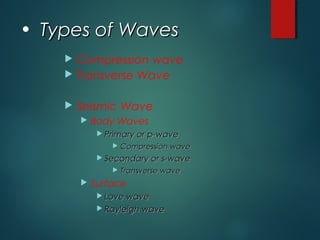
• Types of WavesTypes of Waves
 Compression wave
 Transverse Wave
 Seismic Wave
 Body Waves
 Primary or p-wavePrimary or p-wave
 Compression waveCompression wave
 Secondary or s-waveSecondary or s-wave
 Transverse waveTransverse wave
 Surface
 Love waveLove wave
 Rayleigh waveRayleigh wave
Seismic WaveSeismic Wave
 Seismic waves are the waves of
energy caused by the sudden
breaking of rock within the earth or an
explosion. They are the energy that
travels through the earth and is
recorded on seismographs.
 There are several different kinds of
seismic waves, and they all move in
different ways. The two main types of
waves are body waves and surface
waves.
Body WavesBody Waves
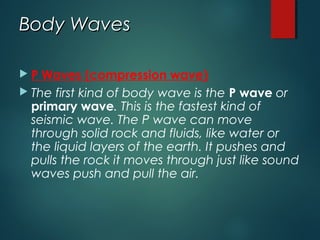
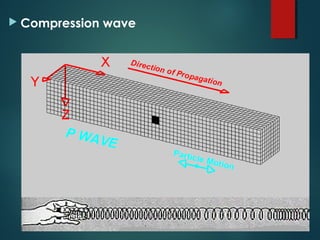
 P Waves (compression wave)
 The first kind of body wave is the P wave or
primary wave. This is the fastest kind of
seismic wave. The P wave can move
through solid rock and fluids, like water or
the liquid layers of the earth. It pushes and
pulls the rock it moves through just like sound
waves push and pull the air.
 Compression wave
Body WavesBody Waves
 S wave (transverse wave)
 The second type of body wave is the S wave
or secondary wave, which is the second
wave you feel in an earthquake. An S wave
is slower than a P wave and can only move
through solid rock. This wave moves rock up
and down, or side-to-side.
 Transverse wave
Surface Waves
Love Waves
The first kind of surface wave is called
a Love wave, named after A.E.H. Love,
a British mathematician who worked
out the mathematical model for this
kind of wave in 1911. It's the fastest
surface wave and moves the ground
from side-to-side.
Surface Waves
Rayleigh Waves
 The other kind of surface wave is the
Rayleigh wave, named for John William
Strutt, Lord Rayleigh, who mathematically
predicted the existence of this kind of wave
in 1885. A Rayleigh wave rolls along the
ground just like a wave rolls across a lake or
an ocean. Because it rolls, it moves the
ground up and down, and side-to-side in
the same direction that the wave is moving.
Most of the shaking felt from an earthquake
is due to the Rayleigh wave, which can be
much larger than the other waves.
ANY QUESTION
THANKS

Seismic waves

  • 1.
    > Seismic wavesand its Types BY Shayan Ahmad Yar BS-v DEPARTMENT OF GEOLOGY, BACHA KHAN UNIVERSITY
  • 2.
  • 3.
    • Types ofWavesTypes of Waves  Compression wave  Transverse Wave  Seismic Wave  Body Waves  Primary or p-wavePrimary or p-wave  Compression waveCompression wave  Secondary or s-waveSecondary or s-wave  Transverse waveTransverse wave  Surface  Love waveLove wave  Rayleigh waveRayleigh wave
  • 4.
    Seismic WaveSeismic Wave Seismic waves are the waves of energy caused by the sudden breaking of rock within the earth or an explosion. They are the energy that travels through the earth and is recorded on seismographs.  There are several different kinds of seismic waves, and they all move in different ways. The two main types of waves are body waves and surface waves.
  • 5.
    Body WavesBody Waves P Waves (compression wave)  The first kind of body wave is the P wave or primary wave. This is the fastest kind of seismic wave. The P wave can move through solid rock and fluids, like water or the liquid layers of the earth. It pushes and pulls the rock it moves through just like sound waves push and pull the air.
  • 6.
  • 7.
    Body WavesBody Waves S wave (transverse wave)  The second type of body wave is the S wave or secondary wave, which is the second wave you feel in an earthquake. An S wave is slower than a P wave and can only move through solid rock. This wave moves rock up and down, or side-to-side.
  • 8.
  • 9.
    Surface Waves Love Waves Thefirst kind of surface wave is called a Love wave, named after A.E.H. Love, a British mathematician who worked out the mathematical model for this kind of wave in 1911. It's the fastest surface wave and moves the ground from side-to-side.
  • 11.
    Surface Waves Rayleigh Waves The other kind of surface wave is the Rayleigh wave, named for John William Strutt, Lord Rayleigh, who mathematically predicted the existence of this kind of wave in 1885. A Rayleigh wave rolls along the ground just like a wave rolls across a lake or an ocean. Because it rolls, it moves the ground up and down, and side-to-side in the same direction that the wave is moving. Most of the shaking felt from an earthquake is due to the Rayleigh wave, which can be much larger than the other waves.
  • 13.
  • 14.