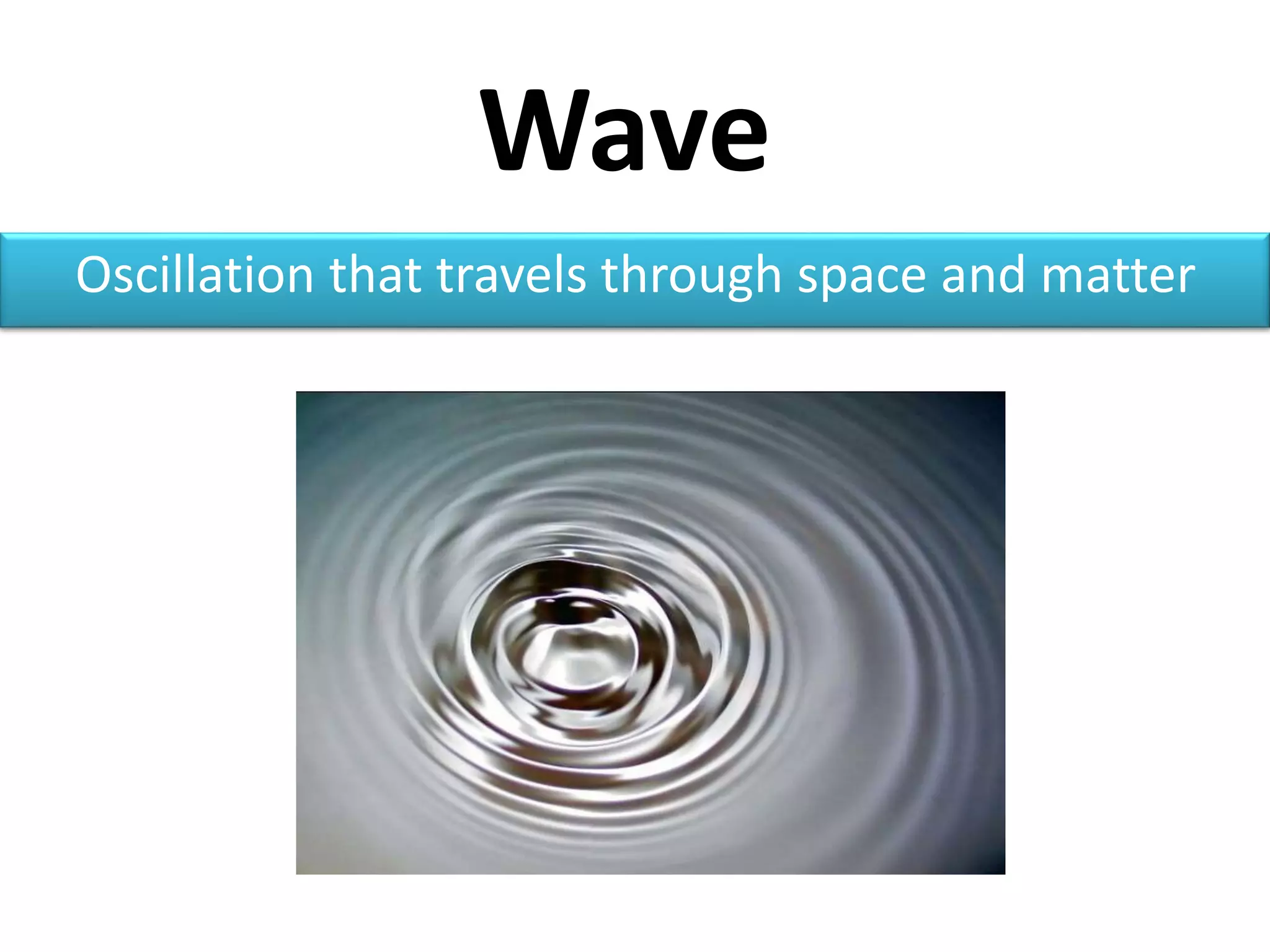
Wave
Oscillation that travels through space and matter
Wave
A Wave is a kind of
oscillation(disturbance) that travels
through space and matter . Wave
motions transfer energy from one
place to another.
EXAMPLES
Wave are found everywhere in the natural
world.
Examples of waves:
• Sound
• Water waves
• Seismic waves(earthquakes)
• Electromagnetic waves
– Light wave
– Radio wave
SEISMIC WAVES
• Seismic waves are
waves of energy that
travel through the
Earth's layers, and are a
result of earthquakes,
volcanic eruptions,
magma movement,
large landslides and
large man-made
explosions that give out
low-frequency acoustic
energy.
SEISMIC WAVES
• Seismic waves are studied by geophysicists called
seismologists. Seismic wave fields are recorded by a
seismometer, hydrophone (in water), or accelerometer.
• Seismologists use seismographs to record the amount
of time it takes seismic waves to travel through
different layers of the Earth. As the waves travel
through different densities and stiffness, the waves can
be refracted and reflected. Because of the different
behaviour of waves in different materials, seismologists
can deduce the type of material the waves are
travelling through.
SEISMIC WAVES
• The results can provide a snapshot of the
Earth’s internal structure and help us to locate
and understand fault planes and the stresses
and strains acting on them.
• This wave behaviour can also be used on a
smaller scale by recording waves generated by
explosions or ground vibrators in the search
for oil and gas.
TYPES OF SEISMIC WAVES
There are three basic types of seismic waves :-
• P-waves
• S-waves
• Surface waves
P-waves and S-waves are sometimes
collectively called Body waves.
BODY WAVES
Body waves travel through the interior of
the Earth along paths controlled by the
material properties in terms of density and
modulus (stiffness). The density and modulus,
in turn, vary according to temperature,
composition, and material phase. This effect
resembles the refraction of light waves.
• Two types of particle motion result in two types of
body waves: Primary and Secondary waves.
• P- WAVES:- P-waves, also known as primary waves or
pressure waves, travel at the greatest velocity6 through
the Earth. When they travel through air, they take the
form of sound waves – they travel at the speed of
sound (330 ms-1) through air but may travel at 5000
ms-1 in granite7. Because of their speed, they are the
first waves to be recorded by a seismograph8 during an
earthquake.
BODY WAVES
BODY WAVES
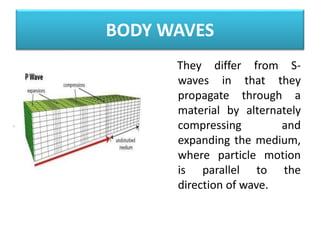
They differ from S-
waves in that they
propagate through a
material by alternately
compressing and
expanding the medium,
where particle motion
is parallel to the
direction of wave.
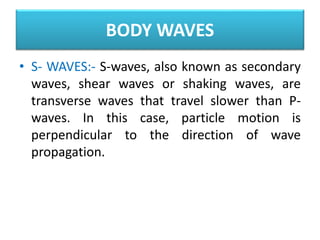
• S- WAVES:- S-waves, also known as secondary
waves, shear waves or shaking waves, are
transverse waves that travel slower than P-
waves. In this case, particle motion is
perpendicular to the direction of wave
propagation.
BODY WAVES
BODY WAVES
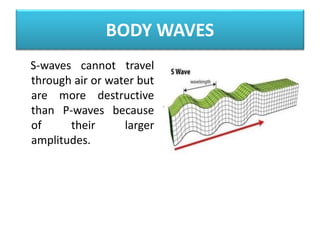
S-waves cannot travel
through air or water but
are more destructive
than P-waves because
of their larger
amplitudes.
SURFACE WAVES
Seismic surface waves travel along the Earth's surface.
They can be classified as a form of mechanical surface
waves. They are called surface waves, as they diminish
as they get further from the surface. They travel more
slowly than seismic body waves (P and S). In large
earthquakes, surface waves can have an amplitude of
several centimeters.
• Types of surface waves:-
1. Rayleigh waves
2. Love waves
SURFACE WAVES
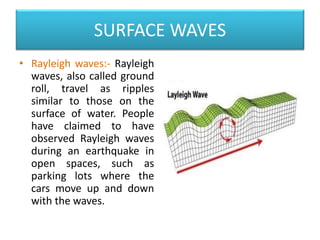
• Rayleigh waves:- Rayleigh
waves, also called ground
roll, travel as ripples
similar to those on the
surface of water. People
have claimed to have
observed Rayleigh waves
during an earthquake in
open spaces, such as
parking lots where the
cars move up and down
with the waves.
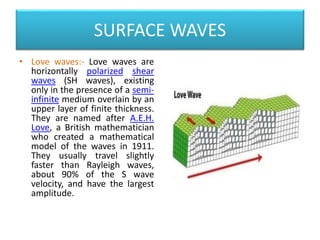
• Love waves:- Love waves are
horizontally polarized shear
waves (SH waves), existing
only in the presence of a semi-
infinite medium overlain by an
upper layer of finite thickness.
They are named after A.E.H.
Love, a British mathematician
who created a mathematical
model of the waves in 1911.
They usually travel slightly
faster than Rayleigh waves,
about 90% of the S wave
velocity, and have the largest
amplitude.
SURFACE WAVES
How can we record seismic waves ?
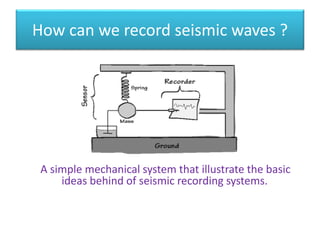
Seismographs, which generally consist of two
parts, a sensor of ground motion which we
call a seismometer, and a seismic recording
system. Modern seismometers are sensitive
electromechanical devices but the basic idea
behind measuring ground movement can be
illustrated using a simpler physical system that
is actually quite similar to some of the earliest
seismograph systems.
A simple mechanical system that illustrate the basic
ideas behind of seismic recording systems.
How can we record seismic waves ?
What can seismic waves tell us?
• Studies of the different types of seismic waves can tell
us much about the nature of the Earth’s structure.
• For example, seismologists can use the direction and
the difference in the arrival times between P-waves
and S-waves to determine the distance to the source of
an earthquake. If the seismographs are too far away
from the event to record S-waves, several recordings of
P-waves can be crunched in a computer program to
give an approximate location of the source.
REFERENCES
• https://www.sciencelearn.org.nz/resources/3
40-seismic-waves
• https://en.wikipedia.org/wiki/Seismic_wave
THANK YOU

Seismicwave

  • 1.
    Wave Oscillation that travelsthrough space and matter
  • 2.
    Wave A Wave isa kind of oscillation(disturbance) that travels through space and matter . Wave motions transfer energy from one place to another.
  • 3.
    EXAMPLES Wave are foundeverywhere in the natural world. Examples of waves: • Sound • Water waves • Seismic waves(earthquakes) • Electromagnetic waves – Light wave – Radio wave
  • 4.
    SEISMIC WAVES • Seismicwaves are waves of energy that travel through the Earth's layers, and are a result of earthquakes, volcanic eruptions, magma movement, large landslides and large man-made explosions that give out low-frequency acoustic energy.
  • 5.
    SEISMIC WAVES • Seismicwaves are studied by geophysicists called seismologists. Seismic wave fields are recorded by a seismometer, hydrophone (in water), or accelerometer. • Seismologists use seismographs to record the amount of time it takes seismic waves to travel through different layers of the Earth. As the waves travel through different densities and stiffness, the waves can be refracted and reflected. Because of the different behaviour of waves in different materials, seismologists can deduce the type of material the waves are travelling through.
  • 6.
    SEISMIC WAVES • Theresults can provide a snapshot of the Earth’s internal structure and help us to locate and understand fault planes and the stresses and strains acting on them. • This wave behaviour can also be used on a smaller scale by recording waves generated by explosions or ground vibrators in the search for oil and gas.
  • 7.
    TYPES OF SEISMICWAVES There are three basic types of seismic waves :- • P-waves • S-waves • Surface waves P-waves and S-waves are sometimes collectively called Body waves.
  • 8.
    BODY WAVES Body wavestravel through the interior of the Earth along paths controlled by the material properties in terms of density and modulus (stiffness). The density and modulus, in turn, vary according to temperature, composition, and material phase. This effect resembles the refraction of light waves.
  • 9.
    • Two typesof particle motion result in two types of body waves: Primary and Secondary waves. • P- WAVES:- P-waves, also known as primary waves or pressure waves, travel at the greatest velocity6 through the Earth. When they travel through air, they take the form of sound waves – they travel at the speed of sound (330 ms-1) through air but may travel at 5000 ms-1 in granite7. Because of their speed, they are the first waves to be recorded by a seismograph8 during an earthquake. BODY WAVES
  • 10.
    BODY WAVES They differfrom S- waves in that they propagate through a material by alternately compressing and expanding the medium, where particle motion is parallel to the direction of wave.
  • 11.
    • S- WAVES:-S-waves, also known as secondary waves, shear waves or shaking waves, are transverse waves that travel slower than P- waves. In this case, particle motion is perpendicular to the direction of wave propagation. BODY WAVES
  • 12.
    BODY WAVES S-waves cannottravel through air or water but are more destructive than P-waves because of their larger amplitudes.
  • 13.
    SURFACE WAVES Seismic surfacewaves travel along the Earth's surface. They can be classified as a form of mechanical surface waves. They are called surface waves, as they diminish as they get further from the surface. They travel more slowly than seismic body waves (P and S). In large earthquakes, surface waves can have an amplitude of several centimeters. • Types of surface waves:- 1. Rayleigh waves 2. Love waves
  • 14.
    SURFACE WAVES • Rayleighwaves:- Rayleigh waves, also called ground roll, travel as ripples similar to those on the surface of water. People have claimed to have observed Rayleigh waves during an earthquake in open spaces, such as parking lots where the cars move up and down with the waves.
  • 15.
    • Love waves:-Love waves are horizontally polarized shear waves (SH waves), existing only in the presence of a semi- infinite medium overlain by an upper layer of finite thickness. They are named after A.E.H. Love, a British mathematician who created a mathematical model of the waves in 1911. They usually travel slightly faster than Rayleigh waves, about 90% of the S wave velocity, and have the largest amplitude. SURFACE WAVES
  • 16.
    How can werecord seismic waves ? Seismographs, which generally consist of two parts, a sensor of ground motion which we call a seismometer, and a seismic recording system. Modern seismometers are sensitive electromechanical devices but the basic idea behind measuring ground movement can be illustrated using a simpler physical system that is actually quite similar to some of the earliest seismograph systems.
  • 17.
    A simple mechanicalsystem that illustrate the basic ideas behind of seismic recording systems. How can we record seismic waves ?
  • 18.
    What can seismicwaves tell us? • Studies of the different types of seismic waves can tell us much about the nature of the Earth’s structure. • For example, seismologists can use the direction and the difference in the arrival times between P-waves and S-waves to determine the distance to the source of an earthquake. If the seismographs are too far away from the event to record S-waves, several recordings of P-waves can be crunched in a computer program to give an approximate location of the source.
  • 19.
  • 20.