LEARNING EARTHQUAKE DESIGN
AND CONSTRUCTION
(EARTHQUAKE TIP 2)
Prepared By :-
Amardeep Gohel
Sangeeta Sanghani
Divyesh Bharkhada
INTRODUCTION OF EARTHQUAKE
What is EQ. :- sudden movement or shaking of
the Earth is Known as Earthquake.
Why occurs:-Caused by: plate tectonic stresses,
volcanic or magmatic activity
Where:- Located at plate boundaries

1) Extra Plate Earthquake
2) Intra Plate Earthquake
Large ‘Strain Energy’ released during
Earthquake.
Stress= P/A
Strain=∆L/L
HOW IT OCCURS EARTHQUAKE
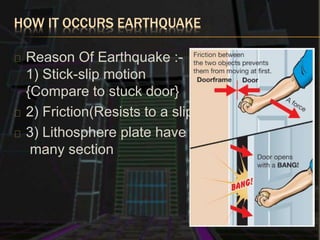
Reason Of Earthquake :-
1) Stick-slip motion
{Compare to stuck door}
2) Friction(Resists to a slip)
3) Lithosphere plate have
many section
HOW IT OCCURS EARTHQUAKE
SEISMIC WAVES
Seismic waves are the vibrations from
earthquakes, that travel through the Earth.
Different Kind of seismic waves, and they
move in different ways. The two main type of
waves are Body Wave And Surface Wave.
Body Wave:-
Travel through the Earth’s interior
Surface Wave:-
Move along the earth’s surface. ( Similar to
ocean waves )
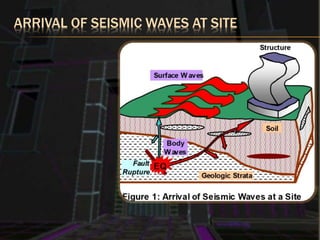
ARRIVAL OF SEISMIC WAVES AT SITE
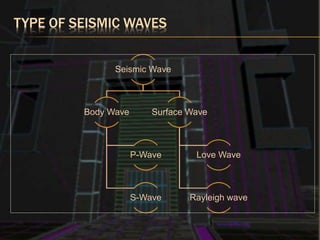
TYPE OF SEISMIC WAVES
Seismic Wave
Body Wave
P-Wave
S-Wave
Surface Wave
Love Wave
Rayleigh wave
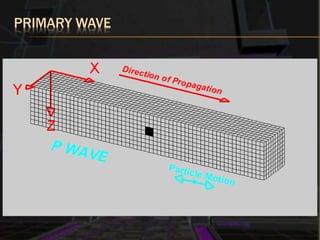
PRIMARY WAVE
Is Also known as Compressional Wave,
Longitudinal Wave.
Can Pass Through Rock
Can pass through a Liquid
It pushes and pulls the rock.
It moves through just like sound wave push
and pull the air.
Higher velocity (6 Km/Sec in the crust)
PRIMARY WAVE
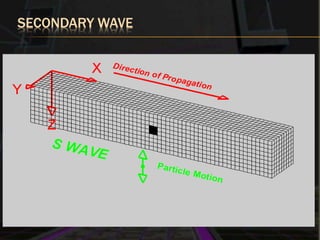
SECONDARY WAVE
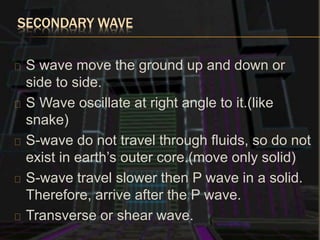
S wave move the ground up and down or
side to side.
S Wave oscillate at right angle to it.(like
snake)
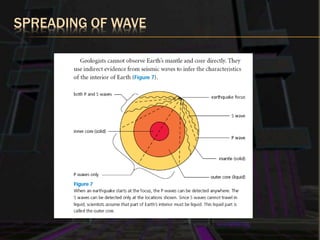
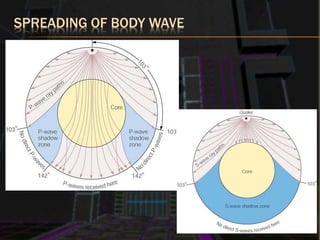
S-wave do not travel through fluids, so do not
exist in earth’s outer core.(move only solid)
S-wave travel slower then P wave in a solid.
Therefore, arrive after the P wave.
Transverse or shear wave.
SECONDARY WAVE
BODY WAVE
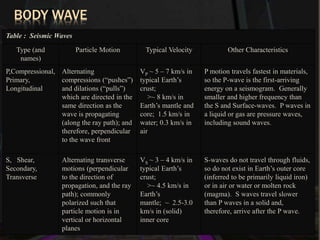
Table : Seismic Waves
Type (and
names)
Particle Motion Typical Velocity Other Characteristics
P,Compressional,
Primary,
Longitudinal
Alternating
compressions (“pushes”)
and dilations (“pulls”)
which are directed in the
same direction as the
wave is propagating
(along the ray path); and
therefore, perpendicular
to the wave front
VP ~ 5 – 7 km/s in
typical Earth’s
crust;
>~ 8 km/s in
Earth’s mantle and
core; 1.5 km/s in
water; 0.3 km/s in
air
P motion travels fastest in materials,
so the P-wave is the first-arriving
energy on a seismogram. Generally
smaller and higher frequency than
the S and Surface-waves. P waves in
a liquid or gas are pressure waves,
including sound waves.
S, Shear,
Secondary,
Transverse
Alternating transverse
motions (perpendicular
to the direction of
propagation, and the ray
path); commonly
polarized such that
particle motion is in
vertical or horizontal
planes
VS ~ 3 – 4 km/s in
typical Earth’s
crust;
>~ 4.5 km/s in
Earth’s
mantle; ~ 2.5-3.0
km/s in (solid)
inner core
S-waves do not travel through fluids,
so do not exist in Earth’s outer core
(inferred to be primarily liquid iron)
or in air or water or molten rock
(magma). S waves travel slower
than P waves in a solid and,
therefore, arrive after the P wave.
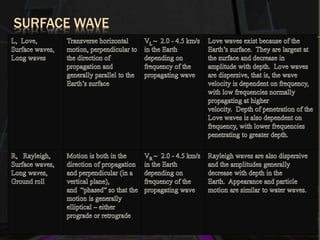
SURFACE WAVE
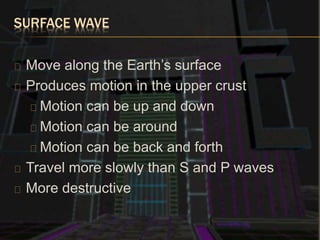
Move along the Earth’s surface
Produces motion in the upper crust
Motion can be up and down
Motion can be around
Motion can be back and forth
Travel more slowly than S and P waves
More destructive
LOVE WAVE
The first kind of surface wave is called a
Love wave.
L-wave named after A.E.H. Love, a British
mathematician who worked out the
mathematical model for this kind of wave in
1911.
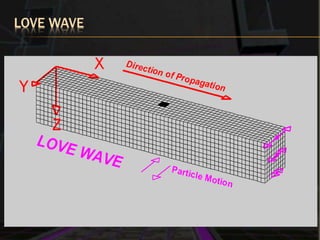
It's the fastest surface wave and moves the
ground from side-to-side.
LOVE WAVE
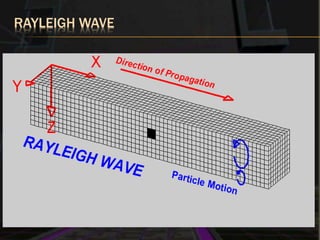
RAYLEIGH WAVE
The other kind of surface wave is the
Rayleigh wave. named for John William
Strutt, Lord Rayleigh, who mathematically
predicted the existence of this kind of wave
in 1885.
A Rayleigh wave rolls along the ground just
like a wave rolls across a lake or an ocean.
Because it rolls, it moves the ground up and
down, and side-to-side in the same direction
that the wave is moving
More shaking and more damage.
RAYLEIGH WAVE
SURFACE WAVE
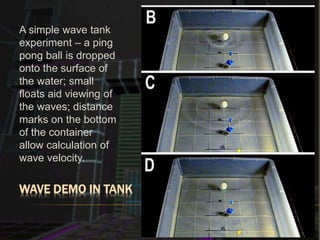
WAVE DEMO IN TANK
A simple wave tank
experiment – a ping
pong ball is dropped
onto the surface of
the water; small
floats aid viewing of
the waves; distance
marks on the bottom
of the container
allow calculation of
wave velocity.
SPREADING OF WAVE
SPREADING OF BODY WAVE
VIDIO AND SOFTWER TUTORIAL
Sesmic wave effect on stru. vidio
ClinkSesmok wave effect on structure.avi
softwer for how to spreed wave
How meny walkeno and eathquke from 1960.
C:UsersAmar GohelDesktop1Smithsonian
Fasttrak.lnk
VIDIO AND SOFTWER TUTORIAL
With plate eathquak counter
C:UsersAmar GohelDesktop1Seismic
Eruption.lnk
Slinky effect
C:UsersAmar GohelDesktop1sliky efect
on building.avi
IRIS Sismogrph have 2 vidio with dempar
C:UsersAmar GohelDesktop1IRIS
Seismographs in Schools -
Seismometers.MP4
MEASURING INSTRUMENT
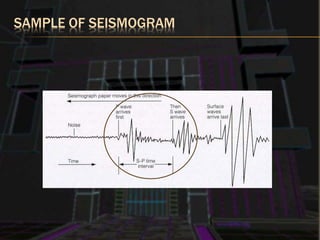
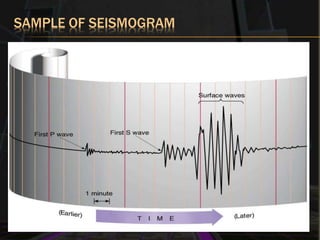
Seismographs record earthquake wave.
Seismographs show :-
-Amplitude of seismic wave (how much rock
moves or vibrate)
-Distance from epicenter
-Earthquake direction
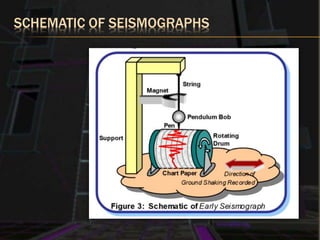
Three Component:- 1)sensor:-Pendulum
mass, string, magnet, support.
2)recorder:-Drum, pen, chart paper.
3)timer:-motor of the rotating drum at
constant speed
SCHEMATIC OF SEISMOGRAPHS
WORKING PRINCIPAL SEISMOGRAPHS
Pen attach at bottom of pendulum, Drum
rotate at constant speed, magnet provide for
control of damping.
Seismoscopes :- “Which instrument do not
have a timer device, drum dose not rotate
measured only maximum intensity they are
called sieismoscopes.”
Digital Instrument :- AS-1 Seismometer, EQ-
1, EAI S102, SEP etc. . .
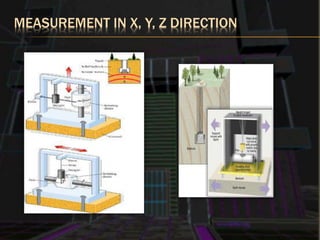
MEASUREMENT IN X, Y, Z DIRECTION
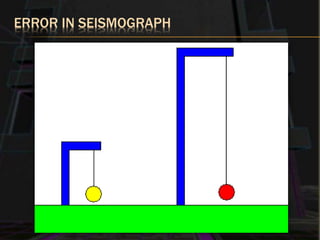
ERROR IN SEISMOGRAPH
SAMPLE OF SEISMOGRAM
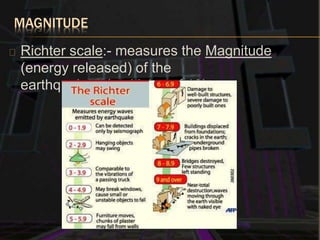
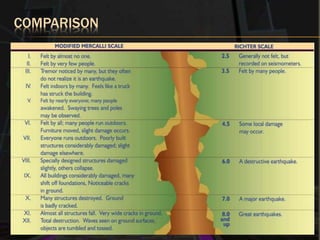
MAGNITUDE
Richter scale:- measures the Magnitude
(energy released) of the
earthquake…(multiples of 10)
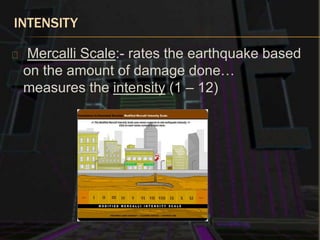
INTENSITY
Mercalli Scale:- rates the earthquake based
on the amount of damage done…
measures the intensity (1 – 12)
COMPARISON
STRONG GROUND MOTION
Seismic wave arrive at varies instant of the
time, have different amplitude and carry a
different level of energy.
Represented as intensity v/s time.
However, engineering point of view strong
motion can be possible damage structure are
of interest.
CHARACTERISTIC OF STRONG GROUND MOTION
Described in terms of displacement, velocity
or acceleration.
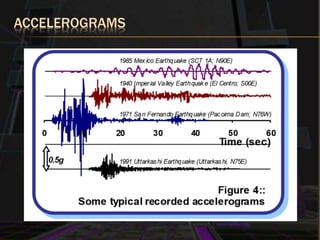
The variation of ground acceleration with
time recorded at a point on ground during an
earthquake is called an accelerogram.
They denote ground shaking, peak
amplitude, duration of strong shaking,
frequency ,(e.g., amplitude of shaking
associated with each frequency) and energy
content (i.e., energy carried by ground
shaking at each frequency).
ACCELEROGRAMS
Specially thanks to
Pro. Mazar Dhankot
Pro. Dipesh Rathod
THANK TO ALL OF YOU

EARTHQUAKE Presentation [TIPS 2]

  • 1.
    LEARNING EARTHQUAKE DESIGN ANDCONSTRUCTION (EARTHQUAKE TIP 2) Prepared By :- Amardeep Gohel Sangeeta Sanghani Divyesh Bharkhada
  • 2.
    INTRODUCTION OF EARTHQUAKE Whatis EQ. :- sudden movement or shaking of the Earth is Known as Earthquake. Why occurs:-Caused by: plate tectonic stresses, volcanic or magmatic activity Where:- Located at plate boundaries 1) Extra Plate Earthquake 2) Intra Plate Earthquake Large ‘Strain Energy’ released during Earthquake. Stress= P/A Strain=∆L/L
  • 3.
    HOW IT OCCURSEARTHQUAKE Reason Of Earthquake :- 1) Stick-slip motion {Compare to stuck door} 2) Friction(Resists to a slip) 3) Lithosphere plate have many section
  • 4.
    HOW IT OCCURSEARTHQUAKE
  • 5.
    SEISMIC WAVES Seismic wavesare the vibrations from earthquakes, that travel through the Earth. Different Kind of seismic waves, and they move in different ways. The two main type of waves are Body Wave And Surface Wave. Body Wave:- Travel through the Earth’s interior Surface Wave:- Move along the earth’s surface. ( Similar to ocean waves )
  • 6.
    ARRIVAL OF SEISMICWAVES AT SITE
  • 7.
    TYPE OF SEISMICWAVES Seismic Wave Body Wave P-Wave S-Wave Surface Wave Love Wave Rayleigh wave
  • 8.
    PRIMARY WAVE Is Alsoknown as Compressional Wave, Longitudinal Wave. Can Pass Through Rock Can pass through a Liquid It pushes and pulls the rock. It moves through just like sound wave push and pull the air. Higher velocity (6 Km/Sec in the crust)
  • 9.
  • 10.
    SECONDARY WAVE S wavemove the ground up and down or side to side. S Wave oscillate at right angle to it.(like snake) S-wave do not travel through fluids, so do not exist in earth’s outer core.(move only solid) S-wave travel slower then P wave in a solid. Therefore, arrive after the P wave. Transverse or shear wave.
  • 11.
  • 12.
    BODY WAVE Table :Seismic Waves Type (and names) Particle Motion Typical Velocity Other Characteristics P,Compressional, Primary, Longitudinal Alternating compressions (“pushes”) and dilations (“pulls”) which are directed in the same direction as the wave is propagating (along the ray path); and therefore, perpendicular to the wave front VP ~ 5 – 7 km/s in typical Earth’s crust; >~ 8 km/s in Earth’s mantle and core; 1.5 km/s in water; 0.3 km/s in air P motion travels fastest in materials, so the P-wave is the first-arriving energy on a seismogram. Generally smaller and higher frequency than the S and Surface-waves. P waves in a liquid or gas are pressure waves, including sound waves. S, Shear, Secondary, Transverse Alternating transverse motions (perpendicular to the direction of propagation, and the ray path); commonly polarized such that particle motion is in vertical or horizontal planes VS ~ 3 – 4 km/s in typical Earth’s crust; >~ 4.5 km/s in Earth’s mantle; ~ 2.5-3.0 km/s in (solid) inner core S-waves do not travel through fluids, so do not exist in Earth’s outer core (inferred to be primarily liquid iron) or in air or water or molten rock (magma). S waves travel slower than P waves in a solid and, therefore, arrive after the P wave.
  • 13.
    SURFACE WAVE Move alongthe Earth’s surface Produces motion in the upper crust Motion can be up and down Motion can be around Motion can be back and forth Travel more slowly than S and P waves More destructive
  • 14.
    LOVE WAVE The firstkind of surface wave is called a Love wave. L-wave named after A.E.H. Love, a British mathematician who worked out the mathematical model for this kind of wave in 1911. It's the fastest surface wave and moves the ground from side-to-side.
  • 15.
  • 16.
    RAYLEIGH WAVE The otherkind of surface wave is the Rayleigh wave. named for John William Strutt, Lord Rayleigh, who mathematically predicted the existence of this kind of wave in 1885. A Rayleigh wave rolls along the ground just like a wave rolls across a lake or an ocean. Because it rolls, it moves the ground up and down, and side-to-side in the same direction that the wave is moving More shaking and more damage.
  • 17.
  • 18.
  • 19.
    WAVE DEMO INTANK A simple wave tank experiment – a ping pong ball is dropped onto the surface of the water; small floats aid viewing of the waves; distance marks on the bottom of the container allow calculation of wave velocity.
  • 20.
  • 21.
  • 22.
    VIDIO AND SOFTWERTUTORIAL Sesmic wave effect on stru. vidio ClinkSesmok wave effect on structure.avi softwer for how to spreed wave How meny walkeno and eathquke from 1960. C:UsersAmar GohelDesktop1Smithsonian Fasttrak.lnk
  • 23.
    VIDIO AND SOFTWERTUTORIAL With plate eathquak counter C:UsersAmar GohelDesktop1Seismic Eruption.lnk Slinky effect C:UsersAmar GohelDesktop1sliky efect on building.avi IRIS Sismogrph have 2 vidio with dempar C:UsersAmar GohelDesktop1IRIS Seismographs in Schools - Seismometers.MP4
  • 24.
    MEASURING INSTRUMENT Seismographs recordearthquake wave. Seismographs show :- -Amplitude of seismic wave (how much rock moves or vibrate) -Distance from epicenter -Earthquake direction Three Component:- 1)sensor:-Pendulum mass, string, magnet, support. 2)recorder:-Drum, pen, chart paper. 3)timer:-motor of the rotating drum at constant speed
  • 25.
  • 26.
    WORKING PRINCIPAL SEISMOGRAPHS Penattach at bottom of pendulum, Drum rotate at constant speed, magnet provide for control of damping. Seismoscopes :- “Which instrument do not have a timer device, drum dose not rotate measured only maximum intensity they are called sieismoscopes.” Digital Instrument :- AS-1 Seismometer, EQ- 1, EAI S102, SEP etc. . .
  • 27.
    MEASUREMENT IN X,Y, Z DIRECTION
  • 28.
  • 29.
  • 30.
  • 31.
    MAGNITUDE Richter scale:- measuresthe Magnitude (energy released) of the earthquake…(multiples of 10)
  • 32.
    INTENSITY Mercalli Scale:- ratesthe earthquake based on the amount of damage done… measures the intensity (1 – 12)
  • 33.
  • 34.
    STRONG GROUND MOTION Seismicwave arrive at varies instant of the time, have different amplitude and carry a different level of energy. Represented as intensity v/s time. However, engineering point of view strong motion can be possible damage structure are of interest.
  • 35.
    CHARACTERISTIC OF STRONGGROUND MOTION Described in terms of displacement, velocity or acceleration. The variation of ground acceleration with time recorded at a point on ground during an earthquake is called an accelerogram. They denote ground shaking, peak amplitude, duration of strong shaking, frequency ,(e.g., amplitude of shaking associated with each frequency) and energy content (i.e., energy carried by ground shaking at each frequency).
  • 36.
  • 37.
    Specially thanks to Pro.Mazar Dhankot Pro. Dipesh Rathod THANK TO ALL OF YOU