Unit 1 Module 2
THE EARTH’s INTERIOR
• In Module 1, you have learned about
the different processes and landforms
along plate boundaries that slowly
shaped the Earth’s surface.
• In Module 2, you will learn the
connection between these processes
with the internal structure and
mechanisms of our planet.
What to expect:
• This module will help you
visualize and understand the
composition and structure of
the Earth’s interior.
Studying the Earth’s Interior
Scientists tried to explore and study
the interior of the Earth. Yet, until
today, there are no mechanical
probes or actual explorations done
to totally discover the deepest region
of the Earth.
The Earth is made up of three layers:
•the crust,
•the mantle, and
•the core.
The study of these layers is
mostly done in the Earth’s
crust since mechanical probes
are impossible due to the
tremendous heat and very
high pressure underneath the
Earth’s surface.
Seismic Waves
In Grade 8, it was mentioned that
seismic waves from earthquakes are
used to analyze the composition and
internal structure of the Earth.
What are seismic waves?
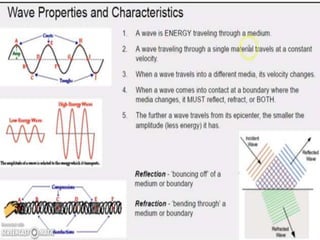
Wave Properties and
Characteristics
What are seismic waves?
Earthquake- is a vibration of the
Earth produced by the rapid release of energy
most often because of the slippage along a
fault in the Earth’s crust.
This energy radiates in all directions from the
focus in the form of waves called seismic
waves, which are recorded in seismographs.
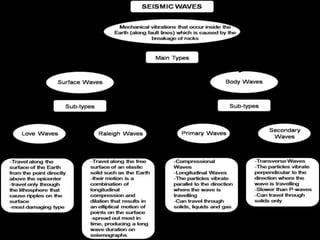
Seismic waves
•It is a mechanical vibrations
that occur inside the Earth
which caused by the
breakage of rocks.
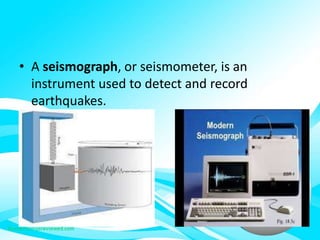
• A seismograph, or seismometer, is an
instrument used to detect and record
earthquakes.
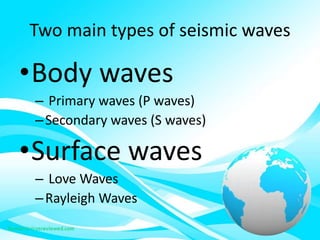
Two main types of seismic waves
•Body waves
– Primary waves (P waves)
–Secondary waves (S waves)
•Surface waves
– Love Waves
–Rayleigh Waves
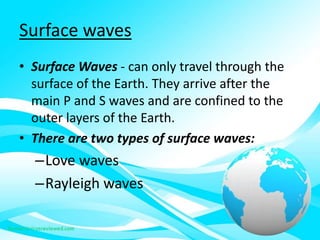
Surface waves
• Surface Waves - can only travel through the
surface of the Earth. They arrive after the
main P and S waves and are confined to the
outer layers of the Earth.
• There are two types of surface waves:
–Love waves
–Rayleigh waves
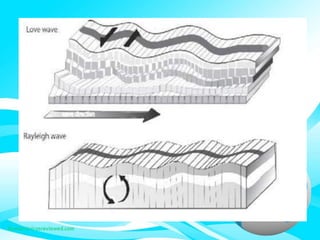
Love Waves
• Love wave is named after A.E.H. Love, a British
mathematician who worked out the
mathematical model for this kind of wave in
1911.
• It is faster than Rayleigh wave and it moves the
ground in a side-to-side horizontal motion, like
that of a snake’s causing the ground to twist.
• This is why Love waves cause the most damage
to structures during an earthquake.
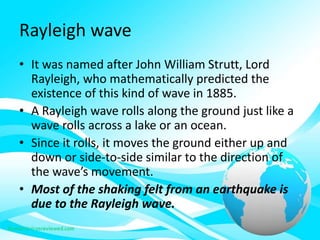
Rayleigh wave
• It was named after John William Strutt, Lord
Rayleigh, who mathematically predicted the
existence of this kind of wave in 1885.
• A Rayleigh wave rolls along the ground just like a
wave rolls across a lake or an ocean.
• Since it rolls, it moves the ground either up and
down or side-to-side similar to the direction of
the wave’s movement.
• Most of the shaking felt from an earthquake is
due to the Rayleigh wave.
Unlike surface waves, body waves
can travel through the Earth’s inner
layers. With this characteristic of the
body waves, they are used by
scientists to study the Earth’s
interior. These waves are of a higher
frequency than the surface waves.
Body Waves
• Unlike surface waves, body waves can travel
through the Earth’s inner layers.
• With this characteristic of the body waves,
they are used by scientists to study the Earth’s
interior.
• These waves are of a higher frequency than
the surface waves.
The two types of body waves are:
P-waves (primary waves)
S-waves (secondary waves).
Primary waves (P waves)
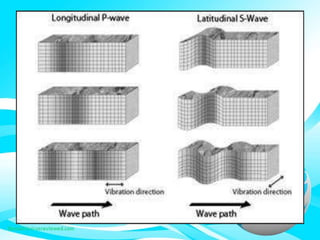
• The P-waves also called
compressional waves, travel
by particles vibrating parallel
to the direction the wave
travel.
Primary waves properties
• Travel faster than S-wave
• Longitudinal/compressional
• Travel through solids/liquids/gas
• Double the speed of s-waves
• 1450 m/s in water
• 5000 m/s in granite
Secondary wave (S-wave)
• Also known as Shear waves.
• The S-waves move as shear or
transverse waves, and force the
ground to sway from side to side, in
rolling motion that shakes the
ground back and forth perpendicular
to the direction of the waves.
Secondary wave properties
• Travel slower than p-waves
• Transverse/shear wave
• Can only travel through solids only
Scientists gained information about
the Earth’s internal structure by
studying how seismic waves travel
through the Earth.
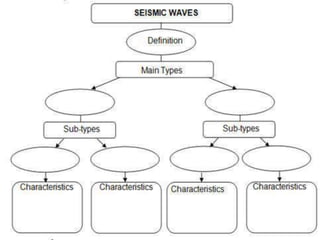
Seatwork:
• Using the given organizer,
write the necessary
information to complete
the concept about seismic
waves.
Answer briefly:
• Differentiate surface waves from
body waves.
• Which type of waves do you think
were useful to seismologists in their
study of the Earth’s interior? Explain
your answer.
Key to correction:
Answers to questions:
Differentiate surface waves from body waves.
• Surface waves travel only on the Earth’s
surface like ripples of water while body waves
travel through the Earth’s body (interior). In
addition, surface waves arrive last at seismic
recording stations compared to the body
waves.
Answers to questions:
Which type of wave do you think were useful to
seismologists in their study of the Earth’s
interior? Explain your answer.
• The body waves were used by seismologists
because they can pass through the Earth’s
interior.

Seismic Waves quarter 1 for Grade 10.ppt

  • 1.
    Unit 1 Module2 THE EARTH’s INTERIOR
  • 2.
    • In Module1, you have learned about the different processes and landforms along plate boundaries that slowly shaped the Earth’s surface. • In Module 2, you will learn the connection between these processes with the internal structure and mechanisms of our planet.
  • 3.
    What to expect: •This module will help you visualize and understand the composition and structure of the Earth’s interior.
  • 4.
    Studying the Earth’sInterior Scientists tried to explore and study the interior of the Earth. Yet, until today, there are no mechanical probes or actual explorations done to totally discover the deepest region of the Earth.
  • 5.
    The Earth ismade up of three layers: •the crust, •the mantle, and •the core.
  • 6.
    The study ofthese layers is mostly done in the Earth’s crust since mechanical probes are impossible due to the tremendous heat and very high pressure underneath the Earth’s surface.
  • 7.
  • 8.
    In Grade 8,it was mentioned that seismic waves from earthquakes are used to analyze the composition and internal structure of the Earth.
  • 9.
  • 10.
  • 11.
  • 12.
    Earthquake- is avibration of the Earth produced by the rapid release of energy most often because of the slippage along a fault in the Earth’s crust. This energy radiates in all directions from the focus in the form of waves called seismic waves, which are recorded in seismographs.
  • 13.
    Seismic waves •It isa mechanical vibrations that occur inside the Earth which caused by the breakage of rocks.
  • 14.
    • A seismograph,or seismometer, is an instrument used to detect and record earthquakes.
  • 15.
    Two main typesof seismic waves •Body waves – Primary waves (P waves) –Secondary waves (S waves) •Surface waves – Love Waves –Rayleigh Waves
  • 16.
    Surface waves • SurfaceWaves - can only travel through the surface of the Earth. They arrive after the main P and S waves and are confined to the outer layers of the Earth. • There are two types of surface waves: –Love waves –Rayleigh waves
  • 18.
    Love Waves • Lovewave is named after A.E.H. Love, a British mathematician who worked out the mathematical model for this kind of wave in 1911. • It is faster than Rayleigh wave and it moves the ground in a side-to-side horizontal motion, like that of a snake’s causing the ground to twist. • This is why Love waves cause the most damage to structures during an earthquake.
  • 19.
    Rayleigh wave • Itwas named after John William Strutt, Lord Rayleigh, who mathematically predicted the existence of this kind of wave in 1885. • A Rayleigh wave rolls along the ground just like a wave rolls across a lake or an ocean. • Since it rolls, it moves the ground either up and down or side-to-side similar to the direction of the wave’s movement. • Most of the shaking felt from an earthquake is due to the Rayleigh wave.
  • 20.
    Unlike surface waves,body waves can travel through the Earth’s inner layers. With this characteristic of the body waves, they are used by scientists to study the Earth’s interior. These waves are of a higher frequency than the surface waves.
  • 21.
    Body Waves • Unlikesurface waves, body waves can travel through the Earth’s inner layers. • With this characteristic of the body waves, they are used by scientists to study the Earth’s interior. • These waves are of a higher frequency than the surface waves.
  • 22.
    The two typesof body waves are: P-waves (primary waves) S-waves (secondary waves).
  • 24.
    Primary waves (Pwaves) • The P-waves also called compressional waves, travel by particles vibrating parallel to the direction the wave travel.
  • 25.
    Primary waves properties •Travel faster than S-wave • Longitudinal/compressional • Travel through solids/liquids/gas • Double the speed of s-waves • 1450 m/s in water • 5000 m/s in granite
  • 26.
    Secondary wave (S-wave) •Also known as Shear waves. • The S-waves move as shear or transverse waves, and force the ground to sway from side to side, in rolling motion that shakes the ground back and forth perpendicular to the direction of the waves.
  • 27.
    Secondary wave properties •Travel slower than p-waves • Transverse/shear wave • Can only travel through solids only
  • 28.
    Scientists gained informationabout the Earth’s internal structure by studying how seismic waves travel through the Earth.
  • 30.
    Seatwork: • Using thegiven organizer, write the necessary information to complete the concept about seismic waves.
  • 32.
    Answer briefly: • Differentiatesurface waves from body waves. • Which type of waves do you think were useful to seismologists in their study of the Earth’s interior? Explain your answer.
  • 33.
  • 35.
    Answers to questions: Differentiatesurface waves from body waves. • Surface waves travel only on the Earth’s surface like ripples of water while body waves travel through the Earth’s body (interior). In addition, surface waves arrive last at seismic recording stations compared to the body waves.
  • 36.
    Answers to questions: Whichtype of wave do you think were useful to seismologists in their study of the Earth’s interior? Explain your answer. • The body waves were used by seismologists because they can pass through the Earth’s interior.