Areas of Interest Plate Tectonics Plate Boundaries Causes of Plate Tectonics Evidences Earth Tectonic Plates
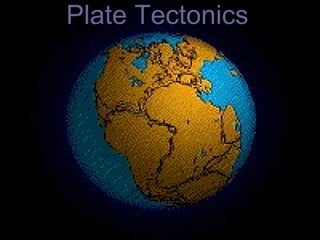
Plate Tectonics
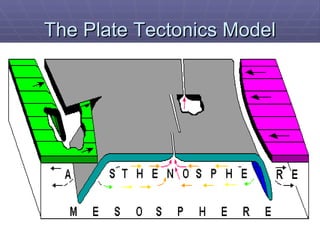
Plate tectonics  (from  Greek   tektōn  "builder") is a  theory  of  geology  that has been developed to explain the observed evidence for large scale motions of the  Earth 's  lithosphere   The outermost part of the Earth's interior is made up of two layers: above is the  lithosphere , comprising the  crust  and the rigid uppermost part of the  mantle . Below the lithosphere lies the  asthenosphere
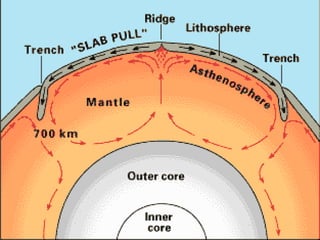
The lithosphere is broken up into what are called  tectonic plates The lateral movement of the plates is typically at speeds of 0.66 to 8.50 centimeters per year   This movement is caused by convection current in the mantle
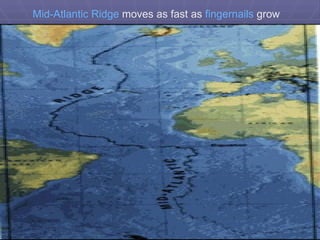
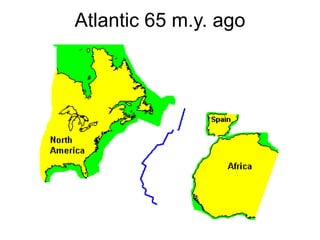
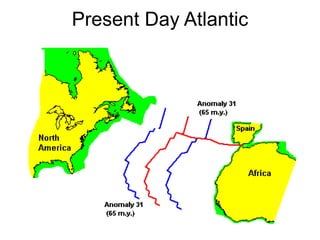
Mid-Atlantic Ridge  moves as fast as  fingernails  grow
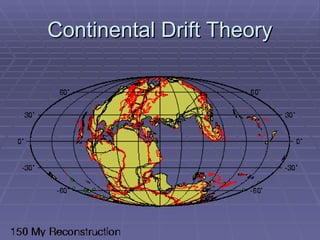
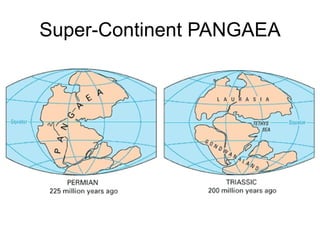
Continental Drift Theory
 
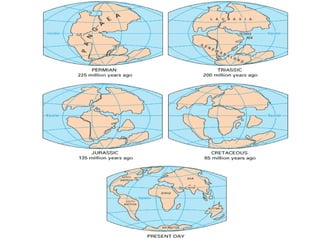
Super-Continent PANGAEA
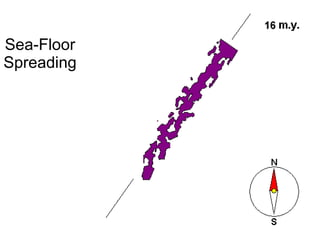
Sea-Floor Spreading
Atlantic 65 m.y. ago
Present Day Atlantic
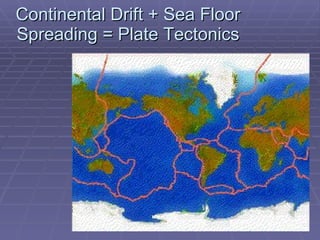
Continental Drift + Sea Floor Spreading = Plate Tectonics
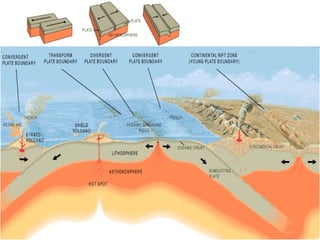
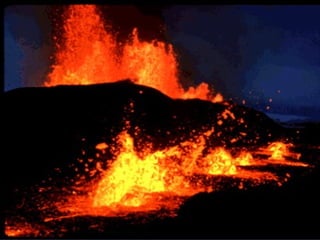
These plates move in relation to one another at one of three types of plate boundaries:  convergent  or collision boundaries,  divergent  or spreading boundaries, and  transform  boundaries.  Earthquakes ,  volcanic activity ,  mountain -building, and  oceanic trench  formation occur along plate boundaries
Types of plate boundaries Three types of plate boundaries exist, characterized by the way the plates move relative to each other. They are associated with different types of surface phenomena. The different types of plate boundaries are: Transform Plate Boundaries Divergent Plate Boundaries Convergent Plate Boundaries
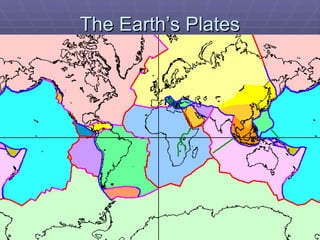
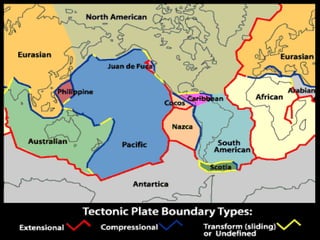
The Earth’s Plates
 
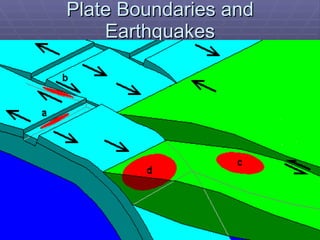
Plate Boundaries and Earthquakes
 
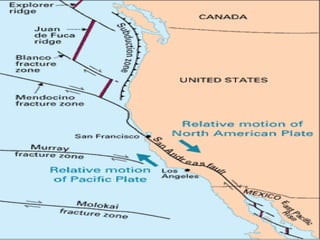
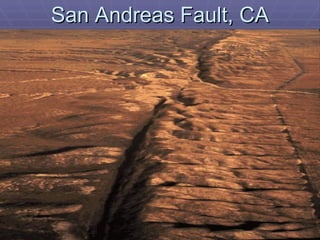
Transverse bounaries occur where the plates slide laterally past one another The  San Andreas Fault  in California is one example. Other examples of transform faults include the  Alpine Fault  in  New Zealand  and the  North Anatolian Fault  in  Turkey .Volcanoes are rare but earthquakes are common. 1.  Transform boundaries
 
San Andreas Fault, CA
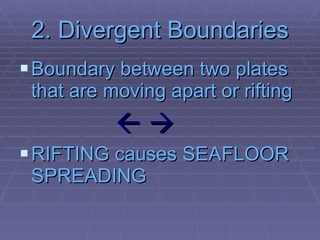
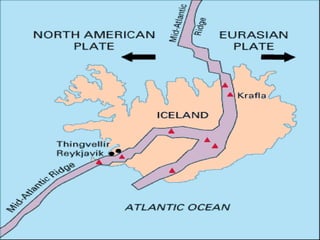
2. Divergent Boundaries Boundary between two plates that are moving apart or rifting     RIFTING causes SEAFLOOR SPREADING
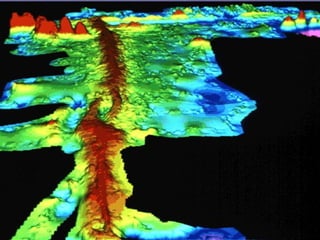
Features of Divergent Boundaries Mid-ocean ridges rift valleys fissure volcanoes
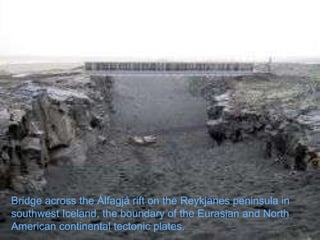
Bridge across the  Álfagjá rift  on the  Reykjanes  peninsula in southwest  Iceland , the boundary of the Eurasian and North American continental tectonic plates.


3. Convergent Boundaries Boundaries between two plates that are colliding     There are 3 types…
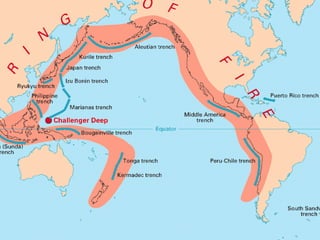
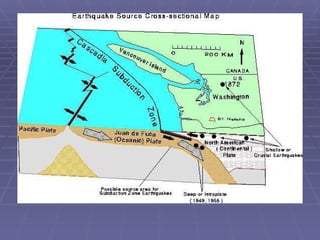
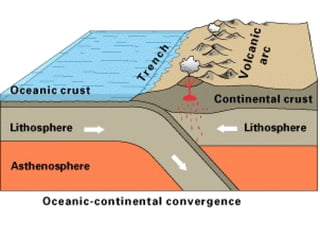
Type 1 Ocean plate colliding with a less dense continental plate Subduction Zone: where the less dense plate slides under the more dense plate VOLCANOES occur at subduction zones
 
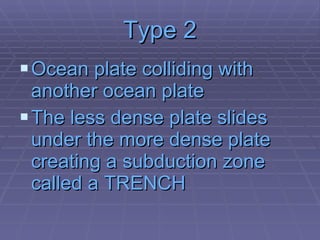
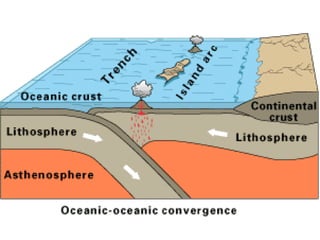
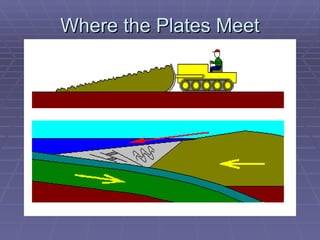
Type 2 Ocean plate colliding with another ocean plate The less dense plate slides under the more dense plate creating a subduction zone called a TRENCH
 
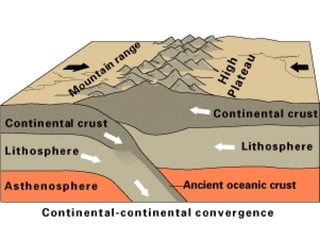
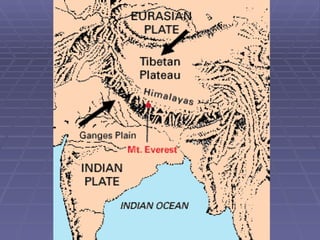
Type 3 A continental plate colliding with another continental plate Have Collision Zones: a place where folded and thrust faulted mountains form.
 
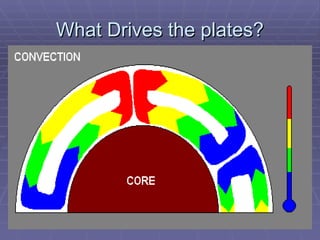
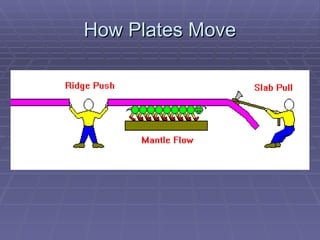
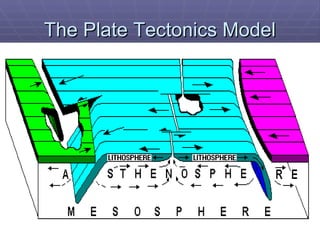
Convection Currents Hot magma in the Earth moves toward the surface, cools, then sinks again. Creates convection currents beneath the plates that cause the plates to move.
 
What Drives the plates?
The Plate Tectonics Model
Evidence for Continental Drift Early Evidence Puzzle-like fit of the continents Fossil clues Mesosaurus Glossopteris Plants Climate clues Glaciers Glacial deposits Rock clues
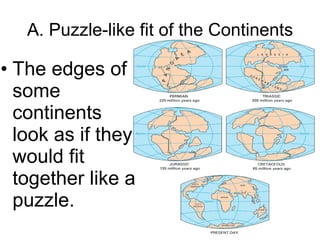
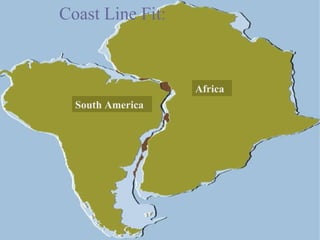
A. Puzzle-like fit of the Continents The edges of some continents look as if they would fit together like a puzzle.
South America Africa Coast Line Fit:
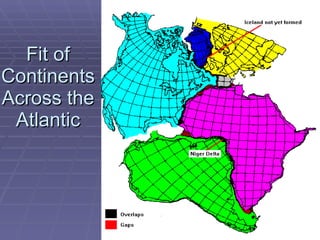
Fit of Continents Across the Atlantic
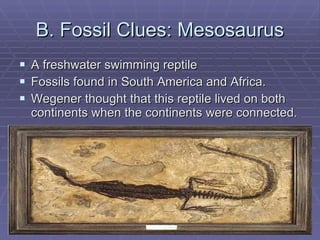
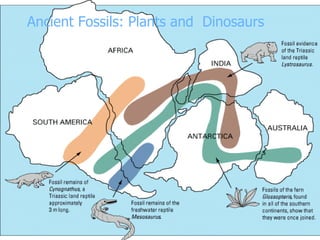
B. Fossil Clues: Mesosaurus A freshwater swimming reptile  Fossils found in South America and Africa. Wegener thought that this reptile lived on both continents when the continents were connected.
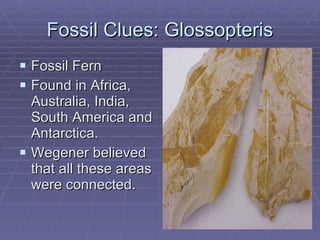
Fossil Clues: Glossopteris Fossil Fern Found in Africa, Australia, India, South America and Antarctica. Wegener believed that all these areas were connected.
Ancient Fossils: Plants and  Dinosaurs
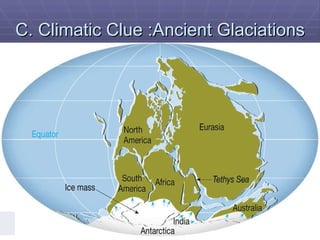
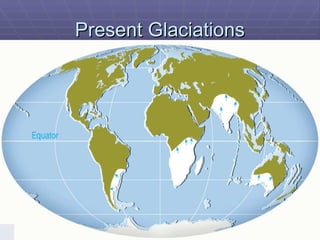
Climate Clues: Glacial Deposits Glacial deposits and grooved bedrock found in southern areas of South America, Africa, India, and Australia.  Indicates that these continents were once covered with glaciers. Wegener believed that these continents were covered with ice near Earth’s South Pole at one time.
C. Climatic Clue :Ancient Glaciations
Present Glaciations
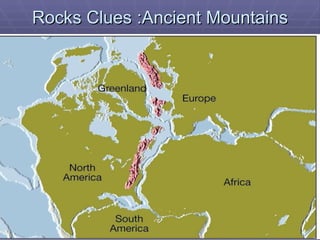
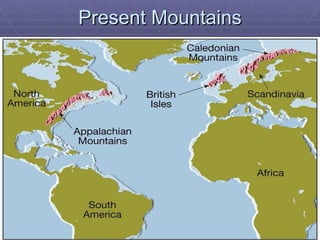
Rock Clues Similar rock structures  are  found on different continents. Mountains found in the eastern U.S. are similar to those found in Greenland and western Europe. The clues found in rocks, support the idea that continents were connected when these rock structures formed.
Rocks Clues :Ancient Mountains
Present Mountains
EARTH  TECTONIC  PLATE
 
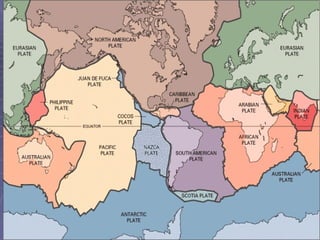
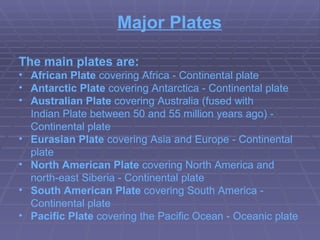
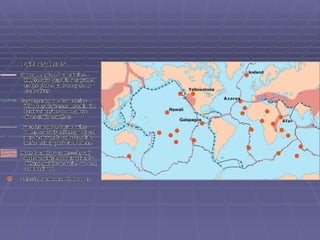
Major Plates The main plates are: African Plate  covering  Africa  - Continental plate  Antarctic Plate  covering  Antarctica  - Continental plate  Australian Plate  covering  Australia  (fused with  Indian Plate  between 50 and 55 million years ago) - Continental plate  Eurasian Plate  covering  Asia  and  Europe  - Continental plate  North American Plate  covering  North America  and north-east  Siberia  - Continental plate  South American Plate  covering  South America  - Continental plate  Pacific Plate  covering the  Pacific Ocean  - Oceanic   plate
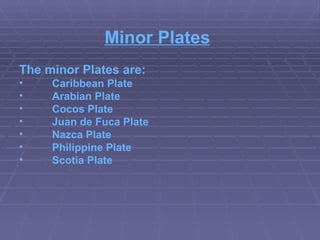
The minor Plates are: Caribbean Plate Arabian Plate Cocos Plate Juan de Fuca Plate   Nazca Plate   Philippine Plate   Scotia Plate   Minor Plates
Activity # 01
Questions... What is the theory of plate tectonics? What is the lithosphere? What is the asthenosphere? What is the connection between the two? What are the two types of plates?
Questions... What are the three types of boundaries? What direction do plates go for each? Which boundary has a subduction zone…what occurs at a subduction zone?
Questions... What causes plates to move? How is a convection current formed?
What is the Lithosphere? The crust and part of the upper mantle = lithosphere 100 km thick  Less dense than the material below it so it “floats”
What is the Asthenoshere? The plastic layer below the lithosphere = asthenosphere The plates of the lithosphere float on the asthenosphere
 
Causes of Plate  Tectonics
2 Types of Plates Ocean plates - plates below the oceans Continental plates - plates below the continents
 
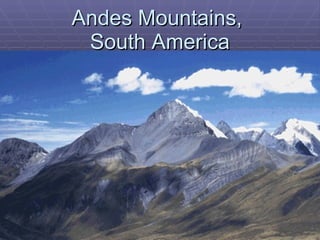
Andes Mountains,  South America
How Plates Move
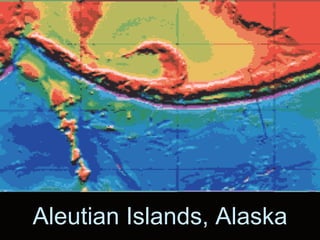
Aleutian Islands, Alaska
 
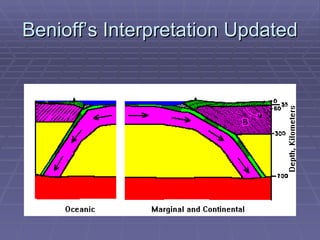
Benioff’s Interpretation Updated
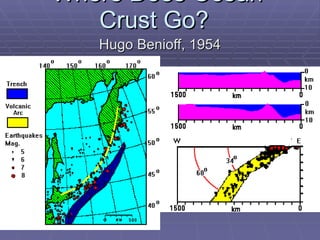
Where Does Ocean Crust Go?  Hugo Benioff, 1954
Where the Plates Meet
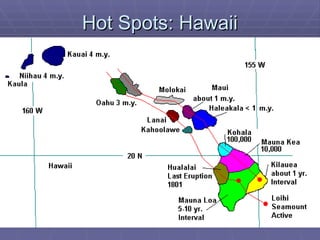
Hot Spots: Hawaii
Brief History of Plate Tectonics Idea of Continental Drift began to form in 1830’s when the shapes of the continents across the Atlantic were known Alfred Wegener was the first one to systematically expound the idea Lack of reliable data prevented the acceptance of the such model until its revival in early 1960’s
 
Rates of Plate Motions The relative plate motion rates vary from about 2 cm to over 10 cm/yr Average rate: about 5 cm/yr or as fast as your finger nail growth San Andreas – average rate Pacific Plate near Japan – 10 cm/yr
 
Scientists Reject Wegener’s Theory  Wegener provided more than evidence for his theory.  He attempted to explain how drift took place. Unfortunately, Wegener could not provide a satisfactory explanation for the force that pushes or pulls the continents. Therefore, scientists rejected his theory.
Climate Clues Fossils of warm weather plants were found on islands in the Arctic Ocean.  Wegener believed that these islands drifted from tropical regions.

Plate Tectonics

  • 1.
  • 2.
    Areas of InterestPlate Tectonics Plate Boundaries Causes of Plate Tectonics Evidences Earth Tectonic Plates
  • 3.
  • 4.
    Plate tectonics (from Greek tektōn "builder") is a theory of geology that has been developed to explain the observed evidence for large scale motions of the Earth 's lithosphere The outermost part of the Earth's interior is made up of two layers: above is the lithosphere , comprising the crust and the rigid uppermost part of the mantle . Below the lithosphere lies the asthenosphere
  • 5.
    The lithosphere isbroken up into what are called tectonic plates The lateral movement of the plates is typically at speeds of 0.66 to 8.50 centimeters per year This movement is caused by convection current in the mantle
  • 6.
    Mid-Atlantic Ridge moves as fast as fingernails grow
  • 7.
  • 8.
  • 9.
  • 10.
  • 11.
  • 12.
  • 13.
    Continental Drift +Sea Floor Spreading = Plate Tectonics
  • 14.
    These plates movein relation to one another at one of three types of plate boundaries: convergent or collision boundaries, divergent or spreading boundaries, and transform boundaries. Earthquakes , volcanic activity , mountain -building, and oceanic trench formation occur along plate boundaries
  • 15.
    Types of plateboundaries Three types of plate boundaries exist, characterized by the way the plates move relative to each other. They are associated with different types of surface phenomena. The different types of plate boundaries are: Transform Plate Boundaries Divergent Plate Boundaries Convergent Plate Boundaries
  • 16.
  • 17.
  • 18.
  • 19.
  • 20.
    Transverse bounaries occurwhere the plates slide laterally past one another The San Andreas Fault in California is one example. Other examples of transform faults include the Alpine Fault in New Zealand and the North Anatolian Fault in Turkey .Volcanoes are rare but earthquakes are common. 1. Transform boundaries
  • 21.
  • 22.
  • 23.
    2. Divergent BoundariesBoundary between two plates that are moving apart or rifting   RIFTING causes SEAFLOOR SPREADING
  • 24.
    Features of DivergentBoundaries Mid-ocean ridges rift valleys fissure volcanoes
  • 25.
    Bridge across the Álfagjá rift on the Reykjanes peninsula in southwest Iceland , the boundary of the Eurasian and North American continental tectonic plates.
  • 26.
  • 27.
  • 28.
  • 29.
    3. Convergent BoundariesBoundaries between two plates that are colliding   There are 3 types…
  • 30.
    Type 1 Oceanplate colliding with a less dense continental plate Subduction Zone: where the less dense plate slides under the more dense plate VOLCANOES occur at subduction zones
  • 31.
  • 32.
    Type 2 Oceanplate colliding with another ocean plate The less dense plate slides under the more dense plate creating a subduction zone called a TRENCH
  • 33.
  • 34.
    Type 3 Acontinental plate colliding with another continental plate Have Collision Zones: a place where folded and thrust faulted mountains form.
  • 35.
  • 36.
    Convection Currents Hotmagma in the Earth moves toward the surface, cools, then sinks again. Creates convection currents beneath the plates that cause the plates to move.
  • 37.
  • 38.
  • 39.
  • 40.
  • 41.
    Evidence for ContinentalDrift Early Evidence Puzzle-like fit of the continents Fossil clues Mesosaurus Glossopteris Plants Climate clues Glaciers Glacial deposits Rock clues
  • 42.
    A. Puzzle-like fitof the Continents The edges of some continents look as if they would fit together like a puzzle.
  • 43.
    South America AfricaCoast Line Fit:
  • 44.
    Fit of ContinentsAcross the Atlantic
  • 45.
    B. Fossil Clues:Mesosaurus A freshwater swimming reptile Fossils found in South America and Africa. Wegener thought that this reptile lived on both continents when the continents were connected.
  • 46.
    Fossil Clues: GlossopterisFossil Fern Found in Africa, Australia, India, South America and Antarctica. Wegener believed that all these areas were connected.
  • 47.
  • 48.
    Climate Clues: GlacialDeposits Glacial deposits and grooved bedrock found in southern areas of South America, Africa, India, and Australia. Indicates that these continents were once covered with glaciers. Wegener believed that these continents were covered with ice near Earth’s South Pole at one time.
  • 49.
    C. Climatic Clue:Ancient Glaciations
  • 50.
  • 51.
    Rock Clues Similarrock structures are found on different continents. Mountains found in the eastern U.S. are similar to those found in Greenland and western Europe. The clues found in rocks, support the idea that continents were connected when these rock structures formed.
  • 52.
  • 53.
  • 54.
  • 55.
  • 56.
    Major Plates Themain plates are: African Plate covering Africa - Continental plate Antarctic Plate covering Antarctica - Continental plate Australian Plate covering Australia (fused with Indian Plate between 50 and 55 million years ago) - Continental plate Eurasian Plate covering Asia and Europe - Continental plate North American Plate covering North America and north-east Siberia - Continental plate South American Plate covering South America - Continental plate Pacific Plate covering the Pacific Ocean - Oceanic plate
  • 57.
    The minor Platesare: Caribbean Plate Arabian Plate Cocos Plate Juan de Fuca Plate Nazca Plate Philippine Plate Scotia Plate Minor Plates
  • 58.
  • 59.
    Questions... What isthe theory of plate tectonics? What is the lithosphere? What is the asthenosphere? What is the connection between the two? What are the two types of plates?
  • 60.
    Questions... What arethe three types of boundaries? What direction do plates go for each? Which boundary has a subduction zone…what occurs at a subduction zone?
  • 61.
    Questions... What causesplates to move? How is a convection current formed?
  • 62.
    What is theLithosphere? The crust and part of the upper mantle = lithosphere 100 km thick Less dense than the material below it so it “floats”
  • 63.
    What is theAsthenoshere? The plastic layer below the lithosphere = asthenosphere The plates of the lithosphere float on the asthenosphere
  • 64.
  • 65.
    Causes of Plate Tectonics
  • 66.
    2 Types ofPlates Ocean plates - plates below the oceans Continental plates - plates below the continents
  • 67.
  • 68.
    Andes Mountains, South America
  • 69.
  • 70.
  • 71.
  • 72.
  • 73.
    Where Does OceanCrust Go? Hugo Benioff, 1954
  • 74.
  • 75.
  • 76.
    Brief History ofPlate Tectonics Idea of Continental Drift began to form in 1830’s when the shapes of the continents across the Atlantic were known Alfred Wegener was the first one to systematically expound the idea Lack of reliable data prevented the acceptance of the such model until its revival in early 1960’s
  • 77.
  • 78.
    Rates of PlateMotions The relative plate motion rates vary from about 2 cm to over 10 cm/yr Average rate: about 5 cm/yr or as fast as your finger nail growth San Andreas – average rate Pacific Plate near Japan – 10 cm/yr
  • 79.
  • 80.
    Scientists Reject Wegener’sTheory Wegener provided more than evidence for his theory. He attempted to explain how drift took place. Unfortunately, Wegener could not provide a satisfactory explanation for the force that pushes or pulls the continents. Therefore, scientists rejected his theory.
  • 81.
    Climate Clues Fossilsof warm weather plants were found on islands in the Arctic Ocean. Wegener believed that these islands drifted from tropical regions.