Introduction to Petroleum
Geology and Geophysics
Geophysical Methods in
Hydrocarbon Exploration
GEO4210
About this part of the course
• Purpose: to give an overview of the basic
geophysical methods used in hydrocarbon
exploration
• Working Plan:
– Lecture: Principles + Intro to Exercise
– Practical: Seismic Interpretation excercise
Lecture Contents
• Geophysical Methods
• Theory / Principles
• Extensional Sedimentary Basins and its
Seismic Signature
• Introduction to the Exercise
Geophysical methods
• Passive:
Method using the natural fields of the Earth, e.g. gravity
and magnetic
• Active:
Method that requires the input of artificially generated
energy, e.g. seismic reflection
• The objective of geophysics
is to locate or detect the presence of subsurface
structures or bodies and determine their size, shape,
depth, and physical properties (density, velocity,
porosity…) + fluid content
Geophysical methods
Density
Spatial variations in the
strength of the
gravitational field of the
Earth
Gravity
Seismic velocity (and
density)
Travel times of
reflected/refracted
seismic waves
Seismic
Electric
conductivity/resistivity
and inductance
Response to
electromagnetic radiation
Electromagnetic
(SeaBed
Logging)
Magnetic susceptibility
and remanence
Spatial variations in the
strength of the
geomagnetic field
Magnetic
“Operative” physical
property
Measured parameter
Method
Further reading
• Keary, P. & Brooks, M. (1991) An Introduction to
Geophysical Exploration. Blackwell Scientific
Publications.
• Mussett, A.E. & Khan, M. (2000) Looking into the Earth –
An Introduction to Geological Geophysics. Cambridge
University Press.
• McQuillin, R., Bacon, M. & Barclay, W. (1984) An
Introduction to Seismic Interpretation – Reflection
Seismics in Petroleum Exploration. Graham & Trotman.
• Badley, M.E. (1985) Practical Seismic Interpretation. D.
Reidel Publishing Company.
http://www.learninggeoscience.net/modules.php
Gravity
• Gravity surveying measures spatial variations in
the Earth’s gravitational field caused by
differences in the density of sub-surface rocks
• In fact, it measures the variation in the
accelaration due to gravity
• It is expressed in so called gravity anomalies (in
milligal, 10-5 ms-2), i.e. deviations from a
predefined reference level, geoid (a surface over
which the gravitational field has equal value)
• Gravity is a scalar
Gravity
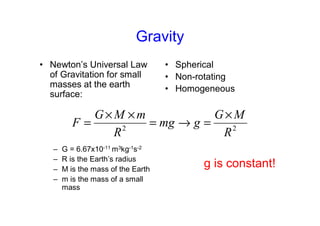
• Newton’s Universal Law
of Gravitation for small
masses at the earth
surface:
– G = 6.67x10⁻¹¹ m3kg-1s-2
– R is the Earth’s radius
– M is the mass of the Earth
– m is the mass of a small
mass
• Spherical
• Non-rotating
• Homogeneous
g is constant!
2
2
R
M
G
g
mg
R
m
M
G
F
×
=
→
=
×
×
=
Gravity
• Non-spherical Ellipse of rotation
• Rotating Centrifugal forces
• Non-homogeneous Subsurface
heterogeneities
Disturbances in the acceleration
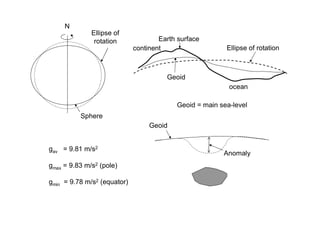
N
Sphere
Ellipse of
rotation
gav = 9.81 m/s2
gmax = 9.83 m/s2 (pole)
gmin = 9.78 m/s2 (equator)
Earth surface
continent
ocean
Ellipse of rotation
Geoid
Geoid = main sea-level
Geoid
Anomaly
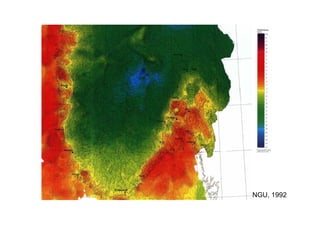
NGU, 1992
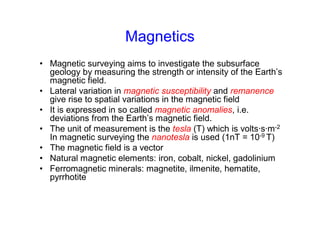
Magnetics
• Magnetic surveying aims to investigate the subsurface
geology by measuring the strength or intensity of the Earth’s
magnetic field.
• Lateral variation in magnetic susceptibility and remanence
give rise to spatial variations in the magnetic field
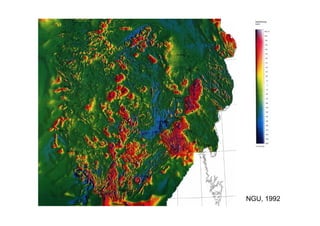
• It is expressed in so called magnetic anomalies, i.e.
deviations from the Earth’s magnetic field.
• The unit of measurement is the tesla (T) which is volts·s·m-2
In magnetic surveying the nanotesla is used (1nT = 10-9 T)
• The magnetic field is a vector
• Natural magnetic elements: iron, cobalt, nickel, gadolinium
• Ferromagnetic minerals: magnetite, ilmenite, hematite,
pyrrhotite
Magnetics
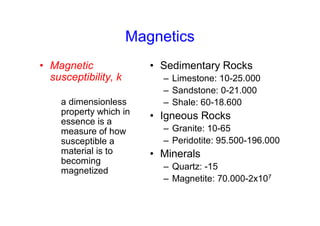
• Magnetic
susceptibility, k
a dimensionless
property which in
essence is a
measure of how
susceptible a
material is to
becoming
magnetized
• Sedimentary Rocks
– Limestone: 10-25.000
– Sandstone: 0-21.000
– Shale: 60-18.600
• Igneous Rocks
– Granite: 10-65
– Peridotite: 95.500-196.000
• Minerals
– Quartz: -15
– Magnetite: 70.000-2x10⁷
Magnetics
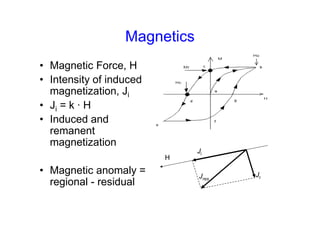
• Magnetic Force, H
• Intensity of induced
magnetization, Ji
• Ji = k · H
• Induced and
remanent
magnetization
• Magnetic anomaly =
regional - residual
H
Ji
Jres
Jr
NGU, 1992
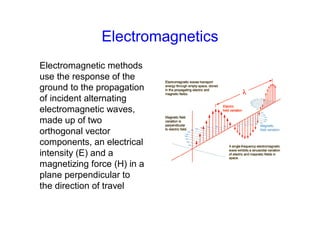
Electromagnetics
Electromagnetic methods
use the response of the
ground to the propagation
of incident alternating
electromagnetic waves,
made up of two
orthogonal vector
components, an electrical
intensity (E) and a
magnetizing force (H) in a
plane perpendicular to
the direction of travel
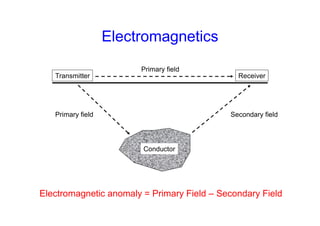
Electromagnetics
Transmitter Receiver
Primary field Secondary field
Conductor
Primary field
Electromagnetic anomaly = Primary Field – Secondary Field
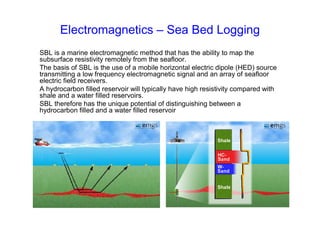
Electromagnetics – Sea Bed Logging
SBL is a marine electromagnetic method that has the ability to map the
subsurface resistivity remotely from the seafloor.
The basis of SBL is the use of a mobile horizontal electric dipole (HED) source
transmitting a low frequency electromagnetic signal and an array of seafloor
electric field receivers.
A hydrocarbon filled reservoir will typically have high resistivity compared with
shale and a water filled reservoirs.
SBL therefore has the unique potential of distinguishing between a
hydrocarbon filled and a water filled reservoir
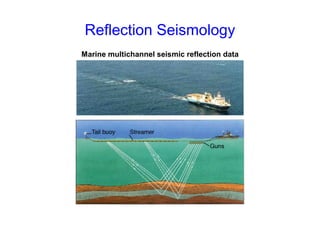
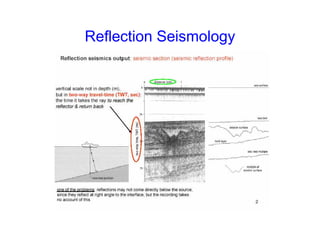
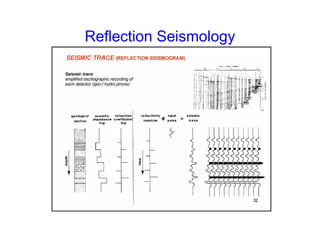
Marine multichannel seismic reflection data
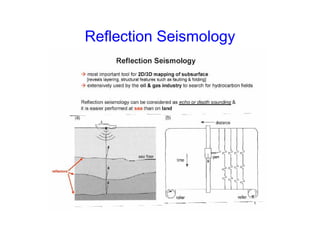
Reflection Seismology
1
2
1
2
1
1
2
2
1
1
2
2
Z
Z
Z
Z
v
v
v
v
R
+
−
=
+
−
=
ρ
ρ
ρ
ρ
Incident ray
Amplitude: A0
Reflected ray
Amplitude: A1
Transmitted ray
Amplitude: A2
ρ1, v1
ρ2, v2
ρ2, v2 ≠ ρ1, v1
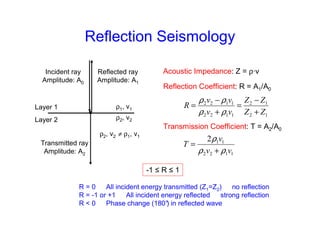
Acoustic Impedance: Z = ρ·v
Reflection Coefficient: R = A1/A0
R = 0 All incident energy transmitted (Z1=Z2) no reflection
R = -1 or +1 All incident energy reflected strong reflection
R < 0 Phase change (180°
) in reflected wave
Layer 1
Layer 2
Transmission Coefficient: T = A2/A0
1
1
2
2
1
1
2
v
v
v
T
ρ
ρ
ρ
+
=
-1 ≤ R ≤ 1
Reflection Seismology
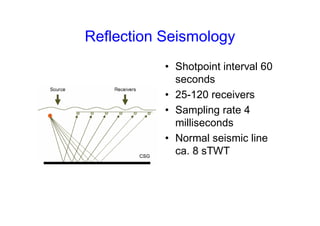
• Shotpoint interval 60
seconds
• 25-120 receivers
• Sampling rate 4
milliseconds
• Normal seismic line
ca. 8 sTWT
Reflection Seismology
Sedimentary Basins
• Hydrocarbon provinces are found in sedimentary basins
• Important to know how basins are formed
• Basin Analysis
– Hydrocarbon traps
– Stratigraphy of
• Source rock
• Reservoir rock
• Cap rock
– Maturation of source rocks
– Migration path-ways
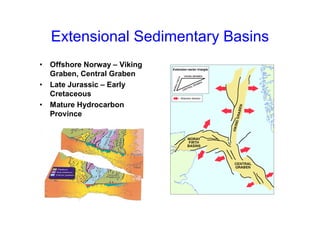
Extensional Sedimentary Basins
• Offshore Norway – Viking
Graben, Central Graben
• Late Jurassic – Early
Cretaceous
• Mature Hydrocarbon
Province
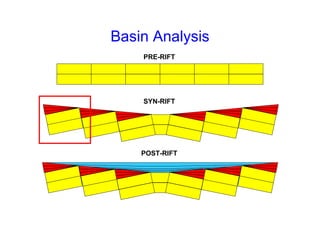
Basin Analysis
PRE-RIFT
SYN-RIFT
POST-RIFT
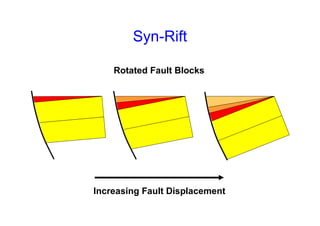
Syn-Rift
Rotated Fault Blocks
Increasing Fault Displacement
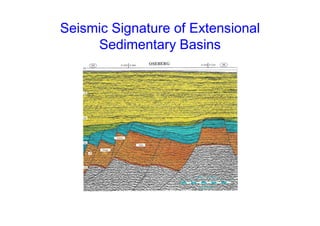
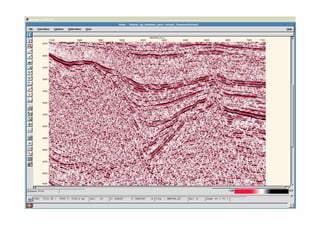
Seismic Signature of Extensional
Sedimentary Basins
INTRODUCTION TO EXERCISE
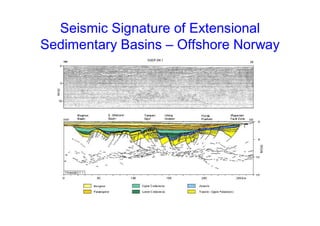
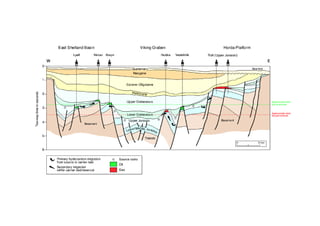
Seismic Signature of Extensional
Sedimentary Basins – Offshore Norway
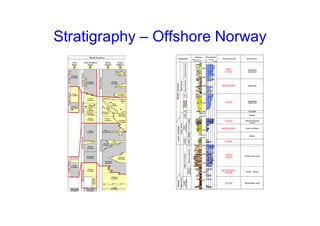
Stratigraphy – Offshore Norway
Summary Offshore Norway
• Main Rifting Event: Late-Jurassic – Early
Cretaceous
• Structural Traps – Fault bounded
• Main Reservoir: Upper Triassic – Middle
Jurassic, containing Tarbert, Ness,
Rannoch, Cook, Statfjord and Lunde Fms.
• Source Rock: Upper Jurassic, Heather Fm
• Cap Rock: Early Cretaceous
Exercise
• Interprete seismic line NVGTI92-105
• Interprete pre-, syn- and post-rift
sequences
• Interprete possible hydrocarbon traps
• Point out source-, reservoir, and cap-rock

Geophysical methods

  • 1.
    Introduction to Petroleum Geologyand Geophysics Geophysical Methods in Hydrocarbon Exploration GEO4210
  • 2.
    About this partof the course • Purpose: to give an overview of the basic geophysical methods used in hydrocarbon exploration • Working Plan: – Lecture: Principles + Intro to Exercise – Practical: Seismic Interpretation excercise
  • 3.
    Lecture Contents • GeophysicalMethods • Theory / Principles • Extensional Sedimentary Basins and its Seismic Signature • Introduction to the Exercise
  • 4.
    Geophysical methods • Passive: Methodusing the natural fields of the Earth, e.g. gravity and magnetic • Active: Method that requires the input of artificially generated energy, e.g. seismic reflection • The objective of geophysics is to locate or detect the presence of subsurface structures or bodies and determine their size, shape, depth, and physical properties (density, velocity, porosity…) + fluid content
  • 5.
    Geophysical methods Density Spatial variationsin the strength of the gravitational field of the Earth Gravity Seismic velocity (and density) Travel times of reflected/refracted seismic waves Seismic Electric conductivity/resistivity and inductance Response to electromagnetic radiation Electromagnetic (SeaBed Logging) Magnetic susceptibility and remanence Spatial variations in the strength of the geomagnetic field Magnetic “Operative” physical property Measured parameter Method
  • 6.
    Further reading • Keary,P. & Brooks, M. (1991) An Introduction to Geophysical Exploration. Blackwell Scientific Publications. • Mussett, A.E. & Khan, M. (2000) Looking into the Earth – An Introduction to Geological Geophysics. Cambridge University Press. • McQuillin, R., Bacon, M. & Barclay, W. (1984) An Introduction to Seismic Interpretation – Reflection Seismics in Petroleum Exploration. Graham & Trotman. • Badley, M.E. (1985) Practical Seismic Interpretation. D. Reidel Publishing Company. http://www.learninggeoscience.net/modules.php
  • 7.
    Gravity • Gravity surveyingmeasures spatial variations in the Earth’s gravitational field caused by differences in the density of sub-surface rocks • In fact, it measures the variation in the accelaration due to gravity • It is expressed in so called gravity anomalies (in milligal, 10-5 ms-2), i.e. deviations from a predefined reference level, geoid (a surface over which the gravitational field has equal value) • Gravity is a scalar
  • 8.
    Gravity • Newton’s UniversalLaw of Gravitation for small masses at the earth surface: – G = 6.67x10⁻¹¹ m3kg-1s-2 – R is the Earth’s radius – M is the mass of the Earth – m is the mass of a small mass • Spherical • Non-rotating • Homogeneous g is constant! 2 2 R M G g mg R m M G F × = → = × × =
  • 9.
    Gravity • Non-spherical Ellipseof rotation • Rotating Centrifugal forces • Non-homogeneous Subsurface heterogeneities Disturbances in the acceleration
  • 10.
    N Sphere Ellipse of rotation gav =9.81 m/s2 gmax = 9.83 m/s2 (pole) gmin = 9.78 m/s2 (equator) Earth surface continent ocean Ellipse of rotation Geoid Geoid = main sea-level Geoid Anomaly
  • 11.
  • 12.
    Magnetics • Magnetic surveyingaims to investigate the subsurface geology by measuring the strength or intensity of the Earth’s magnetic field. • Lateral variation in magnetic susceptibility and remanence give rise to spatial variations in the magnetic field • It is expressed in so called magnetic anomalies, i.e. deviations from the Earth’s magnetic field. • The unit of measurement is the tesla (T) which is volts·s·m-2 In magnetic surveying the nanotesla is used (1nT = 10-9 T) • The magnetic field is a vector • Natural magnetic elements: iron, cobalt, nickel, gadolinium • Ferromagnetic minerals: magnetite, ilmenite, hematite, pyrrhotite
  • 13.
    Magnetics • Magnetic susceptibility, k adimensionless property which in essence is a measure of how susceptible a material is to becoming magnetized • Sedimentary Rocks – Limestone: 10-25.000 – Sandstone: 0-21.000 – Shale: 60-18.600 • Igneous Rocks – Granite: 10-65 – Peridotite: 95.500-196.000 • Minerals – Quartz: -15 – Magnetite: 70.000-2x10⁷
  • 14.
    Magnetics • Magnetic Force,H • Intensity of induced magnetization, Ji • Ji = k · H • Induced and remanent magnetization • Magnetic anomaly = regional - residual H Ji Jres Jr
  • 15.
  • 16.
    Electromagnetics Electromagnetic methods use theresponse of the ground to the propagation of incident alternating electromagnetic waves, made up of two orthogonal vector components, an electrical intensity (E) and a magnetizing force (H) in a plane perpendicular to the direction of travel
  • 17.
    Electromagnetics Transmitter Receiver Primary fieldSecondary field Conductor Primary field Electromagnetic anomaly = Primary Field – Secondary Field
  • 18.
    Electromagnetics – SeaBed Logging SBL is a marine electromagnetic method that has the ability to map the subsurface resistivity remotely from the seafloor. The basis of SBL is the use of a mobile horizontal electric dipole (HED) source transmitting a low frequency electromagnetic signal and an array of seafloor electric field receivers. A hydrocarbon filled reservoir will typically have high resistivity compared with shale and a water filled reservoirs. SBL therefore has the unique potential of distinguishing between a hydrocarbon filled and a water filled reservoir
  • 19.
    Marine multichannel seismicreflection data Reflection Seismology
  • 20.
  • 21.
  • 22.
    Reflection Seismology 1 2 1 2 1 1 2 2 1 1 2 2 Z Z Z Z v v v v R + − = + − = ρ ρ ρ ρ Incident ray Amplitude:A0 Reflected ray Amplitude: A1 Transmitted ray Amplitude: A2 ρ1, v1 ρ2, v2 ρ2, v2 ≠ ρ1, v1 Acoustic Impedance: Z = ρ·v Reflection Coefficient: R = A1/A0 R = 0 All incident energy transmitted (Z1=Z2) no reflection R = -1 or +1 All incident energy reflected strong reflection R < 0 Phase change (180° ) in reflected wave Layer 1 Layer 2 Transmission Coefficient: T = A2/A0 1 1 2 2 1 1 2 v v v T ρ ρ ρ + = -1 ≤ R ≤ 1
  • 23.
    Reflection Seismology • Shotpointinterval 60 seconds • 25-120 receivers • Sampling rate 4 milliseconds • Normal seismic line ca. 8 sTWT
  • 24.
  • 25.
    Sedimentary Basins • Hydrocarbonprovinces are found in sedimentary basins • Important to know how basins are formed • Basin Analysis – Hydrocarbon traps – Stratigraphy of • Source rock • Reservoir rock • Cap rock – Maturation of source rocks – Migration path-ways
  • 26.
    Extensional Sedimentary Basins •Offshore Norway – Viking Graben, Central Graben • Late Jurassic – Early Cretaceous • Mature Hydrocarbon Province
  • 27.
  • 28.
  • 29.
    Seismic Signature ofExtensional Sedimentary Basins
  • 31.
  • 32.
    Seismic Signature ofExtensional Sedimentary Basins – Offshore Norway
  • 33.
  • 35.
    Summary Offshore Norway •Main Rifting Event: Late-Jurassic – Early Cretaceous • Structural Traps – Fault bounded • Main Reservoir: Upper Triassic – Middle Jurassic, containing Tarbert, Ness, Rannoch, Cook, Statfjord and Lunde Fms. • Source Rock: Upper Jurassic, Heather Fm • Cap Rock: Early Cretaceous
  • 36.
    Exercise • Interprete seismicline NVGTI92-105 • Interprete pre-, syn- and post-rift sequences • Interprete possible hydrocarbon traps • Point out source-, reservoir, and cap-rock