SEMINAR ON
REFLECTING METHOD
OF SEISMIC
PROSPECTING
CONTENTS
 INTRODUCTION
 SEISMIC PROSPECTING
 TYPES OF SEISMIC WAVES
 VELOCITIES OF SEISMIC WAVES IN ROCKS
 SEISMIC REFLECTING METHOD
 APPLICATIONS
 CONCLUSION
 REFERENCES
19/4/2013 2
INTRODUCTION
PROSPECTING is the first stage of the geological analysis,
physical search for hydrocarbons, minerals, fossils, precious metals or
mineral specimens, and is also known as fossicking.
GEOPHYSICAL PROSPECTING is the study of the structure of the
earth’s crust by physical methods for the location and surveying of
minerals, it is an integral part of geophysics.
GEOPHYSICAL PROSPECTING TECHNIQUES:
 Seismic method.
 Gravity method.
 Magnetic method.
 Electrical method.
 Radioactive method.
 Well logging method
 Electromagnetic method
19/4/2013 3
Prospecting based on the analysis of elastic waves generated in the
earth by artificial means.
The elastic waves produced during sudden disturbance is called as
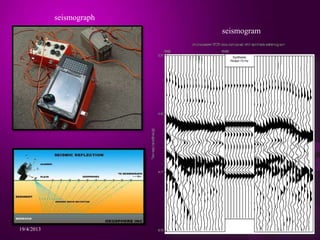
Seismic wave. These seismic waves are recorded using the instrument
Seismograph and the record obtained is Seismogram.
It is an important geophysical prospecting applied in exploration
of oil and natural gas deposits, deep ground water exploration, depth
estimation, geotechnical problems.
Seismic prospecting can be done by two methods
1. Reflection method
2. Refraction method
SEISMIC PROSPECTING
19/4/2013 4
TYPES OF SEISMIC WAVES
Seismic wave are classified in to the following
1. Compressional or Longitudinal or primary waves (P waves)
2. Shear or Transverse or secondary wave (S wave)
3. Surface waves (L wave)
19/4/2013 5
Motion of the particles in a medium is parallel to direction of
propagation of the wave. It has the highest velocity and is therefore
the first to be recorded, These waves can travel through any type
of material, including fluids. It is formed from
alternating compressions and expansions.
COMPRESSIONAL OR
LONGITUDINAL OR PRIMARY
WAVES (P WAVES)
19/4/2013 6
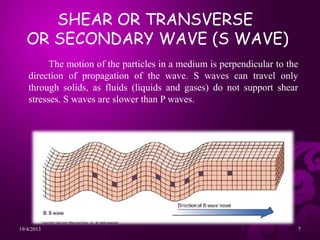
The motion of the particles in a medium is perpendicular to the
direction of propagation of the wave. S waves can travel only
through solids, as fluids (liquids and gases) do not support shear
stresses. S waves are slower than P waves.
SHEAR OR TRANSVERSE
OR SECONDARY WAVE (S WAVE)
19/4/2013 7
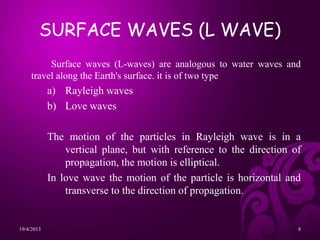
SURFACE WAVES (L WAVE)
Surface waves (L-waves) are analogous to water waves and
travel along the Earth's surface. it is of two type
a) Rayleigh waves
b) Love waves
The motion of the particles in Rayleigh wave is in a
vertical plane, but with reference to the direction of
propagation, the motion is elliptical.
In love wave the motion of the particle is horizontal and
transverse to the direction of propagation.
19/4/2013 8
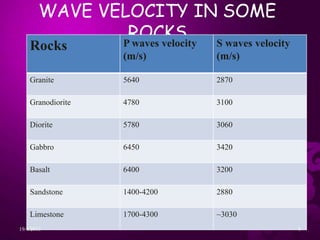
WAVE VELOCITY IN SOME
ROCKS
Rocks P waves velocity
(m/s)
S waves velocity
(m/s)
Granite 5640 2870
Granodiorite 4780 3100
Diorite 5780 3060
Gabbro 6450 3420
Basalt 6400 3200
Sandstone 1400-4200 2880
Limestone 1700-4300 ~3030
19/4/2013 9
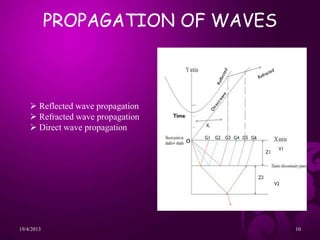
PROPAGATION OF WAVES
19/4/2013 10
 Reflected wave propagation
 Refracted wave propagation
 Direct wave propagation
SEISMIC REFLECTING
METHOD
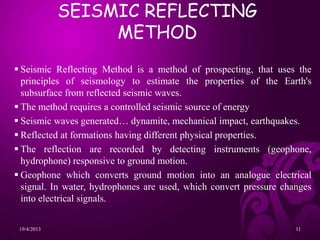
 Seismic Reflecting Method is a method of prospecting, that uses the
principles of seismology to estimate the properties of the Earth's
subsurface from reflected seismic waves.
 The method requires a controlled seismic source of energy
 Seismic waves generated… dynamite, mechanical impact, earthquakes.
 Reflected at formations having different physical properties.
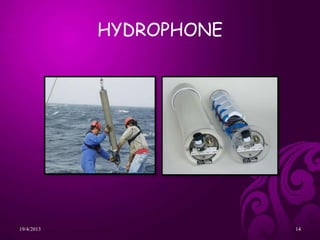
 The reflection are recorded by detecting instruments (geophone,
hydrophone) responsive to ground motion.
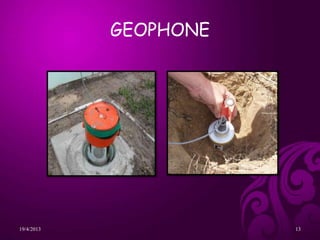
 Geophone which converts ground motion into an analogue electrical
signal. In water, hydrophones are used, which convert pressure changes
into electrical signals.
19/4/2013 11
seismograph
seismogram
19/4/2013 12
GEOPHONE
19/4/2013 13
HYDROPHONE
19/4/2013 14
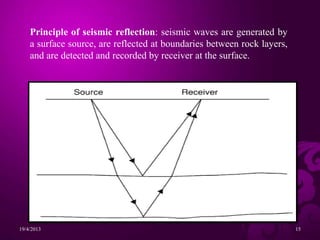
Principle of seismic reflection: seismic waves are generated by
a surface source, are reflected at boundaries between rock layers,
and are detected and recorded by receiver at the surface.
19/4/2013 15
SEISMIC SURVEY
• Seismic surveys use vibration induced by a sound
generating equipment to provide a picture of subterranean rock
formations found at depth [30,000 feet below ground level (BGL)].
This is accomplished by generating sound waves downward into the
earth's crust which are reflected through various boundaries between
different rock strata. On land, the sound waves are generated by
small explosive charges embedded in the ground or by vibrator
trucks, referred to as thumpers which shake the ground.
• The human ear can barely hear the thump, but the
frequency generated penetrates the earth's crust. The echoes are
detected by electronic devices called geophones which receive the
reflected sound waves and the data are recorded on magnetic tape
which is printed to produce a two-dimensional graphic data through
which illustration of the subsurface can be done.
19/4/2013 16
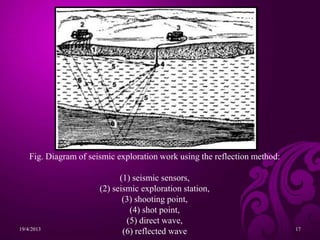
Fig. Diagram of seismic exploration work using the reflection method:
(1) seismic sensors,
(2) seismic exploration station,
(3) shooting point,
(4) shot point,
(5) direct wave,
(6) reflected wave
19/4/2013 17
Calculation of depth
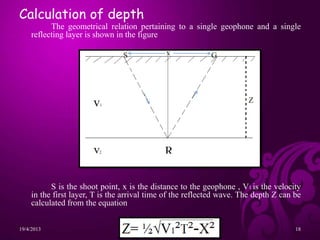
The geometrical relation pertaining to a single geophone and a single
reflecting layer is shown in the figure
S is the shoot point, x is the distance to the geophone , V1 is the velocity
in the first layer, T is the arrival time of the reflected wave. The depth Z can be
calculated from the equation
19/4/2013 18
S G
Z
x
APPLICATIONS
Reflection seismology is used extensively in a number of fields and
its applications can be categorized into three groups, each defined by
their depth of investigation:
 Near-surface applications – to understand geology at depths of up to
approximately 1 km, used for engineering and environmental surveys, as
well as coal and mineral exploration, for geothermal energy surveys.
 Hydrocarbon exploration: Hydrocarbon exploration used by the
hydrocarbon industry to provide a high resolution map of acoustic
impedance contrasts at depths of up to 10 km within the subsurface.
 Crustal studies – investigation of the structure and origin of the Earth's
crust, through to the Mohorovicic discontinuity and beyond, at depths of
up to 100 km.
19/4/2013 19
CONCLUSION
• GEOPHYSICAL PROSPECTING : The study of the structure of the
earth’s crust by physical methods for the location and surveying of
minerals.
• Seismic prospecting can be done by two methods, reflection and
refraction seismic method.
• Seismic Reflecting Method is a method of prospecting, that uses the
principles of seismology to estimate the properties of the Earth's
subsurface from reflected seismic waves.
• Reflection seismology is used in three types of applications:-
Near-surface applications, Hydrocarbon exploration, Crustal studies.
19/4/2013 20
REFERENCE
• Milton. B. Dobrin, Introduction to Geophysical
prospecting, Third edition, McGaaw-Hill Book Company,
pp:292-338.
• M.B. Ramachandra Rao, Outlines of Geophysical
prospecting- A manual for Geologists, Prasaranga Mysore,
pp:243-264.
Websites:
http://en.wikipedia.org/wiki/Reflection_seismology
http://aspire.cosmic-ray.org/labs/seismic/index.htm
www.zonge.com/PDF_Papers/GeophysicalProspec
tingMethods.pdf
19/4/2013 21
Thanks . . .
19/4/2013 22

reflectingmethodofseismicprospecting-170911184242.pdf

  • 1.
  • 2.
    CONTENTS  INTRODUCTION  SEISMICPROSPECTING  TYPES OF SEISMIC WAVES  VELOCITIES OF SEISMIC WAVES IN ROCKS  SEISMIC REFLECTING METHOD  APPLICATIONS  CONCLUSION  REFERENCES 19/4/2013 2
  • 3.
    INTRODUCTION PROSPECTING is thefirst stage of the geological analysis, physical search for hydrocarbons, minerals, fossils, precious metals or mineral specimens, and is also known as fossicking. GEOPHYSICAL PROSPECTING is the study of the structure of the earth’s crust by physical methods for the location and surveying of minerals, it is an integral part of geophysics. GEOPHYSICAL PROSPECTING TECHNIQUES:  Seismic method.  Gravity method.  Magnetic method.  Electrical method.  Radioactive method.  Well logging method  Electromagnetic method 19/4/2013 3
  • 4.
    Prospecting based onthe analysis of elastic waves generated in the earth by artificial means. The elastic waves produced during sudden disturbance is called as Seismic wave. These seismic waves are recorded using the instrument Seismograph and the record obtained is Seismogram. It is an important geophysical prospecting applied in exploration of oil and natural gas deposits, deep ground water exploration, depth estimation, geotechnical problems. Seismic prospecting can be done by two methods 1. Reflection method 2. Refraction method SEISMIC PROSPECTING 19/4/2013 4
  • 5.
    TYPES OF SEISMICWAVES Seismic wave are classified in to the following 1. Compressional or Longitudinal or primary waves (P waves) 2. Shear or Transverse or secondary wave (S wave) 3. Surface waves (L wave) 19/4/2013 5
  • 6.
    Motion of theparticles in a medium is parallel to direction of propagation of the wave. It has the highest velocity and is therefore the first to be recorded, These waves can travel through any type of material, including fluids. It is formed from alternating compressions and expansions. COMPRESSIONAL OR LONGITUDINAL OR PRIMARY WAVES (P WAVES) 19/4/2013 6
  • 7.
    The motion ofthe particles in a medium is perpendicular to the direction of propagation of the wave. S waves can travel only through solids, as fluids (liquids and gases) do not support shear stresses. S waves are slower than P waves. SHEAR OR TRANSVERSE OR SECONDARY WAVE (S WAVE) 19/4/2013 7
  • 8.
    SURFACE WAVES (LWAVE) Surface waves (L-waves) are analogous to water waves and travel along the Earth's surface. it is of two type a) Rayleigh waves b) Love waves The motion of the particles in Rayleigh wave is in a vertical plane, but with reference to the direction of propagation, the motion is elliptical. In love wave the motion of the particle is horizontal and transverse to the direction of propagation. 19/4/2013 8
  • 9.
    WAVE VELOCITY INSOME ROCKS Rocks P waves velocity (m/s) S waves velocity (m/s) Granite 5640 2870 Granodiorite 4780 3100 Diorite 5780 3060 Gabbro 6450 3420 Basalt 6400 3200 Sandstone 1400-4200 2880 Limestone 1700-4300 ~3030 19/4/2013 9
  • 10.
    PROPAGATION OF WAVES 19/4/201310  Reflected wave propagation  Refracted wave propagation  Direct wave propagation
  • 11.
    SEISMIC REFLECTING METHOD  SeismicReflecting Method is a method of prospecting, that uses the principles of seismology to estimate the properties of the Earth's subsurface from reflected seismic waves.  The method requires a controlled seismic source of energy  Seismic waves generated… dynamite, mechanical impact, earthquakes.  Reflected at formations having different physical properties.  The reflection are recorded by detecting instruments (geophone, hydrophone) responsive to ground motion.  Geophone which converts ground motion into an analogue electrical signal. In water, hydrophones are used, which convert pressure changes into electrical signals. 19/4/2013 11
  • 12.
  • 13.
  • 14.
  • 15.
    Principle of seismicreflection: seismic waves are generated by a surface source, are reflected at boundaries between rock layers, and are detected and recorded by receiver at the surface. 19/4/2013 15
  • 16.
    SEISMIC SURVEY • Seismicsurveys use vibration induced by a sound generating equipment to provide a picture of subterranean rock formations found at depth [30,000 feet below ground level (BGL)]. This is accomplished by generating sound waves downward into the earth's crust which are reflected through various boundaries between different rock strata. On land, the sound waves are generated by small explosive charges embedded in the ground or by vibrator trucks, referred to as thumpers which shake the ground. • The human ear can barely hear the thump, but the frequency generated penetrates the earth's crust. The echoes are detected by electronic devices called geophones which receive the reflected sound waves and the data are recorded on magnetic tape which is printed to produce a two-dimensional graphic data through which illustration of the subsurface can be done. 19/4/2013 16
  • 17.
    Fig. Diagram ofseismic exploration work using the reflection method: (1) seismic sensors, (2) seismic exploration station, (3) shooting point, (4) shot point, (5) direct wave, (6) reflected wave 19/4/2013 17
  • 18.
    Calculation of depth Thegeometrical relation pertaining to a single geophone and a single reflecting layer is shown in the figure S is the shoot point, x is the distance to the geophone , V1 is the velocity in the first layer, T is the arrival time of the reflected wave. The depth Z can be calculated from the equation 19/4/2013 18 S G Z x
  • 19.
    APPLICATIONS Reflection seismology isused extensively in a number of fields and its applications can be categorized into three groups, each defined by their depth of investigation:  Near-surface applications – to understand geology at depths of up to approximately 1 km, used for engineering and environmental surveys, as well as coal and mineral exploration, for geothermal energy surveys.  Hydrocarbon exploration: Hydrocarbon exploration used by the hydrocarbon industry to provide a high resolution map of acoustic impedance contrasts at depths of up to 10 km within the subsurface.  Crustal studies – investigation of the structure and origin of the Earth's crust, through to the Mohorovicic discontinuity and beyond, at depths of up to 100 km. 19/4/2013 19
  • 20.
    CONCLUSION • GEOPHYSICAL PROSPECTING: The study of the structure of the earth’s crust by physical methods for the location and surveying of minerals. • Seismic prospecting can be done by two methods, reflection and refraction seismic method. • Seismic Reflecting Method is a method of prospecting, that uses the principles of seismology to estimate the properties of the Earth's subsurface from reflected seismic waves. • Reflection seismology is used in three types of applications:- Near-surface applications, Hydrocarbon exploration, Crustal studies. 19/4/2013 20
  • 21.
    REFERENCE • Milton. B.Dobrin, Introduction to Geophysical prospecting, Third edition, McGaaw-Hill Book Company, pp:292-338. • M.B. Ramachandra Rao, Outlines of Geophysical prospecting- A manual for Geologists, Prasaranga Mysore, pp:243-264. Websites: http://en.wikipedia.org/wiki/Reflection_seismology http://aspire.cosmic-ray.org/labs/seismic/index.htm www.zonge.com/PDF_Papers/GeophysicalProspec tingMethods.pdf 19/4/2013 21
  • 22.
    Thanks . .. 19/4/2013 22