Sedation , Analgesia & Paralysis 
in ICU 
Dr.Venugopalan.P.P 
DA,DNB,MNAMS 
Chief, Emergency Medicine –MIMS 
Site Director ,Masters program in EM 
Executive director ,Angels international foundation
Objectives 
Guidelines for sedation, analgesia, and 
chemical paralysis 
Benefits of daily awakening/lightening and 
sedation titration programs 
Rational pharmacologic strategy based on 
treatment goals and co morbidities
What We Know About ICU 
Agitation/Discomfort? 
Prevalence 
• 50% incidence in those with length of stay > 24 hours 
Primary causes 
• Unrelieved pain 
• Delirium 
• Anxiety 
• Sleep deprivation.
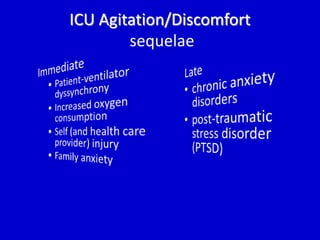
ICU Agitation/Discomfort 
sequelae
Recall in the ICU 
Some degree of recall occurs in up to 70% of 
ICU patients. 
• Anxiety, fear, pain, panic, agony, or nightmares reported in 90% of those who 
did have recall. 
Potentially cruel: 
• Up to 36% recalled some aspect of paralysis. 
Associated with PTSD in ARDS? 
• 41% risk of recall of two or more traumatic experiences. 
Associated with PTSD in cardiac surgery
Appropriate Recall May be Important 
Factual memories help to put ICU experience 
into perspective 
Delusional memories cause panic attacks 
and PTSD 
The optimal level of sedation for most 
patients - Offers comfort while allowing for 
interaction with the environment.
Why sedation in ICU? 
• Anxiety 
• Pain 
• Acute confusional status 
• Mechanical ventilation 
• Treatment or diagnostic procedures 
• Psychological response to stress
Sedation Goal 
• Patient comfort 
• Control of pain 
• Anxiolysis and 
amnesia 
• Blunting adverse 
autonomic and 
hemodynamic 
responses 
• Facilitate nursing 
management 
• Facilitate mechanical 
ventilation 
• Avoid self-extubation 
• Reduce oxygen 
consumption
Ideal sedation agents 
• No respiratory 
depression 
• Analgesia 
• Rapid onset, 
titratable, with a 
short 
elimination half-time 
• Sedation with 
ease of 
orientation and 
arousability 
• Anxiolytic 
• Hemodynamic 
stability
The Challenges 
• Assessment of sedation 
• Altered pharmacology 
• Tolerance 
• Delayed emergence 
• Withdrawal 
• Drug interaction
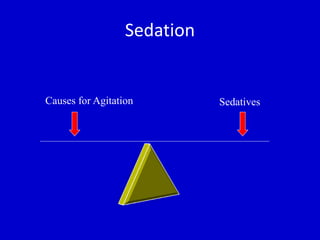
Sedation 
Causes for Agitation Sedatives
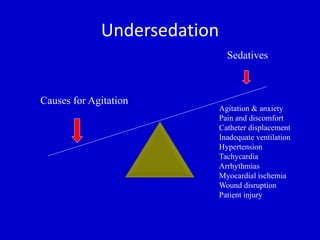
Undersedation 
Sedatives 
Causes for Agitation 
Agitation & anxiety 
Pain and discomfort 
Catheter displacement 
Inadequate ventilation 
Hypertension 
Tachycardia 
Arrhythmias 
Myocardial ischemia 
Wound disruption 
Patient injury
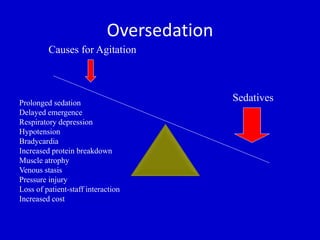
Oversedation 
Sedatives 
Causes for Agitation 
Prolonged sedation 
Delayed emergence 
Respiratory depression 
Hypotension 
Bradycardia 
Increased protein breakdown 
Muscle atrophy 
Venous stasis 
Pressure injury 
Loss of patient-staff interaction 
Increased cost
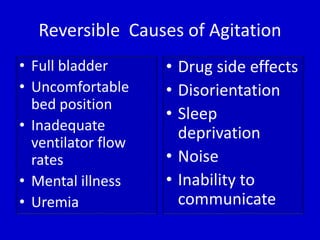
Reversible Causes of Agitation 
• Full bladder 
• Uncomfortable 
bed position 
• Inadequate 
ventilator flow 
rates 
• Mental illness 
• Uremia 
• Drug side effects 
• Disorientation 
• Sleep 
deprivation 
• Noise 
• Inability to 
communicate
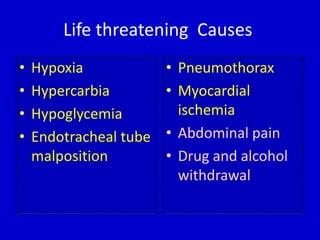
Life threatening Causes 
• Hypoxia 
• Hypercarbia 
• Hypoglycemia 
• Endotracheal tube 
malposition 
• Pneumothorax 
• Myocardial 
ischemia 
• Abdominal pain 
• Drug and alcohol 
withdrawal
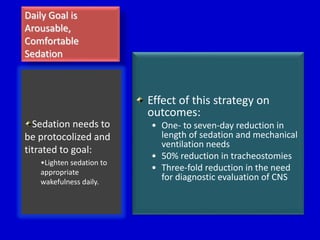
Daily Goal is 
Arousable, 
Comfortable 
Sedation 
Effect of this strategy on 
outcomes: 
• One- to seven-day reduction in 
length of sedation and mechanical 
ventilation needs 
• 50% reduction in tracheostomies 
• Three-fold reduction in the need 
for diagnostic evaluation of CNS 
Sedation needs to 
be protocolized and 
titrated to goal: 
•Lighten sedation to 
appropriate 
wakefulness daily.
Protocols and Assessment Tools 
Sedation 
o Validated sedation 
assessment tools (Ramsay 
Sedation Scale [RSS], 
o Sedation-Agitation Scale 
[SAS] 
o Richmond Sedation-agitation 
Scale [RSAS] 
No evidence that one is preferred over 
another 
Pain 
o Numeric rating scale 
[NRS] 
o Visual analogue scale 
[VAS] 
Pain assessment tools - none validated 
in ICU
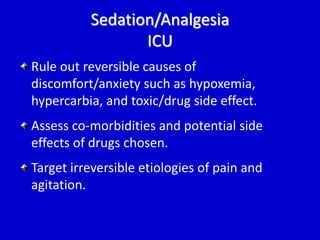
Sedation/Analgesia 
ICU 
Rule out reversible causes of 
discomfort/anxiety such as hypoxemia, 
hypercarbia, and toxic/drug side effect. 
Assess co-morbidities and potential side 
effects of drugs chosen. 
Target irreversible etiologies of pain and 
agitation.
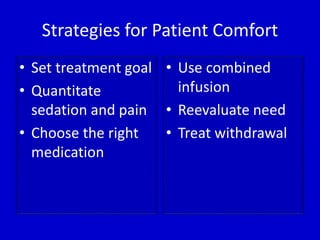
Strategies for Patient Comfort 
• Set treatment goal 
• Quantitate 
sedation and pain 
• Choose the right 
medication 
• Use combined 
infusion 
• Reevaluate need 
• Treat withdrawal
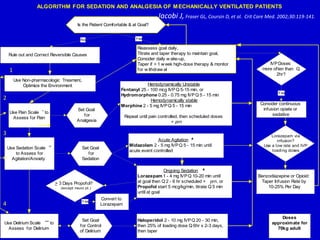
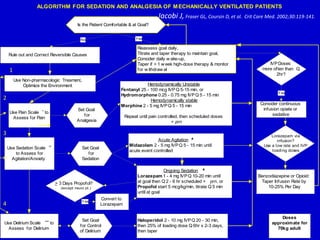
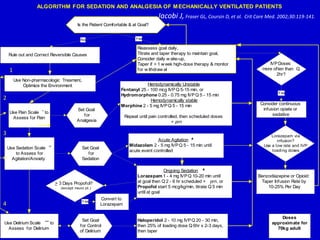
ALGORITHM FOR SEDATION AND ANALGESIA OF MECHANICALLY VENTILATED PATIENTS 
Yes 
Reassess goal daily, 
Titrate and taper therapy to maintain goal, 
Consider daily wake-up, 
Taper if > 1 week high-dose therapy & monitor 
for withdrawal 
No 
Set Goal 
for 
Analgesia 
Hemodynamically Unstable 
Fentanyl 25 - 100 mcg IVP Q 5-15 min, or 
Hydromorphone 0.25 - 0.75 mg IVP Q 5 - 15 min 
Hemodynamically stable 
Morphine 2 - 5 mg IVP Q 5 - 15 min 
Repeat until pain controlled, then scheduled doses 
+ prn 
Set Goal 
for 
Sedation 
Acute Agitation # 
Midazolam 2 - 5 mg IVP Q 5 - 15 min until 
acute event controlled 
Ongoing Sedation # 
Lorazepam 1 - 4 mg IVP Q 10-20 min until 
at goal then Q 2 - 6 hr scheduled + prn, or 
Propofol start 5 mcg/kg/min, titrate Q 5 min 
until at goal 
Set Goal 
for Control 
of Delirium 
Haloperidol 2 - 10 mg IVP Q 20 - 30 min, 
then 25% of loading dose Q 6hr x 2-3 days, 
then taper 
IVP Doses 
more of ten than Q 
2hr? 
Consider continuous 
infusion opiate or 
sedative 
> 3 Days Propofol? 
(except neuro pt.) 
Convert to 
Lorazepam 
Yes 
Benzodiazepine or Opioid: 
Taper Infusion Rate by 
10-25% Per Day 
Yes 
Doses 
approximate for 
70kg adult 
Rule out and Correct Reversible Causes 
Use Non-pharmacologic Treament, 
Optimize the Environment 
Use Pain Scale * to 
Assess for Pain 
Use Sedation Scale ** 
to Assess for 
Agitation/Anxiety 
Use Delirium Scale *** to 
Assess for Delirium 
Is the Patient Comfortable & at Goal? 
Lorazepam via 
infusion? 
Use a low rate and IVP 
loading doses 
1 
2 
3 
4 
Jacobi J, Fraser GL, Coursin D, et al. Crit Care Med. 2002;30:119-141.
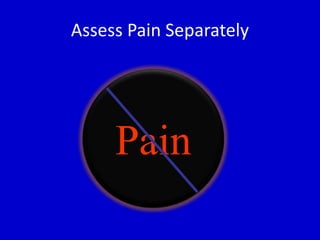
Assess Pain Separately 
Pain
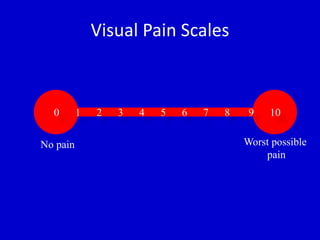
Visual Pain Scales 
0 1 2 3 4 5 6 7 8 9 10 
No pain Worst possible 
pain
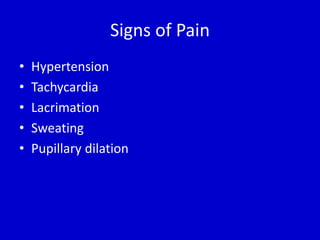
Signs of Pain 
• Hypertension 
• Tachycardia 
• Lacrimation 
• Sweating 
• Pupillary dilation
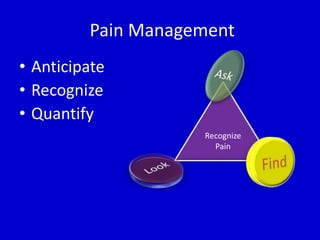
Pain Management 
• Anticipate 
• Recognize 
• Quantify 
Recognize 
Pain
Treat Pain 
oQuantify the pain perception 
oCorrect the correctable causes 
oUse appropriate analgesics 
• Remember- most sedative agents 
do not provide analgesia 
• Reassess
Non-pharmacological 
Methods 
• Proper position of the patient 
• Stabilization of fractures 
• Elimination of irritating stimulation 
• Proper positioning of the ventilator 
tubing to avoid traction on 
endotracheal tube
ALGORITHM FOR SEDATION AND ANALGESIA OF MECHANICALLY VENTILATED PATIENTS 
Yes 
Reassess goal daily, 
Titrate and taper therapy to maintain goal, 
Consider daily wake-up, 
Taper if > 1 week high-dose therapy & monitor 
for withdrawal 
No 
Set Goal 
for 
Analgesia 
Hemodynamically Unstable 
Fentanyl 25 - 100 mcg IVP Q 5-15 min, or 
Hydromorphone 0.25 - 0.75 mg IVP Q 5 - 15 min 
Hemodynamically stable 
Morphine 2 - 5 mg IVP Q 5 - 15 min 
Repeat until pain controlled, then scheduled doses 
+ prn 
Set Goal 
for 
Sedation 
Acute Agitation # 
Midazolam 2 - 5 mg IVP Q 5 - 15 min until 
acute event controlled 
Ongoing Sedation # 
Lorazepam 1 - 4 mg IVP Q 10-20 min until 
at goal then Q 2 - 6 hr scheduled + prn, or 
Propofol start 5 mcg/kg/min, titrate Q 5 min 
until at goal 
Set Goal 
for Control 
of Delirium 
Haloperidol 2 - 10 mg IVP Q 20 - 30 min, 
then 25% of loading dose Q 6hr x 2-3 days, 
then taper 
IVP Doses 
more of ten than Q 
2hr? 
Consider continuous 
infusion opiate or 
sedative 
> 3 Days Propofol? 
(except neuro pt.) 
Convert to 
Lorazepam 
Yes 
Benzodiazepine or Opioid: 
Taper Infusion Rate by 
10-25% Per Day 
Yes 
Doses 
approximate for 
70kg adult 
Rule out and Correct Reversible Causes 
Use Non-pharmacologic Treament, 
Optimize the Environment 
Use Pain Scale * to 
Assess for Pain 
Use Sedation Scale ** 
to Assess for 
Agitation/Anxiety 
Use Delirium Scale *** to 
Assess for Delirium 
Is the Patient Comfortable & at Goal? 
Lorazepam via 
infusion? 
Use a low rate and IVP 
loading doses 
1 
2 
3 
4 
Jacobi J, Fraser GL, Coursin D, et al. Crit Care Med. 2002;30:119-141.
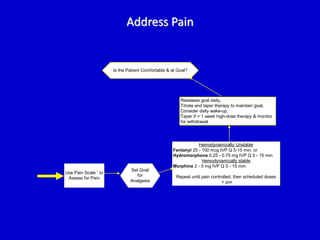
Address Pain 
Is the Patient Comfortable & at Goal? 
Set Goal 
for 
Analgesia 
Hemodynamically Unstable 
Fentanyl 25 - 100 mcg IVP Q 5-15 min, or 
Hydromorphone 0.25 - 0.75 mg IVP Q 5 - 15 min 
Hemodynamically stable 
Morphine 2 - 5 mg IVP Q 5 - 15 min 
Repeat until pain controlled, then scheduled doses 
+ prn 
Use Pain Scale * to 
Assess for Pain 
Reassess goal daily, 
Titrate and taper therapy to maintain goal, 
Consider daily wake-up, 
Taper if > 1 week high-dose therapy & monitor 
for withdrawal
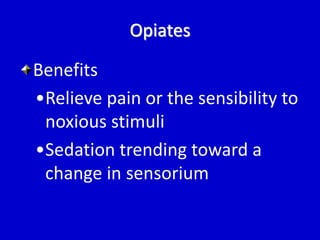
Opiates 
Benefits 
•Relieve pain or the sensibility to 
noxious stimuli 
•Sedation trending toward a 
change in sensorium
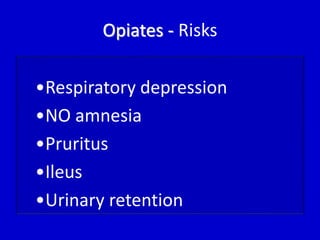
Opiates - Risks 
•Respiratory depression 
•NO amnesia 
•Pruritus 
•Ileus 
•Urinary retention
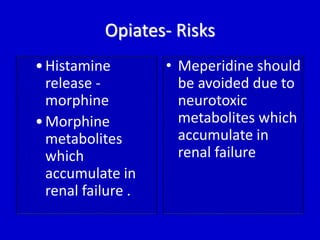
Opiates- Risks 
• Histamine 
release - 
morphine 
•Morphine 
metabolites 
which 
accumulate in 
renal failure . 
• Meperidine should 
be avoided due to 
neurotoxic 
metabolites which 
accumulate in 
renal failure
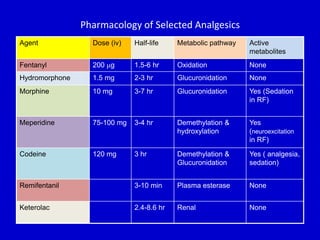
Pharmacology of Selected Analgesics 
Agent Dose (iv) Half-life Metabolic pathway Active 
metabolites 
Fentanyl 200 g 1.5-6 hr Oxidation None 
Hydromorphone 1.5 mg 2-3 hr Glucuronidation None 
Morphine 10 mg 3-7 hr Glucuronidation Yes (Sedation 
in RF) 
Meperidine 75-100 mg 3-4 hr Demethylation & 
hydroxylation 
Yes 
(neuroexcitation 
in RF) 
Codeine 120 mg 3 hr Demethylation & 
Glucuronidation 
Yes ( analgesia, 
sedation) 
Remifentanil 3-10 min Plasma esterase None 
Keterolac 2.4-8.6 hr Renal None
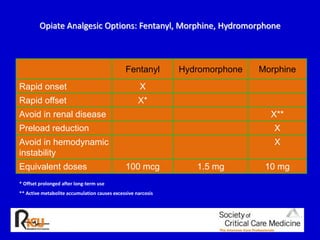
Opiate Analgesic Options: Fentanyl, Morphine, Hydromorphone 
Fentanyl Hydromorphone Morphine 
Rapid onset X 
Rapid offset X* 
Avoid in renal disease X** 
Preload reduction X 
Avoid in hemodynamic 
X 
instability 
Equivalent doses 100 mcg 1.5 mg 10 mg 
* Offset prolonged after long-term use 
** Active metabolite accumulation causes excessive narcosis
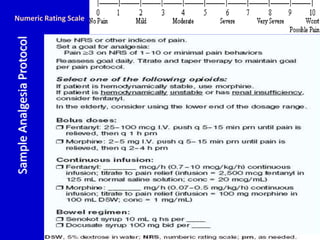
Numeric Rating Scale 
Sample Analgesia Protocol
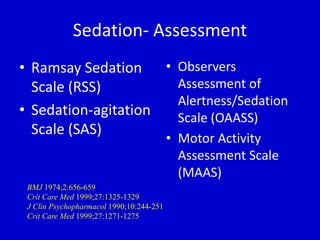
Sedation- Assessment 
• Ramsay Sedation 
Scale (RSS) 
• Sedation-agitation 
Scale (SAS) 
• Observers 
Assessment of 
Alertness/Sedation 
Scale (OAASS) 
• Motor Activity 
Assessment Scale 
(MAAS) 
BMJ 1974;2:656-659 
Crit Care Med 1999;27:1325-1329 
J Clin Psychopharmacol 1990;10:244-251 
Crit Care Med 1999;27:1271-1275
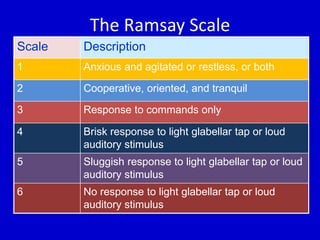
The Ramsay Scale 
Scale Description 
1 Anxious and agitated or restless, or both 
2 Cooperative, oriented, and tranquil 
3 Response to commands only 
4 Brisk response to light glabellar tap or loud 
auditory stimulus 
5 Sluggish response to light glabellar tap or loud 
auditory stimulus 
6 No response to light glabellar tap or loud 
auditory stimulus
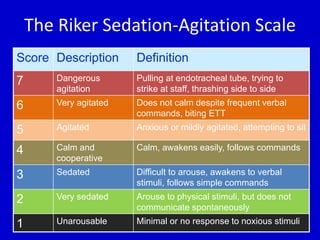
The Riker Sedation-Agitation Scale 
Score Description Definition 
7 Dangerous 
agitation 
Pulling at endotracheal tube, trying to 
strike at staff, thrashing side to side 
6 Very agitated Does not calm despite frequent verbal 
commands, biting ETT 
5 Agitated Anxious or mildly agitated, attempting to sit 
4 Calm and 
cooperative 
Calm, awakens easily, follows commands 
3 Sedated Difficult to arouse, awakens to verbal 
stimuli, follows simple commands 
2 Very sedated Arouse to physical stimuli, but does not 
communicate spontaneously 
1 Unarousable Minimal or no response to noxious stimuli
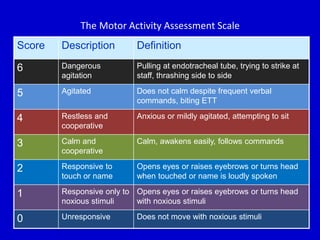
The Motor Activity Assessment Scale 
Score Description Definition 
6 Dangerous 
agitation 
Pulling at endotracheal tube, trying to strike at 
staff, thrashing side to side 
5 Agitated Does not calm despite frequent verbal 
commands, biting ETT 
4 Restless and 
cooperative 
Anxious or mildly agitated, attempting to sit 
3 Calm and 
cooperative 
Calm, awakens easily, follows commands 
2 Responsive to 
touch or name 
Opens eyes or raises eyebrows or turns head 
when touched or name is loudly spoken 
1 Responsive only to 
noxious stimuli 
Opens eyes or raises eyebrows or turns head 
with noxious stimuli 
0 Unresponsive Does not move with noxious stimuli
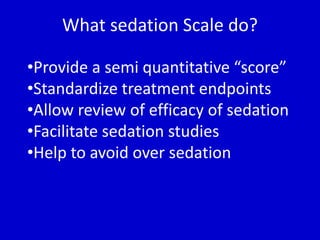
What sedation Scale do? 
•Provide a semi quantitative “score” 
•Standardize treatment endpoints 
•Allow review of efficacy of sedation 
•Facilitate sedation studies 
•Help to avoid over sedation
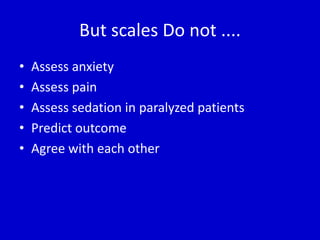
But scales Do not .... 
• Assess anxiety 
• Assess pain 
• Assess sedation in paralyzed patients 
• Predict outcome 
• Agree with each other
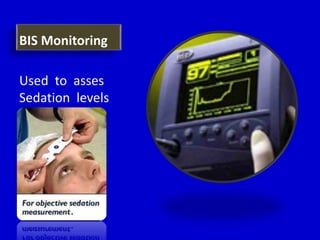
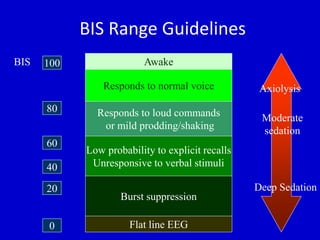
BIS Monitoring 
Used to asses 
Sedation levels
BIS Range Guidelines 
Awake 
Responds to normal voice Axiolysis 
Responds to loud commands 
or mild prodding/shaking 
Low probability to explicit recalls 
Unresponsive to verbal stimuli 
Burst suppression 
Flat line EEG 
Moderate 
sedation 
Deep Sedation 
100 
80 
60 
40 
20 
0 
BIS
ALGORITHM FOR SEDATION AND ANALGESIA OF MECHANICALLY VENTILATED PATIENTS 
Yes 
Reassess goal daily, 
Titrate and taper therapy to maintain goal, 
Consider daily wake-up, 
Taper if > 1 week high-dose therapy & monitor 
for withdrawal 
No 
Set Goal 
for 
Analgesia 
Hemodynamically Unstable 
Fentanyl 25 - 100 mcg IVP Q 5-15 min, or 
Hydromorphone 0.25 - 0.75 mg IVP Q 5 - 15 min 
Hemodynamically stable 
Morphine 2 - 5 mg IVP Q 5 - 15 min 
Repeat until pain controlled, then scheduled doses 
+ prn 
Set Goal 
for 
Sedation 
Acute Agitation # 
Midazolam 2 - 5 mg IVP Q 5 - 15 min until 
acute event controlled 
Ongoing Sedation # 
Lorazepam 1 - 4 mg IVP Q 10-20 min until 
at goal then Q 2 - 6 hr scheduled + prn, or 
Propofol start 5 mcg/kg/min, titrate Q 5 min 
until at goal 
Set Goal 
for Control 
of Delirium 
Haloperidol 2 - 10 mg IVP Q 20 - 30 min, 
then 25% of loading dose Q 6hr x 2-3 days, 
then taper 
IVP Doses 
more of ten than Q 
2hr? 
Consider continuous 
infusion opiate or 
sedative 
> 3 Days Propofol? 
(except neuro pt.) 
Convert to 
Lorazepam 
Yes 
Benzodiazepine or Opioid: 
Taper Infusion Rate by 
10-25% Per Day 
Yes 
Doses 
approximate for 
70kg adult 
Rule out and Correct Reversible Causes 
Use Non-pharmacologic Treament, 
Optimize the Environment 
Use Pain Scale * to 
Assess for Pain 
Use Sedation Scale ** 
to Assess for 
Agitation/Anxiety 
Use Delirium Scale *** to 
Assess for Delirium 
Is the Patient Comfortable & at Goal? 
Lorazepam via 
infusion? 
Use a low rate and IVP 
loading doses 
1 
2 
3 
4 
Jacobi J, Fraser GL, Coursin D, et al. Crit Care Med. 2002;30:119-141.
Set Goal 
for 
Sedation 
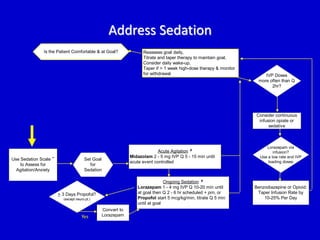
Address Sedation 
Acute Agitation # 
Midazolam 2 - 5 mg IVP Q 5 - 15 min until 
acute event controlled 
Ongoing Sedation # 
Lorazepam 1 - 4 mg IVP Q 10-20 min until 
at goal then Q 2 - 6 hr scheduled + prn, or 
Propofol start 5 mcg/kg/min, titrate Q 5 min 
until at goal 
IVP Doses 
more often than Q 
2hr? 
Consider continuous 
infusion opiate or 
sedative 
> 3 Days Propofol? 
(except neuro pt.) 
Convert to 
Lorazepam 
Benzodiazepine or Opioid: 
Taper Infusion Rate by 
10-25% Per Day 
Use Sedation Scale ** 
to Assess for 
Agitation/Anxiety 
Lorazepam via 
infusion? 
Use a low rate and IVP 
loading doses 
Yes 
Reassess goal daily, 
Titrate and taper therapy to maintain goal, 
Consider daily wake-up, 
Taper if > 1 week high-dose therapy & monitor 
for withdrawal 
Is the Patient Comfortable & at Goal?
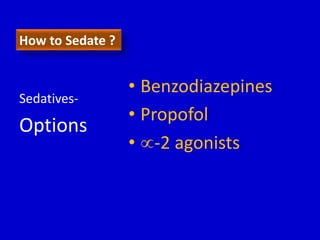
How to Sedate ? 
• Benzodiazepines 
• Propofol 
• -2 agonists 
Sedatives- 
Options
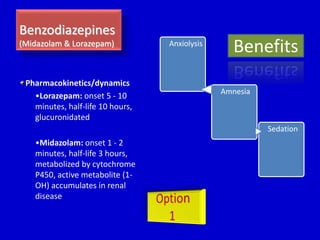
Benzodiazepines 
(Midazolam & Lorazepam) Anxiolysis 
Amnesia 
Sedation 
Pharmacokinetics/dynamics 
•Lorazepam: onset 5 - 10 
minutes, half-life 10 hours, 
glucuronidated 
•Midazolam: onset 1 - 2 
minutes, half-life 3 hours, 
metabolized by cytochrome 
P450, active metabolite (1- 
OH) accumulates in renal 
disease 
Benefits
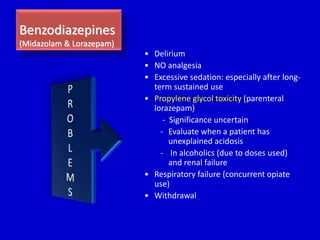
Benzodiazepines 
(Midazolam & Lorazepam) 
• Delirium 
• NO analgesia 
• Excessive sedation: especially after long-term 
sustained use 
• Propylene glycol toxicity (parenteral 
lorazepam) 
- Significance uncertain 
- Evaluate when a patient has 
unexplained acidosis 
- In alcoholics (due to doses used) 
and renal failure 
• Respiratory failure (concurrent opiate 
use) 
• Withdrawal
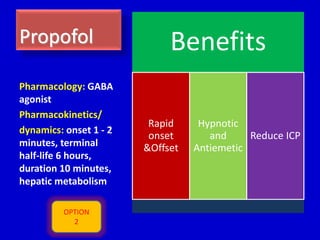
Propofol 
Pharmacology: GABA 
agonist 
Pharmacokinetics/ 
dynamics: onset 1 - 2 
minutes, terminal 
half-life 6 hours, 
duration 10 minutes, 
hepatic metabolism 
Benefits 
Rapid 
onset 
&Offset 
Hypnotic 
and 
Antiemetic 
Reduce ICP 
OPTION 
2
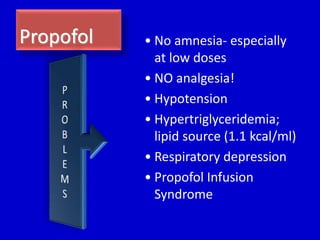
Propofol • No amnesia- especially 
at low doses 
• NO analgesia! 
• Hypotension 
• Hypertriglyceridemia; 
lipid source (1.1 kcal/ml) 
• Respiratory depression 
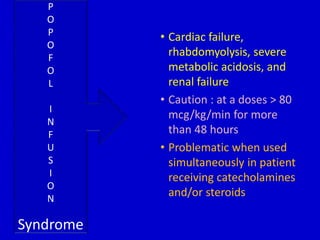
• Propofol Infusion 
Syndrome
• Cardiac failure, 
rhabdomyolysis, severe 
metabolic acidosis, and 
renal failure 
• Caution : at a doses > 80 
mcg/kg/min for more 
than 48 hours 
• Problematic when used 
simultaneously in patient 
receiving catecholamines 
and/or steroids 
P 
O 
P 
O 
F 
O 
L 
I 
N 
F 
U 
S 
I 
O 
N 
Syndrome
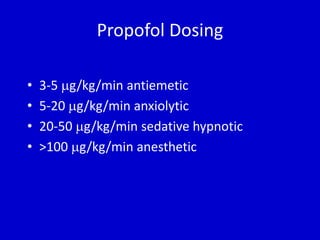
Propofol Dosing 
• 3-5 g/kg/min antiemetic 
• 5-20 g/kg/min anxiolytic 
• 20-50 g/kg/min sedative hypnotic 
• >100 g/kg/min anesthetic
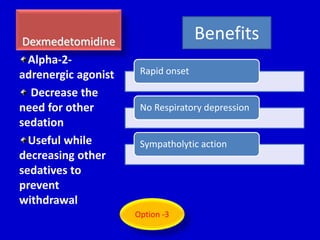
Dexmedetomidine 
Alpha-2- 
adrenergic agonist 
Decrease the 
need for other 
sedation 
Useful while 
decreasing other 
sedatives to 
prevent 
withdrawal 
Rapid onset 
Benefits 
No Respiratory depression 
Sympatholytic action 
Option -3
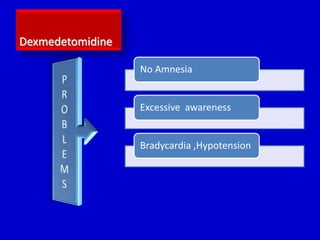
Dexmedetomidine 
No Amnesia 
Excessive awareness 
Bradycardia ,Hypotension
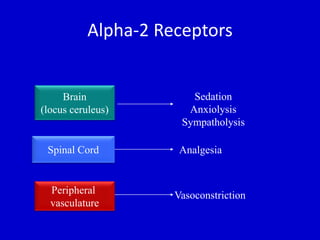
Alpha-2 Receptors 
Brain 
(locus ceruleus) 
Spinal Cord 
Peripheral 
vasculature 
Sedation 
Anxiolysis 
Sympatholysis 
Analgesia 
Vasoconstriction
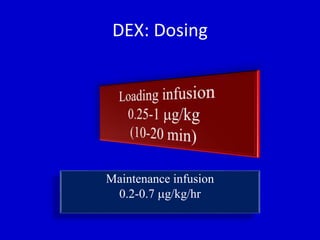
DEX: Dosing 
Maintenance infusion 
0.2-0.7 g/kg/hr
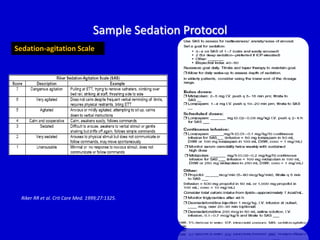
Sample Sedation Protocol 
Sedation-agitation Scale 
Riker RR et al. Crit Care Med. 1999;27:1325.
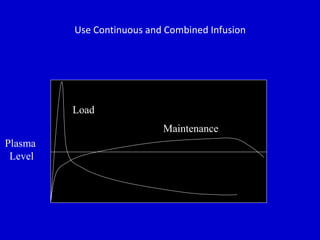
Use Continuous and Combined Infusion 
Plasma 
Level 
Load 
Maintenance
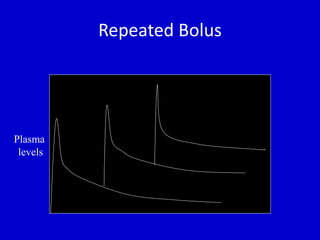
Repeated Bolus 
Plasma 
levels
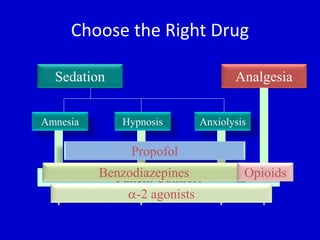
Choose the Right Drug 
Sedation Analgesia 
Amnesia Hypnosis Anxiolysis 
Propofol 
BenPzaotideinatz eCpoinmefsort 
-2 agonists 
Opioids
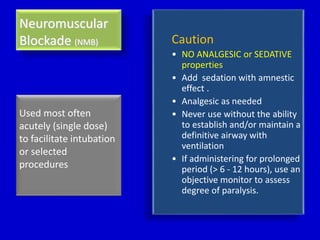
Neuromuscular 
Blockade (NMB) Caution 
• NO ANALGESIC or SEDATIVE 
properties 
• Add sedation with amnestic 
effect . 
• Analgesic as needed 
• Never use without the ability 
to establish and/or maintain a 
definitive airway with 
ventilation 
• If administering for prolonged 
period (> 6 - 12 hours), use an 
objective monitor to assess 
degree of paralysis. 
Used most often 
acutely (single dose) 
to facilitate intubation 
or selected 
procedures
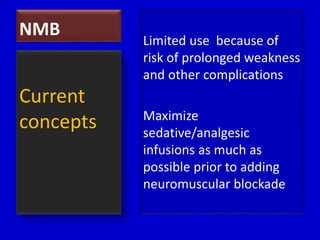
NMB 
Limited use because of 
risk of prolonged weakness 
and other complications 
Maximize 
sedative/analgesic 
infusions as much as 
possible prior to adding 
neuromuscular blockade 
Current 
concepts
NMB • Facilitate mechanical 
ventilation [abdominal compartment 
syndrome, high airway pressures, and 
dyssynchrony] 
• High Frequency Ventilation, 
Prone ventilation 
• Elevated intracranial 
pressures 
• Reduce oxygen consumption 
• Prevent muscle spasm 
[neuroleptic malignant syndrome, tetanus, etc.] 
• Protect surgical wounds or 
medical device placement 
When to Use it?
NMB agents 
•Depolarizers 
Two classes •Non depolarizers
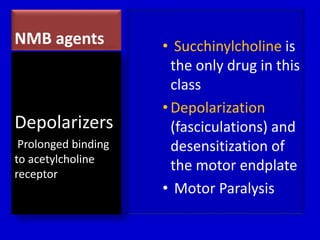
NMB agents • Succhinylcholine is 
the only drug in this 
class 
• Depolarization 
(fasciculations) and 
desensitization of 
the motor endplate 
• Motor Paralysis 
Depolarizers 
Prolonged binding 
to acetylcholine 
receptor
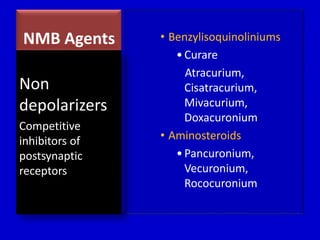
NMB Agents • Benzylisoquinoliniums 
• Curare 
Atracurium, 
Cisatracurium, 
Mivacurium, 
Doxacuronium 
• Aminosteroids 
• Pancuronium, 
Vecuronium, 
Rococuronium 
Non 
depolarizers 
Competitive 
inhibitors of 
postsynaptic 
receptors
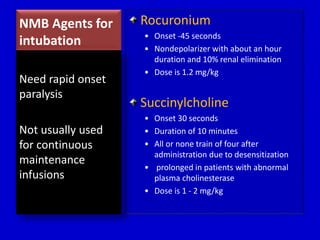
NMB Agents for 
intubation 
Rocuronium 
• Onset -45 seconds 
• Nondepolarizer with about an hour 
duration and 10% renal elimination 
• Dose is 1.2 mg/kg 
Succinylcholine 
• Onset 30 seconds 
• Duration of 10 minutes 
• All or none train of four after 
administration due to desensitization 
• prolonged in patients with abnormal 
plasma cholinesterase 
• Dose is 1 - 2 mg/kg 
Need rapid onset 
paralysis 
Not usually used 
for continuous 
maintenance 
infusions
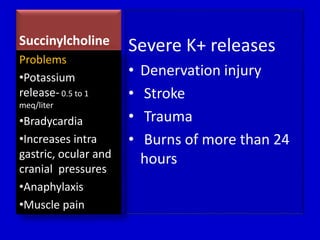
Succinylcholine Severe K+ releases 
• Denervation injury 
• Stroke 
• Trauma 
• Burns of more than 24 
hours 
Problems 
•Potassium 
release- 0.5 to 1 
meq/liter 
•Bradycardia 
•Increases intra 
gastric, ocular and 
cranial pressures 
•Anaphylaxis 
•Muscle pain
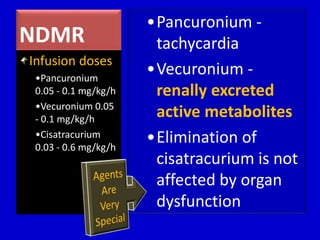
NDMR 
•Pancuronium - 
tachycardia 
•Vecuronium - 
renally excreted 
active metabolites 
•Elimination of 
cisatracurium is not 
affected by organ 
dysfunction 
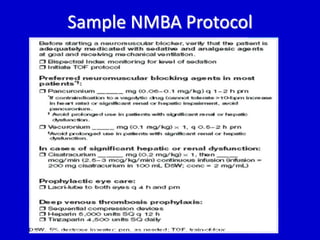
Infusion doses 
•Pancuronium 
0.05 - 0.1 mg/kg/h 
•Vecuronium 0.05 
- 0.1 mg/kg/h 
•Cisatracurium 
0.03 - 0.6 mg/kg/h
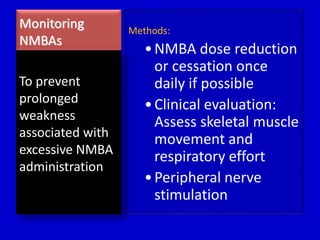
Monitoring 
NMBAs 
Methods: 
•NMBA dose reduction 
or cessation once 
daily if possible 
• Clinical evaluation: 
Assess skeletal muscle 
movement and 
respiratory effort 
•Peripheral nerve 
stimulation 
To prevent 
prolonged 
weakness 
associated with 
excessive NMBA 
administration
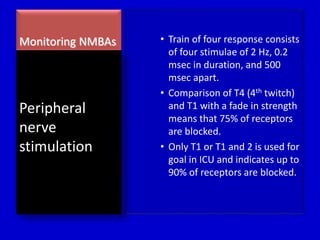
Monitoring NMBAs • Train of four response consists 
of four stimulae of 2 Hz, 0.2 
msec in duration, and 500 
msec apart. 
• Comparison of T4 (4th twitch) 
and T1 with a fade in strength 
means that 75% of receptors 
are blocked. 
• Only T1 or T1 and 2 is used for 
goal in ICU and indicates up to 
90% of receptors are blocked. 
Peripheral 
nerve 
stimulation
Complications of NMB Agents 
Associated with inactivity: 
• Muscle wasting, deconditioning, decubitus 
ulcers, corneal drying 
Associated with inability to assess 
patient: 
• Recall, unrelieved pain, acute neurologic 
event, anxiety
Complications of NMB Agents 
Associated with loss of respiratory 
function: 
• Asphyxiation from ventilator malfunction or 
accidental extubation, atelectasis, pneumonia 
Other: 
• Prolonged paralysis or acute NMBA related myopathy 
- Related to decreased membrane excitability or 
even muscle necrosis 
- Risk can be compounded by concurrent use of 
steroids.
Monitoring Sedation During Paralysis 
• Bispectral index 
• Titrating to appropriate sedation to the least 
amount required, not proven to achieve the 
goal. 
• Potential for baseline neurologic deficit and 
EEG interference in ICU patients
Monitoring Sedation During Paralysis… 
No randomized controlled studies to support 
reliable use in ICU. 
Other neuromonitoring (awareness) 
modalities are likely to be developed. 
Cessation of NMB as soon as safe in 
conjunction with other patient parameters 
should be a daily consideration.
Sample NMBA Protocol
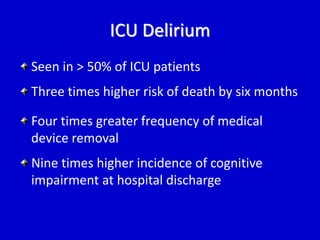
ICU Delirium 
Seen in > 50% of ICU patients 
Three times higher risk of death by six months 
Four times greater frequency of medical 
device removal 
Nine times higher incidence of cognitive 
impairment at hospital discharge
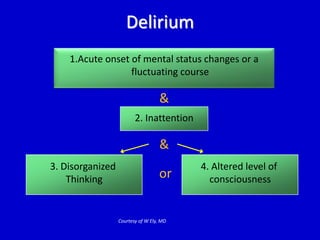
Delirium 
1.Acute onset of mental status changes or a 
fluctuating course 
& 
2. Inattention 
& 
or 
Courtesy of W Ely, MD 
3. Disorganized 
Thinking 
4. Altered level of 
consciousness
Risk Factors for Delirium 
Primary CNS Dx 
Infection 
Metabolic derangement 
Pain 
Sleep deprivation 
Age 
Substances including tobacco (withdrawal as well as direct 
effect)
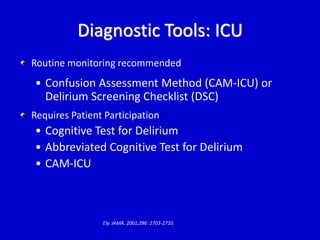
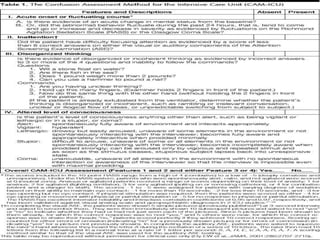
Diagnostic Tools: ICU 
Routine monitoring recommended 
• Confusion Assessment Method (CAM-ICU) or 
Delirium Screening Checklist (DSC) 
Requires Patient Participation 
• Cognitive Test for Delirium 
• Abbreviated Cognitive Test for Delirium 
• CAM-ICU 
Ely. JAMA. 2001;286: 2703-2710.
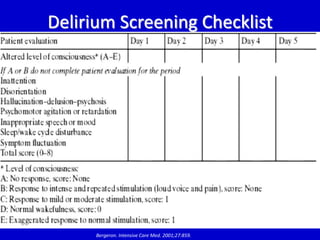
Delirium Screening Checklist 
No Patient Participation 
• Delirium Screening Checklist 
Bergeron. Intensive Care Med. 2001;27:859.
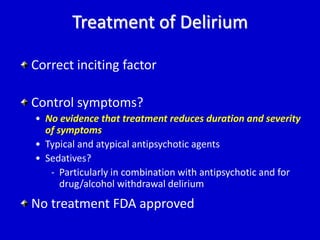
Treatment of Delirium 
Correct inciting factor 
Control symptoms? 
• No evidence that treatment reduces duration and severity 
of symptoms 
• Typical and atypical antipsychotic agents 
• Sedatives? 
- Particularly in combination with antipsychotic and for 
drug/alcohol withdrawal delirium 
No treatment FDA approved
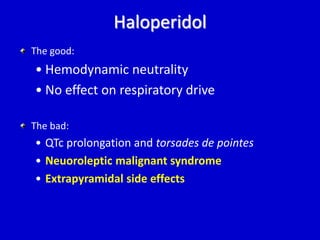
Haloperidol 
The good: 
• Hemodynamic neutrality 
• No effect on respiratory drive 
The bad: 
• QTc prolongation and torsades de pointes 
• Neuoroleptic malignant syndrome 
• Extrapyramidal side effects
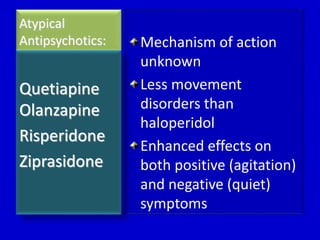
Atypical 
Antipsychotics: Mechanism of action 
unknown 
Less movement 
disorders than 
haloperidol 
Enhanced effects on 
both positive (agitation) 
and negative (quiet) 
symptoms 
Quetiapine 
Olanzapine 
Risperidone 
Ziprasidone
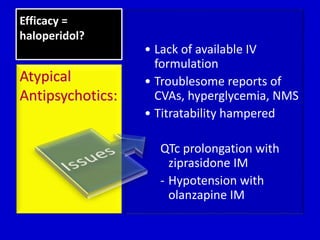
Efficacy = 
haloperidol? 
• Lack of available IV 
formulation 
• Troublesome reports of 
CVAs, hyperglycemia, NMS 
• Titratability hampered 
QTc prolongation with 
ziprasidone IM 
- Hypotension with 
olanzapine IM 
Atypical 
Antipsychotics:
Summary 
• Patient discomfort in ICU should be addressed 
appropriately and seriously 
• Protocol based practice will bring up excellent 
results. 
• Assess and Manage Sedation and Analgesia 
• Paralysis should be restricted to indicated 
cases 
• Address delirium and withdrawals
Thank you 
for your 
patient 
listening

Sedation , analgesia & paralysis

  • 1.
    Sedation , Analgesia& Paralysis in ICU Dr.Venugopalan.P.P DA,DNB,MNAMS Chief, Emergency Medicine –MIMS Site Director ,Masters program in EM Executive director ,Angels international foundation
  • 2.
    Objectives Guidelines forsedation, analgesia, and chemical paralysis Benefits of daily awakening/lightening and sedation titration programs Rational pharmacologic strategy based on treatment goals and co morbidities
  • 3.
    What We KnowAbout ICU Agitation/Discomfort? Prevalence • 50% incidence in those with length of stay > 24 hours Primary causes • Unrelieved pain • Delirium • Anxiety • Sleep deprivation.
  • 4.
  • 5.
    Recall in theICU Some degree of recall occurs in up to 70% of ICU patients. • Anxiety, fear, pain, panic, agony, or nightmares reported in 90% of those who did have recall. Potentially cruel: • Up to 36% recalled some aspect of paralysis. Associated with PTSD in ARDS? • 41% risk of recall of two or more traumatic experiences. Associated with PTSD in cardiac surgery
  • 6.
    Appropriate Recall Maybe Important Factual memories help to put ICU experience into perspective Delusional memories cause panic attacks and PTSD The optimal level of sedation for most patients - Offers comfort while allowing for interaction with the environment.
  • 7.
    Why sedation inICU? • Anxiety • Pain • Acute confusional status • Mechanical ventilation • Treatment or diagnostic procedures • Psychological response to stress
  • 8.
    Sedation Goal •Patient comfort • Control of pain • Anxiolysis and amnesia • Blunting adverse autonomic and hemodynamic responses • Facilitate nursing management • Facilitate mechanical ventilation • Avoid self-extubation • Reduce oxygen consumption
  • 9.
    Ideal sedation agents • No respiratory depression • Analgesia • Rapid onset, titratable, with a short elimination half-time • Sedation with ease of orientation and arousability • Anxiolytic • Hemodynamic stability
  • 10.
    The Challenges •Assessment of sedation • Altered pharmacology • Tolerance • Delayed emergence • Withdrawal • Drug interaction
  • 11.
    Sedation Causes forAgitation Sedatives
  • 12.
    Undersedation Sedatives Causesfor Agitation Agitation & anxiety Pain and discomfort Catheter displacement Inadequate ventilation Hypertension Tachycardia Arrhythmias Myocardial ischemia Wound disruption Patient injury
  • 13.
    Oversedation Sedatives Causesfor Agitation Prolonged sedation Delayed emergence Respiratory depression Hypotension Bradycardia Increased protein breakdown Muscle atrophy Venous stasis Pressure injury Loss of patient-staff interaction Increased cost
  • 14.
    Reversible Causes ofAgitation • Full bladder • Uncomfortable bed position • Inadequate ventilator flow rates • Mental illness • Uremia • Drug side effects • Disorientation • Sleep deprivation • Noise • Inability to communicate
  • 15.
    Life threatening Causes • Hypoxia • Hypercarbia • Hypoglycemia • Endotracheal tube malposition • Pneumothorax • Myocardial ischemia • Abdominal pain • Drug and alcohol withdrawal
  • 16.
    Daily Goal is Arousable, Comfortable Sedation Effect of this strategy on outcomes: • One- to seven-day reduction in length of sedation and mechanical ventilation needs • 50% reduction in tracheostomies • Three-fold reduction in the need for diagnostic evaluation of CNS Sedation needs to be protocolized and titrated to goal: •Lighten sedation to appropriate wakefulness daily.
  • 17.
    Protocols and AssessmentTools Sedation o Validated sedation assessment tools (Ramsay Sedation Scale [RSS], o Sedation-Agitation Scale [SAS] o Richmond Sedation-agitation Scale [RSAS] No evidence that one is preferred over another Pain o Numeric rating scale [NRS] o Visual analogue scale [VAS] Pain assessment tools - none validated in ICU
  • 18.
    Sedation/Analgesia ICU Ruleout reversible causes of discomfort/anxiety such as hypoxemia, hypercarbia, and toxic/drug side effect. Assess co-morbidities and potential side effects of drugs chosen. Target irreversible etiologies of pain and agitation.
  • 19.
    Strategies for PatientComfort • Set treatment goal • Quantitate sedation and pain • Choose the right medication • Use combined infusion • Reevaluate need • Treat withdrawal
  • 20.
    ALGORITHM FOR SEDATIONAND ANALGESIA OF MECHANICALLY VENTILATED PATIENTS Yes Reassess goal daily, Titrate and taper therapy to maintain goal, Consider daily wake-up, Taper if > 1 week high-dose therapy & monitor for withdrawal No Set Goal for Analgesia Hemodynamically Unstable Fentanyl 25 - 100 mcg IVP Q 5-15 min, or Hydromorphone 0.25 - 0.75 mg IVP Q 5 - 15 min Hemodynamically stable Morphine 2 - 5 mg IVP Q 5 - 15 min Repeat until pain controlled, then scheduled doses + prn Set Goal for Sedation Acute Agitation # Midazolam 2 - 5 mg IVP Q 5 - 15 min until acute event controlled Ongoing Sedation # Lorazepam 1 - 4 mg IVP Q 10-20 min until at goal then Q 2 - 6 hr scheduled + prn, or Propofol start 5 mcg/kg/min, titrate Q 5 min until at goal Set Goal for Control of Delirium Haloperidol 2 - 10 mg IVP Q 20 - 30 min, then 25% of loading dose Q 6hr x 2-3 days, then taper IVP Doses more of ten than Q 2hr? Consider continuous infusion opiate or sedative > 3 Days Propofol? (except neuro pt.) Convert to Lorazepam Yes Benzodiazepine or Opioid: Taper Infusion Rate by 10-25% Per Day Yes Doses approximate for 70kg adult Rule out and Correct Reversible Causes Use Non-pharmacologic Treament, Optimize the Environment Use Pain Scale * to Assess for Pain Use Sedation Scale ** to Assess for Agitation/Anxiety Use Delirium Scale *** to Assess for Delirium Is the Patient Comfortable & at Goal? Lorazepam via infusion? Use a low rate and IVP loading doses 1 2 3 4 Jacobi J, Fraser GL, Coursin D, et al. Crit Care Med. 2002;30:119-141.
  • 21.
  • 22.
    Visual Pain Scales 0 1 2 3 4 5 6 7 8 9 10 No pain Worst possible pain
  • 23.
    Signs of Pain • Hypertension • Tachycardia • Lacrimation • Sweating • Pupillary dilation
  • 24.
    Pain Management •Anticipate • Recognize • Quantify Recognize Pain
  • 25.
    Treat Pain oQuantifythe pain perception oCorrect the correctable causes oUse appropriate analgesics • Remember- most sedative agents do not provide analgesia • Reassess
  • 26.
    Non-pharmacological Methods •Proper position of the patient • Stabilization of fractures • Elimination of irritating stimulation • Proper positioning of the ventilator tubing to avoid traction on endotracheal tube
  • 27.
    ALGORITHM FOR SEDATIONAND ANALGESIA OF MECHANICALLY VENTILATED PATIENTS Yes Reassess goal daily, Titrate and taper therapy to maintain goal, Consider daily wake-up, Taper if > 1 week high-dose therapy & monitor for withdrawal No Set Goal for Analgesia Hemodynamically Unstable Fentanyl 25 - 100 mcg IVP Q 5-15 min, or Hydromorphone 0.25 - 0.75 mg IVP Q 5 - 15 min Hemodynamically stable Morphine 2 - 5 mg IVP Q 5 - 15 min Repeat until pain controlled, then scheduled doses + prn Set Goal for Sedation Acute Agitation # Midazolam 2 - 5 mg IVP Q 5 - 15 min until acute event controlled Ongoing Sedation # Lorazepam 1 - 4 mg IVP Q 10-20 min until at goal then Q 2 - 6 hr scheduled + prn, or Propofol start 5 mcg/kg/min, titrate Q 5 min until at goal Set Goal for Control of Delirium Haloperidol 2 - 10 mg IVP Q 20 - 30 min, then 25% of loading dose Q 6hr x 2-3 days, then taper IVP Doses more of ten than Q 2hr? Consider continuous infusion opiate or sedative > 3 Days Propofol? (except neuro pt.) Convert to Lorazepam Yes Benzodiazepine or Opioid: Taper Infusion Rate by 10-25% Per Day Yes Doses approximate for 70kg adult Rule out and Correct Reversible Causes Use Non-pharmacologic Treament, Optimize the Environment Use Pain Scale * to Assess for Pain Use Sedation Scale ** to Assess for Agitation/Anxiety Use Delirium Scale *** to Assess for Delirium Is the Patient Comfortable & at Goal? Lorazepam via infusion? Use a low rate and IVP loading doses 1 2 3 4 Jacobi J, Fraser GL, Coursin D, et al. Crit Care Med. 2002;30:119-141.
  • 28.
    Address Pain Isthe Patient Comfortable & at Goal? Set Goal for Analgesia Hemodynamically Unstable Fentanyl 25 - 100 mcg IVP Q 5-15 min, or Hydromorphone 0.25 - 0.75 mg IVP Q 5 - 15 min Hemodynamically stable Morphine 2 - 5 mg IVP Q 5 - 15 min Repeat until pain controlled, then scheduled doses + prn Use Pain Scale * to Assess for Pain Reassess goal daily, Titrate and taper therapy to maintain goal, Consider daily wake-up, Taper if > 1 week high-dose therapy & monitor for withdrawal
  • 29.
    Opiates Benefits •Relievepain or the sensibility to noxious stimuli •Sedation trending toward a change in sensorium
  • 30.
    Opiates - Risks •Respiratory depression •NO amnesia •Pruritus •Ileus •Urinary retention
  • 31.
    Opiates- Risks •Histamine release - morphine •Morphine metabolites which accumulate in renal failure . • Meperidine should be avoided due to neurotoxic metabolites which accumulate in renal failure
  • 32.
    Pharmacology of SelectedAnalgesics Agent Dose (iv) Half-life Metabolic pathway Active metabolites Fentanyl 200 g 1.5-6 hr Oxidation None Hydromorphone 1.5 mg 2-3 hr Glucuronidation None Morphine 10 mg 3-7 hr Glucuronidation Yes (Sedation in RF) Meperidine 75-100 mg 3-4 hr Demethylation & hydroxylation Yes (neuroexcitation in RF) Codeine 120 mg 3 hr Demethylation & Glucuronidation Yes ( analgesia, sedation) Remifentanil 3-10 min Plasma esterase None Keterolac 2.4-8.6 hr Renal None
  • 33.
    Opiate Analgesic Options:Fentanyl, Morphine, Hydromorphone Fentanyl Hydromorphone Morphine Rapid onset X Rapid offset X* Avoid in renal disease X** Preload reduction X Avoid in hemodynamic X instability Equivalent doses 100 mcg 1.5 mg 10 mg * Offset prolonged after long-term use ** Active metabolite accumulation causes excessive narcosis
  • 34.
    Numeric Rating Scale Sample Analgesia Protocol
  • 36.
    Sedation- Assessment •Ramsay Sedation Scale (RSS) • Sedation-agitation Scale (SAS) • Observers Assessment of Alertness/Sedation Scale (OAASS) • Motor Activity Assessment Scale (MAAS) BMJ 1974;2:656-659 Crit Care Med 1999;27:1325-1329 J Clin Psychopharmacol 1990;10:244-251 Crit Care Med 1999;27:1271-1275
  • 37.
    The Ramsay Scale Scale Description 1 Anxious and agitated or restless, or both 2 Cooperative, oriented, and tranquil 3 Response to commands only 4 Brisk response to light glabellar tap or loud auditory stimulus 5 Sluggish response to light glabellar tap or loud auditory stimulus 6 No response to light glabellar tap or loud auditory stimulus
  • 38.
    The Riker Sedation-AgitationScale Score Description Definition 7 Dangerous agitation Pulling at endotracheal tube, trying to strike at staff, thrashing side to side 6 Very agitated Does not calm despite frequent verbal commands, biting ETT 5 Agitated Anxious or mildly agitated, attempting to sit 4 Calm and cooperative Calm, awakens easily, follows commands 3 Sedated Difficult to arouse, awakens to verbal stimuli, follows simple commands 2 Very sedated Arouse to physical stimuli, but does not communicate spontaneously 1 Unarousable Minimal or no response to noxious stimuli
  • 39.
    The Motor ActivityAssessment Scale Score Description Definition 6 Dangerous agitation Pulling at endotracheal tube, trying to strike at staff, thrashing side to side 5 Agitated Does not calm despite frequent verbal commands, biting ETT 4 Restless and cooperative Anxious or mildly agitated, attempting to sit 3 Calm and cooperative Calm, awakens easily, follows commands 2 Responsive to touch or name Opens eyes or raises eyebrows or turns head when touched or name is loudly spoken 1 Responsive only to noxious stimuli Opens eyes or raises eyebrows or turns head with noxious stimuli 0 Unresponsive Does not move with noxious stimuli
  • 40.
    What sedation Scaledo? •Provide a semi quantitative “score” •Standardize treatment endpoints •Allow review of efficacy of sedation •Facilitate sedation studies •Help to avoid over sedation
  • 41.
    But scales Donot .... • Assess anxiety • Assess pain • Assess sedation in paralyzed patients • Predict outcome • Agree with each other
  • 42.
    BIS Monitoring Usedto asses Sedation levels
  • 43.
    BIS Range Guidelines Awake Responds to normal voice Axiolysis Responds to loud commands or mild prodding/shaking Low probability to explicit recalls Unresponsive to verbal stimuli Burst suppression Flat line EEG Moderate sedation Deep Sedation 100 80 60 40 20 0 BIS
  • 44.
    ALGORITHM FOR SEDATIONAND ANALGESIA OF MECHANICALLY VENTILATED PATIENTS Yes Reassess goal daily, Titrate and taper therapy to maintain goal, Consider daily wake-up, Taper if > 1 week high-dose therapy & monitor for withdrawal No Set Goal for Analgesia Hemodynamically Unstable Fentanyl 25 - 100 mcg IVP Q 5-15 min, or Hydromorphone 0.25 - 0.75 mg IVP Q 5 - 15 min Hemodynamically stable Morphine 2 - 5 mg IVP Q 5 - 15 min Repeat until pain controlled, then scheduled doses + prn Set Goal for Sedation Acute Agitation # Midazolam 2 - 5 mg IVP Q 5 - 15 min until acute event controlled Ongoing Sedation # Lorazepam 1 - 4 mg IVP Q 10-20 min until at goal then Q 2 - 6 hr scheduled + prn, or Propofol start 5 mcg/kg/min, titrate Q 5 min until at goal Set Goal for Control of Delirium Haloperidol 2 - 10 mg IVP Q 20 - 30 min, then 25% of loading dose Q 6hr x 2-3 days, then taper IVP Doses more of ten than Q 2hr? Consider continuous infusion opiate or sedative > 3 Days Propofol? (except neuro pt.) Convert to Lorazepam Yes Benzodiazepine or Opioid: Taper Infusion Rate by 10-25% Per Day Yes Doses approximate for 70kg adult Rule out and Correct Reversible Causes Use Non-pharmacologic Treament, Optimize the Environment Use Pain Scale * to Assess for Pain Use Sedation Scale ** to Assess for Agitation/Anxiety Use Delirium Scale *** to Assess for Delirium Is the Patient Comfortable & at Goal? Lorazepam via infusion? Use a low rate and IVP loading doses 1 2 3 4 Jacobi J, Fraser GL, Coursin D, et al. Crit Care Med. 2002;30:119-141.
  • 45.
    Set Goal for Sedation Address Sedation Acute Agitation # Midazolam 2 - 5 mg IVP Q 5 - 15 min until acute event controlled Ongoing Sedation # Lorazepam 1 - 4 mg IVP Q 10-20 min until at goal then Q 2 - 6 hr scheduled + prn, or Propofol start 5 mcg/kg/min, titrate Q 5 min until at goal IVP Doses more often than Q 2hr? Consider continuous infusion opiate or sedative > 3 Days Propofol? (except neuro pt.) Convert to Lorazepam Benzodiazepine or Opioid: Taper Infusion Rate by 10-25% Per Day Use Sedation Scale ** to Assess for Agitation/Anxiety Lorazepam via infusion? Use a low rate and IVP loading doses Yes Reassess goal daily, Titrate and taper therapy to maintain goal, Consider daily wake-up, Taper if > 1 week high-dose therapy & monitor for withdrawal Is the Patient Comfortable & at Goal?
  • 46.
    How to Sedate? • Benzodiazepines • Propofol • -2 agonists Sedatives- Options
  • 47.
    Benzodiazepines (Midazolam &Lorazepam) Anxiolysis Amnesia Sedation Pharmacokinetics/dynamics •Lorazepam: onset 5 - 10 minutes, half-life 10 hours, glucuronidated •Midazolam: onset 1 - 2 minutes, half-life 3 hours, metabolized by cytochrome P450, active metabolite (1- OH) accumulates in renal disease Benefits
  • 48.
    Benzodiazepines (Midazolam &Lorazepam) • Delirium • NO analgesia • Excessive sedation: especially after long-term sustained use • Propylene glycol toxicity (parenteral lorazepam) - Significance uncertain - Evaluate when a patient has unexplained acidosis - In alcoholics (due to doses used) and renal failure • Respiratory failure (concurrent opiate use) • Withdrawal
  • 49.
    Propofol Pharmacology: GABA agonist Pharmacokinetics/ dynamics: onset 1 - 2 minutes, terminal half-life 6 hours, duration 10 minutes, hepatic metabolism Benefits Rapid onset &Offset Hypnotic and Antiemetic Reduce ICP OPTION 2
  • 50.
    Propofol • Noamnesia- especially at low doses • NO analgesia! • Hypotension • Hypertriglyceridemia; lipid source (1.1 kcal/ml) • Respiratory depression • Propofol Infusion Syndrome
  • 51.
    • Cardiac failure, rhabdomyolysis, severe metabolic acidosis, and renal failure • Caution : at a doses > 80 mcg/kg/min for more than 48 hours • Problematic when used simultaneously in patient receiving catecholamines and/or steroids P O P O F O L I N F U S I O N Syndrome
  • 52.
    Propofol Dosing •3-5 g/kg/min antiemetic • 5-20 g/kg/min anxiolytic • 20-50 g/kg/min sedative hypnotic • >100 g/kg/min anesthetic
  • 53.
    Dexmedetomidine Alpha-2- adrenergicagonist Decrease the need for other sedation Useful while decreasing other sedatives to prevent withdrawal Rapid onset Benefits No Respiratory depression Sympatholytic action Option -3
  • 54.
    Dexmedetomidine No Amnesia Excessive awareness Bradycardia ,Hypotension
  • 55.
    Alpha-2 Receptors Brain (locus ceruleus) Spinal Cord Peripheral vasculature Sedation Anxiolysis Sympatholysis Analgesia Vasoconstriction
  • 56.
    DEX: Dosing Maintenanceinfusion 0.2-0.7 g/kg/hr
  • 57.
    Sample Sedation Protocol Sedation-agitation Scale Riker RR et al. Crit Care Med. 1999;27:1325.
  • 58.
    Use Continuous andCombined Infusion Plasma Level Load Maintenance
  • 59.
  • 60.
    Choose the RightDrug Sedation Analgesia Amnesia Hypnosis Anxiolysis Propofol BenPzaotideinatz eCpoinmefsort -2 agonists Opioids
  • 62.
    Neuromuscular Blockade (NMB)Caution • NO ANALGESIC or SEDATIVE properties • Add sedation with amnestic effect . • Analgesic as needed • Never use without the ability to establish and/or maintain a definitive airway with ventilation • If administering for prolonged period (> 6 - 12 hours), use an objective monitor to assess degree of paralysis. Used most often acutely (single dose) to facilitate intubation or selected procedures
  • 63.
    NMB Limited usebecause of risk of prolonged weakness and other complications Maximize sedative/analgesic infusions as much as possible prior to adding neuromuscular blockade Current concepts
  • 64.
    NMB • Facilitatemechanical ventilation [abdominal compartment syndrome, high airway pressures, and dyssynchrony] • High Frequency Ventilation, Prone ventilation • Elevated intracranial pressures • Reduce oxygen consumption • Prevent muscle spasm [neuroleptic malignant syndrome, tetanus, etc.] • Protect surgical wounds or medical device placement When to Use it?
  • 65.
    NMB agents •Depolarizers Two classes •Non depolarizers
  • 66.
    NMB agents •Succhinylcholine is the only drug in this class • Depolarization (fasciculations) and desensitization of the motor endplate • Motor Paralysis Depolarizers Prolonged binding to acetylcholine receptor
  • 67.
    NMB Agents •Benzylisoquinoliniums • Curare Atracurium, Cisatracurium, Mivacurium, Doxacuronium • Aminosteroids • Pancuronium, Vecuronium, Rococuronium Non depolarizers Competitive inhibitors of postsynaptic receptors
  • 68.
    NMB Agents for intubation Rocuronium • Onset -45 seconds • Nondepolarizer with about an hour duration and 10% renal elimination • Dose is 1.2 mg/kg Succinylcholine • Onset 30 seconds • Duration of 10 minutes • All or none train of four after administration due to desensitization • prolonged in patients with abnormal plasma cholinesterase • Dose is 1 - 2 mg/kg Need rapid onset paralysis Not usually used for continuous maintenance infusions
  • 69.
    Succinylcholine Severe K+releases • Denervation injury • Stroke • Trauma • Burns of more than 24 hours Problems •Potassium release- 0.5 to 1 meq/liter •Bradycardia •Increases intra gastric, ocular and cranial pressures •Anaphylaxis •Muscle pain
  • 70.
    NDMR •Pancuronium - tachycardia •Vecuronium - renally excreted active metabolites •Elimination of cisatracurium is not affected by organ dysfunction Infusion doses •Pancuronium 0.05 - 0.1 mg/kg/h •Vecuronium 0.05 - 0.1 mg/kg/h •Cisatracurium 0.03 - 0.6 mg/kg/h
  • 71.
    Monitoring NMBAs Methods: •NMBA dose reduction or cessation once daily if possible • Clinical evaluation: Assess skeletal muscle movement and respiratory effort •Peripheral nerve stimulation To prevent prolonged weakness associated with excessive NMBA administration
  • 72.
    Monitoring NMBAs •Train of four response consists of four stimulae of 2 Hz, 0.2 msec in duration, and 500 msec apart. • Comparison of T4 (4th twitch) and T1 with a fade in strength means that 75% of receptors are blocked. • Only T1 or T1 and 2 is used for goal in ICU and indicates up to 90% of receptors are blocked. Peripheral nerve stimulation
  • 73.
    Complications of NMBAgents Associated with inactivity: • Muscle wasting, deconditioning, decubitus ulcers, corneal drying Associated with inability to assess patient: • Recall, unrelieved pain, acute neurologic event, anxiety
  • 74.
    Complications of NMBAgents Associated with loss of respiratory function: • Asphyxiation from ventilator malfunction or accidental extubation, atelectasis, pneumonia Other: • Prolonged paralysis or acute NMBA related myopathy - Related to decreased membrane excitability or even muscle necrosis - Risk can be compounded by concurrent use of steroids.
  • 75.
    Monitoring Sedation DuringParalysis • Bispectral index • Titrating to appropriate sedation to the least amount required, not proven to achieve the goal. • Potential for baseline neurologic deficit and EEG interference in ICU patients
  • 76.
    Monitoring Sedation DuringParalysis… No randomized controlled studies to support reliable use in ICU. Other neuromonitoring (awareness) modalities are likely to be developed. Cessation of NMB as soon as safe in conjunction with other patient parameters should be a daily consideration.
  • 77.
  • 79.
    ICU Delirium Seenin > 50% of ICU patients Three times higher risk of death by six months Four times greater frequency of medical device removal Nine times higher incidence of cognitive impairment at hospital discharge
  • 80.
    Delirium 1.Acute onsetof mental status changes or a fluctuating course & 2. Inattention & or Courtesy of W Ely, MD 3. Disorganized Thinking 4. Altered level of consciousness
  • 81.
    Risk Factors forDelirium Primary CNS Dx Infection Metabolic derangement Pain Sleep deprivation Age Substances including tobacco (withdrawal as well as direct effect)
  • 82.
    Diagnostic Tools: ICU Routine monitoring recommended • Confusion Assessment Method (CAM-ICU) or Delirium Screening Checklist (DSC) Requires Patient Participation • Cognitive Test for Delirium • Abbreviated Cognitive Test for Delirium • CAM-ICU Ely. JAMA. 2001;286: 2703-2710.
  • 84.
    Delirium Screening Checklist No Patient Participation • Delirium Screening Checklist Bergeron. Intensive Care Med. 2001;27:859.
  • 85.
    Treatment of Delirium Correct inciting factor Control symptoms? • No evidence that treatment reduces duration and severity of symptoms • Typical and atypical antipsychotic agents • Sedatives? - Particularly in combination with antipsychotic and for drug/alcohol withdrawal delirium No treatment FDA approved
  • 86.
    Haloperidol The good: • Hemodynamic neutrality • No effect on respiratory drive The bad: • QTc prolongation and torsades de pointes • Neuoroleptic malignant syndrome • Extrapyramidal side effects
  • 87.
    Atypical Antipsychotics: Mechanismof action unknown Less movement disorders than haloperidol Enhanced effects on both positive (agitation) and negative (quiet) symptoms Quetiapine Olanzapine Risperidone Ziprasidone
  • 88.
    Efficacy = haloperidol? • Lack of available IV formulation • Troublesome reports of CVAs, hyperglycemia, NMS • Titratability hampered QTc prolongation with ziprasidone IM - Hypotension with olanzapine IM Atypical Antipsychotics:
  • 89.
    Summary • Patientdiscomfort in ICU should be addressed appropriately and seriously • Protocol based practice will bring up excellent results. • Assess and Manage Sedation and Analgesia • Paralysis should be restricted to indicated cases • Address delirium and withdrawals
  • 90.
    Thank you foryour patient listening