




ROLE OF ENVIRONMENT IN
SHAPING LANGUAGE
LEARNING
LEARNERS’ INNATE
CHARACTERISTICS
INTEGRATION OF LEARNERS’
CHARACTERISTICS AND
ENVIRONMENTAL FACTORS
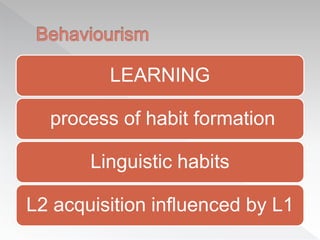
LEARNING
process of habit formation
Linguistic habits
L2 acquisition influenced by L1
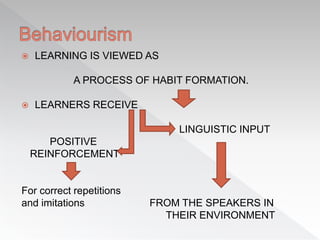
 LEARNING IS VIEWED AS
A PROCESS OF HABIT FORMATION.
 LEARNERS RECEIVE
LINGUISTIC INPUT
POSITIVE
REINFORCEMENT
For correct repetitions
and imitations FROM THE SPEAKERS IN
THEIR ENVIRONMENT
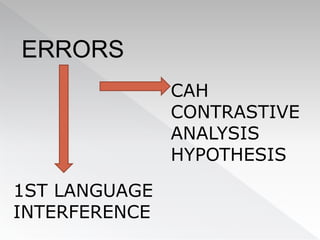
ERRORS
1ST LANGUAGE
INTERFERENCE
CAH
CONTRASTIVE
ANALYSIS
HYPOTHESIS
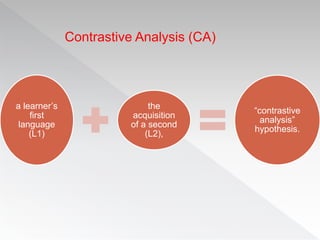
a learner’s
first
language
(L1)
the
acquisition
of a second
(L2),
“contrastive
analysis”
hypothesis.
Contrastive Analysis (CA)
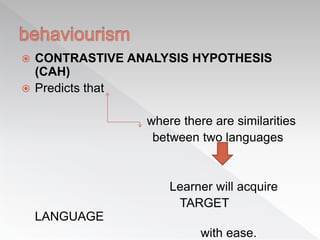
 CONTRASTIVE ANALYSIS HYPOTHESIS
(CAH)
 Predicts that
where there are similarities
between two languages
Learner will acquire
TARGET
LANGUAGE
with ease.
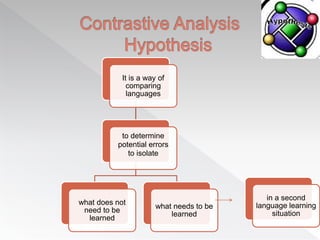
It is a way of
comparing
languages
to determine
potential errors
to isolate
what does not
need to be
learned
what needs to be
learned
in a second
language learning
situation
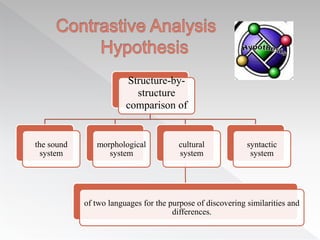
Structure-by-
structure
comparison of
the sound
system
morphological
system
cultural
system
of two languages for the purpose of discovering similarities and
differences.
syntactic
system
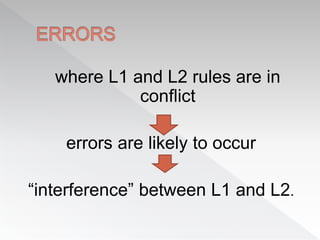
where L1 and L2 rules are in
conflict
errors are likely to occur
“interference” between L1 and L2.
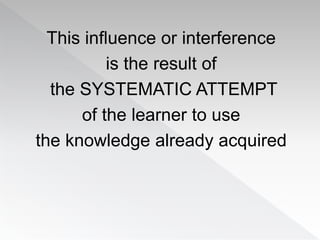
This influence or interference
is the result of
the SYSTEMATIC ATTEMPT
of the learner to use
the knowledge already acquired
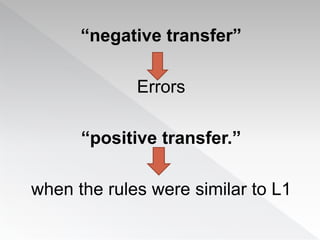
“negative transfer”
Errors
“positive transfer.”
when the rules were similar to L1
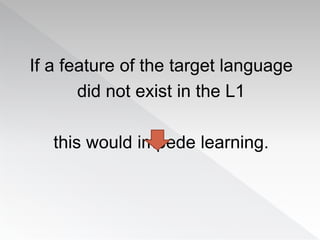
If a feature of the target language
did not exist in the L1
this would impede learning.
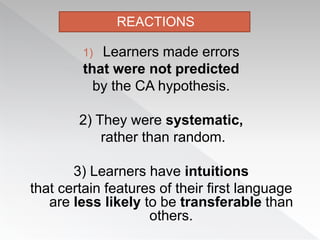
1) Learners made errors
that were not predicted
by the CA hypothesis.
2) They were systematic,
rather than random.
3) Learners have intuitions
that certain features of their first language
are less likely to be transferable than
others.
REACTIONS
4) The interference of L1
is not only a matter of habits but
a more complex process
of identifying points of similarity.
5) Stimuli-Response models offer
“little promises as explanations of SLA,
except for perhaps pronunciation and
the rote memorization of formulae”.
Larsen-Freeman and Long (1991:266)
6) Interlanguage studies
 Lightbown, Patsy M. and Nina Spada. How
Languages are Learned. Oxford University
Press. 1996.

Second language Acquisition behaviourism