









Language attitudes of
Turkish students towards the
English language and its use
in Turkish context
Sue Anne Andrew
 The most widely taught foreign language at all
stages of education system
 Many start learning English in secondary school,
some as early as primary or pre-school
 The problem? The desired level of proficiency is
not attained
 Definition:
“The attitude which speakers of different languages or
language varieties have towards each other’s
languages or to their own language. Expressions of
positive or negative feelings towards a language may
reflect impressions of linguistic difficulty or simplicity,
ease or difficulty of learning, degree of importance,
elegance, social status, etc. Attitudes towards a
language may also show what people feel about the
speakers of that language”
(Longman Dictionary of Applied Linguistics, 1992:199)
 Gardner (1985)-motivation: combination of efforts
plus desire to achieve the goal of learning the
language plus favourable attitudes toward learning
the language
 Wenden (1991)-3 components of attitudes:
-cognitive (beliefs or perceptions about the
language) –
evaluative ( the language may generate like
or dislike)
-behavioural (prompt learners to adopt particular
learning behaviours)
To investigate :
1. the interlaced relationship among language
attitudes
2. the starting age of language learning, and the
place where the individual started to learn
language within the context of EFL students in
Turkey.
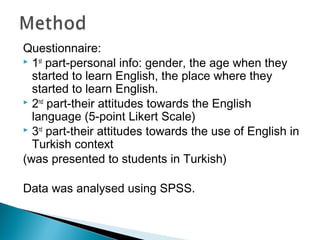
Questionnaire:
 1st
part-personal info: gender, the age when they
started to learn English, the place where they
started to learn English.
 2nd
part-their attitudes towards the English
language (5-point Likert Scale)
 3rd
part-their attitudes towards the use of English in
Turkish context
(was presented to students in Turkish)
Data was analysed using SPSS.
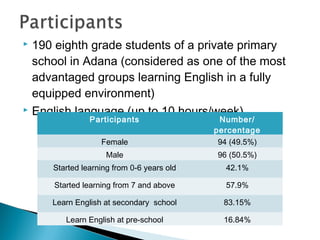
 190 eighth grade students of a private primary
school in Adana (considered as one of the most
advantaged groups learning English in a fully
equipped environment)
 English language (up to 10 hours/week)
Participants Number/
percentage
Female 94 (49.5%)
Male 96 (50.5%)
Started learning from 0-6 years old 42.1%
Started learning from 7 and above 57.9%
Learn English at secondary school 83.15%
Learn English at pre-school 16.84%
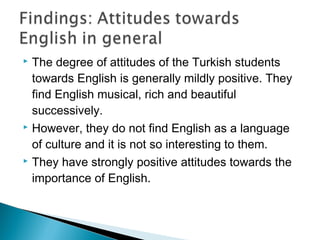
 The degree of attitudes of the Turkish students
towards English is generally mildly positive. They
find English musical, rich and beautiful
successively.
 However, they do not find English as a language
of culture and it is not so interesting to them.
 They have strongly positive attitudes towards the
importance of English.
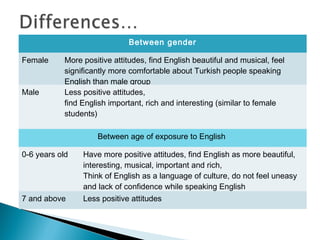
Between gender
Female More positive attitudes, find English beautiful and musical, feel
significantly more comfortable about Turkish people speaking
English than male group
Male Less positive attitudes,
find English important, rich and interesting (similar to female
students)
Between age of exposure to English
0-6 years old Have more positive attitudes, find English as more beautiful,
interesting, musical, important and rich,
Think of English as a language of culture, do not feel uneasy
and lack of confidence while speaking English
7 and above Less positive attitudes
 Students do not support English as a language of
instruction in schools
 However, they wish to take English as an elective course.
 They do not feel that using English has detrimental effect
on their identity as Turkish people.
 Both groups do not want to have a course book in English
 low level of attitude towards the educational value of
English.
 In contrast, the intrinsic value of English based culture is
very high  strong desire to learn the culture but not the
language
 Previous expectation: they have strongly
positive attitudes towards English.
 However, they only have mildly positive
attitudes.
 They welcome English as the frequently used
foreign language in Turkey, evaluate the social
and instrumental value of English, prefer reading
and speaking in English, and take English even
if it not compulsory at school.
 They recognize the importance of English as an
instrument to get a better job, higher status in
society, etc.
 However, they are not that willing to take active
steps at the expected level in order to learn
English
 Also, they are less tolerant to the use of English
among Turkish.
 But, they are unbigoted against English based
culture
 It might be claimed that starting to learn English
at an earlier age at pre-school environment has a
significant effect on language learning in foreign
context
 The findings support the general contention
partially that positive language attitudes let learner
have positive orientation towards learning English
 Interestingly, the recognition of the importance of
English as a foreign language in Turkish society
may not lead students to have active steps in
learning process.
 The reason?  they do not have positive attitudes
towards English language (outcome of Turkey
edu. System) but the English based culture ( a
result of social tendencies affected by
globalisation).
 Another reason? The students do not feel the
need of English language in daily life yet. They
delay learning English until adulthood
(professional needs)
 Awareness is not enough strategy-based
learning and teaching might be a solution bcoz
these students have positive attitudes towards the
culture and high level of recognition on the
importance of the language

Language Attitude by Karahan F

  • 1.
    Language attitudes of Turkishstudents towards the English language and its use in Turkish context Sue Anne Andrew
  • 2.
     The mostwidely taught foreign language at all stages of education system  Many start learning English in secondary school, some as early as primary or pre-school  The problem? The desired level of proficiency is not attained
  • 3.
     Definition: “The attitudewhich speakers of different languages or language varieties have towards each other’s languages or to their own language. Expressions of positive or negative feelings towards a language may reflect impressions of linguistic difficulty or simplicity, ease or difficulty of learning, degree of importance, elegance, social status, etc. Attitudes towards a language may also show what people feel about the speakers of that language” (Longman Dictionary of Applied Linguistics, 1992:199)
  • 4.
     Gardner (1985)-motivation:combination of efforts plus desire to achieve the goal of learning the language plus favourable attitudes toward learning the language  Wenden (1991)-3 components of attitudes: -cognitive (beliefs or perceptions about the language) – evaluative ( the language may generate like or dislike) -behavioural (prompt learners to adopt particular learning behaviours)
  • 5.
    To investigate : 1.the interlaced relationship among language attitudes 2. the starting age of language learning, and the place where the individual started to learn language within the context of EFL students in Turkey.
  • 6.
    Questionnaire:  1st part-personal info:gender, the age when they started to learn English, the place where they started to learn English.  2nd part-their attitudes towards the English language (5-point Likert Scale)  3rd part-their attitudes towards the use of English in Turkish context (was presented to students in Turkish) Data was analysed using SPSS.
  • 7.
     190 eighthgrade students of a private primary school in Adana (considered as one of the most advantaged groups learning English in a fully equipped environment)  English language (up to 10 hours/week) Participants Number/ percentage Female 94 (49.5%) Male 96 (50.5%) Started learning from 0-6 years old 42.1% Started learning from 7 and above 57.9% Learn English at secondary school 83.15% Learn English at pre-school 16.84%
  • 8.
     The degreeof attitudes of the Turkish students towards English is generally mildly positive. They find English musical, rich and beautiful successively.  However, they do not find English as a language of culture and it is not so interesting to them.  They have strongly positive attitudes towards the importance of English.
  • 9.
    Between gender Female Morepositive attitudes, find English beautiful and musical, feel significantly more comfortable about Turkish people speaking English than male group Male Less positive attitudes, find English important, rich and interesting (similar to female students) Between age of exposure to English 0-6 years old Have more positive attitudes, find English as more beautiful, interesting, musical, important and rich, Think of English as a language of culture, do not feel uneasy and lack of confidence while speaking English 7 and above Less positive attitudes
  • 10.
     Students donot support English as a language of instruction in schools  However, they wish to take English as an elective course.  They do not feel that using English has detrimental effect on their identity as Turkish people.  Both groups do not want to have a course book in English  low level of attitude towards the educational value of English.  In contrast, the intrinsic value of English based culture is very high  strong desire to learn the culture but not the language
  • 11.
     Previous expectation:they have strongly positive attitudes towards English.  However, they only have mildly positive attitudes.  They welcome English as the frequently used foreign language in Turkey, evaluate the social and instrumental value of English, prefer reading and speaking in English, and take English even if it not compulsory at school.  They recognize the importance of English as an instrument to get a better job, higher status in society, etc.
  • 12.
     However, theyare not that willing to take active steps at the expected level in order to learn English  Also, they are less tolerant to the use of English among Turkish.  But, they are unbigoted against English based culture  It might be claimed that starting to learn English at an earlier age at pre-school environment has a significant effect on language learning in foreign context
  • 13.
     The findingssupport the general contention partially that positive language attitudes let learner have positive orientation towards learning English  Interestingly, the recognition of the importance of English as a foreign language in Turkish society may not lead students to have active steps in learning process.  The reason?  they do not have positive attitudes towards English language (outcome of Turkey edu. System) but the English based culture ( a result of social tendencies affected by globalisation).
  • 14.
     Another reason?The students do not feel the need of English language in daily life yet. They delay learning English until adulthood (professional needs)  Awareness is not enough strategy-based learning and teaching might be a solution bcoz these students have positive attitudes towards the culture and high level of recognition on the importance of the language