IQRA LIAQAT.
Second language acquisition is the Process by which 
people learn a Second Language (L2). 
What is SLA? 
Cognitive 
variation 
Second 
culture 
learning 
New 
Linguis 
tics 
system 
Communi 
cative 
Functions
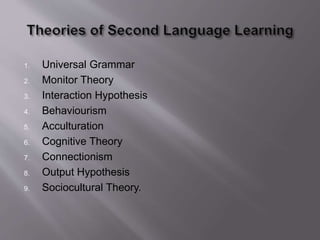
1. Universal Grammar 
2. Monitor Theory 
3. Interaction Hypothesis 
4. Behaviourism 
5. Acculturation 
6. Cognitive Theory 
7. Connectionism 
8. Output Hypothesis 
9. Sociocultural Theory.
1.Universal Grammar 
Chomsky describes this theory as knowledge that people are born 
with. Basically skill of language people already have without being 
thought. 
Chomsky (1976) is interested in the nature of language and sees 
language as a mirror of the mind. Although he is not concerned with 
SLA, his work has been influencing studies in SLA. According to his 
theory, every human being is biologically endowed with a language 
faculty, the language acquisition device, which is responsible for the 
initial state of language development.
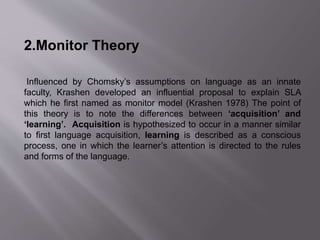
2.Monitor Theory 
Influenced by Chomsky’s assumptions on language as an innate 
faculty, Krashen developed an influential proposal to explain SLA 
which he first named as monitor model (Krashen 1978) The point of 
this theory is to note the differences between ‘acquisition’ and 
‘learning’. Acquisition is hypothesized to occur in a manner similar 
to first language acquisition, learning is described as a conscious 
process, one in which the learner’s attention is directed to the rules 
and forms of the language.
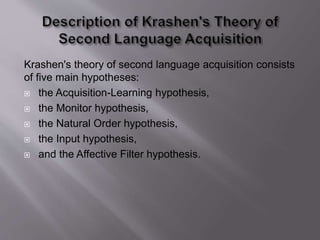
Krashen's theory of second language acquisition consists 
of five main hypotheses: 
 the Acquisition-Learning hypothesis, 
 the Monitor hypothesis, 
 the Natural Order hypothesis, 
 the Input hypothesis, 
 and the Affective Filter hypothesis.
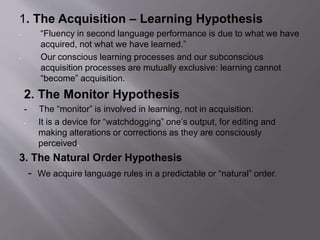
1. The Acquisition – Learning Hypothesis 
- “Fluency in second language performance is due to what we have 
acquired, not what we have learned.” 
- Our conscious learning processes and our subconscious 
acquisition processes are mutually exclusive: learning cannot 
“become” acquisition. 
2. The Monitor Hypothesis 
- The “monitor” is involved in learning, not in acquisition. 
- It is a device for “watchdogging” one’s output, for editing and 
making alterations or corrections as they are consciously 
perceived. 
3. The Natural Order Hypothesis 
- We acquire language rules in a predictable or “natural” order.
4. The Input Hypothesis 
- We acquire by comprehensible input (i) + 1 
- Input Hypothesis relates to acquisition, not learning 
- Focus not on structure but on understanding the message. 
5. The Affective Filter Hypothesis 
- Motivation 
- Self-confidence 
- Anxiety 
- Lower affective filter will go further.
It is usually attributed to Professor Michael Long, when he wrote a 
paper entitled “The Role of the Linguistic Environment in Second 
Language Acquisition” in 1996. 
Through the Interaction Hypothesis, Professor Long integrated and 
reconciled two hypotheses on second language acquisition (SLA): the 
input and the output hypotheses. The Input Hypothesis states that a 
language learner only needs to be supplied with “input” through the 
forms of reading, listening to conversations, and lessons on grammar 
and vocabulary. The Output Hypothesis, on the other hand, stresses 
the importance of practicing and speaking to retain and remember the 
language. The Interaction Hypothesis combines both the “input” and 
“output” by stating that interaction is not only a means for a learner to 
study the language, but also a way for the learner to practice what he 
has learned.
4. Behaviourism 
It dominated psychology and education theories of second 
language learning and teaching. Behaviourism was based on the 
view that all learning including language learning occurs through a 
process of imitation, practice, reinforcement and habit formation. 
Behaviourism gave birth to a stimulus-response (S-R) theory 
which sees language as a set of structures and acquisition as a 
matter of habit formation.
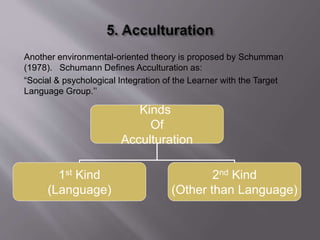
Another environmental-oriented theory is proposed by Schumman 
(1978). Schumann Defines Acculturation as: 
“Social & psychological Integration of the Learner with the Target 
Language Group.’’ 
Kinds 
Of 
Acculturation 
1st Kind 
(Language) 
2nd Kind 
(Other than Language)
Type 1 
Individual is socially integrated with the other community and 
Psychologically open to the other language. 
Type 2 
Individual takes the other community as a reference group whose 
life style & values he consciously or unconsciously desires to adopt. 
Similarity 
Social Interaction is common in both types. 
Difference 
But in Type 2 Acculturation, individual strives to become like members 
of that community in more ways than linguistically. 
i.e. adopts customs, rituals, values, dress.
6. Cognitive Psychology 
• Emerged as a response to Behaviorism 
• Focused on the inner mental activities of human beings 
to understand how people learn 
• Behaviorists saw humans as programmed animals, 
cognitivists viewed them as rational beings. 
• Language acquisition is viewed in light of the child’s 
cognitive development.
8. Output hypothesis 
Swain (1985, 1995) also goes against Krashen’s radical position 
towards the role of input and argues in favour of the output 
hypothesis. According to Merrill Swain, “The output hypothesis claims 
that the act of producing language (speaking or writing) constitutes 
under certain circumstances, part of the process of second language 
learning”1. As it can be noticed, there is a need for implementing and 
improving the use of these two skills which are different from the Input 
Hypothesis and that could be grouped together, forming a whole 
construct necessary for students to be able to convey meaning and 
communicate their ideas.
Three functions of output 
1) the noticing/triggering function 
2) the hypothesis-testing function 
3) the metalinguistic (reflective) function. 
This means that the message needs to be conveyed precisely, 
coherently, and appropriately. This form of ‘pushing’ students in terms 
of output is precisely the same as that of Krashen’s comprehensible 
input notion of i +1.
The sociocultural theory (SCT), based on Vygotskian thoughts, claims that 
language learning is a socially mediated process. Mediation is a fundamental 
principle and language is a cultural art fact that mediates social and 
psychological activities. The sociocultural theory, a second language 
acquisition theory module, proposes that second language can be acquired 
through social interactions. The sociocultural theory believes that language 
can be acquired by allowing the students to socialize and interact either with 
other learners or with the speakers of the language they are learning. The 
interaction should also be within the context of the language being learned. 
Ideally, the sociocultural theory suggests that the best way to acquire a 
language is to learn it from the place it is being used and to interact with 
native speakers.

Second language acquisition 120501105117-phpapp02 (1)

  • 1.
  • 2.
    Second language acquisitionis the Process by which people learn a Second Language (L2). What is SLA? Cognitive variation Second culture learning New Linguis tics system Communi cative Functions
  • 3.
    1. Universal Grammar 2. Monitor Theory 3. Interaction Hypothesis 4. Behaviourism 5. Acculturation 6. Cognitive Theory 7. Connectionism 8. Output Hypothesis 9. Sociocultural Theory.
  • 4.
    1.Universal Grammar Chomskydescribes this theory as knowledge that people are born with. Basically skill of language people already have without being thought. Chomsky (1976) is interested in the nature of language and sees language as a mirror of the mind. Although he is not concerned with SLA, his work has been influencing studies in SLA. According to his theory, every human being is biologically endowed with a language faculty, the language acquisition device, which is responsible for the initial state of language development.
  • 5.
    2.Monitor Theory Influencedby Chomsky’s assumptions on language as an innate faculty, Krashen developed an influential proposal to explain SLA which he first named as monitor model (Krashen 1978) The point of this theory is to note the differences between ‘acquisition’ and ‘learning’. Acquisition is hypothesized to occur in a manner similar to first language acquisition, learning is described as a conscious process, one in which the learner’s attention is directed to the rules and forms of the language.
  • 6.
    Krashen's theory ofsecond language acquisition consists of five main hypotheses:  the Acquisition-Learning hypothesis,  the Monitor hypothesis,  the Natural Order hypothesis,  the Input hypothesis,  and the Affective Filter hypothesis.
  • 7.
    1. The Acquisition– Learning Hypothesis - “Fluency in second language performance is due to what we have acquired, not what we have learned.” - Our conscious learning processes and our subconscious acquisition processes are mutually exclusive: learning cannot “become” acquisition. 2. The Monitor Hypothesis - The “monitor” is involved in learning, not in acquisition. - It is a device for “watchdogging” one’s output, for editing and making alterations or corrections as they are consciously perceived. 3. The Natural Order Hypothesis - We acquire language rules in a predictable or “natural” order.
  • 8.
    4. The InputHypothesis - We acquire by comprehensible input (i) + 1 - Input Hypothesis relates to acquisition, not learning - Focus not on structure but on understanding the message. 5. The Affective Filter Hypothesis - Motivation - Self-confidence - Anxiety - Lower affective filter will go further.
  • 9.
    It is usuallyattributed to Professor Michael Long, when he wrote a paper entitled “The Role of the Linguistic Environment in Second Language Acquisition” in 1996. Through the Interaction Hypothesis, Professor Long integrated and reconciled two hypotheses on second language acquisition (SLA): the input and the output hypotheses. The Input Hypothesis states that a language learner only needs to be supplied with “input” through the forms of reading, listening to conversations, and lessons on grammar and vocabulary. The Output Hypothesis, on the other hand, stresses the importance of practicing and speaking to retain and remember the language. The Interaction Hypothesis combines both the “input” and “output” by stating that interaction is not only a means for a learner to study the language, but also a way for the learner to practice what he has learned.
  • 10.
    4. Behaviourism Itdominated psychology and education theories of second language learning and teaching. Behaviourism was based on the view that all learning including language learning occurs through a process of imitation, practice, reinforcement and habit formation. Behaviourism gave birth to a stimulus-response (S-R) theory which sees language as a set of structures and acquisition as a matter of habit formation.
  • 11.
    Another environmental-oriented theoryis proposed by Schumman (1978). Schumann Defines Acculturation as: “Social & psychological Integration of the Learner with the Target Language Group.’’ Kinds Of Acculturation 1st Kind (Language) 2nd Kind (Other than Language)
  • 12.
    Type 1 Individualis socially integrated with the other community and Psychologically open to the other language. Type 2 Individual takes the other community as a reference group whose life style & values he consciously or unconsciously desires to adopt. Similarity Social Interaction is common in both types. Difference But in Type 2 Acculturation, individual strives to become like members of that community in more ways than linguistically. i.e. adopts customs, rituals, values, dress.
  • 13.
    6. Cognitive Psychology • Emerged as a response to Behaviorism • Focused on the inner mental activities of human beings to understand how people learn • Behaviorists saw humans as programmed animals, cognitivists viewed them as rational beings. • Language acquisition is viewed in light of the child’s cognitive development.
  • 14.
    8. Output hypothesis Swain (1985, 1995) also goes against Krashen’s radical position towards the role of input and argues in favour of the output hypothesis. According to Merrill Swain, “The output hypothesis claims that the act of producing language (speaking or writing) constitutes under certain circumstances, part of the process of second language learning”1. As it can be noticed, there is a need for implementing and improving the use of these two skills which are different from the Input Hypothesis and that could be grouped together, forming a whole construct necessary for students to be able to convey meaning and communicate their ideas.
  • 15.
    Three functions ofoutput 1) the noticing/triggering function 2) the hypothesis-testing function 3) the metalinguistic (reflective) function. This means that the message needs to be conveyed precisely, coherently, and appropriately. This form of ‘pushing’ students in terms of output is precisely the same as that of Krashen’s comprehensible input notion of i +1.
  • 16.
    The sociocultural theory(SCT), based on Vygotskian thoughts, claims that language learning is a socially mediated process. Mediation is a fundamental principle and language is a cultural art fact that mediates social and psychological activities. The sociocultural theory, a second language acquisition theory module, proposes that second language can be acquired through social interactions. The sociocultural theory believes that language can be acquired by allowing the students to socialize and interact either with other learners or with the speakers of the language they are learning. The interaction should also be within the context of the language being learned. Ideally, the sociocultural theory suggests that the best way to acquire a language is to learn it from the place it is being used and to interact with native speakers.