LEARNING TO LANGUAGE LEARNING Wallace,J.(1991)  Training Foreign Language Teachers.  Cambridge University Press  By: Dolly Ramos G
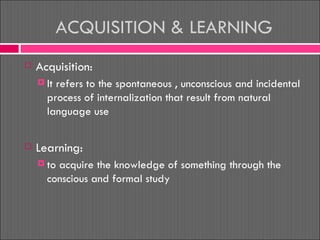
ACQUISITION & LEARNING Acquisition:  It refers to the spontaneous , unconscious and incidental process of internalization that result from natural language use Learning:  to acquire the knowledge of something through the conscious and formal study
ACQUISITION & LEARNING Pick up the lg naturally Implicit knowdlege Formal teaching is not necessary Using lg for real communication Formal teaching is necessay Knowing about the lg Knowledge of the rules ACQUISTION LEARNING
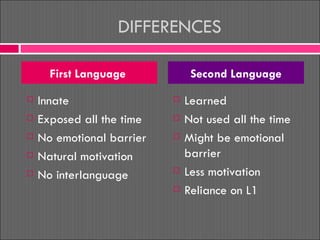
DIFFERENCES Innate Exposed all the time No emotional barrier Natural motivation No interlanguage Learned Not used all the time Might be emotional barrier Less motivation Reliance on L1 First Language  Second Language
FIRST, SECOND AND FOREIGN LANGUAGE Concern on children’s learning The main charateristics of  Foreign lg  Learning  Amount of time Type F or S  Responsibility of the teacher
LEARNING THE FRIST LANGUAGE READING Age 5 L1  incompletely  developed  Age 5-6 Literacy skill is on process SPEAKING & WRITING Age  7  Narrative  & Extended discourse Reference to characters Age 11& 15 (not fully developed) Relative Clauses & pronouns  Logical understanding Co-ordinators    & language LINGUISTIC DOMAINS (P,M,S,L, conversation & discourse) largely independent  Child’s early experience(family)  Narative & discourse Vocabulary Teacher Consider: Childrens’ individual differences and lg  strengths
LEARNING A SECOND LANGUAGE  Children learn faster than adults. ( Hypothesis )  Critical Period Hypothesis Children learning is more effectively before puberty (mechanisim assited the L1) Lightbown & Spada (1999) Against the Hypothesis Factor needs  Motivation  native- profiency  SL Context  communicative-goal  FL
THE INFLUENCE OF L1 ON L2 Competition Model Bates & Whinney(1989) Explain how L1 learning affects L2 &FL L1 Reliable or Unreliable Babies (particular cues) transfer to SL Learning the whole & the parts 7-8 age. Sound and rythm 12-14 age. Word order
AGE AND LANGUAGE FIRST  Who has less prolonged attention? FL lesson influence lg development Does conversation develop independently fron extended discourse? Modelling for scaffolding How can a teacher deal with this?
IS YOUNGER REALLY BETTER Catherine Snow & Marian Hoefnagel (1978) X= beginning Y = end  TASK CHILD ADOLESCENT ADULT PRONUNCIATION AUDITORY DISC  MORPHOLOGY  SENTENCE REPET  SENTENCE TRANSL  SSENTENCE JUST/  VOCAB TEST STORY COMPREH STORY TELLING
IS YOUNGER REALLY BETTER Catherine Snow & Marian Hoefnagel (1978) TASK CHILD ADOLESCENT ADULT PRONUNC  Y Y X AUDITORY DISC  XY MORPHOLOGY  XY SENTENCE REPET XY SENTENCE TRANSL  XY SSENTENCE JUST/  XY VOCAB TEST XY STORY COMPREH Y X STORY TELLING Y X
ADVANTAGES TO STARTING YOUNG WITH FOREIGN LG ADVANTAGES Early starters develop & maintain SOME areas fo the lg skill Listening comprehension pronunciation Language development DISAVANTAGES grammar slower  Cognitive development
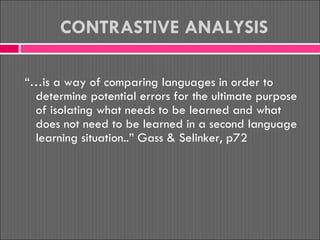
CONTRASTIVE ANALYSIS “… is a way of comparing languages in order to determine potential errors for the ultimate purpose of isolating what needs to be learned and what does not need to be learned in a second language learning situation..” Gass & Selinker, p72
CONTRASTIVE ANALYSIS HYPOTHESIS (CAH) " The most efficient materials are those that are based upon a scientific description of the language to be learned, carefully compared with a parallel description of the native language of the learner. " Fries (1945) "...those elements that are similar to his native language will be simple for him, and those elements that are different will be difficult." Lado (1957)
CONTRASTIVE ANALYSIS ASSUMPTIONS (1) 1- Errors are accounted for by considering differences between L1 and L2 2-  The greater the differences, the more errors will occur 3- Focus on dissimilarities in learning;  similarities require little new learning 4- Difficulty and ease in predicted by differences and similarities between L1 and L2
CAH: Two positions A priori or strong view: comparison between languages will  predict  learning outcomes A posterior or weak view: comparison between languages will help  explain  learning outcomes, especially errors.
‘ MISTAKE ’  VERSUS  ‘ ERROR’ Mistake : Random performance slip caused by fatigue, excitement, etc. Readily self-corrected. Error : Systematic deviation by learners who have not yet mastered the rules. More difficult to correct. Indication of learner’s attempt to figure out the L2 system Second Language Acquisition
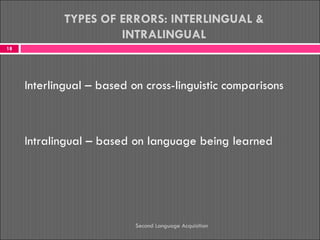
TYPES OF ERRORS: INTERLINGUAL & INTRALINGUAL Interlingual – based on cross-linguistic comparisons Intralingual – based on language being learned Second Language Acquisition
A DEVELOPMENTAL SEQUENCE FOR NEGATION. Stage Sample Utterance 1. External >>  No this one /  No you playing here 2. Internal, pre-verbal >>  Juana no / don’t have job. 3. Aux. + neg. >>  I didn’t went to Costa Rica 4. Analysed don’t >>  She doesn’t drink alcohol .  (Larsen-Freeman & Long, 1991, p94) Second Language Acquisition
THANK YOU  See you next Monday do not forget your to study and read

Learning To Language Learning

  • 1.
    LEARNING TO LANGUAGELEARNING Wallace,J.(1991) Training Foreign Language Teachers. Cambridge University Press By: Dolly Ramos G
  • 2.
    ACQUISITION & LEARNINGAcquisition: It refers to the spontaneous , unconscious and incidental process of internalization that result from natural language use Learning: to acquire the knowledge of something through the conscious and formal study
  • 3.
    ACQUISITION & LEARNINGPick up the lg naturally Implicit knowdlege Formal teaching is not necessary Using lg for real communication Formal teaching is necessay Knowing about the lg Knowledge of the rules ACQUISTION LEARNING
  • 4.
    DIFFERENCES Innate Exposedall the time No emotional barrier Natural motivation No interlanguage Learned Not used all the time Might be emotional barrier Less motivation Reliance on L1 First Language Second Language
  • 5.
    FIRST, SECOND ANDFOREIGN LANGUAGE Concern on children’s learning The main charateristics of Foreign lg Learning Amount of time Type F or S Responsibility of the teacher
  • 6.
    LEARNING THE FRISTLANGUAGE READING Age 5 L1 incompletely developed Age 5-6 Literacy skill is on process SPEAKING & WRITING Age 7 Narrative & Extended discourse Reference to characters Age 11& 15 (not fully developed) Relative Clauses & pronouns Logical understanding Co-ordinators & language LINGUISTIC DOMAINS (P,M,S,L, conversation & discourse) largely independent Child’s early experience(family) Narative & discourse Vocabulary Teacher Consider: Childrens’ individual differences and lg strengths
  • 7.
    LEARNING A SECONDLANGUAGE Children learn faster than adults. ( Hypothesis ) Critical Period Hypothesis Children learning is more effectively before puberty (mechanisim assited the L1) Lightbown & Spada (1999) Against the Hypothesis Factor needs Motivation native- profiency SL Context communicative-goal FL
  • 8.
    THE INFLUENCE OFL1 ON L2 Competition Model Bates & Whinney(1989) Explain how L1 learning affects L2 &FL L1 Reliable or Unreliable Babies (particular cues) transfer to SL Learning the whole & the parts 7-8 age. Sound and rythm 12-14 age. Word order
  • 9.
    AGE AND LANGUAGEFIRST Who has less prolonged attention? FL lesson influence lg development Does conversation develop independently fron extended discourse? Modelling for scaffolding How can a teacher deal with this?
  • 10.
    IS YOUNGER REALLYBETTER Catherine Snow & Marian Hoefnagel (1978) X= beginning Y = end TASK CHILD ADOLESCENT ADULT PRONUNCIATION AUDITORY DISC MORPHOLOGY SENTENCE REPET SENTENCE TRANSL SSENTENCE JUST/ VOCAB TEST STORY COMPREH STORY TELLING
  • 11.
    IS YOUNGER REALLYBETTER Catherine Snow & Marian Hoefnagel (1978) TASK CHILD ADOLESCENT ADULT PRONUNC Y Y X AUDITORY DISC XY MORPHOLOGY XY SENTENCE REPET XY SENTENCE TRANSL XY SSENTENCE JUST/ XY VOCAB TEST XY STORY COMPREH Y X STORY TELLING Y X
  • 12.
    ADVANTAGES TO STARTINGYOUNG WITH FOREIGN LG ADVANTAGES Early starters develop & maintain SOME areas fo the lg skill Listening comprehension pronunciation Language development DISAVANTAGES grammar slower Cognitive development
  • 13.
    CONTRASTIVE ANALYSIS “…is a way of comparing languages in order to determine potential errors for the ultimate purpose of isolating what needs to be learned and what does not need to be learned in a second language learning situation..” Gass & Selinker, p72
  • 14.
    CONTRASTIVE ANALYSIS HYPOTHESIS(CAH) " The most efficient materials are those that are based upon a scientific description of the language to be learned, carefully compared with a parallel description of the native language of the learner. " Fries (1945) "...those elements that are similar to his native language will be simple for him, and those elements that are different will be difficult." Lado (1957)
  • 15.
    CONTRASTIVE ANALYSIS ASSUMPTIONS(1) 1- Errors are accounted for by considering differences between L1 and L2 2- The greater the differences, the more errors will occur 3- Focus on dissimilarities in learning; similarities require little new learning 4- Difficulty and ease in predicted by differences and similarities between L1 and L2
  • 16.
    CAH: Two positionsA priori or strong view: comparison between languages will predict learning outcomes A posterior or weak view: comparison between languages will help explain learning outcomes, especially errors.
  • 17.
    ‘ MISTAKE ’ VERSUS ‘ ERROR’ Mistake : Random performance slip caused by fatigue, excitement, etc. Readily self-corrected. Error : Systematic deviation by learners who have not yet mastered the rules. More difficult to correct. Indication of learner’s attempt to figure out the L2 system Second Language Acquisition
  • 18.
    TYPES OF ERRORS:INTERLINGUAL & INTRALINGUAL Interlingual – based on cross-linguistic comparisons Intralingual – based on language being learned Second Language Acquisition
  • 19.
    A DEVELOPMENTAL SEQUENCEFOR NEGATION. Stage Sample Utterance 1. External >> No this one / No you playing here 2. Internal, pre-verbal >> Juana no / don’t have job. 3. Aux. + neg. >> I didn’t went to Costa Rica 4. Analysed don’t >> She doesn’t drink alcohol . (Larsen-Freeman & Long, 1991, p94) Second Language Acquisition
  • 20.
    THANK YOU See you next Monday do not forget your to study and read