* Second Language
               Acquisition
Prepared By:
Edward Valcárcel Melgarejo


                   Docente de Educación en Idiomas
                       Universidad Nacional de San
                               Agustín de Arequipa
*   CHAPTER 1
    KEY ISSUES IN SECOND
    LANGUAGE ACQUISITION

    OBJECTIVES
    1.   Demonstrate an understanding of the internal
         factors influencing the learning process.

    2.   Integrate knowledge of second language
         acquisition research and diverse cognitive
         style.
*THEMATIC NUCLEUS 1
 PREVIOUS CONCEPTS
* What is Second
 Language Acquisition?


   SLA as a Uniforms Phenomenon
   SLA is not a uniform and predictable
phenomenon. There is no single way in
which learners acquire a knowledge of a
second language. SLA is the product of
many factors pertaining to the learner on the
one hand and the learning situation on the
other.
* SECOND LANGAGE ACQUISITION
VS FIRST LANGUAGE ACQUISITION

   Second language acquisition stands in
contrast to first language acquisition. It is the
study of how learners learn an additional
language after they have acquired their
mother tongue. The study of language leaner
language began with the study of first
language (L1) acquisition.
* What is the Study of Second Language
                         Acquisition?

It is the study of:
   how second languages are learned;

   how learners create a new language system with limited
   exposure to a second language;

   why most second language learners do not achieve the same
   degree of proficiency in a second language as they do in their
   native language; and

   why some learners appear to achieve native-like proficiency in
   more than one language.
THE CENTRALITY OF SYNTAX AND
           MORPHOLOGY
 COMPETENCE VERSUS PERFORMANCE

A distinction is often made beween competence
and performance in the study of language.
According to Chomsky competence consists of
the mental representation of linguistic rules
which         constitute  the  speaker-hearer’s
internalized grammar. Performance consists of
comprehension and production of language.
* Competence Vs. Performance

     According to Chomsky (1965), competence consists
   of mental representations of linguistic rules that
   constitute the speaker-hearer’s internal grammar.

      This internal grammar is implicit rather than explicit.
   It is evident in the intuitions, which the speaker-hearer
   has about the grammaticality of sentences.

     Performance consists of the use of this grammar in
   the comprehension and production of the language.
*Language transfer
*L1 helps L2
*L1 makes difficult


    *THE ROLE OF THE FIRST
                      LANGUAGE
* THE GIRL SMART
* THE SMART GIRL
*


    Contrastive analysis is a way of comparing languages
    in order to determine potential errors.

    The ultimate goal of contrastive analysis is to predict
    areas that will be either easy or difficult for learners.
* AGE: Do adults learn a L2 in the same way as
 children.
* APTITUDE
* MOTIVATION: Intrinsec and Extrinsec.
* PERSONALITY AND COGNITIVE STYLE: What kind
 of personality is most successful in learning a
 L2? What role does inhibition play in SLA?


             *INDIVIDUAL LEARNER
                              DIFFERENCES
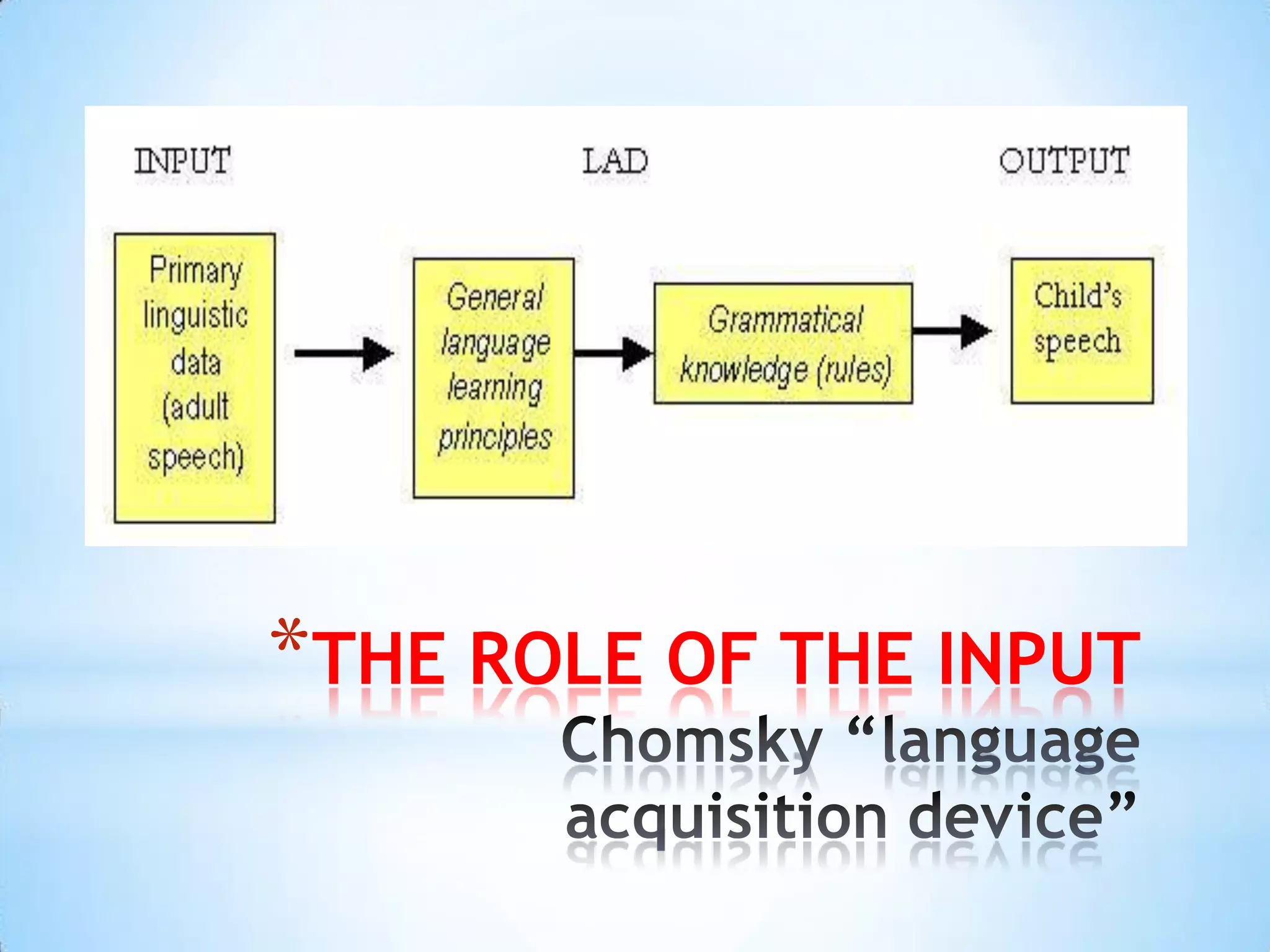
*THE ROLE OF THE INPUT
*Cognitive Strategies.
*Universal Grammar


        *LEARNER PROCESSES
* The effect that   instruction has on the route of
 learning and
* The effect that it has on rate of learning.
Order of grammar.
Does formal instruction help learners to perform in
all types of situations? Why?
* Accelerating the whole process.
* Learn more rapidly.

           *THE ROLE OF FORMAL
                                 INSTRUCTION
*THEMATIC NUCLEUS 2
THE ROLE OF THE FIRST
           LANGUAGE
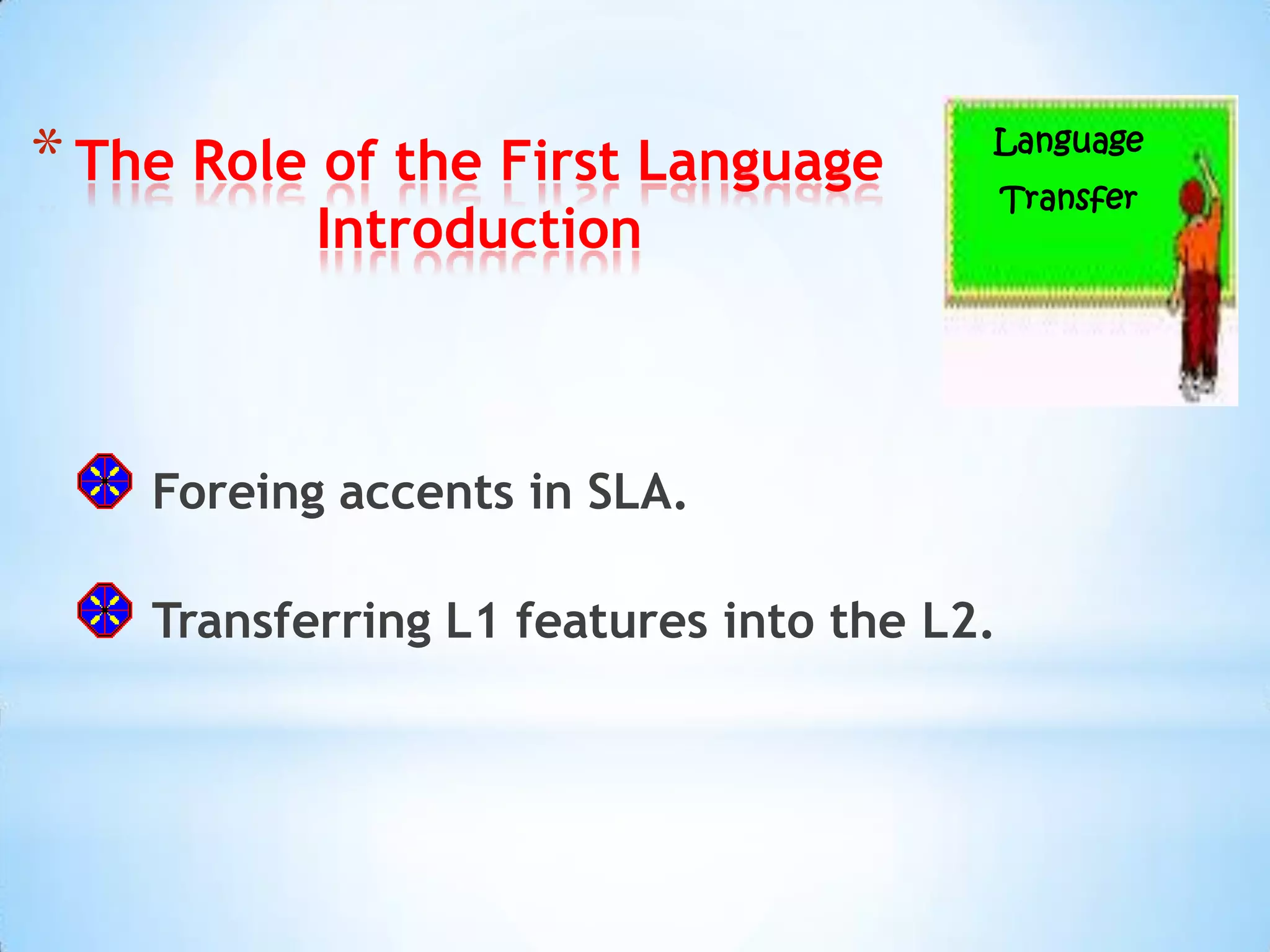
* The Role of the First Language        Language
                                            Transfer
           Introduction


    Foreing accents in SLA.

    Transferring L1 features into the L2.
*Habits:  Different stimuli produced
 differente responses from a learner.
*What is a habit?
*The stimulus elicits the response.
*Imitation and reinforcement.


           *Behaviourist        Learning
                                 Theory
*Errors: old habits get in the way
of learning new habits.
*Interference
            was the result of
what was called proactive
inhibition.

     *Behaviourist     Learning
                        Theory
* Contrastive Analysis
Hypothesis: The Psychological
           Aspect

   There are two positions that developed with
   regard to CA: (1) strong (2) weak.

   The strong version (predictive) maintained that all
   L2 errors can be predicted.

   The weak version (explanatory) maintained that a
   contrastive analysis can be used to identify which
   errors are the result of interference..
*Contrastive Analysis
Hypothesis: The Linguistic
         Aspect
   Structuralist linguists: description of the different
   categories that make up the patterns of a
   language.

   Procedure:

oDescription of the two languages.
oSelection of items or areas for comparison
oComparison.
oPrediction of areas which can cause errors.
*The ability of Contrastive Analysis to
predict errors.
*Contrastive  Analysis doesn’t have
anything relevant to offer to language
teaching.


                 *Criticisms of the
               Contrastive Analysis
                        Hypothesis
*Four types of errors.
1.   Interference-like errors: reflect native language
     structure.
2.   First language developmental errors: are found in first
     language acquisition data.
3.   Ambigous errors: can not be categorized.
4.   Unique errors.


           *Empirical Research and
                      the predictability of
                                    errors
*The attack on behaviourist accounts
of language learning which was given
impetus by chomsky`s (1959) review
of Skinner`s Verbal Behaviour;


                  *Theoretical
                      Criticisms
*Is Contrastive Analysis useful for the
 teacher?
*The  final set of criticisms concerns
 whether Contrastive Analysis is of any
 practical worth to language teachers.


        *Practical Criticisms

E10 02 second languaje acquisition cap1

  • 1.
    * Second Language Acquisition Prepared By: Edward Valcárcel Melgarejo Docente de Educación en Idiomas Universidad Nacional de San Agustín de Arequipa
  • 2.
    * CHAPTER 1 KEY ISSUES IN SECOND LANGUAGE ACQUISITION OBJECTIVES 1. Demonstrate an understanding of the internal factors influencing the learning process. 2. Integrate knowledge of second language acquisition research and diverse cognitive style.
  • 3.
    *THEMATIC NUCLEUS 1 PREVIOUS CONCEPTS
  • 4.
    * What isSecond Language Acquisition? SLA as a Uniforms Phenomenon SLA is not a uniform and predictable phenomenon. There is no single way in which learners acquire a knowledge of a second language. SLA is the product of many factors pertaining to the learner on the one hand and the learning situation on the other.
  • 5.
    * SECOND LANGAGEACQUISITION VS FIRST LANGUAGE ACQUISITION Second language acquisition stands in contrast to first language acquisition. It is the study of how learners learn an additional language after they have acquired their mother tongue. The study of language leaner language began with the study of first language (L1) acquisition.
  • 6.
    * What isthe Study of Second Language Acquisition? It is the study of: how second languages are learned; how learners create a new language system with limited exposure to a second language; why most second language learners do not achieve the same degree of proficiency in a second language as they do in their native language; and why some learners appear to achieve native-like proficiency in more than one language.
  • 7.
    THE CENTRALITY OFSYNTAX AND MORPHOLOGY COMPETENCE VERSUS PERFORMANCE A distinction is often made beween competence and performance in the study of language. According to Chomsky competence consists of the mental representation of linguistic rules which constitute the speaker-hearer’s internalized grammar. Performance consists of comprehension and production of language.
  • 8.
    * Competence Vs.Performance According to Chomsky (1965), competence consists of mental representations of linguistic rules that constitute the speaker-hearer’s internal grammar. This internal grammar is implicit rather than explicit. It is evident in the intuitions, which the speaker-hearer has about the grammaticality of sentences. Performance consists of the use of this grammar in the comprehension and production of the language.
  • 9.
    *Language transfer *L1 helpsL2 *L1 makes difficult *THE ROLE OF THE FIRST LANGUAGE
  • 10.
    * THE GIRLSMART * THE SMART GIRL
  • 11.
    * Contrastive analysis is a way of comparing languages in order to determine potential errors. The ultimate goal of contrastive analysis is to predict areas that will be either easy or difficult for learners.
  • 12.
    * AGE: Doadults learn a L2 in the same way as children. * APTITUDE * MOTIVATION: Intrinsec and Extrinsec. * PERSONALITY AND COGNITIVE STYLE: What kind of personality is most successful in learning a L2? What role does inhibition play in SLA? *INDIVIDUAL LEARNER DIFFERENCES
  • 13.
    *THE ROLE OFTHE INPUT
  • 14.
  • 15.
    * The effectthat instruction has on the route of learning and * The effect that it has on rate of learning. Order of grammar. Does formal instruction help learners to perform in all types of situations? Why? * Accelerating the whole process. * Learn more rapidly. *THE ROLE OF FORMAL INSTRUCTION
  • 16.
    *THEMATIC NUCLEUS 2 THEROLE OF THE FIRST LANGUAGE
  • 17.
    * The Roleof the First Language Language Transfer Introduction Foreing accents in SLA. Transferring L1 features into the L2.
  • 18.
    *Habits: Differentstimuli produced differente responses from a learner. *What is a habit? *The stimulus elicits the response. *Imitation and reinforcement. *Behaviourist Learning Theory
  • 19.
    *Errors: old habitsget in the way of learning new habits. *Interference was the result of what was called proactive inhibition. *Behaviourist Learning Theory
  • 20.
    * Contrastive Analysis Hypothesis:The Psychological Aspect There are two positions that developed with regard to CA: (1) strong (2) weak. The strong version (predictive) maintained that all L2 errors can be predicted. The weak version (explanatory) maintained that a contrastive analysis can be used to identify which errors are the result of interference..
  • 21.
    *Contrastive Analysis Hypothesis: TheLinguistic Aspect Structuralist linguists: description of the different categories that make up the patterns of a language. Procedure: oDescription of the two languages. oSelection of items or areas for comparison oComparison. oPrediction of areas which can cause errors.
  • 22.
    *The ability ofContrastive Analysis to predict errors. *Contrastive Analysis doesn’t have anything relevant to offer to language teaching. *Criticisms of the Contrastive Analysis Hypothesis
  • 23.
    *Four types oferrors. 1. Interference-like errors: reflect native language structure. 2. First language developmental errors: are found in first language acquisition data. 3. Ambigous errors: can not be categorized. 4. Unique errors. *Empirical Research and the predictability of errors
  • 24.
    *The attack onbehaviourist accounts of language learning which was given impetus by chomsky`s (1959) review of Skinner`s Verbal Behaviour; *Theoretical Criticisms
  • 25.
    *Is Contrastive Analysisuseful for the teacher? *The final set of criticisms concerns whether Contrastive Analysis is of any practical worth to language teachers. *Practical Criticisms