What Is Morphology?
Morphology is the component of mental grammar that deals
with types of words and how words are formed out of smaller
meaningful pieces and other words.
 Example: Every speaker of English knows that wind is an English
word, as are
unwind, rewind, winding, windable, windy, etc.
 However, even though woman is also an English word, none of the
following are possible:
unwoman, rewoman, womaning, womanable, womany, etc.
 Why is it that you can add re- to wind and get another word, but
adding re- to woman does not result in a word?
 Morphology as a subfield of linguistics studies the internal structure of
words.
It tries to describe which meaningful pieces of language can be
combined to form words and what the consequences of such combinations
are on the meaning or the grammatical function of the resulting word.
 For example, the addition of re- to wind modifies the meaning of wind in a
certain way, and in fact, it does so in the same way when added to unite
(reunite), or play (replay)
Morphology is the system of categories and rules
involved in Word formation.
It´s the study of the internal structures of words
inventory of notions relevant to the anlalysis of the
WORD STRUCTURE.
What Are Words Like?
 Every language has some (large) number of words available for its users to
choose from as they need. This stock of words can be thought of as a sort
of mental dictionary that language users—both speakers and hearers—
have internalized as part and parcel of acquiring their particular language.
We call this mental dictionary THE LEXICON.
What is a Word?
The smallest FREE FORM found in a language.
An element that can occur in isolation or whose
position with respect to neighbouring categories is not
completely fixed.
E.g. BIRD
THE (do not occur in isolation)
(But it’s position is not entirely fixed)
WORDS
BELONG TO LEXICAL CATEGORIES:
(Parts of the speech)
OPEN LEXICAL CATEGORIES: Nouns, verbs, adjectives, and adverbs
New words added to the language usually belong to these categories.
CLOSED LEXICAL CATEGORIES
 pronouns (e.g., we, she, they)
 determiners (e.g., a, the, this, your)
 prepositions (e.g., on, of, under, for)
 conjunctions (e.g., and, or, but).
They rarely acquire new members.
MORPHEME
It’s the smallest unit that CARRIES INFORMATION
about meaning and function.
e.g. BUILD-ER ( 2 morphemes)
 SIMPLE WORDS Train – pig
 COMPLEX WORDS Computers – mankind
 It’s meaning and a strecht of sound joined together
constitutes SOUND MEANING UNIT.
 They are ARBITRARY There is no connection
sound and meaning.
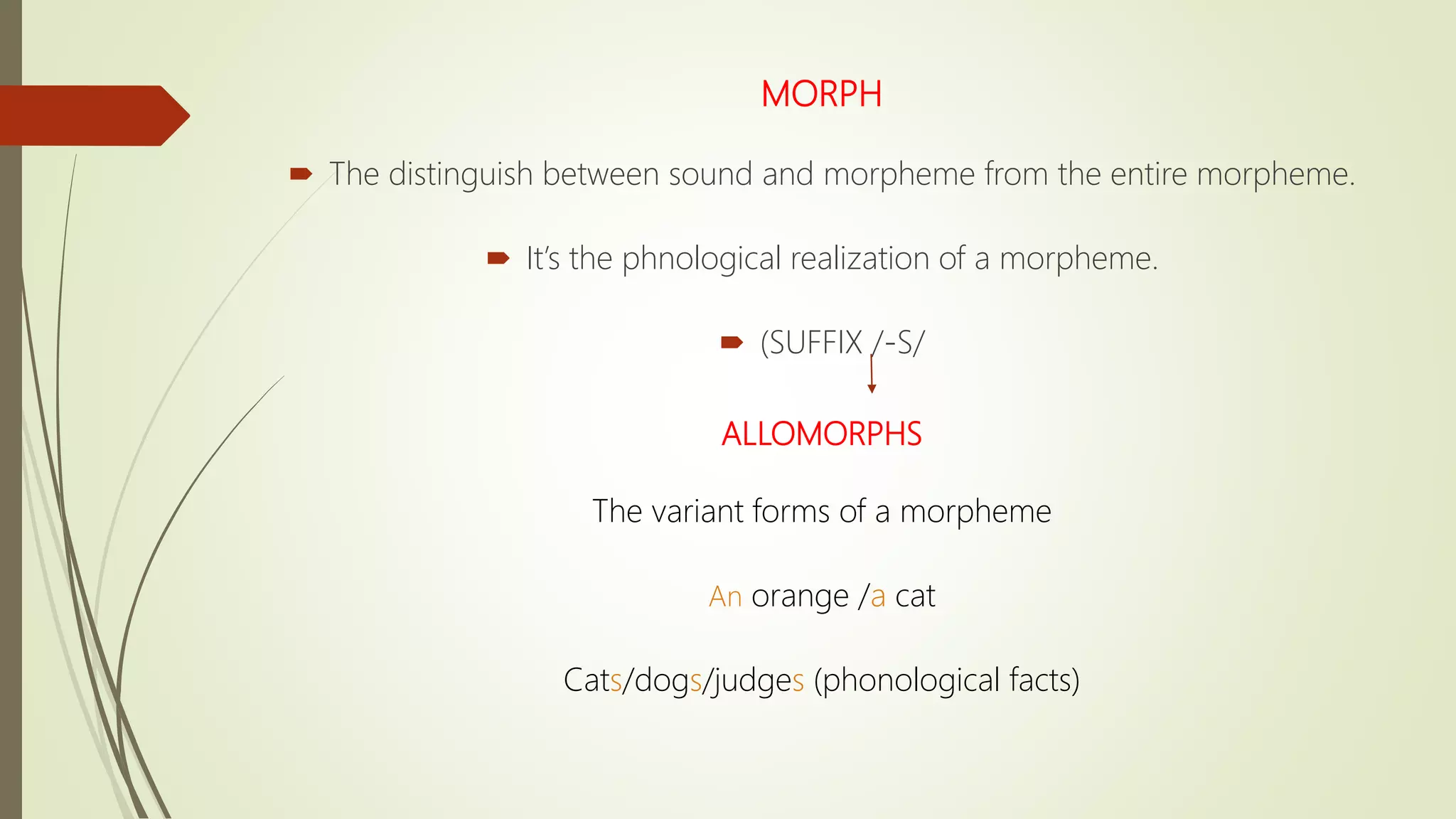
MORPH
 The distinguish between sound and morpheme from the entire morpheme.
 It’s the phnological realization of a morpheme.
 (SUFFIX /-S/
ALLOMORPHS
The variant forms of a morpheme
An orange /a cat
Cats/dogs/judges (phonological facts)
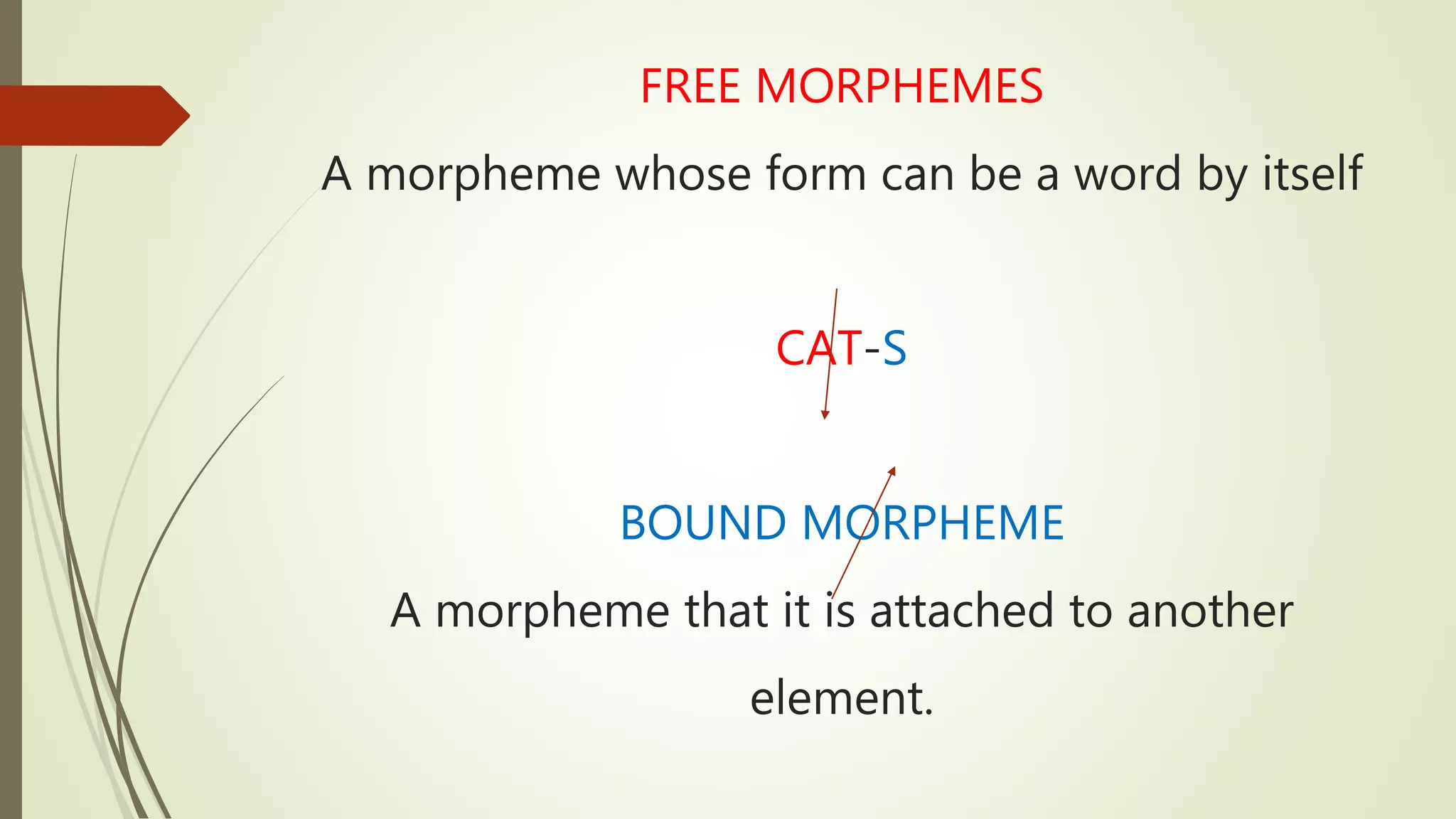
FREE MORPHEMES
A morpheme whose form can be a word by itself
CAT-S
BOUND MORPHEME
A morpheme that it is attached to another
element.
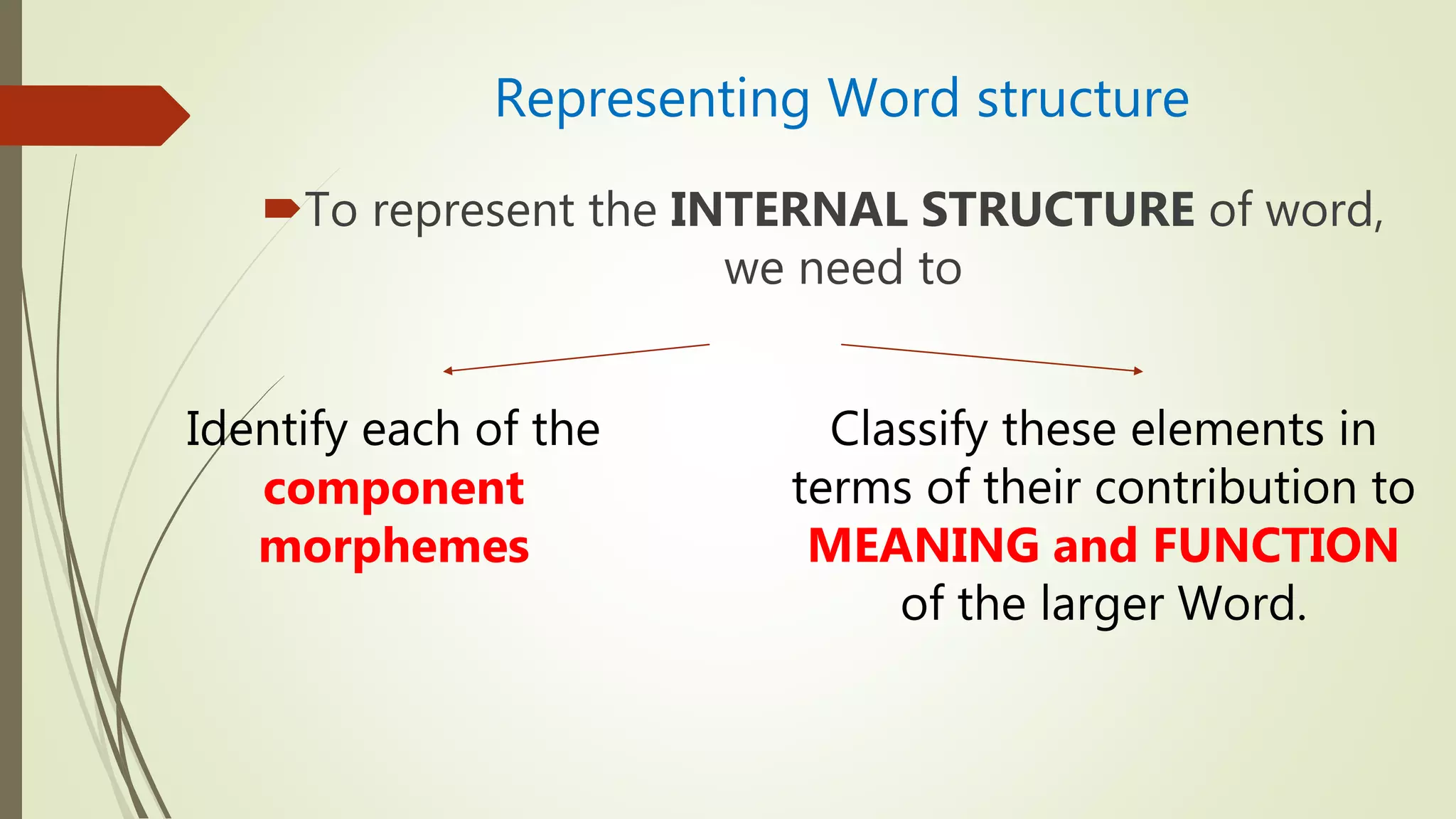
Representing Word structure
To represent the INTERNAL STRUCTURE of word,
we need to
Identify each of the
component
morphemes
Classify these elements in
terms of their contribution to
MEANING and FUNCTION
of the larger Word.
ROOTS and AFFIXES
It belongs to
LEXICAL CATEGORY
Nouns – adverbs –
adjectives - verbs
Do not belong to
lexical categories.
They are BOUND
MORPHEMES
TEACH-
ER
v Af.
n
TREE STRUCTURES
BASES
It’s and element to which an affix is added
Base BOOK-S affix
Sometimes the BASE is also the ROOT.
Sometimes it is added to a unit larger than a ROOT.
Black – en – ed
Root and base base for -ed
for -en
 Dawson, H.C. and Phelan, M. (2016). Language Files. Materials for an Introduction
to Language and Linguistics. Department of Linguistics. The Ohio State University.

Morphology

  • 1.
  • 2.
    Morphology is thecomponent of mental grammar that deals with types of words and how words are formed out of smaller meaningful pieces and other words.  Example: Every speaker of English knows that wind is an English word, as are unwind, rewind, winding, windable, windy, etc.  However, even though woman is also an English word, none of the following are possible: unwoman, rewoman, womaning, womanable, womany, etc.  Why is it that you can add re- to wind and get another word, but adding re- to woman does not result in a word?
  • 3.
     Morphology asa subfield of linguistics studies the internal structure of words. It tries to describe which meaningful pieces of language can be combined to form words and what the consequences of such combinations are on the meaning or the grammatical function of the resulting word.  For example, the addition of re- to wind modifies the meaning of wind in a certain way, and in fact, it does so in the same way when added to unite (reunite), or play (replay)
  • 4.
    Morphology is thesystem of categories and rules involved in Word formation. It´s the study of the internal structures of words inventory of notions relevant to the anlalysis of the WORD STRUCTURE.
  • 5.
    What Are WordsLike?  Every language has some (large) number of words available for its users to choose from as they need. This stock of words can be thought of as a sort of mental dictionary that language users—both speakers and hearers— have internalized as part and parcel of acquiring their particular language. We call this mental dictionary THE LEXICON.
  • 6.
    What is aWord? The smallest FREE FORM found in a language. An element that can occur in isolation or whose position with respect to neighbouring categories is not completely fixed. E.g. BIRD THE (do not occur in isolation) (But it’s position is not entirely fixed)
  • 7.
    WORDS BELONG TO LEXICALCATEGORIES: (Parts of the speech) OPEN LEXICAL CATEGORIES: Nouns, verbs, adjectives, and adverbs New words added to the language usually belong to these categories. CLOSED LEXICAL CATEGORIES  pronouns (e.g., we, she, they)  determiners (e.g., a, the, this, your)  prepositions (e.g., on, of, under, for)  conjunctions (e.g., and, or, but). They rarely acquire new members.
  • 8.
    MORPHEME It’s the smallestunit that CARRIES INFORMATION about meaning and function. e.g. BUILD-ER ( 2 morphemes)
  • 9.
     SIMPLE WORDSTrain – pig  COMPLEX WORDS Computers – mankind  It’s meaning and a strecht of sound joined together constitutes SOUND MEANING UNIT.  They are ARBITRARY There is no connection sound and meaning.
  • 10.
    MORPH  The distinguishbetween sound and morpheme from the entire morpheme.  It’s the phnological realization of a morpheme.  (SUFFIX /-S/ ALLOMORPHS The variant forms of a morpheme An orange /a cat Cats/dogs/judges (phonological facts)
  • 11.
    FREE MORPHEMES A morphemewhose form can be a word by itself CAT-S BOUND MORPHEME A morpheme that it is attached to another element.
  • 12.
    Representing Word structure Torepresent the INTERNAL STRUCTURE of word, we need to Identify each of the component morphemes Classify these elements in terms of their contribution to MEANING and FUNCTION of the larger Word.
  • 13.
    ROOTS and AFFIXES Itbelongs to LEXICAL CATEGORY Nouns – adverbs – adjectives - verbs Do not belong to lexical categories. They are BOUND MORPHEMES TEACH- ER v Af. n TREE STRUCTURES
  • 14.
    BASES It’s and elementto which an affix is added Base BOOK-S affix Sometimes the BASE is also the ROOT. Sometimes it is added to a unit larger than a ROOT. Black – en – ed Root and base base for -ed for -en
  • 15.
     Dawson, H.C.and Phelan, M. (2016). Language Files. Materials for an Introduction to Language and Linguistics. Department of Linguistics. The Ohio State University.