Why do weWhy do we
havehave
seasons?seasons?
Earth’s rotationEarth’s rotation
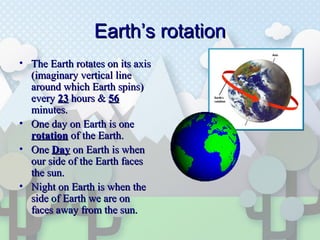
• The Earth rotates on its axisThe Earth rotates on its axis
(imaginary vertical line(imaginary vertical line
around which Earth spins)around which Earth spins)
everyevery 2323 hours &hours & 5656
minutes.minutes.
• One day on Earth is oneOne day on Earth is one
rotationrotation of the Earth.of the Earth.
• OneOne DayDay on Earth is whenon Earth is when
our side of the Earth facesour side of the Earth faces
the sun.the sun.
• Night on Earth is when theNight on Earth is when the
side of Earth we are onside of Earth we are on
faces away from the sun.faces away from the sun.
Earth’s revolutionEarth’s revolution
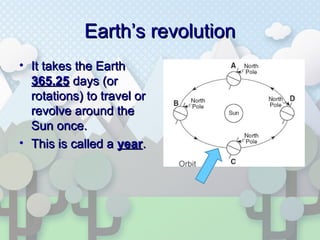
• It takes the EarthIt takes the Earth
365.25365.25 days (ordays (or
rotations) to travel orrotations) to travel or
revolve around therevolve around the
Sun once.Sun once.
• This is called aThis is called a yearyear..
Orbit
Motion TerminologyMotion Terminology
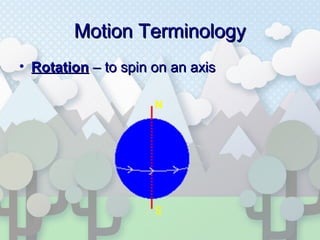
• RotationRotation – to spin on an axis– to spin on an axis
Motion TerminologyMotion Terminology
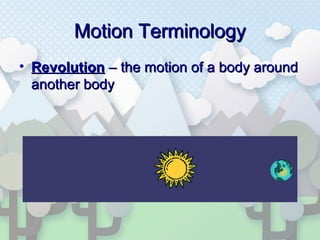
• RevolutionRevolution – the motion of a body around– the motion of a body around
another bodyanother body
Motion TerminologyMotion Terminology
• OrbitOrbit – the path that is followed around– the path that is followed around
another body in spaceanother body in space
Why do we have seasons?Why do we have seasons?
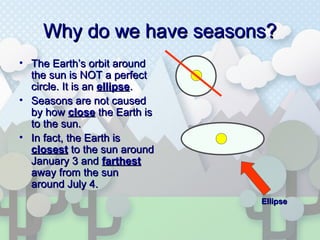
• The Earth’s orbit aroundThe Earth’s orbit around
the sun is NOT a perfectthe sun is NOT a perfect
circle. It is ancircle. It is an ellipseellipse..
• Seasons are not causedSeasons are not caused
by howby how closeclose the Earth isthe Earth is
to the sun.to the sun.
• In fact, the Earth isIn fact, the Earth is
closestclosest to the sun aroundto the sun around
January 3 andJanuary 3 and farthestfarthest
away from the sunaway from the sun
around July 4.around July 4.
EllipseEllipse
Why do we have seasons?Why do we have seasons?
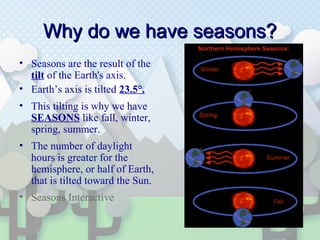
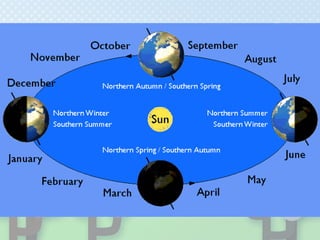
• Seasons are the result of the
tilt of the Earth's axis.
• Earth’s axis is tilted 23.5°.
• This tilting is why we have
SEASONS like fall, winter,
spring, summer.
• The number of daylight
hours is greater for the
hemisphere, or half of Earth,
that is tilted toward the Sun.
• Seasons Interactive
Why do we have seasons?Why do we have seasons?
• Summer is warmer than winter (in eachSummer is warmer than winter (in each
hemisphere) because the Sun's rays hit thehemisphere) because the Sun's rays hit the
Earth at a moreEarth at a more directdirect angle during summer thanangle during summer than
during winterduring winter
Why do we have seasons?Why do we have seasons?
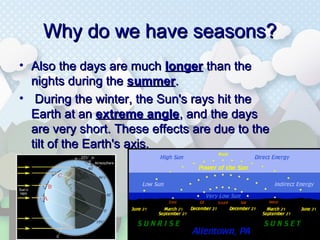
• Also the days are muchAlso the days are much longerlonger than thethan the
nights during thenights during the summersummer..
• During the winter, the Sun's rays hit theDuring the winter, the Sun's rays hit the
Earth at anEarth at an extreme angleextreme angle, and the days, and the days
are very short. These effects are due to theare very short. These effects are due to the
tilt of the Earth's axis.tilt of the Earth's axis.
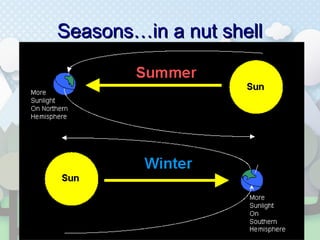
Seasons…in a nut shellSeasons…in a nut shell
SolsticesSolstices
• Occur twice a year, when the tilt of the Earth's axis isOccur twice a year, when the tilt of the Earth's axis is
oriented at its extremes.oriented at its extremes. Tilted the farthest or closestTilted the farthest or closest
• Winter solstice is the shortest day of the year. In theWinter solstice is the shortest day of the year. In the
Northern Hemisphere. It occurs onNorthern Hemisphere. It occurs on December 21 or 22December 21 or 22
and marks the beginning of winter.and marks the beginning of winter.
• The Summer Solstice is the longest day of the year. ItThe Summer Solstice is the longest day of the year. It
occurs onoccurs on June 20 or 21June 20 or 21 and marks the beginning ofand marks the beginning of
summer.summer.
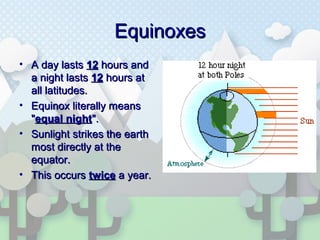
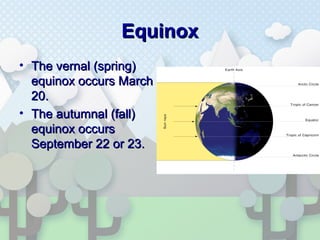
EquinoxesEquinoxes
• A day lastsA day lasts 1212 hours andhours and
a night lastsa night lasts 1212 hours athours at
all latitudes.all latitudes.
• Equinox literally meansEquinox literally means
""equal nightequal night".".
• Sunlight strikes the earthSunlight strikes the earth
most directly at themost directly at the
equator.equator.
• This occursThis occurs twicetwice a year.a year.
EquinoxEquinox
• The vernal (spring)The vernal (spring)
equinox occurs Marchequinox occurs March
20.20.
• The autumnal (fall)The autumnal (fall)
equinox occursequinox occurs
September 22 or 23.September 22 or 23.
The Earth's seasons are notThe Earth's seasons are not
caused by the differences in thecaused by the differences in the
distance from the Sun throughoutdistance from the Sun throughout
the year.the year.
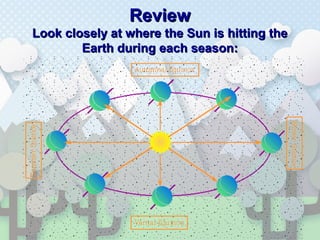
ReviewReview
Look closely at where the Sun is hitting theLook closely at where the Sun is hitting the
Earth during each season:Earth during each season:
Seasons wd equinox & solstice

Seasons wd equinox & solstice

  • 1.
    Why do weWhydo we havehave seasons?seasons?
  • 2.
    Earth’s rotationEarth’s rotation •The Earth rotates on its axisThe Earth rotates on its axis (imaginary vertical line(imaginary vertical line around which Earth spins)around which Earth spins) everyevery 2323 hours &hours & 5656 minutes.minutes. • One day on Earth is oneOne day on Earth is one rotationrotation of the Earth.of the Earth. • OneOne DayDay on Earth is whenon Earth is when our side of the Earth facesour side of the Earth faces the sun.the sun. • Night on Earth is when theNight on Earth is when the side of Earth we are onside of Earth we are on faces away from the sun.faces away from the sun.
  • 3.
    Earth’s revolutionEarth’s revolution •It takes the EarthIt takes the Earth 365.25365.25 days (ordays (or rotations) to travel orrotations) to travel or revolve around therevolve around the Sun once.Sun once. • This is called aThis is called a yearyear.. Orbit
  • 4.
    Motion TerminologyMotion Terminology •RotationRotation – to spin on an axis– to spin on an axis
  • 5.
    Motion TerminologyMotion Terminology •RevolutionRevolution – the motion of a body around– the motion of a body around another bodyanother body
  • 6.
    Motion TerminologyMotion Terminology •OrbitOrbit – the path that is followed around– the path that is followed around another body in spaceanother body in space
  • 7.
    Why do wehave seasons?Why do we have seasons? • The Earth’s orbit aroundThe Earth’s orbit around the sun is NOT a perfectthe sun is NOT a perfect circle. It is ancircle. It is an ellipseellipse.. • Seasons are not causedSeasons are not caused by howby how closeclose the Earth isthe Earth is to the sun.to the sun. • In fact, the Earth isIn fact, the Earth is closestclosest to the sun aroundto the sun around January 3 andJanuary 3 and farthestfarthest away from the sunaway from the sun around July 4.around July 4. EllipseEllipse
  • 8.
    Why do wehave seasons?Why do we have seasons? • Seasons are the result of the tilt of the Earth's axis. • Earth’s axis is tilted 23.5°. • This tilting is why we have SEASONS like fall, winter, spring, summer. • The number of daylight hours is greater for the hemisphere, or half of Earth, that is tilted toward the Sun. • Seasons Interactive
  • 9.
    Why do wehave seasons?Why do we have seasons? • Summer is warmer than winter (in eachSummer is warmer than winter (in each hemisphere) because the Sun's rays hit thehemisphere) because the Sun's rays hit the Earth at a moreEarth at a more directdirect angle during summer thanangle during summer than during winterduring winter
  • 10.
    Why do wehave seasons?Why do we have seasons? • Also the days are muchAlso the days are much longerlonger than thethan the nights during thenights during the summersummer.. • During the winter, the Sun's rays hit theDuring the winter, the Sun's rays hit the Earth at anEarth at an extreme angleextreme angle, and the days, and the days are very short. These effects are due to theare very short. These effects are due to the tilt of the Earth's axis.tilt of the Earth's axis.
  • 11.
    Seasons…in a nutshellSeasons…in a nut shell
  • 12.
    SolsticesSolstices • Occur twicea year, when the tilt of the Earth's axis isOccur twice a year, when the tilt of the Earth's axis is oriented at its extremes.oriented at its extremes. Tilted the farthest or closestTilted the farthest or closest • Winter solstice is the shortest day of the year. In theWinter solstice is the shortest day of the year. In the Northern Hemisphere. It occurs onNorthern Hemisphere. It occurs on December 21 or 22December 21 or 22 and marks the beginning of winter.and marks the beginning of winter. • The Summer Solstice is the longest day of the year. ItThe Summer Solstice is the longest day of the year. It occurs onoccurs on June 20 or 21June 20 or 21 and marks the beginning ofand marks the beginning of summer.summer.
  • 14.
    EquinoxesEquinoxes • A daylastsA day lasts 1212 hours andhours and a night lastsa night lasts 1212 hours athours at all latitudes.all latitudes. • Equinox literally meansEquinox literally means ""equal nightequal night".". • Sunlight strikes the earthSunlight strikes the earth most directly at themost directly at the equator.equator. • This occursThis occurs twicetwice a year.a year.
  • 15.
    EquinoxEquinox • The vernal(spring)The vernal (spring) equinox occurs Marchequinox occurs March 20.20. • The autumnal (fall)The autumnal (fall) equinox occursequinox occurs September 22 or 23.September 22 or 23.
  • 16.
    The Earth's seasonsare notThe Earth's seasons are not caused by the differences in thecaused by the differences in the distance from the Sun throughoutdistance from the Sun throughout the year.the year.
  • 17.
    ReviewReview Look closely atwhere the Sun is hitting theLook closely at where the Sun is hitting the Earth during each season:Earth during each season: