Space CyclesSpace Cycles
Seasons
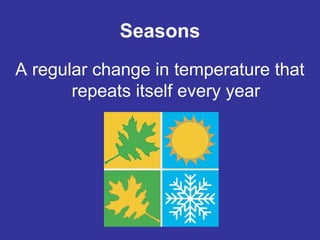
Seasons
A regular change in temperature that
repeats itself every year
Words to know:
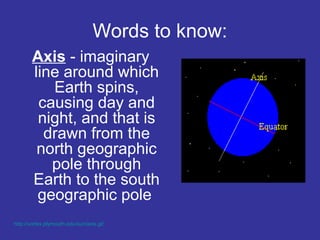
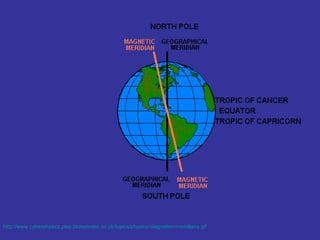
Axis - imaginary
line around which
Earth spins,
causing day and
night, and that is
drawn from the
north geographic
pole through
Earth to the south
geographic pole
http://vortex.plymouth.edu/sun/axis.gif
Words to know:
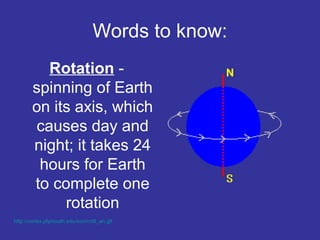
Rotation -
spinning of Earth
on its axis, which
causes day and
night; it takes 24
hours for Earth
to complete one
rotation
http://vortex.plymouth.edu/sun/rot8_an.gif
Words to know:
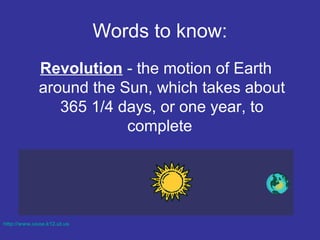
Revolution - the motion of Earth
around the Sun, which takes about
365 1/4 days, or one year, to
complete
http://www.usoe.k12.ut.us
Words to know:
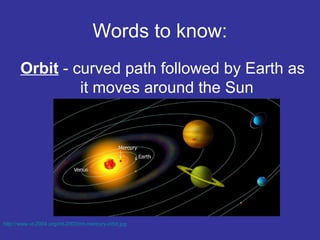
Orbit - curved path followed by Earth as
it moves around the Sun
http://www.vt-2004.org/mt-2003/mt-mercury-orbit.jpg
The Earth’s Tilt
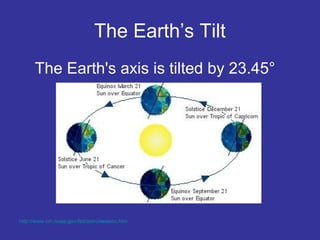
The Earth's axis is tilted by 23.45°
http://www.crh.noaa.gov/fsd/astro/season.htm
http://www.cyberphysics.pwp.blueyonder.co.uk/topics/physics/magnetsm/meridians.gif
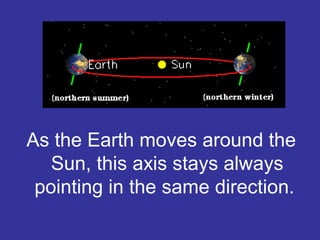
As the Earth moves around the
Sun, this axis stays always
pointing in the same direction.
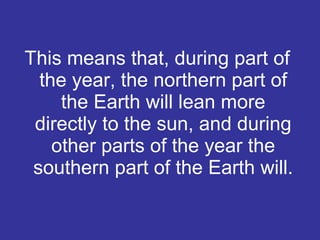
This means that, during part of
the year, the northern part of
the Earth will lean more
directly to the sun, and during
other parts of the year the
southern part of the Earth will.
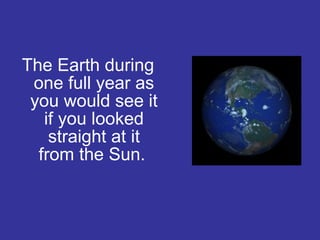
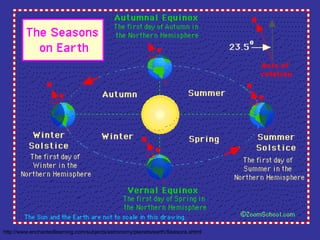
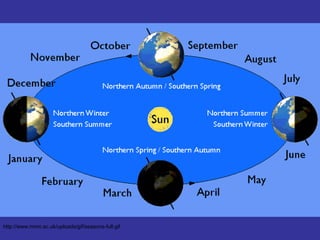
The Earth during
one full year as
you would see it
if you looked
straight at it
from the Sun.
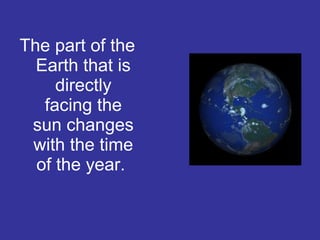
The part of the
Earth that is
directly
facing the
sun changes
with the time
of the year.
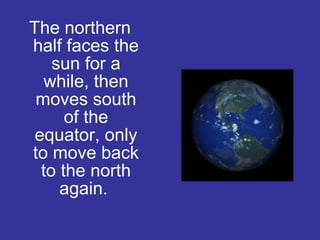
The northern
half faces the
sun for a
while, then
moves south
of the
equator, only
to move back
to the north
again.
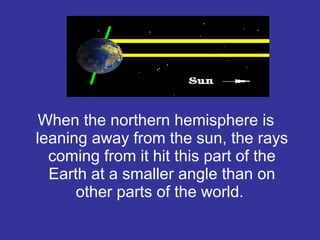
When the northern hemisphere is
leaning away from the sun, the rays
coming from it hit this part of the
Earth at a smaller angle than on
other parts of the world.
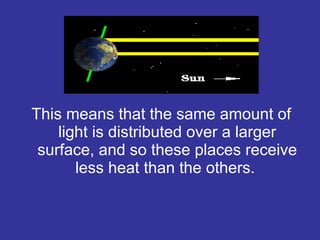
This means that the same amount of
light is distributed over a larger
surface, and so these places receive
less heat than the others.
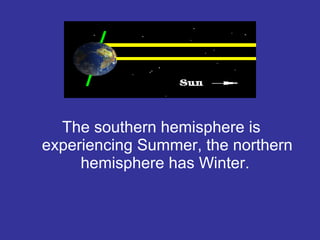
The southern hemisphere is
experiencing Summer, the northern
hemisphere has Winter.
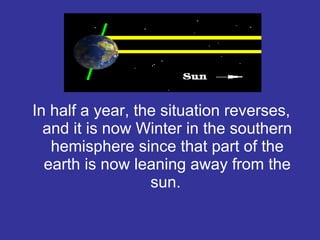
In half a year, the situation reverses,
and it is now Winter in the southern
hemisphere since that part of the
earth is now leaning away from the
sun.
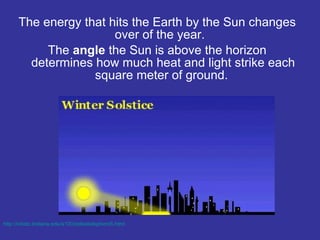
The energy that hits the Earth by the Sun changes
over of the year.
The angle the Sun is above the horizon
determines how much heat and light strike each
square meter of ground.
http://inkido.indiana.edu/a100/celestialsphere5.html
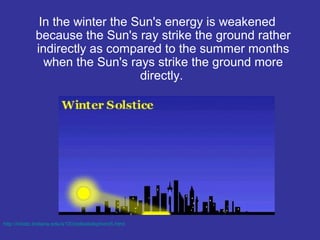
In the winter the Sun's energy is weakened
because the Sun's ray strike the ground rather
indirectly as compared to the summer months
when the Sun's rays strike the ground more
directly.
http://inkido.indiana.edu/a100/celestialsphere5.html
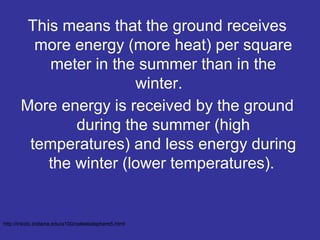
This means that the ground receives
more energy (more heat) per square
meter in the summer than in the
winter.
More energy is received by the ground
during the summer (high
temperatures) and less energy during
the winter (lower temperatures).
http://inkido.indiana.edu/a100/celestialsphere5.html
So, seasons are caused theSo, seasons are caused the
tilt of the Earth’s axistilt of the Earth’s axis
Remember:
• The seasons are the result of this
tilt of the Earth's axis.
• If the tilt of the Earth's axis was 0°
there would be no difference in
how the rays from the sun hit its
different regions, and there would
be no seasons.
The Earth's seasons are not
caused by the differences in the
distance from the Sun throughout
the year.
The seasons are the result ofThe seasons are the result of
the tilt of the Earth's axis.the tilt of the Earth's axis.
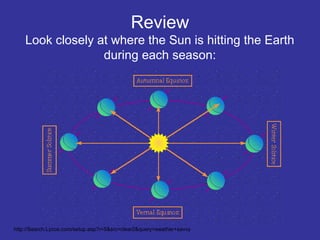
Review
Look closely at where the Sun is hitting the Earth
during each season:
http://Search.Lycos.com/setup.asp?r=5&src=clear2&query=weather+savvy
http://www.enchantedlearning.com/subjects/astronomy/planets/earth/Seasons.shtml
http://www.nmm.ac.uk/uploads/gif/seasons-full.gif

Season wd animation

  • 1.
  • 2.
    Seasons A regular changein temperature that repeats itself every year
  • 3.
    Words to know: Axis- imaginary line around which Earth spins, causing day and night, and that is drawn from the north geographic pole through Earth to the south geographic pole http://vortex.plymouth.edu/sun/axis.gif
  • 4.
    Words to know: Rotation- spinning of Earth on its axis, which causes day and night; it takes 24 hours for Earth to complete one rotation http://vortex.plymouth.edu/sun/rot8_an.gif
  • 5.
    Words to know: Revolution- the motion of Earth around the Sun, which takes about 365 1/4 days, or one year, to complete http://www.usoe.k12.ut.us
  • 6.
    Words to know: Orbit- curved path followed by Earth as it moves around the Sun http://www.vt-2004.org/mt-2003/mt-mercury-orbit.jpg
  • 7.
    The Earth’s Tilt TheEarth's axis is tilted by 23.45° http://www.crh.noaa.gov/fsd/astro/season.htm
  • 8.
  • 9.
    As the Earthmoves around the Sun, this axis stays always pointing in the same direction.
  • 10.
    This means that,during part of the year, the northern part of the Earth will lean more directly to the sun, and during other parts of the year the southern part of the Earth will.
  • 11.
    The Earth during onefull year as you would see it if you looked straight at it from the Sun.
  • 12.
    The part ofthe Earth that is directly facing the sun changes with the time of the year.
  • 13.
    The northern half facesthe sun for a while, then moves south of the equator, only to move back to the north again.
  • 14.
    When the northernhemisphere is leaning away from the sun, the rays coming from it hit this part of the Earth at a smaller angle than on other parts of the world.
  • 15.
    This means thatthe same amount of light is distributed over a larger surface, and so these places receive less heat than the others.
  • 16.
    The southern hemisphereis experiencing Summer, the northern hemisphere has Winter.
  • 17.
    In half ayear, the situation reverses, and it is now Winter in the southern hemisphere since that part of the earth is now leaning away from the sun.
  • 18.
    The energy thathits the Earth by the Sun changes over of the year. The angle the Sun is above the horizon determines how much heat and light strike each square meter of ground. http://inkido.indiana.edu/a100/celestialsphere5.html
  • 19.
    In the winterthe Sun's energy is weakened because the Sun's ray strike the ground rather indirectly as compared to the summer months when the Sun's rays strike the ground more directly. http://inkido.indiana.edu/a100/celestialsphere5.html
  • 20.
    This means thatthe ground receives more energy (more heat) per square meter in the summer than in the winter. More energy is received by the ground during the summer (high temperatures) and less energy during the winter (lower temperatures). http://inkido.indiana.edu/a100/celestialsphere5.html
  • 21.
    So, seasons arecaused theSo, seasons are caused the tilt of the Earth’s axistilt of the Earth’s axis
  • 22.
    Remember: • The seasonsare the result of this tilt of the Earth's axis. • If the tilt of the Earth's axis was 0° there would be no difference in how the rays from the sun hit its different regions, and there would be no seasons.
  • 23.
    The Earth's seasonsare not caused by the differences in the distance from the Sun throughout the year.
  • 24.
    The seasons arethe result ofThe seasons are the result of the tilt of the Earth's axis.the tilt of the Earth's axis.
  • 25.
    Review Look closely atwhere the Sun is hitting the Earth during each season: http://Search.Lycos.com/setup.asp?r=5&src=clear2&query=weather+savvy
  • 26.
  • 27.