ICE AGES
ICE AGES
INTRODUCTION
• An ice age is a period of long-term reduction in the temperature
of Earth's surface and atmosphere, resulting in the presence or
expansion of continental and polar ice sheets and
alpine glaciers. Within a long-term ice age, individual pulses of
cold climate are termed "glacial periods" (or, alternatively,
"glacials" or "glaciations", or colloquially "ice ages"), and"glacials" or "glaciations", or colloquially "ice ages"), and
intermittent warm periods are called "interglacials".
• In the terminology of glaciology, ice age implies the presence of
extensive ice sheets in both northern and southern
hemispheres. By this definition, we are in an interglacial
period—the Holocene—of the ice age.
• The ice age began 2.6 million years ago at the start of
the Pleistocene epoch, because the Greenland, Arctic,
and Antarctic ice sheets still exist.
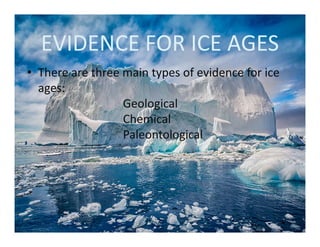
EVIDENCE FOR ICE AGES
• There are three main types of evidence for ice
ages:
Geological
ChemicalChemical
Paleontological
Geological evidence for ice ages comes in various forms,
including rock scouring and scratching, glacial
moraines, drumlins, valley cutting, and the deposition
of till or tillites and glacial erratic. Successive glaciations
tend to distort and erase the geological evidence, making it
GEOLOGICAL EVIDENCE:
tend to distort and erase the geological evidence, making it
difficult to interpret. Furthermore, this evidence was
difficult to date exactly; early theories assumed that the
glacials were short compared to the long interglacial. The
advent of sediment and ice cores revealed the true
situation: glacials are long, interglacial's short. It took some
time for the current theory to be worked out.
The chemical evidence mainly consists of variations
in the ratios of isotopes in fossils present in sediments and
sedimentary rocks and ocean sediment cores. For the most
recent glacial periods ice cores provide climate proxies from
their ice, and atmospheric samples from included bubbles of
CHEMICAL EVIDENCE
their ice, and atmospheric samples from included bubbles of
air. Because water containing heavier isotopes has a
higher heat of evaporation, its proportion decreases with
colder conditions. This allows a temperature record to be
constructed. However, this evidence can be confounded by
other factors recorded by isotope ratios.
The paleontological evidence consists of changes in the
geographical distribution of fossils. During a glacial period cold-
adapted organisms spread into lower latitudes, and organisms that
prefer warmer conditions become extinct or are squeezed into
lower latitudes. This evidence is also difficult to interpret because
PALEONTOLOGICAL EVIDENCE
lower latitudes. This evidence is also difficult to interpret because
it requires (1) sequences of sediments covering a long period of
time, over a wide range of latitudes and which are easily
correlated; (2) ancient organisms which survive for several
million years without change and whose temperature preferences
are easily diagnosed; and (3) the finding of the relevant fossils.
Despite the difficulties, analysis of ice core and ocean sediment coreshas shown
periods of glacials and interglacials over the past few million years. These also
confirm the linkage between ice ages and continental crust phenomena such as
glacial moraines, drumlins, and glacial erratics. Hence the continental crust
phenomena are accepted as good evidence of earlier ice ages when they are
found in layers created much earlier than the time range for which ice cores and
ocean sediment cores are available.
Drumlins Moraines Erratics
PAST ICE AGES
The earth is nearly 5 billion years old. Much of the
climatic record of this long interval is lost to antiquity,
we have determined with some certainty that four great
Ice Ages occurred during the past billion years. The
first two are still rather poorly known, but the rock
records of the last two, and the last in particular, arerecords of the last two, and the last in particular, are
quite good.
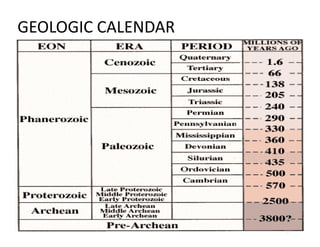
To set these events in a proper framework, we must
place them within their Geologic Calendar, a simplified
form of which is shown below:
GEOLOGIC CALENDAR
The Late Cenozoic Ice Age
• The Ice Age we know best is the most recent. It appears to have
begun with the formation of an ice cap on Antarctica about 20
million years ago, or in the early part of the Miocene time division
of the Cenozoic Era. The evidence for this is the presence of rock
fragments of this age found in cores of sediment raised from the
Southern Ocean. The only explanation for these fragments so far
from land is their transportation by icebergs that broke from afrom land is their transportation by icebergs that broke from a
large, parent ice sheet on Antarctica. Also layers of glacially
deposited rock rubble are found in Antarctica beneath lava flows
whose age has been determined to be 10 million years by the
process of radioactive dating of rocks.
THE PALEOZOIC ICE AGE
• Evidences of glaciation during at least some part of the Paleozoic
Era are found on all of the continents of the Southern Hemisphere.
In Africa, for example Gouges are found on rocks of Ordovician
age in the Sahara Desert (near the present equator). These Gouges
are made by the erosional action of pebbles and rocks dragged
along the bottom of the glacier. Definite ice-deposited rocks of a
somewhat later age are found all the way to the southern tip ofsomewhat later age are found all the way to the southern tip of
Africa.
Despite the vastness of the areas covered by glacial
ice in the Southern Hemisphere, no glaciation of Paleozoic Age
has been found anywhere in the Northern Hemisphere except
India.
GOUGES
CAUSES OF ICE AGES
• Ice ages are caused when long periods of climatic
cooling allow ice sheets to grow. Larger ice sheets
reflect more of the sun's energy into the atmosphere,
cooling the planet to an even greater degree.
Scientists believe that ice sheets form most readilyScientists believe that ice sheets form most readily
under certain conditions.
Shuffling Continents
• The continents were not always located where they are today.
Over hundreds of millions of years, they have moved around the
planet, carried by enormous tectonic plates that float on the earth's
surface. For most of the planet's history, the arrangement of the
continents and oceans has allowed warm currents from the Tropics
to reach the Polar regions.
• Today's arrangement of land masses around the globe is unusual.
At the South Pole, Antarctica is a large ice-covered land mass. At
the North Pole, the Arctic Ocean is almost cut off from the
surrounding waters by land barriers. These barriers prevent warm
ocean currents from circulating heat to the Arctic. During arctic
summers, not all of the ice and snow accumulated during the
previous winter melts. Instead, it collects from year to year.
Uplift Of Continental Blocks
• When the enormous plates on the earth's surface collide,
they can create mountains, like a carpet wrinkling up
underfoot. Such large changes to the surface of the earth
(including under the oceans) can alter circulation
patterns in the oceans and atmosphere, and cause climatepatterns in the oceans and atmosphere, and cause climate
change.
Marine Iron Concentrations
• Some scientists believe that ice ages were affected by the amount
of iron in the oceans. In a cooler climate, continents would have
been drier. Higher winds might have carried iron-rich dust into the
oceans. There, the iron would have stimulated plant growth,
pulling carbon dioxide out of the air and further chilling thepulling carbon dioxide out of the air and further chilling the
planet. Some scientists have even suggested that one way to slow
global warming is to "fertilize" the oceans with iron.
Reduction Of CO2 In The Atmosphere
• Scientists believe that, over time, changes in the amount
of CO2 in the atmosphere have altered the climate of the
planet. The proportion of CO2 that is dissolved in the
ocean, as opposed to the CO2 that is present in the
atmosphere, also varies over time. When more CO isatmosphere, also varies over time. When more CO2 is
trapped in the oceans, the planet cools. By contrast, when
atmospheric levels are high, the planet warms. Carbon
dioxide is considered to be the most important greenhouse
gas involved in global warming.
Astronomical Factors
• Within an ice age, the advance and retreat of ice sheets over land
depends on the patterning of seasonal warming and cooling. This
pattern may be driven by forces beyond the earth. Over hundreds
of thousands of years, the amount of sunshine reaching the poles
is affected by changes in earth's orbit around the sun. This theory
of climate change is called the astronomical theory, or the
Milankovitch theory. The 100,000 year cycle in the behavior ofMilankovitch theory. The 100,000 year cycle in the behavior of
earth during its orbit around the sun is called the Milankovitch
Cycle.
• During one phase in the Milankovitch Cycle, the contrast between
the seasons is lower, or smoothed out. At this time, summer
temperatures in the Arctic fail to climb high enough to melt all of
the previous winter's snow and ice. Huge continental ice sheets
can then begin to grow and move into temperate latitudes, even
when winters are mild.
•Conversely, during another phase within the cycle,
summers are hot enough to melt snow and ice before the
next winter (except in polar land masses, such as
Greenland and Antarctica). Although the winters in this
phase are extra cold, they do not impede the summer
thaw. As summers gradually warm near one extreme ofthaw. As summers gradually warm near one extreme of
the Milankovitch Cycle, glacial ice begins to melt. The
earth last reached this stage about 18,000–20,000 years
ago, causing a melting of the huge ice sheets that covered
much of northern North America during the last glaciation.
Ice ages

Ice ages

  • 1.
  • 2.
    INTRODUCTION • An iceage is a period of long-term reduction in the temperature of Earth's surface and atmosphere, resulting in the presence or expansion of continental and polar ice sheets and alpine glaciers. Within a long-term ice age, individual pulses of cold climate are termed "glacial periods" (or, alternatively, "glacials" or "glaciations", or colloquially "ice ages"), and"glacials" or "glaciations", or colloquially "ice ages"), and intermittent warm periods are called "interglacials". • In the terminology of glaciology, ice age implies the presence of extensive ice sheets in both northern and southern hemispheres. By this definition, we are in an interglacial period—the Holocene—of the ice age. • The ice age began 2.6 million years ago at the start of the Pleistocene epoch, because the Greenland, Arctic, and Antarctic ice sheets still exist.
  • 3.
    EVIDENCE FOR ICEAGES • There are three main types of evidence for ice ages: Geological ChemicalChemical Paleontological
  • 4.
    Geological evidence forice ages comes in various forms, including rock scouring and scratching, glacial moraines, drumlins, valley cutting, and the deposition of till or tillites and glacial erratic. Successive glaciations tend to distort and erase the geological evidence, making it GEOLOGICAL EVIDENCE: tend to distort and erase the geological evidence, making it difficult to interpret. Furthermore, this evidence was difficult to date exactly; early theories assumed that the glacials were short compared to the long interglacial. The advent of sediment and ice cores revealed the true situation: glacials are long, interglacial's short. It took some time for the current theory to be worked out.
  • 5.
    The chemical evidencemainly consists of variations in the ratios of isotopes in fossils present in sediments and sedimentary rocks and ocean sediment cores. For the most recent glacial periods ice cores provide climate proxies from their ice, and atmospheric samples from included bubbles of CHEMICAL EVIDENCE their ice, and atmospheric samples from included bubbles of air. Because water containing heavier isotopes has a higher heat of evaporation, its proportion decreases with colder conditions. This allows a temperature record to be constructed. However, this evidence can be confounded by other factors recorded by isotope ratios.
  • 6.
    The paleontological evidenceconsists of changes in the geographical distribution of fossils. During a glacial period cold- adapted organisms spread into lower latitudes, and organisms that prefer warmer conditions become extinct or are squeezed into lower latitudes. This evidence is also difficult to interpret because PALEONTOLOGICAL EVIDENCE lower latitudes. This evidence is also difficult to interpret because it requires (1) sequences of sediments covering a long period of time, over a wide range of latitudes and which are easily correlated; (2) ancient organisms which survive for several million years without change and whose temperature preferences are easily diagnosed; and (3) the finding of the relevant fossils.
  • 7.
    Despite the difficulties,analysis of ice core and ocean sediment coreshas shown periods of glacials and interglacials over the past few million years. These also confirm the linkage between ice ages and continental crust phenomena such as glacial moraines, drumlins, and glacial erratics. Hence the continental crust phenomena are accepted as good evidence of earlier ice ages when they are found in layers created much earlier than the time range for which ice cores and ocean sediment cores are available. Drumlins Moraines Erratics
  • 8.
  • 9.
    The earth isnearly 5 billion years old. Much of the climatic record of this long interval is lost to antiquity, we have determined with some certainty that four great Ice Ages occurred during the past billion years. The first two are still rather poorly known, but the rock records of the last two, and the last in particular, arerecords of the last two, and the last in particular, are quite good. To set these events in a proper framework, we must place them within their Geologic Calendar, a simplified form of which is shown below:
  • 10.
  • 11.
    The Late CenozoicIce Age • The Ice Age we know best is the most recent. It appears to have begun with the formation of an ice cap on Antarctica about 20 million years ago, or in the early part of the Miocene time division of the Cenozoic Era. The evidence for this is the presence of rock fragments of this age found in cores of sediment raised from the Southern Ocean. The only explanation for these fragments so far from land is their transportation by icebergs that broke from afrom land is their transportation by icebergs that broke from a large, parent ice sheet on Antarctica. Also layers of glacially deposited rock rubble are found in Antarctica beneath lava flows whose age has been determined to be 10 million years by the process of radioactive dating of rocks.
  • 12.
    THE PALEOZOIC ICEAGE • Evidences of glaciation during at least some part of the Paleozoic Era are found on all of the continents of the Southern Hemisphere. In Africa, for example Gouges are found on rocks of Ordovician age in the Sahara Desert (near the present equator). These Gouges are made by the erosional action of pebbles and rocks dragged along the bottom of the glacier. Definite ice-deposited rocks of a somewhat later age are found all the way to the southern tip ofsomewhat later age are found all the way to the southern tip of Africa. Despite the vastness of the areas covered by glacial ice in the Southern Hemisphere, no glaciation of Paleozoic Age has been found anywhere in the Northern Hemisphere except India.
  • 13.
  • 14.
  • 15.
    • Ice agesare caused when long periods of climatic cooling allow ice sheets to grow. Larger ice sheets reflect more of the sun's energy into the atmosphere, cooling the planet to an even greater degree. Scientists believe that ice sheets form most readilyScientists believe that ice sheets form most readily under certain conditions.
  • 16.
    Shuffling Continents • Thecontinents were not always located where they are today. Over hundreds of millions of years, they have moved around the planet, carried by enormous tectonic plates that float on the earth's surface. For most of the planet's history, the arrangement of the continents and oceans has allowed warm currents from the Tropics to reach the Polar regions. • Today's arrangement of land masses around the globe is unusual. At the South Pole, Antarctica is a large ice-covered land mass. At the North Pole, the Arctic Ocean is almost cut off from the surrounding waters by land barriers. These barriers prevent warm ocean currents from circulating heat to the Arctic. During arctic summers, not all of the ice and snow accumulated during the previous winter melts. Instead, it collects from year to year.
  • 17.
    Uplift Of ContinentalBlocks • When the enormous plates on the earth's surface collide, they can create mountains, like a carpet wrinkling up underfoot. Such large changes to the surface of the earth (including under the oceans) can alter circulation patterns in the oceans and atmosphere, and cause climatepatterns in the oceans and atmosphere, and cause climate change.
  • 18.
    Marine Iron Concentrations •Some scientists believe that ice ages were affected by the amount of iron in the oceans. In a cooler climate, continents would have been drier. Higher winds might have carried iron-rich dust into the oceans. There, the iron would have stimulated plant growth, pulling carbon dioxide out of the air and further chilling thepulling carbon dioxide out of the air and further chilling the planet. Some scientists have even suggested that one way to slow global warming is to "fertilize" the oceans with iron.
  • 19.
    Reduction Of CO2In The Atmosphere • Scientists believe that, over time, changes in the amount of CO2 in the atmosphere have altered the climate of the planet. The proportion of CO2 that is dissolved in the ocean, as opposed to the CO2 that is present in the atmosphere, also varies over time. When more CO isatmosphere, also varies over time. When more CO2 is trapped in the oceans, the planet cools. By contrast, when atmospheric levels are high, the planet warms. Carbon dioxide is considered to be the most important greenhouse gas involved in global warming.
  • 20.
    Astronomical Factors • Withinan ice age, the advance and retreat of ice sheets over land depends on the patterning of seasonal warming and cooling. This pattern may be driven by forces beyond the earth. Over hundreds of thousands of years, the amount of sunshine reaching the poles is affected by changes in earth's orbit around the sun. This theory of climate change is called the astronomical theory, or the Milankovitch theory. The 100,000 year cycle in the behavior ofMilankovitch theory. The 100,000 year cycle in the behavior of earth during its orbit around the sun is called the Milankovitch Cycle. • During one phase in the Milankovitch Cycle, the contrast between the seasons is lower, or smoothed out. At this time, summer temperatures in the Arctic fail to climb high enough to melt all of the previous winter's snow and ice. Huge continental ice sheets can then begin to grow and move into temperate latitudes, even when winters are mild.
  • 21.
    •Conversely, during anotherphase within the cycle, summers are hot enough to melt snow and ice before the next winter (except in polar land masses, such as Greenland and Antarctica). Although the winters in this phase are extra cold, they do not impede the summer thaw. As summers gradually warm near one extreme ofthaw. As summers gradually warm near one extreme of the Milankovitch Cycle, glacial ice begins to melt. The earth last reached this stage about 18,000–20,000 years ago, causing a melting of the huge ice sheets that covered much of northern North America during the last glaciation.