BHMCT 1ST year
G.Bhavani
Submitted to: Samuel Chef
 Seafood is any form of sea life regarded as
food by humans, prominently including fish
and shellfish. Shellfish include various
species of mollusks, crustaceans, and
echinoderms.
 Seafood comprises all bony fishes and the
more primitive sharks, skates, rays, sawfish,
sturgeons, and lampreys; crustaceans such as
lobsters, crabs, shrimps, prawns, and
crayfish; mollusks, including clams, oysters,
cockles, mussels, periwinkles, whelks, snails,
abalones, scallops, and limpets; the
cephalopod mollusks
 Fish are gill-bearing aquatic craniate animals
that lack limbs with digits
 It is an important resource for humans
worldwide, especially as food.
 They are abundant in most bodies of water.
They can be found in nearly all aquatic
environments, from high mountain streams
 It is one of the most nutritious and easily
digestible foods in our diet.
 Available in a wide variety and can be
cooked in many ways and in a short time.
 The fibers are thinner and smaller than the
meat so it is more sensitive.
 Cooked fish should be handled very carefully
because it breaks very easily.
 We avoid overcooking them because they go
too "dry" and become indigestible.
 There are mainly two types of fish based on
their origin:
 Fish of salt water that live in the seas.
 Fish of fresh water that live in lakes, rivers,
dams, or aquariums.
 Saltwater fish, also called marine fish, are
fish that live in ocean water.
 It can swim and live alone or live in a large
group together, called a school of fish.
 They are very popular among deep sea
fishermen and aquariums all over the
country.
 Many kinds of fish live in the salty water of
the oceans.
 A fish's kidney keeps the proper balance of
salt in its body.
 Popular saltwater fish are bluefish, cod,
flounder, striped bass (also found in
freshwater), sea trout, tarpon, tuna, halibut,
rockfish, sea perch, lingcod, and yellowtail.
 Flame Angelfish (Centropyge loricula)
 Maroon Clownfish (Premnas biaculeatus)
 Coral Beauty (Centropyge bispinosa)
 Six-line Wrasse (Pseudocheilinus
hexateaenia)
 Tomato Clownfish (Amphiprion frenatus)
 Royal Gramma (Gramma loreto)
 Pajama Cardinalfish (Sphaeramia
nematoptera)
 In a saltwater aquarium, many fish (even
carnivores) can be weaned off of their usual
fare in the wild and coaxed into taking hand
fed foods such as pellets and flakes with
their protein requirements being
supplemented with frozen foods such as
shrimp, fish, squid, or krill
 Scientists estimate that there are almost
22,000 fish species in the world.
 The most fruitful potential areas for
discovery include the tropics, deep seas and
southern hemisphere.
 Some fish that only live in
a saltwater environment, such as tuna, drink
the very, very salty seawater.
 Their kidneys are specially adapted to
excrete lots of salt, and even their gills can
excrete salt in this way so that they keep
their blood salinity levels at an optimum
 The water in saltwater fish is continuously
pulled out of their bodies into the
surrounding water because their bodily fluids
have lower concentrations of salt.
 It's important to note that all fish
require some level of salt in their bodies to
be healthy, but like humans, too much or too
little can make them sick.
 Saltwater fish can't survive in
freshwater because their bodies are highly
concentrated of salt solution (too much
for freshwater).
 The water would flow into their body until
all their cells accumulate so much water that
they bloat and die eventually.
 Marine fish do not taste salty because get rid
of the excess salt they ingest in order to
maintain a balance of electrolytes in the
body.
 Freshwater fish are those that spend some
or all of their lives in fresh water, such as
rivers and lakes, with a salinity of less than
0.05%.
 These environments differ from marine
conditions in many ways, the most obvious
being the difference in levels of salinity
 Eyes: Shiny, bright, clear, open and bulging.
 Color: Be lively.
 Flesh: Be firm, stuck in the bones and
elastic. When the finger pressed does not
form cavity.
 Fins: Be hard and not easily moved.
 Scales: Be hard and not easily moved.
 Gills: To have a pink or red color, not dark.
 Tail: When you hold the fish between two
fingers, the tails are up and do not bend
their body, but stays in a straight line.
 Catfish.
 Characins and other characiformes.
 Cichlids.
 Cyprinids.
 Loaches and related cypriniformes.
 Live-bearers and killifish.
 Labyrinth fish.
 Rainbow fish.
 It has been estimated that the total number
of all fishes is 32,500 species.
 Considering that freshwater may constitute
less than 0.3% of available global water, it is
remarkable that there are more than
15,000 freshwater fish species
 There are more than 800 known freshwater
fish species in North America alone.
 Worldwide, the number is over
10,000 species.
 Some species of freshwater fish, such as
salmon and trout, are called anadromous.
 They hatch in fresh water, head out to sea,
where they live until they return to fresh
water to reproduce.
 Vampire fish prey primarily on smaller fish,
especially piranhas, which they impale with
their long, sharp fangs.
 The intimidating teeth can grow up to six
inches long.
 Perhaps the most feared freshwater species
of all, candiru are parasitic catfish in the
family Trichomycteridae.
 Fish and shellfish concentrate mercury in
their bodies, often in the form of
methylmercury, a highly toxic
organomercury compound.
 Fish products have been shown to contain
varying amounts of heavy metals,
particularly mercury and fat-soluble
pollutants from water pollution.
 The freshwater fish most likely
to contain harmful amounts
of mercury include smallmouth bass,
walleye, largemouth bass, lake trout and
Northern pike.
SPECIES MERCURY
CONCENTRATIO
N MEAN (PPM)
MERCURY
CONCENTRATIO
N MAX (PPM)
TILAPIA 0.013 0.084
SALMON
(CANNED)
0.014 0.086
ANCHOVIES 0.016 0.049
SALMON
(FRESH/FROZEN)
0.022 0.19
 Most of the popular species
of fish and shellfish consumed in the
U.S. have been shown to have low
mercury levels.
 Seafood choices that are
very low in mercury include: salmon,
sardines, pollock, flounders, cod,
tilapia, shrimp, oysters, clams, scallops and
crab.
 That amounts to about 2 to 3 servings
of fish per week, which can be eaten in place
of other types of protein.
 Make sure to choose a variety of fish lower
in mercury, such as salmon, tilapia, shrimp,
tuna (canned-light), cod, and catfish.
 Consumption of white (albacore) tuna should
not exceed 6 ounces per week.
 Bluefin Tuna - This controversial food, no
doubt one of the most expensive fish you can
buy, is well-known for its popularity in the
sushi culture and with Japanese foodies. ...
 Puffer Fish (Fugu)
 Swordfish
 Yellowfin Tuna (Ahi)
 Wild King Salmon.
 A tuna is a saltwater fish that belongs to the
tribe Thunnini, a subgrouping of the
Scombridae family.
 The Thunnini comprise 15 species across five
genera, the sizes of which vary greatly,
ranging from the bullet tuna up to the
Atlantic bluefin tuna.
 The bluefin averages 2 m, and is believed to
live up to 50 years
 Salmon is the common name for several
species of ray-finned fish in the family
Salmonidae.
 Other fish in the same family include trout,
char, grayling and whitefish.
 Salmon are native to tributaries of the North
Atlantic and Pacific Ocean.
 Perch is a common name for fish of the genus
Perca, freshwater gamefish belonging to the
family Percidae
 "Sardine" and "pilchard" are common names
used to refer to various small, oily forage
fish in the herring family Clupeidae.
 The term "sardine" was first used in English
during the early 15th century and may come
from the Mediterranean island of Sardinia,
around which sardines were once abundant
 The mahi-mahi or common dolphinfish is a
surface-dwelling ray-finned fish found in off-
shore temperate, tropical, and subtropical
waters worldwide.
 Also widely called dorado and dolphin, it is
one of two members of the family
Coryphaenidae, the other being the pompano
dolphinfish.
 The European plaice (Pleuronectes platessa)
is a right-eyed flounder belonging to the
Pleuronectidae family.
 They are a commercially important flatfish
which lives on the sandy bottoms of the
European shelf. They range geographically
from the Barents Sea to the Mediterranean.
 The lemon sole is a flatfish of the family
Pleuronectidae.
 It is native to shallow seas around Northern
Europe, where it lives on stony bottoms
down to depths of about 200 metres.
 It grows up to 65 centimetres in length and
reaches about 3 kilograms in weight. It is a
popular food fish
 Flounders are a group of flatfish species.
They are demersal fish, found at the bottom
of oceans around the world; some species
will also enter estuaries.
 The turbot (Scophthalmus maximus) is a
species of flatfish in the family
Scophthalmidae.
 It is a demersal fish native to marine or
brackish waters of the North Atlantic, Baltic
Sea and the Mediterranean Sea.
 Members of the genus Lophius, also
sometimes called monkfish, fishing-frogs,
frog-fish, and sea-devils, are various species
of lophiid anglerfishes found in the Atlantic
and Indian Oceans.
 Carp are various species of oily freshwater
fish from the family Cyprinidae, a very large
group of fish native to Europe and Asia.
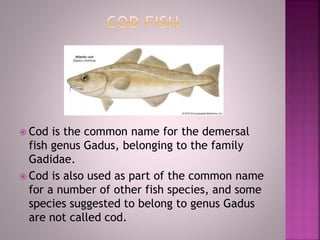
 Cod is the common name for the demersal
fish genus Gadus, belonging to the family
Gadidae.
 Cod is also used as part of the common name
for a number of other fish species, and some
species suggested to belong to genus Gadus
are not called cod.
 The haddock is a saltwater fish from the
family Gadidae, the true cods.
 It is the only species in the monotypic genus
Melanogrammus.
 It is found in the North Atlantic Ocean and
associated seas where it is an important
species for fisheries, especially in northern
Europe.
 The cobia is a species of perciform marine
fish, the only representative of the genus
Rachycentron and the family Rachycentridae.
 Other common names include black kingfish,
black salmon, ling, lemonfish, crabeater,
prodigal son and black bonito.
 The Japanese seabass, also suzuki, is a
species of Asian sea bass native to the
western Pacific Ocean, where it occurs from
Japan to the South China Sea.
 They inhabit fresh, brackish, and marine
waters of inshore rocky reefs and in estuaries
at depths of at least 5 m
 The mullets or grey mullets are a family of
ray-finned fish found worldwide in coastal
temperate and tropical waters, and some
species in fresh water.
 Mullets have served as an important source
of food in Mediterranean Europe since Roman
times. The family includes about 78 species
in 20 genera.
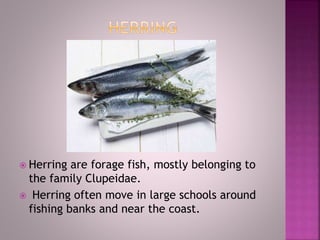
 Herring are forage fish, mostly belonging to
the family Clupeidae.
 Herring often move in large schools around
fishing banks and near the coast.
 The red drum, also known as redfish, channel
bass, puppy drum, spottail bass, or simply
red, is a game fish found in the Atlantic
Ocean from Massachusetts to Florida and in
the Gulf of Mexico from Florida to northern
Mexico.
 It is the only species in the genus Sciaenops.
 John Dory, St Pierre or Peter's Fish, refers to
fish of the genus Zeus, especially Zeus faber,
of widespread distribution.
 It is an edible demersal coastal marine fish
with a laterally compressed olive-yellow
body which has a large dark spot, and long
spines on the dorsal fin.
 Shellfish is a colloquial and fisheries term for
exoskeleton-bearing aquatic invertebrates
used as food, including various species of
mollusks, crustaceans, and echinoderms.
 Although most kinds of shellfish are
harvested from saltwater environments,
some are found in freshwater
 Seafood includes fish (like tuna or cod)
and shellfish (like lobster or clams).
 Even though they both fall into the category
of "seafood," fish and shellfish are
biologically different.
 Crustaceans, like shrimp, crab, or lobster.
mollusks, like clams, mussels, oysters,
scallops, octopus, or squid.
 They can be divided into two groups:
Crustaceans and Mollusks.
 Crustaceans include shrimp, crayfish, crab,
and lobster, while clams, scallops, oysters,
 Mussels are examples of mollusks.
 Most shellfish live in saltwater, but the name
also refers to species found in freshwater
 Crustaceans form a large, diverse arthropod
taxon which includes such familiar animals as
crabs, lobsters, crayfish, shrimps, prawns,
krill, woodlice, and barnacles.
 A hard exoskeleton made of calcium - no
internal skeleton.
 The head has two compound eyes, two pairs
of antennae, and three pairs of mouthparts.
 A pair of green glands excrete wastes near
the base of antennae.
 The abdominal segments have swimmerets
(swimming legs)
 The four main features of a crustaceans
body are :
 Two distinct body sections, a hard
exoskeleton, two pairs of antennae, & one
pair of appendages on each segment.
 Most crustaceans live in the ocean—although
some species live in freshwater, and woodlice
and a few crabs live on land.
 Prawns and shrimp swim freely in open
water.
 Barnacles live attached to rocks, harbor
walls, or the sides of ships.
 Two different excretory organs are found
among crustaceans: the antennal gland and
the maxillary gland.
 In most adult crustaceans only one or the
other gland functions.
 The world largest crustacean is the
Japanese Spider Crab.
 It can weigh up to 20kg (45 lb).
 If it stretches out its legs, they can reach up
to 4 metres (13 feet) from tip to tip!
 Most crustaceans reproduce sexually with a
separate male and female.
 Most females lay eggs that hatch into free-
swimming larvae, though
some crustaceans such as shrimps hatch into
tiny versions of adults.
 Many crustaceans are scavengers, feeding on
scraps and dead creatures.
 Crabs, shrimp, and prawns search for food
mainly at night and hide in crevices by day.
 Some crabs and lobsters are active
predators, seizing prey in their powerful
claws.
 Barnacles filter tiny creatures from the
water using their hairy legs.
 Shrimps, crabs, lobsters, and
other crustaceans find protection from
predators in crevices or
between coral branches.
 Crustaceans are also predators.
 The coral crab crushes sea urchins and clams
with its strong claws.
 Mollusca is the second-largest phylum of
invertebrate animals after the arthropoda.
 The members are known as mollusks or
mollusks.
 Around 85,000 extant species of mollusks
are recognized.
 The number of fossil species is estimated
between 60,000 and 100,000 additional
species
 There are several subgroups of mollusks, but
only three major ones: -
 The Gastropods, made up mostly of snails
and slugs.
 The Bivalves, a group including clams,
scallops, mussels, and oysters.
 The Cephalopods, a group including octopus
and squid.
 Unsegment soft body with bilateral
symmetry.
 Presence of an internal or external shell. A
toothed tongue (made mostly of chitin)
called the radula.
 A mantle which is a fold in the body wall that
lines the shell.
 Mollusks include many of the most important
seafood's such as abalone, clams, mussels,
octopus, oysters, squid, and scallops as well
as terrestrial snails.
 Marine mollusks and crustacean (shrimps,
prawns, crabs, crayfish and lobsters) are
both known as shellfish.
 Mollusks reproduce sexually.
 Slugs and snails are hermaphrodites
(possessing both male and female organs),
but they must still mate to fertilize their
eggs.
 Most aquatic mollusks lay eggs that hatch
into small, free-swimming larvae called
veliger.
 Bivalves are mollusks with two shells such as
clams and oysters.
 Univalves are animals with one shell such as
a snail.
 Mollusks without shells include squid,
banana slugs, and octopi

Seafood and Types

  • 1.
  • 2.
     Seafood isany form of sea life regarded as food by humans, prominently including fish and shellfish. Shellfish include various species of mollusks, crustaceans, and echinoderms.  Seafood comprises all bony fishes and the more primitive sharks, skates, rays, sawfish, sturgeons, and lampreys; crustaceans such as lobsters, crabs, shrimps, prawns, and crayfish; mollusks, including clams, oysters, cockles, mussels, periwinkles, whelks, snails, abalones, scallops, and limpets; the cephalopod mollusks
  • 3.
     Fish aregill-bearing aquatic craniate animals that lack limbs with digits  It is an important resource for humans worldwide, especially as food.  They are abundant in most bodies of water. They can be found in nearly all aquatic environments, from high mountain streams
  • 4.
     It isone of the most nutritious and easily digestible foods in our diet.  Available in a wide variety and can be cooked in many ways and in a short time.  The fibers are thinner and smaller than the meat so it is more sensitive.  Cooked fish should be handled very carefully because it breaks very easily.  We avoid overcooking them because they go too "dry" and become indigestible.
  • 5.
     There aremainly two types of fish based on their origin:  Fish of salt water that live in the seas.  Fish of fresh water that live in lakes, rivers, dams, or aquariums.
  • 6.
     Saltwater fish,also called marine fish, are fish that live in ocean water.  It can swim and live alone or live in a large group together, called a school of fish.  They are very popular among deep sea fishermen and aquariums all over the country.
  • 7.
     Many kindsof fish live in the salty water of the oceans.  A fish's kidney keeps the proper balance of salt in its body.  Popular saltwater fish are bluefish, cod, flounder, striped bass (also found in freshwater), sea trout, tarpon, tuna, halibut, rockfish, sea perch, lingcod, and yellowtail.
  • 8.
     Flame Angelfish(Centropyge loricula)  Maroon Clownfish (Premnas biaculeatus)  Coral Beauty (Centropyge bispinosa)  Six-line Wrasse (Pseudocheilinus hexateaenia)  Tomato Clownfish (Amphiprion frenatus)  Royal Gramma (Gramma loreto)  Pajama Cardinalfish (Sphaeramia nematoptera)
  • 9.
     In asaltwater aquarium, many fish (even carnivores) can be weaned off of their usual fare in the wild and coaxed into taking hand fed foods such as pellets and flakes with their protein requirements being supplemented with frozen foods such as shrimp, fish, squid, or krill
  • 10.
     Scientists estimatethat there are almost 22,000 fish species in the world.  The most fruitful potential areas for discovery include the tropics, deep seas and southern hemisphere.
  • 11.
     Some fishthat only live in a saltwater environment, such as tuna, drink the very, very salty seawater.  Their kidneys are specially adapted to excrete lots of salt, and even their gills can excrete salt in this way so that they keep their blood salinity levels at an optimum
  • 12.
     The waterin saltwater fish is continuously pulled out of their bodies into the surrounding water because their bodily fluids have lower concentrations of salt.  It's important to note that all fish require some level of salt in their bodies to be healthy, but like humans, too much or too little can make them sick.
  • 13.
     Saltwater fishcan't survive in freshwater because their bodies are highly concentrated of salt solution (too much for freshwater).  The water would flow into their body until all their cells accumulate so much water that they bloat and die eventually.
  • 14.
     Marine fishdo not taste salty because get rid of the excess salt they ingest in order to maintain a balance of electrolytes in the body.
  • 15.
     Freshwater fishare those that spend some or all of their lives in fresh water, such as rivers and lakes, with a salinity of less than 0.05%.  These environments differ from marine conditions in many ways, the most obvious being the difference in levels of salinity
  • 16.
     Eyes: Shiny,bright, clear, open and bulging.  Color: Be lively.  Flesh: Be firm, stuck in the bones and elastic. When the finger pressed does not form cavity.  Fins: Be hard and not easily moved.  Scales: Be hard and not easily moved.  Gills: To have a pink or red color, not dark.  Tail: When you hold the fish between two fingers, the tails are up and do not bend their body, but stays in a straight line.
  • 17.
     Catfish.  Characinsand other characiformes.  Cichlids.  Cyprinids.  Loaches and related cypriniformes.  Live-bearers and killifish.  Labyrinth fish.  Rainbow fish.
  • 18.
     It hasbeen estimated that the total number of all fishes is 32,500 species.  Considering that freshwater may constitute less than 0.3% of available global water, it is remarkable that there are more than 15,000 freshwater fish species
  • 19.
     There aremore than 800 known freshwater fish species in North America alone.  Worldwide, the number is over 10,000 species.  Some species of freshwater fish, such as salmon and trout, are called anadromous.  They hatch in fresh water, head out to sea, where they live until they return to fresh water to reproduce.
  • 20.
     Vampire fishprey primarily on smaller fish, especially piranhas, which they impale with their long, sharp fangs.  The intimidating teeth can grow up to six inches long.  Perhaps the most feared freshwater species of all, candiru are parasitic catfish in the family Trichomycteridae.
  • 21.
     Fish andshellfish concentrate mercury in their bodies, often in the form of methylmercury, a highly toxic organomercury compound.  Fish products have been shown to contain varying amounts of heavy metals, particularly mercury and fat-soluble pollutants from water pollution.
  • 22.
     The freshwaterfish most likely to contain harmful amounts of mercury include smallmouth bass, walleye, largemouth bass, lake trout and Northern pike.
  • 23.
    SPECIES MERCURY CONCENTRATIO N MEAN(PPM) MERCURY CONCENTRATIO N MAX (PPM) TILAPIA 0.013 0.084 SALMON (CANNED) 0.014 0.086 ANCHOVIES 0.016 0.049 SALMON (FRESH/FROZEN) 0.022 0.19
  • 24.
     Most ofthe popular species of fish and shellfish consumed in the U.S. have been shown to have low mercury levels.  Seafood choices that are very low in mercury include: salmon, sardines, pollock, flounders, cod, tilapia, shrimp, oysters, clams, scallops and crab.
  • 25.
     That amountsto about 2 to 3 servings of fish per week, which can be eaten in place of other types of protein.  Make sure to choose a variety of fish lower in mercury, such as salmon, tilapia, shrimp, tuna (canned-light), cod, and catfish.  Consumption of white (albacore) tuna should not exceed 6 ounces per week.
  • 26.
     Bluefin Tuna- This controversial food, no doubt one of the most expensive fish you can buy, is well-known for its popularity in the sushi culture and with Japanese foodies. ...  Puffer Fish (Fugu)  Swordfish  Yellowfin Tuna (Ahi)  Wild King Salmon.
  • 28.
     A tunais a saltwater fish that belongs to the tribe Thunnini, a subgrouping of the Scombridae family.  The Thunnini comprise 15 species across five genera, the sizes of which vary greatly, ranging from the bullet tuna up to the Atlantic bluefin tuna.  The bluefin averages 2 m, and is believed to live up to 50 years
  • 29.
     Salmon isthe common name for several species of ray-finned fish in the family Salmonidae.  Other fish in the same family include trout, char, grayling and whitefish.  Salmon are native to tributaries of the North Atlantic and Pacific Ocean.
  • 30.
     Perch isa common name for fish of the genus Perca, freshwater gamefish belonging to the family Percidae
  • 31.
     "Sardine" and"pilchard" are common names used to refer to various small, oily forage fish in the herring family Clupeidae.  The term "sardine" was first used in English during the early 15th century and may come from the Mediterranean island of Sardinia, around which sardines were once abundant
  • 32.
     The mahi-mahior common dolphinfish is a surface-dwelling ray-finned fish found in off- shore temperate, tropical, and subtropical waters worldwide.  Also widely called dorado and dolphin, it is one of two members of the family Coryphaenidae, the other being the pompano dolphinfish.
  • 33.
     The Europeanplaice (Pleuronectes platessa) is a right-eyed flounder belonging to the Pleuronectidae family.  They are a commercially important flatfish which lives on the sandy bottoms of the European shelf. They range geographically from the Barents Sea to the Mediterranean.
  • 34.
     The lemonsole is a flatfish of the family Pleuronectidae.  It is native to shallow seas around Northern Europe, where it lives on stony bottoms down to depths of about 200 metres.  It grows up to 65 centimetres in length and reaches about 3 kilograms in weight. It is a popular food fish
  • 35.
     Flounders area group of flatfish species. They are demersal fish, found at the bottom of oceans around the world; some species will also enter estuaries.
  • 36.
     The turbot(Scophthalmus maximus) is a species of flatfish in the family Scophthalmidae.  It is a demersal fish native to marine or brackish waters of the North Atlantic, Baltic Sea and the Mediterranean Sea.
  • 37.
     Members ofthe genus Lophius, also sometimes called monkfish, fishing-frogs, frog-fish, and sea-devils, are various species of lophiid anglerfishes found in the Atlantic and Indian Oceans.
  • 38.
     Carp arevarious species of oily freshwater fish from the family Cyprinidae, a very large group of fish native to Europe and Asia.
  • 39.
     Cod isthe common name for the demersal fish genus Gadus, belonging to the family Gadidae.  Cod is also used as part of the common name for a number of other fish species, and some species suggested to belong to genus Gadus are not called cod.
  • 40.
     The haddockis a saltwater fish from the family Gadidae, the true cods.  It is the only species in the monotypic genus Melanogrammus.  It is found in the North Atlantic Ocean and associated seas where it is an important species for fisheries, especially in northern Europe.
  • 41.
     The cobiais a species of perciform marine fish, the only representative of the genus Rachycentron and the family Rachycentridae.  Other common names include black kingfish, black salmon, ling, lemonfish, crabeater, prodigal son and black bonito.
  • 42.
     The Japaneseseabass, also suzuki, is a species of Asian sea bass native to the western Pacific Ocean, where it occurs from Japan to the South China Sea.  They inhabit fresh, brackish, and marine waters of inshore rocky reefs and in estuaries at depths of at least 5 m
  • 43.
     The mulletsor grey mullets are a family of ray-finned fish found worldwide in coastal temperate and tropical waters, and some species in fresh water.  Mullets have served as an important source of food in Mediterranean Europe since Roman times. The family includes about 78 species in 20 genera.
  • 44.
     Herring areforage fish, mostly belonging to the family Clupeidae.  Herring often move in large schools around fishing banks and near the coast.
  • 45.
     The reddrum, also known as redfish, channel bass, puppy drum, spottail bass, or simply red, is a game fish found in the Atlantic Ocean from Massachusetts to Florida and in the Gulf of Mexico from Florida to northern Mexico.  It is the only species in the genus Sciaenops.
  • 46.
     John Dory,St Pierre or Peter's Fish, refers to fish of the genus Zeus, especially Zeus faber, of widespread distribution.  It is an edible demersal coastal marine fish with a laterally compressed olive-yellow body which has a large dark spot, and long spines on the dorsal fin.
  • 47.
     Shellfish isa colloquial and fisheries term for exoskeleton-bearing aquatic invertebrates used as food, including various species of mollusks, crustaceans, and echinoderms.  Although most kinds of shellfish are harvested from saltwater environments, some are found in freshwater
  • 48.
     Seafood includesfish (like tuna or cod) and shellfish (like lobster or clams).  Even though they both fall into the category of "seafood," fish and shellfish are biologically different.  Crustaceans, like shrimp, crab, or lobster. mollusks, like clams, mussels, oysters, scallops, octopus, or squid.
  • 49.
     They canbe divided into two groups: Crustaceans and Mollusks.  Crustaceans include shrimp, crayfish, crab, and lobster, while clams, scallops, oysters,  Mussels are examples of mollusks.  Most shellfish live in saltwater, but the name also refers to species found in freshwater
  • 50.
     Crustaceans forma large, diverse arthropod taxon which includes such familiar animals as crabs, lobsters, crayfish, shrimps, prawns, krill, woodlice, and barnacles.
  • 51.
     A hardexoskeleton made of calcium - no internal skeleton.  The head has two compound eyes, two pairs of antennae, and three pairs of mouthparts.  A pair of green glands excrete wastes near the base of antennae.  The abdominal segments have swimmerets (swimming legs)
  • 52.
     The fourmain features of a crustaceans body are :  Two distinct body sections, a hard exoskeleton, two pairs of antennae, & one pair of appendages on each segment.
  • 53.
     Most crustaceanslive in the ocean—although some species live in freshwater, and woodlice and a few crabs live on land.  Prawns and shrimp swim freely in open water.  Barnacles live attached to rocks, harbor walls, or the sides of ships.
  • 54.
     Two differentexcretory organs are found among crustaceans: the antennal gland and the maxillary gland.  In most adult crustaceans only one or the other gland functions.
  • 55.
     The worldlargest crustacean is the Japanese Spider Crab.  It can weigh up to 20kg (45 lb).  If it stretches out its legs, they can reach up to 4 metres (13 feet) from tip to tip!
  • 56.
     Most crustaceansreproduce sexually with a separate male and female.  Most females lay eggs that hatch into free- swimming larvae, though some crustaceans such as shrimps hatch into tiny versions of adults.
  • 57.
     Many crustaceansare scavengers, feeding on scraps and dead creatures.  Crabs, shrimp, and prawns search for food mainly at night and hide in crevices by day.  Some crabs and lobsters are active predators, seizing prey in their powerful claws.  Barnacles filter tiny creatures from the water using their hairy legs.
  • 58.
     Shrimps, crabs,lobsters, and other crustaceans find protection from predators in crevices or between coral branches.  Crustaceans are also predators.  The coral crab crushes sea urchins and clams with its strong claws.
  • 59.
     Mollusca isthe second-largest phylum of invertebrate animals after the arthropoda.  The members are known as mollusks or mollusks.  Around 85,000 extant species of mollusks are recognized.  The number of fossil species is estimated between 60,000 and 100,000 additional species
  • 60.
     There areseveral subgroups of mollusks, but only three major ones: -  The Gastropods, made up mostly of snails and slugs.  The Bivalves, a group including clams, scallops, mussels, and oysters.  The Cephalopods, a group including octopus and squid.
  • 61.
     Unsegment softbody with bilateral symmetry.  Presence of an internal or external shell. A toothed tongue (made mostly of chitin) called the radula.  A mantle which is a fold in the body wall that lines the shell.
  • 62.
     Mollusks includemany of the most important seafood's such as abalone, clams, mussels, octopus, oysters, squid, and scallops as well as terrestrial snails.  Marine mollusks and crustacean (shrimps, prawns, crabs, crayfish and lobsters) are both known as shellfish.
  • 63.
     Mollusks reproducesexually.  Slugs and snails are hermaphrodites (possessing both male and female organs), but they must still mate to fertilize their eggs.  Most aquatic mollusks lay eggs that hatch into small, free-swimming larvae called veliger.
  • 64.
     Bivalves aremollusks with two shells such as clams and oysters.  Univalves are animals with one shell such as a snail.  Mollusks without shells include squid, banana slugs, and octopi