Is the method of extending
the shell life of fish and other
fishery products by applying
the principles of chemistry,
engineering, and other
branches of science in order to
improve the quality of the
products.
PRINCIPLES BEHIND THE FISH
PRESERVATION
• Prevent or delay microbial
decomposition of fish.
• Prevent or delay self-
decomposition of fish.
• Prevent other causes of spoilage of
fish like physical damages.
PREPARATION FOR FISH
• Fish easily spoils.
• Fish is always tender and
requires short cooking time.
• Fish may be broiled, baked,
fried, boiled and steamed.
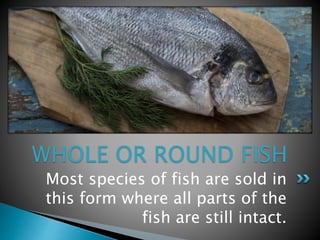
Most species of fish are sold in
this form where all parts of the
fish are still intact.
WHOLE OR ROUND FISH
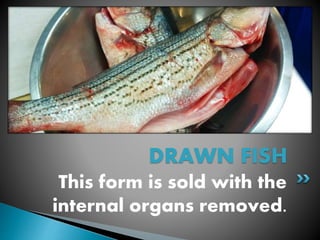
This form is sold with the
internal organs removed.
DRAWN FISH
Bigger fish are sold chopped or
cut along the cross sections.
STEAKS
The scales, internal organs,
fins, head, and tail are
removed
DRESSED FISH
The most common cut and
available from any fish- round
or flat.
FILLETS
Types of fish Fillets
BUTTERFLY
FILLET
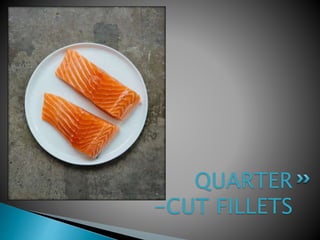
QUARTER
-CUT FILLETS
STICKS
Dalag (mudfish), hito (catfish),
and tilapia are usually sold
alive.
LIVE FISH
STEPS IN PREPARING
THE FISH
Remove the head
by cutting it off
on a slanted line
following the
gills.
In gutting a fish,
cut from the gill
cavity along the
ventral fold to
the anal vent.
All species of fish
must be thoroughly
bled – if the head has
not been removed,
cut the throat;
removed the gills and
all blood vessels.
The shape into
which the fish is
cut defends on
local custom.
•What is the
importance of
preparation for fish?
Fish processing
Fish processing
Fish processing
Fish processing
Fish processing
Fish processing
Fish processing
Fish processing
Fish processing
Fish processing
Fish processing
Fish processing
Fish processing
Fish processing
Fish processing
Fish processing
Fish processing
Fish processing
Fish processing
Fish processing
Fish processing
Fish processing
Fish processing
Fish processing
Fish processing

Fish processing