
• Two methods mainly.
• Utilizing atmospheric conditions like temp,
humidity, airflow etc. – natural drying
• Using artificial means like mechanical dryer for
drying under controlled condition – dehydration
• Sun drying :
• Traditionally fish dried under sun.
• Carried out in open air using solar energy to
evaporate water.
METHOD OF DRYING
• Water is carried away by natural air current.
• depends on weather condition.
• Disadvantages :
 Operation carried out only under bright sun
 Long duration of drying.
 No control over operating parameters.
 More time required
 Possibility of contamination with dust, sand etc.
 Infestation with insects, their larvae & egg a problem
 Poor quality product
 Short shelf life
• NATURAL DRYING :
• Sun drying is also called natural drying.
• Solar & wind energies are utilized.
• requirements are:
 Sufficiently high temp 35- 40° C
 Sufficiently low RH. RH above 75% is not desirable.
 Use of raised platform (about 1 m) as air movement
at ground level is slow.
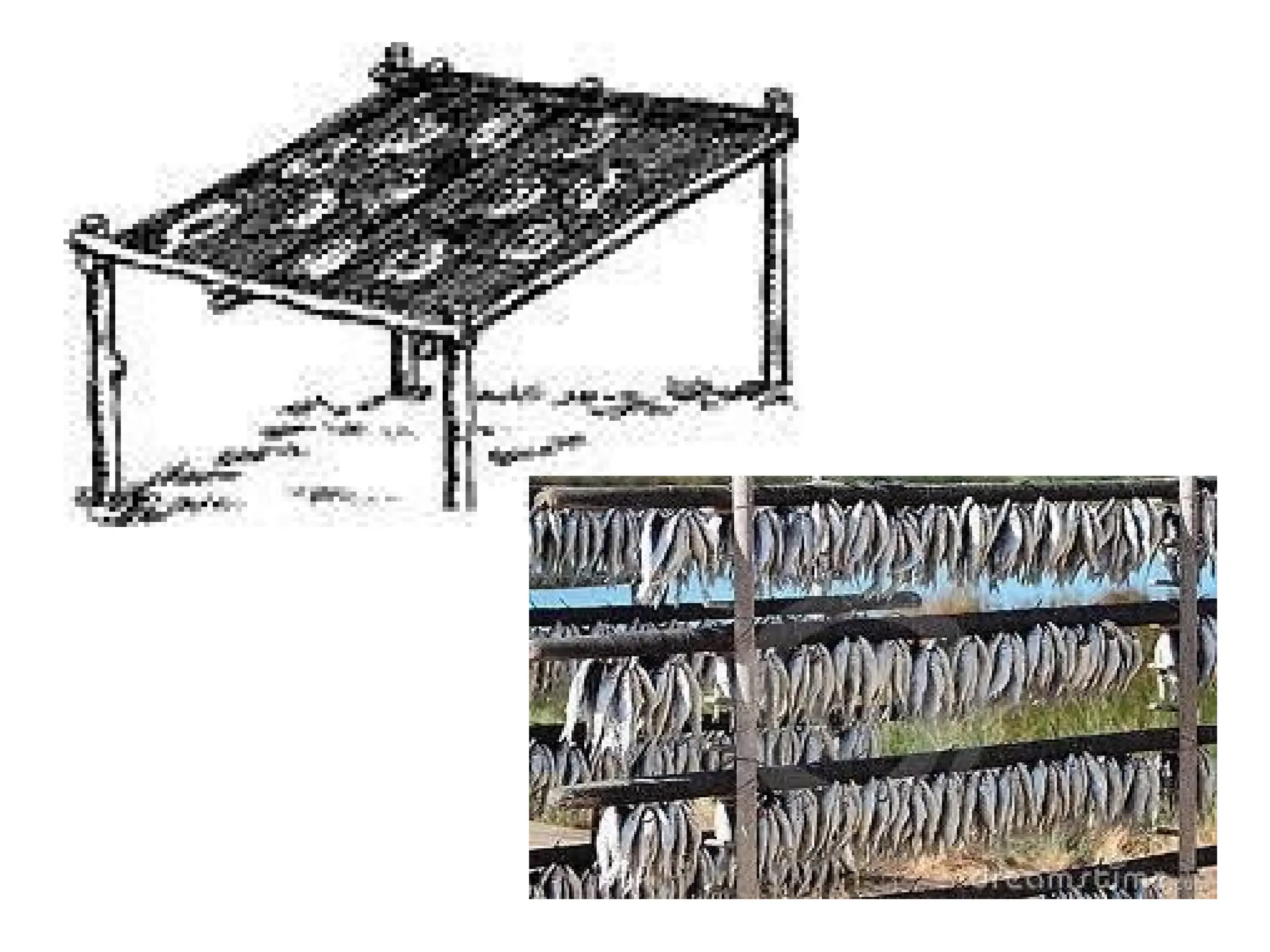
 Use of drying racks – facilitate air movement both
under & over fish. Contamination of fish by dust/
sand is minimized.
 Racks with sloping top – easy draining of water
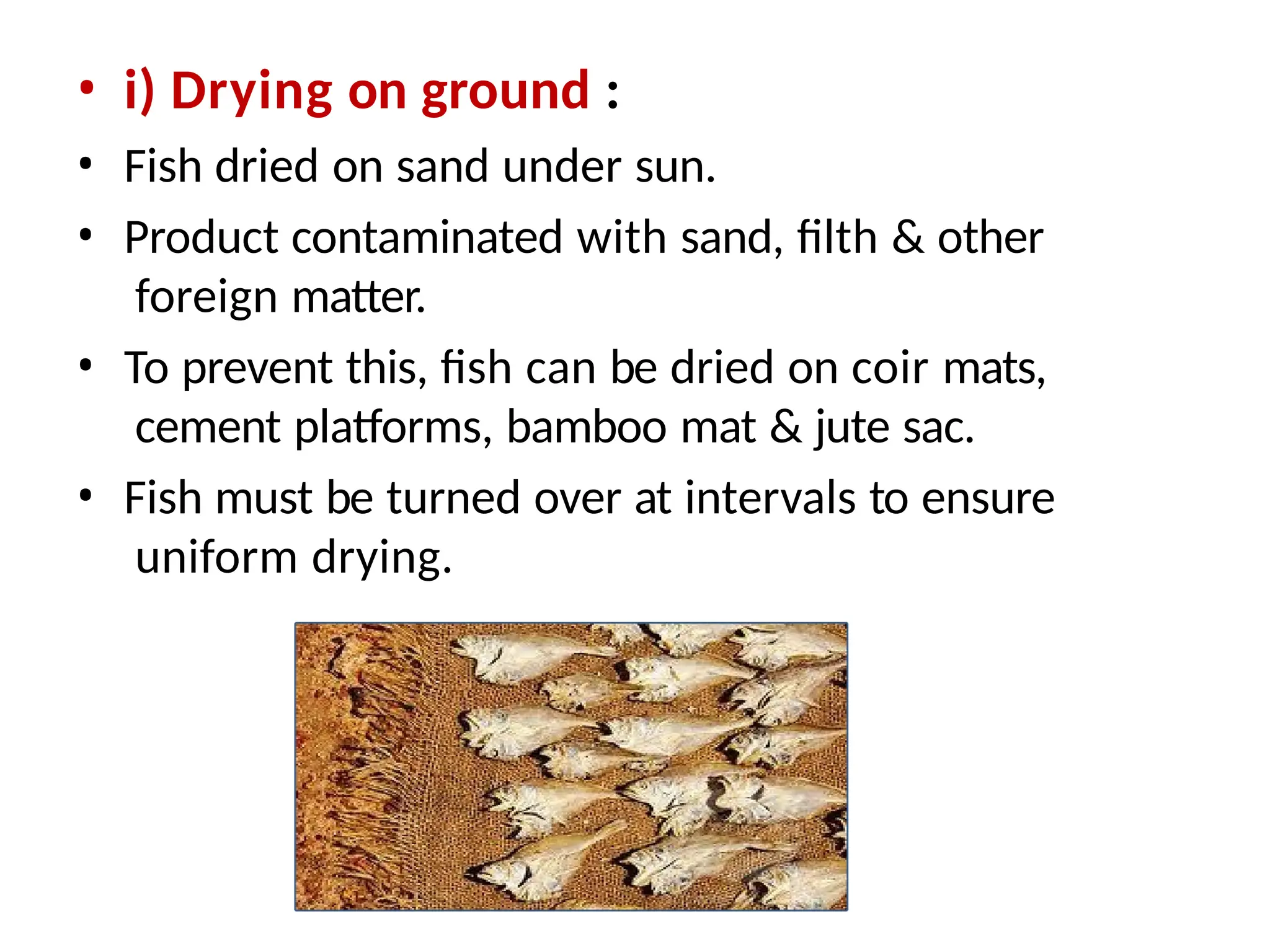
• i) Drying on ground :
• Fish dried on sand under sun.
• Product contaminated with sand, filth & other
foreign matter.
• To prevent this, fish can be dried on coir mats,
cement platforms, bamboo mat & jute sac.
• Fish must be turned over at intervals to ensure
uniform drying.
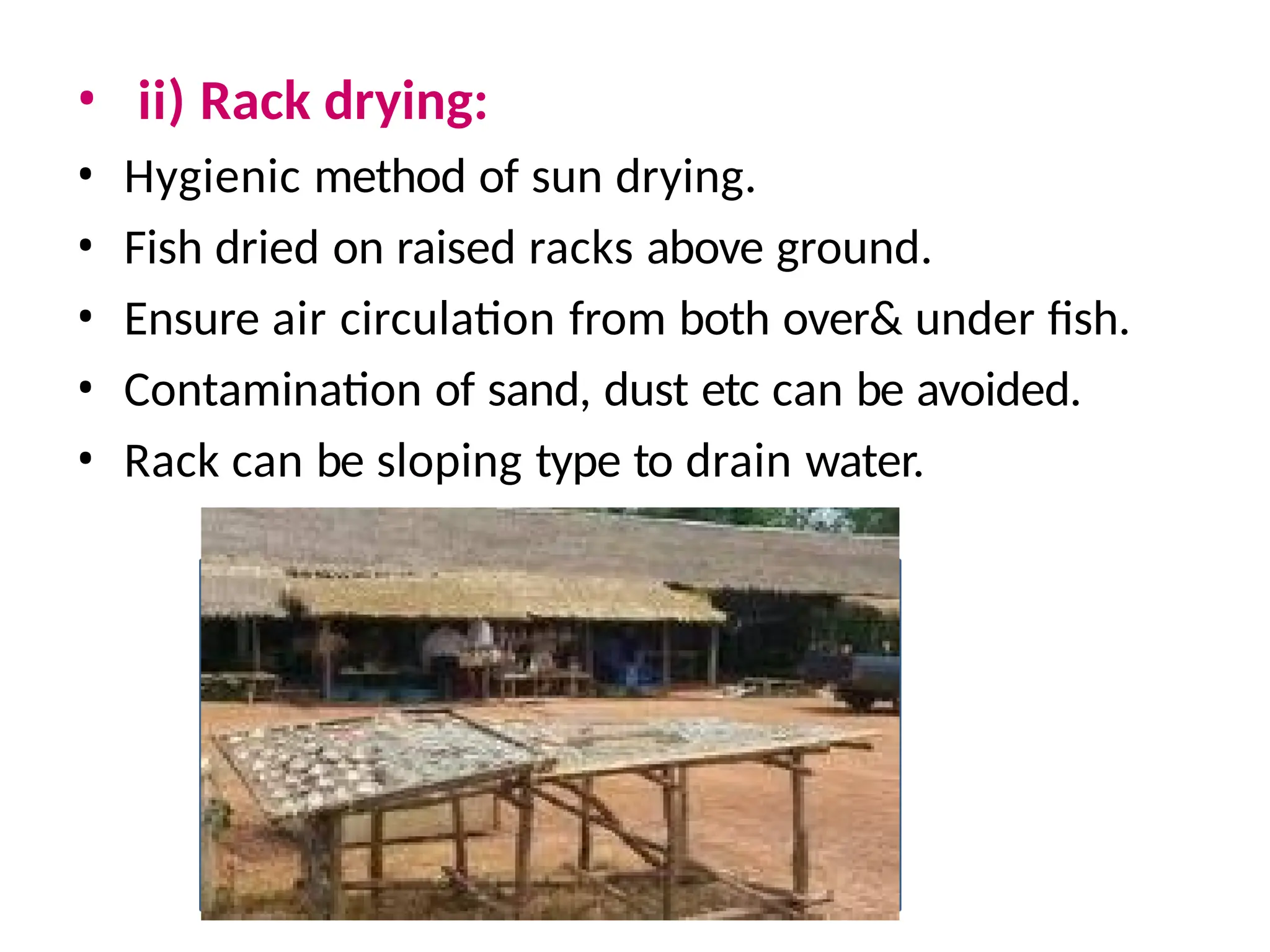
• ii) Rack drying:
• Hygienic method of sun drying.
• Fish dried on raised racks above ground.
• Ensure air circulation from both over& under fish.
• Contamination of sand, dust etc can be avoided.
• Rack can be sloping type to drain water.
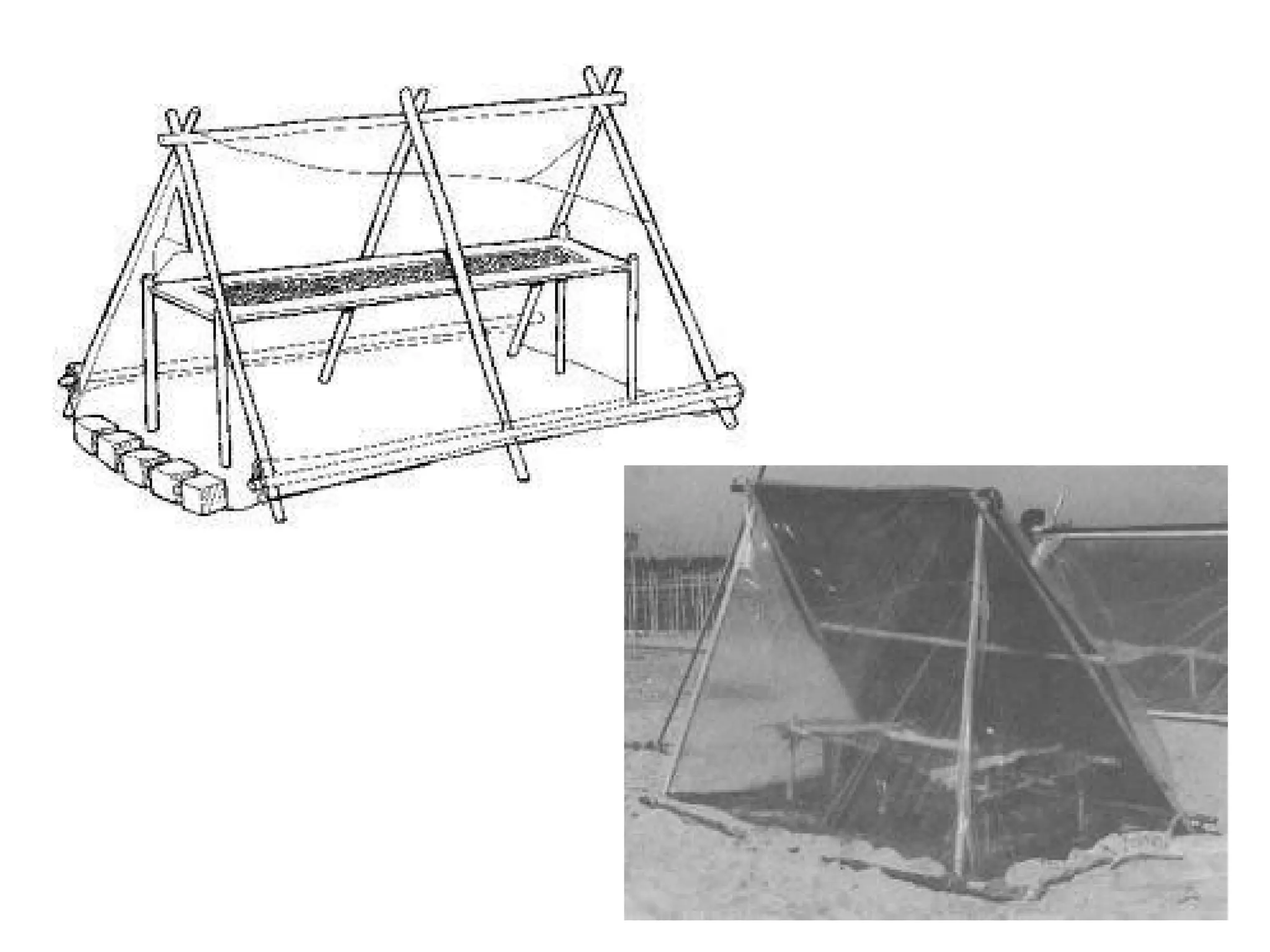
• iii) Solar tent drying :
• Use solar radiation for drying.
• One of the simplest form solar tent drier.
• Principle is a black surface absorb sun’
s
energy effectively than any light coloured
surface.
• Air heated is passed through the fish & escape via a
vent at top.
• Fresh air enters inside through vent at the bottom.
• Air temp rises to 60° C or more in tropical climate.
• This may affect physical/nutritional quality of fish.
• advantages of solar tent drier over sun drying is :
No energy cost
Very low equipment cost
Shorter drying period
No contamination from dust, sand, flies, birds etc.
Produces hygienic product with low moisture.
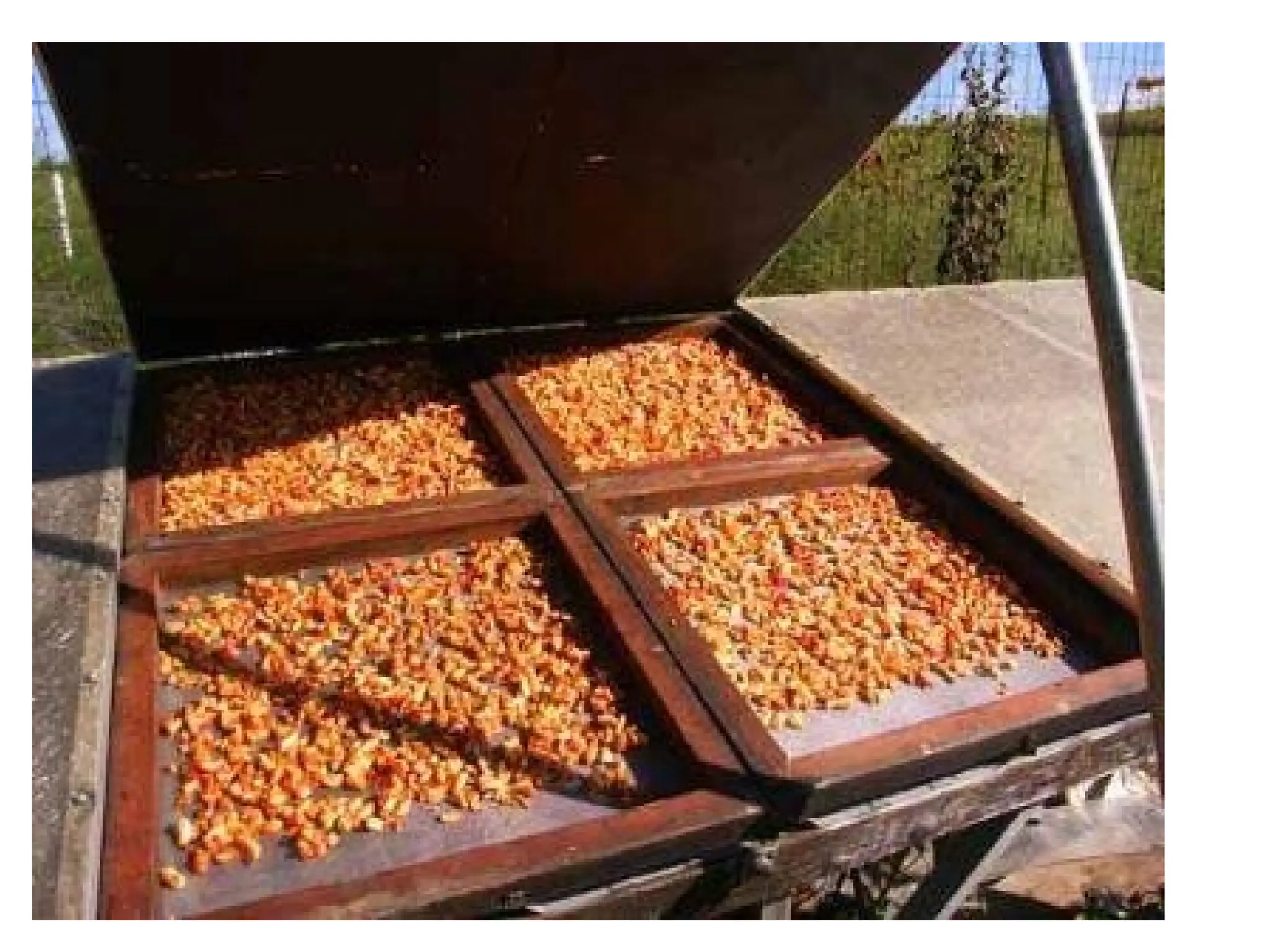
• iv) Solar collector drier :
• Solar energy is first collected in the solar collector
chamber.
• Heated air then passed through the drying
chamber.
• Fishes kept for drying inside chamber in mesh/ trays.
• Hot humid air will escape through chimney.
• Clear polythene sheet at upper side, black PVC sheet
at the bottom.
• Rack for fish spreading & drying is made up of black
plastic mesh.
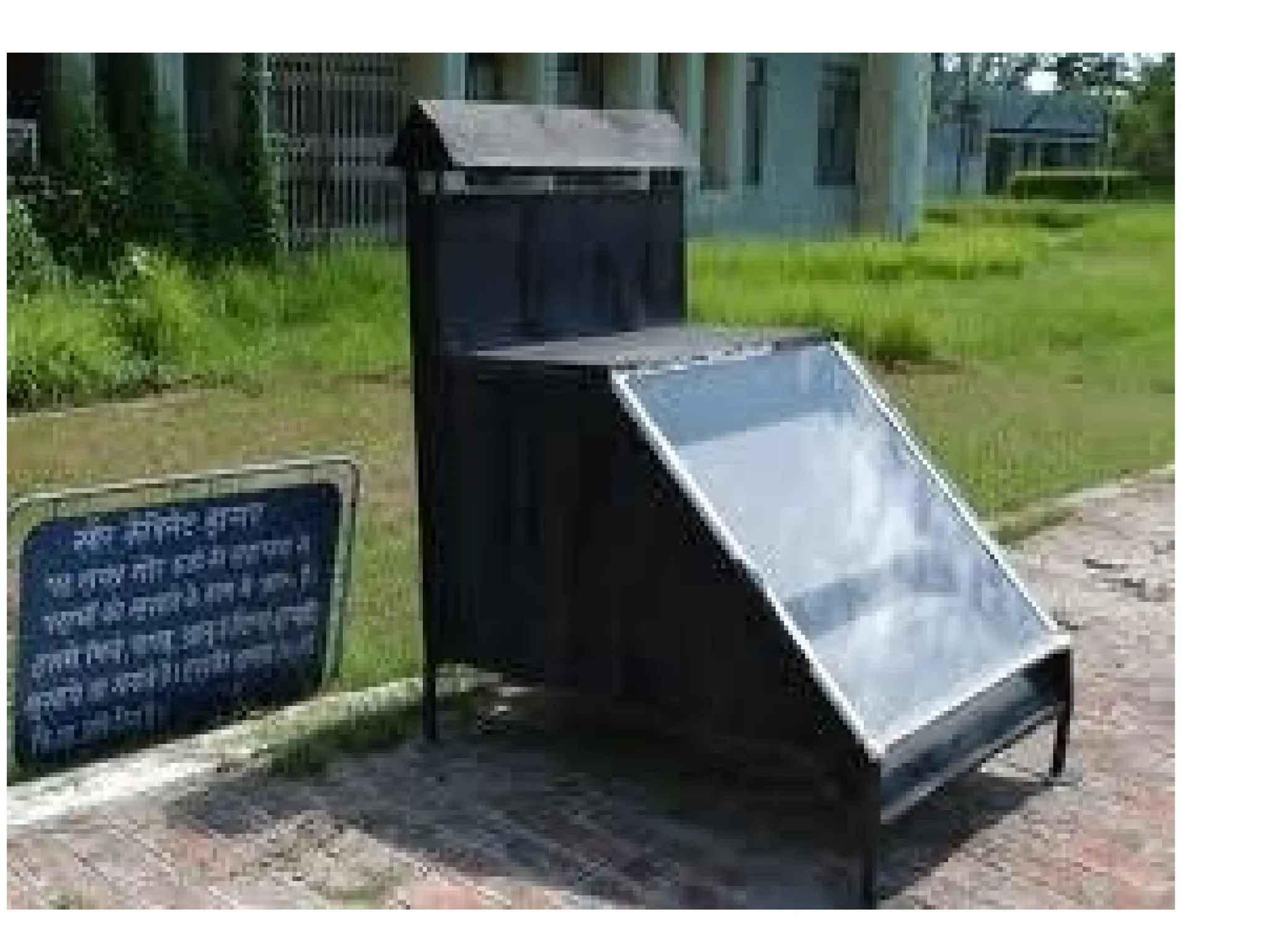
• V)Solar cabinet dryer :
• Rectangular shaped dryer made up of plywood.
• Front side – double walled.
• Inlet & outlet for entry & escape of air
• loading & unloading of fish through two doors.
ARTIFICIAL OR MECHANICAL DRYING
• Removal of water from fish is by external input of
thermal energy.
• Expensive method as need of fuel for heating & temp
maintenance.
• Classified into 2 classes.
• i) Heat transferred to product through hot gas.
• Heat exchange takes place at the contact point.
• Outgoing air carry water vapour away.
• Eg. Kiln drier, tunnel drier.
• ii) Heat transferred to product through a solid
surface.
• Cabinet holding the product may also be
used.
• Eg. Drum drier, vacuum drier.
• HOT AIR DRYERS :
• Air heated by steam/electricity.
• Hot air blown over fish through fan/blower.
• Temp, air velocity, humidity are controlled.
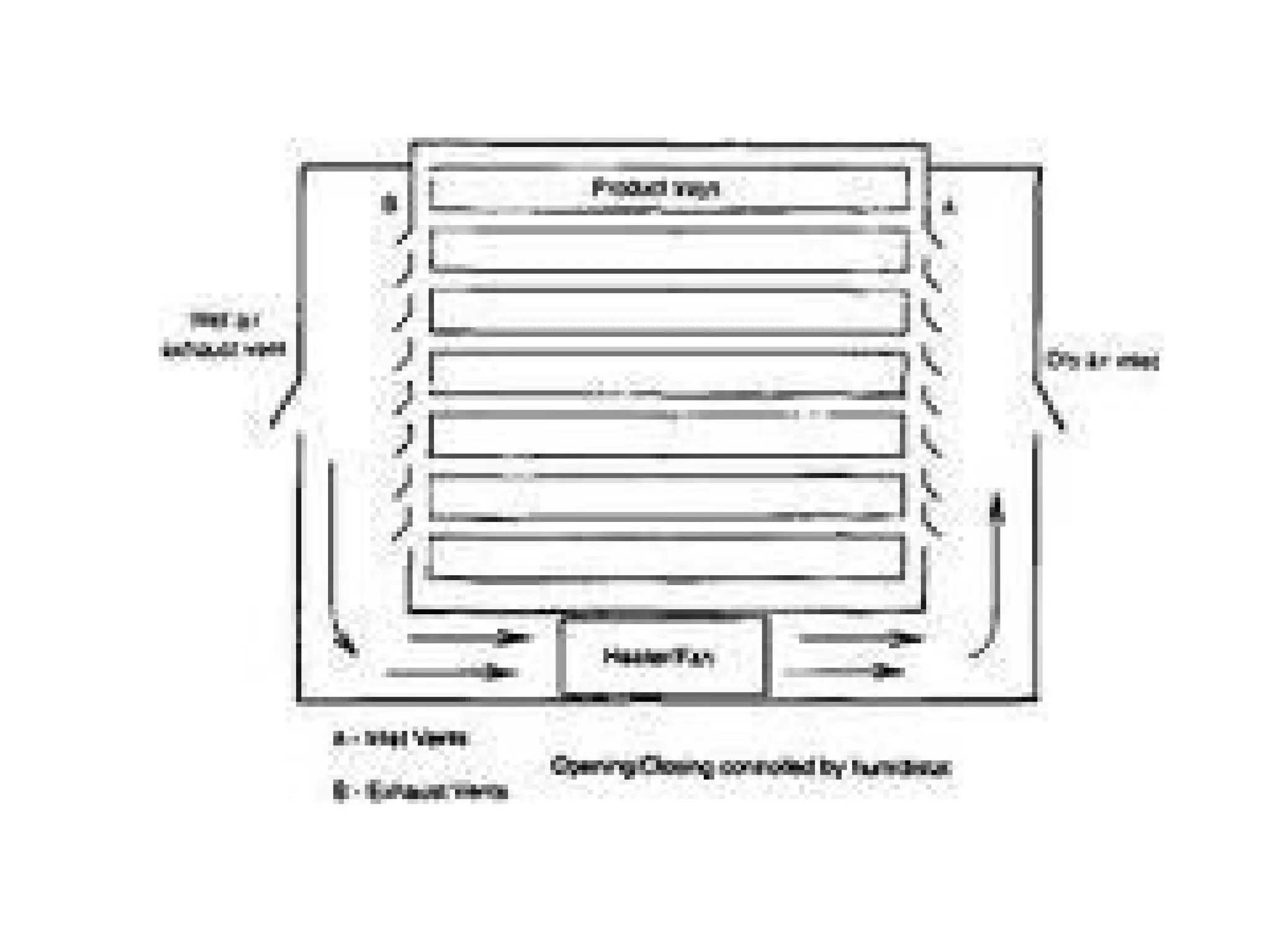
• i) Cabinet Dryer :
• Batch operated model for small scale operation.
• Consists of insulated/non-insulated framed str.
• Materials placed uniformly on trays inside .
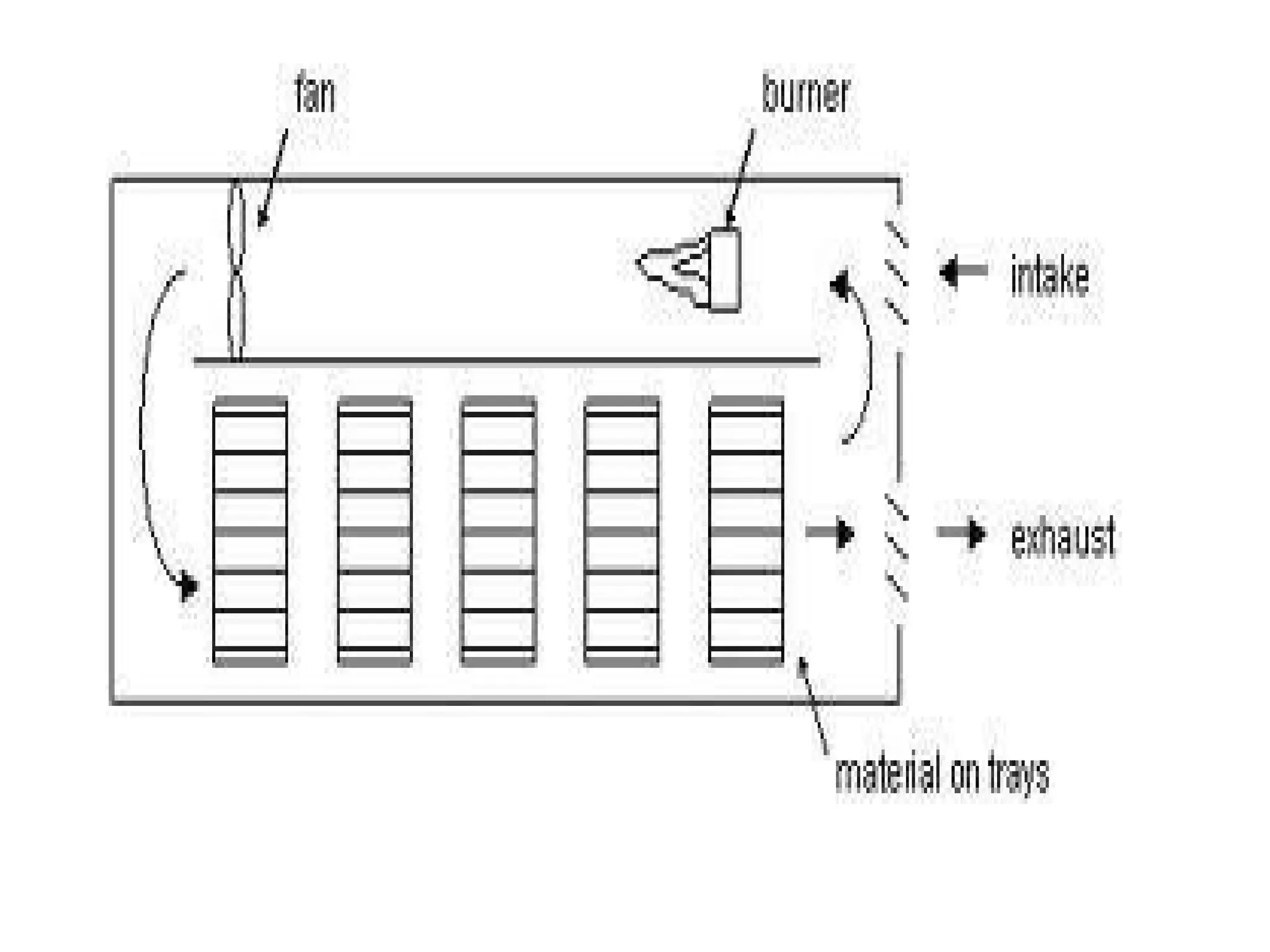
• Fan inside blow air through a heat source.
• Hot air pass over the fish loaded in trays.
• ii) Kiln Dryer :
• Batch dryer of 2 story building.
• Floor of upper story having narrow slats where
material is spread.
• Serves as drying room.
• Lower floor – burner /furnace producing hot gas.
• Hot gas pass through product by natural conduction
• Fan to blow hot gas.
• Material turned frequently for uniform drying.
• iii) Tunnel Dryer :
• Most commonly used for fish drying.
• 10-15 cm long tunnels.
• Trolleys loaded with fish move through the tunnel at
a pre-determined schedule.
• Temp & air velocity controls are provided
• Hot air is blown over the fish across trays.
• when trolley of fresh fish leaves drier at one end, a
fresh trolley of fish is introduced at the other end.
• Parallel flow drying tunnel :
• Here, movement of air is in the same direction as
that of material.
• Hottest air in contact with wettest fish.
• Relatively higher temp.
• Air towards outlet may be cool & highly humid.
• Counter flow drying tunnel :
• Air movement is opposite to movement of product.
• Hot air comes in contact with driest material &
finished product is very dry.
• If left long inside drier product may dry too much
with poor organoleptic characteristics.
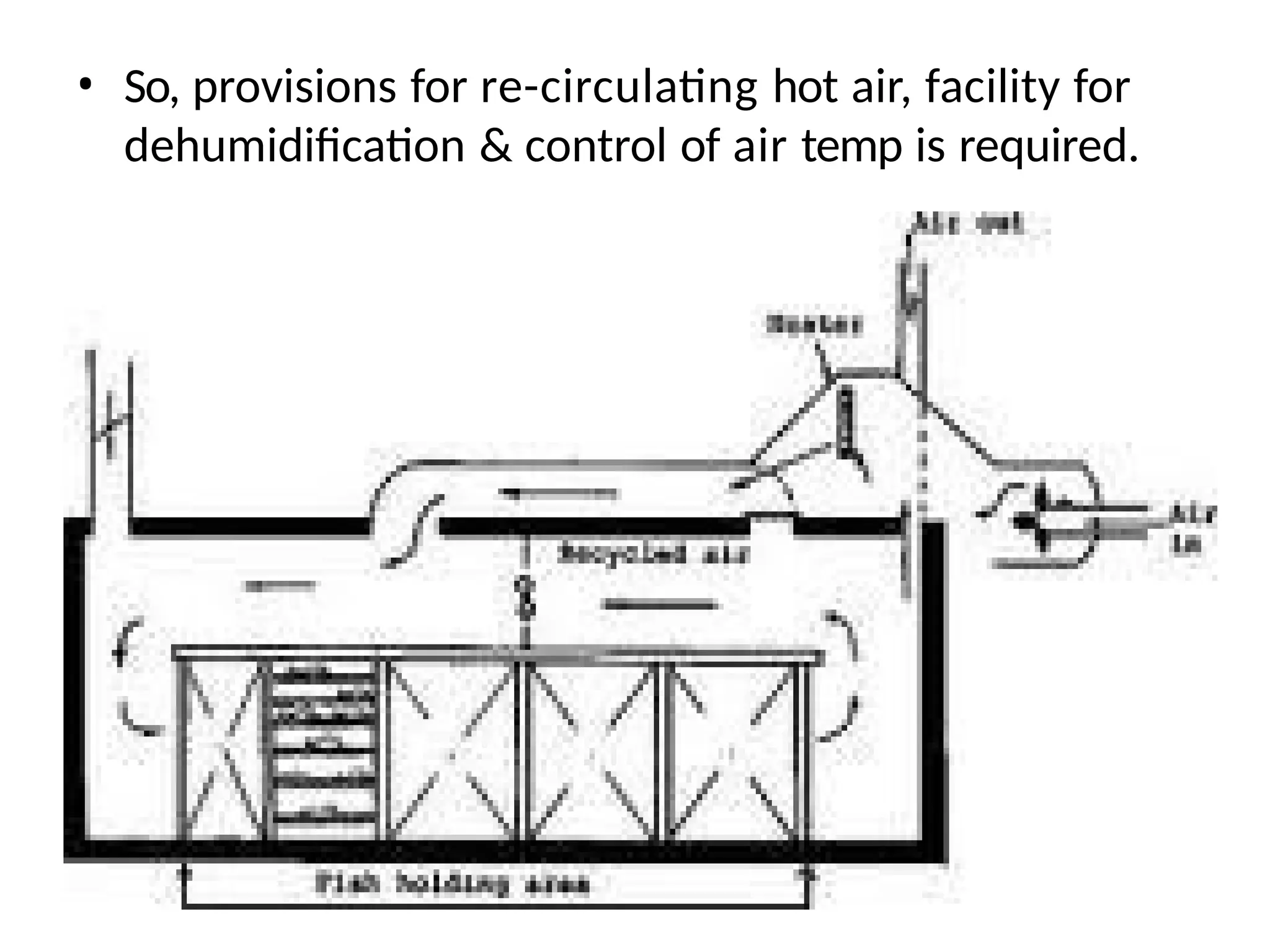
• Tunnel driers designed based on concept of hot air
re-circulation/allowing hot air passing over fish to
escape to atm.
• Re-circulating air becomes humid & slow down
drying significantly.
• So, provisions for re-circulating hot air, facility for
dehumidification & control of air temp is required.
• iv) Multi deck tunnel dryer :
• Several tunnels are placed one above the other.
• Air is blown in zigzag manner thrice then exhausted
• Heater, air blower & exhaust are placed in one side.
• v) Fluidized bed dryer :
• Product passed on a perforated conveyor bed.
• Air is passed below.
• So, product is partially lifted & dried.
• Used mainly for fish meal & fish powder.
• CONTACT
DRYERS :
• i) Vacuum dryer :
• Hollow shelves fitted in chamber through which
heating medium is circulated.
• Material is placed inside chamber in metal trays.
• Vacuum is drawn & drying proceeds under
vacuum.
• Expensive method.
• Suitable for fatty fishes as oxidation & rancidity of
fish can be minimized.
• ii) Rotary dryer :
• Air circulated through the shell or supplied from
steam heat jacket.
• Rotary drum dryer, direct rotary dryer, indirect
rotary dryer & steam dryer are some types.
• Used mainly for fish meal.
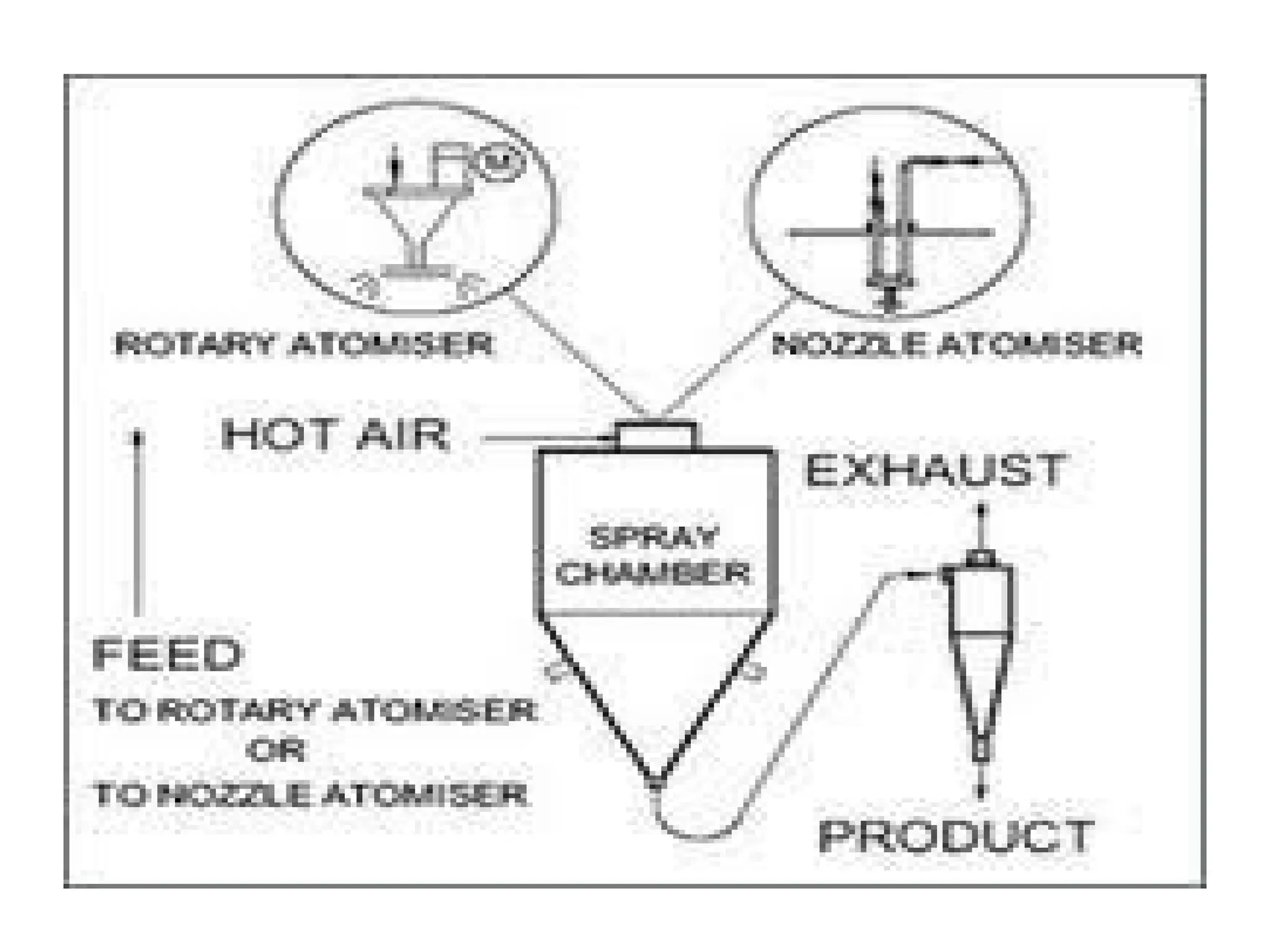
• iii) Spray dryer :
• For drying foods in liquid form or in
suspension.
• liquid food which is in solubilised form, is atomized
& dispersed as minute droplets
• Then suspended in stream of hot air in a Chamber.
• it gets rapidly dried
• Application on fish products is limited to FPH & fish
powder.
• Better retention of color, flavor & nutritive value are
advantages.
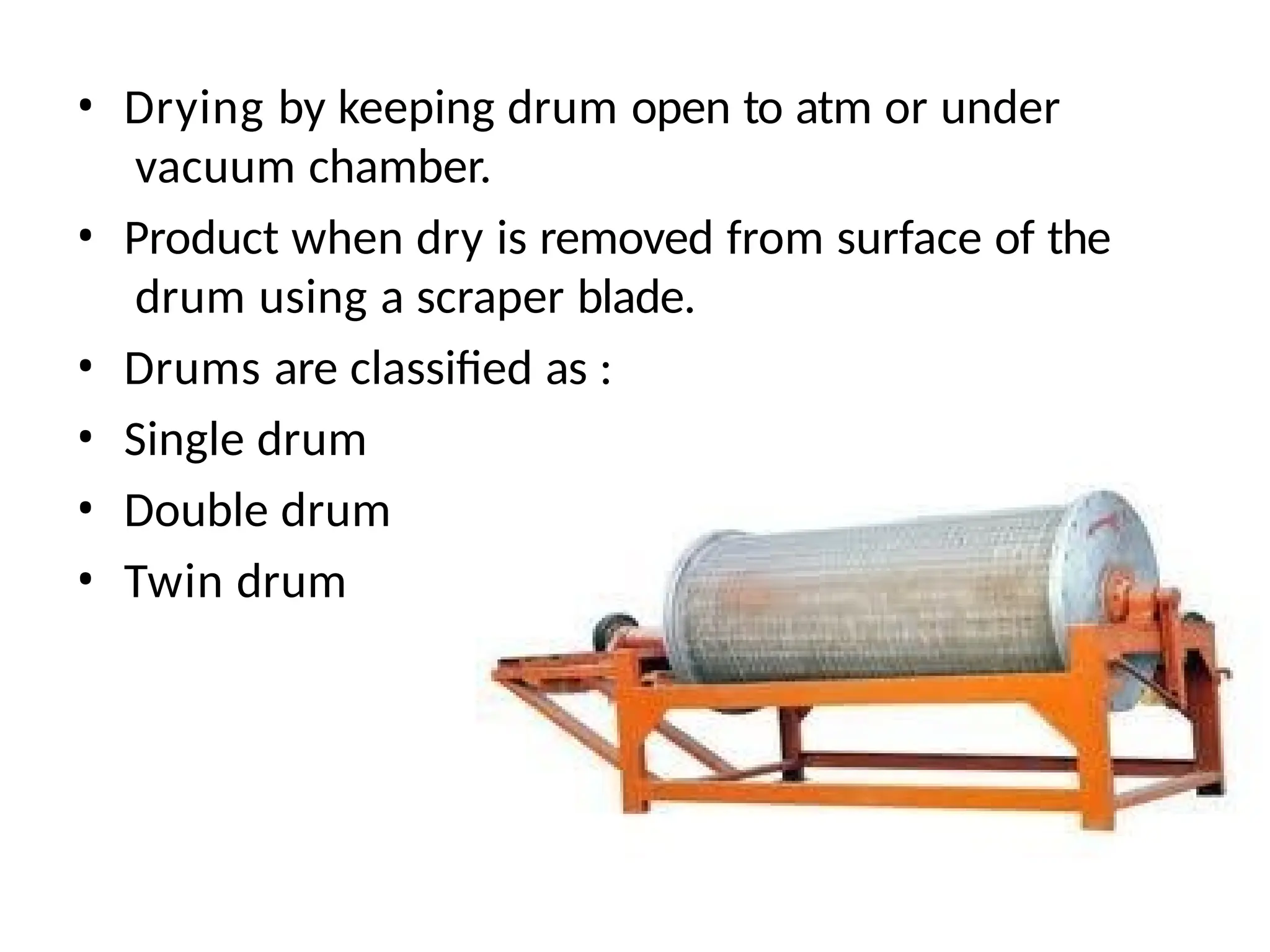
• iv) Drum Dryer :
• Heat transfer through solid surface.
• Used for drying fluid materials.
• Food product in the form of slurry is deposited as
thin film on the drum.
• Drum is heated by steam, while being rotated.
• Drying by keeping drum open to atm or under
vacuum chamber.
• Product when dry is removed from surface of the
drum using a scraper blade.
• Drums are classified as :
• Single drum
• Double drum
• Twin drum
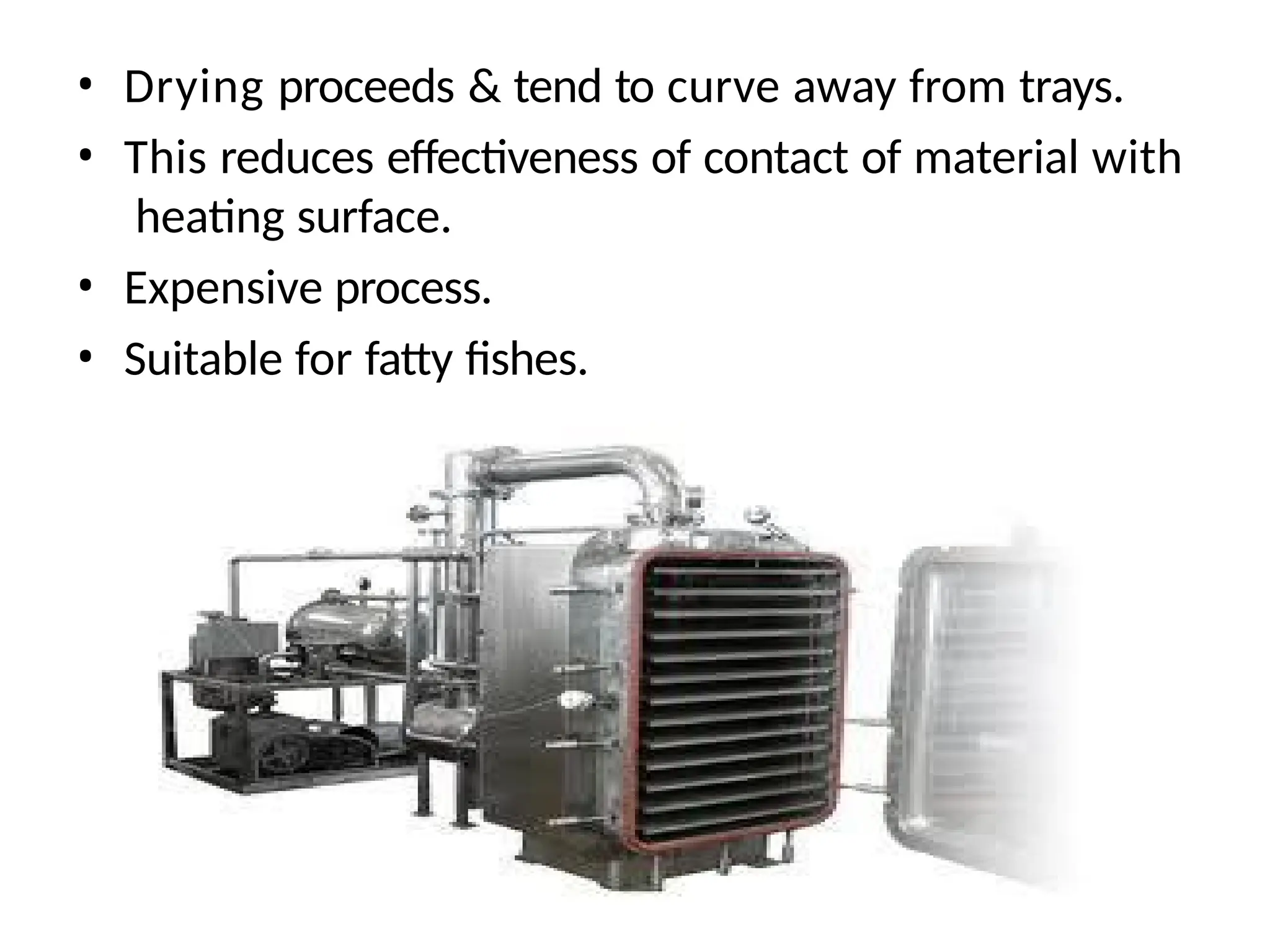
v) Vacuum shelf dryer :
• A vacuum tight chamber with access door & outlet
for gas & vapours.
• Hollow shelves fitted inside to circulate the heating
medium.
• Materials to be dried is spread in thin layers in metal
trays which rest on these shelves.
• Heating by circulating hot oil, steam or other
heating medium.
• Vacuum drawn in chamber through outlet.
• Drying proceeds under vacuum.
• Initial drying rate is high, material shrinks
later as
• Drying proceeds & tend to curve away from trays.
• This reduces effectiveness of contact of material with
heating surface.
• Expensive process.
• Suitable for fatty fishes.
EFFECT OF DRYING ON QUALITY OF FISH
• 1. Shrinkage :
• Major physical change observed in dried fish.
• Shrinkage in volume as a result of structural change
in fish muscle during drying.
• 2. Case hardening :
• Water in fish – dissolved salts, proteins, org matters
• Water moves to surface of fish carries these.
• Evaporating from fish surface is pure water .
• Dissolved substances deposit on surface
• If drying is above ambient temp, & RH low constant,
• Faster rate of drying.
• Surface of fishes dry but interior moist.
• Diffusion slows down
• product will be dry on surface but transfer of
moisture from interior will not take place.
• This is Case hardening.
• In such condition temp of fish muscle is high results
in its cooking.
• Final product is brittle, rehydration property is
affected.
• Controlled by maintaining high RH & also temp of
drying.
• 3. Denaturation of protein & toughening of texture :
• As drying progresses, conc. of dissolved solids in
water increases.
• Reduced evaporation due to case hardening results
increase in temp of fish muscle.
• This causes denaturation of protein & tough texture
with loss of juiciness.
• 4. Rehydration :
• Air dried fish is hard in texture.
• Proteins denatured, water holding capacity is lost.
• Penetration of water retarded resulting poor
rehydration.
• 5. Effects on color, flavor :
• Pigments, fat in fish susceptible to oxidation.
• Prolonged drying of fish exposing to hot air
accelerate the process.
• Air dried fish often suffers from discoloration &
rancid flavor & odour.
• Non-enzymatic browning develops.
SPOILAGE OF FISH DURING DRYING
• 1. Moulds :
• Mould grow on salted & un-salted dried fish at high
moisture content & RH (above 75%)
• If storage temp is 30-35° C moulds grow.
• Moulds on surface of fish increase moisture &
product becomes susceptible to other spoilage.
• 2. Insect infestation :
• Unsalted dried fish infested with blow flies,
Chrysomya sp, Lucilia sp., etc.
• Adult flies attracted & their larvae feed on wet
fish
• Small fish dry quickly & larvae may perish before
causing damage.
• Large fishes remain wet for longer time.
• Controlled by :
• Maintaining hygienic condition in fish handling &
processing premises.
• Eliminating areas where adult flies may lay eggs,
salt- drying.
• Control of Insect attack during storage like Beetle,
Dermestes sp.
• They grow on 15 % moisture level, larvae feed on
fish leaving the bones only.
• Drying with salting can reduce their activity.
• 3. Rancidity :
• Fatty fish prone to oxidation & development of
rancid flavor.
• To some degree rancid flavor is acceptable in dried
fish.
• Rancidity can be controlled by airtight packaging of
dried fish.
PACKAGING &
STORAGE
• Most important concerns regarding packaging
• to prevent moisture pick-up
• recontamination by insects & micro-organisms.
• Traditional packaging materials include :
• cane baskets, leaves, and jute bags.
• Alternatives include flexible packaging such
as polythene bags, or wooden and cardboard
packs.
• Dry fish possess some problems during packaging :
 Irregular shape, Sharp protrusion, which may
puncture packaging material & occupy
space.
 Often brittle & will break up when packed in regular
shape packet.
 Individual fish packaging shoot up the cost.
 If not packed appropriately, absorb moisture & spoil
quickly.
 Necessitates water proof/vapour proof packaging
• An ideal packaging material for dry fish should have
properties like :
 Resistance towards mechanical abrasion & puncture
 Sufficiently robust to prevent breakage
during handling & distribution.
 Eg. Corrugated fibreboard containers provide
adequate mechanical protection
 Be impermeable to moisture, oxygen & insects. Eg.
Boxes of poly propylene can meet the requirement.
Quality standard for cured fish products
• Quality issues & safety aspect :
• Main problem affecting cured fish are histamine,
mycotoxins, 3,4 benzopyrene, oxidation of fat,
halophilic bacteria & mould.
• Histamine – a biogenic amine index of bacterial
spoilage & a risk factor to consumer’s health.
• Max conc. of 20 mg/ 100g in fish is fixed as
rejection level.
• Mainly seen in Scombroid fishes.
• Cured fish prone to mould & fungal attack.
• Product must be fully dried & not left in
damp areas
• Lightly infected fish – cleaned by brine solution &
re-dried.
• Main fungi isolated from dry fish is aspergillus,
mucor & penecillium sp.
• Quality requirements of cured fish products :

DRYING OF FISH - METHOD OF FISH PRESERVATION

  • 2.
    • Two methodsmainly. • Utilizing atmospheric conditions like temp, humidity, airflow etc. – natural drying • Using artificial means like mechanical dryer for drying under controlled condition – dehydration • Sun drying : • Traditionally fish dried under sun. • Carried out in open air using solar energy to evaporate water. METHOD OF DRYING
  • 3.
    • Water iscarried away by natural air current. • depends on weather condition. • Disadvantages :  Operation carried out only under bright sun  Long duration of drying.  No control over operating parameters.  More time required  Possibility of contamination with dust, sand etc.  Infestation with insects, their larvae & egg a problem  Poor quality product  Short shelf life
  • 4.
    • NATURAL DRYING: • Sun drying is also called natural drying. • Solar & wind energies are utilized. • requirements are:  Sufficiently high temp 35- 40° C  Sufficiently low RH. RH above 75% is not desirable.  Use of raised platform (about 1 m) as air movement at ground level is slow.  Use of drying racks – facilitate air movement both under & over fish. Contamination of fish by dust/ sand is minimized.  Racks with sloping top – easy draining of water
  • 6.
    • i) Dryingon ground : • Fish dried on sand under sun. • Product contaminated with sand, filth & other foreign matter. • To prevent this, fish can be dried on coir mats, cement platforms, bamboo mat & jute sac. • Fish must be turned over at intervals to ensure uniform drying.
  • 7.
    • ii) Rackdrying: • Hygienic method of sun drying. • Fish dried on raised racks above ground. • Ensure air circulation from both over& under fish. • Contamination of sand, dust etc can be avoided. • Rack can be sloping type to drain water.
  • 8.
    • iii) Solartent drying : • Use solar radiation for drying. • One of the simplest form solar tent drier. • Principle is a black surface absorb sun’ s energy effectively than any light coloured surface. • Air heated is passed through the fish & escape via a vent at top. • Fresh air enters inside through vent at the bottom. • Air temp rises to 60° C or more in tropical climate. • This may affect physical/nutritional quality of fish.
  • 9.
    • advantages ofsolar tent drier over sun drying is : No energy cost Very low equipment cost Shorter drying period No contamination from dust, sand, flies, birds etc. Produces hygienic product with low moisture. • iv) Solar collector drier : • Solar energy is first collected in the solar collector chamber. • Heated air then passed through the drying chamber.
  • 12.
    • Fishes keptfor drying inside chamber in mesh/ trays. • Hot humid air will escape through chimney. • Clear polythene sheet at upper side, black PVC sheet at the bottom. • Rack for fish spreading & drying is made up of black plastic mesh. • V)Solar cabinet dryer : • Rectangular shaped dryer made up of plywood. • Front side – double walled. • Inlet & outlet for entry & escape of air • loading & unloading of fish through two doors.
  • 14.
    ARTIFICIAL OR MECHANICALDRYING • Removal of water from fish is by external input of thermal energy. • Expensive method as need of fuel for heating & temp maintenance. • Classified into 2 classes. • i) Heat transferred to product through hot gas. • Heat exchange takes place at the contact point. • Outgoing air carry water vapour away. • Eg. Kiln drier, tunnel drier.
  • 15.
    • ii) Heattransferred to product through a solid surface. • Cabinet holding the product may also be used. • Eg. Drum drier, vacuum drier. • HOT AIR DRYERS : • Air heated by steam/electricity. • Hot air blown over fish through fan/blower. • Temp, air velocity, humidity are controlled.
  • 16.
    • i) CabinetDryer : • Batch operated model for small scale operation. • Consists of insulated/non-insulated framed str. • Materials placed uniformly on trays inside . • Fan inside blow air through a heat source. • Hot air pass over the fish loaded in trays. • ii) Kiln Dryer : • Batch dryer of 2 story building. • Floor of upper story having narrow slats where material is spread.
  • 18.
    • Serves asdrying room. • Lower floor – burner /furnace producing hot gas. • Hot gas pass through product by natural conduction • Fan to blow hot gas. • Material turned frequently for uniform drying. • iii) Tunnel Dryer : • Most commonly used for fish drying. • 10-15 cm long tunnels. • Trolleys loaded with fish move through the tunnel at a pre-determined schedule. • Temp & air velocity controls are provided
  • 19.
    • Hot airis blown over the fish across trays. • when trolley of fresh fish leaves drier at one end, a fresh trolley of fish is introduced at the other end. • Parallel flow drying tunnel : • Here, movement of air is in the same direction as that of material. • Hottest air in contact with wettest fish. • Relatively higher temp. • Air towards outlet may be cool & highly humid.
  • 21.
    • Counter flowdrying tunnel : • Air movement is opposite to movement of product. • Hot air comes in contact with driest material & finished product is very dry. • If left long inside drier product may dry too much with poor organoleptic characteristics. • Tunnel driers designed based on concept of hot air re-circulation/allowing hot air passing over fish to escape to atm. • Re-circulating air becomes humid & slow down drying significantly.
  • 22.
    • So, provisionsfor re-circulating hot air, facility for dehumidification & control of air temp is required.
  • 23.
    • iv) Multideck tunnel dryer : • Several tunnels are placed one above the other. • Air is blown in zigzag manner thrice then exhausted • Heater, air blower & exhaust are placed in one side. • v) Fluidized bed dryer : • Product passed on a perforated conveyor bed. • Air is passed below. • So, product is partially lifted & dried. • Used mainly for fish meal & fish powder.
  • 24.
    • CONTACT DRYERS : •i) Vacuum dryer : • Hollow shelves fitted in chamber through which heating medium is circulated. • Material is placed inside chamber in metal trays. • Vacuum is drawn & drying proceeds under vacuum. • Expensive method. • Suitable for fatty fishes as oxidation & rancidity of fish can be minimized.
  • 25.
    • ii) Rotarydryer : • Air circulated through the shell or supplied from steam heat jacket. • Rotary drum dryer, direct rotary dryer, indirect rotary dryer & steam dryer are some types. • Used mainly for fish meal. • iii) Spray dryer : • For drying foods in liquid form or in suspension. • liquid food which is in solubilised form, is atomized & dispersed as minute droplets • Then suspended in stream of hot air in a Chamber.
  • 27.
    • it getsrapidly dried • Application on fish products is limited to FPH & fish powder. • Better retention of color, flavor & nutritive value are advantages. • iv) Drum Dryer : • Heat transfer through solid surface. • Used for drying fluid materials. • Food product in the form of slurry is deposited as thin film on the drum. • Drum is heated by steam, while being rotated.
  • 28.
    • Drying bykeeping drum open to atm or under vacuum chamber. • Product when dry is removed from surface of the drum using a scraper blade. • Drums are classified as : • Single drum • Double drum • Twin drum
  • 29.
    v) Vacuum shelfdryer : • A vacuum tight chamber with access door & outlet for gas & vapours. • Hollow shelves fitted inside to circulate the heating medium. • Materials to be dried is spread in thin layers in metal trays which rest on these shelves. • Heating by circulating hot oil, steam or other heating medium. • Vacuum drawn in chamber through outlet. • Drying proceeds under vacuum. • Initial drying rate is high, material shrinks later as
  • 30.
    • Drying proceeds& tend to curve away from trays. • This reduces effectiveness of contact of material with heating surface. • Expensive process. • Suitable for fatty fishes.
  • 31.
    EFFECT OF DRYINGON QUALITY OF FISH • 1. Shrinkage : • Major physical change observed in dried fish. • Shrinkage in volume as a result of structural change in fish muscle during drying. • 2. Case hardening : • Water in fish – dissolved salts, proteins, org matters • Water moves to surface of fish carries these. • Evaporating from fish surface is pure water . • Dissolved substances deposit on surface • If drying is above ambient temp, & RH low constant,
  • 32.
    • Faster rateof drying. • Surface of fishes dry but interior moist. • Diffusion slows down • product will be dry on surface but transfer of moisture from interior will not take place. • This is Case hardening. • In such condition temp of fish muscle is high results in its cooking. • Final product is brittle, rehydration property is affected. • Controlled by maintaining high RH & also temp of drying.
  • 33.
    • 3. Denaturationof protein & toughening of texture : • As drying progresses, conc. of dissolved solids in water increases. • Reduced evaporation due to case hardening results increase in temp of fish muscle. • This causes denaturation of protein & tough texture with loss of juiciness. • 4. Rehydration : • Air dried fish is hard in texture. • Proteins denatured, water holding capacity is lost. • Penetration of water retarded resulting poor rehydration.
  • 34.
    • 5. Effectson color, flavor : • Pigments, fat in fish susceptible to oxidation. • Prolonged drying of fish exposing to hot air accelerate the process. • Air dried fish often suffers from discoloration & rancid flavor & odour. • Non-enzymatic browning develops.
  • 35.
    SPOILAGE OF FISHDURING DRYING • 1. Moulds : • Mould grow on salted & un-salted dried fish at high moisture content & RH (above 75%) • If storage temp is 30-35° C moulds grow. • Moulds on surface of fish increase moisture & product becomes susceptible to other spoilage. • 2. Insect infestation : • Unsalted dried fish infested with blow flies, Chrysomya sp, Lucilia sp., etc. • Adult flies attracted & their larvae feed on wet fish
  • 36.
    • Small fishdry quickly & larvae may perish before causing damage. • Large fishes remain wet for longer time. • Controlled by : • Maintaining hygienic condition in fish handling & processing premises. • Eliminating areas where adult flies may lay eggs, salt- drying. • Control of Insect attack during storage like Beetle, Dermestes sp.
  • 37.
    • They growon 15 % moisture level, larvae feed on fish leaving the bones only. • Drying with salting can reduce their activity. • 3. Rancidity : • Fatty fish prone to oxidation & development of rancid flavor. • To some degree rancid flavor is acceptable in dried fish. • Rancidity can be controlled by airtight packaging of dried fish.
  • 38.
    PACKAGING & STORAGE • Mostimportant concerns regarding packaging • to prevent moisture pick-up • recontamination by insects & micro-organisms. • Traditional packaging materials include : • cane baskets, leaves, and jute bags. • Alternatives include flexible packaging such as polythene bags, or wooden and cardboard packs.
  • 39.
    • Dry fishpossess some problems during packaging :  Irregular shape, Sharp protrusion, which may puncture packaging material & occupy space.  Often brittle & will break up when packed in regular shape packet.  Individual fish packaging shoot up the cost.  If not packed appropriately, absorb moisture & spoil quickly.  Necessitates water proof/vapour proof packaging
  • 40.
    • An idealpackaging material for dry fish should have properties like :  Resistance towards mechanical abrasion & puncture  Sufficiently robust to prevent breakage during handling & distribution.  Eg. Corrugated fibreboard containers provide adequate mechanical protection  Be impermeable to moisture, oxygen & insects. Eg. Boxes of poly propylene can meet the requirement.
  • 41.
    Quality standard forcured fish products • Quality issues & safety aspect : • Main problem affecting cured fish are histamine, mycotoxins, 3,4 benzopyrene, oxidation of fat, halophilic bacteria & mould. • Histamine – a biogenic amine index of bacterial spoilage & a risk factor to consumer’s health. • Max conc. of 20 mg/ 100g in fish is fixed as rejection level. • Mainly seen in Scombroid fishes. • Cured fish prone to mould & fungal attack. • Product must be fully dried & not left in damp areas
  • 42.
    • Lightly infectedfish – cleaned by brine solution & re-dried. • Main fungi isolated from dry fish is aspergillus, mucor & penecillium sp. • Quality requirements of cured fish products :