FISH HANDLING AND
PROCESSING
By
Dr. Geeta Chauhan
Senior Scientist
Division Of Livestock Products Technology
Indian Veterinary Research Institute
Izatnagar, Bareilly (U.P)
INTRODUCTION
Afterindependence, India has made glorious achievements in
food production and have witnessed multicolorrevolutions in
terms of green, yellow, white and blue.
 As compared to food grains, milk eggs and otherfoods,
country’s fish production has increased at a higherrate.
 This sectoris contributing 1.2% to the national GDPand 5.3%
to the agricultural GDP.
 Fish is a highly perishable commodity requiring a cautious
handling and careful processing.
 To ensure best quality, appropriate technologies and processes
must be followed with clean and hygienic conditions.
KEEPING QUALITY OFFISH
 The physical, chemical and bacteriological
characteristics of fish are influenced by the species,
seasons, catching methods and fishing grounds etc.
 The characteristics of fresh fish are-
 Shining, iridescent surface covered with a nearly
transparent, uniformly and thinly spread slime.
 protruding eyes with a jet black pupil and
transparent cornea
 gills that are bright and free from visible slime
 flesh is soft and flabby, tending to retain finger
indentations
 the flesh odoris ‘marine’, ‘fresh sea weedy’ orlaky in
addition pleasant, margarine like odorin case of fatty
fish.
 As the spoilage is developed in fish-
 its structure loses bright sheen and colorand slime
becomes thicker, turbid and lumpy
 lately, Slime becomes yellow orbrown
eyes sink and shrink with cloudy and milky pupil and
opaque cornea
 gills become bleached, light pink in color, finally
turning to grayish brown covered with a thick slime.
 flesh becomes soft and inelastic and may be easily
stripped from backbone and extrudes juice underlight
pressure.
 odorchanges from ‘sweetish’ then ‘ammoniacal’ or
‘fishy’ and finally putrefaction odor.
CAUSES OFSPOILAGE
 The fish spoilage may be caused by 3 causes-
a)Bacteria
b)Digestive enzymes
c)Others such as oxidation, etc.
The flesh of freshly caught fish is sterile while the
spoiling microflora is present in external slime and
digestive tracts.
Fatty fishes may develop spoilage due to all 3 above
mentioned causes.
If not gutted soon aftercatch, strong digestive
enzymes affect the viscera and belly walls and cause
discoloration- ‘ belly bum’ ordisruption- ‘ torn bellies’.
HANDLING OFFISH
Handling of market fish
 Fish should be purchased as fresh orfrozen as possible
 Exposure to unsafe temperature should be avoided
 Exposure to contaminants should be avoided by keeping
fishes in plastic bag
 It should be kept in refrigerators at home
 Raw fish purchased should not come in contact with
cooked fish, othercooked food stuffs and raw fruits and
vegetables as raw fish contains bacterial load
It should be stored at propertemperature- if hot,
temperature should be 140ºFand if to be kept cold,
temperature should be 40ºForless.
Handling of fresh catch
 Efforts should be done to keep the fish alive as long
as possible- by keeping in metal link basket orlive
box.
 The fish should be checked forsigns of disease or
parasites orforany abnormal growth in the flesh.
 It should be made certain that the fish is being
taken from safe waterwithout any contaminants.
 If it is difficult to keep fish alive, it should be stored
at temperature below 40ºF.
GUTTING, CLEANING ANDCOOLING
The harvested fish should be cleaned and cooled as
soon possible due to theirstrong digestive juices, fish
spoil very soon and if not gutted and cleaned promptly
may develop off flavourand color.
A sharp knife, clean cloth, plastic bags and crushed ice
must be kept ready forgutting and cleaning of fish.
With the help of knife, fish should be cleaned and
bled.
Throat should be cut and gills and entrails are
removed.
Cleaned fish first be put in plastic bags and then in ice.
To prevent contamination, hands, working area, cutting
boards, knives and otherutensils should be properly
cleaned with waterand soap.
PREPARATION OFFILLETS
Wash the fish in clean cold waterto remove blood,
microbes and enzymes.
Filleting is done with a sharp knife with flexible
blades.
The fillets collected should be stored properly at low
temperature.
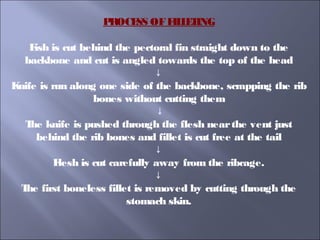
PROCESS OFFILLETING
Fish is cut behind the pectoral fin straight down to the
backbone and cut is angled towards the top of the head
↓
Knife is run along one side of the backbone, scrapping the rib
bones without cutting them
↓
The knife is pushed through the flesh nearthe vent just
behind the rib bones and fillet is cut free at the tail
↓
Flesh is cut carefully away from the ribcage.
↓
The first boneless fillet is removed by cutting through the
stomach skin.
STORAGE
Aftercleaning and packaging the fish should be stored
eitherby refrigerating orfreezing.
Refrigerating-
Raw fish can be kept in refrigeratorat the temperature
of 40ºForlower.
Should be stored in covered containers.
While keeping in refrigerator, fish should be moist but
not wet.
Forrefrigerating fish at home, the fish should be
removed from wrapper, rinsed properly in clean cold
water, pat dried with papertowel and kept in a plate or
pan lined with double layerof papertowels.
The pan should be covered tightly with aluminium foil or
plastic wrap to avoid leakage.
This covered fish may be kept in the coldest part of the
Freezing-
It is done if the fish is not to be used within 2 days of
the catch orto be transported.
It must be properly cleaned and handled before
freezing.
The temperature of freezing fish should be 0ºForless.
Following methods can be used forfreezing the fish-
A.Double wrapping-
Suitable forsmall whole fish, steaks orfillets.
In this, fish is tightly wrapped individually in plastic
wrap and again wrapped tightly with anotherlayerof
wrap.
These wrapped pieces are kept in a sealable freezer
bag ormay be wrapped tightly in aluminium foil.
The sealed bags are placed scattered in freezerand
when they are frozen, they can be stocked on top of
B. Freezing in ice block-
 This method is suitable forsteaks and fillets.
 It protects the fish from freezerburn and avoids the
exposure from air.
 Forfreezing fish in ice box, it is cut into small pieces
and placed in containers. Head space of one inch
should be left forexpansion.
 Fish is then covered with cold waterand kept in
freezerto freeze.
 Check whetherfish is completely covered with ice or
not.
 When freezing is done in a pan, the ice block is taken
out by running little cold waterat its bottom and ice
block is double wrapped and kept in freezer.
C. Glazing-
 This method is suitable forwhole fish orlarge cuts.
 In this method, fish is first frozen by placing them on
a baking sheet in a single layerand the frozen fish
is then dipped into a containerhaving ice waterand
allowed to freeze again.
 This process is repeated until an ice coating of at
least 1/8” thickness is made on the fish.
 It is then put in an airtight freezerbag orcontainer
and kept in freezer.
 At interval, glazing should be checked.
CAREDURING FREEZING
 The package should be marked with content and
date.
 Wrapped package should be sealed tightly.
 When fish is frozen, make sure its fully covered with
ice.
 Frozen fish brought from market should be put in the
freezerat the earliest and in the original package only.
 Putting the fish package in freezerbag before
keeping in freezerto provide an extra protection.
SUPERCHILLING
This method is appropriate when freezing facilities are not
available and fish have to be transported.
If followed properly, freshness can be maintained forsix to
seven days.
Forsuperchilling, fish are cleaned and wrapped tightly as
whole with two layers of plastic wrap oraluminium foil.
A mix of rock salt and crushed ice in 1/20 is prepared.
Forplacing a fish forchilling, a fourinch layerof plain
crushed ice is put at the coolerbottom and wrapped fish are
placed on it in a single layer. On this, ice mix layeris put.
The process is repeated till fish are covered.
Finally, the cooleris tightly covered.
During transportation, waterdrain may be left open or
coolershould be removed in between and watershould be
drained off. Accordingly, the ice mix should be put again.
POINTS TO REMEMBERDURING STORAGEOFFISH
 Fish must be cleaned thoroughly.
 Refrigeratortemperature should be 40ºForlow.
 Thawed fish should not be refrozen again.
 Thawing should be done in refrigeratororcold water
that must be changed at every half an hour.
 Fish should be frozen as soon as possible afterthe
catch.
 The package should be mentioned with content and
date.
PROCESSING OFFISH
Raw and fresh fish are given different treatments through
different processing methods forthe purpose of-
Long storage
Enhancing sensory characteristics
The common techniques of fish processing include scanning,
smoking, salting, drying and fermentation.
1.Canning-
In canning fish, high heat treatment is given to destroy the
present bacteria and the product is packaged in hermetically
sealed containers to protect against recontamination.
Canning provides shelf stable fish and so freezing space is not
required. Canning may keep the fish fresh foreven years.
Forcanning fish, only half-pint orpint-jars must be used, quart
jars not to be used. These jars should be thoroughly cleaned with
hot soapy water.
Glass jars with glass threads are best forfish ormeat canning.
Any one of the 2 lids types may be used forthe jars-
Glass lids used with separable rubbersealerring
Metal lid to which a sealing compound is already applied and
overwhich the metal band is screwed.
The process of canning involves following steps-
1.Preparation of fish-
Fish are gutted, gilled and iced down as soon as possible.
Fillets can be prepared.
Large fish may be cut into smallerpieces.
Washing is done in clean and cold waterand properdraining is
done to make them quite dry.
2.Cleaning of jars-
Jars are cleaned and sterilized.
3. Filling of jars-
 Sterilized, clean jars are packed with cleaned fish
 During filling, head space of an inch must be left, so that the
seal is not disturbed.
 There should not be any airpockets left.
4. Closing of jars-
 Warm, dried lids are put on jars and rims are tightened.
 Lids with sealing compound, requiring boiling orholding in
warm waterbefore use may handled so as perthe directions
of the manufacturers.
5. Heating of jars-
 Sealed jars are placed in pressure cannerand heating is done.
 The pressure cannershould be in perfect orderand directions
given to work with it to avoid the risk of botulism food
poisoning.
2. Smoking-
 It is done for2 purposes-
 Forpreservation
 Fortexture and flavor.
 Smoking is much common in less developed countries where
refrigeration and transportation facilities are not very good.
 Smoking is very popularin developed countries fortaste.
 Steps in smoking includes-
1. Preparation/cleaning of fish-
Scales, head, fins, tail, viscera are removed and fish are
washed with clean cold water.
2. Curing of fish-
It can be done in two ways-
a. Wet/brine curing-
 Ingredients used forbrine curing are 3 cups table salt, 1½
cups brown sugarand 1 gallon of cold water. Otherspices
may also be added as perthe choice.
All these are mixed properly in a non-metallic container.
 Fish is completely immersed in brine. One gallon of brine is
sufficient forcuring fourpounds of fish.
 It is then refrigerated orkept in ice bags to keep the fish
cool.
 Brining is done for2 to 6 hours.
b. Dry curing-
 In this salt is rubbed directly on the fish.
 Forthis, three parts of brown sugaris mixed with one part of
non-iodized salt and fish fillets are placed in a deep non-
metallic pan.
 The piece is covered with dry cure mix and kept in
refrigeratorfor18-24 hours.
 Aftercuring, fish are taken out, rinsed lightly, pat dried and
placed on papertowel and airdried forone hour.
3.Drying of fish-
Cured fish are dried before smoking.
Drying forms a pellicle orglaze on the skin, which keeps
moisture in and contamination out and allows the smoke to
adhere properly to get smoky flavorand uniform color.
Drying can be done in cool shady place orin smokerracks.
4.Smoking-
The fish may be cold orhot smoked.
Smoked fish may be kept formany months in freezerbut in
refrigerator, cold smoked fish may be preserved forseveral
months but hot smoked may be kept only fora week.
Smoking requires- a smoke source, a smoking chamberand an
airventilation system.
a. Cold smoking-
 The fish is smoked at low temperature forlong time.
 Forthis, fish is placed in smokerhaving temperature
maintained at about 80ºF. It should not exceed 90ºFelse it
will become cured and cooked and unsafe forconsumption.
 The smoking time forsmall fish may be 24 hours and for
large fish it may be 3-4 days of continuous smoking.
b. Hot smoking-
 In this, fish is placed in smokerhaving temperature of not
more than 90ºFforthe first two hours. During this period, fish
will get a brown color.
 The temperature is then raised gradually to about 175ºFand
smoking is done for4-8 hours.
5. Cooling and Packaging-
Aftersmoking is completed, the fish are cooled and then
packaged in suitable packaging material and stored.
3. Salting of fish-
 Salting of fish is an art as well as a science.
 This process is affected by weather, size and species of fish.
 Forsalting, good quality fish should be chosen and proper
cleaning should be maintained.
 Following operations are followed forsalting fish-
1. Preparing the fish-
 Beheading, gutting, bleeding and cleaning of fish should be
done as soon as possible.
 Largerfish can be cut into suitable pieces.
2. Salting-
 The bottom of waterproof vat is covered with a thin layerof
salt and fish are layered on it with flesh side up.
 Fish layeris covered with thin layerof salt leaving no space.
In the same mannertwo orthree layers of fishes are placed.
Then fish is reversed with skin side up covering them with salt
layer. The top layeris always a salt layer.
As due to salt, moisture comes out and brine is formed. The
brine is kept saturated by adding more salt.
Because of moisture loss, fish level is fallen and accordingly
more fish may be placed along with the salt layer.
The fish may be cured for12-15 days in warm weatherand 21
days ormore in cold weather.
Properly salted fish flesh is translucent, firm but yields to light
pressure.
3.Washing and drying to remove extra salt-
Aftersalting, fish are washed in unpolluted sea waterorfresh
brine and put on plain surface, applying pressure on them to
remove moisture and make them thinner.
4.Drying-
Salted fish may be dried in sun orby artificial heat and air
generated by fans.
4. Drying and Dehydration-
 Oldest method of preserving perishable food items like fish
and is considered as least costly method.
 Two common methods fordrying fish are-
a. Sun drying-
Advantages-
 Due to high concentration and diminished watercontent,
spoilage due to microbes and enzymes are avoided.
 It is simple and inexpensive method.
 Further, dried fish may be stored at most ambient
temperatures.
Demerits-
 No control overdrying conditions.
 Dependency on natural weather
 Greaterchances of contamination with dirt and dust and
infestation with insects, theireggs and larvae.
b. Dehydration-
 The drying carried out in controlled conditions.
 Dehydrated fish have high quality and longershelf life than
sun dried fish.
 Various driers like cabinet drier, kiln drier, tunnel drier, etc
are used.
5. Fermentation-
 Fermented fish have been considered as a Southeast-Asian
product forlong.
 Fermented fish products are prepared by salting and
fermenting the fish to convert the flesh into simple
components.
 Fish fermentation lasts for3-9 months and the flesh liquefy
orbecomes like a paste.
 Fermented fish means any fishy product having degradative
changes due to enzymatic ormicrobial activity.
Some common fermented fish products are- Nuoc-man of
Vietnam, Nam-pla of Thailand, Sushi of Japan and Patis of
Philippines.
The main fermentation procedures are-
i.Fermentation with salting and drying
ii.Fermentation and drying without salting
iii.Fermented with salting but without drying.
CONCLUSION
 Fish is a highly perishable product and can be handled
safely to improve its shelf life.
 Different processing methods like canning, drying,
smoking, etc if applied properly to the fish as soon as the fish
is caught, can enhance the shelf life from months to years
depending on the methods used.
 The processed fish can be transported to the distance places
without the risk of spoilage and food poisoning.
THANK YOU

Fish processing ppt

  • 1.
    FISH HANDLING AND PROCESSING By Dr.Geeta Chauhan Senior Scientist Division Of Livestock Products Technology Indian Veterinary Research Institute Izatnagar, Bareilly (U.P)
  • 2.
    INTRODUCTION Afterindependence, India hasmade glorious achievements in food production and have witnessed multicolorrevolutions in terms of green, yellow, white and blue.  As compared to food grains, milk eggs and otherfoods, country’s fish production has increased at a higherrate.  This sectoris contributing 1.2% to the national GDPand 5.3% to the agricultural GDP.  Fish is a highly perishable commodity requiring a cautious handling and careful processing.  To ensure best quality, appropriate technologies and processes must be followed with clean and hygienic conditions.
  • 3.
    KEEPING QUALITY OFFISH The physical, chemical and bacteriological characteristics of fish are influenced by the species, seasons, catching methods and fishing grounds etc.  The characteristics of fresh fish are-  Shining, iridescent surface covered with a nearly transparent, uniformly and thinly spread slime.  protruding eyes with a jet black pupil and transparent cornea  gills that are bright and free from visible slime  flesh is soft and flabby, tending to retain finger indentations  the flesh odoris ‘marine’, ‘fresh sea weedy’ orlaky in addition pleasant, margarine like odorin case of fatty fish.
  • 4.
     As thespoilage is developed in fish-  its structure loses bright sheen and colorand slime becomes thicker, turbid and lumpy  lately, Slime becomes yellow orbrown eyes sink and shrink with cloudy and milky pupil and opaque cornea  gills become bleached, light pink in color, finally turning to grayish brown covered with a thick slime.  flesh becomes soft and inelastic and may be easily stripped from backbone and extrudes juice underlight pressure.  odorchanges from ‘sweetish’ then ‘ammoniacal’ or ‘fishy’ and finally putrefaction odor.
  • 5.
    CAUSES OFSPOILAGE  Thefish spoilage may be caused by 3 causes- a)Bacteria b)Digestive enzymes c)Others such as oxidation, etc. The flesh of freshly caught fish is sterile while the spoiling microflora is present in external slime and digestive tracts. Fatty fishes may develop spoilage due to all 3 above mentioned causes. If not gutted soon aftercatch, strong digestive enzymes affect the viscera and belly walls and cause discoloration- ‘ belly bum’ ordisruption- ‘ torn bellies’.
  • 6.
    HANDLING OFFISH Handling ofmarket fish  Fish should be purchased as fresh orfrozen as possible  Exposure to unsafe temperature should be avoided  Exposure to contaminants should be avoided by keeping fishes in plastic bag  It should be kept in refrigerators at home  Raw fish purchased should not come in contact with cooked fish, othercooked food stuffs and raw fruits and vegetables as raw fish contains bacterial load It should be stored at propertemperature- if hot, temperature should be 140ºFand if to be kept cold, temperature should be 40ºForless.
  • 7.
    Handling of freshcatch  Efforts should be done to keep the fish alive as long as possible- by keeping in metal link basket orlive box.  The fish should be checked forsigns of disease or parasites orforany abnormal growth in the flesh.  It should be made certain that the fish is being taken from safe waterwithout any contaminants.  If it is difficult to keep fish alive, it should be stored at temperature below 40ºF.
  • 8.
    GUTTING, CLEANING ANDCOOLING Theharvested fish should be cleaned and cooled as soon possible due to theirstrong digestive juices, fish spoil very soon and if not gutted and cleaned promptly may develop off flavourand color. A sharp knife, clean cloth, plastic bags and crushed ice must be kept ready forgutting and cleaning of fish. With the help of knife, fish should be cleaned and bled. Throat should be cut and gills and entrails are removed. Cleaned fish first be put in plastic bags and then in ice. To prevent contamination, hands, working area, cutting boards, knives and otherutensils should be properly cleaned with waterand soap.
  • 9.
    PREPARATION OFFILLETS Wash thefish in clean cold waterto remove blood, microbes and enzymes. Filleting is done with a sharp knife with flexible blades. The fillets collected should be stored properly at low temperature.
  • 10.
    PROCESS OFFILLETING Fish iscut behind the pectoral fin straight down to the backbone and cut is angled towards the top of the head ↓ Knife is run along one side of the backbone, scrapping the rib bones without cutting them ↓ The knife is pushed through the flesh nearthe vent just behind the rib bones and fillet is cut free at the tail ↓ Flesh is cut carefully away from the ribcage. ↓ The first boneless fillet is removed by cutting through the stomach skin.
  • 11.
    STORAGE Aftercleaning and packagingthe fish should be stored eitherby refrigerating orfreezing. Refrigerating- Raw fish can be kept in refrigeratorat the temperature of 40ºForlower. Should be stored in covered containers. While keeping in refrigerator, fish should be moist but not wet. Forrefrigerating fish at home, the fish should be removed from wrapper, rinsed properly in clean cold water, pat dried with papertowel and kept in a plate or pan lined with double layerof papertowels. The pan should be covered tightly with aluminium foil or plastic wrap to avoid leakage. This covered fish may be kept in the coldest part of the
  • 12.
    Freezing- It is doneif the fish is not to be used within 2 days of the catch orto be transported. It must be properly cleaned and handled before freezing. The temperature of freezing fish should be 0ºForless. Following methods can be used forfreezing the fish- A.Double wrapping- Suitable forsmall whole fish, steaks orfillets. In this, fish is tightly wrapped individually in plastic wrap and again wrapped tightly with anotherlayerof wrap. These wrapped pieces are kept in a sealable freezer bag ormay be wrapped tightly in aluminium foil. The sealed bags are placed scattered in freezerand when they are frozen, they can be stocked on top of
  • 13.
    B. Freezing inice block-  This method is suitable forsteaks and fillets.  It protects the fish from freezerburn and avoids the exposure from air.  Forfreezing fish in ice box, it is cut into small pieces and placed in containers. Head space of one inch should be left forexpansion.  Fish is then covered with cold waterand kept in freezerto freeze.  Check whetherfish is completely covered with ice or not.  When freezing is done in a pan, the ice block is taken out by running little cold waterat its bottom and ice block is double wrapped and kept in freezer.
  • 14.
    C. Glazing-  Thismethod is suitable forwhole fish orlarge cuts.  In this method, fish is first frozen by placing them on a baking sheet in a single layerand the frozen fish is then dipped into a containerhaving ice waterand allowed to freeze again.  This process is repeated until an ice coating of at least 1/8” thickness is made on the fish.  It is then put in an airtight freezerbag orcontainer and kept in freezer.  At interval, glazing should be checked.
  • 15.
    CAREDURING FREEZING  Thepackage should be marked with content and date.  Wrapped package should be sealed tightly.  When fish is frozen, make sure its fully covered with ice.  Frozen fish brought from market should be put in the freezerat the earliest and in the original package only.  Putting the fish package in freezerbag before keeping in freezerto provide an extra protection.
  • 16.
    SUPERCHILLING This method isappropriate when freezing facilities are not available and fish have to be transported. If followed properly, freshness can be maintained forsix to seven days. Forsuperchilling, fish are cleaned and wrapped tightly as whole with two layers of plastic wrap oraluminium foil. A mix of rock salt and crushed ice in 1/20 is prepared. Forplacing a fish forchilling, a fourinch layerof plain crushed ice is put at the coolerbottom and wrapped fish are placed on it in a single layer. On this, ice mix layeris put. The process is repeated till fish are covered. Finally, the cooleris tightly covered. During transportation, waterdrain may be left open or coolershould be removed in between and watershould be drained off. Accordingly, the ice mix should be put again.
  • 17.
    POINTS TO REMEMBERDURINGSTORAGEOFFISH  Fish must be cleaned thoroughly.  Refrigeratortemperature should be 40ºForlow.  Thawed fish should not be refrozen again.  Thawing should be done in refrigeratororcold water that must be changed at every half an hour.  Fish should be frozen as soon as possible afterthe catch.  The package should be mentioned with content and date.
  • 18.
    PROCESSING OFFISH Raw andfresh fish are given different treatments through different processing methods forthe purpose of- Long storage Enhancing sensory characteristics The common techniques of fish processing include scanning, smoking, salting, drying and fermentation. 1.Canning- In canning fish, high heat treatment is given to destroy the present bacteria and the product is packaged in hermetically sealed containers to protect against recontamination. Canning provides shelf stable fish and so freezing space is not required. Canning may keep the fish fresh foreven years. Forcanning fish, only half-pint orpint-jars must be used, quart jars not to be used. These jars should be thoroughly cleaned with hot soapy water.
  • 19.
    Glass jars withglass threads are best forfish ormeat canning. Any one of the 2 lids types may be used forthe jars- Glass lids used with separable rubbersealerring Metal lid to which a sealing compound is already applied and overwhich the metal band is screwed. The process of canning involves following steps- 1.Preparation of fish- Fish are gutted, gilled and iced down as soon as possible. Fillets can be prepared. Large fish may be cut into smallerpieces. Washing is done in clean and cold waterand properdraining is done to make them quite dry. 2.Cleaning of jars- Jars are cleaned and sterilized.
  • 20.
    3. Filling ofjars-  Sterilized, clean jars are packed with cleaned fish  During filling, head space of an inch must be left, so that the seal is not disturbed.  There should not be any airpockets left. 4. Closing of jars-  Warm, dried lids are put on jars and rims are tightened.  Lids with sealing compound, requiring boiling orholding in warm waterbefore use may handled so as perthe directions of the manufacturers. 5. Heating of jars-  Sealed jars are placed in pressure cannerand heating is done.  The pressure cannershould be in perfect orderand directions given to work with it to avoid the risk of botulism food poisoning.
  • 21.
    2. Smoking-  Itis done for2 purposes-  Forpreservation  Fortexture and flavor.  Smoking is much common in less developed countries where refrigeration and transportation facilities are not very good.  Smoking is very popularin developed countries fortaste.  Steps in smoking includes- 1. Preparation/cleaning of fish- Scales, head, fins, tail, viscera are removed and fish are washed with clean cold water. 2. Curing of fish- It can be done in two ways-
  • 22.
    a. Wet/brine curing- Ingredients used forbrine curing are 3 cups table salt, 1½ cups brown sugarand 1 gallon of cold water. Otherspices may also be added as perthe choice. All these are mixed properly in a non-metallic container.  Fish is completely immersed in brine. One gallon of brine is sufficient forcuring fourpounds of fish.  It is then refrigerated orkept in ice bags to keep the fish cool.  Brining is done for2 to 6 hours. b. Dry curing-  In this salt is rubbed directly on the fish.  Forthis, three parts of brown sugaris mixed with one part of non-iodized salt and fish fillets are placed in a deep non- metallic pan.  The piece is covered with dry cure mix and kept in refrigeratorfor18-24 hours.
  • 23.
     Aftercuring, fishare taken out, rinsed lightly, pat dried and placed on papertowel and airdried forone hour. 3.Drying of fish- Cured fish are dried before smoking. Drying forms a pellicle orglaze on the skin, which keeps moisture in and contamination out and allows the smoke to adhere properly to get smoky flavorand uniform color. Drying can be done in cool shady place orin smokerracks. 4.Smoking- The fish may be cold orhot smoked. Smoked fish may be kept formany months in freezerbut in refrigerator, cold smoked fish may be preserved forseveral months but hot smoked may be kept only fora week. Smoking requires- a smoke source, a smoking chamberand an airventilation system.
  • 24.
    a. Cold smoking- The fish is smoked at low temperature forlong time.  Forthis, fish is placed in smokerhaving temperature maintained at about 80ºF. It should not exceed 90ºFelse it will become cured and cooked and unsafe forconsumption.  The smoking time forsmall fish may be 24 hours and for large fish it may be 3-4 days of continuous smoking. b. Hot smoking-  In this, fish is placed in smokerhaving temperature of not more than 90ºFforthe first two hours. During this period, fish will get a brown color.  The temperature is then raised gradually to about 175ºFand smoking is done for4-8 hours. 5. Cooling and Packaging- Aftersmoking is completed, the fish are cooled and then packaged in suitable packaging material and stored.
  • 25.
    3. Salting offish-  Salting of fish is an art as well as a science.  This process is affected by weather, size and species of fish.  Forsalting, good quality fish should be chosen and proper cleaning should be maintained.  Following operations are followed forsalting fish- 1. Preparing the fish-  Beheading, gutting, bleeding and cleaning of fish should be done as soon as possible.  Largerfish can be cut into suitable pieces. 2. Salting-  The bottom of waterproof vat is covered with a thin layerof salt and fish are layered on it with flesh side up.  Fish layeris covered with thin layerof salt leaving no space. In the same mannertwo orthree layers of fishes are placed.
  • 26.
    Then fish isreversed with skin side up covering them with salt layer. The top layeris always a salt layer. As due to salt, moisture comes out and brine is formed. The brine is kept saturated by adding more salt. Because of moisture loss, fish level is fallen and accordingly more fish may be placed along with the salt layer. The fish may be cured for12-15 days in warm weatherand 21 days ormore in cold weather. Properly salted fish flesh is translucent, firm but yields to light pressure. 3.Washing and drying to remove extra salt- Aftersalting, fish are washed in unpolluted sea waterorfresh brine and put on plain surface, applying pressure on them to remove moisture and make them thinner. 4.Drying- Salted fish may be dried in sun orby artificial heat and air generated by fans.
  • 27.
    4. Drying andDehydration-  Oldest method of preserving perishable food items like fish and is considered as least costly method.  Two common methods fordrying fish are- a. Sun drying- Advantages-  Due to high concentration and diminished watercontent, spoilage due to microbes and enzymes are avoided.  It is simple and inexpensive method.  Further, dried fish may be stored at most ambient temperatures. Demerits-  No control overdrying conditions.  Dependency on natural weather  Greaterchances of contamination with dirt and dust and infestation with insects, theireggs and larvae.
  • 28.
    b. Dehydration-  Thedrying carried out in controlled conditions.  Dehydrated fish have high quality and longershelf life than sun dried fish.  Various driers like cabinet drier, kiln drier, tunnel drier, etc are used. 5. Fermentation-  Fermented fish have been considered as a Southeast-Asian product forlong.  Fermented fish products are prepared by salting and fermenting the fish to convert the flesh into simple components.  Fish fermentation lasts for3-9 months and the flesh liquefy orbecomes like a paste.  Fermented fish means any fishy product having degradative changes due to enzymatic ormicrobial activity.
  • 29.
    Some common fermentedfish products are- Nuoc-man of Vietnam, Nam-pla of Thailand, Sushi of Japan and Patis of Philippines. The main fermentation procedures are- i.Fermentation with salting and drying ii.Fermentation and drying without salting iii.Fermented with salting but without drying.
  • 30.
    CONCLUSION  Fish isa highly perishable product and can be handled safely to improve its shelf life.  Different processing methods like canning, drying, smoking, etc if applied properly to the fish as soon as the fish is caught, can enhance the shelf life from months to years depending on the methods used.  The processed fish can be transported to the distance places without the risk of spoilage and food poisoning.
  • 31.