


FISH PRODUCTSFISH PRODUCTS
Mrs.R.Sinthiya
Assistant Professor
Department of Food Processing and
Preservation Technology
Faculty of Engineering
Avinashilingam Institute for Home Science &
Higher Education for Women University,
Coimbatore
Smoking Fish
Freezing Fish
Dried Fish
Canned Fish
Fish Oil
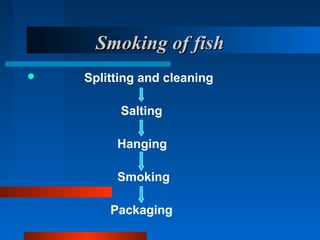
Smoking of fishSmoking of fish
 Splitting and cleaning
Salting
Hanging
Smoking
Packaging
Splitting and cleaningSplitting and cleaning
The fish is split and the gut,gills are
removed
Then they are cleaned with water
SaltingSalting
The cleaned fish is then soaked in
brine solution
Duration of treatment with brine
depends up on the strength of the
brine solution
The brine is stored at a temperature
of 52 to 55 degree C and is changed
atleast once a day
HangingHanging
The salted fish is hung in the kiln on
a rack for dipping
The protein which has dissolved in
the salt form a sticky solution on the
surface of the fish
Which gives the skin a glossy
appearance which is one of the
commercial criteria of the quality
SmokingSmoking
Two types of smoking
• Hot Smoking process
• Cold Smoking process
The Hot Smoking ProcessThe Hot Smoking Process
 The smoking time will vary as well depending
on the size of the fish and the conditions for
the marketing of the products but will usually
be 1-2 hours.
 The fish is dried for a period before smoking
in order to prepare the skin for the reception
of the smoke
 The fish could be lightly salted or not be
salted at all before smoking, sometimes a
sprinkle of salt is given when packed in boxes
after smoking
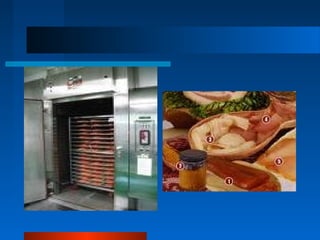
The equipment for the hot smoking
process has developed from the most
simple chimney/barrel to specially
designed cabinets with inbuilt devises
for the control of the smoking process
but it is characteristic that the very
primitive equipment persists.
During cooking process it loosesits
weight
If the fish is packed hot it may
develop a moist,flabby appearance
sand mould growth may occur
The Cold Smoking ProcessThe Cold Smoking Process
 The characteristic feature for cold smoked
fish will be that the flesh does not appear
cooked
 Most cold smoked fish are smoked as fillets
 The fish could be exposed to smoke for an
extended period of 24 hours or more in a
smoking cabinet
 However the time is shortened considerably
in the modern cold smoking process to
approach the times known from the hot
smoking process.
Freezing of fishFreezing of fish
 Freezing extends the period of storage
and effective in keeping the fish in a
condition similar to the resh fish
 Three methods:
1.By direct contact between the fish and
a refrigerated metal plates
2.By blowing a continuous stream of
refrigerated air over the product
3.By immersing the fish in a low
temperature liquid
Dried fishDried fish
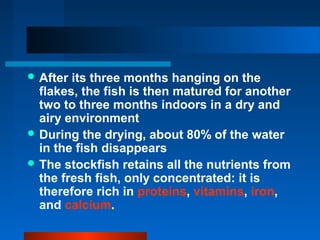
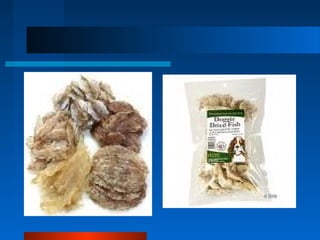
 The fish is prepared immediately after
capture
 After gutting the fish, it is either dried
whole, or split along the spine leaving the
tail connected.
 Stable cool weather protects the fish from
insects and prevents bacterial growth.
 Too much frost will spoil the fish, as ice
destroys the fibers in the fish.
 After its three months hanging on the
flakes, the fish is then matured for another
two to three months indoors in a dry and
airy environment
 During the drying, about 80% of the water
in the fish disappears
 The stockfish retains all the nutrients from
the fresh fish, only concentrated: it is
therefore rich in proteins, vitamins, iron,
and calcium.
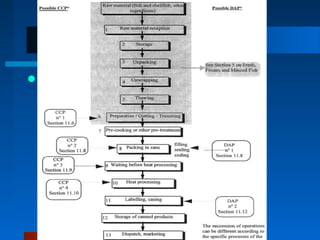
Canning of fish

Requirements Concerning RawRequirements Concerning Raw
MaterialsMaterials
Fish intended for canning should be
produced in accordance with the
appropriate Sections of this code
Storage of raw materialStorage of raw material
 Raw materials should be stored, as quickly as
possible after reception, in suitable premises
 Raw materials should be stored so that any
recontamination of final products, in-process
products or containers should be prevented
 All materials for containers or packages should
be stored in satisfactory clean and hygienic
conditions
 During loading, stowing and unloading of
empty containers, containers shouldn't be
stepped on. These precautions become more
imperative when cans are put in bags or on
pallets.
Unwrapping, UnpackingUnwrapping, Unpacking
During unwrapping and unpacking
operations, precautions should be
taken in order to limit product
contamination and foreign matters
introduction into the product.
To avoid microbial proliferation,
there should be no waiting periods
during these operations.
ThawingThawing
 Thawing time and temperature should be
selected to avoid conditions favourable
for development of microorganisms or
decomposition
 During thawing products should not be
exposed to excessively high temperatures
 After thawing should be immediately
processed or refrigerated and kept at the
adequate temperature (temperature of
melting ice).
Gutting and WashingGutting and Washing
 fish requiring gutting on arrival at the
plant should be gutted efficiently and with
care to avoid contamination
 gutting must be complete to remove
pieces of intestinal tract and internal
organs
 immediately after gutting, fish should be
washed with clean sea water or potable
water. After washing the fish should be
drained and properly iced
Pre-Cooking and Other Pre-Pre-Cooking and Other Pre-
TreatmentsTreatments
 There are several reasons for pre-cooking
fish or shellfish prior to canning:
- to lower the water content of the
flesh in order to avoid water exudation
during heat processing
- to give a particular flavour or texture
to the product
- in some cases, to prepare the
products for later treatments.
Packing in Cans (Filling,Packing in Cans (Filling,
Sealing and Coding)Sealing and Coding)
 Filling
- Containers and covers should be inspected
immediately before delivery to the filling
machines or packing tables to ensure that they
are clean, undamaged and without visible flaws
- Containers of canned fish should be filled
as directed in the scheduled process
- Mechanical or manual filling of containers
should be checked in order to comply with the
filling rate and the headspace specified in the
adopted sterilization schedule
 The necessary amount of headspace will
depend partly on the nature of the contents.
 The filling should also take into account the
heat processing method
 If fish has been brine-frozen or stored in
refrigerated brine, the amount of salt
absorbed should be taken into
consideration when salt is added to the
product for flavoring
 Excessive vacuum may cause the container
to panel, particularly if the headspace is
large, and may also cause contaminants
Filled containers should be
inspected
- to ensure that they have been
properly filled and will meet accepted
standards for weight of contents
- and to verify product quality and
workmanship just before they are
closed.
SealingSealing
 Sealing the container is one of the most
essential processes in canning
 The operation, maintenance, regular
inspection and adjustment of sealing
machines should received particular care.
 If vacuum is used during packing, it
should sufficient to prevent the containers
from bulging under any condition likely to
be encountered during the transport,
storage or marketing of the product.
This is useful for deep containers or
glass containers.
It is difficult and hardly necessary to
create a vacuum in shallow
containers that have relatively large
flexible covers.
Handling of Containers AfterHandling of Containers After
Closure - Waiting Before HeatClosure - Waiting Before Heat
ProcessingProcessing
 Containers after closure should always be
handled carefully in such a way as to
prevent every damage capable to
determine defects and microbiological
recontamination
 Filled and sealed metal containers should
be thoroughly washed before heat
processing to remove grease, dirt and fish
or shellfish marks on their outside walls
the filled and sealed containers must
be held for a long time before heat
processing, refrigeration or heat
holding (> 63°C) for fish soups, for
example, are necessary
Heat Processing andHeat Processing and
CoolingCooling
Heat processing is one of the most
essential operations in canning
1. Sterilization Schedule
2. Heat Processing Operation
3. Cooling
Labeling, Casing and Storage ofLabeling, Casing and Storage of
Finished ProductsFinished Products
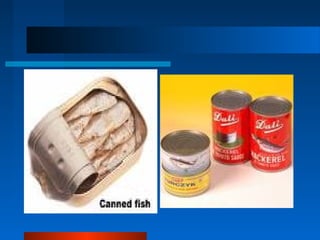
 The materials used for labelling and
casing canned fish and shellfish should
not be conducive to corrosion of the
container
 Code marks appearing on containers of
canned fish and shellfish should also be
shown on the cases in which they are
packed
 Canned fish and shellfish should be so
stored that they will be kept dry and not
exposed to extremes of temperature
Fish products
Fish products

Fish products

  • 1.
    FISH PRODUCTSFISH PRODUCTS Mrs.R.Sinthiya AssistantProfessor Department of Food Processing and Preservation Technology Faculty of Engineering Avinashilingam Institute for Home Science & Higher Education for Women University, Coimbatore
  • 2.
    Smoking Fish Freezing Fish DriedFish Canned Fish Fish Oil
  • 3.
    Smoking of fishSmokingof fish  Splitting and cleaning Salting Hanging Smoking Packaging
  • 4.
    Splitting and cleaningSplittingand cleaning The fish is split and the gut,gills are removed Then they are cleaned with water
  • 5.
    SaltingSalting The cleaned fishis then soaked in brine solution Duration of treatment with brine depends up on the strength of the brine solution The brine is stored at a temperature of 52 to 55 degree C and is changed atleast once a day
  • 6.
    HangingHanging The salted fishis hung in the kiln on a rack for dipping The protein which has dissolved in the salt form a sticky solution on the surface of the fish Which gives the skin a glossy appearance which is one of the commercial criteria of the quality
  • 7.
    SmokingSmoking Two types ofsmoking • Hot Smoking process • Cold Smoking process
  • 8.
    The Hot SmokingProcessThe Hot Smoking Process  The smoking time will vary as well depending on the size of the fish and the conditions for the marketing of the products but will usually be 1-2 hours.  The fish is dried for a period before smoking in order to prepare the skin for the reception of the smoke  The fish could be lightly salted or not be salted at all before smoking, sometimes a sprinkle of salt is given when packed in boxes after smoking
  • 9.
    The equipment forthe hot smoking process has developed from the most simple chimney/barrel to specially designed cabinets with inbuilt devises for the control of the smoking process but it is characteristic that the very primitive equipment persists.
  • 10.
    During cooking processit loosesits weight If the fish is packed hot it may develop a moist,flabby appearance sand mould growth may occur
  • 12.
    The Cold SmokingProcessThe Cold Smoking Process  The characteristic feature for cold smoked fish will be that the flesh does not appear cooked  Most cold smoked fish are smoked as fillets  The fish could be exposed to smoke for an extended period of 24 hours or more in a smoking cabinet  However the time is shortened considerably in the modern cold smoking process to approach the times known from the hot smoking process.
  • 13.
    Freezing of fishFreezingof fish  Freezing extends the period of storage and effective in keeping the fish in a condition similar to the resh fish  Three methods: 1.By direct contact between the fish and a refrigerated metal plates 2.By blowing a continuous stream of refrigerated air over the product 3.By immersing the fish in a low temperature liquid
  • 15.
    Dried fishDried fish The fish is prepared immediately after capture  After gutting the fish, it is either dried whole, or split along the spine leaving the tail connected.  Stable cool weather protects the fish from insects and prevents bacterial growth.  Too much frost will spoil the fish, as ice destroys the fibers in the fish.
  • 16.
     After itsthree months hanging on the flakes, the fish is then matured for another two to three months indoors in a dry and airy environment  During the drying, about 80% of the water in the fish disappears  The stockfish retains all the nutrients from the fresh fish, only concentrated: it is therefore rich in proteins, vitamins, iron, and calcium.
  • 18.
  • 19.
  • 20.
    Requirements Concerning RawRequirementsConcerning Raw MaterialsMaterials Fish intended for canning should be produced in accordance with the appropriate Sections of this code
  • 21.
    Storage of rawmaterialStorage of raw material  Raw materials should be stored, as quickly as possible after reception, in suitable premises  Raw materials should be stored so that any recontamination of final products, in-process products or containers should be prevented  All materials for containers or packages should be stored in satisfactory clean and hygienic conditions  During loading, stowing and unloading of empty containers, containers shouldn't be stepped on. These precautions become more imperative when cans are put in bags or on pallets.
  • 22.
    Unwrapping, UnpackingUnwrapping, Unpacking Duringunwrapping and unpacking operations, precautions should be taken in order to limit product contamination and foreign matters introduction into the product. To avoid microbial proliferation, there should be no waiting periods during these operations.
  • 23.
    ThawingThawing  Thawing timeand temperature should be selected to avoid conditions favourable for development of microorganisms or decomposition  During thawing products should not be exposed to excessively high temperatures  After thawing should be immediately processed or refrigerated and kept at the adequate temperature (temperature of melting ice).
  • 24.
    Gutting and WashingGuttingand Washing  fish requiring gutting on arrival at the plant should be gutted efficiently and with care to avoid contamination  gutting must be complete to remove pieces of intestinal tract and internal organs  immediately after gutting, fish should be washed with clean sea water or potable water. After washing the fish should be drained and properly iced
  • 25.
    Pre-Cooking and OtherPre-Pre-Cooking and Other Pre- TreatmentsTreatments  There are several reasons for pre-cooking fish or shellfish prior to canning: - to lower the water content of the flesh in order to avoid water exudation during heat processing - to give a particular flavour or texture to the product - in some cases, to prepare the products for later treatments.
  • 26.
    Packing in Cans(Filling,Packing in Cans (Filling, Sealing and Coding)Sealing and Coding)  Filling - Containers and covers should be inspected immediately before delivery to the filling machines or packing tables to ensure that they are clean, undamaged and without visible flaws - Containers of canned fish should be filled as directed in the scheduled process - Mechanical or manual filling of containers should be checked in order to comply with the filling rate and the headspace specified in the adopted sterilization schedule
  • 27.
     The necessaryamount of headspace will depend partly on the nature of the contents.  The filling should also take into account the heat processing method  If fish has been brine-frozen or stored in refrigerated brine, the amount of salt absorbed should be taken into consideration when salt is added to the product for flavoring  Excessive vacuum may cause the container to panel, particularly if the headspace is large, and may also cause contaminants
  • 28.
    Filled containers shouldbe inspected - to ensure that they have been properly filled and will meet accepted standards for weight of contents - and to verify product quality and workmanship just before they are closed.
  • 29.
    SealingSealing  Sealing thecontainer is one of the most essential processes in canning  The operation, maintenance, regular inspection and adjustment of sealing machines should received particular care.  If vacuum is used during packing, it should sufficient to prevent the containers from bulging under any condition likely to be encountered during the transport, storage or marketing of the product.
  • 30.
    This is usefulfor deep containers or glass containers. It is difficult and hardly necessary to create a vacuum in shallow containers that have relatively large flexible covers.
  • 31.
    Handling of ContainersAfterHandling of Containers After Closure - Waiting Before HeatClosure - Waiting Before Heat ProcessingProcessing  Containers after closure should always be handled carefully in such a way as to prevent every damage capable to determine defects and microbiological recontamination  Filled and sealed metal containers should be thoroughly washed before heat processing to remove grease, dirt and fish or shellfish marks on their outside walls
  • 32.
    the filled andsealed containers must be held for a long time before heat processing, refrigeration or heat holding (> 63°C) for fish soups, for example, are necessary
  • 33.
    Heat Processing andHeatProcessing and CoolingCooling Heat processing is one of the most essential operations in canning 1. Sterilization Schedule 2. Heat Processing Operation 3. Cooling
  • 34.
    Labeling, Casing andStorage ofLabeling, Casing and Storage of Finished ProductsFinished Products  The materials used for labelling and casing canned fish and shellfish should not be conducive to corrosion of the container  Code marks appearing on containers of canned fish and shellfish should also be shown on the cases in which they are packed  Canned fish and shellfish should be so stored that they will be kept dry and not exposed to extremes of temperature