SEA FOODS AND FAT REPLACER
BY
Pintu Choudhary
Master of Technology
( Food Science and Technology)
Indian Institute of Crop Processing Technology
Ministry of Food Processing Industries
Government of India
Thanjavur - 613005
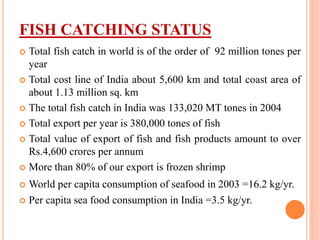
FISH CATCHING STATUS
 Total fish catch in world is of the order of 92 million tones per
year
 Total cost line of India about 5,600 km and total coast area of
about 1.13 million sq. km
 The total fish catch in India was 133,020 MT tones in 2004
 Total export per year is 380,000 tones of fish
 Total value of export of fish and fish products amount to over
Rs.4,600 crores per annum
 More than 80% of our export is frozen shrimp
 World per capita consumption of seafood in 2003 =16.2 kg/yr.
 Per capita sea food consumption in India =3.5 kg/yr.
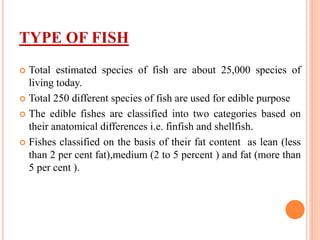
TYPE OF FISH
 Total estimated species of fish are about 25,000 species of
living today.
 Total 250 different species of fish are used for edible purpose
 The edible fishes are classified into two categories based on
their anatomical differences i.e. finfish and shellfish.
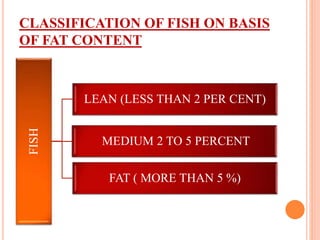
 Fishes classified on the basis of their fat content as lean (less
than 2 per cent fat),medium (2 to 5 percent ) and fat (more than
5 per cent ).
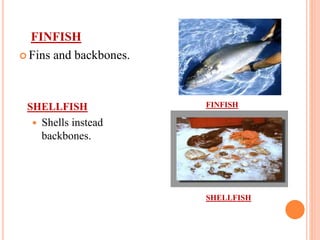
FINFISH
 Fins and backbones.
SHELLFISH
 Shells instead
backbones.
FINFISH
SHELLFISH
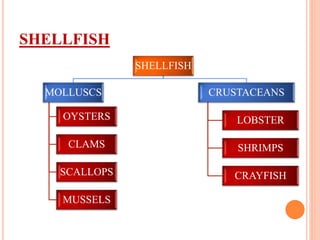
SHELLFISH
SHELLFISH
MOLLUSCS
OYSTERS
CLAMS
SCALLOPS
MUSSELS
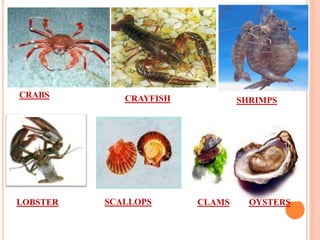
CRUSTACEANS
LOBSTER
SHRIMPS
CRAYFISH
SHRIMPS
OYSTERSSCALLOPS
CRAYFISH
CLAMSLOBSTER
CRABS
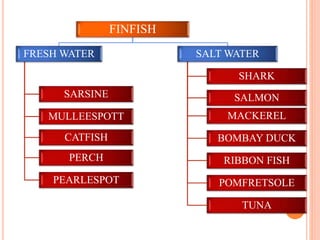
FINFISH
FRESH WATER
SARSINE
MULLEESPOTT
CATFISH
PERCH
PEARLESPOT
SALT WATER
SHARK
SALMON
MACKEREL
BOMBAY DUCK
RIBBON FISH
POMFRETSOLE
TUNA
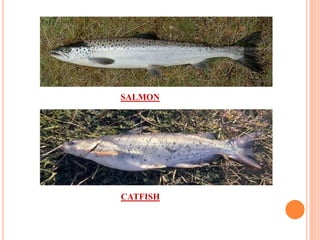
CATFISH
SALMON
CLASSIFICATION OF FISH ON BASIS
OF FAT CONTENT
FISH
LEAN (LESS THAN 2 PER CENT)
MEDIUM 2 TO 5 PERCENT
FAT ( MORE THAN 5 %)
SEAFOOD –NUTRITIONAL BENEFITS
• High quality protein
• High in omega-3 fatty acids
• Low in saturated fat
• Contributes to a healthy heart
• Contributes to proper growth and
development of children
• Source of vitamins and minerals
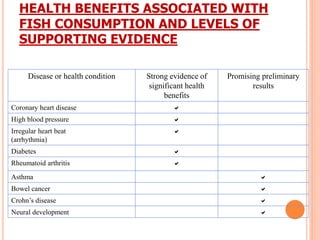
HEALTH BENEFITS ASSOCIATED WITH
FISH CONSUMPTION AND LEVELS OF
SUPPORTING EVIDENCE
Disease or health condition Strong evidence of
significant health
benefits
Promising preliminary
results
Coronary heart disease 
High blood pressure 
Irregular heart beat
(arrhythmia)

Diabetes 
Rheumatoid arthritis 
Asthma 
Bowel cancer 
Crohn’s disease 
Neural development 
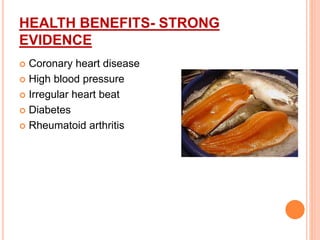
HEALTH BENEFITS- STRONG
EVIDENCE
 Coronary heart disease
 High blood pressure
 Irregular heart beat
 Diabetes
 Rheumatoid arthritis
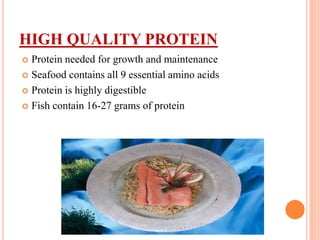
HIGH QUALITY PROTEIN
 Protein needed for growth and maintenance
 Seafood contains all 9 essential amino acids
 Protein is highly digestible
 Fish contain 16-27 grams of protein
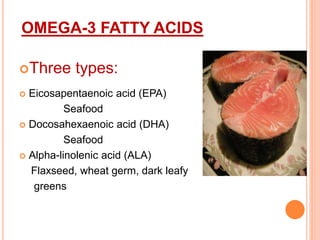
OMEGA-3 FATTY ACIDS
Three types:
 Eicosapentaenoic acid (EPA)
Seafood
 Docosahexaenoic acid (DHA)
Seafood
 Alpha-linolenic acid (ALA)
Flaxseed, wheat germ, dark leafy
greens
HEALTH BENEFITS OF OMEGA-3
FATTY ACIDS
HEART
 Lowers triglyceride levels
 Counteracts inflammation
 Helps arteries stay elastic
 Helps prevent build-up of plaque deposits
 Reduces risk of dying from heart attack
OMEGA-3S AND DIABETES
 Onset of diabetes
- May keep the immune system in check
 Control of symptoms
- Low level of DHA associated with an increased
insulin resistance
 Complications of diabetes
- Influence development of cardiovascular disease
- May delay onset of kidney and nerve complications
OMEGA-3S AND CANCER
 Onset
May help healthy cells resist damage
 Multiplication of cells
May interfere with tumor growth
 Spread
May inhibit tumor spread in the body
OTHER BENEFITS OF OMEGA-3 FATTY
ACIDS
 Joints
Fewer tender joints and decrease stiffness
 Mood
Higher levels of EPA and DHA protective against
depression
 Mind
Perhaps caused by inflammation in center of the brain
 Lungs
May decrease severity of asthma
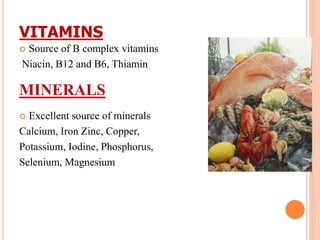
VITAMINS
 Source of B complex vitamins
Niacin, B12 and B6, Thiamin
MINERALS
 Excellent source of minerals
Calcium, Iron Zinc, Copper,
Potassium, Iodine, Phosphorus,
Selenium, Magnesium
FISH OR FISH OIL
SUPPLEMENTS
 Taking supplements may be more convenient
 Fish contains more of the “long-chain” fatty acid DHA
 Excessive amounts of supplement – may increase
bleeding
 May also increase both good and bad cholesterol
FISH FLOUR
 Ingredient used for preparation of fish flour is defatted
fish.
 It is rich in high quality protein and minerals.
 Fish flour contain 85-90 % percent of high quality
protein .
 It is less coastally and good quality protein is generally
used in several areas of the world
FAT REPLACER
 Fat replacers are compounds incorporated into food
products to provide them with some qualities of fat.
 Fat may be replaced in food products by traditional
techniques such as substituting water or air for fat, using
lean meats in frozen entrées, skim milk instead of whole
milk in frozen desserts, and baking instead of frying for
manufacturing or preparing snack foods.
 Some lipids may be replaced in foods by reformulating
with selected ingredients that provide some fat-like
attributes . These fat replacers can be lipid, protein or
carbohydrate-based and can be used alone or in unique
combinations
TYPES OF FAT REPLACER
 Fat replacers are generally categorized into two groups: fat
substitutes and fat mimetics.
 Fat substitutes are ingredients that have a chemical structure
somewhat close to fats and have similar physiochemical
properties. They are usually either indigestible or contribute
lower calories on a per gram basis.
 Fat mimetics are ingredients that have distinctly different
chemical structures from fat. They are usually carbohydrate
and/or protein-based. They have diverse functional
properties that mimic some of the characteristic
physiochemical attributes and desirable eating qualities of
fat.
FAT SUBSTITUTES
 Protein-based
 Carbohydrate-based
 Synthetic compounds
 Combination products
 Yoghurt; fruit-based
PROTEIN BASED FAT SUBSTITUTES
 Simplesse introduced in 1988 by Nutra Sweet, GRAS
status 1990 for application in frozen desserts. Produced
from milk and/or egg proteins by heating and blending
process known as microparticulation.
 1g of Simplesse + 2 g of water = 3 g of fat
4kcal 27kcal
CARBOHYDRATE-BASED FAT
SUBSTITUTES
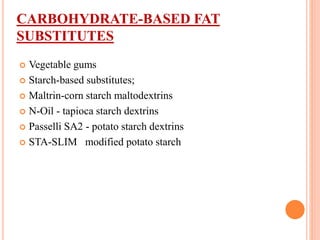
 Vegetable gums
 Starch-based substitutes;
 Maltrin-corn starch maltodextrins
 N-Oil - tapioca starch dextrins
 Passelli SA2 - potato starch dextrins
 STA-SLIM modified potato starch
SYNTHETIC COMPOUNDS
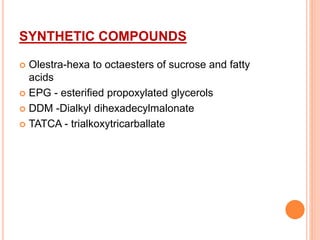
 Olestra-hexa to octaesters of sucrose and fatty
acids
 EPG - esterified propoxylated glycerols
 DDM -Dialkyl dihexadecylmalonate
 TATCA - trialkoxytricarballate
FAT SUBSTITUTES THAT CAN BE
USED AT HOME
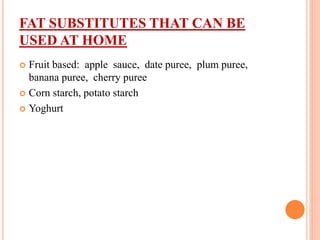
 Fruit based: apple sauce, date puree, plum puree,
banana puree, cherry puree
 Corn starch, potato starch
 Yoghurt
FAT MIMETICS
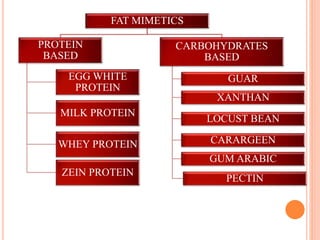
PROTEIN
BASED
EGG WHITE
PROTEIN
MILK PROTEIN
WHEY PROTEIN
ZEIN PROTEIN
CARBOHYDRATES
BASED
GUAR
XANTHAN
LOCUST BEAN
CARARGEEN
GUM ARABIC
PECTIN
REFERENCES
 Anonymous. 2010. Information on Nutrition and Health Claims.
Food Safety Authority of Ireland, Dublin, Ireland.
 Belury,M.A. 2002. Dietary conjugated linoleic acid in health.
Annual Review of Nutrition, 22, 505-531.
 Finley, J.W. 2003. Reduction of cancer risk by consumption of
selenium-enriched plants: enrichment of broccoli with selenium
increases the anti-carcinogenic properties of broccoli. Journal of
Medicinal Food, 6, 19-26.
 Akoh, C.C. (1998). Fat replacers, Food Technology, 52, 47-52.
 Chronakis, I.S. (1997). Structural-Functional and Water-holding
Studies of Biopolymers in Low Fat Content Spreads, Lebensmittel-
Wissenschaft und-Technology 30,36-44.
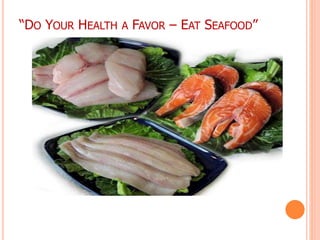
“DO YOUR HEALTH A FAVOR – EAT SEAFOOD”

Sea foods

  • 1.
    SEA FOODS ANDFAT REPLACER BY Pintu Choudhary Master of Technology ( Food Science and Technology) Indian Institute of Crop Processing Technology Ministry of Food Processing Industries Government of India Thanjavur - 613005
  • 2.
    FISH CATCHING STATUS Total fish catch in world is of the order of 92 million tones per year  Total cost line of India about 5,600 km and total coast area of about 1.13 million sq. km  The total fish catch in India was 133,020 MT tones in 2004  Total export per year is 380,000 tones of fish  Total value of export of fish and fish products amount to over Rs.4,600 crores per annum  More than 80% of our export is frozen shrimp  World per capita consumption of seafood in 2003 =16.2 kg/yr.  Per capita sea food consumption in India =3.5 kg/yr.
  • 3.
    TYPE OF FISH Total estimated species of fish are about 25,000 species of living today.  Total 250 different species of fish are used for edible purpose  The edible fishes are classified into two categories based on their anatomical differences i.e. finfish and shellfish.  Fishes classified on the basis of their fat content as lean (less than 2 per cent fat),medium (2 to 5 percent ) and fat (more than 5 per cent ).
  • 4.
    FINFISH  Fins andbackbones. SHELLFISH  Shells instead backbones. FINFISH SHELLFISH
  • 5.
  • 6.
  • 7.
  • 8.
  • 9.
    CLASSIFICATION OF FISHON BASIS OF FAT CONTENT FISH LEAN (LESS THAN 2 PER CENT) MEDIUM 2 TO 5 PERCENT FAT ( MORE THAN 5 %)
  • 10.
    SEAFOOD –NUTRITIONAL BENEFITS •High quality protein • High in omega-3 fatty acids • Low in saturated fat • Contributes to a healthy heart • Contributes to proper growth and development of children • Source of vitamins and minerals
  • 11.
    HEALTH BENEFITS ASSOCIATEDWITH FISH CONSUMPTION AND LEVELS OF SUPPORTING EVIDENCE Disease or health condition Strong evidence of significant health benefits Promising preliminary results Coronary heart disease  High blood pressure  Irregular heart beat (arrhythmia)  Diabetes  Rheumatoid arthritis  Asthma  Bowel cancer  Crohn’s disease  Neural development 
  • 12.
    HEALTH BENEFITS- STRONG EVIDENCE Coronary heart disease  High blood pressure  Irregular heart beat  Diabetes  Rheumatoid arthritis
  • 13.
    HIGH QUALITY PROTEIN Protein needed for growth and maintenance  Seafood contains all 9 essential amino acids  Protein is highly digestible  Fish contain 16-27 grams of protein
  • 14.
    OMEGA-3 FATTY ACIDS Threetypes:  Eicosapentaenoic acid (EPA) Seafood  Docosahexaenoic acid (DHA) Seafood  Alpha-linolenic acid (ALA) Flaxseed, wheat germ, dark leafy greens
  • 15.
    HEALTH BENEFITS OFOMEGA-3 FATTY ACIDS HEART  Lowers triglyceride levels  Counteracts inflammation  Helps arteries stay elastic  Helps prevent build-up of plaque deposits  Reduces risk of dying from heart attack
  • 16.
    OMEGA-3S AND DIABETES Onset of diabetes - May keep the immune system in check  Control of symptoms - Low level of DHA associated with an increased insulin resistance  Complications of diabetes - Influence development of cardiovascular disease - May delay onset of kidney and nerve complications
  • 17.
    OMEGA-3S AND CANCER Onset May help healthy cells resist damage  Multiplication of cells May interfere with tumor growth  Spread May inhibit tumor spread in the body
  • 18.
    OTHER BENEFITS OFOMEGA-3 FATTY ACIDS  Joints Fewer tender joints and decrease stiffness  Mood Higher levels of EPA and DHA protective against depression  Mind Perhaps caused by inflammation in center of the brain  Lungs May decrease severity of asthma
  • 19.
    VITAMINS  Source ofB complex vitamins Niacin, B12 and B6, Thiamin MINERALS  Excellent source of minerals Calcium, Iron Zinc, Copper, Potassium, Iodine, Phosphorus, Selenium, Magnesium
  • 20.
    FISH OR FISHOIL SUPPLEMENTS  Taking supplements may be more convenient  Fish contains more of the “long-chain” fatty acid DHA  Excessive amounts of supplement – may increase bleeding  May also increase both good and bad cholesterol
  • 21.
    FISH FLOUR  Ingredientused for preparation of fish flour is defatted fish.  It is rich in high quality protein and minerals.  Fish flour contain 85-90 % percent of high quality protein .  It is less coastally and good quality protein is generally used in several areas of the world
  • 22.
    FAT REPLACER  Fatreplacers are compounds incorporated into food products to provide them with some qualities of fat.  Fat may be replaced in food products by traditional techniques such as substituting water or air for fat, using lean meats in frozen entrées, skim milk instead of whole milk in frozen desserts, and baking instead of frying for manufacturing or preparing snack foods.  Some lipids may be replaced in foods by reformulating with selected ingredients that provide some fat-like attributes . These fat replacers can be lipid, protein or carbohydrate-based and can be used alone or in unique combinations
  • 23.
    TYPES OF FATREPLACER  Fat replacers are generally categorized into two groups: fat substitutes and fat mimetics.  Fat substitutes are ingredients that have a chemical structure somewhat close to fats and have similar physiochemical properties. They are usually either indigestible or contribute lower calories on a per gram basis.  Fat mimetics are ingredients that have distinctly different chemical structures from fat. They are usually carbohydrate and/or protein-based. They have diverse functional properties that mimic some of the characteristic physiochemical attributes and desirable eating qualities of fat.
  • 24.
    FAT SUBSTITUTES  Protein-based Carbohydrate-based  Synthetic compounds  Combination products  Yoghurt; fruit-based
  • 25.
    PROTEIN BASED FATSUBSTITUTES  Simplesse introduced in 1988 by Nutra Sweet, GRAS status 1990 for application in frozen desserts. Produced from milk and/or egg proteins by heating and blending process known as microparticulation.  1g of Simplesse + 2 g of water = 3 g of fat 4kcal 27kcal
  • 26.
    CARBOHYDRATE-BASED FAT SUBSTITUTES  Vegetablegums  Starch-based substitutes;  Maltrin-corn starch maltodextrins  N-Oil - tapioca starch dextrins  Passelli SA2 - potato starch dextrins  STA-SLIM modified potato starch
  • 27.
    SYNTHETIC COMPOUNDS  Olestra-hexato octaesters of sucrose and fatty acids  EPG - esterified propoxylated glycerols  DDM -Dialkyl dihexadecylmalonate  TATCA - trialkoxytricarballate
  • 28.
    FAT SUBSTITUTES THATCAN BE USED AT HOME  Fruit based: apple sauce, date puree, plum puree, banana puree, cherry puree  Corn starch, potato starch  Yoghurt
  • 29.
    FAT MIMETICS PROTEIN BASED EGG WHITE PROTEIN MILKPROTEIN WHEY PROTEIN ZEIN PROTEIN CARBOHYDRATES BASED GUAR XANTHAN LOCUST BEAN CARARGEEN GUM ARABIC PECTIN
  • 30.
    REFERENCES  Anonymous. 2010.Information on Nutrition and Health Claims. Food Safety Authority of Ireland, Dublin, Ireland.  Belury,M.A. 2002. Dietary conjugated linoleic acid in health. Annual Review of Nutrition, 22, 505-531.  Finley, J.W. 2003. Reduction of cancer risk by consumption of selenium-enriched plants: enrichment of broccoli with selenium increases the anti-carcinogenic properties of broccoli. Journal of Medicinal Food, 6, 19-26.  Akoh, C.C. (1998). Fat replacers, Food Technology, 52, 47-52.  Chronakis, I.S. (1997). Structural-Functional and Water-holding Studies of Biopolymers in Low Fat Content Spreads, Lebensmittel- Wissenschaft und-Technology 30,36-44.
  • 31.
    “DO YOUR HEALTHA FAVOR – EAT SEAFOOD”