Fishing Gears and Fishing Techniques
Presented By: Shahzaib Khurshid
Fishing Methods
• Fishing Methods use a wide range of gear to land
their catch. Every type has its own effects on ocean.
• By Selecting the right gear for the right job,the fishing
industry can help minimize its impact on the
environment.
• How the gear is used is the fishing method.
Be an Opportunity Creator:
• Give a man a fish, and he will
be hungry again tomorrow;
teach him how to catch a fish,
and he will be richer all his life.
Fishing Gears:
• The tools used to capture the aquatic organisms are
collectively called as Fishing Gears.
• Mainly two type:
• Active Gears
• Passive Gears
Difference Between Active and Passive Gears
 Active gears are designed to chase and
capture target species (e.g. trawls, dredges).
 While passive gears generally sit in one
place allowing the target species to approach
the capture device (e.g. traps),
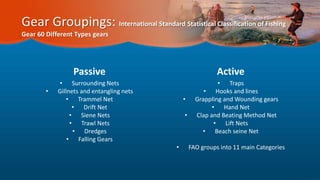
Gear Groupings: International Standard Statistical Classification of Fishing
Gear 60 Different Types gears
Passive
• Surrounding Nets
• Gillnets and entangling nets
• Trammel Net
• Drift Net
• Siene Nets
• Trawl Nets
• Dredges
• Falling Gears
Active
• Traps
• Hooks and lines
• Grappling and Wounding gears
• Hand Net
• Clap and Beating Method Net
• Lift Nets
• Beach seine Net
• FAO groups into 11 main Categories
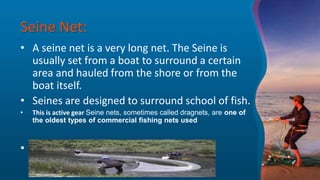
Seine Net:
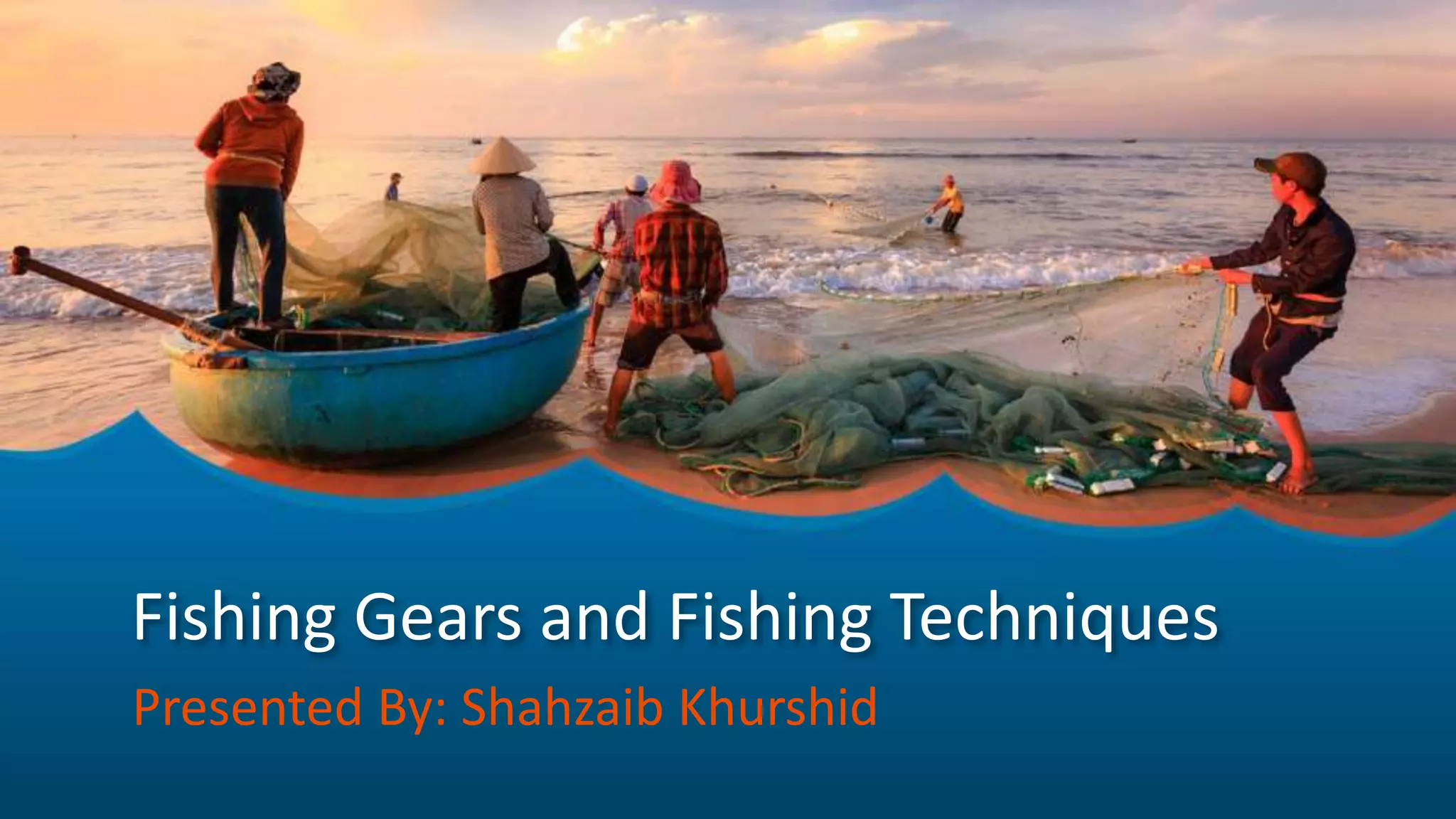
• A seine net is a very long net. The Seine is
usually set from a boat to surround a certain
area and hauled from the shore or from the
boat itself.
• Seines are designed to surround school of fish.
• This is active gear Seine nets, sometimes called dragnets, are one of
the oldest types of commercial fishing nets used
• Beach Seine, Purse Seine
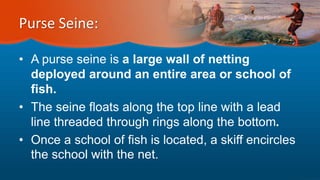
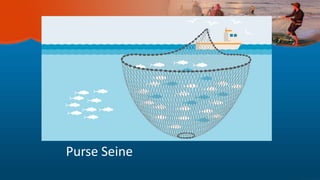
Purse Seine:
• A purse seine is a large wall of netting
deployed around an entire area or school of
fish.
• The seine floats along the top line with a lead
line threaded through rings along the bottom.
• Once a school of fish is located, a skiff encircles
the school with the net.
Purse Seine
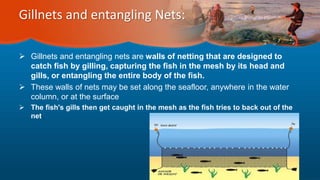
Gillnets and entangling Nets:
 Gillnets and entangling nets are walls of netting that are designed to
catch fish by gilling, capturing the fish in the mesh by its head and
gills, or entangling the entire body of the fish.
 These walls of nets may be set along the seafloor, anywhere in the water
column, or at the surface
 The fish's gills then get caught in the mesh as the fish tries to back out of the
net..
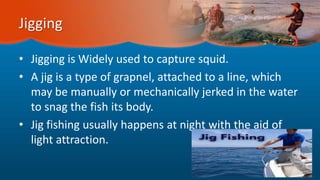
Jigging
• Jigging is Widely used to capture squid.
• A jig is a type of grapnel, attached to a line, which
may be manually or mechanically jerked in the water
to snag the fish its body.
• Jig fishing usually happens at night with the aid of
light attraction.
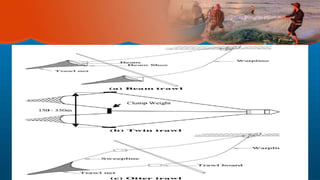
Classification of trawls:
• Based on the mouth-opening device
a. Beam Trawl
b. Bull Trawl
c. Otter Trawl
• Based on the depth of operation:
a. Bottom Trawl
b. Mid Water Trawl/Pelagic trawl
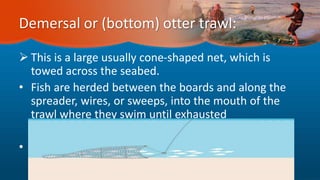
Demersal or (bottom) otter trawl:
 This is a large usually cone-shaped net, which is
towed across the seabed.
• Fish are herded between the boards and along the
spreader, wires, or sweeps, into the mouth of the
trawl where they swim until exhausted
• The forward part of the net the wings are kept open
laterally by otter boards or doors.
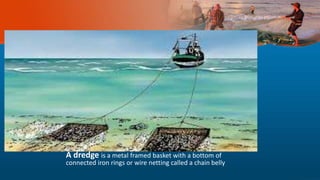
Dredging
• Dredging. A typical dredge consists of a mouth
frame with an attached collection bag.
• Dredging is a fishing method in which a
dredge is dragged across the sea floor, either
scraping or penetrating the bottom
• It is used for harvesting bivalve, molluscs
such as oyster, clams and scallops from the
seabed
A dredge is a metal framed basket with a bottom of
connected iron rings or wire netting called a chain belly.
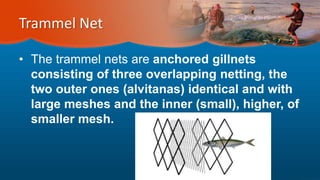
Trammel Net
• The trammel nets are anchored gillnets
consisting of three overlapping netting, the
two outer ones (alvitanas) identical and with
large meshes and the inner (small), higher, of
smaller mesh.
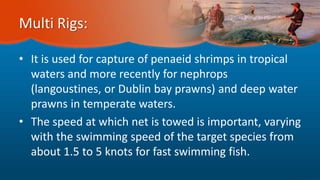
Multi Rigs:
• It is used for capture of penaeid shrimps in tropical
waters and more recently for nephrops
(langoustines, or Dublin bay prawns) and deep water
prawns in temperate waters.
• The speed at which net is towed is important, varying
with the swimming speed of the target species from
about 1.5 to 5 knots for fast swimming fish.
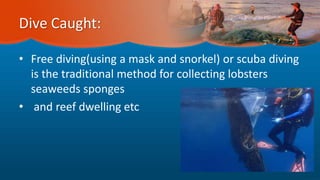
Dive Caught:
• Free diving(using a mask and snorkel) or scuba diving
is the traditional method for collecting lobsters
seaweeds sponges
• and reef dwelling etc
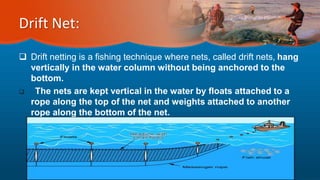
Drift Net:
 Drift netting is a fishing technique where nets, called drift nets, hang
vertically in the water column without being anchored to the
bottom.
 . The nets are kept vertical in the water by floats attached to a
rope along the top of the net and weights attached to another
rope along the bottom of the net.
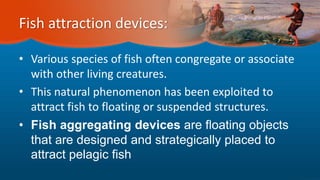
Fish attraction devices:
• Various species of fish often congregate or associate
with other living creatures.
• This natural phenomenon has been exploited to
attract fish to floating or suspended structures.
• Fish aggregating devices are floating objects
that are designed and strategically placed to
attract pelagic fish
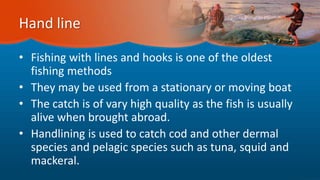
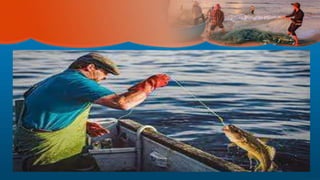
Hand line
• Fishing with lines and hooks is one of the oldest
fishing methods
• They may be used from a stationary or moving boat
• The catch is of vary high quality as the fish is usually
alive when brought abroad.
• Handlining is used to catch cod and other dermal
species and pelagic species such as tuna, squid and
mackeral.
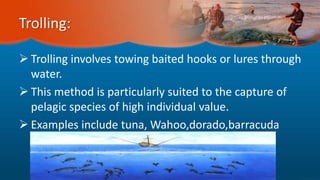
Trolling:
 Trolling involves towing baited hooks or lures through
water.
 This method is particularly suited to the capture of
pelagic species of high individual value.
 Examples include tuna, Wahoo,dorado,barracuda
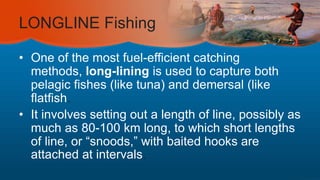
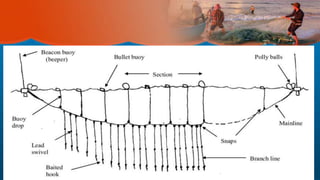
LONGLINE Fishing
• One of the most fuel-efficient catching
methods, long-lining is used to capture both
pelagic fishes (like tuna) and demersal (like
flatfish.
• It involves setting out a length of line, possibly as
much as 80-100 km long, to which short lengths
of line, or “snoods,” with baited hooks are
attached at intervals.
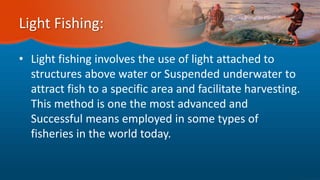
Light Fishing:
• Light fishing involves the use of light attached to
structures above water or Suspended underwater to
attract fish to a specific area and facilitate harvesting.
This method is one the most advanced and
Successful means employed in some types of
fisheries in the world today.
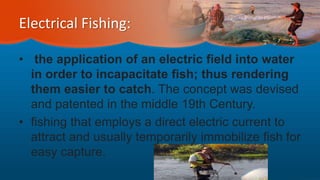
Electrical Fishing:
• the application of an electric field into water
in order to incapacitate fish; thus rendering
them easier to catch. The concept was devised
and patented in the middle 19th Century.
• fishing that employs a direct electric current to
attract and usually temporarily immobilize fish for
easy capture.
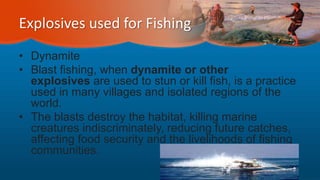
Explosives used for Fishing
• Dynamite
• Blast fishing, when dynamite or other
explosives are used to stun or kill fish, is a practice
used in many villages and isolated regions of the
world.
• The blasts destroy the habitat, killing marine
creatures indiscriminately, reducing future catches,
affecting food security and the livelihoods of fishing
communities.
Advantages of Fishing Gears:
• Highly selective for the target species and sizes,
with negligible direct or indirect impact on non-
target species, sizes, and habitats
• Effective, giving high catches of target species at
the lowest possible cost.
• Commercially and Industrially Profitable
Disadvantages:
• Fishing line that breaks and is lost in the ocean
can entangle birds, fish, and mammals.
• Illegal Fishing in the deep sea.
• Some fishing poles catch extra animals, or bycatch,
like turtles instead of fish.
• Disturb and destroy Seabed including
seagrasses and reefs where fish hide from
predators or for Spawning
Mitigating Methods:
• Using larger meshes in the cod-ends
• Devices in the trawl that reduce the capture of small
and unwanted organisms
• TED-Turtles excluder Devices(Turtles and Sharks)
• Legislation and Implementations
BE ECO-FRIENDLY FOR FISHES
Sea and fisherman are not good friends
because fisherman takes the good
treasures of the sea without giving
something good in return.
Fishing Gears and Fishing Methods

Fishing Gears and Fishing Methods

  • 1.
    Fishing Gears andFishing Techniques Presented By: Shahzaib Khurshid
  • 2.
    Fishing Methods • FishingMethods use a wide range of gear to land their catch. Every type has its own effects on ocean. • By Selecting the right gear for the right job,the fishing industry can help minimize its impact on the environment. • How the gear is used is the fishing method.
  • 3.
    Be an OpportunityCreator: • Give a man a fish, and he will be hungry again tomorrow; teach him how to catch a fish, and he will be richer all his life.
  • 4.
    Fishing Gears: • Thetools used to capture the aquatic organisms are collectively called as Fishing Gears. • Mainly two type: • Active Gears • Passive Gears
  • 5.
    Difference Between Activeand Passive Gears  Active gears are designed to chase and capture target species (e.g. trawls, dredges).  While passive gears generally sit in one place allowing the target species to approach the capture device (e.g. traps),
  • 6.
    Gear Groupings: InternationalStandard Statistical Classification of Fishing Gear 60 Different Types gears Passive • Surrounding Nets • Gillnets and entangling nets • Trammel Net • Drift Net • Siene Nets • Trawl Nets • Dredges • Falling Gears Active • Traps • Hooks and lines • Grappling and Wounding gears • Hand Net • Clap and Beating Method Net • Lift Nets • Beach seine Net • FAO groups into 11 main Categories
  • 7.
    Seine Net: • Aseine net is a very long net. The Seine is usually set from a boat to surround a certain area and hauled from the shore or from the boat itself. • Seines are designed to surround school of fish. • This is active gear Seine nets, sometimes called dragnets, are one of the oldest types of commercial fishing nets used • Beach Seine, Purse Seine
  • 8.
    Purse Seine: • Apurse seine is a large wall of netting deployed around an entire area or school of fish. • The seine floats along the top line with a lead line threaded through rings along the bottom. • Once a school of fish is located, a skiff encircles the school with the net.
  • 9.
  • 10.
    Gillnets and entanglingNets:  Gillnets and entangling nets are walls of netting that are designed to catch fish by gilling, capturing the fish in the mesh by its head and gills, or entangling the entire body of the fish.  These walls of nets may be set along the seafloor, anywhere in the water column, or at the surface  The fish's gills then get caught in the mesh as the fish tries to back out of the net..
  • 11.
    Jigging • Jigging isWidely used to capture squid. • A jig is a type of grapnel, attached to a line, which may be manually or mechanically jerked in the water to snag the fish its body. • Jig fishing usually happens at night with the aid of light attraction.
  • 12.
    Classification of trawls: •Based on the mouth-opening device a. Beam Trawl b. Bull Trawl c. Otter Trawl • Based on the depth of operation: a. Bottom Trawl b. Mid Water Trawl/Pelagic trawl
  • 13.
    Demersal or (bottom)otter trawl:  This is a large usually cone-shaped net, which is towed across the seabed. • Fish are herded between the boards and along the spreader, wires, or sweeps, into the mouth of the trawl where they swim until exhausted • The forward part of the net the wings are kept open laterally by otter boards or doors.
  • 14.
    Dredging • Dredging. Atypical dredge consists of a mouth frame with an attached collection bag. • Dredging is a fishing method in which a dredge is dragged across the sea floor, either scraping or penetrating the bottom • It is used for harvesting bivalve, molluscs such as oyster, clams and scallops from the seabed
  • 15.
    A dredge isa metal framed basket with a bottom of connected iron rings or wire netting called a chain belly.
  • 16.
    Trammel Net • Thetrammel nets are anchored gillnets consisting of three overlapping netting, the two outer ones (alvitanas) identical and with large meshes and the inner (small), higher, of smaller mesh.
  • 17.
    Multi Rigs: • Itis used for capture of penaeid shrimps in tropical waters and more recently for nephrops (langoustines, or Dublin bay prawns) and deep water prawns in temperate waters. • The speed at which net is towed is important, varying with the swimming speed of the target species from about 1.5 to 5 knots for fast swimming fish.
  • 18.
    Dive Caught: • Freediving(using a mask and snorkel) or scuba diving is the traditional method for collecting lobsters seaweeds sponges • and reef dwelling etc
  • 19.
    Drift Net:  Driftnetting is a fishing technique where nets, called drift nets, hang vertically in the water column without being anchored to the bottom.  . The nets are kept vertical in the water by floats attached to a rope along the top of the net and weights attached to another rope along the bottom of the net.
  • 20.
    Fish attraction devices: •Various species of fish often congregate or associate with other living creatures. • This natural phenomenon has been exploited to attract fish to floating or suspended structures. • Fish aggregating devices are floating objects that are designed and strategically placed to attract pelagic fish
  • 21.
    Hand line • Fishingwith lines and hooks is one of the oldest fishing methods • They may be used from a stationary or moving boat • The catch is of vary high quality as the fish is usually alive when brought abroad. • Handlining is used to catch cod and other dermal species and pelagic species such as tuna, squid and mackeral.
  • 23.
    Trolling:  Trolling involvestowing baited hooks or lures through water.  This method is particularly suited to the capture of pelagic species of high individual value.  Examples include tuna, Wahoo,dorado,barracuda
  • 25.
    LONGLINE Fishing • Oneof the most fuel-efficient catching methods, long-lining is used to capture both pelagic fishes (like tuna) and demersal (like flatfish. • It involves setting out a length of line, possibly as much as 80-100 km long, to which short lengths of line, or “snoods,” with baited hooks are attached at intervals.
  • 27.
    Light Fishing: • Lightfishing involves the use of light attached to structures above water or Suspended underwater to attract fish to a specific area and facilitate harvesting. This method is one the most advanced and Successful means employed in some types of fisheries in the world today.
  • 28.
    Electrical Fishing: • theapplication of an electric field into water in order to incapacitate fish; thus rendering them easier to catch. The concept was devised and patented in the middle 19th Century. • fishing that employs a direct electric current to attract and usually temporarily immobilize fish for easy capture.
  • 29.
    Explosives used forFishing • Dynamite • Blast fishing, when dynamite or other explosives are used to stun or kill fish, is a practice used in many villages and isolated regions of the world. • The blasts destroy the habitat, killing marine creatures indiscriminately, reducing future catches, affecting food security and the livelihoods of fishing communities.
  • 30.
    Advantages of FishingGears: • Highly selective for the target species and sizes, with negligible direct or indirect impact on non- target species, sizes, and habitats • Effective, giving high catches of target species at the lowest possible cost. • Commercially and Industrially Profitable
  • 31.
    Disadvantages: • Fishing linethat breaks and is lost in the ocean can entangle birds, fish, and mammals. • Illegal Fishing in the deep sea. • Some fishing poles catch extra animals, or bycatch, like turtles instead of fish. • Disturb and destroy Seabed including seagrasses and reefs where fish hide from predators or for Spawning
  • 32.
    Mitigating Methods: • Usinglarger meshes in the cod-ends • Devices in the trawl that reduce the capture of small and unwanted organisms • TED-Turtles excluder Devices(Turtles and Sharks) • Legislation and Implementations
  • 33.
    BE ECO-FRIENDLY FORFISHES Sea and fisherman are not good friends because fisherman takes the good treasures of the sea without giving something good in return.