FISH FOOD PROCESSING
FOOD TECHNOLOGY
A. INDUMATHI
BON SECOURS COLLEGE FOR WOMEN,
THANJAVUR
Introduction
Introduction
•Seafood is any form of sea life regarded as food by humans.
•The harvesting of wild seafood is known as fishing and the cultivation and
farming of seafood is known as aquaculture, mariculture, or in the case of
fish, fish farming.
•Seafood prominently includes fish and shellfish. Shellfish include various
species of mollusks, crustaceans, and echinoderms.
•Edible sea plants, such as some seaweed and microalgae, are widely
eaten as seafood around the world, especially inAsia
•Seafood is an important source of protein in many diets around the world,
especially in coastal areas.
Products Products
Fish Products





Whole fish
Drawn fish
Dressed fish
Pan dressed fish
Filleted fish




Fish steaks
Fish sticks
Fish cakes
Fish fingers
Fish Grading
•Grading is selectively harvesting fish so that only the best
quality fish are brought.
•The practice is popular in situations under individual fishing
quotas where only a limited number of fish are allowed to
be harvested.
•Following the latter, but not the spirit of the law, fish are
caught, and if not considered optimal in term of size and
quality, thrown back into the ocean.
•The practice of high grading allows fishers to get high prices
for their limited catch but is environmentally destructive
because many of the fish returned to the water die.
Fish Grading objective
•Harvesting juvenile fish (Prior to adulthood), before stocking
them in fattening ponds.
•Best quality Fish (Bright eyes) having higher yield of
flesh.
•Separating faster- from slower-growing stock, for example
male and female tilapias.
•Early life of predatory fish when the range of sizes becomes too
large.
•Selecting predatory fish for a suitable size to use for controlling
fry populations.
•Selecting fish of a suitable size for polyculture.
Chilling and Freezing
•Chilling is the process of cooling fish or fish products to a
temperature approaching that of melting ice 0°C – 5°C.
•Preservation techniques are needed to prevent fish spoilage and
lengthen shelf life.
•Inhibit the activity of spoilage bacteria and the metabolic changes
that result in the loss of fish quality.
•Spoilage bacteria are the specific bacteria that produce the
unpleasant odors and flavors associated with spoiled fish.
•Fish normally host many bacteria that are not spoilage bacteria, and
most of the bacteria present on spoiled fish played no role in the spoilage.
•To flourish, bacteria need the right temperature, sufficient water
and oxygen, and surroundings that are not too acidic.
The Rate of Chilling
•The size, shape and thickness of fish
•The method of stowage
•Adequate mixing of ice, water and fish (in ice slurries)
•Adequate contact of ice/ cold air with the fish surface
/ The size of the ice particles.
days for others)
Relatively cheap Relatively costly
Relatively low-tech Relatively high tech
Portable refrigeration Generally static operations
Advantages and Disadvantages
(chilling and freezing)
Chilling Freezing
Short-term storage (up to one month Long-term storage (a year or more
maximum for some species, only a few for some species)
Storage temperature 0 °C Storage temperature well below zero,
e.g. -18°C
Product resembles fresh fish If poorly done can badly affect
quality
Low skills required High skills required
Other methods for Preservation of Fish
products
 Preservation includes
 Smoking
 Pickling
 Salting
 Marination
 The preservation of fish has been an integral part of
every seafaring culture.
 Fish is a highly perishable food which needs proper
handling and preservation.
 For a long shelf life, better quality and nutritional value
over the course of thousands of years drying, salting and
smoking technique of fish the has been.
 Cold smoking requires temperatures below 80°F. for
several days. Hot smoking however can be done at
temperatures of up to 250°F. and only takes a few hours
 The control of temperature using ice, refrigeration or
freezing used to preserve fish and fish products )
 The control of water activity by drying, salting, smoking or
freeze- drying.
 The physical control of microbial loads through microwave
heating or ionizing irradiation
 The chemical control of microbial loads by adding acids
 Oxygen deprivation, such as vacuum packing.
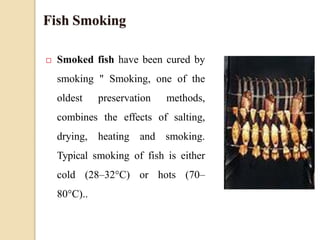
 Smoked fish have been cured by
smoking " Smoking, one of the
oldest preservation methods,
combines the effects of salting,
drying, heating and smoking.
Typical smoking of fish is either
cold (28–32°C) or hots (70–
80°C)..
Fish Smoking
 Preserving Seafood with acid, usually vinegar (acetic acid) or citrus
juices (citric acid) is one of the earliest food preservation techniques
known.
 Pickling is an easy method of preserving fish. Pickled fish must be
stored in the refrigerator at no higher than 400F (refrigerator
temperature), and for best flavor must be used within four to six weeks.
 Few species of fish are preserved commercially by pickling, but almost
any type of fish may be pickled at home.
 Refrigerate the fish during all stages of the pickling process.
Fish Pickling
 Salting is the preservation of food with dry edible salt. It is
related to pickling (preparing food with brine, i.e. salty
water).
 It is one of the oldest methods of preserving food, and two
historically significant salt-cured foods are dried and salted
cod.
 Salting is used because most bacteria, fungi and other
potentially pathogenic organisms cannot survive in a
highly salty environment, due to the hypertonic nature of
salt.
 Any living cell in such an environment will become
dehydrated through osmosis and die or become
temporarily inactivated.
Salting
 Marination is the process of soaking foods in a seasoned,
often acidic, and liquid before cooking. Marinating fish
adds flavor and moisture to the flesh.
 The word alludes to the use of brine (aqua marina) in the
pickling process, which led to the technique of adding
flavor by immersion in liquid.
 The 'marinade', can be either acidic, (made with
ingredients such as vinegar, lemon juice, or wine) or
enzymatic (made with ingredients such as pineapple or
papaya).
 Marinades include oil (extra virgin olive oil provides the
best flavor) and an acidic ingredient like chopped
tomatoes, red wine vinegar, or lemon juice, along with
seasonings including salt and pepper.
Marination
•Fish oil is derived from the tissues of oily fish or from the fat of cold water fish
such as Anchovies, Mackerel and Sardine.
•Fish oil approximately has 25% saturated and 75%unsaturated fatty acids.
•Omega 3 essential fatty acids (EFAs) are key ingredients of fish oil.These EFAs are:
Docosa Hexaenoic Acid (DHA) and Eicosa Pentaenoic Acid (EPA)
Fish oil
•Liver is chopped into small pieces and is boiled into sufficient
water.
•The oil is skimmed off from the surface of water.
•Composition :
▪Fat 55- 75% Protein 5-10% Water 20-36% Vitamin A and D
•It has high levels of the omega 3 fatty acids, (EPA) and (DHA)
• Sources of liver oil are Cod, Haddock and Shark.
Fish Body Oil
• Oil is extracted from either whole fish or fish fat
• It varies in colour i.e. pale yellow to light brown to brown.
Composition :
Polyunsaturated fatty acids, particularly omega-3-PUFA .
• Sources :
Sardine, Pilchard, Herring
•It is used in the manufacture of soaps and candles.
• It is used in oiling the bottom of the boats to protect them against
sea-rot.
• It is used in manufacture of paints and varnishes that are more
resistant to heat.
•A good quality oil is clear pale yellow to brown in color , while dark
colored oil is of inferior quality.
Fish Meal is a dry powder prepared from whole fish or from fish
filleting wastes which are unacceptable for human consumption.
• It is used as a high-protein supplement in aquaculture feed.
Composition:
• High-quality fishmeal normally contains between 60% and 72%
crude protein by weight.
•Enhances nutrient uptake, digestion, and absorption.And helping to maintain
a healthy functional immune system.
•The balanced amino acid composition of fishmeal promote fast growth and
reduce feeding costs.
• Helps to reduce pollution from the wastewater effluent by providing
greater nutrient digestibility.
• Mukene fish powder contain high levels of Ca, Zn, Fe, P and Se (FAO).
Fish Meal
Types of Fish Fertilizer
•Sources:
•https://epgp.inflibnet.ac.in/Home/ViewSubject?catid=15
•fishby-productsbyumaiya-170303142407
THANK YOU

Fish food processing indu

  • 1.
    FISH FOOD PROCESSING FOODTECHNOLOGY A. INDUMATHI BON SECOURS COLLEGE FOR WOMEN, THANJAVUR
  • 2.
  • 3.
    Introduction •Seafood is anyform of sea life regarded as food by humans. •The harvesting of wild seafood is known as fishing and the cultivation and farming of seafood is known as aquaculture, mariculture, or in the case of fish, fish farming. •Seafood prominently includes fish and shellfish. Shellfish include various species of mollusks, crustaceans, and echinoderms. •Edible sea plants, such as some seaweed and microalgae, are widely eaten as seafood around the world, especially inAsia •Seafood is an important source of protein in many diets around the world, especially in coastal areas.
  • 4.
    Products Products Fish Products      Wholefish Drawn fish Dressed fish Pan dressed fish Filleted fish     Fish steaks Fish sticks Fish cakes Fish fingers
  • 6.
    Fish Grading •Grading isselectively harvesting fish so that only the best quality fish are brought. •The practice is popular in situations under individual fishing quotas where only a limited number of fish are allowed to be harvested. •Following the latter, but not the spirit of the law, fish are caught, and if not considered optimal in term of size and quality, thrown back into the ocean. •The practice of high grading allows fishers to get high prices for their limited catch but is environmentally destructive because many of the fish returned to the water die.
  • 7.
    Fish Grading objective •Harvestingjuvenile fish (Prior to adulthood), before stocking them in fattening ponds. •Best quality Fish (Bright eyes) having higher yield of flesh. •Separating faster- from slower-growing stock, for example male and female tilapias. •Early life of predatory fish when the range of sizes becomes too large. •Selecting predatory fish for a suitable size to use for controlling fry populations. •Selecting fish of a suitable size for polyculture.
  • 8.
    Chilling and Freezing •Chillingis the process of cooling fish or fish products to a temperature approaching that of melting ice 0°C – 5°C. •Preservation techniques are needed to prevent fish spoilage and lengthen shelf life. •Inhibit the activity of spoilage bacteria and the metabolic changes that result in the loss of fish quality. •Spoilage bacteria are the specific bacteria that produce the unpleasant odors and flavors associated with spoiled fish. •Fish normally host many bacteria that are not spoilage bacteria, and most of the bacteria present on spoiled fish played no role in the spoilage. •To flourish, bacteria need the right temperature, sufficient water and oxygen, and surroundings that are not too acidic.
  • 9.
    The Rate ofChilling •The size, shape and thickness of fish •The method of stowage •Adequate mixing of ice, water and fish (in ice slurries) •Adequate contact of ice/ cold air with the fish surface / The size of the ice particles.
  • 10.
    days for others) Relativelycheap Relatively costly Relatively low-tech Relatively high tech Portable refrigeration Generally static operations Advantages and Disadvantages (chilling and freezing) Chilling Freezing Short-term storage (up to one month Long-term storage (a year or more maximum for some species, only a few for some species) Storage temperature 0 °C Storage temperature well below zero, e.g. -18°C Product resembles fresh fish If poorly done can badly affect quality Low skills required High skills required
  • 11.
    Other methods forPreservation of Fish products  Preservation includes  Smoking  Pickling  Salting  Marination
  • 12.
     The preservationof fish has been an integral part of every seafaring culture.  Fish is a highly perishable food which needs proper handling and preservation.  For a long shelf life, better quality and nutritional value over the course of thousands of years drying, salting and smoking technique of fish the has been.  Cold smoking requires temperatures below 80°F. for several days. Hot smoking however can be done at temperatures of up to 250°F. and only takes a few hours
  • 13.
     The controlof temperature using ice, refrigeration or freezing used to preserve fish and fish products )  The control of water activity by drying, salting, smoking or freeze- drying.  The physical control of microbial loads through microwave heating or ionizing irradiation  The chemical control of microbial loads by adding acids  Oxygen deprivation, such as vacuum packing.
  • 14.
     Smoked fishhave been cured by smoking " Smoking, one of the oldest preservation methods, combines the effects of salting, drying, heating and smoking. Typical smoking of fish is either cold (28–32°C) or hots (70– 80°C).. Fish Smoking
  • 15.
     Preserving Seafoodwith acid, usually vinegar (acetic acid) or citrus juices (citric acid) is one of the earliest food preservation techniques known.  Pickling is an easy method of preserving fish. Pickled fish must be stored in the refrigerator at no higher than 400F (refrigerator temperature), and for best flavor must be used within four to six weeks.  Few species of fish are preserved commercially by pickling, but almost any type of fish may be pickled at home.  Refrigerate the fish during all stages of the pickling process. Fish Pickling
  • 16.
     Salting isthe preservation of food with dry edible salt. It is related to pickling (preparing food with brine, i.e. salty water).  It is one of the oldest methods of preserving food, and two historically significant salt-cured foods are dried and salted cod.  Salting is used because most bacteria, fungi and other potentially pathogenic organisms cannot survive in a highly salty environment, due to the hypertonic nature of salt.  Any living cell in such an environment will become dehydrated through osmosis and die or become temporarily inactivated. Salting
  • 17.
     Marination isthe process of soaking foods in a seasoned, often acidic, and liquid before cooking. Marinating fish adds flavor and moisture to the flesh.  The word alludes to the use of brine (aqua marina) in the pickling process, which led to the technique of adding flavor by immersion in liquid.  The 'marinade', can be either acidic, (made with ingredients such as vinegar, lemon juice, or wine) or enzymatic (made with ingredients such as pineapple or papaya).  Marinades include oil (extra virgin olive oil provides the best flavor) and an acidic ingredient like chopped tomatoes, red wine vinegar, or lemon juice, along with seasonings including salt and pepper. Marination
  • 19.
    •Fish oil isderived from the tissues of oily fish or from the fat of cold water fish such as Anchovies, Mackerel and Sardine. •Fish oil approximately has 25% saturated and 75%unsaturated fatty acids. •Omega 3 essential fatty acids (EFAs) are key ingredients of fish oil.These EFAs are: Docosa Hexaenoic Acid (DHA) and Eicosa Pentaenoic Acid (EPA) Fish oil •Liver is chopped into small pieces and is boiled into sufficient water. •The oil is skimmed off from the surface of water. •Composition : ▪Fat 55- 75% Protein 5-10% Water 20-36% Vitamin A and D •It has high levels of the omega 3 fatty acids, (EPA) and (DHA) • Sources of liver oil are Cod, Haddock and Shark.
  • 20.
    Fish Body Oil •Oil is extracted from either whole fish or fish fat • It varies in colour i.e. pale yellow to light brown to brown. Composition : Polyunsaturated fatty acids, particularly omega-3-PUFA . • Sources : Sardine, Pilchard, Herring •It is used in the manufacture of soaps and candles. • It is used in oiling the bottom of the boats to protect them against sea-rot. • It is used in manufacture of paints and varnishes that are more resistant to heat. •A good quality oil is clear pale yellow to brown in color , while dark colored oil is of inferior quality.
  • 21.
    Fish Meal isa dry powder prepared from whole fish or from fish filleting wastes which are unacceptable for human consumption. • It is used as a high-protein supplement in aquaculture feed. Composition: • High-quality fishmeal normally contains between 60% and 72% crude protein by weight. •Enhances nutrient uptake, digestion, and absorption.And helping to maintain a healthy functional immune system. •The balanced amino acid composition of fishmeal promote fast growth and reduce feeding costs. • Helps to reduce pollution from the wastewater effluent by providing greater nutrient digestibility. • Mukene fish powder contain high levels of Ca, Zn, Fe, P and Se (FAO). Fish Meal
  • 23.
    Types of FishFertilizer
  • 24.