METHODS OF CATCHING
FISH
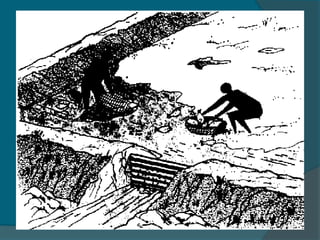
1. Draining – This method
is done by draining
completely the pond water
and then, the fish are
collected using a scoop
net.
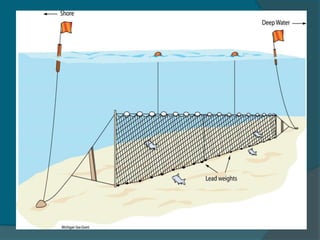
2. Gill netting – This
method is used for
selective harvesting where
the stock is multiple sizes.
COMMON
NON-TEXTILE
FISHING DEVICES
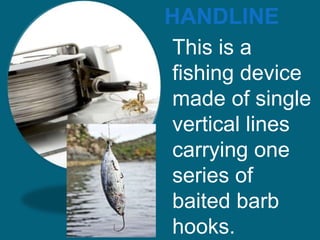
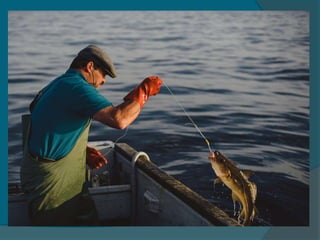
HANDLINE
This is a
fishing device
made of single
vertical lines
carrying one
series of
baited barb
hooks.
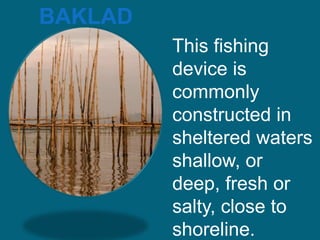
BAKLAD
This fishing
device is
commonly
constructed in
sheltered waters
shallow, or
deep, fresh or
salty, close to
shoreline.
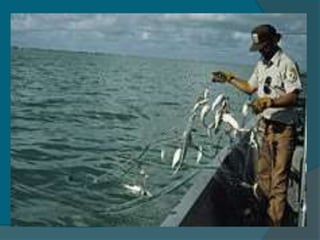
3. GILL NET
This is a
curtain-like
net. This net is
usually used
at night or
early in the
morning
PUKOT
This fishing
device is used
in smoothly,
gradually
shelving
fishing shores.
SALAKAB
This entrapping
device with no
return valve
and with an
opening at the
lower most end
to enclosed the
fish
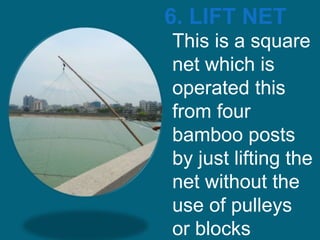
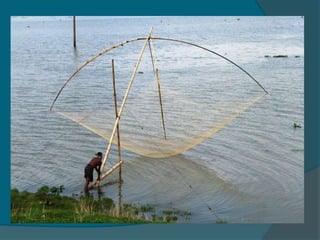
6. LIFT NET
This is a square
net which is
operated this
from four
bamboo posts
by just lifting the
net without the
use of pulleys
or blocks
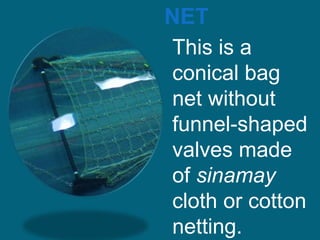
NET
This is a
conical bag
net without
funnel-shaped
valves made
of sinamay
cloth or cotton
netting.
8. DIP NET
This net is a
simple
instrument
made of a
round frame
and netting
material.
NET
It is a bag net,
triangular in
form, and
attached to a
collapsible
wooden frame
with a bamboo
handle.
NET
This is a
fishing device
made of single
vertical lines
carrying one
series of
baited barb
hooks.
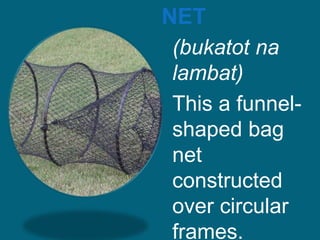
NET
(bukatot na
lambat)
This a funnel-
shaped bag
net
constructed
over circular
frames.
NET
(dayakas)
This is a winged
conical filter net
with a series of
circular hoops
leading into a
closed sac or
trap.
NET
(otoshi-ami)
It is a fixed
impounding
net supported
by stakes.
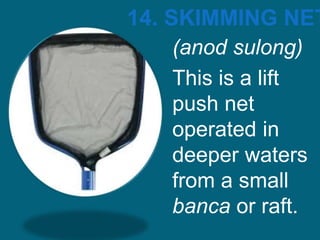
14. SKIMMING NET
(anod sulong)
This is a lift
push net
operated in
deeper waters
from a small
banca or raft.
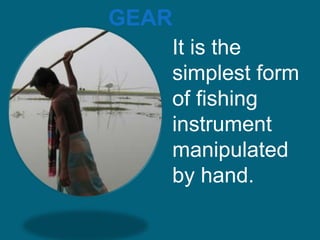
GEAR
It is the
simplest form
of fishing
instrument
manipulated
by hand.
KINDS OF
WOUNDING GEARS
1. SPEAR
(pana)
It is a hand
instrument provided
with pointed barbed
blades at the straight
tip which are either
thrown by hand or
with the aid of a
bowlike device.
2. HARPOON
(panibat)
Harpooning is a
traditional method of
catching large fish
and it is still used
today by skilled
fishermen.

Fish capture