Momina Ali
Muhammad Imtiaz
Muhammad Wasif Imran
Muhammad Hamza Naeem
Momna Bashir
Smoking of Fish
1
SEE INSIDE…
• Introduction;
• What is smoking of fish?
• How Preservation is affected by smoking
• Types of smoking (Traditional & mechanical)
• Hot smoking
• Cold smoking
• Benefits & limitations
2
Introduction
3
Momina Ali
Introduction
Smoking is one of the oldest of food preservation methods,
• Smoking is a method of processing food
• Purpose preservation
• Exposure to smoke increases its palatability
4
What is smoking of fish?
According to Jeffrey J. Rozum,
"The process of smoking fish occurs through the use of fire. Wood contains three
major components that are broken down in the burning process to form smoke. The
burning process is called pyrolysis, which is simply defined as the chemical
decomposition by heat. The major wood components are cellulose, hemicellulose
and lignin”
5
How does smoking preserve food?
• Smoking food preserves it by killing bacteria that can cause food to spoil
• The smoke from the fire penetrates the food
• Destroying the bacteria and preventing them from growing
6
How does it work?
• The smoke from the burning wood helps to create a barrier on the surface
• Helps to preserve the food
• Smoking is a method of drying out the food
• The smoking process also adds a pleasant smoky flavor
• Keeps away insects and bacteria while the food dries
7
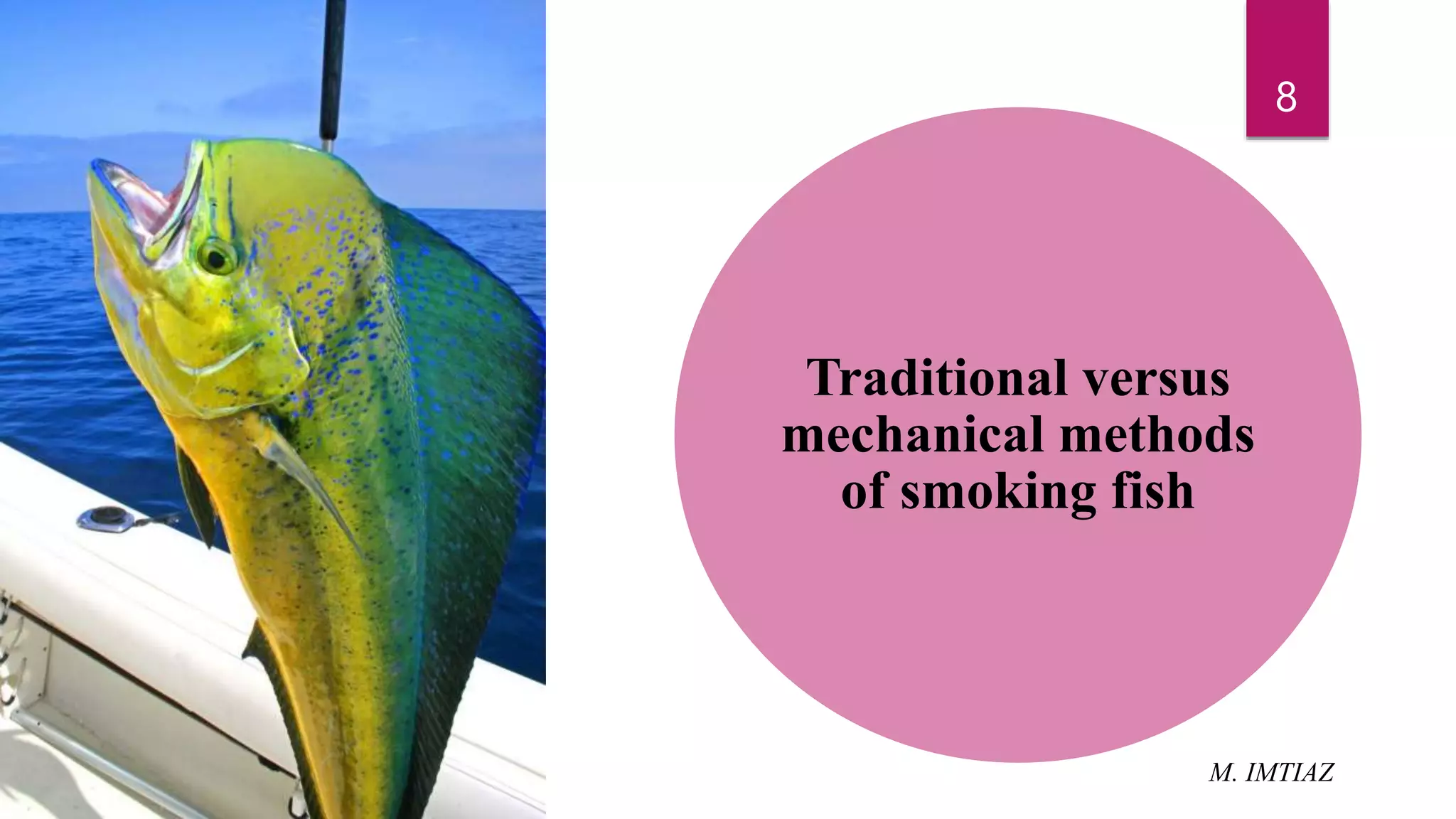
Traditional versus
mechanical methods
of smoking fish
8
M. IMTIAZ
There are two main method of smoking fish:
Traditional Method
 The traditional method involves the fish
being suspended in smokehouses over
slowly smouldering wood shavings. The
fish are left overnight to be naturally
infused with smoke.
Mechanical Method
 In the mechanical method smoke is generated
through the use of smoke condensates, which are
created by the industrial process of turning smoke
into a solid or liquid form. The flow of smoke in the
mechanical kiln is computer controlled and the fish
generally spend less time being smoked than in a
traditional kiln.
9
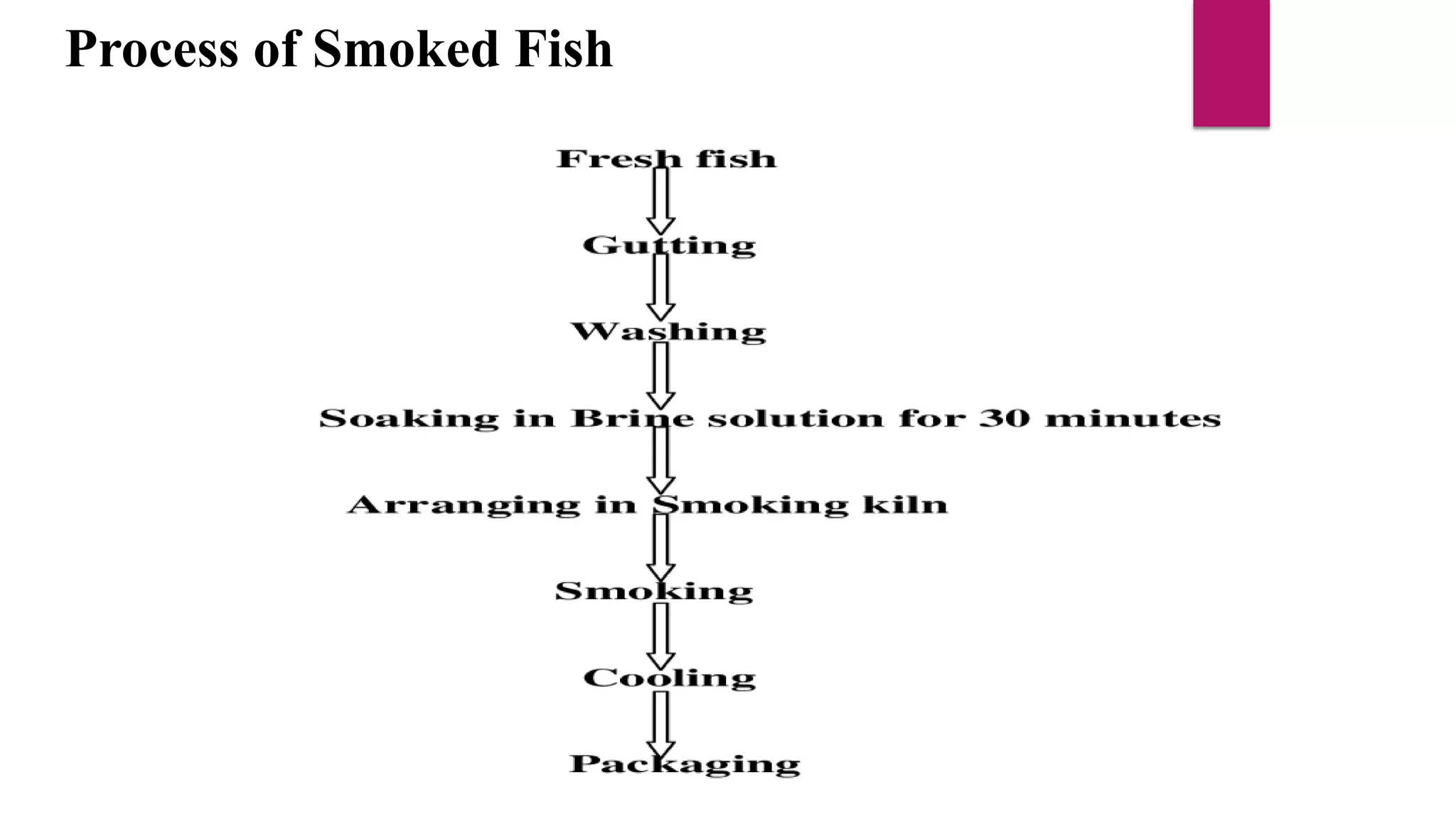
Process of Smoked Fish
Salting
• The cleaned fish is then soaked in brine solution
• Duration of treatment with brine depends up on the strength of the brine solution
• The brine is stored at a temperature of 52 to 55 degree C and is changed at least
once a day
11
Hanging
• The salted fish is hung in the kiln on a rack for dipping
• The protein which has dissolved in the salt form a sticky solution on the surface of
the fish
• Which gives the skin a glossy appearance which is one of the commercial criteria
of the quality
12
Two types of smoking
• Hot Smoking process
• Cold Smoking process
13
Hot Smoking of Fish
Wasif Imran
14
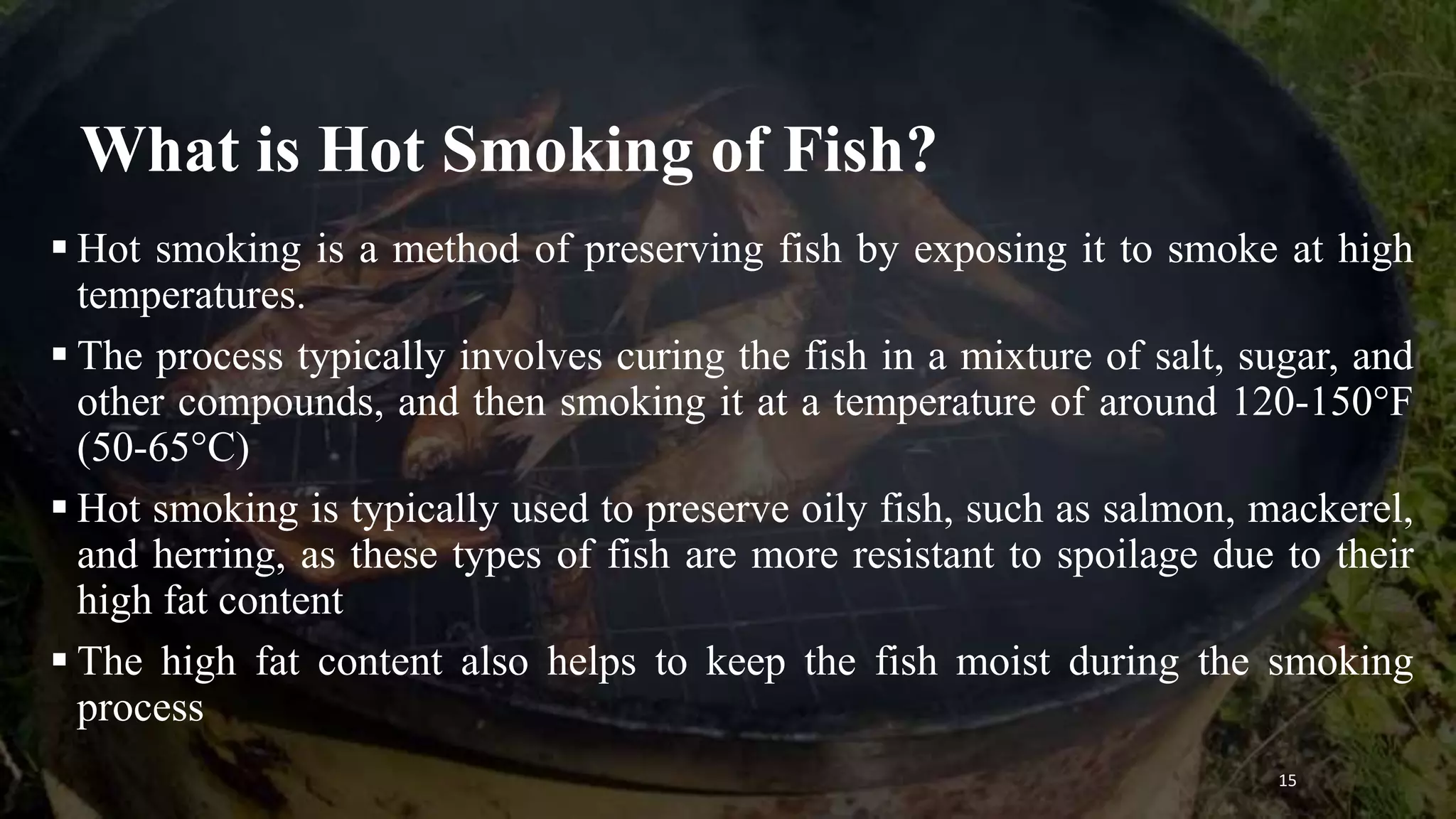
What is Hot Smoking of Fish?
 Hot smoking is a method of preserving fish by exposing it to smoke at high
temperatures.
 The process typically involves curing the fish in a mixture of salt, sugar, and
other compounds, and then smoking it at a temperature of around 120-150°F
(50-65°C)
 Hot smoking is typically used to preserve oily fish, such as salmon, mackerel,
and herring, as these types of fish are more resistant to spoilage due to their
high fat content
 The high fat content also helps to keep the fish moist during the smoking
process
15
History of Hot Smoking:
16
• Hot smoking is a traditional method of preserving and flavoring fish that has
been practiced for centuries in many cultures around the world
• In Europe, hot smoking fish has a long history, with many different cultures
and regions having their own variations on the process
• It is believed that the first commercial use originated in the 17th century
• For example, in Scandinavian countries, hot smoking fish has been a traditional
method of preservation for centuries, with salmon being a particularly popular
choice for hot smoking
• However, it is known that Native American tribes in the Pacific Northwest
region smoked fish to preserve it for the winter months
17
Raw Material Used While Smoking
Fish
• The main raw
material in hot
smoking fish is, of
course, the fish
itself
Wood Chips
• Wood chips are
used to create the
smoke that flavors
the fish during the
hot smoking
process
Salt
• Salt is often used in
a brine solution to
help preserve the
fish and add flavor
before it is hot
smoked
Water
• Water is used to
create the brine
solution in which
the fish is soaked
before it is hot
smoked
18
Raw Material Used While Smoking
Seasoning
• Seasonings can be added to the
brine solution or applied to the
surface of the fish before hot
smoking to add additional
flavor. Common seasonings
include herbs, spices, and citrus
zest
Smoke:
• Smoke is created by burning
wood chips in the smoker and is
what flavors the fish during the
hot smoking process
19
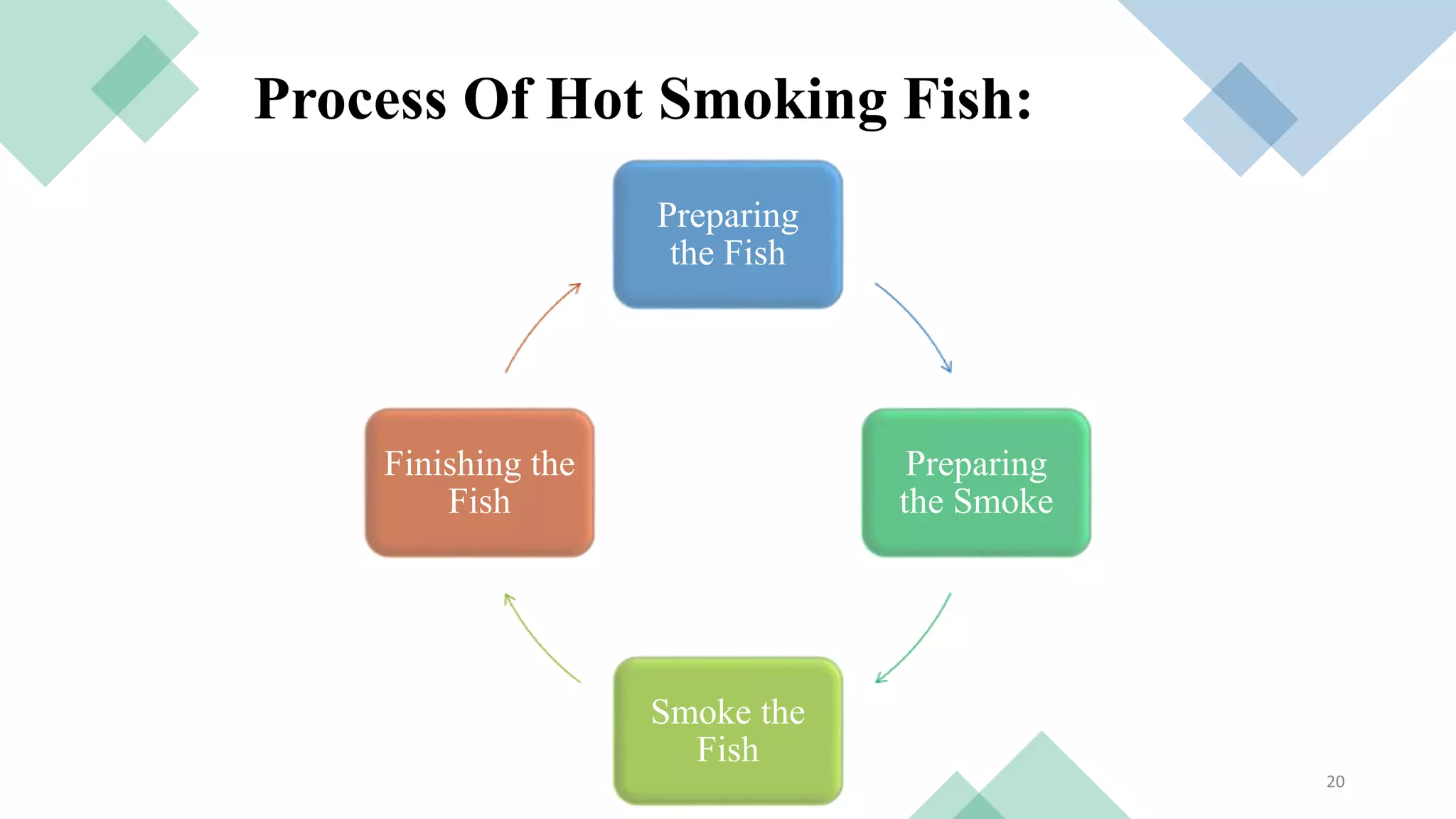
Process Of Hot Smoking Fish:
Preparing
the Fish
Preparing
the Smoke
Smoke the
Fish
Finishing the
Fish
20
Different Time Temperature Combination
Salmon
• Salmon is a popular choice for hot
smoking, and it can be smoked at a
temperature of 80-90°C (176-
194°F) for 1-2 hours, depending on
the size of the fish
Trout
• Trout is another popular choice for
hot smoking, and it can be smoked
at a temperature of 80-90°C (176-
194°F) for 1-2 hours, depending on
the size of the fish
Mackerel
• Mackerel is a firm-fleshed fish that
is well suited for hot smoking. It
can be smoked at a temperature of
80-90°C (176-194°F) for 1-2 hours,
depending on the size of the fish
Herring
• Herring is a small, oily fish that is
well suited for hot smoking. It can
be smoked at a temperature of 80-
90°C (176-194°F) for 30-60
minutes, depending on the size of
the fish
21
Key Benefits:
Flavor
• Hot smoking adds a
distinct smoky flavor
to the fish, which can
be very enjoyable. The
type of wood chips
used for smoking can
also contribute to the
flavor of the finished
product
Texture
• Hot smoking can help
to preserve the texture
of the fish, resulting in
a firm, flaky finished
product
Shelf life
• Hot smoking can help
to preserve the fish and
increase its shelf life.
Hot smoked fish can be
stored in the
refrigerator for several
weeks or in the freezer
for several months,
depending on the type
of fish and the specific
hot smoking technique
used
Convenience
• Hot smoking fish can
be a convenient way to
preserve and flavor
fish, as it does not
require special
equipment or
ingredients
22
Increasing Shelf Life
23
• Hot smoked salmon can have a shelf life of up to 2 weeks
when refrigerated, or up to 3 months when frozen
Salmon:
• Hot smoked trout can have a shelf life of up to 1 week
when refrigerated, or up to 3 months when frozen
Trout:
• Hot smoked mackerel can have a shelf life of up to 1 week
when refrigerated, or up to 3 months when frozen
Mackerel:
• Hot smoked herring can have a shelf life of up to 1 week
when refrigerated, or up to 3 months when frozen
Herring:
How Shelf Life Increased?
1.Water: Water vapor
is produced when the
wood chips or sawdust
burn, and it helps to
remove moisture from
the fish, which makes it
difficult for bacteria to
grow
1.Polycyclic aromatic
hydrocarbons (PAHs):
PAHs are produced
when the wood chips or
sawdust burn, and they
contribute to the flavor
and color of the smoked
fish
1.Acids: Acids, such as
formic acid and acetic
acid, are produced when
the wood chips or
sawdust burn, and they
help to preserve the fish
by lowering the pH of
the flesh
1.Aldehydes:
Aldehydes, such as
formaldehyde and
acetaldehyde, are
produced when the
wood chips or sawdust
burn, and they help to
preserve the fish by
inhibiting the growth of
bacteria
24
Cold Smoking
• What is Cold Smoking
• Mechanism of Cold
Smoking
• Impacts of Cold
Smoking
• Benefits & Limitations
of Cold Smoking
25
M.Hamza Naeem
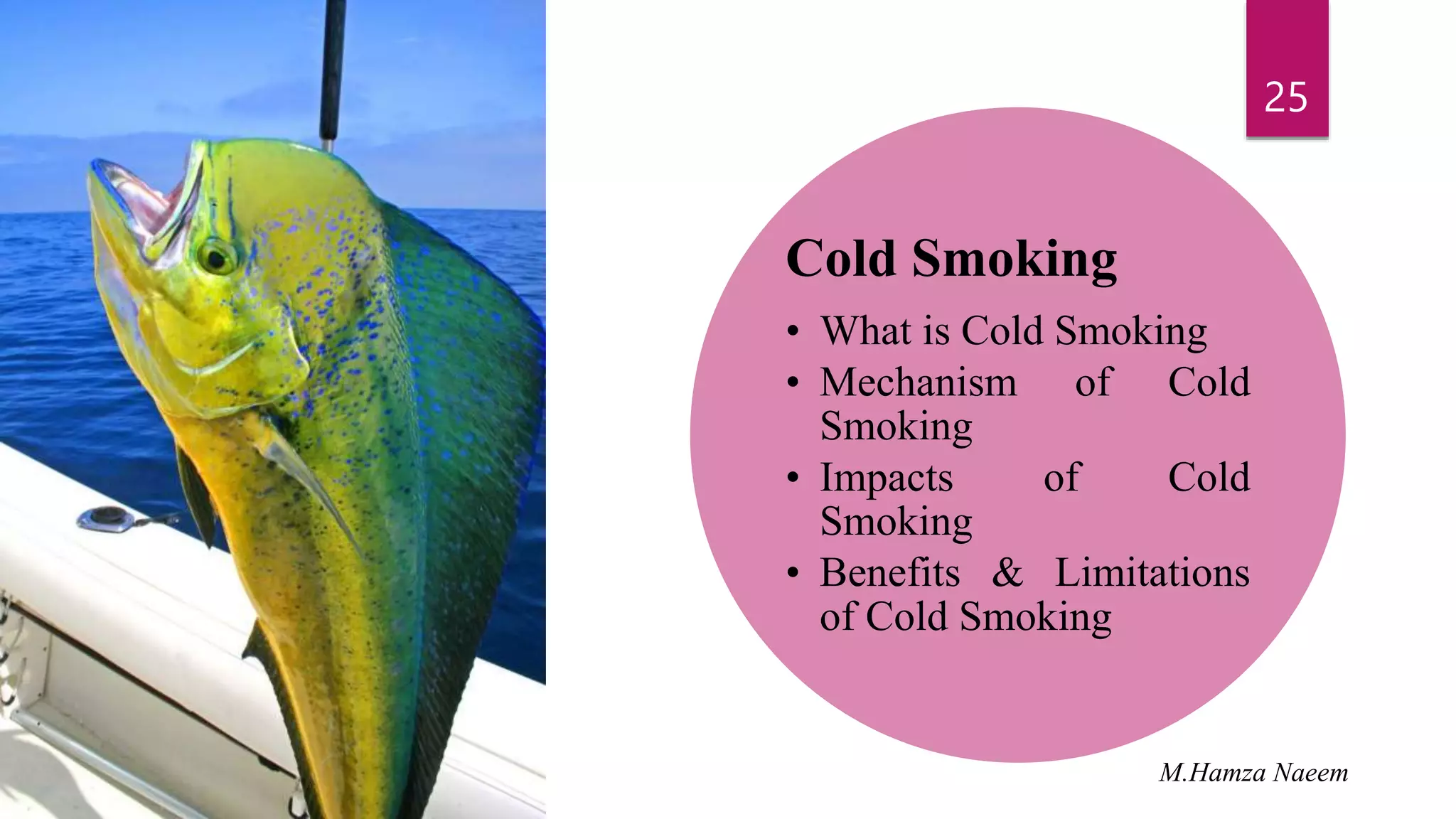
Cold Smoking
• A preservation method without cooking
• Temperature mostly below 30℃ (ranges from 21.5 ℃ to 29.9 ℃)
• Cold smoked process resulted in better fillet appearance and color
• In cold conditions, shelf may increase from few weeks to few months
How it is different?
• It is different due to;
• Low temperature
• Preservation without cooking
26
Mechanism
27
Impacts of Cold Smoking
• Water holding capacity;
• Stable in Mahi mahi and blue whiting
• Decreases in sardine
• During storage;
• Lipid oxidation was observed in sardine,
• Though mahi mahi and blue whiting prevented
• Total volatile basic nitrogen increased in all these species
• Microbial impact;
• Enterobacteriaceae did not show any growth during storage
• Lactic acid bacteria only dominants
• Sensory shelf life was 9-11 weeks (9 for mahi mahi and blue whiting)
28
Benefits and Drawbacks of Cold Smoking
Benefits:
• Smoke flavor without over cooking, less energy
• Desired color maintain
• Better appearance
• Less water loss than hot smoking
Drawbacks:
• Fish remains in danger temperature zone
• Some microbes still can survive (Listeria innocua )
• Need to combine with fermentation, vacuum packaging etc, which increase
cost
29
Benefits & Limitations of
overall smoking method
• Benefits of Cold Smoking
• Limitations of Cold Smoking
30
Momna Bashir
Benefits of Smoking
Removing moisture helps to prevent
bacterial and fungal growth
It is a method of drying that imparts
flavor to the fish
Smoke helps keep bacteria-carrying-
insects away process
Smoked fish rich in nutrients like
omega-3 fatty acid and iron
Cooking with very low fat (control
cholesterol problems)
Avoid many pitfalls which other
cooking methods experience
Combined preservation technique
(drying, cooking & preservation)
31
Drawbacks of Smoking
May contain polycyclic aromatic
hydrocarbons (carcinogenic)
Too much consumption of smoked fish
can cause stomach cancer
Microbiological hazards
Hazard of protein denaturation
Smaller upkeep period
Unwanted fish color
Hazards of parasities
32
Conclusion
• Combined preservation technique
• Organoleptic properties improve by smoking
• Some sort of anti microbial effect
• Traditional method with minimum cooking losses
• Improves shelf life
33
Reference:
• https://www.sbs.com.au/food/article/2018/10/29/cold-smoking-versus-
hot-smoking-whats-difference
• https://eatcuredmeat.com/what-is-the-difference-between-hot-
smoking-and-cold-smoking/
• https://ifst.onlinelibrary.wiley.com/doi/abs/10.1111/j.1365-
2621.2008.01762.x#
• https://www.mdpi.com/2304-8158/10/11/2522
34
35

Smoking of Fish. Ppt

  • 1.
    Momina Ali Muhammad Imtiaz MuhammadWasif Imran Muhammad Hamza Naeem Momna Bashir Smoking of Fish 1
  • 2.
    SEE INSIDE… • Introduction; •What is smoking of fish? • How Preservation is affected by smoking • Types of smoking (Traditional & mechanical) • Hot smoking • Cold smoking • Benefits & limitations 2
  • 3.
  • 4.
    Introduction Smoking is oneof the oldest of food preservation methods, • Smoking is a method of processing food • Purpose preservation • Exposure to smoke increases its palatability 4
  • 5.
    What is smokingof fish? According to Jeffrey J. Rozum, "The process of smoking fish occurs through the use of fire. Wood contains three major components that are broken down in the burning process to form smoke. The burning process is called pyrolysis, which is simply defined as the chemical decomposition by heat. The major wood components are cellulose, hemicellulose and lignin” 5
  • 6.
    How does smokingpreserve food? • Smoking food preserves it by killing bacteria that can cause food to spoil • The smoke from the fire penetrates the food • Destroying the bacteria and preventing them from growing 6
  • 7.
    How does itwork? • The smoke from the burning wood helps to create a barrier on the surface • Helps to preserve the food • Smoking is a method of drying out the food • The smoking process also adds a pleasant smoky flavor • Keeps away insects and bacteria while the food dries 7
  • 8.
  • 9.
    There are twomain method of smoking fish: Traditional Method  The traditional method involves the fish being suspended in smokehouses over slowly smouldering wood shavings. The fish are left overnight to be naturally infused with smoke. Mechanical Method  In the mechanical method smoke is generated through the use of smoke condensates, which are created by the industrial process of turning smoke into a solid or liquid form. The flow of smoke in the mechanical kiln is computer controlled and the fish generally spend less time being smoked than in a traditional kiln. 9
  • 10.
  • 11.
    Salting • The cleanedfish is then soaked in brine solution • Duration of treatment with brine depends up on the strength of the brine solution • The brine is stored at a temperature of 52 to 55 degree C and is changed at least once a day 11
  • 12.
    Hanging • The saltedfish is hung in the kiln on a rack for dipping • The protein which has dissolved in the salt form a sticky solution on the surface of the fish • Which gives the skin a glossy appearance which is one of the commercial criteria of the quality 12
  • 13.
    Two types ofsmoking • Hot Smoking process • Cold Smoking process 13
  • 14.
    Hot Smoking ofFish Wasif Imran 14
  • 15.
    What is HotSmoking of Fish?  Hot smoking is a method of preserving fish by exposing it to smoke at high temperatures.  The process typically involves curing the fish in a mixture of salt, sugar, and other compounds, and then smoking it at a temperature of around 120-150°F (50-65°C)  Hot smoking is typically used to preserve oily fish, such as salmon, mackerel, and herring, as these types of fish are more resistant to spoilage due to their high fat content  The high fat content also helps to keep the fish moist during the smoking process 15
  • 16.
    History of HotSmoking: 16 • Hot smoking is a traditional method of preserving and flavoring fish that has been practiced for centuries in many cultures around the world • In Europe, hot smoking fish has a long history, with many different cultures and regions having their own variations on the process • It is believed that the first commercial use originated in the 17th century • For example, in Scandinavian countries, hot smoking fish has been a traditional method of preservation for centuries, with salmon being a particularly popular choice for hot smoking • However, it is known that Native American tribes in the Pacific Northwest region smoked fish to preserve it for the winter months
  • 17.
  • 18.
    Raw Material UsedWhile Smoking Fish • The main raw material in hot smoking fish is, of course, the fish itself Wood Chips • Wood chips are used to create the smoke that flavors the fish during the hot smoking process Salt • Salt is often used in a brine solution to help preserve the fish and add flavor before it is hot smoked Water • Water is used to create the brine solution in which the fish is soaked before it is hot smoked 18
  • 19.
    Raw Material UsedWhile Smoking Seasoning • Seasonings can be added to the brine solution or applied to the surface of the fish before hot smoking to add additional flavor. Common seasonings include herbs, spices, and citrus zest Smoke: • Smoke is created by burning wood chips in the smoker and is what flavors the fish during the hot smoking process 19
  • 20.
    Process Of HotSmoking Fish: Preparing the Fish Preparing the Smoke Smoke the Fish Finishing the Fish 20
  • 21.
    Different Time TemperatureCombination Salmon • Salmon is a popular choice for hot smoking, and it can be smoked at a temperature of 80-90°C (176- 194°F) for 1-2 hours, depending on the size of the fish Trout • Trout is another popular choice for hot smoking, and it can be smoked at a temperature of 80-90°C (176- 194°F) for 1-2 hours, depending on the size of the fish Mackerel • Mackerel is a firm-fleshed fish that is well suited for hot smoking. It can be smoked at a temperature of 80-90°C (176-194°F) for 1-2 hours, depending on the size of the fish Herring • Herring is a small, oily fish that is well suited for hot smoking. It can be smoked at a temperature of 80- 90°C (176-194°F) for 30-60 minutes, depending on the size of the fish 21
  • 22.
    Key Benefits: Flavor • Hotsmoking adds a distinct smoky flavor to the fish, which can be very enjoyable. The type of wood chips used for smoking can also contribute to the flavor of the finished product Texture • Hot smoking can help to preserve the texture of the fish, resulting in a firm, flaky finished product Shelf life • Hot smoking can help to preserve the fish and increase its shelf life. Hot smoked fish can be stored in the refrigerator for several weeks or in the freezer for several months, depending on the type of fish and the specific hot smoking technique used Convenience • Hot smoking fish can be a convenient way to preserve and flavor fish, as it does not require special equipment or ingredients 22
  • 23.
    Increasing Shelf Life 23 •Hot smoked salmon can have a shelf life of up to 2 weeks when refrigerated, or up to 3 months when frozen Salmon: • Hot smoked trout can have a shelf life of up to 1 week when refrigerated, or up to 3 months when frozen Trout: • Hot smoked mackerel can have a shelf life of up to 1 week when refrigerated, or up to 3 months when frozen Mackerel: • Hot smoked herring can have a shelf life of up to 1 week when refrigerated, or up to 3 months when frozen Herring:
  • 24.
    How Shelf LifeIncreased? 1.Water: Water vapor is produced when the wood chips or sawdust burn, and it helps to remove moisture from the fish, which makes it difficult for bacteria to grow 1.Polycyclic aromatic hydrocarbons (PAHs): PAHs are produced when the wood chips or sawdust burn, and they contribute to the flavor and color of the smoked fish 1.Acids: Acids, such as formic acid and acetic acid, are produced when the wood chips or sawdust burn, and they help to preserve the fish by lowering the pH of the flesh 1.Aldehydes: Aldehydes, such as formaldehyde and acetaldehyde, are produced when the wood chips or sawdust burn, and they help to preserve the fish by inhibiting the growth of bacteria 24
  • 25.
    Cold Smoking • Whatis Cold Smoking • Mechanism of Cold Smoking • Impacts of Cold Smoking • Benefits & Limitations of Cold Smoking 25 M.Hamza Naeem
  • 26.
    Cold Smoking • Apreservation method without cooking • Temperature mostly below 30℃ (ranges from 21.5 ℃ to 29.9 ℃) • Cold smoked process resulted in better fillet appearance and color • In cold conditions, shelf may increase from few weeks to few months How it is different? • It is different due to; • Low temperature • Preservation without cooking 26
  • 27.
  • 28.
    Impacts of ColdSmoking • Water holding capacity; • Stable in Mahi mahi and blue whiting • Decreases in sardine • During storage; • Lipid oxidation was observed in sardine, • Though mahi mahi and blue whiting prevented • Total volatile basic nitrogen increased in all these species • Microbial impact; • Enterobacteriaceae did not show any growth during storage • Lactic acid bacteria only dominants • Sensory shelf life was 9-11 weeks (9 for mahi mahi and blue whiting) 28
  • 29.
    Benefits and Drawbacksof Cold Smoking Benefits: • Smoke flavor without over cooking, less energy • Desired color maintain • Better appearance • Less water loss than hot smoking Drawbacks: • Fish remains in danger temperature zone • Some microbes still can survive (Listeria innocua ) • Need to combine with fermentation, vacuum packaging etc, which increase cost 29
  • 30.
    Benefits & Limitationsof overall smoking method • Benefits of Cold Smoking • Limitations of Cold Smoking 30 Momna Bashir
  • 31.
    Benefits of Smoking Removingmoisture helps to prevent bacterial and fungal growth It is a method of drying that imparts flavor to the fish Smoke helps keep bacteria-carrying- insects away process Smoked fish rich in nutrients like omega-3 fatty acid and iron Cooking with very low fat (control cholesterol problems) Avoid many pitfalls which other cooking methods experience Combined preservation technique (drying, cooking & preservation) 31
  • 32.
    Drawbacks of Smoking Maycontain polycyclic aromatic hydrocarbons (carcinogenic) Too much consumption of smoked fish can cause stomach cancer Microbiological hazards Hazard of protein denaturation Smaller upkeep period Unwanted fish color Hazards of parasities 32
  • 33.
    Conclusion • Combined preservationtechnique • Organoleptic properties improve by smoking • Some sort of anti microbial effect • Traditional method with minimum cooking losses • Improves shelf life 33
  • 34.
  • 35.