GlusterFS
Challenges and Futures
Jeff Darcy
Storage Developer Conference
September 17, 2012
What Is GlusterFS?
● Just your basic distributed file system
● sharding, replication, striping
● Decentralized
● no central metadata server
● core functionality on clients
● Modular
● “translators”
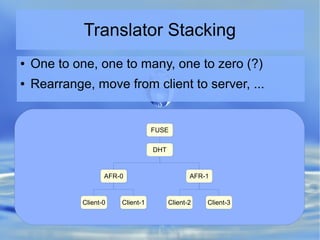
Translator Stacking
FUSE
DHT
AFR-1
Client-3Client-1
AFR-0
Client-2Client-0
● One to one, one to many, one to zero (?)
● Rearrange, move from client to server, ...
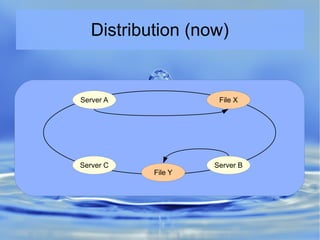
Distribution (now)
Server A
Server BServer C
File X
File Y
Replication (now)
● Based on changelog (“dirty flags”)
● set flags, do operation, clear flags
● use flags to determine repair (“self-heal”) after
failure
● Latency sensitive
● 3+ network round trips per user request
● implementation heavily optimized
Challenge: Multitenancy
● Focus of CloudFSHekaFS
● to be merged with GlusterFS soon-ish
● Isolate name and ID spaces
● Encrypt in flight and at rest
● Auth*
● Quota (next slide)
● Performance isolation
● cgroups
Challenge: Distributed Quota
● Can't trust clients to enforce quota
● Can't just divide equally among servers
● unequal usage (e.g. due to explicit placement)
● EDQUOT on one while still space on another
● “Quota rebalancing daemon”
● monitor/adjust continuously
● interesting problem at high scale
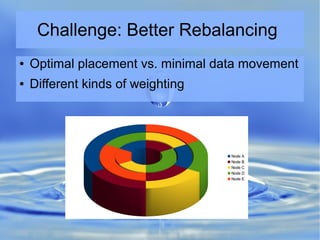
Challenge: Better Rebalancing
● Optimal placement vs. minimal data movement
● Different kinds of weighting
Node A
Node B
Node C
Node D
Node E
Challenge: Replication Latency
● Reaching limits of current approach
● Have to go async?
● but still ordered
● exploit compute/data locality (e.g. Hadoop)
● journaling, conflict resolution
Challenge: Directory Traversal
● Piggyback attrs (and xattrs) on readdir
● Even better: cursor approach
● read everything in opendir
● zero network activity for readdir
● less current, but more consistent
Challenge: Many Small Files
● Prefetch whole directories
● if marked, below size threshold, ...
● Exploit async journal
● only works if compute/data colocated
● Weaken consistency?
● allow create/write/close to be buffered
● directory-level fsync (magic xattr)
Conclusions
● Most of these challenges are not unique to
GlusterFS
● Modularity and incremental progress are
preferable to monolithic “solve all problems at
once”
● GlusterFS provides a good environment in
which to experiment with solutions

Sdc challenges-2012

  • 1.
    GlusterFS Challenges and Futures JeffDarcy Storage Developer Conference September 17, 2012
  • 2.
    What Is GlusterFS? ●Just your basic distributed file system ● sharding, replication, striping ● Decentralized ● no central metadata server ● core functionality on clients ● Modular ● “translators”
  • 3.
    Translator Stacking FUSE DHT AFR-1 Client-3Client-1 AFR-0 Client-2Client-0 ● Oneto one, one to many, one to zero (?) ● Rearrange, move from client to server, ...
  • 4.
    Distribution (now) Server A ServerBServer C File X File Y
  • 5.
    Replication (now) ● Basedon changelog (“dirty flags”) ● set flags, do operation, clear flags ● use flags to determine repair (“self-heal”) after failure ● Latency sensitive ● 3+ network round trips per user request ● implementation heavily optimized
  • 6.
    Challenge: Multitenancy ● Focusof CloudFSHekaFS ● to be merged with GlusterFS soon-ish ● Isolate name and ID spaces ● Encrypt in flight and at rest ● Auth* ● Quota (next slide) ● Performance isolation ● cgroups
  • 7.
    Challenge: Distributed Quota ●Can't trust clients to enforce quota ● Can't just divide equally among servers ● unequal usage (e.g. due to explicit placement) ● EDQUOT on one while still space on another ● “Quota rebalancing daemon” ● monitor/adjust continuously ● interesting problem at high scale
  • 8.
    Challenge: Better Rebalancing ●Optimal placement vs. minimal data movement ● Different kinds of weighting Node A Node B Node C Node D Node E
  • 9.
    Challenge: Replication Latency ●Reaching limits of current approach ● Have to go async? ● but still ordered ● exploit compute/data locality (e.g. Hadoop) ● journaling, conflict resolution
  • 10.
    Challenge: Directory Traversal ●Piggyback attrs (and xattrs) on readdir ● Even better: cursor approach ● read everything in opendir ● zero network activity for readdir ● less current, but more consistent
  • 11.
    Challenge: Many SmallFiles ● Prefetch whole directories ● if marked, below size threshold, ... ● Exploit async journal ● only works if compute/data colocated ● Weaken consistency? ● allow create/write/close to be buffered ● directory-level fsync (magic xattr)
  • 12.
    Conclusions ● Most ofthese challenges are not unique to GlusterFS ● Modularity and incremental progress are preferable to monolithic “solve all problems at once” ● GlusterFS provides a good environment in which to experiment with solutions