MySQL High Availability Solutions


     Lenz Grimmer <lenz@grimmer.com>
                  <
     http://lenzg.net/ | Twitter: @lenzgr
2011-01-26 | San Francisco MySQL Meetup | USA
$ whoami


1998              2002


2008              2010
Agenda
●   High Availability: Concepts &
    Considerations
●   MySQL Replication
●   DRBD / Pacemaker
●   MySQL Cluster
●   Other HA tools/applications
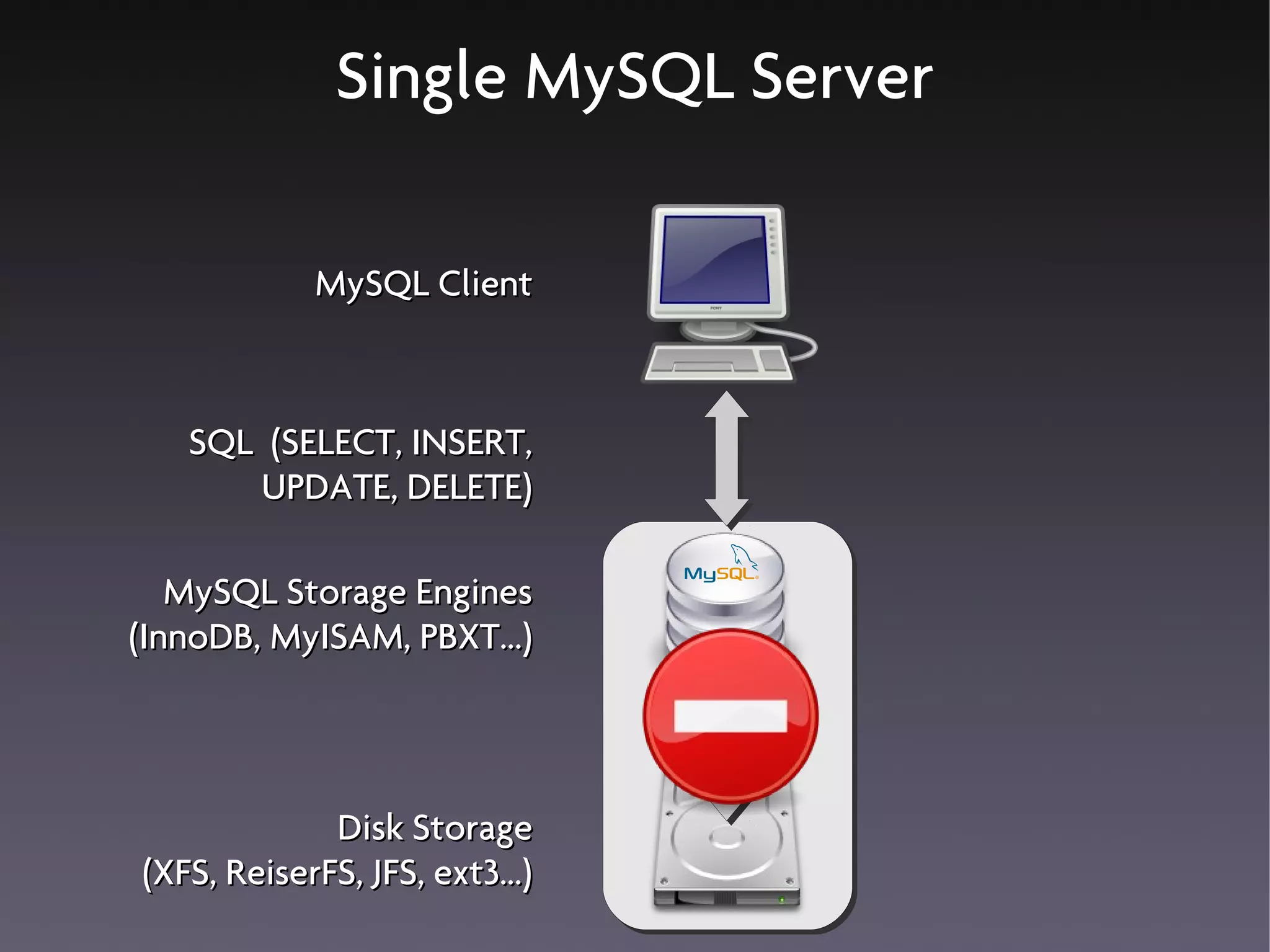
Single MySQL Server

            MySQL Client


   SQL (SELECT, INSERT,
      UPDATE, DELETE)

   MySQL Storage Engines
(InnoDB, MyISAM, PBXT...)


             Disk Storage
(XFS, ReiserFS, JFS, ext3...)
Why HA?
●   Something can and will fail
●   Service Maintenance
●   Downtime is expensive
●   Adding HA to an existing system is complex
Elimination of the SPOF
●   Identify what will fail eventually
     ●   Hard disks
     ●   Fans
●   Consider what might fail
     ●   Application crashes
     ●   OOM-Situations, Kernel-Panics
     ●   Network connections, Cables
     ●   Power supply
What is HA Clustering?
●   Redundancy
●   One system or service goes down → others
    take over
●   IP address takeover, service takeover
●   Ensuring data availability & integrity
●   Not designed for high-performance
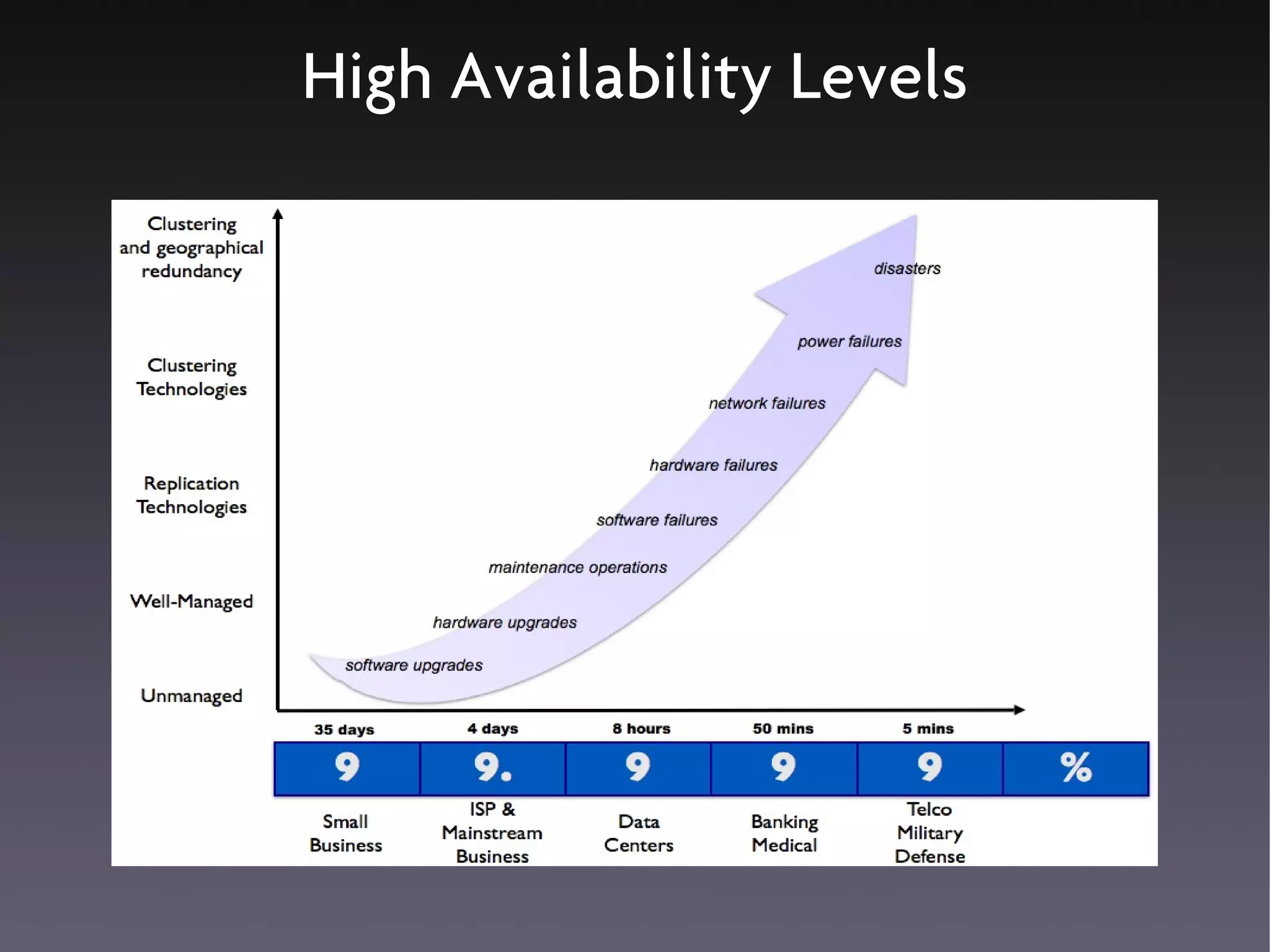
High Availability Levels
Rules of High Availability
●   Prepare for failure
●   Aim to ensure that no important data is
    lost
●   Keep it simple, stupid (KISS)
●   Complexity is the enemy of reliability
●   Automate it
●   Test your setup frequently!
HA Components
●   Heartbeat
     ●   Checks that services that are monitored, are alive.
     ●   Can check individual servers, software services,
         networking etc.
●   HA Monitor
     ●   Configuration of the services
     ●   Ensures proper shutdown and startup
     ●   Allows manual control
●   Shared storage / Replication
Split-Brain
●   Communications failures can lead to
    separated partitions of the cluster
●   If those partitions each try and take control
    of the cluster, then it's called a split-brain
    condition
●   If this happens, then bad things will happen
●   Use Fencing or Moderation/Arbitration to
    avoid it
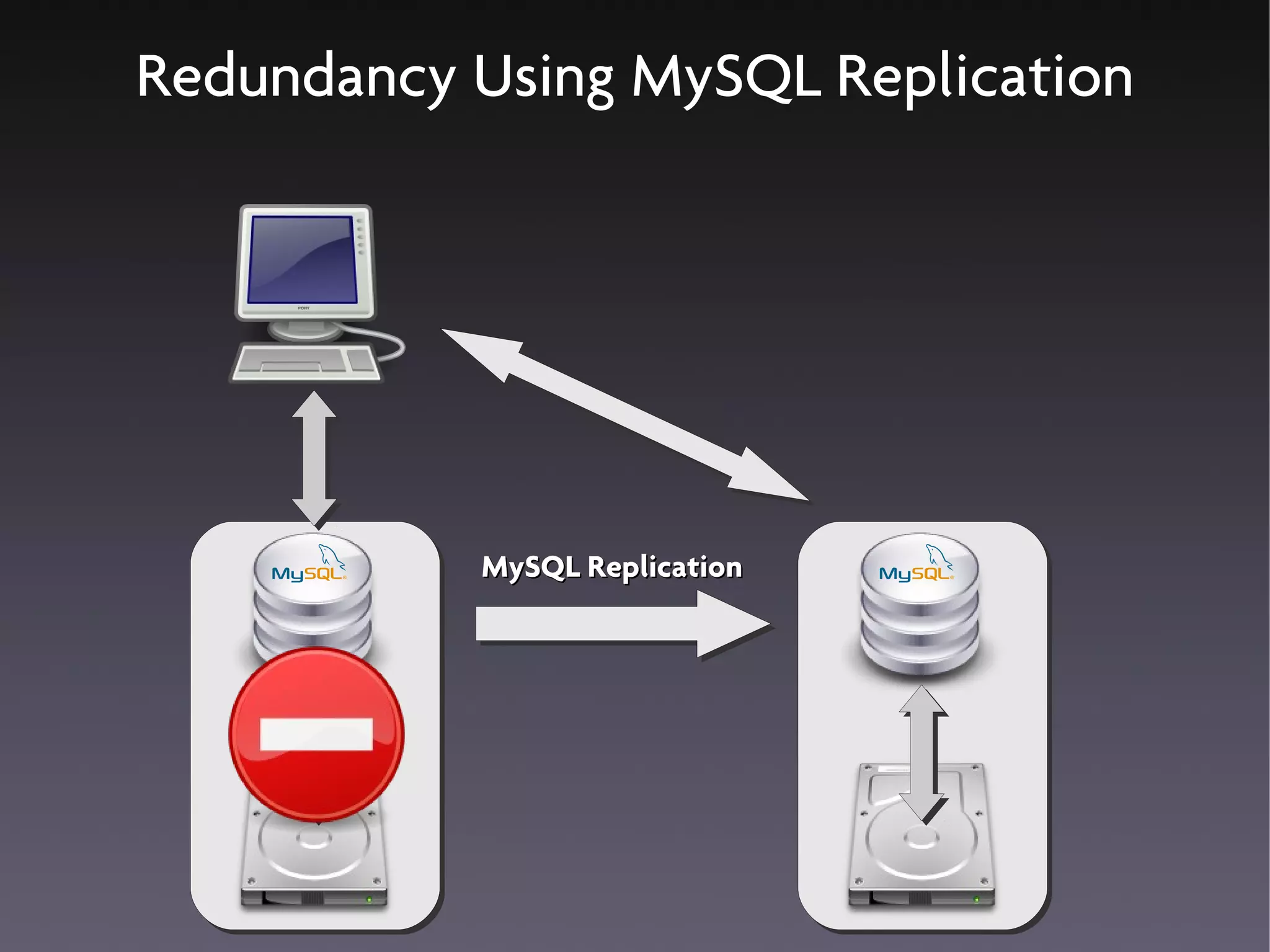
Redundancy Using MySQL Replication


           MySQL Replication
MySQL Replication
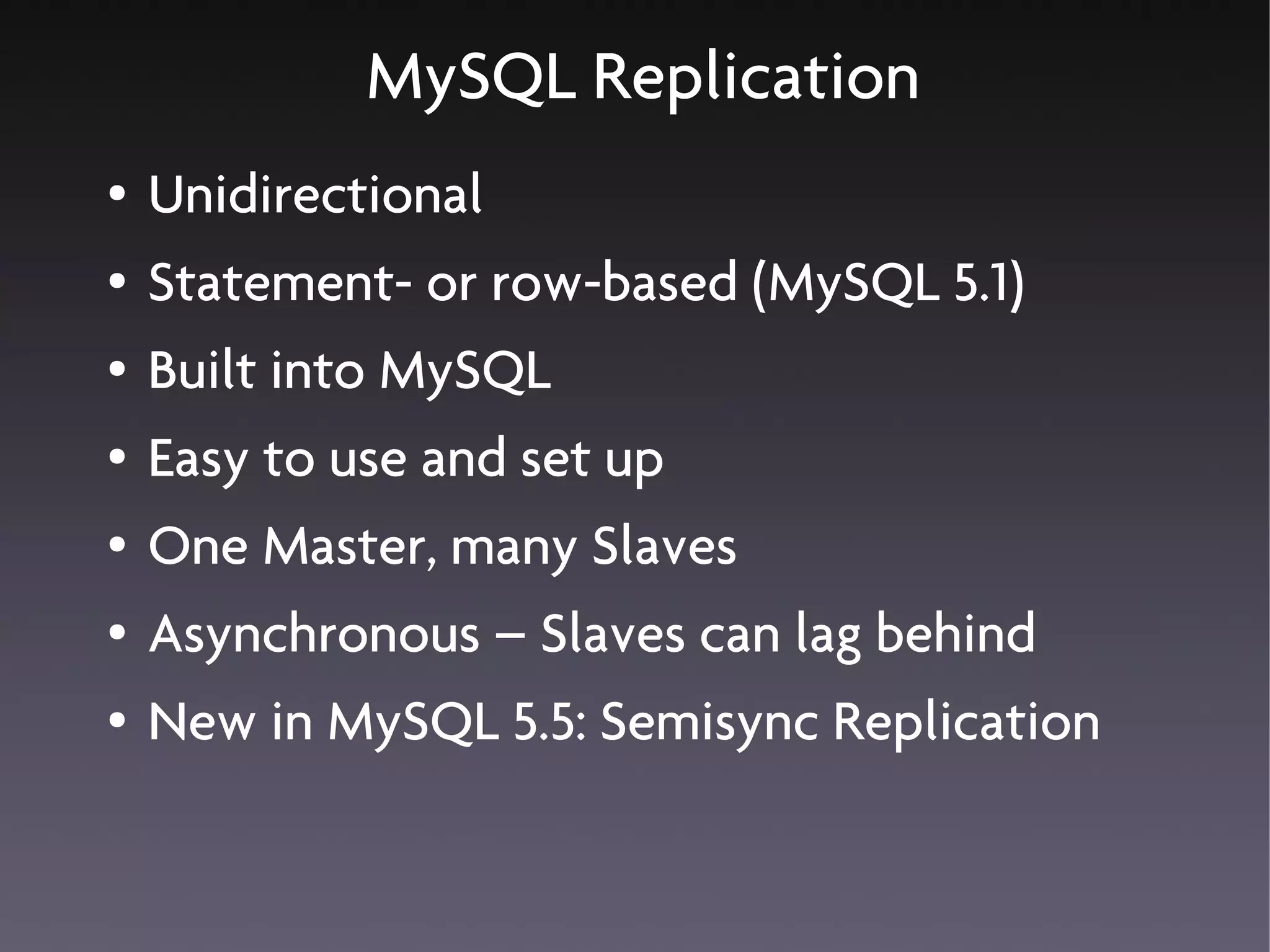
●   Unidirectional
●   Statement- or row-based (MySQL 5.1)
●   Built into MySQL
●   Easy to use and set up
●   One Master, many Slaves
●   Asynchronous – Slaves can lag behind
●   New in MySQL 5.5: Semisync Replication
MySQL Replication (2)
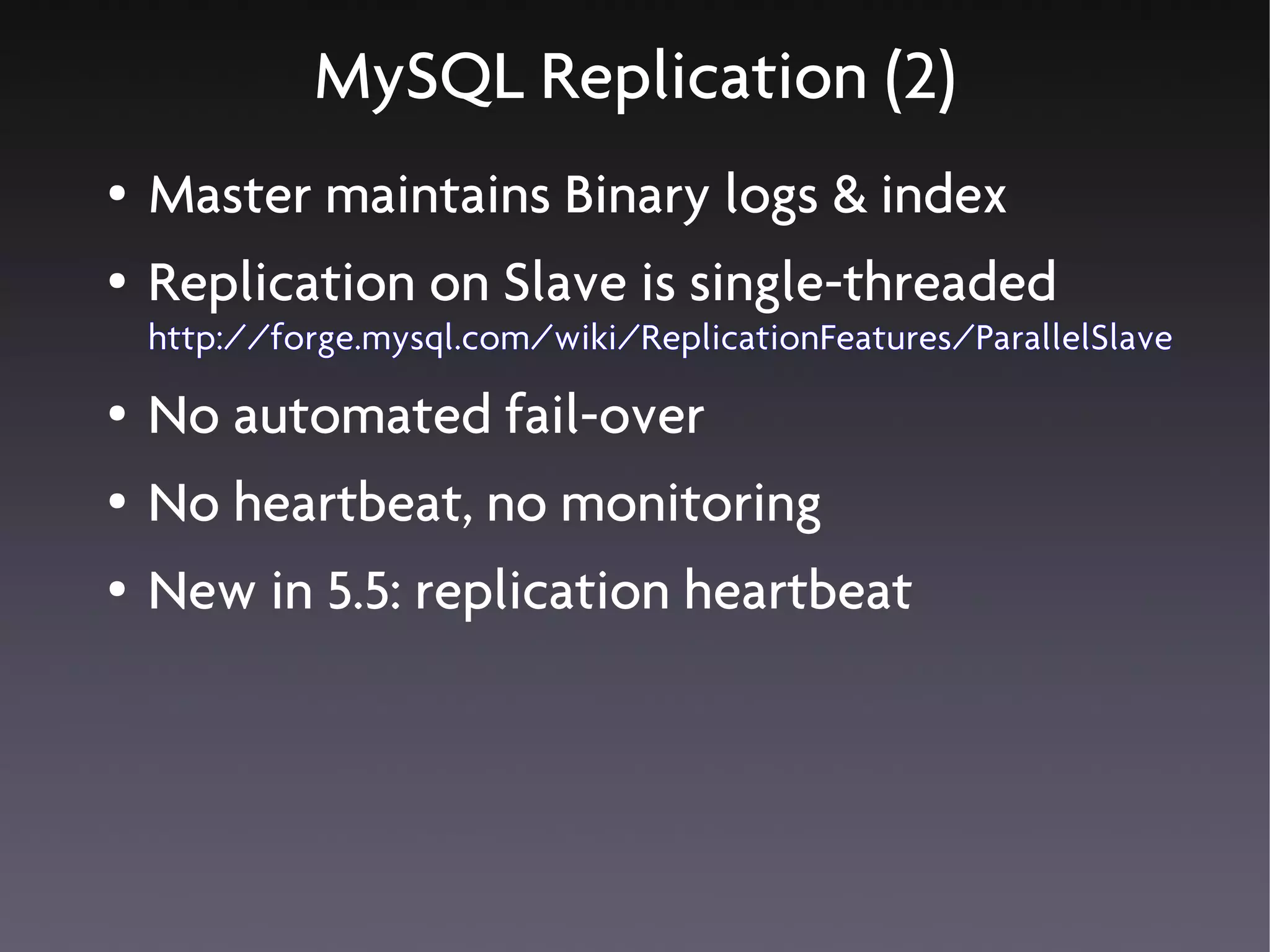
●   Master maintains Binary logs & index
●   Replication on Slave is single-threaded
    http://forge.mysql.com/wiki/ReplicationFeatures/ParallelSlave
●   No automated fail-over
●   No heartbeat, no monitoring
●   New in 5.5: replication heartbeat
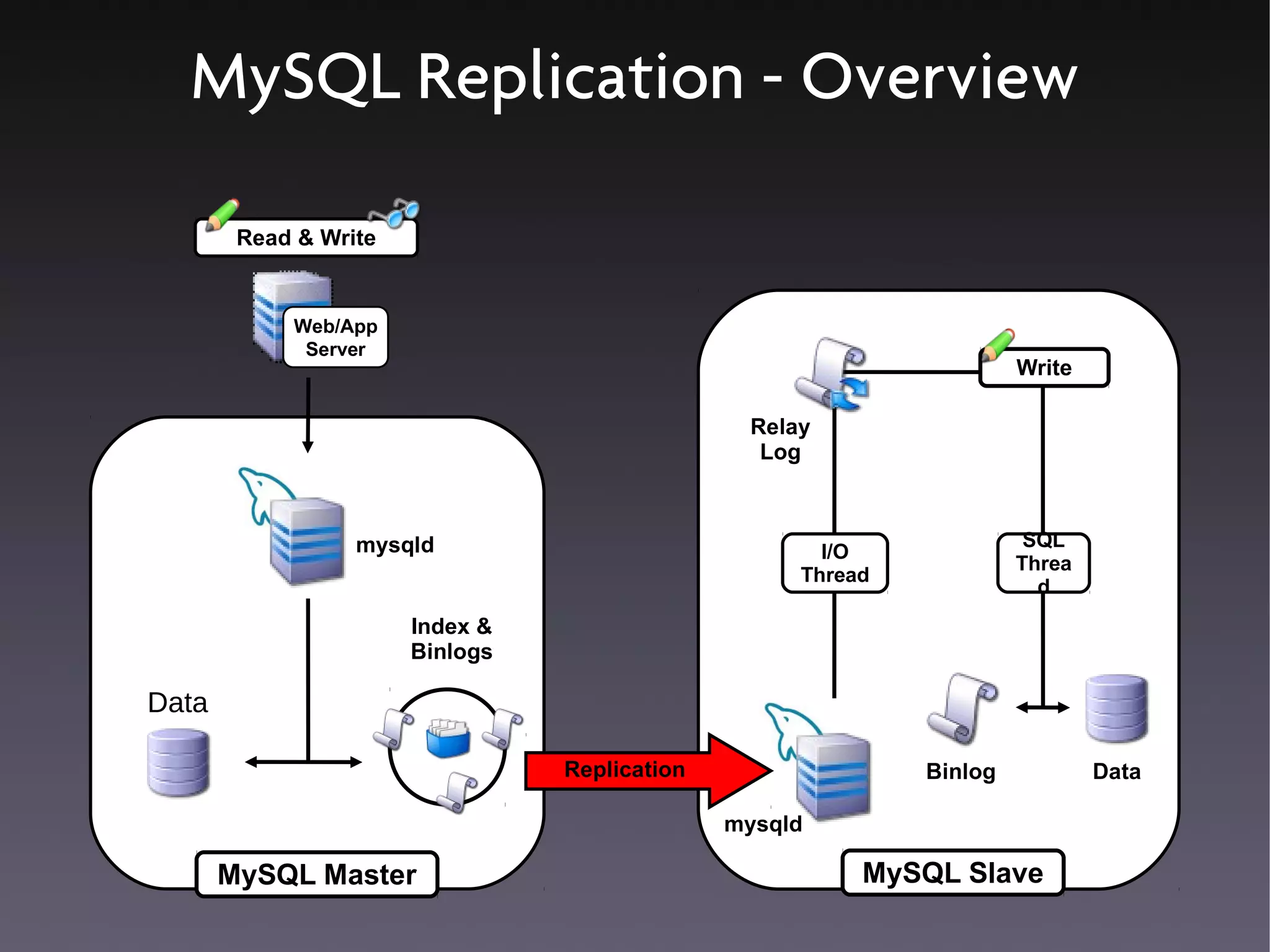
MySQL Replication - Overview

        Read & Write


            Web/App
             Server
                                                                       Write

                                                 Relay
                                                  Log


                  mysqld                                                SQL
                                                       I/O
                                                                       Threa
                                                     Thread
                                                                         d
                       Index &
                       Binlogs

Data

                                 Replication                  Binlog           Data

                                               mysqld

       MySQL Master                                       MySQL Slave
Statement-based Replication
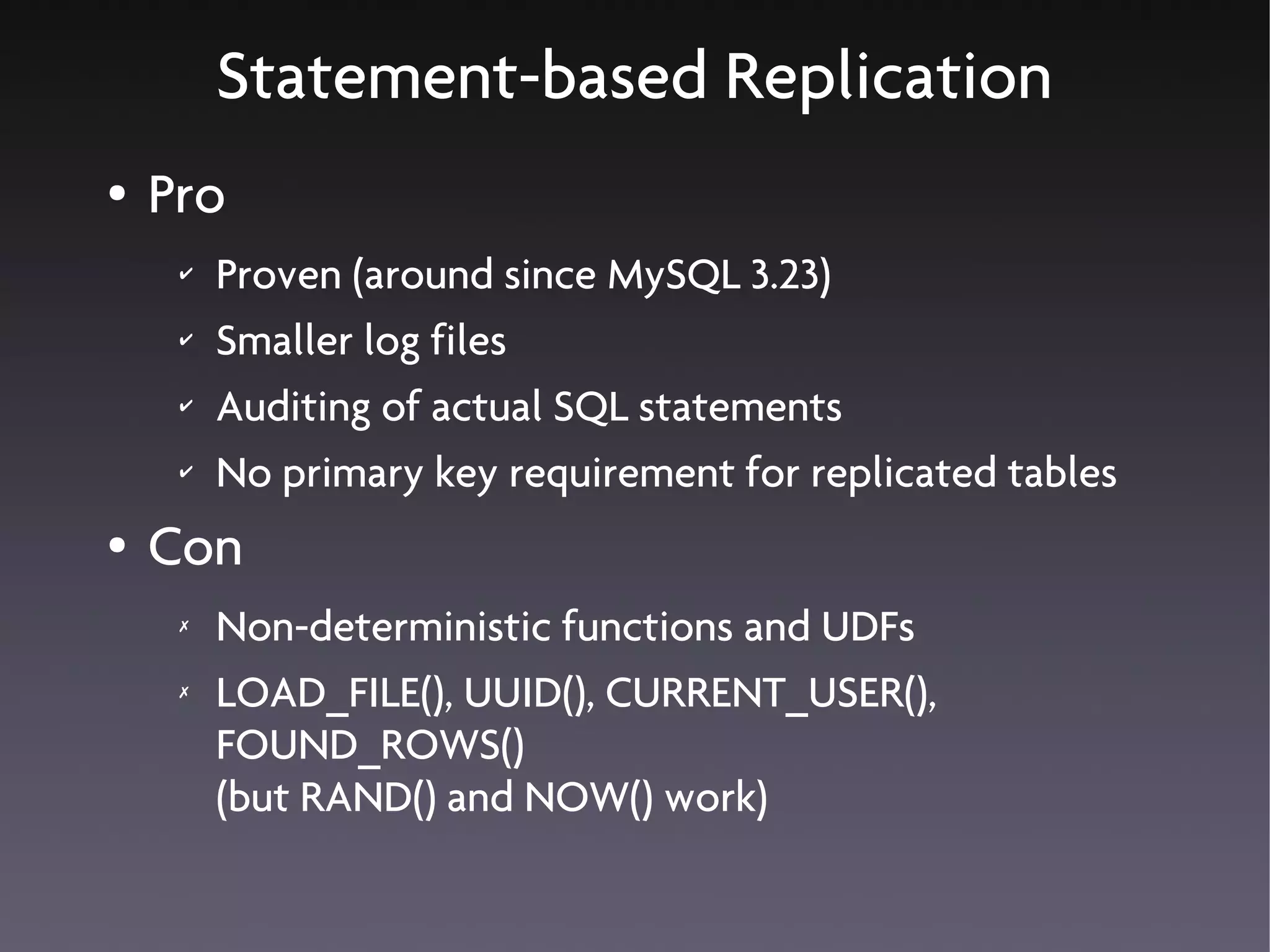
●   Pro
     ✔   Proven (around since MySQL 3.23)
     ✔   Smaller log files
     ✔   Auditing of actual SQL statements
     ✔   No primary key requirement for replicated tables
●   Con
     ✗   Non-deterministic functions and UDFs
     ✗   LOAD_FILE(), UUID(), CURRENT_USER(),
         FOUND_ROWS()
         (but RAND() and NOW() work)
Row-based Replication
●   Pro
     ✔   All changes can be replicated
     ✔   Similar technology used by other RDBMSes
     ✔   Fewer locks required for some INSERT, UPDATE or
         DELETE statements
●   Con
     ✗   More data to be logged
     ✗   Log file size increases (backup/restore implications)
     ✗   Replicated tables require explicit primary keys
     ✗   Possible different result sets on bulk INSERTs
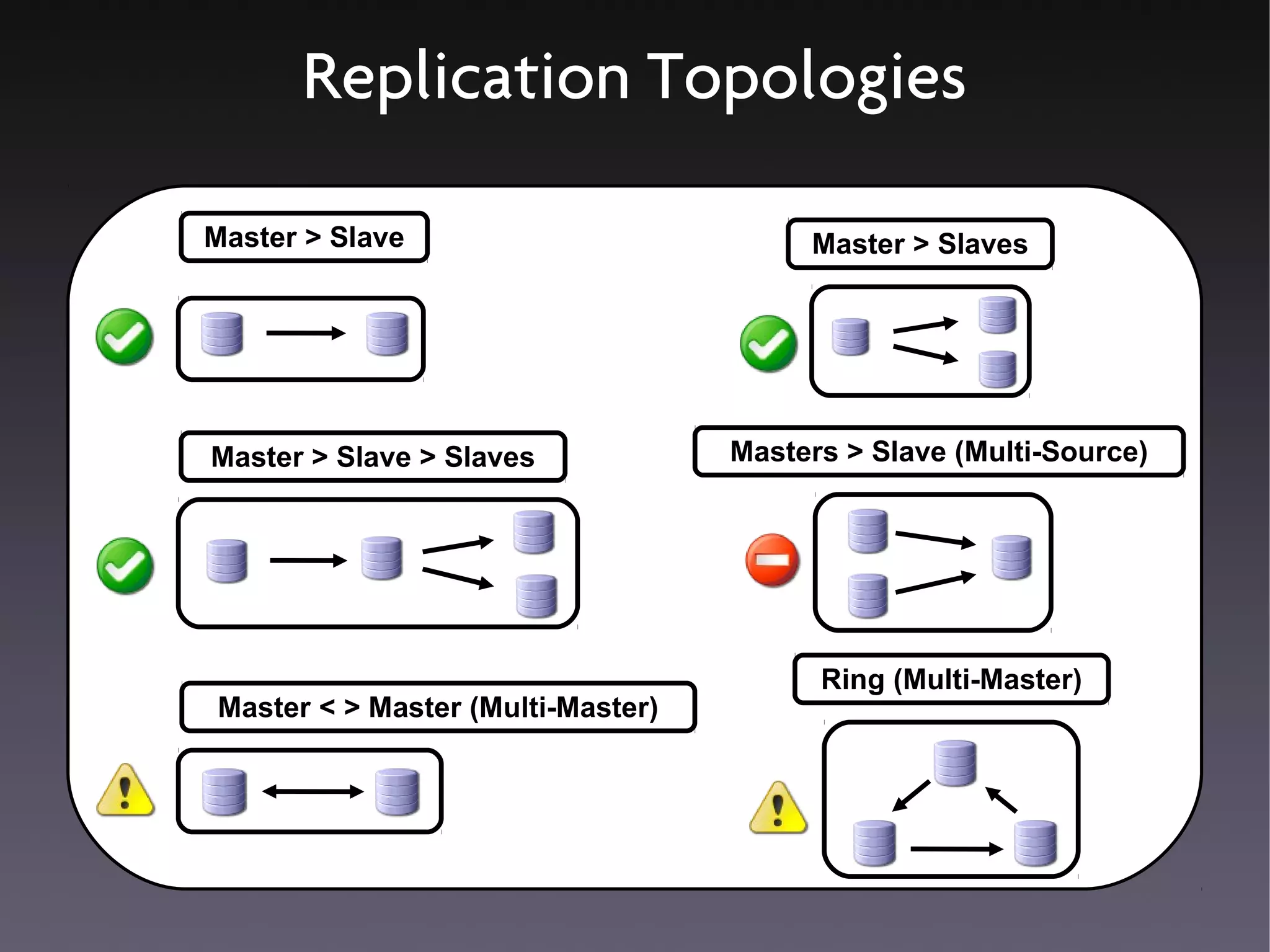
Replication Topologies

Master > Slave                          Master > Slaves


Master > Slave > Slaves            Masters > Slave (Multi-Source)


                                         Ring (Multi-Master)
Master < > Master (Multi-Master)
Master-Master Replication
●   Two nodes are both master and slave to
    each other
●   Useful for easier failover
●   Not suitable for (write) load-balancing
●   Don't write to both masters
    simultaneously!
●   Use Sharding or Partitioning instead
    (e.g. MySQL Proxy)
MySQL Replication as a HA Solution
●   What happens if the Master fails?
●   What happens if the Slave fails?
●   This doesn’t sound like High Availability!
●   Yes!
●   Replication is only part of a HA
    configuration
Pacemaker (Linux-HA)
●   Supports 2 or more Nodes (v2)
●   Resource monitoring (Apps and HW)
●   Active fencing mechanism (STONITH)
●   Node failure detection in seconds
●   Supports many applications (incl. MySQL)
●   http://clusterlabs.org/
●   http://www.clusterlabs.org/wiki/Load_Balanced_MySQL_Replicated_Cluster
●   http://www.clusterlabs.org/wiki/DRBD_MySQL_HowTo
Replication & HA
●   Combined with Pacemaker
●   Virtual IP takeover
●   Slave gets promoted to Master
●   Side benefits: load balancing & backup
●   Can be tricky to fail back
●   No automatic conflict resolution
●   Proper failover needs to be scripted
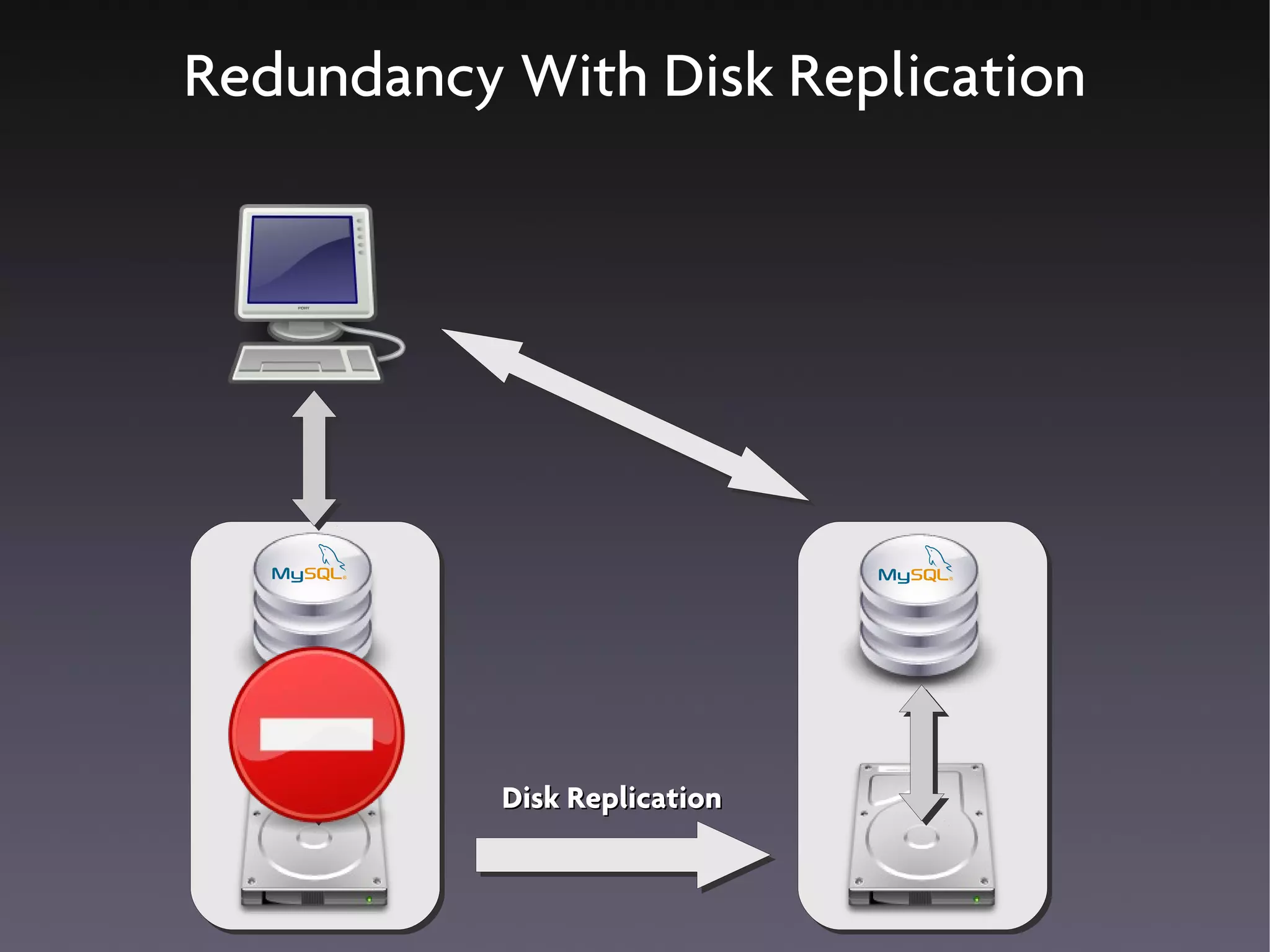
Redundancy With Disk Replication


           Disk Replication
DRBD
●   Distributed Replicated Block Device
●   “RAID-1 over network”
●   Synchronous/asynchronous block replication
●   Automatic resynchronisation
●   Application-agnostic
●   Can mask local I/O-Errors
●   Active/passive configuration
●   Dual-primary mode (requires cluster file sytem
    like GFS or OCFS2)
●   http://drbd.org/
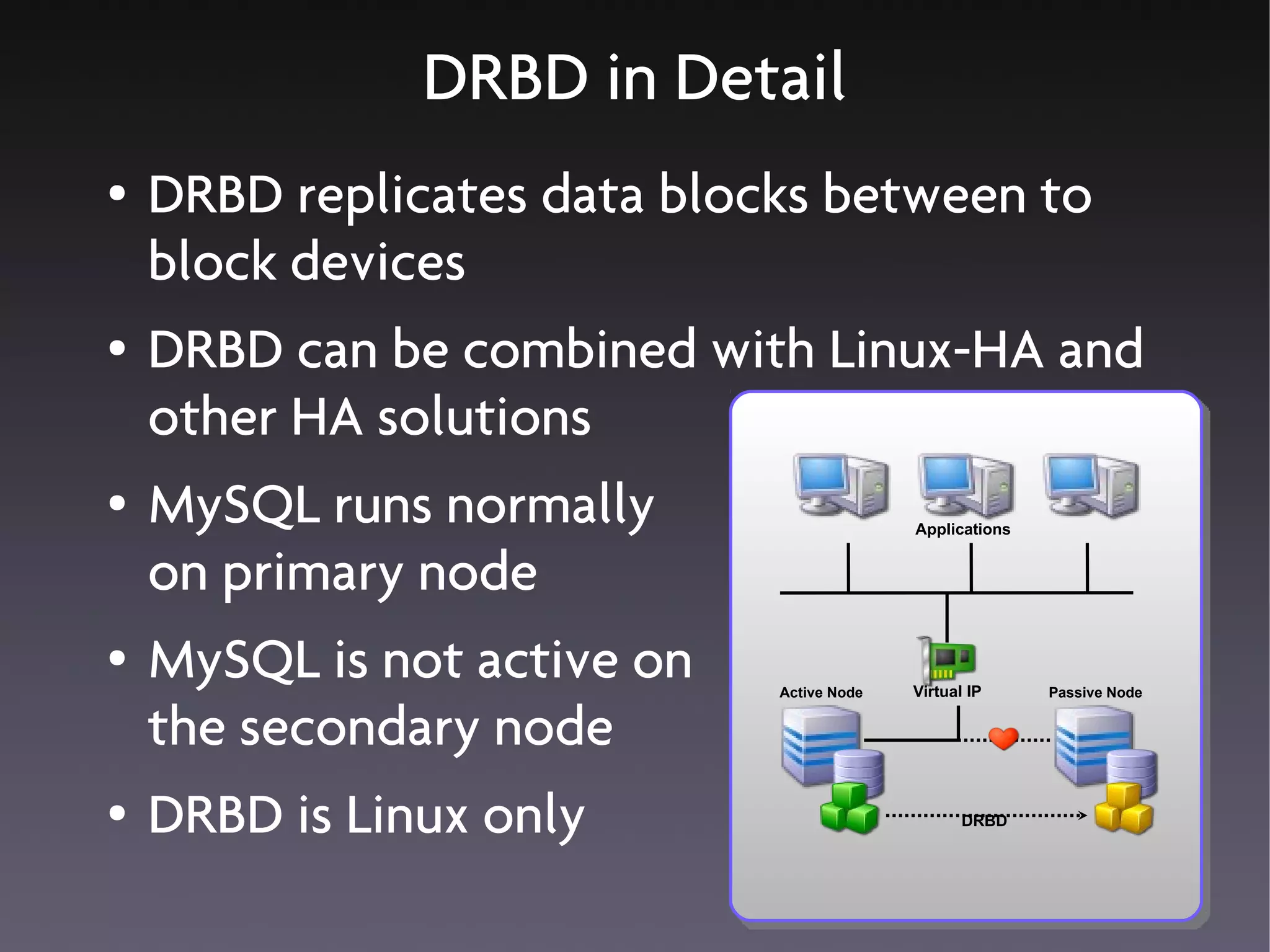
DRBD in Detail
●   DRBD replicates data blocks between to
    block devices
●   DRBD can be combined with Linux-HA and
    other HA solutions
●   MySQL runs normally                    Applications


    on primary node
●   MySQL is not active on   Active Node   Virtual IP     Passive Node


    the secondary node
●   DRBD is Linux only                            DRBD
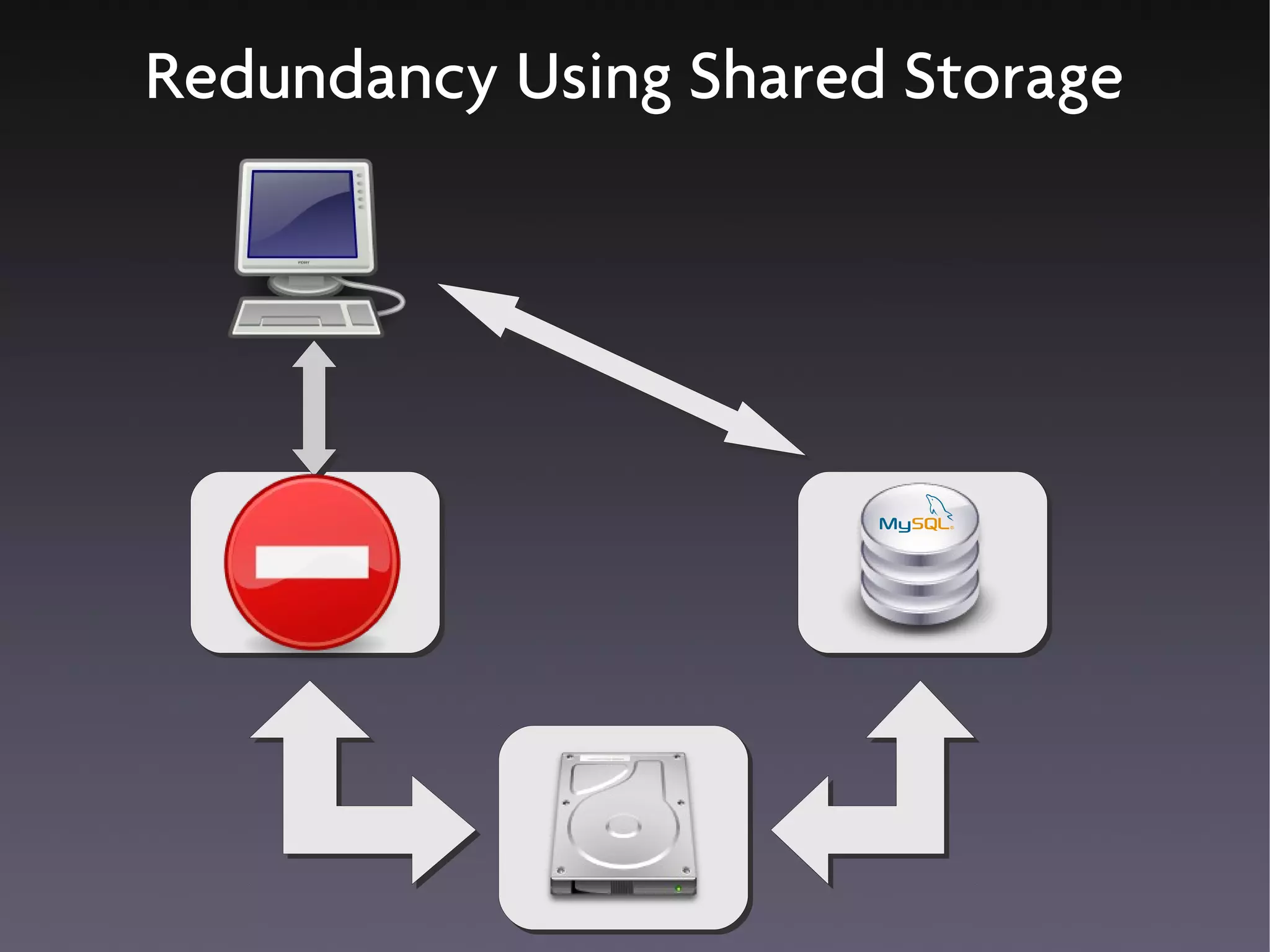
Redundancy Using Shared Storage
Replication vs. SAN
●   Data Consistency / Integrity
●   Synchronous vs. asynchronous
●   SAN can become the SPOF
●   Cold caches
●   “Split brain”-Situations
●   SAN/NAS I/O Overhead
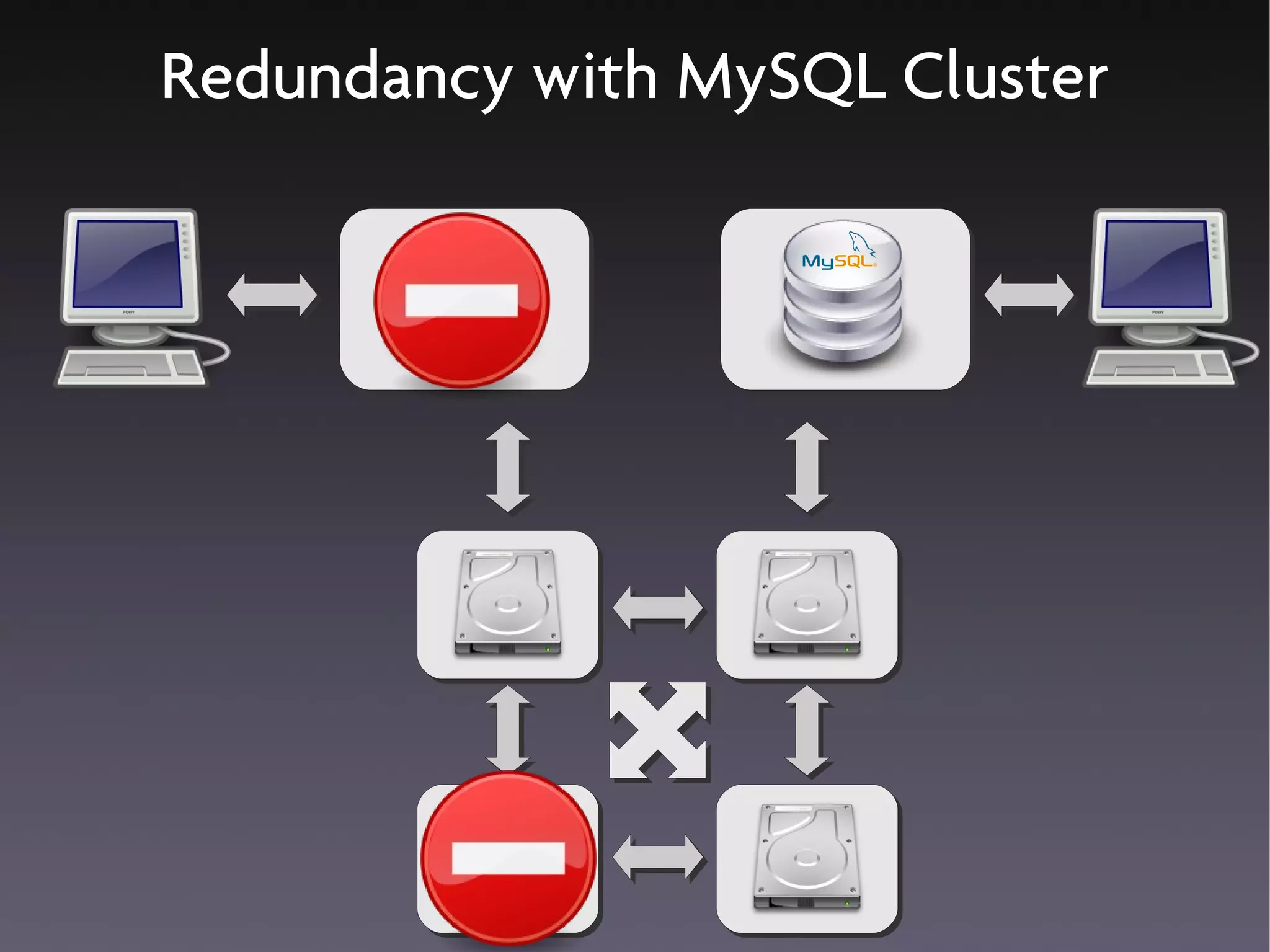
Redundancy with MySQL Cluster
MySQL Cluster
●   “Shared-nothing”-Architecture
●   Automatic partitioning
●   Distributed fragments
●   Synchronous replication
●   Fast, automatic fail-over of data nodes
●   Automatic resynchronisation
●   Transparent to MySQL applicationen
●   Supports transactions
●   http://mysql.com/products/database/cluster/
MySQL Cluster
●   In-memory indexes
●   Not suitable for all query patterns
    (cross-table JOINs, range scans)
●   No support for foreign keys
●   Not suitable for long running transactions
●   Network latency crucial
●   Can be combined with MySQL replication
    (RBR)
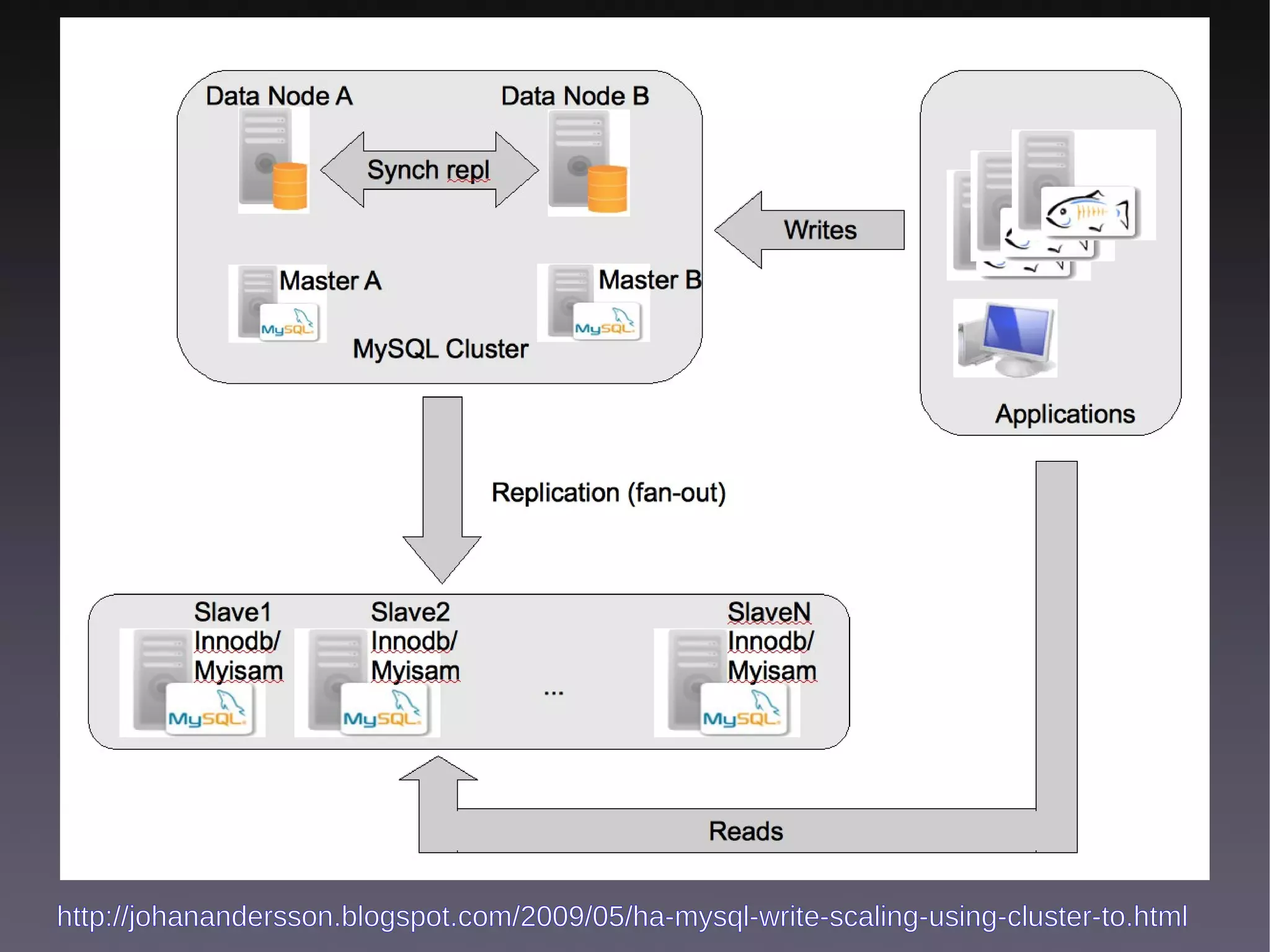
MySQL Cluster & Replikation
●   MySQL Cluster
     ●   Easy failover from one MySQL node to another
     ●   Scaling write load using multiple SQL nodes
●   Asynchronous replication from Cluster to
    regular MySQL slaves
●   Slaves take read load (InnoDB/MyISAM)
●   Quick setup of new slaves (Cluster Online
    Backup)
●   Easy failover and fast recovery
http://johanandersson.blogspot.com/2009/05/ha-mysql-write-scaling-using-cluster-to.html
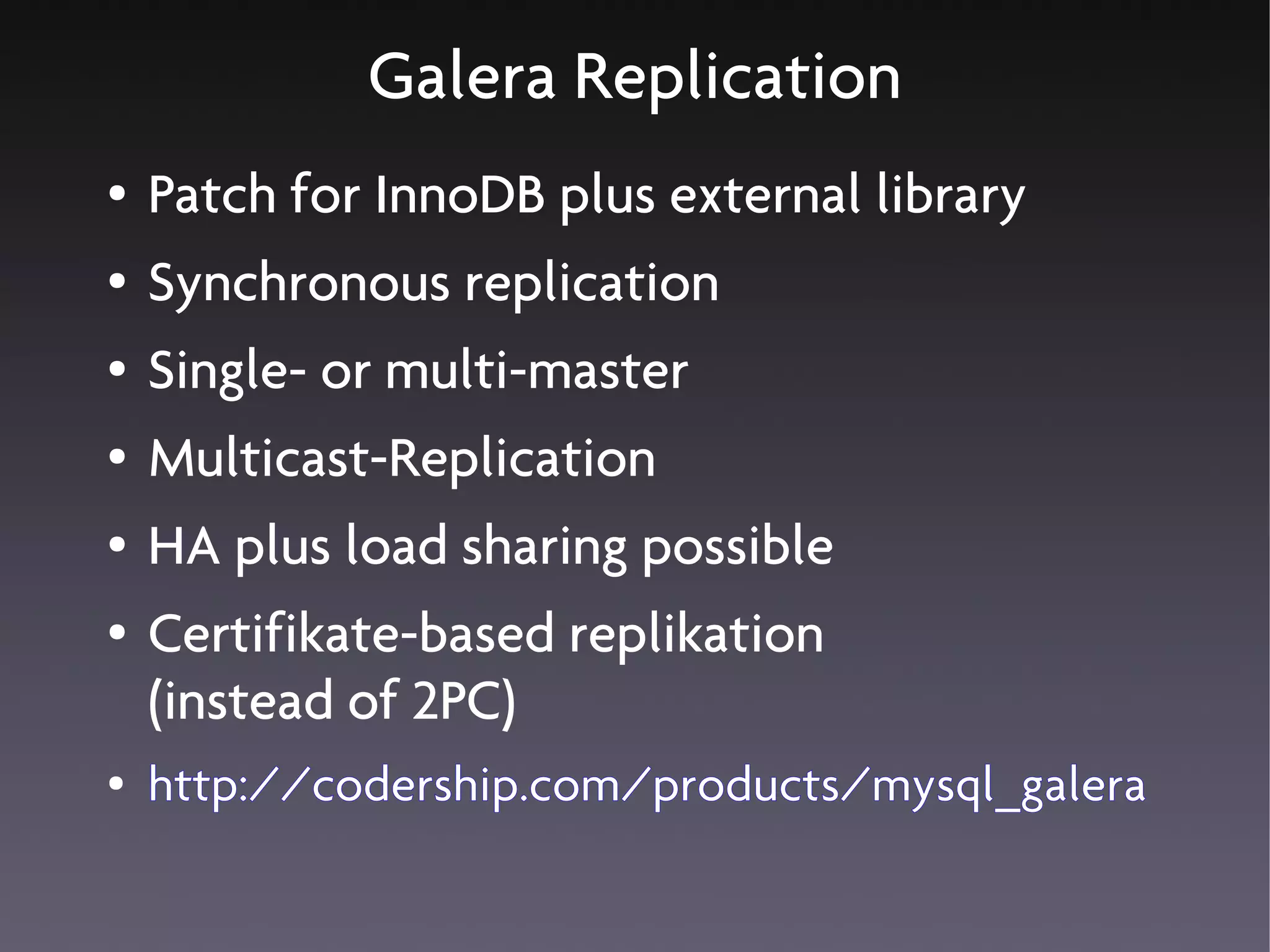
Galera Replication
●   Patch for InnoDB plus external library
●   Synchronous replication
●   Single- or multi-master
●   Multicast-Replication
●   HA plus load sharing possible
●   Certifikate-based replikation
    (instead of 2PC)
●   http://codership.com/products/mysql_galera
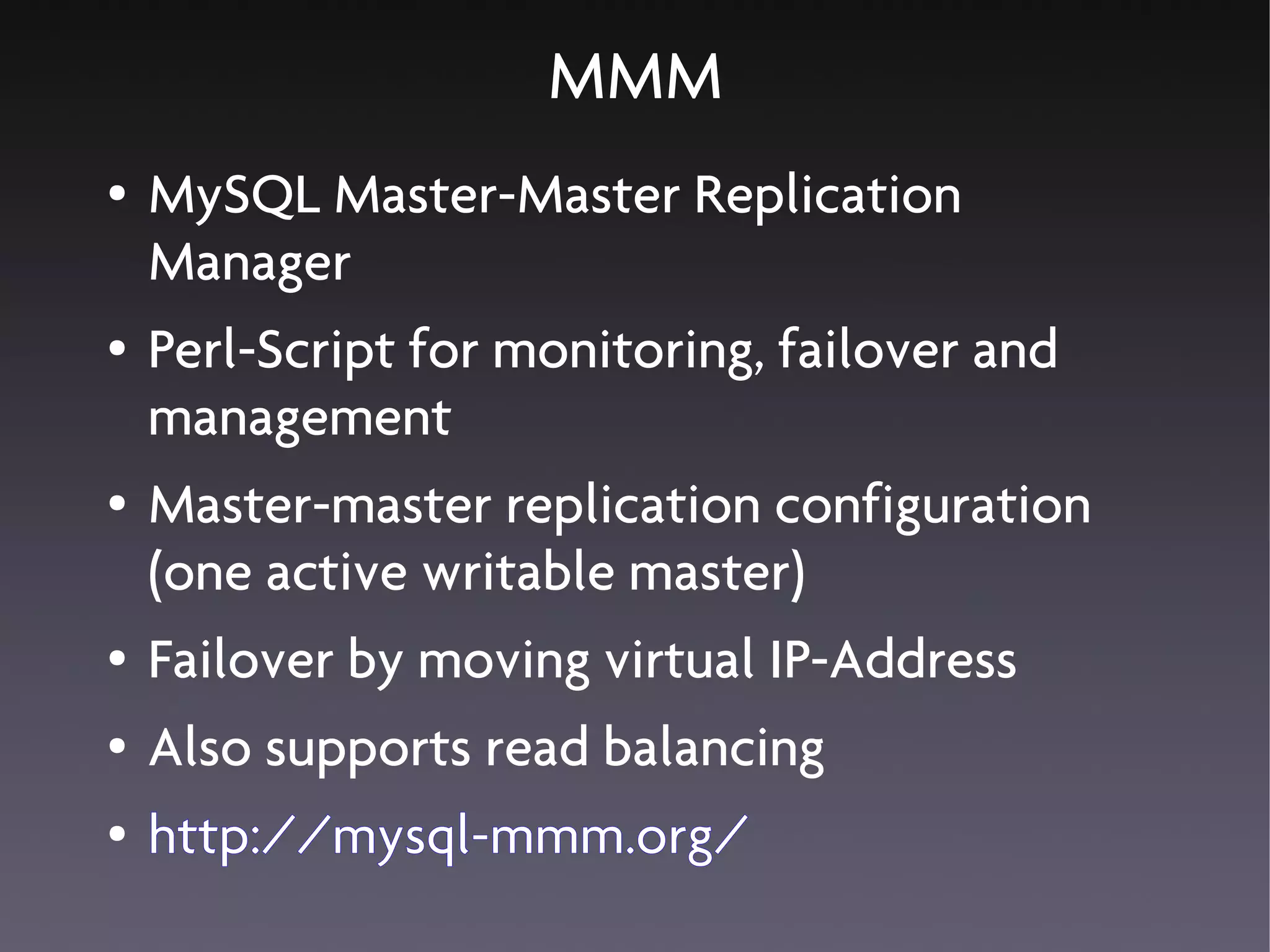
MMM
●   MySQL Master-Master Replication
    Manager
●   Perl-Script for monitoring, failover and
    management
●   Master-master replication configuration
    (one active writable master)
●   Failover by moving virtual IP-Address
●   Also supports read balancing
●   http://mysql-mmm.org/
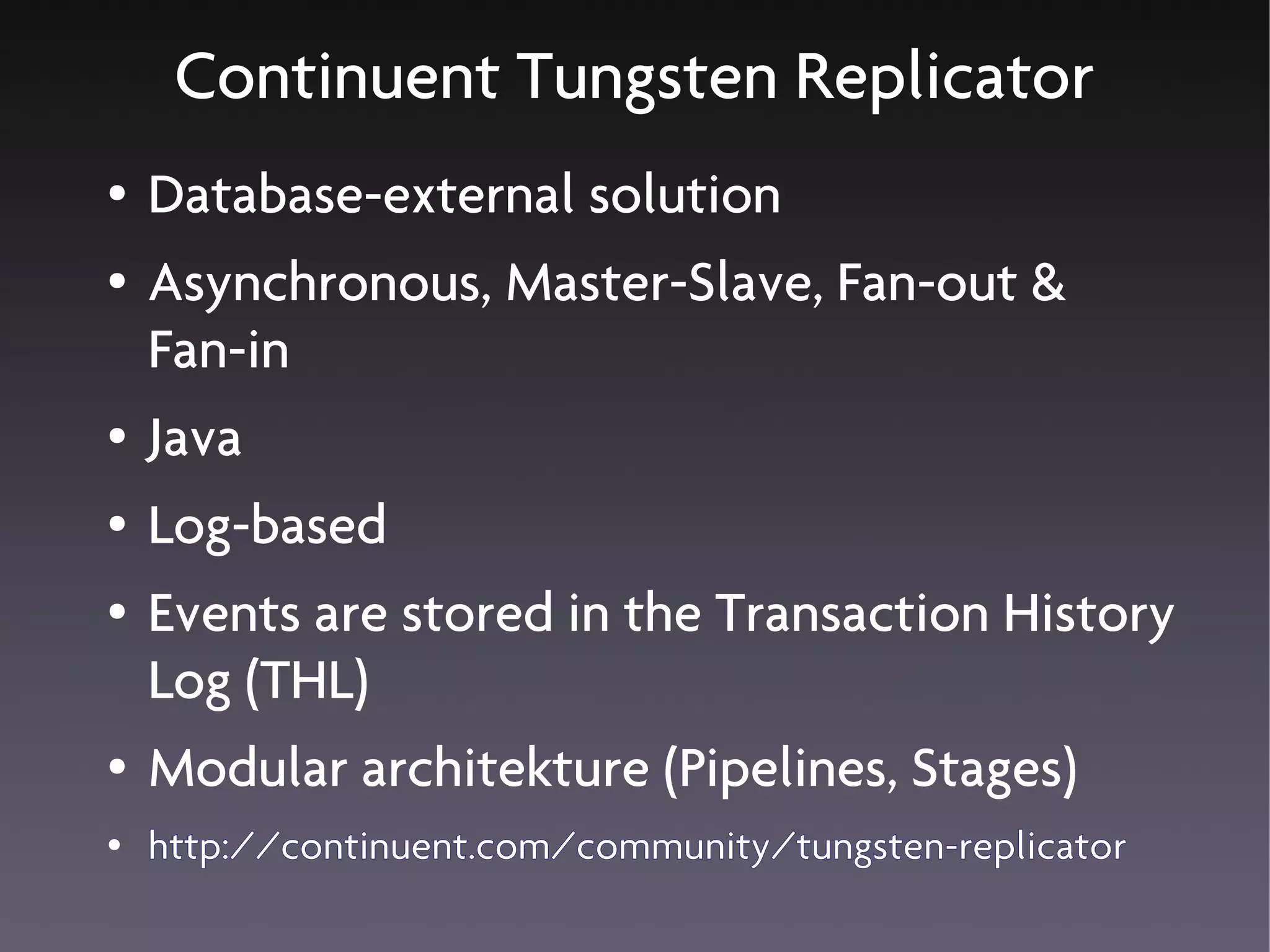
Continuent Tungsten Replicator
●   Database-external solution
●   Asynchronous, Master-Slave, Fan-out &
    Fan-in
●   Java
●   Log-based
●   Events are stored in the Transaction History
    Log (THL)
●   Modular architekture (Pipelines, Stages)
●   http://continuent.com/community/tungsten-replicator
Red Hat Cluster Suite
●   HA and load balancing
●   Supports up to 16 nodes
●   Shared storage
●   Monitors services, file systems and network
    status
●   Fencing (STONITH) or distributed lock
    manager
●   Configuration synchronization
●   http://www.redhat.com/cluster_suite/
Solaris Cluster / OpenHA Cluster
●   Provides failover and scalability services
●   Solaris / OpenSolaris (Project Colorado)
●   Kernel-level components plus userland
●   Agents monitor applications
●   Geo Edition to provide Disaster Recovery
    using Replication
●   Open Source since June 2007
●   http://hub.opensolaris.org/bin/view/Community+Group+ha-clusters/WebHome
●   http://hub.opensolaris.org/bin/view/Project+ha-mysql/WebHome
Flipper
●   Perl Script managing pairs of MySQL
    servers replicating to each other.
●   Automatic switchover, triggered manually
●   Enables one half of the pair to be taken
    offline for maintenance work while other
    half carries on
●   Moves IP addresses based on a role ("read-
    only", "writable")
●   http://provenscaling.com/software/flipper/
Q&A


Questions, Comments?
Thank you!


Lenz Grimmer <lenz@grimmer.com>
         Twitter: @lenzgr
         http://lenzg.net/

Mysqlhacodebits20091203 1260184765-phpapp02

  • 1.
    MySQL High AvailabilitySolutions Lenz Grimmer <lenz@grimmer.com> < http://lenzg.net/ | Twitter: @lenzgr 2011-01-26 | San Francisco MySQL Meetup | USA
  • 2.
    $ whoami 1998 2002 2008 2010
  • 3.
    Agenda ● High Availability: Concepts & Considerations ● MySQL Replication ● DRBD / Pacemaker ● MySQL Cluster ● Other HA tools/applications
  • 4.
    Single MySQL Server MySQL Client SQL (SELECT, INSERT, UPDATE, DELETE) MySQL Storage Engines (InnoDB, MyISAM, PBXT...) Disk Storage (XFS, ReiserFS, JFS, ext3...)
  • 5.
    Why HA? ● Something can and will fail ● Service Maintenance ● Downtime is expensive ● Adding HA to an existing system is complex
  • 6.
    Elimination of theSPOF ● Identify what will fail eventually ● Hard disks ● Fans ● Consider what might fail ● Application crashes ● OOM-Situations, Kernel-Panics ● Network connections, Cables ● Power supply
  • 7.
    What is HAClustering? ● Redundancy ● One system or service goes down → others take over ● IP address takeover, service takeover ● Ensuring data availability & integrity ● Not designed for high-performance
  • 8.
  • 9.
    Rules of HighAvailability ● Prepare for failure ● Aim to ensure that no important data is lost ● Keep it simple, stupid (KISS) ● Complexity is the enemy of reliability ● Automate it ● Test your setup frequently!
  • 10.
    HA Components ● Heartbeat ● Checks that services that are monitored, are alive. ● Can check individual servers, software services, networking etc. ● HA Monitor ● Configuration of the services ● Ensures proper shutdown and startup ● Allows manual control ● Shared storage / Replication
  • 11.
    Split-Brain ● Communications failures can lead to separated partitions of the cluster ● If those partitions each try and take control of the cluster, then it's called a split-brain condition ● If this happens, then bad things will happen ● Use Fencing or Moderation/Arbitration to avoid it
  • 12.
    Redundancy Using MySQLReplication MySQL Replication
  • 13.
    MySQL Replication ● Unidirectional ● Statement- or row-based (MySQL 5.1) ● Built into MySQL ● Easy to use and set up ● One Master, many Slaves ● Asynchronous – Slaves can lag behind ● New in MySQL 5.5: Semisync Replication
  • 14.
    MySQL Replication (2) ● Master maintains Binary logs & index ● Replication on Slave is single-threaded http://forge.mysql.com/wiki/ReplicationFeatures/ParallelSlave ● No automated fail-over ● No heartbeat, no monitoring ● New in 5.5: replication heartbeat
  • 15.
    MySQL Replication -Overview Read & Write Web/App Server Write Relay Log mysqld SQL I/O Threa Thread d Index & Binlogs Data Replication Binlog Data mysqld MySQL Master MySQL Slave
  • 16.
    Statement-based Replication ● Pro ✔ Proven (around since MySQL 3.23) ✔ Smaller log files ✔ Auditing of actual SQL statements ✔ No primary key requirement for replicated tables ● Con ✗ Non-deterministic functions and UDFs ✗ LOAD_FILE(), UUID(), CURRENT_USER(), FOUND_ROWS() (but RAND() and NOW() work)
  • 17.
    Row-based Replication ● Pro ✔ All changes can be replicated ✔ Similar technology used by other RDBMSes ✔ Fewer locks required for some INSERT, UPDATE or DELETE statements ● Con ✗ More data to be logged ✗ Log file size increases (backup/restore implications) ✗ Replicated tables require explicit primary keys ✗ Possible different result sets on bulk INSERTs
  • 18.
    Replication Topologies Master >Slave Master > Slaves Master > Slave > Slaves Masters > Slave (Multi-Source) Ring (Multi-Master) Master < > Master (Multi-Master)
  • 19.
    Master-Master Replication ● Two nodes are both master and slave to each other ● Useful for easier failover ● Not suitable for (write) load-balancing ● Don't write to both masters simultaneously! ● Use Sharding or Partitioning instead (e.g. MySQL Proxy)
  • 20.
    MySQL Replication asa HA Solution ● What happens if the Master fails? ● What happens if the Slave fails? ● This doesn’t sound like High Availability! ● Yes! ● Replication is only part of a HA configuration
  • 21.
    Pacemaker (Linux-HA) ● Supports 2 or more Nodes (v2) ● Resource monitoring (Apps and HW) ● Active fencing mechanism (STONITH) ● Node failure detection in seconds ● Supports many applications (incl. MySQL) ● http://clusterlabs.org/ ● http://www.clusterlabs.org/wiki/Load_Balanced_MySQL_Replicated_Cluster ● http://www.clusterlabs.org/wiki/DRBD_MySQL_HowTo
  • 22.
    Replication & HA ● Combined with Pacemaker ● Virtual IP takeover ● Slave gets promoted to Master ● Side benefits: load balancing & backup ● Can be tricky to fail back ● No automatic conflict resolution ● Proper failover needs to be scripted
  • 23.
    Redundancy With DiskReplication Disk Replication
  • 24.
    DRBD ● Distributed Replicated Block Device ● “RAID-1 over network” ● Synchronous/asynchronous block replication ● Automatic resynchronisation ● Application-agnostic ● Can mask local I/O-Errors ● Active/passive configuration ● Dual-primary mode (requires cluster file sytem like GFS or OCFS2) ● http://drbd.org/
  • 25.
    DRBD in Detail ● DRBD replicates data blocks between to block devices ● DRBD can be combined with Linux-HA and other HA solutions ● MySQL runs normally Applications on primary node ● MySQL is not active on Active Node Virtual IP Passive Node the secondary node ● DRBD is Linux only DRBD
  • 26.
  • 27.
    Replication vs. SAN ● Data Consistency / Integrity ● Synchronous vs. asynchronous ● SAN can become the SPOF ● Cold caches ● “Split brain”-Situations ● SAN/NAS I/O Overhead
  • 28.
  • 29.
    MySQL Cluster ● “Shared-nothing”-Architecture ● Automatic partitioning ● Distributed fragments ● Synchronous replication ● Fast, automatic fail-over of data nodes ● Automatic resynchronisation ● Transparent to MySQL applicationen ● Supports transactions ● http://mysql.com/products/database/cluster/
  • 30.
    MySQL Cluster ● In-memory indexes ● Not suitable for all query patterns (cross-table JOINs, range scans) ● No support for foreign keys ● Not suitable for long running transactions ● Network latency crucial ● Can be combined with MySQL replication (RBR)
  • 32.
    MySQL Cluster &Replikation ● MySQL Cluster ● Easy failover from one MySQL node to another ● Scaling write load using multiple SQL nodes ● Asynchronous replication from Cluster to regular MySQL slaves ● Slaves take read load (InnoDB/MyISAM) ● Quick setup of new slaves (Cluster Online Backup) ● Easy failover and fast recovery
  • 33.
  • 34.
    Galera Replication ● Patch for InnoDB plus external library ● Synchronous replication ● Single- or multi-master ● Multicast-Replication ● HA plus load sharing possible ● Certifikate-based replikation (instead of 2PC) ● http://codership.com/products/mysql_galera
  • 35.
    MMM ● MySQL Master-Master Replication Manager ● Perl-Script for monitoring, failover and management ● Master-master replication configuration (one active writable master) ● Failover by moving virtual IP-Address ● Also supports read balancing ● http://mysql-mmm.org/
  • 36.
    Continuent Tungsten Replicator ● Database-external solution ● Asynchronous, Master-Slave, Fan-out & Fan-in ● Java ● Log-based ● Events are stored in the Transaction History Log (THL) ● Modular architekture (Pipelines, Stages) ● http://continuent.com/community/tungsten-replicator
  • 37.
    Red Hat ClusterSuite ● HA and load balancing ● Supports up to 16 nodes ● Shared storage ● Monitors services, file systems and network status ● Fencing (STONITH) or distributed lock manager ● Configuration synchronization ● http://www.redhat.com/cluster_suite/
  • 38.
    Solaris Cluster /OpenHA Cluster ● Provides failover and scalability services ● Solaris / OpenSolaris (Project Colorado) ● Kernel-level components plus userland ● Agents monitor applications ● Geo Edition to provide Disaster Recovery using Replication ● Open Source since June 2007 ● http://hub.opensolaris.org/bin/view/Community+Group+ha-clusters/WebHome ● http://hub.opensolaris.org/bin/view/Project+ha-mysql/WebHome
  • 39.
    Flipper ● Perl Script managing pairs of MySQL servers replicating to each other. ● Automatic switchover, triggered manually ● Enables one half of the pair to be taken offline for maintenance work while other half carries on ● Moves IP addresses based on a role ("read- only", "writable") ● http://provenscaling.com/software/flipper/
  • 40.
  • 41.
    Thank you! Lenz Grimmer<lenz@grimmer.com> Twitter: @lenzgr http://lenzg.net/