GlusterFS Translators
Conceptual Overview
Jeff Darcy
August 28, 2012
We Should Have Called It DIYFS
● GlusterFS is a not a file system
● It's a way to build new file systems
● We happen to have built a fairly nice one
● distribution, replication, NFS/Swift/Hadoop, . . .
● come see that presentation tomorrow
● Don't like it? Build your own!
Translating “translator”
● A translator converts requests from users into requests
for storage
● one to one, one to many, one to zero (e.g. caching)
● A translator can modify requests on the way through
● convert one request type into another
● modify paths, flags, even data (e.g. encryption)
● ...intercept or block them (e.g. access control)
● ...or spawn new requests (e.g. pre-fetch)
Example: Request Routing in DHT
User (via FUSE)
DHT
Brick 1 Brick 2
Request goes
this way (not used)
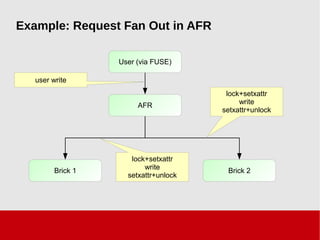
Example: Request Fan Out in AFR
User (via FUSE)
AFR
Brick 1 Brick 2
lock+setxattr
write
setxattr+unlock
lock+setxattr
write
setxattr+unlock
user write
Example: Read Ahead
User (via FUSE)
read-ahead
Brick 1
Prefetch read
(async)
Original
read
First
user read
User (via FUSE)
read-ahead
Brick 1
Second
user read
(not used)
Reply
from cache
Why Build Your Own?
● GlusterFS represents a particular set of design choices
● e.g. data safety is first priority
● . . . then consistency is second . . .
● . . . finally performance
● Those choices aren't right for everyone
● Tuning only gets you so far
● We can never cover all of the use cases
● this is where HekaFS came from
Tradeoff Example: Slow Replication
● Principle: data safety before performance
● We do extra operations to make sure data survives a
crash
● That means more network round trips
● Optimizations work well for buffered sequential writes
● not so much for small/random/synchronous writes
● Lesson: AFR (today) might not be right for some
workloads (e.g. virtual-machine images)
● . . . so I wrote bypass, hsrepl
Tradeoff Example: Slow Directory Listings
● Principle: consistency before performance
● We assume other clients might have added, changed,
or deleted files
● We do a new lookup/stat/getxattr each time
● This especially hurts us e.g. with PHP scripts, git
service
● Lesson: tune cache/prefetch translators, use
autoloaders/APC
● . . . or try xattr-prefetch, negative-lookup
Benefit of DIY
● Let's see how negative-lookup helps “PHP” workload
● 1000 files spread across 10 directories
● power-law distribution: 80% of hits to 10% of files
● Measure time to find each file
[root@gfs-i8c-04 phpsim]# ./worker.py
average latency = 0.690ms
[root@gfs-i8c-04 phpsim]# ./worker.py
average latency = 2.478ms
GlusterFS 3.3
negative-lookup
over 3x as fast
How Do Translators Work?
● Shared objects
● Dynamically loaded according to “volfile”
● dlopen/dlsym
● set up pointers to parents/children
● call init (constructor)
● call I/O functions through fops
● Conventions for validating/passing options etc.
● “Translator 101” series at hekafs.org
Asynchronous Programming Model
1267 STACK_WIND (frame, dht_unlink_cbk,
1268 cached_subvol, cached_subvol->fops->unlink,
1269 &local->loc);
1270
1271 return 0;
callback function
next translator specific function
DANGER ZONE
Danger Zone?
● You lost control when you called STACK_WIND
● callback might have already happened reentrantly
● . . . or it might be running on another thread right now
● . . . or it might not run for a long time
● Data might be modified, freed, still in use
● Be extremely careful doing anything but return after
STACK_WIND
● (please clean up local allocations/references though)
Saving Context
● Pass translator-specific information between original
function and call back
● Framework provides frame->local for exactly this
● pointer to whatever structure you want
● local to call, not translator (that's this->private)
● you allocate from mem_pool, we free when call is done
● Gotcha: frame will be shared between STACK_WIND
callbacks
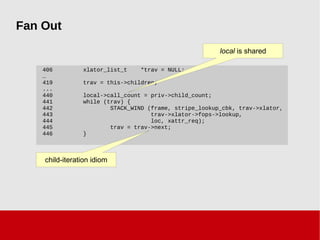
Fan Out
406 xlator_list_t *trav = NULL;
…
419 trav = this->children;
...
440 local->call_count = priv->child_count;
441 while (trav) {
442 STACK_WIND (frame, stripe_lookup_cbk, trav->xlator,
443 trav->xlator->fops->lookup,
444 loc, xattr_req);
445 trav = trav->next;
446 }
local is shared
child-iteration idiom
Fan In
314 LOCK (&frame->lock);
315 {
316 callcnt = --local->call_count;
…
374 }
375 UNLOCK (&frame->lock);
376
377 if (!callcnt) {
lock shared structure
how we know
we're done
Deferring Calls
2175 stub = fop_writev_stub (frame, NULL, fd, vector, count, offset, flags,
2176 iobref, xdata);
....
1843 call_resume (stub);
● There's an fop_xxx_stub for each operation type
● . . . and for each callback too
● You can also call_stub_destroy instead of resuming
capture arguments
in a structure
from callback
or worker thread
Initiating New Calls
477 newframe = create_frame(this,&priv->pool);
...
487 STACK_WIND_COOKIE (newframe, hsrepl_np_cbk, child1,
488 child1, child1->fops->setxattr,
489 &tmploc, dict, 0, NULL);
...
120 STACK_DESTROY(frame->root);
actually creates
a whole stack
sometimes
copy_frame
in callback
instead of STACK_UNWIND
Persistent objects
● Inode (inode_t) represents a file on disk
● File descriptor (fd_t) represents an open file
● Reference counted - inode_ref, fd_unref
● Translators can add own context
● e.g. inode_ctx_put (inode, xlator, value)
● values are 64-bit unsigned (or pointers)
● adding context causes translator's forget/release to be
called when object is deleted
Utility Functions
● Dictionaries
● Memory management with accounting: GF_MALLOC,
GF_CALLOC, GF_FREE
● Logging: gf_log, gf_print_trace
● UUIDs, hashes, red/black trees, name resolution
● all sorts of other stuff

Lcna tutorial-2012

  • 1.
  • 2.
    We Should HaveCalled It DIYFS ● GlusterFS is a not a file system ● It's a way to build new file systems ● We happen to have built a fairly nice one ● distribution, replication, NFS/Swift/Hadoop, . . . ● come see that presentation tomorrow ● Don't like it? Build your own!
  • 3.
    Translating “translator” ● Atranslator converts requests from users into requests for storage ● one to one, one to many, one to zero (e.g. caching) ● A translator can modify requests on the way through ● convert one request type into another ● modify paths, flags, even data (e.g. encryption) ● ...intercept or block them (e.g. access control) ● ...or spawn new requests (e.g. pre-fetch)
  • 4.
    Example: Request Routingin DHT User (via FUSE) DHT Brick 1 Brick 2 Request goes this way (not used)
  • 5.
    Example: Request FanOut in AFR User (via FUSE) AFR Brick 1 Brick 2 lock+setxattr write setxattr+unlock lock+setxattr write setxattr+unlock user write
  • 6.
    Example: Read Ahead User(via FUSE) read-ahead Brick 1 Prefetch read (async) Original read First user read User (via FUSE) read-ahead Brick 1 Second user read (not used) Reply from cache
  • 7.
    Why Build YourOwn? ● GlusterFS represents a particular set of design choices ● e.g. data safety is first priority ● . . . then consistency is second . . . ● . . . finally performance ● Those choices aren't right for everyone ● Tuning only gets you so far ● We can never cover all of the use cases ● this is where HekaFS came from
  • 8.
    Tradeoff Example: SlowReplication ● Principle: data safety before performance ● We do extra operations to make sure data survives a crash ● That means more network round trips ● Optimizations work well for buffered sequential writes ● not so much for small/random/synchronous writes ● Lesson: AFR (today) might not be right for some workloads (e.g. virtual-machine images) ● . . . so I wrote bypass, hsrepl
  • 9.
    Tradeoff Example: SlowDirectory Listings ● Principle: consistency before performance ● We assume other clients might have added, changed, or deleted files ● We do a new lookup/stat/getxattr each time ● This especially hurts us e.g. with PHP scripts, git service ● Lesson: tune cache/prefetch translators, use autoloaders/APC ● . . . or try xattr-prefetch, negative-lookup
  • 10.
    Benefit of DIY ●Let's see how negative-lookup helps “PHP” workload ● 1000 files spread across 10 directories ● power-law distribution: 80% of hits to 10% of files ● Measure time to find each file [root@gfs-i8c-04 phpsim]# ./worker.py average latency = 0.690ms [root@gfs-i8c-04 phpsim]# ./worker.py average latency = 2.478ms GlusterFS 3.3 negative-lookup over 3x as fast
  • 11.
    How Do TranslatorsWork? ● Shared objects ● Dynamically loaded according to “volfile” ● dlopen/dlsym ● set up pointers to parents/children ● call init (constructor) ● call I/O functions through fops ● Conventions for validating/passing options etc. ● “Translator 101” series at hekafs.org
  • 12.
    Asynchronous Programming Model 1267STACK_WIND (frame, dht_unlink_cbk, 1268 cached_subvol, cached_subvol->fops->unlink, 1269 &local->loc); 1270 1271 return 0; callback function next translator specific function DANGER ZONE
  • 13.
    Danger Zone? ● Youlost control when you called STACK_WIND ● callback might have already happened reentrantly ● . . . or it might be running on another thread right now ● . . . or it might not run for a long time ● Data might be modified, freed, still in use ● Be extremely careful doing anything but return after STACK_WIND ● (please clean up local allocations/references though)
  • 14.
    Saving Context ● Passtranslator-specific information between original function and call back ● Framework provides frame->local for exactly this ● pointer to whatever structure you want ● local to call, not translator (that's this->private) ● you allocate from mem_pool, we free when call is done ● Gotcha: frame will be shared between STACK_WIND callbacks
  • 15.
    Fan Out 406 xlator_list_t*trav = NULL; … 419 trav = this->children; ... 440 local->call_count = priv->child_count; 441 while (trav) { 442 STACK_WIND (frame, stripe_lookup_cbk, trav->xlator, 443 trav->xlator->fops->lookup, 444 loc, xattr_req); 445 trav = trav->next; 446 } local is shared child-iteration idiom
  • 16.
    Fan In 314 LOCK(&frame->lock); 315 { 316 callcnt = --local->call_count; … 374 } 375 UNLOCK (&frame->lock); 376 377 if (!callcnt) { lock shared structure how we know we're done
  • 17.
    Deferring Calls 2175 stub= fop_writev_stub (frame, NULL, fd, vector, count, offset, flags, 2176 iobref, xdata); .... 1843 call_resume (stub); ● There's an fop_xxx_stub for each operation type ● . . . and for each callback too ● You can also call_stub_destroy instead of resuming capture arguments in a structure from callback or worker thread
  • 18.
    Initiating New Calls 477newframe = create_frame(this,&priv->pool); ... 487 STACK_WIND_COOKIE (newframe, hsrepl_np_cbk, child1, 488 child1, child1->fops->setxattr, 489 &tmploc, dict, 0, NULL); ... 120 STACK_DESTROY(frame->root); actually creates a whole stack sometimes copy_frame in callback instead of STACK_UNWIND
  • 19.
    Persistent objects ● Inode(inode_t) represents a file on disk ● File descriptor (fd_t) represents an open file ● Reference counted - inode_ref, fd_unref ● Translators can add own context ● e.g. inode_ctx_put (inode, xlator, value) ● values are 64-bit unsigned (or pointers) ● adding context causes translator's forget/release to be called when object is deleted
  • 20.
    Utility Functions ● Dictionaries ●Memory management with accounting: GF_MALLOC, GF_CALLOC, GF_FREE ● Logging: gf_log, gf_print_trace ● UUIDs, hashes, red/black trees, name resolution ● all sorts of other stuff

Editor's Notes

  • #6 Note conversion of single user request into multiple lower-level requests (some of different types)
  • #17 NB: we could use atomics, but don't due to portability concerns