Work Queueing with Redis.pm
B. Estrade
http://houston.pm.org/
August 8th, 2013
What is Redis?
● a keyed (shared) data structures server
● supports its own protocol
● supports: scalar, hash, list, set
● “in memory” + optional bin logging
● “single threaded, except when it’s not”
● publish/subscribe “channels”
Demo requires set up time if you wish to run
it yourself.
Now’s a good time to start the Vagrant
process if you have not yet done so.
https://github.com/estrabd/houston-pm-redis-talk
Redis.pm
● “official” Redis client for Perl
● wrapper around Redis protocol, methods
use Redis;
my $redis = Redis->new(server =>
'192.168.2.3');
$redis->ping;
vagrant@precise64:/vagrant$ telnet 192.168.3.2 6379
Trying 192.168.3.2...
Connected to 192.168.3.2.
Escape character is '^]'.
ping
+PONG
Perl Script
Telnet Session
A Work Queue (FIFO)
What is Work Queueing? Why?
● a method of distributing tasks to a pool of
worker processes
● useful for massively scaling web applications
● decouples requests from resource intensive
interactions (e.g., with a DB)
● more secure, workers can be in a private net
● # of workers can be tuned based on load
Redis as a Queue?
● use the “list” data structure
● non-blocking:
○ lpush, rpush, lpop, rpop, rpoplpush*
● blocking
○ blpop, brpop, brpoplpush*
● necessarily implements atomic pop’ing
● other structures can be used for meta data* provides for “reliable” queues
Why Not MySQL as a Queue
● list operations must be emulated
● inefficient table locking req’d for atomic pops
Why Not Memcached as Queue
● federation would be a nice feature of a
queue
● but, memcached supports only scalar
key/val
● back to implementing atomic pops (idk
how?)
● MemcachedQ, based on MemcachedBD
exists, but languishing
Other options
● beanstalkd - not mature, not stable enough
● RabbitMQ - overkill (but not for HA
messaging?)
● NoSQL option? Not sure.
Simple Queue Client using Redis.pm
● submit_task
● get_task
● bget_task
Supporting hooks for serialization/deserialization:
● _encode_task
● _decode_task
Task.pm
● send/receive blessed Task references
● fields: type ($pkg), id, payload (‘HASH’)
● Sending:
○ serialize blessed ref (encode as JSON)
○ lpush string onto Redis list
● Receiving
○ pop off of list, parse decode with JSON::XS
○ re-bless with $task->{type}
Ping Pong
● Synchronize
● Ponger waits for Ping
● Pinger sends Ping, waits for ACK via Pong
● Repeat in turn until $rounds complete
Ping Pong
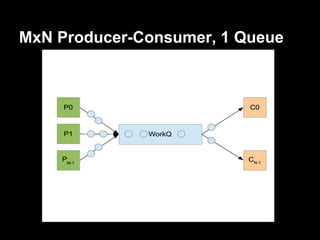
MxN Producer-Consumer, 1 Queue
● M Producers
● N Consumers
● Producers “fire and forget” - asynchronous
task submit
● Consumers pull from Queue in first come
first serve order
MxN Producer-Consumer, 1 Queue
Sync’d MxN Produce-Consume
● M Producers
● N Consumers
● Producer blocks on submit until it gets a
response from whichever Consumer got it
● Requires use of “private” queues for ACKs
Sync’d MxN Produce-Consume
Other Patterns
● Scaling out synchronous produce/consume
○ M producers, N consumers, P queues
○ best implemented with forking consumers,
○ with each child watching a different queue
● Circuitous messaging and routing
○ tasks beget other tasks to other consumers
○ chain reaction like
○ heavy use of private queus
○ useful for something?
Redis Failover Options?
● Master/Slave replication via binary log
● Redis HA Cluster in development
● Craigslist uses sharding & “federated” Redis,
which is not supported natively (here & here)
● Could use a pool of Redis instances/queues
○ Sharing/Federation is often overkill for just queuing
○ Producers will try to submit until successful
○ Available queue assumed to have at least one consumer
Note on General Messaging
● Redis is not the best foundation for “reliable”
2-way messaging
● Redis “cluster”, sharding/federating is best
here for reliability
● RabbitMQ seems to a fine, if heavy solution
for this
● ...which segues nicely into Failover
Tips
● treat Redis instances as ephemeral
● turn off binary logging for high throughput
● not convinced it’s a good durable data store
● Redis seems highly stable/reliable
● 1 machine can support many Redis daemons
● it’s smart to wrap blocking calls with alarm
Demo
● Reproducible using Vagrant manifest (KMA,
Murphy! ;)
● Ping Pong
● Asynchronous M Producer x N Consumer
● Synchronous M Producer x N Consumer
Conclusion
● Redis shines for work queueing
● Lots of potential to make w-q patterns scale
● Similarly, it can be highly available/reliable
● Open Questions -
○ leveraging other data structures for meta data
○ e.g., implement “queue” state -
■ accepting
■ draining
■ offline
Resources
● https://github.com/estrabd/houston-pm-redis-talk
● https://github.com/melo/perl-redis
● http://blog.zawodny.com/2011/02/26/redis-sharding-at-craigslist/
● Vagrant
● http://houston.pm.org/
● http://www.cpanel.net

Work WIth Redis and Perl

  • 1.
    Work Queueing withRedis.pm B. Estrade http://houston.pm.org/ August 8th, 2013
  • 2.
    What is Redis? ●a keyed (shared) data structures server ● supports its own protocol ● supports: scalar, hash, list, set ● “in memory” + optional bin logging ● “single threaded, except when it’s not” ● publish/subscribe “channels”
  • 3.
    Demo requires setup time if you wish to run it yourself. Now’s a good time to start the Vagrant process if you have not yet done so. https://github.com/estrabd/houston-pm-redis-talk
  • 4.
    Redis.pm ● “official” Redisclient for Perl ● wrapper around Redis protocol, methods use Redis; my $redis = Redis->new(server => '192.168.2.3'); $redis->ping; vagrant@precise64:/vagrant$ telnet 192.168.3.2 6379 Trying 192.168.3.2... Connected to 192.168.3.2. Escape character is '^]'. ping +PONG Perl Script Telnet Session
  • 5.
  • 6.
    What is WorkQueueing? Why? ● a method of distributing tasks to a pool of worker processes ● useful for massively scaling web applications ● decouples requests from resource intensive interactions (e.g., with a DB) ● more secure, workers can be in a private net ● # of workers can be tuned based on load
  • 7.
    Redis as aQueue? ● use the “list” data structure ● non-blocking: ○ lpush, rpush, lpop, rpop, rpoplpush* ● blocking ○ blpop, brpop, brpoplpush* ● necessarily implements atomic pop’ing ● other structures can be used for meta data* provides for “reliable” queues
  • 8.
    Why Not MySQLas a Queue ● list operations must be emulated ● inefficient table locking req’d for atomic pops
  • 9.
    Why Not Memcachedas Queue ● federation would be a nice feature of a queue ● but, memcached supports only scalar key/val ● back to implementing atomic pops (idk how?) ● MemcachedQ, based on MemcachedBD exists, but languishing
  • 10.
    Other options ● beanstalkd- not mature, not stable enough ● RabbitMQ - overkill (but not for HA messaging?) ● NoSQL option? Not sure.
  • 11.
    Simple Queue Clientusing Redis.pm ● submit_task ● get_task ● bget_task Supporting hooks for serialization/deserialization: ● _encode_task ● _decode_task
  • 12.
    Task.pm ● send/receive blessedTask references ● fields: type ($pkg), id, payload (‘HASH’) ● Sending: ○ serialize blessed ref (encode as JSON) ○ lpush string onto Redis list ● Receiving ○ pop off of list, parse decode with JSON::XS ○ re-bless with $task->{type}
  • 13.
    Ping Pong ● Synchronize ●Ponger waits for Ping ● Pinger sends Ping, waits for ACK via Pong ● Repeat in turn until $rounds complete
  • 14.
  • 15.
    MxN Producer-Consumer, 1Queue ● M Producers ● N Consumers ● Producers “fire and forget” - asynchronous task submit ● Consumers pull from Queue in first come first serve order
  • 16.
  • 17.
    Sync’d MxN Produce-Consume ●M Producers ● N Consumers ● Producer blocks on submit until it gets a response from whichever Consumer got it ● Requires use of “private” queues for ACKs
  • 18.
  • 19.
    Other Patterns ● Scalingout synchronous produce/consume ○ M producers, N consumers, P queues ○ best implemented with forking consumers, ○ with each child watching a different queue ● Circuitous messaging and routing ○ tasks beget other tasks to other consumers ○ chain reaction like ○ heavy use of private queus ○ useful for something?
  • 20.
    Redis Failover Options? ●Master/Slave replication via binary log ● Redis HA Cluster in development ● Craigslist uses sharding & “federated” Redis, which is not supported natively (here & here) ● Could use a pool of Redis instances/queues ○ Sharing/Federation is often overkill for just queuing ○ Producers will try to submit until successful ○ Available queue assumed to have at least one consumer
  • 21.
    Note on GeneralMessaging ● Redis is not the best foundation for “reliable” 2-way messaging ● Redis “cluster”, sharding/federating is best here for reliability ● RabbitMQ seems to a fine, if heavy solution for this ● ...which segues nicely into Failover
  • 22.
    Tips ● treat Redisinstances as ephemeral ● turn off binary logging for high throughput ● not convinced it’s a good durable data store ● Redis seems highly stable/reliable ● 1 machine can support many Redis daemons ● it’s smart to wrap blocking calls with alarm
  • 23.
    Demo ● Reproducible usingVagrant manifest (KMA, Murphy! ;) ● Ping Pong ● Asynchronous M Producer x N Consumer ● Synchronous M Producer x N Consumer
  • 24.
    Conclusion ● Redis shinesfor work queueing ● Lots of potential to make w-q patterns scale ● Similarly, it can be highly available/reliable ● Open Questions - ○ leveraging other data structures for meta data ○ e.g., implement “queue” state - ■ accepting ■ draining ■ offline
  • 25.
    Resources ● https://github.com/estrabd/houston-pm-redis-talk ● https://github.com/melo/perl-redis ●http://blog.zawodny.com/2011/02/26/redis-sharding-at-craigslist/ ● Vagrant ● http://houston.pm.org/ ● http://www.cpanel.net