1
SCR ~Two Transistor Analogy
2
Learning Objectives
i) Explain the Construction of SCR.
ii) Understand the Operating Principle and Characteristics of
SCR.
SCR
Silicon Controlled Rectifier (SCR)
Unidirectional semiconductor device made of
silicon.
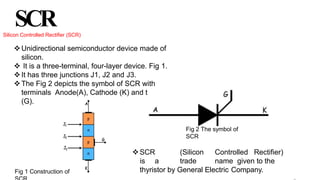
 It is a three-terminal, four-layer device. Fig 1.
It has three junctions J1, J2 and J3.
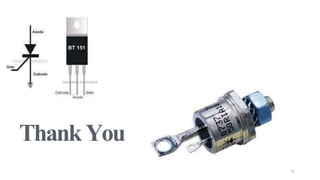
The Fig 2 depicts the symbol of SCR with
terminals Anode(A), Cathode (K) and the Gate
(G).
Fig 2 The symbol of
SCR
SCR (Silicon Controlled Rectifier)
is a trade name given to the
thyristor by General Electric Company.
Fig 1 Construction of
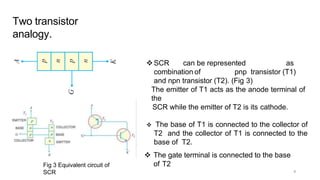
Two transistor
analogy.
SCR can be represented as
combination of pnp transistor (T1)
and npn transistor (T2). (Fig 3)
The emitter of T1 acts as the anode terminal of
the
SCR while the emitter of T2 is its cathode.
 The base of T1 is connected to the collector of
T2 and the collector of T1 is connected to the
base of T2.
 The gate terminal is connected to the base
of T2
4
Fig 3 Equivalent circuit of
SCR
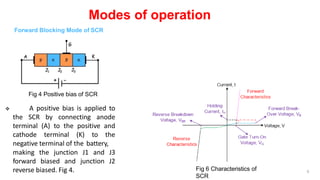
Forward Blocking Mode of SCR
making the junction J1 and J3
forward biased and junction J2
reverse biased. Fig 4.
Fig 4 Positive bias of SCR
 A positive bias is applied to
the SCR by connecting anode
terminal (A) to the positive and
cathode terminal (K) to the
negative terminal of the battery,
5
Modes of operation
Fig 6 Characteristics of
SCR
6
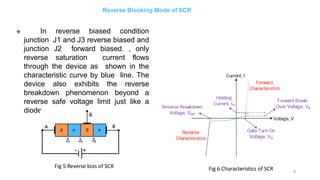
Reverse Blocking Mode of SCR
 In reverse biased condition
junction J1 and J3 reverse biased and
junction J2 forward biased. , only
reverse saturation current flows
through the device as shown in the
characteristic curve by blue line. The
device also exhibits the reverse
breakdown phenomenon beyond a
reverse safe voltage limit just like a
diode.
Fig 5 Reverse bias of SCR Fig 6 Characteristics of SCR
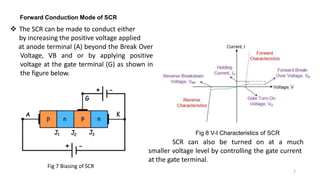
Forward Conduction Mode of SCR
 The SCR can be made to conduct either
by increasing the positive voltage applied
at anode terminal (A) beyond the Break Over
Voltage, VB and or by applying positive
voltage at the gate terminal (G) as shown in
the figure below.
Fig 8 V-I Characteristics of SCR
SCR can also be turned on at a much
smaller voltage level by controlling the gate current
at the gate terminal.
7
Fig 7 Biasing of SCR
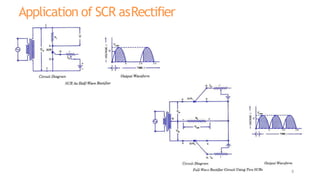
Application of SCR asRectifier
8
Thank You
9

SCR~ Two Transistor Analogy

  • 1.
  • 2.
    2 Learning Objectives i) Explainthe Construction of SCR. ii) Understand the Operating Principle and Characteristics of SCR.
  • 3.
    SCR Silicon Controlled Rectifier(SCR) Unidirectional semiconductor device made of silicon.  It is a three-terminal, four-layer device. Fig 1. It has three junctions J1, J2 and J3. The Fig 2 depicts the symbol of SCR with terminals Anode(A), Cathode (K) and the Gate (G). Fig 2 The symbol of SCR SCR (Silicon Controlled Rectifier) is a trade name given to the thyristor by General Electric Company. Fig 1 Construction of
  • 4.
    Two transistor analogy. SCR canbe represented as combination of pnp transistor (T1) and npn transistor (T2). (Fig 3) The emitter of T1 acts as the anode terminal of the SCR while the emitter of T2 is its cathode.  The base of T1 is connected to the collector of T2 and the collector of T1 is connected to the base of T2.  The gate terminal is connected to the base of T2 4 Fig 3 Equivalent circuit of SCR
  • 5.
    Forward Blocking Modeof SCR making the junction J1 and J3 forward biased and junction J2 reverse biased. Fig 4. Fig 4 Positive bias of SCR  A positive bias is applied to the SCR by connecting anode terminal (A) to the positive and cathode terminal (K) to the negative terminal of the battery, 5 Modes of operation Fig 6 Characteristics of SCR
  • 6.
    6 Reverse Blocking Modeof SCR  In reverse biased condition junction J1 and J3 reverse biased and junction J2 forward biased. , only reverse saturation current flows through the device as shown in the characteristic curve by blue line. The device also exhibits the reverse breakdown phenomenon beyond a reverse safe voltage limit just like a diode. Fig 5 Reverse bias of SCR Fig 6 Characteristics of SCR
  • 7.
    Forward Conduction Modeof SCR  The SCR can be made to conduct either by increasing the positive voltage applied at anode terminal (A) beyond the Break Over Voltage, VB and or by applying positive voltage at the gate terminal (G) as shown in the figure below. Fig 8 V-I Characteristics of SCR SCR can also be turned on at a much smaller voltage level by controlling the gate current at the gate terminal. 7 Fig 7 Biasing of SCR
  • 8.
    Application of SCRasRectifier 8
  • 9.