Presented by
Atika Agarwal
M.Sc Biotechnology IV Semester
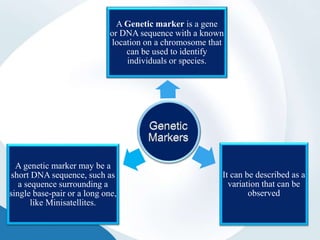
A Genetic marker is a gene
or DNA sequence with a known
location on a chromosome that
can be used to identify
individuals or species.
It can be described as a
variation that can be
observed
A genetic marker may be a
short DNA sequence, such as
a sequence surrounding a
single base-pair or a long one,
like Minisatellites.
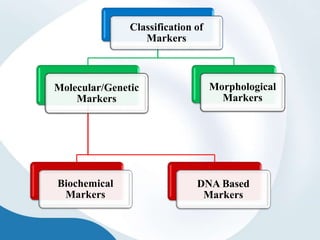
Classification of
Markers
Molecular/Genetic
Markers
Biochemical
Markers
DNA Based
Markers
Morphological
Markers
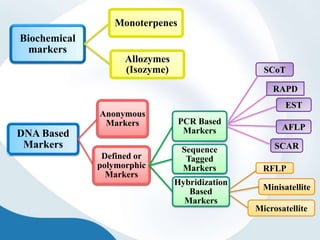
Biochemical
markers
Monoterpenes
Allozymes
(Isozyme)
DNA Based
Markers
Anonymous
Markers
Defined or
polymorphic
Markers
PCR Based
Markers
Sequence
Tagged
Markers
Hybridization
Based
Markers
SCoT
RAPD
EST
AFLP
SCAR
RFLP
Minisatellite
Microsatellite
RAPD
& SCoT
Random Amplified Polymorphic DNA (RAPD)
It is a PCR based technology.
In 1990 Welsh and McClelland and Williams et al.
developed this technique.
In RAPD the Decamer primers will or will not
amplify a segment of DNA depending on the
positions that are complimentary to the primer
sequence.
If the priming sites are in the amplifiable region a
discrete DNA product is formed through cyclic
amplification.
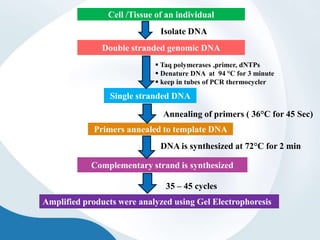
Cell /Tissue of an individual
Double stranded genomic DNA
Single stranded DNA
Primers annealed to template DNA
Complementary strand is synthesized
Isolate DNA
 Taq polymerases ,primer, dNTPs
 Denature DNA at 94 °C for 3 minute
 keep in tubes of PCR thermocycler
Annealing of primers ( 36°C for 45 Sec)
DNA is synthesized at 72°C for 2 min
Amplified products were analyzed using Gel Electrophoresis
35 – 45 cycles
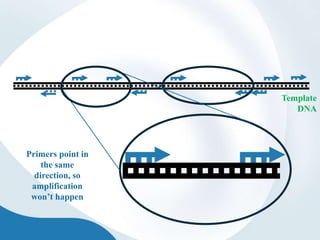
Template
DNA
Primers point in
the same
direction, so
amplification
won’t happen
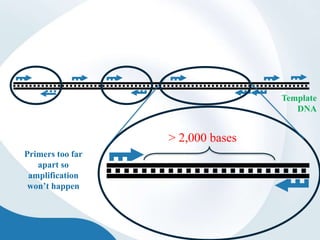
Template
DNA
Primers too far
apart so
amplification
won’t happen
> 2,000 bases
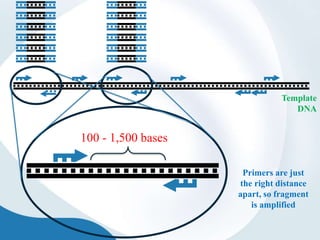
Template
DNA
Primers are just
the right distance
apart, so fragment
is amplified
100 - 1,500 bases
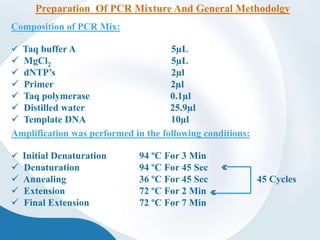
Amplification was performed in the following conditions:
 Initial Denaturation 94 ºC For 3 Min
 Denaturation 94 ºC For 45 Sec
 Annealing 36 ºC For 45 Sec 45 Cycles
 Extension 72 ºC For 2 Min
 Final Extension 72 ºC For 7 Min
Composition of PCR Mix:
 Taq buffer A 5µL
 MgCl2 5µL
 dNTP’s 2µl
 Primer 2µl
 Taq polymerase 0.1µl
 Distilled water 25.9µl
 Template DNA 10µl
Preparation Of PCR Mixture And General Methodolgy
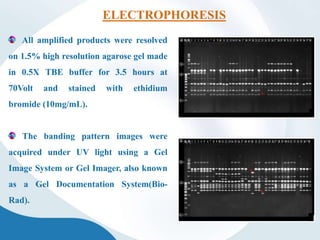
All amplified products were resolved
on 1.5% high resolution agarose gel made
in 0.5X TBE buffer for 3.5 hours at
70Volt and stained with ethidium
bromide (10mg/mL).
The banding pattern images were
acquired under UV light using a Gel
Image System or Gel Imager, also known
as a Gel Documentation System(Bio-
Rad).
ELECTROPHORESIS
Advantages
&
Disadvantages
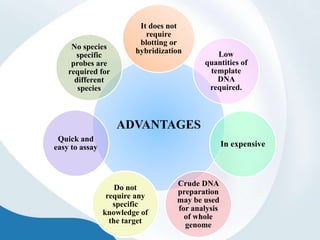
ADVANTAGES
It does not
require
blotting or
hybridization Low
quantities of
template
DNA
required.
In expensive
No species
specific
probes are
required for
different
species
Quick and
easy to assay
Do not
require any
specific
knowledge of
the target
Crude DNA
preparation
may be used
for analysis
of whole
genome
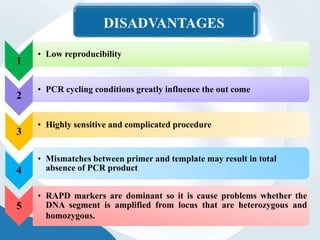
1
• Low reproducibility
2
• PCR cycling conditions greatly influence the out come
3
• Highly sensitive and complicated procedure
4
• Mismatches between primer and template may result in total
absence of PCR product
5
• RAPD markers are dominant so it is cause problems whether the
DNA segment is amplified from locus that are heterozygous and
homozygous.
Applications
of RAPD
In Gene mapping
DNA amplification finger printing
Study of closely related species
RAPD Markers help to determine specific
genes in chromosomes.
RAPD can be used for identification of somatic
Hybrid among the developing regenerates.
APPLICATIONS
SCoT
Start Codon Targeted Polymorphism (SCoT)
PCR based technique developed by Collard and Mackill in
2009.
Simple and novel DNA marker technique, uses 18-mer
single primer in PCR and an annealing of 50 ºC.
PCR products are resolved using standard agarose gel
electrophoresis.
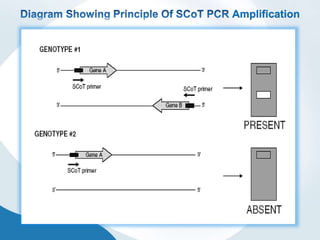
SCoT based on the short conserved region flanking the start
codon (ATG) in plant genes.
This technique has been demonstrated high polymorphic
and efficient, and successfully utilized in rice and peanut for
cultivar identification and genetic diversity analysis
Amplification
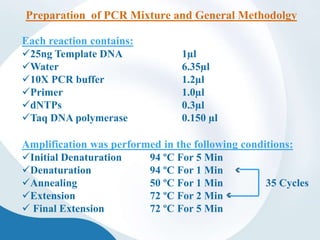
Each reaction contains:
25ng Template DNA 1µl
Water 6.35µl
10X PCR buffer 1.2µl
Primer 1.0µl
dNTPs 0.3µl
Taq DNA polymerase 0.150 µl
Amplification was performed in the following conditions:
Initial Denaturation 94 ºC For 5 Min
Denaturation 94 ºC For 1 Min
Annealing 50 ºC For 1 Min 35 Cycles
Extension 72 ºC For 2 Min
 Final Extension 72 ºC For 5 Min
Preparation of PCR Mixture and General Methodolgy
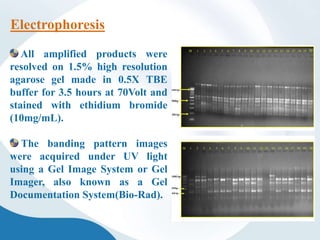
All amplified products were
resolved on 1.5% high resolution
agarose gel made in 0.5X TBE
buffer for 3.5 hours at 70Volt and
stained with ethidium bromide
(10mg/mL).
The banding pattern images
were acquired under UV light
using a Gel Image System or Gel
Imager, also known as a Gel
Documentation System(Bio-Rad).
Electrophoresis
Advantages
of SCoT
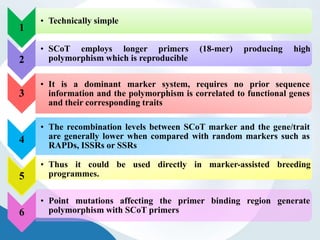
1
• Technically simple
2
• SCoT employs longer primers (18-mer) producing high
polymorphism which is reproducible
3
• It is a dominant marker system, requires no prior sequence
information and the polymorphism is correlated to functional genes
and their corresponding traits
4
• The recombination levels between SCoT marker and the gene/trait
are generally lower when compared with random markers such as
RAPDs, ISSRs or SSRs
5
• Thus it could be used directly in marker-assisted breeding
programmes.
6
• Point mutations affecting the primer binding region generate
polymorphism with SCoT primers
Applications
of SCoT
It is reproducible, reliable, efficient and easy to use.
It has been used to evaluate genetic relationships in
plants.
It is useful for plant breeding.
It is useful for accessing genetic relationships.
This marker system requires no prior knowledge about
the sequence under study.
It is useful for QTL mapping.

SCoT marker has emerged as a superior system when
compared to RAPD.
SCoT is able to give high reproducibility when compared to
RAPD.
Also, the annealing temperature of SCoT is higher than that
of RAPD.
This can be attributed to longer 18-mer primers of SCoT
compared to 10-mer primers of RAPD.
In some cultivars SCoT has emerged superior to ISSR when
used for accessing genetic relationships.
The information generated by Start Codon Targeted
Polymorphism is valuable. Since it is a gene targeted marker
system it produces highly specific and reliable data.
SCoT and RAPD

SCoT and RAPD

  • 2.
    Presented by Atika Agarwal M.ScBiotechnology IV Semester
  • 3.
    A Genetic markeris a gene or DNA sequence with a known location on a chromosome that can be used to identify individuals or species. It can be described as a variation that can be observed A genetic marker may be a short DNA sequence, such as a sequence surrounding a single base-pair or a long one, like Minisatellites.
  • 4.
  • 5.
    Biochemical markers Monoterpenes Allozymes (Isozyme) DNA Based Markers Anonymous Markers Defined or polymorphic Markers PCRBased Markers Sequence Tagged Markers Hybridization Based Markers SCoT RAPD EST AFLP SCAR RFLP Minisatellite Microsatellite
  • 6.
  • 7.
    Random Amplified PolymorphicDNA (RAPD) It is a PCR based technology. In 1990 Welsh and McClelland and Williams et al. developed this technique. In RAPD the Decamer primers will or will not amplify a segment of DNA depending on the positions that are complimentary to the primer sequence. If the priming sites are in the amplifiable region a discrete DNA product is formed through cyclic amplification.
  • 8.
    Cell /Tissue ofan individual Double stranded genomic DNA Single stranded DNA Primers annealed to template DNA Complementary strand is synthesized Isolate DNA  Taq polymerases ,primer, dNTPs  Denature DNA at 94 °C for 3 minute  keep in tubes of PCR thermocycler Annealing of primers ( 36°C for 45 Sec) DNA is synthesized at 72°C for 2 min Amplified products were analyzed using Gel Electrophoresis 35 – 45 cycles
  • 9.
    Template DNA Primers point in thesame direction, so amplification won’t happen
  • 10.
    Template DNA Primers too far apartso amplification won’t happen > 2,000 bases
  • 11.
    Template DNA Primers are just theright distance apart, so fragment is amplified 100 - 1,500 bases
  • 12.
    Amplification was performedin the following conditions:  Initial Denaturation 94 ºC For 3 Min  Denaturation 94 ºC For 45 Sec  Annealing 36 ºC For 45 Sec 45 Cycles  Extension 72 ºC For 2 Min  Final Extension 72 ºC For 7 Min Composition of PCR Mix:  Taq buffer A 5µL  MgCl2 5µL  dNTP’s 2µl  Primer 2µl  Taq polymerase 0.1µl  Distilled water 25.9µl  Template DNA 10µl Preparation Of PCR Mixture And General Methodolgy
  • 13.
    All amplified productswere resolved on 1.5% high resolution agarose gel made in 0.5X TBE buffer for 3.5 hours at 70Volt and stained with ethidium bromide (10mg/mL). The banding pattern images were acquired under UV light using a Gel Image System or Gel Imager, also known as a Gel Documentation System(Bio- Rad). ELECTROPHORESIS
  • 14.
  • 15.
    ADVANTAGES It does not require blottingor hybridization Low quantities of template DNA required. In expensive No species specific probes are required for different species Quick and easy to assay Do not require any specific knowledge of the target Crude DNA preparation may be used for analysis of whole genome
  • 16.
    1 • Low reproducibility 2 •PCR cycling conditions greatly influence the out come 3 • Highly sensitive and complicated procedure 4 • Mismatches between primer and template may result in total absence of PCR product 5 • RAPD markers are dominant so it is cause problems whether the DNA segment is amplified from locus that are heterozygous and homozygous.
  • 17.
  • 18.
    In Gene mapping DNAamplification finger printing Study of closely related species RAPD Markers help to determine specific genes in chromosomes. RAPD can be used for identification of somatic Hybrid among the developing regenerates. APPLICATIONS
  • 19.
  • 20.
    Start Codon TargetedPolymorphism (SCoT) PCR based technique developed by Collard and Mackill in 2009. Simple and novel DNA marker technique, uses 18-mer single primer in PCR and an annealing of 50 ºC. PCR products are resolved using standard agarose gel electrophoresis. SCoT based on the short conserved region flanking the start codon (ATG) in plant genes. This technique has been demonstrated high polymorphic and efficient, and successfully utilized in rice and peanut for cultivar identification and genetic diversity analysis
  • 21.
  • 22.
    Each reaction contains: 25ngTemplate DNA 1µl Water 6.35µl 10X PCR buffer 1.2µl Primer 1.0µl dNTPs 0.3µl Taq DNA polymerase 0.150 µl Amplification was performed in the following conditions: Initial Denaturation 94 ºC For 5 Min Denaturation 94 ºC For 1 Min Annealing 50 ºC For 1 Min 35 Cycles Extension 72 ºC For 2 Min  Final Extension 72 ºC For 5 Min Preparation of PCR Mixture and General Methodolgy
  • 23.
    All amplified productswere resolved on 1.5% high resolution agarose gel made in 0.5X TBE buffer for 3.5 hours at 70Volt and stained with ethidium bromide (10mg/mL). The banding pattern images were acquired under UV light using a Gel Image System or Gel Imager, also known as a Gel Documentation System(Bio-Rad). Electrophoresis
  • 24.
  • 25.
    1 • Technically simple 2 •SCoT employs longer primers (18-mer) producing high polymorphism which is reproducible 3 • It is a dominant marker system, requires no prior sequence information and the polymorphism is correlated to functional genes and their corresponding traits 4 • The recombination levels between SCoT marker and the gene/trait are generally lower when compared with random markers such as RAPDs, ISSRs or SSRs 5 • Thus it could be used directly in marker-assisted breeding programmes. 6 • Point mutations affecting the primer binding region generate polymorphism with SCoT primers
  • 26.
  • 27.
    It is reproducible,reliable, efficient and easy to use. It has been used to evaluate genetic relationships in plants. It is useful for plant breeding. It is useful for accessing genetic relationships. This marker system requires no prior knowledge about the sequence under study. It is useful for QTL mapping.
  • 28.
    SCoT marker hasemerged as a superior system when compared to RAPD. SCoT is able to give high reproducibility when compared to RAPD. Also, the annealing temperature of SCoT is higher than that of RAPD. This can be attributed to longer 18-mer primers of SCoT compared to 10-mer primers of RAPD. In some cultivars SCoT has emerged superior to ISSR when used for accessing genetic relationships. The information generated by Start Codon Targeted Polymorphism is valuable. Since it is a gene targeted marker system it produces highly specific and reliable data.