RAPD
PRESENTED BY,
AISWARIYA S A.
MSc BIOTECHNOLOGY, S3.
Govt.ARTS COLLEGE,
THYCAUD, TVPM
TOPICS TO BE DISCUSSED
1. Introduction.
2. Principle of RAPD.
3. Protocol of RAPD.
4. Steps involved in RAPD.
5. Advantages of RAPD.
6. Disadvantages of RAPD.
7. Applications of RAPD.
8. Variations /Modifications of RAPD.
9. Conclusion.
10. References.
INTRODUCTION
 Expansion of RAPD:-
1. Random Amplification of Polymorphic DNA.
2. Randomly Amplified Polymorphic DNA.
 Sometimes also pronounced as ‘rapid’.
 Developed in 1990 by William et al.
 RAPD is a PCR (Polymerase Chain Reaction) based marker.
 This technique involves random amplification of DNA using short primers or random non-specific
primers.
PRINCIPLE OF RAPD
 The principle is that, a single, short oligonucleotide primer, which binds to many different loci, is
used to amplify random sequences from a DNA template.
 This means that the amplified fragment generated by PCR depends on the length and size of both
the primer and the target genome.
 The assumption is made that a given DNA sequences (complementary to that of the primer) will
occur in the genome, on opposite DNA strands, in opposite orientation within a distance that is
readily amplifiable by PCR.
 Amplified fragments within the size range of 0.5-5kb are separated by agarose gel electrophoresis
and polymorphisms are detected and by ethidium bromide staining the presence or absence of
bands of particular sizes can be identified.
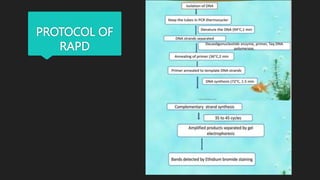
PROTOCOL OF
RAPD
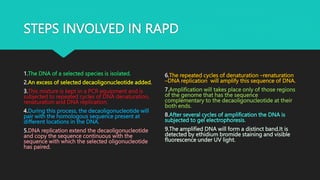
STEPS INVOLVED IN RAPD
1.The DNA of a selected species is isolated.
2.An excess of selected decaoligonucleotide added.
3.This mixture is kept in a PCR equipment and is
subjected to repeated cycles of DNA denaturation,
renaturation and DNA replication.
4.During this process, the decaoligonucleotide will
pair with the homologous sequence present at
different locations in the DNA.
5.DNA replication extend the decaoligonucleotide
and copy the sequence continuous with the
sequence with which the selected oligonucleotide
has paired.
6.The repeated cycles of denaturation –renaturation
–DNA replication will amplify this sequence of DNA.
7.Amplification will takes place only of those regions
of the genome that has the sequence
complementary to the decaoligonucleotide at their
both ends.
8.After several cycles of amplification the DNA is
subjected to gel electrophoresis.
9.The amplified DNA will form a distinct band.It is
detected by ethidium bromide staining and visible
fluorescence under UV light.
ADVANTAGES OF RAPD
 It involves non-radioactive detection so no risk of radiation.
 No prior information on DNA sequence is needed to perform this technique.
 It involves universal primers that work in any genome. (Random primers)
 Very small amounts of genomic DNA is required to perform this technique.
 This is relatively simple technique and no need of expensive equipment.
DISADVANTAGES OF RAPD
 Low reproducibility (reproducibility of experiment is very low since low annealing temperatures are
used).
 Nearly all RAPD markers are dominant ie, it is not possible to distinguish whether a DNA segment
is amplified from a locus that is heterozygous or homozygous.
 Mismatches between the primer and the template can result in the total absence of PCR product as
well as in a merely decreased amount of the product.This is difficult to interpret.
 High quality template DNA is required.
APPLICATIONS OF RAPD
 Used in genetic mapping and DNA fingerprinting.
 Sex determination.
 Generation of specific PCR primers for anonymous genomes.
 Quantitative analysis of mixed biosamples.
 Determination of paternity and kinship relationships.
 Analysis of interspecific geneflow and hybrid speciation.
 Pedigree analysis.
VARIATIONS /MODIFICATIONS OF RAPD
1. SCAR (Sequence Characterized Amplified Regions)
2. DAF (DNA Amplification Fingerprinting).
3. CAPS (Cleaved Amplified Polymorphic Sequence).
4. MAAP (Multiple Arbitrary Amplicon Profiling)
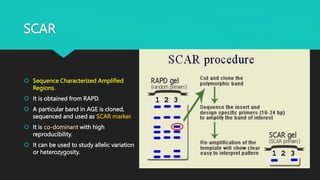
SCAR
 Sequence Characterized Amplified
Regions.
 It is obtained from RAPD.
 A particular band in AGE is cloned,
sequenced and used as SCAR marker.
 It is co-dominant with high
reproducibility.
 It can be used to study allelic variation
or heterozygosity.
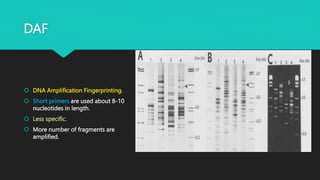
DAF
 DNA Amplification Fingerprinting.
 Short primers are used about 8-10
nucleotides in length.
 Less specific.
 More number of fragments are
amplified.
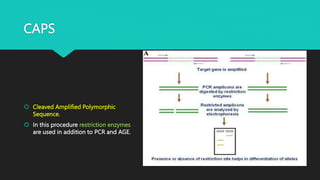
CAPS
 Cleaved Amplified Polymorphic
Sequence.
 In this procedure restriction enzymes
are used in addition to PCR and AGE.
MAAP
 Multiple Arbitrary Amplicon Profiling.
 It is a collective term for techniques using single arbitrary primers.
 It is the acronym proposed to cover the 3 main technologies that fall in this category.
1. RAPD(Random Amplified Polymorphic DNA) .
2. DAF (DNA Amplification Fingerprinting).
3. AP-PCR (Arbitrarily Primed Polymerase Chain Reaction).
CONCLUSION
RAPD markers are DNA fragments from PCR amplification of
random segments of genomic DNA with single primer of
arbitrary nucleotide sequence.
REFERENCES
1. Bardakci, Fevzi. "Random amplified polymorphic DNA (RAPD) markers." Turkish Journal of Biology
25.2 (2001): 185-196.
2. Dubey, R. C. A textbook of Biotechnology. S. Chand Publishing, 1993.page no:-69
3. Hadrys, Heike, M. Balick, and Bi Schierwater. "Applications of random amplified polymorphic DNA
(RAPD) in molecular ecology." Molecular ecology 1.1 (1992): 55-63.
4. Kumar, N. Senthil, and G. Gurusubramanian. "Random amplified polymorphic DNA (RAPD) markers
and its applications." Sci Vis 11.3 (2011): 116-124.
5. Tingey, Scott V., J. Antoni Rafalski, and Michael K. Hanafey. "Genetic analysis with RAPD markers."
Plant Molecular Biology. Springer, Berlin, Heidelberg, 1994. 491-500.
RAPD-Aiswariya S A.pptx

RAPD-Aiswariya S A.pptx

  • 1.
    RAPD PRESENTED BY, AISWARIYA SA. MSc BIOTECHNOLOGY, S3. Govt.ARTS COLLEGE, THYCAUD, TVPM
  • 2.
    TOPICS TO BEDISCUSSED 1. Introduction. 2. Principle of RAPD. 3. Protocol of RAPD. 4. Steps involved in RAPD. 5. Advantages of RAPD. 6. Disadvantages of RAPD. 7. Applications of RAPD. 8. Variations /Modifications of RAPD. 9. Conclusion. 10. References.
  • 3.
    INTRODUCTION  Expansion ofRAPD:- 1. Random Amplification of Polymorphic DNA. 2. Randomly Amplified Polymorphic DNA.  Sometimes also pronounced as ‘rapid’.  Developed in 1990 by William et al.  RAPD is a PCR (Polymerase Chain Reaction) based marker.  This technique involves random amplification of DNA using short primers or random non-specific primers.
  • 4.
    PRINCIPLE OF RAPD The principle is that, a single, short oligonucleotide primer, which binds to many different loci, is used to amplify random sequences from a DNA template.  This means that the amplified fragment generated by PCR depends on the length and size of both the primer and the target genome.  The assumption is made that a given DNA sequences (complementary to that of the primer) will occur in the genome, on opposite DNA strands, in opposite orientation within a distance that is readily amplifiable by PCR.  Amplified fragments within the size range of 0.5-5kb are separated by agarose gel electrophoresis and polymorphisms are detected and by ethidium bromide staining the presence or absence of bands of particular sizes can be identified.
  • 5.
  • 6.
    STEPS INVOLVED INRAPD 1.The DNA of a selected species is isolated. 2.An excess of selected decaoligonucleotide added. 3.This mixture is kept in a PCR equipment and is subjected to repeated cycles of DNA denaturation, renaturation and DNA replication. 4.During this process, the decaoligonucleotide will pair with the homologous sequence present at different locations in the DNA. 5.DNA replication extend the decaoligonucleotide and copy the sequence continuous with the sequence with which the selected oligonucleotide has paired. 6.The repeated cycles of denaturation –renaturation –DNA replication will amplify this sequence of DNA. 7.Amplification will takes place only of those regions of the genome that has the sequence complementary to the decaoligonucleotide at their both ends. 8.After several cycles of amplification the DNA is subjected to gel electrophoresis. 9.The amplified DNA will form a distinct band.It is detected by ethidium bromide staining and visible fluorescence under UV light.
  • 7.
    ADVANTAGES OF RAPD It involves non-radioactive detection so no risk of radiation.  No prior information on DNA sequence is needed to perform this technique.  It involves universal primers that work in any genome. (Random primers)  Very small amounts of genomic DNA is required to perform this technique.  This is relatively simple technique and no need of expensive equipment.
  • 8.
    DISADVANTAGES OF RAPD Low reproducibility (reproducibility of experiment is very low since low annealing temperatures are used).  Nearly all RAPD markers are dominant ie, it is not possible to distinguish whether a DNA segment is amplified from a locus that is heterozygous or homozygous.  Mismatches between the primer and the template can result in the total absence of PCR product as well as in a merely decreased amount of the product.This is difficult to interpret.  High quality template DNA is required.
  • 9.
    APPLICATIONS OF RAPD Used in genetic mapping and DNA fingerprinting.  Sex determination.  Generation of specific PCR primers for anonymous genomes.  Quantitative analysis of mixed biosamples.  Determination of paternity and kinship relationships.  Analysis of interspecific geneflow and hybrid speciation.  Pedigree analysis.
  • 10.
    VARIATIONS /MODIFICATIONS OFRAPD 1. SCAR (Sequence Characterized Amplified Regions) 2. DAF (DNA Amplification Fingerprinting). 3. CAPS (Cleaved Amplified Polymorphic Sequence). 4. MAAP (Multiple Arbitrary Amplicon Profiling)
  • 11.
    SCAR  Sequence CharacterizedAmplified Regions.  It is obtained from RAPD.  A particular band in AGE is cloned, sequenced and used as SCAR marker.  It is co-dominant with high reproducibility.  It can be used to study allelic variation or heterozygosity.
  • 12.
    DAF  DNA AmplificationFingerprinting.  Short primers are used about 8-10 nucleotides in length.  Less specific.  More number of fragments are amplified.
  • 13.
    CAPS  Cleaved AmplifiedPolymorphic Sequence.  In this procedure restriction enzymes are used in addition to PCR and AGE.
  • 14.
    MAAP  Multiple ArbitraryAmplicon Profiling.  It is a collective term for techniques using single arbitrary primers.  It is the acronym proposed to cover the 3 main technologies that fall in this category. 1. RAPD(Random Amplified Polymorphic DNA) . 2. DAF (DNA Amplification Fingerprinting). 3. AP-PCR (Arbitrarily Primed Polymerase Chain Reaction).
  • 15.
    CONCLUSION RAPD markers areDNA fragments from PCR amplification of random segments of genomic DNA with single primer of arbitrary nucleotide sequence.
  • 16.
    REFERENCES 1. Bardakci, Fevzi."Random amplified polymorphic DNA (RAPD) markers." Turkish Journal of Biology 25.2 (2001): 185-196. 2. Dubey, R. C. A textbook of Biotechnology. S. Chand Publishing, 1993.page no:-69 3. Hadrys, Heike, M. Balick, and Bi Schierwater. "Applications of random amplified polymorphic DNA (RAPD) in molecular ecology." Molecular ecology 1.1 (1992): 55-63. 4. Kumar, N. Senthil, and G. Gurusubramanian. "Random amplified polymorphic DNA (RAPD) markers and its applications." Sci Vis 11.3 (2011): 116-124. 5. Tingey, Scott V., J. Antoni Rafalski, and Michael K. Hanafey. "Genetic analysis with RAPD markers." Plant Molecular Biology. Springer, Berlin, Heidelberg, 1994. 491-500.