SCOPE OF ENVIRONMENTAL EDUCATION
S. Anbalagan,
Assistant Professor of Mathematics
Thiagarajar College of Preceptors,
Madurai
Environmental Education
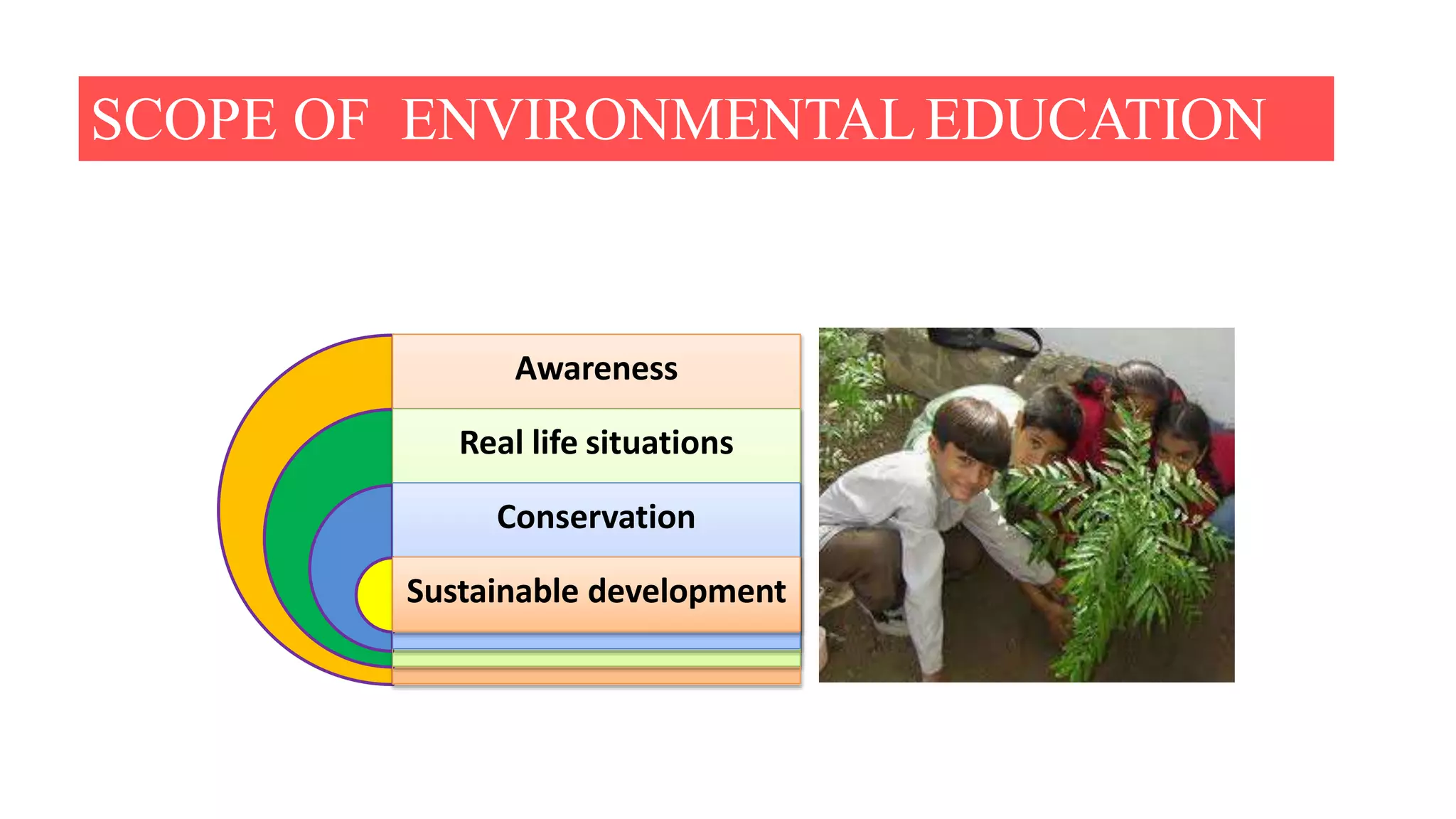
Awareness
Real life situations
Conservation
Sustainable development
SCOPE OF ENVIRONMENTALEDUCATION
Role of Teacher in Meeting the
Challenges of Air Pollution
• World-wide campaign – about smoking
• Use of good quality of automobile fuels
• Planting trees – Afforestation
• Air pollution – checking by cyclone collectors,
electrostatic precipitators etc
• Motor vehicles – sulphur free and lead free fuel
• Non-combustible sources of energy – developed
• Factories chimneys – tall
• Using air filters
• Awareness programmes
Role of Teacher in Meeting the
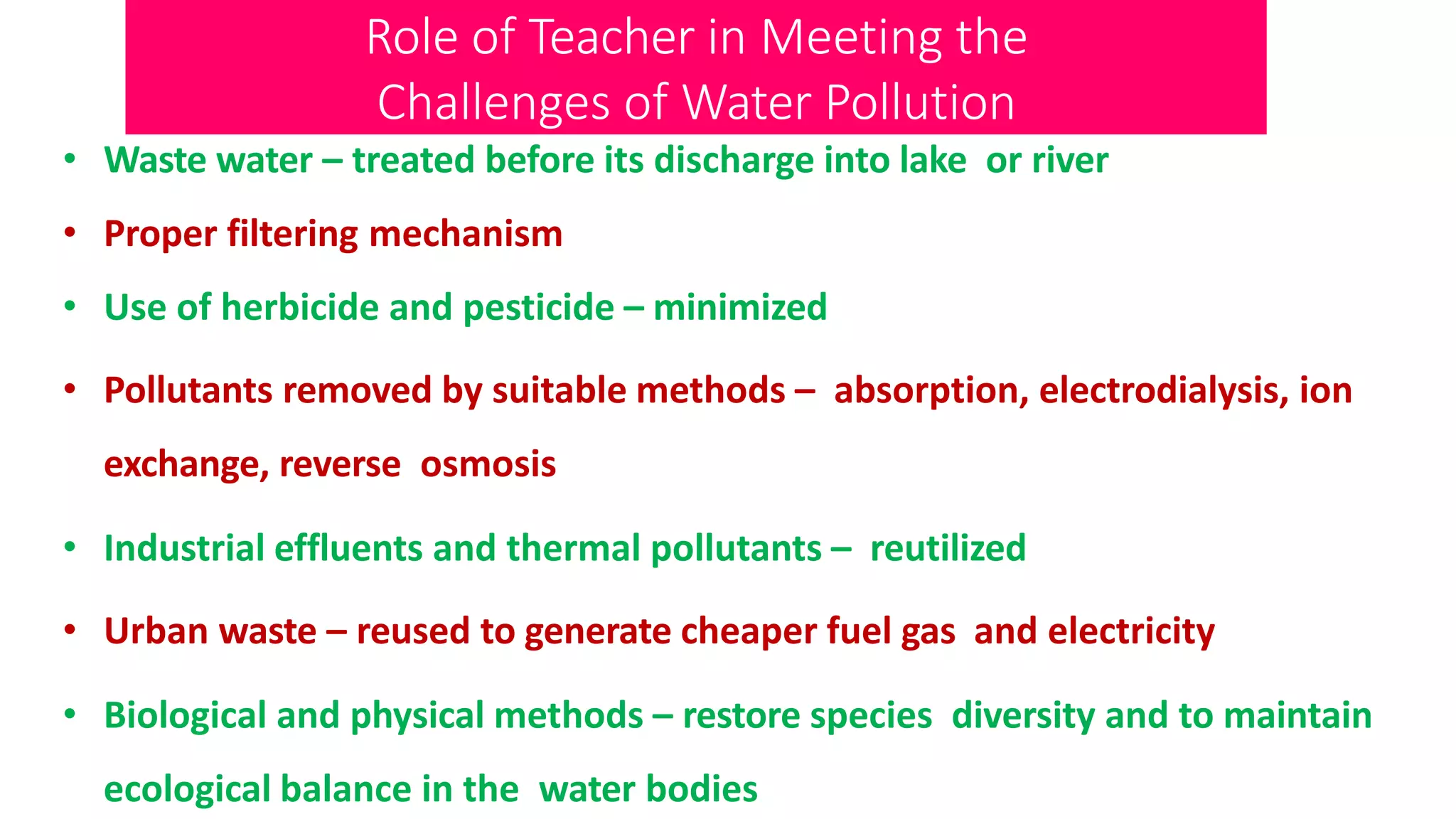
Challenges of Water Pollution
• Waste water – treated before its discharge into lake or river
• Proper filtering mechanism
• Use of herbicide and pesticide – minimized
• Pollutants removed by suitable methods – absorption, electrodialysis, ion
exchange, reverse osmosis
• Industrial effluents and thermal pollutants – reutilized
• Urban waste – reused to generate cheaper fuel gas and electricity
• Biological and physical methods – restore species diversity and to maintain
ecological balance in the water bodies
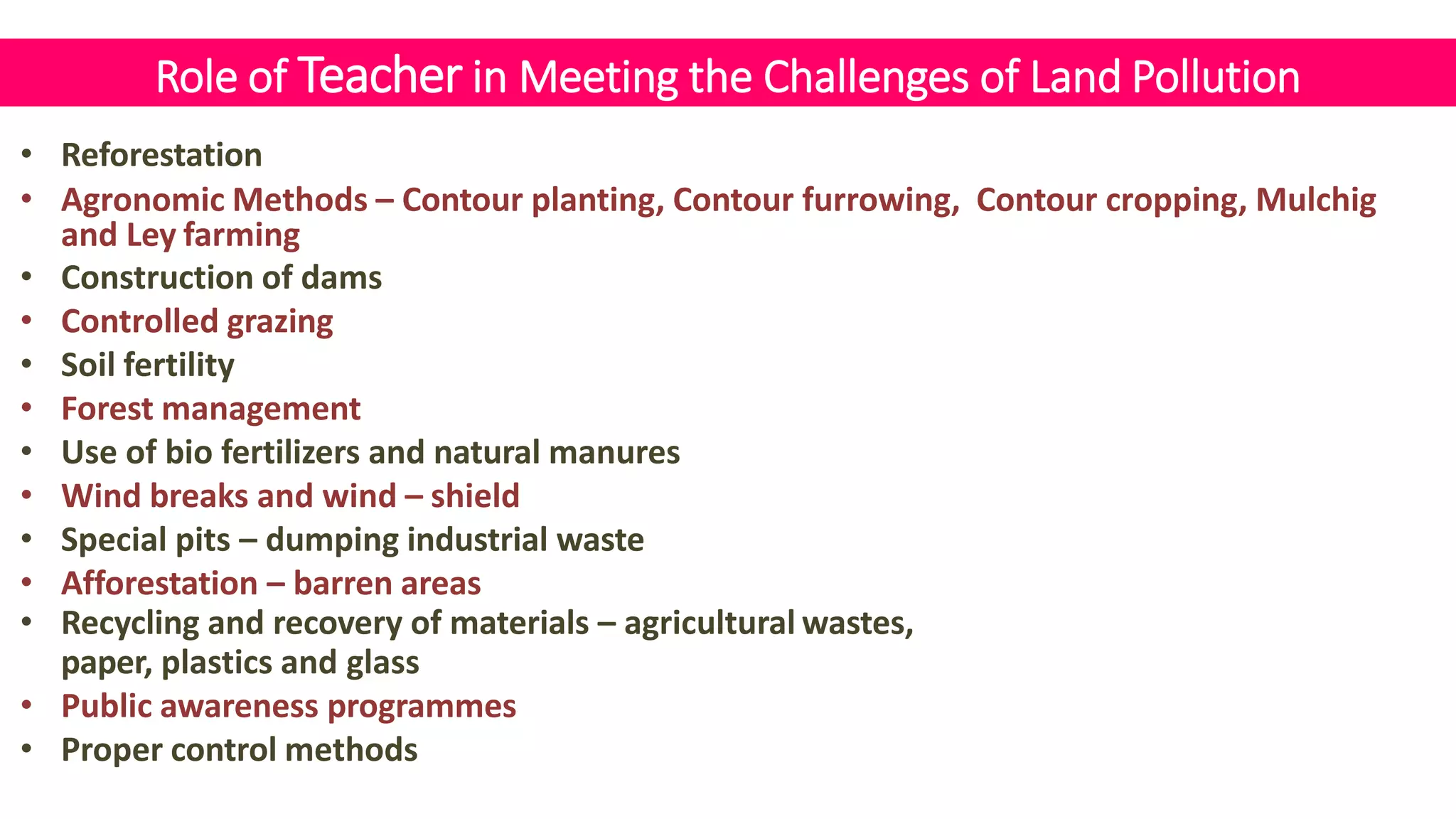
Role of Teacher in Meeting the Challenges of Land Pollution
• Reforestation
• Agronomic Methods – Contour planting, Contour furrowing, Contour cropping, Mulchig
and Ley farming
• Construction of dams
• Controlled grazing
• Soil fertility
• Forest management
• Use of bio fertilizers and natural manures
• Wind breaks and wind – shield
• Special pits – dumping industrial waste
• Afforestation – barren areas
• Recycling and recovery of materials – agricultural wastes,
paper, plastics and glass
• Public awareness programmes
• Proper control methods
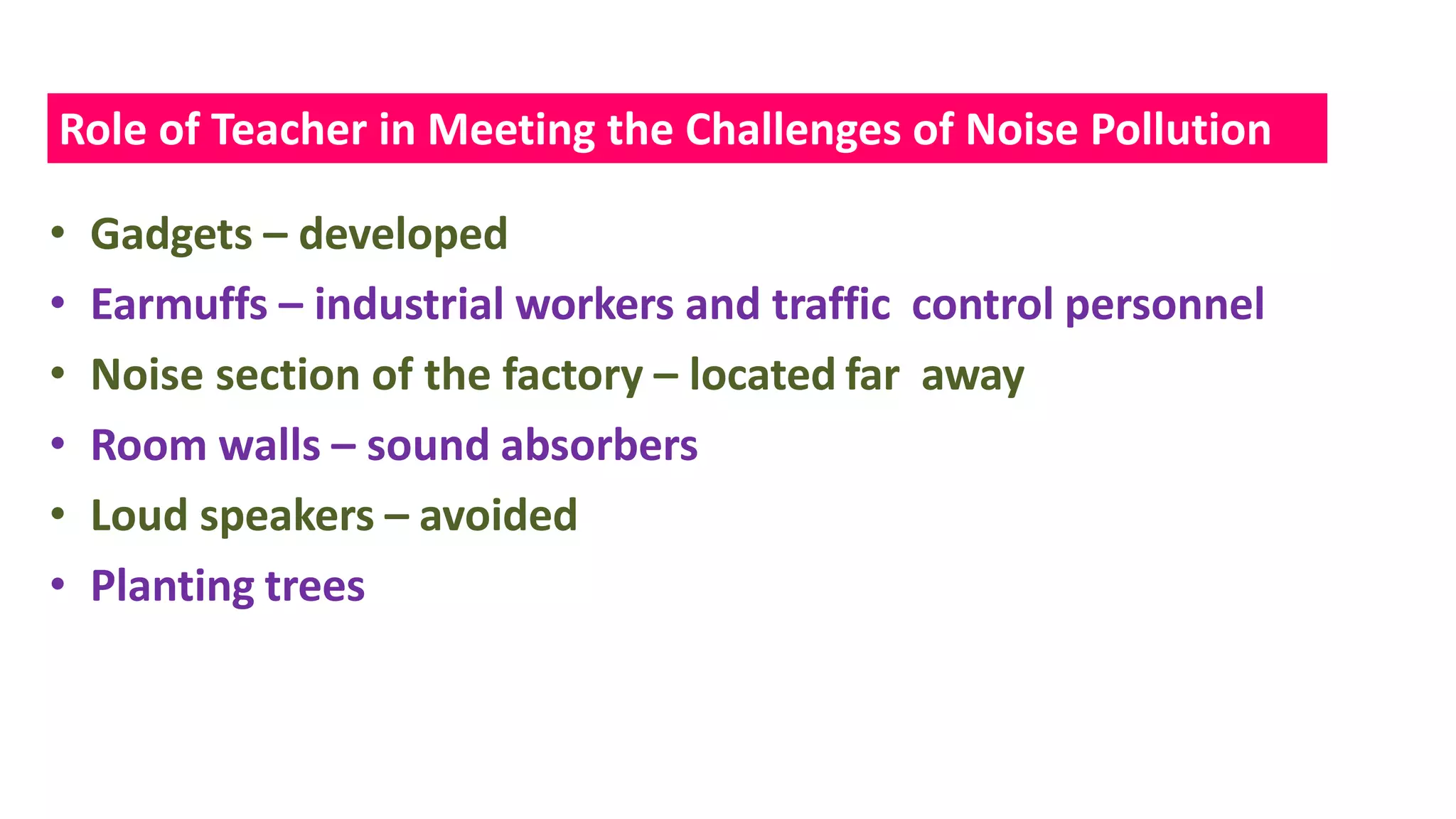
• Gadgets – developed
• Earmuffs – industrial workers and traffic control personnel
• Noise section of the factory – located far away
• Room walls – sound absorbers
• Loud speakers – avoided
• Planting trees
Role of Teacher in Meeting the Challenges of Noise Pollution
Teachers are expected to discharge the following functions
• Developing awareness about environmental
issues
• Providing specific and scientific knowledge
topic-wise
• Organizing community surveys on issues relating
to conservation and protection of environment
• Organizing social service and community service
programmes
• Organizing Population days and Environmental
days
• Organizing Awareness campaigns
• Organizing visits to pollution control centres
• Organizing exhibitions on Environmental
pollution and control
• Organizing tree plantation or vanmahotsavs
• Organizing lectures and workshops for the
benefit of the community
• Developing habits of cleanliness among
students
• Ensuring cleanliness of the school plant
• Arranging lectures of experts on
environmental issues
• Impressing upon students to adopt the following
ways of protecting and improving the environment
• Dispose the wastes after separating them into bio-
degradable and non-biodegradable
• Start a compost heap or use a compost bin
• Don’t burn any waste - plastics
• Reuse carrier bags
• Avoid fast starts and sudden braking of automobiles
• Walk or cycle
• Use public transport
• Use unleaded petrol
• Plant trees
• Observe World Environment Day on 5th June
Air, Water, Land and
Noise Pollution –
Effects on
Human, Animals and
Plants
• Floods, Aridation, Drought, Soil erosion,
sediment load of the river, siltation,
intensification of green house effect etc
• Nitrates – respiratory disorders
• Mine dust affects all
• Chemical fertilizer – increasing the salt
content of the salt
• Radio active minerals – great damage to
human
• Improper irrigation practices – inhibit plant
growth
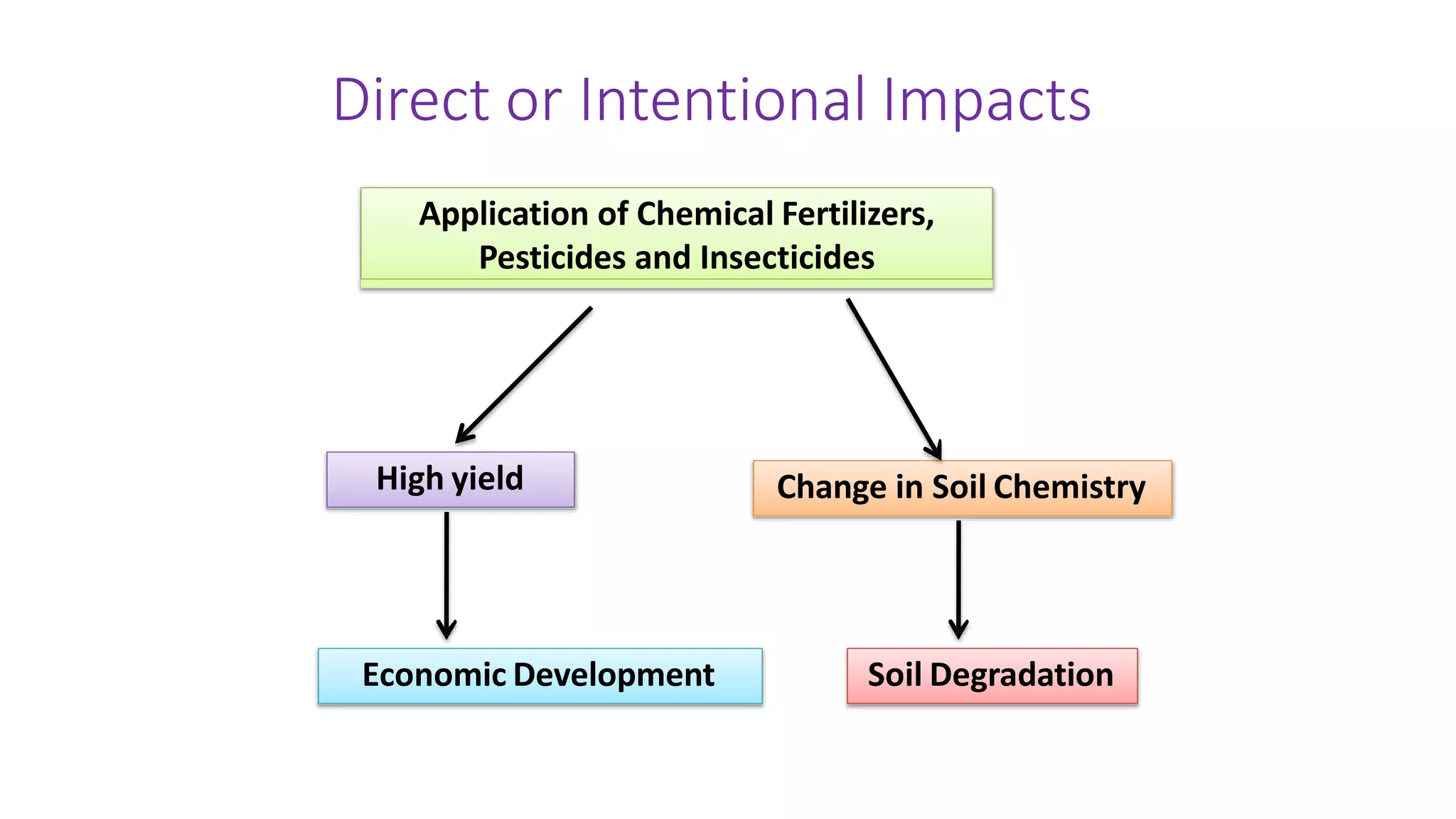
Direct or Intentional Impacts
Application of Chemical Fertilizers,
Pesticides and Insecticides
High yield
Economic Development
Change in Soil Chemistry
Soil Degradation
Indirect or unintentional Impacts
• Experienced after long time when they become
cumulative
• Not reversible
• Related to pollution and environmental
degradation
• Use of chemicals such as DDT, BHC, etc.,
• Excessive use of pesticides, fertilizers and a
number of other chemicals
• Example: toxic materials are transported across
the placenta and reach the developing foetus of
women and cause abortions and delivery of
premature child
• Photochemical smog – eye irritation, respiratory
problems and cancer
• Acid rain –
Depletes the nutrients in soil and destroy plants.
Chlorosis and necrosis in plants.
Irritation in the eyes and skin of human beings
Affects aquatic life
• Airbrone fluoride and arsenic pollution – injuries
to agricultural livestocks
• Green house effect – skin cancer
• Ozone layer depletion – cancer
• Air pollution affects weather and climate at
global level
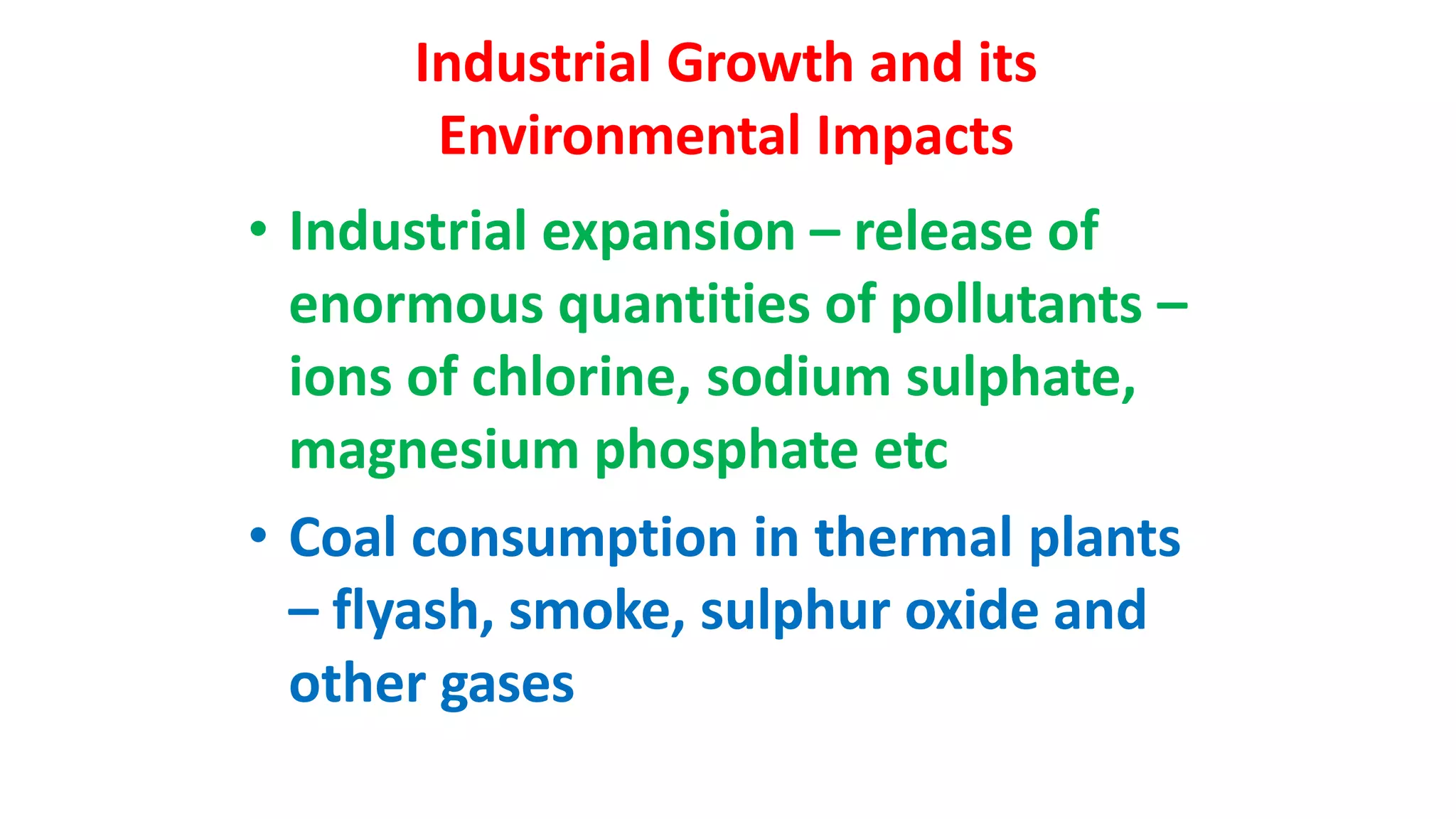
Industrial Growth and its
Environmental Impacts
• Industrial expansion – release of
enormous quantities of pollutants –
ions of chlorine, sodium sulphate,
magnesium phosphate etc
• Coal consumption in thermal plants
– flyash, smoke, sulphur oxide and
other gases
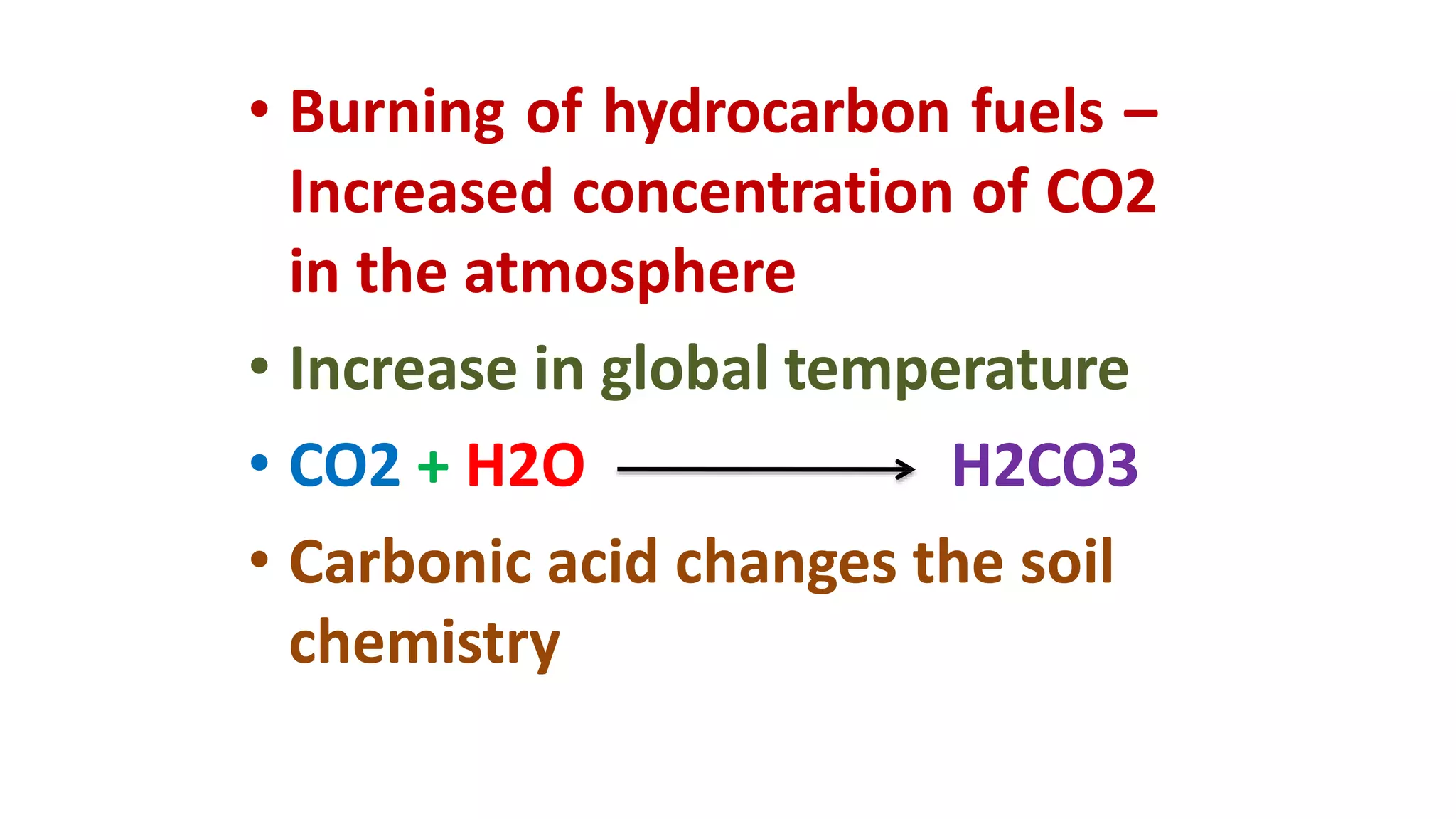
• Burning of hydrocarbon fuels –
Increased concentration of CO2
in the atmosphere
• Increase in global temperature
• CO2 + H2O H2CO3
• Carbonic acid changes the soil
chemistry

SCOPE OF ENVIRONMENTAL EDUCATION

  • 1.
    SCOPE OF ENVIRONMENTALEDUCATION S. Anbalagan, Assistant Professor of Mathematics Thiagarajar College of Preceptors, Madurai
  • 2.
  • 3.
    Awareness Real life situations Conservation Sustainabledevelopment SCOPE OF ENVIRONMENTALEDUCATION
  • 4.
    Role of Teacherin Meeting the Challenges of Air Pollution • World-wide campaign – about smoking • Use of good quality of automobile fuels • Planting trees – Afforestation • Air pollution – checking by cyclone collectors, electrostatic precipitators etc • Motor vehicles – sulphur free and lead free fuel • Non-combustible sources of energy – developed • Factories chimneys – tall • Using air filters • Awareness programmes
  • 6.
    Role of Teacherin Meeting the Challenges of Water Pollution • Waste water – treated before its discharge into lake or river • Proper filtering mechanism • Use of herbicide and pesticide – minimized • Pollutants removed by suitable methods – absorption, electrodialysis, ion exchange, reverse osmosis • Industrial effluents and thermal pollutants – reutilized • Urban waste – reused to generate cheaper fuel gas and electricity • Biological and physical methods – restore species diversity and to maintain ecological balance in the water bodies
  • 7.
    Role of Teacherin Meeting the Challenges of Land Pollution • Reforestation • Agronomic Methods – Contour planting, Contour furrowing, Contour cropping, Mulchig and Ley farming • Construction of dams • Controlled grazing • Soil fertility • Forest management • Use of bio fertilizers and natural manures • Wind breaks and wind – shield • Special pits – dumping industrial waste • Afforestation – barren areas • Recycling and recovery of materials – agricultural wastes, paper, plastics and glass • Public awareness programmes • Proper control methods
  • 8.
    • Gadgets –developed • Earmuffs – industrial workers and traffic control personnel • Noise section of the factory – located far away • Room walls – sound absorbers • Loud speakers – avoided • Planting trees Role of Teacher in Meeting the Challenges of Noise Pollution
  • 9.
    Teachers are expectedto discharge the following functions • Developing awareness about environmental issues • Providing specific and scientific knowledge topic-wise • Organizing community surveys on issues relating to conservation and protection of environment • Organizing social service and community service programmes • Organizing Population days and Environmental days • Organizing Awareness campaigns
  • 10.
    • Organizing visitsto pollution control centres • Organizing exhibitions on Environmental pollution and control • Organizing tree plantation or vanmahotsavs • Organizing lectures and workshops for the benefit of the community • Developing habits of cleanliness among students • Ensuring cleanliness of the school plant • Arranging lectures of experts on environmental issues
  • 11.
    • Impressing uponstudents to adopt the following ways of protecting and improving the environment • Dispose the wastes after separating them into bio- degradable and non-biodegradable • Start a compost heap or use a compost bin • Don’t burn any waste - plastics • Reuse carrier bags • Avoid fast starts and sudden braking of automobiles • Walk or cycle • Use public transport • Use unleaded petrol • Plant trees • Observe World Environment Day on 5th June
  • 12.
    Air, Water, Landand Noise Pollution – Effects on Human, Animals and Plants
  • 13.
    • Floods, Aridation,Drought, Soil erosion, sediment load of the river, siltation, intensification of green house effect etc • Nitrates – respiratory disorders • Mine dust affects all • Chemical fertilizer – increasing the salt content of the salt • Radio active minerals – great damage to human • Improper irrigation practices – inhibit plant growth
  • 14.
    Direct or IntentionalImpacts Application of Chemical Fertilizers, Pesticides and Insecticides High yield Economic Development Change in Soil Chemistry Soil Degradation
  • 15.
    Indirect or unintentionalImpacts • Experienced after long time when they become cumulative • Not reversible • Related to pollution and environmental degradation • Use of chemicals such as DDT, BHC, etc., • Excessive use of pesticides, fertilizers and a number of other chemicals • Example: toxic materials are transported across the placenta and reach the developing foetus of women and cause abortions and delivery of premature child
  • 16.
    • Photochemical smog– eye irritation, respiratory problems and cancer • Acid rain – Depletes the nutrients in soil and destroy plants. Chlorosis and necrosis in plants. Irritation in the eyes and skin of human beings Affects aquatic life • Airbrone fluoride and arsenic pollution – injuries to agricultural livestocks • Green house effect – skin cancer • Ozone layer depletion – cancer • Air pollution affects weather and climate at global level
  • 17.
    Industrial Growth andits Environmental Impacts • Industrial expansion – release of enormous quantities of pollutants – ions of chlorine, sodium sulphate, magnesium phosphate etc • Coal consumption in thermal plants – flyash, smoke, sulphur oxide and other gases
  • 18.
    • Burning ofhydrocarbon fuels – Increased concentration of CO2 in the atmosphere • Increase in global temperature • CO2 + H2O H2CO3 • Carbonic acid changes the soil chemistry