i
ENVIRONMENT MODULE
iii
Definition of the Module……………………………………………………………………….4
Learning Activity –1 ................................................................................................................. 5
ENVIRONMENT
Environmental Issues………………………………………………………………………6
Definitions Related to the Environment ..................................................................... 6
Environmental Pollution…………………………………………………………… 7
Environmental Conservation Measures…………………………………………….. 8
Issues Arising from Sectoral Problems………………………………………………9
IMPLEMENTATION ACTIVITY.................................................................................... 10
Assessment and Evaluation................................................................................................ 11
LEARNING ACTIVITY-2..................................................................................................... 12
NATURE POLLUTION.................................................................................................. 12
Air, Water, and Soil Concepts…………………………………………………….. 13
Causes of Air Pollution…………………………………………………………… 13
Urbanization and Heating of Residential Buildings………………………………. 14
Şehirleşme ve Konutların Isıtılması.......................................................................... 14
Industrialization……………………………………………………………………. 14
Motor Vehicles......................................................................................................... 15
Atmospheric Characteristics...................................................................................... 16
Definition of Water Pollution and Causes of Water Pollution ................................. 17
Environmental Effects of Water Pollution ............................................................... 19
Prevention of Water Pollution.................................................................................. 19
Causes of Soil Pollution ........................................................................................... 21
Prevention of Soil Pollution ..................................................................................... 22
IMPLEMENTATION ACTIVITY................................................................................ 23
Assessment and Evaluation................................................................................................ 25
LEARNING ACTIVITY –3 ................................................................................................... 27
ENERGY…………………………………………………………………………………27
Energy Resources ………………………………………………………………………. 28
Non-Renewable Energy Sources .................................................................................. 28
Renewable energy sources............................................................................................. 29
Hydraulic (Hydroelectric) Energy………………………………………………….29
Geothermal energy………………………………………………………………… 31
Solar energy……………………………………………………………………….. 32
Wind power……………………………………………………………………….. 33
Nuclear Energy……………………………………………………………………. 35
New and Clean Energy Sources………………………………………………….. 36
Assessment and Evaluation……………………………………………………………….. 37
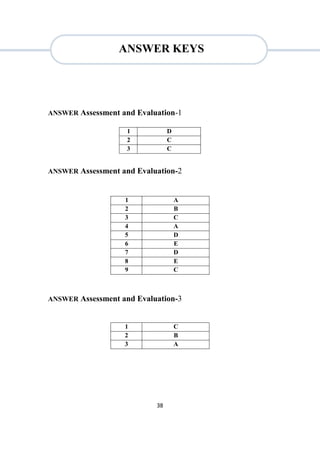
ANSWER KEYS…………………………………………………………………………… 38
References .............................................................................................................................. 39
Contents
4
Definition of the Module
It is a learning material where the necessary knowledge and
skills to protect the environment and take measures against
pollution and waste are provided."
Objective of the Module
Objectives:
You will be able to explain the importance of pollution control,
environmental conservation, and waste prevention using written,
oral, and visual materials.
You will be able to take preventive measures against air, water,
and soil pollution originating from your environment.
You will be able to take preventive measures against noise
pollution originating from your environment.
You will be able to prefer the use of energy sources that do not
harm the environment.
You will be able to explain concepts related to waste.
5
Research
"You will be able to explain the importance of pollution control, environmental
conservation, and waste prevention using written and visual materials.".
 "Research environmental issues and potential measures by conducting
discussions with industry representatives, environmental engineering faculty
members at universities, and utilizing resources such as the internet and
libraries.
 Prepare a presentation based on your research and present it in the classroom.
Discuss the measures that can be taken to address environmental issues in the
classroom.".
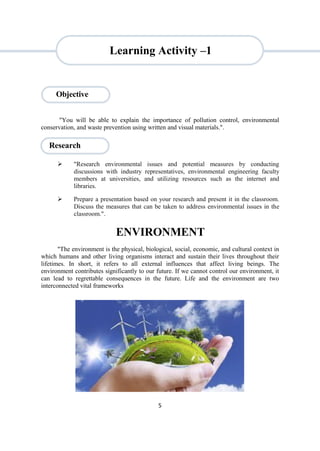
ENVIRONMENT
"The environment is the physical, biological, social, economic, and cultural context in
which humans and other living organisms interact and sustain their lives throughout their
lifetimes. In short, it refers to all external influences that affect living beings. The
environment contributes significantly to our future. If we cannot control our environment, it
can lead to regrettable consequences in the future. Life and the environment are two
interconnected vital frameworks
Objective
Learning Activity –1
6
Environmental Issues
Environment: The environment refers to the surroundings where living and non-
living entities coexist, interact with each other, and influence one another.
Research indicates that 50% of the current environmental pollution worldwide has
occurred in the last 35 years. Rapid population growth is one of the significant sources of
environmental issues. Rapid population growth leads to unplanned urbanization. Urban
living spaces created to meet the housing needs of the increasing population result in urban
problems.
Especially in large cities, air pollution has reached significant levels due to the use of
low-quality fuels. In recent years, the widespread use of natural gas has led to reductions in
air pollution. Particularly, industrial-related air pollution is increasing.
The lack of widespread recycling has led to issues in the disposal of solid waste
materials such as plastics, glass products, and metallic substances that contribute to
environmental pollution.
Definitions Related to the Environment
Waste
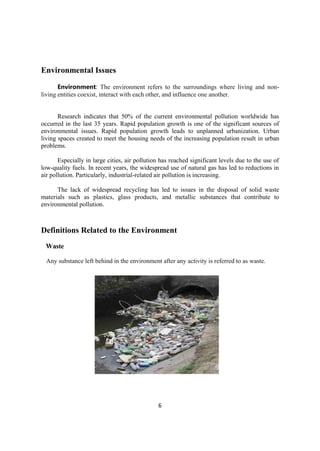
Any substance left behind in the environment after any activity is referred to as waste.
7
Recycling
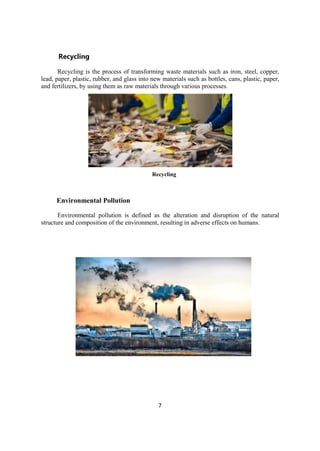
Recycling is the process of transforming waste materials such as iron, steel, copper,
lead, paper, plastic, rubber, and glass into new materials such as bottles, cans, plastic, paper,
and fertilizers, by using them as raw materials through various processes.
Recycling
Environmental Pollution
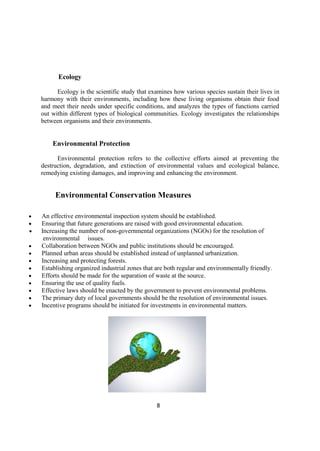
Environmental pollution is defined as the alteration and disruption of the natural
structure and composition of the environment, resulting in adverse effects on humans.
8
Ecology
Ecology is the scientific study that examines how various species sustain their lives in
harmony with their environments, including how these living organisms obtain their food
and meet their needs under specific conditions, and analyzes the types of functions carried
out within different types of biological communities. Ecology investigates the relationships
between organisms and their environments.
Environmental Protection
Environmental protection refers to the collective efforts aimed at preventing the
destruction, degradation, and extinction of environmental values and ecological balance,
remedying existing damages, and improving and enhancing the environment.
Environmental Conservation Measures
 An effective environmental inspection system should be established.
 Ensuring that future generations are raised with good environmental education.
 Increasing the number of non-governmental organizations (NGOs) for the resolution of
environmental issues.
 Collaboration between NGOs and public institutions should be encouraged.
 Planned urban areas should be established instead of unplanned urbanization.
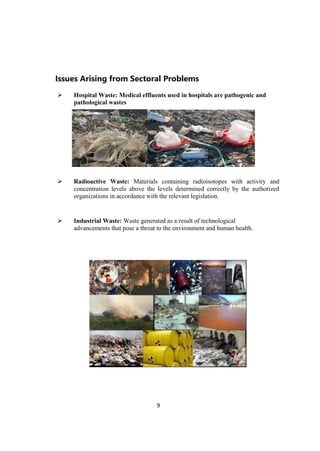
 Increasing and protecting forests.
 Establishing organized industrial zones that are both regular and environmentally friendly.
 Efforts should be made for the separation of waste at the source.
 Ensuring the use of quality fuels.
 Effective laws should be enacted by the government to prevent environmental problems.
 The primary duty of local governments should be the resolution of environmental issues.
 Incentive programs should be initiated for investments in environmental matters.
9
Issues Arising from Sectoral Problems
 Hospital Waste: Medical effluents used in hospitals are pathogenic and
pathological wastes
 Radioactive Waste: Materials containing radioisotopes with activity and
concentration levels above the levels determined correctly by the authorized
organizations in accordance with the relevant legislation.
 Industrial Waste: Waste generated as a result of technological
advancements that pose a threat to the environment and human health.
10
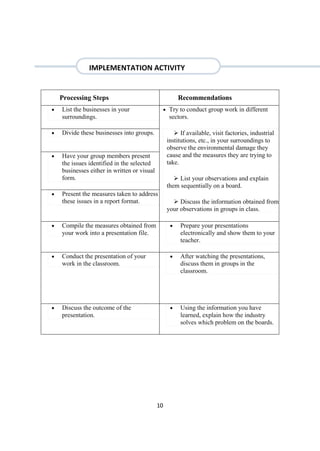
Processing Steps Recommendations
 List the businesses in your
surroundings.
 Try to conduct group work in different
sectors.
 If available, visit factories, industrial
institutions, etc., in your surroundings to
observe the environmental damage they
cause and the measures they are trying to
take.
 List your observations and explain
them sequentially on a board.
 Discuss the information obtained from
your observations in groups in class.
 Divide these businesses into groups.
 Have your group members present
the issues identified in the selected
businesses either in written or visual
form.
 Present the measures taken to address
these issues in a report format.
 Compile the measures obtained from
your work into a presentation file.
 Prepare your presentations
electronically and show them to your
teacher.
 Conduct the presentation of your
work in the classroom.
 After watching the presentations,
discuss them in groups in the
classroom.
 Discuss the outcome of the
presentation.
 Using the information you have
learned, explain how the industry
solves which problem on the boards.
11
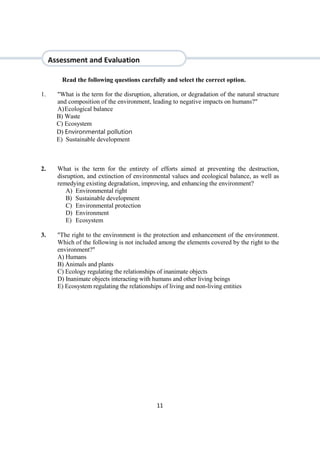
Read the following questions carefully and select the correct option.
1. "What is the term for the disruption, alteration, or degradation of the natural structure
and composition of the environment, leading to negative impacts on humans?"
A)Ecological balance
B) Waste
C) Ecosystem
D) Environmental pollution
E) Sustainable development
2. What is the term for the entirety of efforts aimed at preventing the destruction,
disruption, and extinction of environmental values and ecological balance, as well as
remedying existing degradation, improving, and enhancing the environment?
A) Environmental right
B) Sustainable development
C) Environmental protection
D) Environment
E) Ecosystem
3. "The right to the environment is the protection and enhancement of the environment.
Which of the following is not included among the elements covered by the right to the
environment?"
A) Humans
B) Animals and plants
C) Ecology regulating the relationships of inanimate objects
D) Inanimate objects interacting with humans and other living beings
E) Ecosystem regulating the relationships of living and non-living entities
12
"RESEARCH"
"You will be able to take preventive measures against air, water, and soil pollution
originating from your environment.".
 Investigate preventive measures against factors that cause or may cause air pollution in your environment.
 Observe and research factors contributing to or potentially causing water pollution in your environment.
 Observe and research factors contributing to or potentially causing soil pollution in your environment.
 Research preventive measures against factors contributing to or potentially causing soil pollution in your
environment.
 Prepare documents and presentations based on your research to share in the classroom. Discuss the
preventive measures in the classroom.
 Evaluate your own environmental impact, prepare a presentation about this evaluation, and share it in the
classroom.
 Evaluate your school regarding the environmental damage and solutions. Prepare a presentation or poster
about it and present it to your classmates.
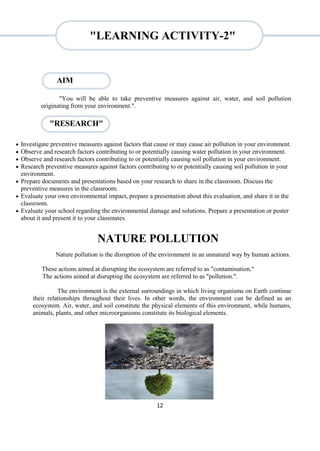
NATURE POLLUTION
Nature pollution is the disruption of the environment in an unnatural way by human actions.
These actions aimed at disrupting the ecosystem are referred to as "contamination."
The actions aimed at disrupting the ecosystem are referred to as "pollution.".
The environment is the external surroundings in which living organisms on Earth continue
their relationships throughout their lives. In other words, the environment can be defined as an
ecosystem. Air, water, and soil constitute the physical elements of this environment, while humans,
animals, plants, and other microorganisms constitute its biological elements.
AIM
"LEARNING ACTIVITY-2"
13
Air, Water, and Soil Concepts
Air: It is a colorless, odorless, and tasteless mixture of gases that surrounds
the Earth and forms the atmosphere layer..
Air: It is vital for the survival of humans and all living organisms. An
individual requires approximately 2.5 liters of water, 1.5 kilograms of food, and
10-20 cubic meters of air per day.While a person can survive for days without food
and water, they cannot survive without breathing for more than a few minutes.
Therefore, air with its natural composition is an essential and fundamental right for
all living beings. The specific weight of air increases closer to the Earth's surface
and decreases as we move away from it.
Water: It is a substance consisting of oxygen and hydrogen, in liquid form,
colorless, odorless, and tasteless. It is the most important and often the only
beverage that sustains both us humans and all other living beings without
discrimination in their vital functions. Water plays numerous roles, including
digestion, absorption, and transportation of nutrients, regular functioning of cells,
organs, and tissues, elimination of waste from the body, regulation of body
temperature, and many others.
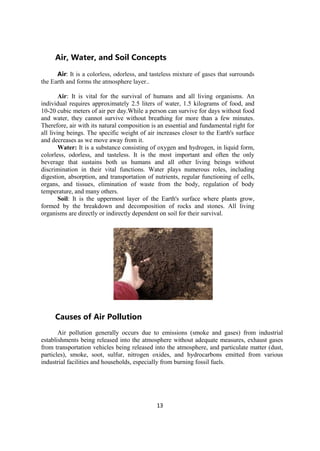
Soil: It is the uppermost layer of the Earth's surface where plants grow,
formed by the breakdown and decomposition of rocks and stones. All living
organisms are directly or indirectly dependent on soil for their survival.
Causes of Air Pollution
Air pollution generally occurs due to emissions (smoke and gases) from industrial
establishments being released into the atmosphere without adequate measures, exhaust gases
from transportation vehicles being released into the atmosphere, and particulate matter (dust,
particles), smoke, soot, sulfur, nitrogen oxides, and hydrocarbons emitted from various
industrial facilities and households, especially from burning fossil fuels.
14
Urbanization and Heating of Residential Buildings
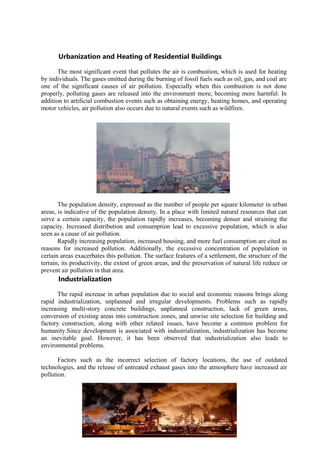
The most significant event that pollutes the air is combustion, which is used for heating
by individuals. The gases emitted during the burning of fossil fuels such as oil, gas, and coal are
one of the significant causes of air pollution. Especially when this combustion is not done
properly, polluting gases are released into the environment more, becoming more harmful. In
addition to artificial combustion events such as obtaining energy, heating homes, and operating
motor vehicles, air pollution also occurs due to natural events such as wildfires.
The population density, expressed as the number of people per square kilometer in urban
areas, is indicative of the population density. In a place with limited natural resources that can
serve a certain capacity, the population rapidly increases, becoming denser and straining the
capacity. Increased distribution and consumption lead to excessive population, which is also
seen as a cause of air pollution.
Rapidly increasing population, increased housing, and more fuel consumption are cited as
reasons for increased pollution. Additionally, the excessive concentration of population in
certain areas exacerbates this pollution. The surface features of a settlement, the structure of the
terrain, its productivity, the extent of green areas, and the preservation of natural life reduce or
prevent air pollution in that area.
Industrialization
The rapid increase in urban population due to social and economic reasons brings along
rapid industrialization, unplanned and irregular developments. Problems such as rapidly
increasing multi-story concrete buildings, unplanned construction, lack of green areas,
conversion of existing areas into construction zones, and unwise site selection for building and
factory construction, along with other related issues, have become a common problem for
humanity.Since development is associated with industrialization, industrialization has become
an inevitable goal. However, it has been observed that industrialization also leads to
environmental problems.
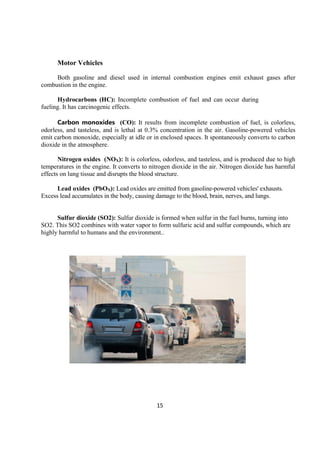
Factors such as the incorrect selection of factory locations, the use of outdated
technologies, and the release of untreated exhaust gases into the atmosphere have increased air
pollution.
15
Motor Vehicles
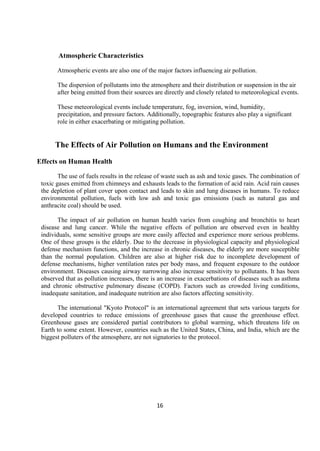
Both gasoline and diesel used in internal combustion engines emit exhaust gases after
combustion in the engine.
Hydrocarbons (HC): Incomplete combustion of fuel and can occur during
fueling. It has carcinogenic effects.
Carbon monoxides (CO): It results from incomplete combustion of fuel, is colorless,
odorless, and tasteless, and is lethal at 0.3% concentration in the air. Gasoline-powered vehicles
emit carbon monoxide, especially at idle or in enclosed spaces. It spontaneously converts to carbon
dioxide in the atmosphere.
Nitrogen oxides (NOX): It is colorless, odorless, and tasteless, and is produced due to high
temperatures in the engine. It converts to nitrogen dioxide in the air. Nitrogen dioxide has harmful
effects on lung tissue and disrupts the blood structure.
Lead oxides (PbOX): Lead oxides are emitted from gasoline-powered vehicles' exhausts.
Excess lead accumulates in the body, causing damage to the blood, brain, nerves, and lungs.
Sulfur dioxide (SO2): Sulfur dioxide is formed when sulfur in the fuel burns, turning into
SO2. This SO2 combines with water vapor to form sulfuric acid and sulfur compounds, which are
highly harmful to humans and the environment..
16
Atmospheric Characteristics
Atmospheric events are also one of the major factors influencing air pollution.
The dispersion of pollutants into the atmosphere and their distribution or suspension in the air
after being emitted from their sources are directly and closely related to meteorological events.
These meteorological events include temperature, fog, inversion, wind, humidity,
precipitation, and pressure factors. Additionally, topographic features also play a significant
role in either exacerbating or mitigating pollution.
The Effects of Air Pollution on Humans and the Environment
Effects on Human Health
The use of fuels results in the release of waste such as ash and toxic gases. The combination of
toxic gases emitted from chimneys and exhausts leads to the formation of acid rain. Acid rain causes
the depletion of plant cover upon contact and leads to skin and lung diseases in humans. To reduce
environmental pollution, fuels with low ash and toxic gas emissions (such as natural gas and
anthracite coal) should be used.
The impact of air pollution on human health varies from coughing and bronchitis to heart
disease and lung cancer. While the negative effects of pollution are observed even in healthy
individuals, some sensitive groups are more easily affected and experience more serious problems.
One of these groups is the elderly. Due to the decrease in physiological capacity and physiological
defense mechanism functions, and the increase in chronic diseases, the elderly are more susceptible
than the normal population. Children are also at higher risk due to incomplete development of
defense mechanisms, higher ventilation rates per body mass, and frequent exposure to the outdoor
environment. Diseases causing airway narrowing also increase sensitivity to pollutants. It has been
observed that as pollution increases, there is an increase in exacerbations of diseases such as asthma
and chronic obstructive pulmonary disease (COPD). Factors such as crowded living conditions,
inadequate sanitation, and inadequate nutrition are also factors affecting sensitivity.
The international "Kyoto Protocol" is an international agreement that sets various targets for
developed countries to reduce emissions of greenhouse gases that cause the greenhouse effect.
Greenhouse gases are considered partial contributors to global warming, which threatens life on
Earth to some extent. However, countries such as the United States, China, and India, which are the
biggest polluters of the atmosphere, are not signatories to the protocol.
17
Effects on the Environment
 Greenhouse: A structure that allows sunlight to enter but limits the escape of
heat, resulting in a warmer interior compared to the outside environment.
 Greenhouse effect: Gases called greenhouse gases, including water vapor, in
the Earth's atmosphere prevent some of the solar energy absorbed from
returning to space. As a result, the Earth's surface becomes warmer than it
would be otherwise. This phenomenon is known as the greenhouse effect.
 Greenhouse gas: Gases in the atmosphere that have the ability to transmit
shortwave solar radiation while trapping longwave radiation emitted from the
Earth's surface to the atmosphere are called greenhouse gases.
Definition of Water Pollution and Causes of Water Pollution
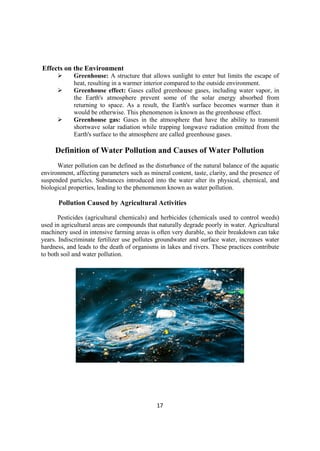
Water pollution can be defined as the disturbance of the natural balance of the aquatic
environment, affecting parameters such as mineral content, taste, clarity, and the presence of
suspended particles. Substances introduced into the water alter its physical, chemical, and
biological properties, leading to the phenomenon known as water pollution.
Pollution Caused by Agricultural Activities
Pesticides (agricultural chemicals) and herbicides (chemicals used to control weeds)
used in agricultural areas are compounds that naturally degrade poorly in water. Agricultural
machinery used in intensive farming areas is often very durable, so their breakdown can take
years. Indiscriminate fertilizer use pollutes groundwater and surface water, increases water
hardness, and leads to the death of organisms in lakes and rivers. These practices contribute
to both soil and water pollution.
18
Another type of pollution is erosion. Erosion results in the loss of large amounts of
agriculturally suitable soil. The disappearance of fertile soil leads to a decrease in agricultural
production, deterioration in quality, and deficiencies in the food chain. Additionally, soil
transported by erosion can cause turbidity in seas and rivers, affecting the aquatic ecological
balance.
Pollution Caused by Industrial Activities
As it is known, industrial waters are an important component of water consumption
worldwide, and as countries advance technologically, the water requirement for industries
increases.
Each industrial process (production) generates waste that can be harmful to natural water
systems. Depending on their usage areas, industrial wastewater discharged through
industrial activities can be categorized into three main groups based on the types and loads
of pollutants they carry:
Production process waste: Each industry has its own specific wastewater. Wastewaters
generated during production are categorized as process wastewater. Process wastewater
includes various raw material wastes, intermediate product wastes, and finished product
wastes. Process waters contain both inorganic and organic waste materials.
Cooling waters: These waters are clean and only elevate the temperature of surface waters.
Rising temperatures cause two problems:
Decreased solubility of oxygen in water.
Increased temperature accelerates biological activity, leading to a decrease in oxygen in
wastewater.
Workplace and personnel cleanliness and sanitation-related wastes: 10% of these waters
come from floor washings and faucets, while 90% come from bathrooms and toilets.
Industrial wastewater containing various chemical substances has adverse effects on surface
waters. Therefore, it is not possible for these waters to be biologically treated on their own.
It should not be forgotten that excessive use of detergents, soaps, and cleaning agents in
homes, as well as waste such as medicines, batteries, burnt oil, and similar substances, contribute
to the pollution of groundwater and surface waters along with rainwater."
The Pollution Caused by Wastes in Residential Areas
Wastewater refers to the total of human-related (anthropogenic) sources discharged into the
sewage system. These are highly contaminated waters where various solid and liquid non-
dissolved substances, suspensions, emulsions, and a wide range of harmful and harmless bacteria
are found, along with some water-soluble acids.
19
Environmental Effects of Water Pollution
Impact on Human Health
Cholera, typhoid fever, paratyphoid fever, dysentery, hepatitis, diarrhea, polio, malaria, and
other diseases unfortunately arise from unhealthy water sources. The pollution on these limited
resources, parallel to the increasing demand for water sources worldwide and in our country, is
steadily increasing.
According to the World Health Organization (WHO), approximately 25,000 people die every
day worldwide due to the use of unhealthy water. Fatal diseases such as typhoid fever, cholera, and
dysentery are transmitted to humans through water, and both waste water and agricultural fertilizers
contaminating well water can lead to chemical substances such as ammonia and nitrite affecting
human health. Moreover, poisoning from agricultural chemicals reaching groundwater can also
result in human
The Impact on Nature
Chemical substances and organic compounds in wastewater lead to a decrease in the amount
of dissolved oxygen in water. This condition increases the mortality rates of plants and animals
living in water. Such waters have a darker color and foul odor. In fact, in some lakes or rivers,
excessive pollution has resulted in the cessation of aquatic life and the formation of islands made
up of waste.
Radioactive waste is also becoming increasingly hazardous over time. While these wastes
are stored under specific conditions, in some cases, they may accidentally or irresponsibly mix with
nature and groundwater. The radiation emitted by radioactive wastes causes cancer and mutations
in living organisms.
Prevention of Water Pollution
Here are several strategies and practices for preventing water pollution:
Regulations and Controls: Governments should establish various regulations and standards
to control the discharge of industrial and agricultural wastewater. These regulations should include
measures such as the establishment and operation of wastewater treatment plants.
Wastewater Treatment Plants: Wastewater from industrial facilities, agricultural areas, and
residential areas should be treated in wastewater treatment plants. These plants clean the water,
preventing the spread of harmful substances into the environment.
Environmental Education: Various education and awareness programs should be organized
to increase awareness of water pollution in society. These programs help people become more
aware of preserving water resources and properly disposing of their waste.
20
Sustainable Agricultural Practices: Sustainable agricultural practices should be promoted to
reduce the use of fertilizers and pesticides, prevent erosion, and preserve soil quality.
Industrial Innovations: Industrial enterprises should develop innovative technologies to
promote less water use in production processes and reduce the amount of wastewater generated.
Waste Management: Proper management of waste generated in households, industrial
facilities, and agricultural areas is essential. Proper disposal of wastewater and solid waste is an
effective way to reduce water pollution.
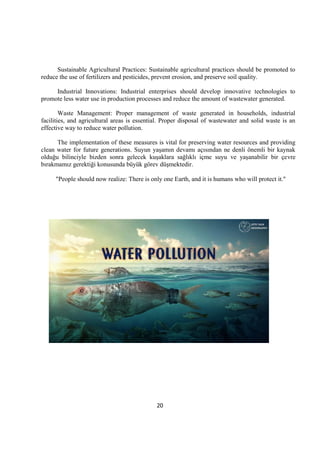
The implementation of these measures is vital for preserving water resources and providing
clean water for future generations. Suyun yaşamın devamı açısından ne denli önemli bir kaynak
olduğu bilinciyle bizden sonra gelecek kuşaklara sağlıklı içme suyu ve yaşanabilir bir çevre
bırakmamız gerektiği konusunda büyük görev düşmektedir.
"People should now realize: There is only one Earth, and it is humans who will protect it."
21
Causes of Soil Pollution
Industrial Pollution
Soil pollution has various causes, including:
Industrial Activities: Industrial processes often release harmful chemicals
and pollutants into the soil, such as heavy metals, solvents, and toxic substances,
leading to contamination.
Agricultural Practices: The use of chemical fertilizers, pesticides, and
herbicides in agriculture can contaminate the soil with harmful chemicals. Soil
erosion due to improper farming practices also contributes to soil pollution.
Mining: Mining operations can release heavy metals and toxic chemicals
into the soil, contaminating large areas of land and disrupting ecosystems.
Improper Waste Disposal: Improper disposal of solid and hazardous waste,
including household waste, industrial waste, and construction debris, can lead to
soil pollution.
Use of Chemical Substances: The use of chemicals in various sectors, such
as manufacturing, construction, and transportation, can result in soil contamination
if not managed properly.
Oil Spills: Accidental spills of oil and petroleum products can result in soil
contamination, affecting soil fertility and harming plant and animal life.
Radioactive Waste: Improper disposal of radioactive waste from nuclear
facilities and medical institutions can lead to soil contamination with radioactive
materials, posing serious health risks.
Acid Rain: Acid rain, which is caused by the release of sulfur dioxide and
nitrogen oxides into the atmosphere from industrial activities and vehicle
emissions, can lead to soil acidification and degradation.
Urbanization: Urban development and expansion can result in soil
compaction, loss of vegetative cover, and increased pollution from human
activities, contributing to soil degradation and pollution.
.
22
Prevention of Soil Pollution
Soil pollution prevention involves various strategies and measures to minimize
the release of pollutants into the soil and to mitigate existing contamination. Some
key approaches include:
Reducing Chemical Inputs: Encouraging the use of organic farming practices
and minimizing the use of synthetic fertilizers, pesticides, and herbicides can help
reduce chemical pollution in the soil.
Proper Waste Management: Implementing effective waste management
practices, such as recycling, composting, and safe disposal of hazardous waste,
helps prevent soil contamination from solid and hazardous waste.
Soil Conservation: Promoting soil conservation measures, such as erosion control,
reforestation, and land restoration, helps protect soil integrity and prevent erosion-
induced soil pollution.
Contaminated Site Remediation: Implementing remediation techniques, such as soil
washing, bioremediation, and phytoremediation, can help clean up contaminated sites
and restore soil quality.
Regulatory Measures: Enforcing regulations and standards for industrial activities,
waste disposal, and land use planning helps prevent soil pollution by ensuring that
businesses and individuals comply with environmental laws.
Education and Awareness: Raising public awareness about the importance of soil
conservation and pollution prevention through education campaigns, outreach
programs, and community engagement initiatives can foster responsible behavior and
practices.
Sustainable Land Use Practices: Encouraging sustainable land use practices, such
as sustainable agriculture, urban planning, and land development, helps minimize soil
degradation and pollution while promoting long-term environmental sustainability.
Monitoring and Assessment: Regular monitoring and assessment of soil quality and
contamination levels are essential for identifying pollution sources, tracking changes
in soil health, and implementing timely interventions to prevent further degradation.
By adopting these preventive measures and implementing effective management
practices, we can minimize soil pollution and protect this vital resource for future
generations.
23
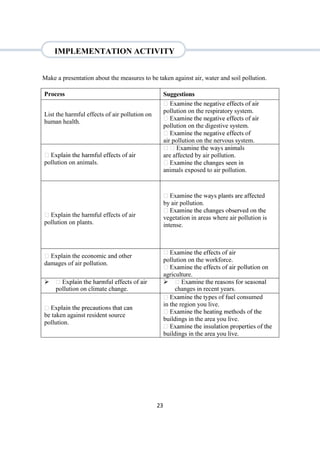
Make a presentation about the measures to be taken against air, water and soil pollution.
Process Suggestions
 List the harmful effects of air pollution on
human health.

pollution on the respiratory system.

pollution on the digestive system.

air pollution on the nervous system.

pollution on animals.

are affected by air pollution.

animals exposed to air pollution.
 Explain the harmful effects of air
pollution on plants.

by air pollution.

vegetation in areas where air pollution is
intense.
 Explain the economic and other
damages of air pollution.

pollution on the workforce.
 n on
agriculture.

pollution on climate change.

changes in recent years.

be taken against resident source
pollution.
 nsumed
in the region you live.

buildings in the area you live.

buildings in the area you live.
IMPLEMENTATION ACTIVITY
24
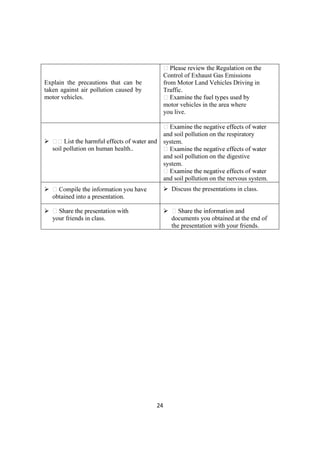
Explain the precautions that can be
taken against air pollution caused by
motor vehicles.

Control of Exhaust Gas Emissions
from Motor Land Vehicles Driving in
Traffic.

motor vehicles in the area where
you live.

soil pollution on human health..

and soil pollution on the respiratory
system.

and soil pollution on the digestive
system.

and soil pollution on the nervous system.

obtained into a presentation.
 Discuss the presentations in class.

your friends in class.

documents you obtained at the end of
the presentation with your friends.
25
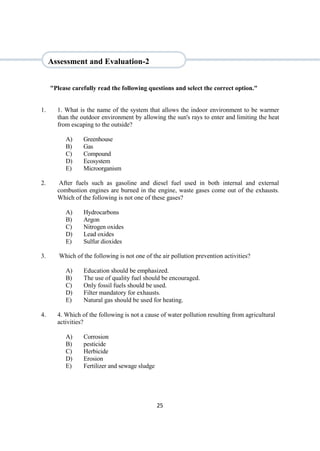
"Please carefully read the following questions and select the correct option."
1. 1. What is the name of the system that allows the indoor environment to be warmer
than the outdoor environment by allowing the sun's rays to enter and limiting the heat
from escaping to the outside?
A) Greenhouse
B) Gas
C) Compound
D) Ecosystem
E) Microorganism
2. After fuels such as gasoline and diesel fuel used in both internal and external
combustion engines are burned in the engine, waste gases come out of the exhausts.
Which of the following is not one of these gases?
A) Hydrocarbons
B) Argon
C) Nitrogen oxides
D) Lead oxides
E) Sulfur dioxides
3. Which of the following is not one of the air pollution prevention activities?
A) Education should be emphasized.
B) The use of quality fuel should be encouraged.
C) Only fossil fuels should be used.
D) Filter mandatory for exhausts.
E) Natural gas should be used for heating.
4. 4. Which of the following is not a cause of water pollution resulting from agricultural
activities?
A) Corrosion
B) pesticide
C) Herbicide
D) Erosion
E) Fertilizer and sewage sludge
Assessment and Evaluation-2
26
5. Every industrial process (production) produces wastes that can be harmful to the
natural water system. Which of the following is not a water waste group according to
its usage areas in industry?
A) Wastes from production processes
B) Cooling waters
C) Wastes related to employee cleaning
D) Hot waters
E) Wastes related to sanitary
6. Which of the following is not among the measures to prevent water pollution?
A) Filter and purification facilities should be installed in factories.
B) Materials that will not harm nature should be used in production.
C) As individuals, we should warn those around us to pollute less.
D) The condition of the receiving environments should be improved.
E) Dilution potentials of receiving water environments should not be used.
7. Which of the following is not among the effects of soil pollution on humans and
the environment?
A) Erosion
B) Old age and barrenness
C) Stony and rocky
D) Organic substances
E) Fertilizer and fertilization
8. . Which of the following is not among the causes of soil pollution?
A) A) Chemical fertilizer
B) B) Exhaust gases
C) C) Erosion
D) D) Industrial wastewater
E) E) Artificial bait
9. Which of the following is not among the measures to prevent soil pollution?
A) Forest areas should be protected.
B) Agricultural lands should not be used for other purposes.
C) Chemical solid and liquid wastes should be discharged into rivers in industrial areas.
D) Municipalities should establish recycling units for city garbage.
E) Chemical solid and liquid wastes should not be left on the ground in industrial areas.
27
RESEARCH
You will be able to choose to use energy sources that do not harm the environment.
 Identify the types of energy that cause and do not cause pollution in the
environment you live in by observing and researching.
 Do research to determine the preventive measures that can be taken against
energies that cause or may cause pollution in the environment you live in.
 Research the relationship between energy and environment in terms of climate,
land use, water use and waste.
 Prepare documents and presentations regarding your research and present them
in the classroom. Discuss the precautions that can be taken in the classroom
environment.
ENERGY
Energy is the ability to do work. The energy of a system is the maximum work that system can do.
Energy Resources
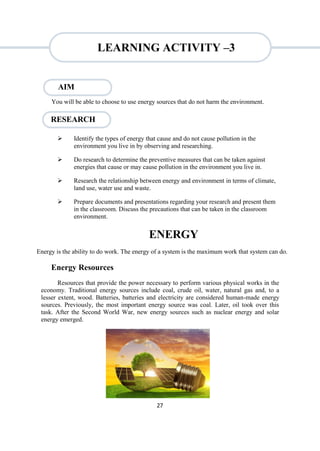
Resources that provide the power necessary to perform various physical works in the
economy. Traditional energy sources include coal, crude oil, water, natural gas and, to a
lesser extent, wood. Batteries, batteries and electricity are considered human-made energy
sources. Previously, the most important energy source was coal. Later, oil took over this
task. After the Second World War, new energy sources such as nuclear energy and solar
energy emerged.
AIM
LEARNING ACTIVITY –3
28
Non-Renewable Energy Sources
These resources run out as they are used and new ones are replaced over a very long
period of time. Coal, oil, natural gas and boron mineral can be given as examples.
Coal
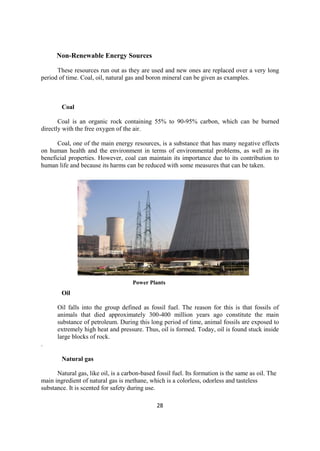
Coal is an organic rock containing 55% to 90-95% carbon, which can be burned
directly with the free oxygen of the air.
Coal, one of the main energy resources, is a substance that has many negative effects
on human health and the environment in terms of environmental problems, as well as its
beneficial properties. However, coal can maintain its importance due to its contribution to
human life and because its harms can be reduced with some measures that can be taken.
Oil
Power Plants
Oil falls into the group defined as fossil fuel. The reason for this is that fossils of
animals that died approximately 300-400 million years ago constitute the main
substance of petroleum. During this long period of time, animal fossils are exposed to
extremely high heat and pressure. Thus, oil is formed. Today, oil is found stuck inside
large blocks of rock.
.
Natural gas
Natural gas, like oil, is a carbon-based fossil fuel. Its formation is the same as oil. The
main ingredient of natural gas is methane, which is a colorless, odorless and tasteless
substance. It is scented for safety during use.
29
Renewable energy sources
They are constantly ongoing energy sources. Hydroelectric energy, geothermal energy,
wind energy, solar energy can be given as examples.
Hydraulic (Hydroelectric) Energy
Hydraulic energy is the energy source with the most advanced technological
development among renewable energy sources. The source of hydraulic energy, one of the
oldest energy sources in use, is water. Therefore, hydroelectric power plants must be on a
water source. Hydraulic energy has become more widely used after the technology that
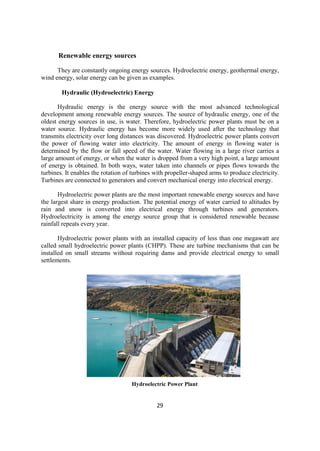
transmits electricity over long distances was discovered. Hydroelectric power plants convert
the power of flowing water into electricity. The amount of energy in flowing water is
determined by the flow or fall speed of the water. Water flowing in a large river carries a
large amount of energy, or when the water is dropped from a very high point, a large amount
of energy is obtained. In both ways, water taken into channels or pipes flows towards the
turbines. It enables the rotation of turbines with propeller-shaped arms to produce electricity.
Turbines are connected to generators and convert mechanical energy into electrical energy.
Hydroelectric power plants are the most important renewable energy sources and have
the largest share in energy production. The potential energy of water carried to altitudes by
rain and snow is converted into electrical energy through turbines and generators.
Hydroelectricity is among the energy source group that is considered renewable because
rainfall repeats every year.
Hydroelectric power plants with an installed capacity of less than one megawatt are
called small hydroelectric power plants (CHPP). These are turbine mechanisms that can be
installed on small streams without requiring dams and provide electrical energy to small
settlements.
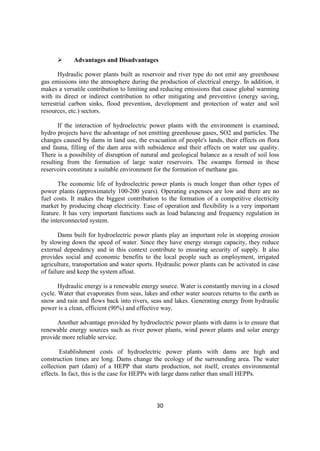
Hydroelectric Power Plant
30
 Advantages and Disadvantages
Hydraulic power plants built as reservoir and river type do not emit any greenhouse
gas emissions into the atmosphere during the production of electrical energy. In addition, it
makes a versatile contribution to limiting and reducing emissions that cause global warming
with its direct or indirect contribution to other mitigating and preventive (energy saving,
terrestrial carbon sinks, flood prevention, development and protection of water and soil
resources, etc.) sectors.
If the interaction of hydroelectric power plants with the environment is examined,
hydro projects have the advantage of not emitting greenhouse gases, SO2 and particles. The
changes caused by dams in land use, the evacuation of people's lands, their effects on flora
and fauna, filling of the dam area with subsidence and their effects on water use quality.
There is a possibility of disruption of natural and geological balance as a result of soil loss
resulting from the formation of large water reservoirs. The swamps formed in these
reservoirs constitute a suitable environment for the formation of methane gas.
The economic life of hydroelectric power plants is much longer than other types of
power plants (approximately 100-200 years). Operating expenses are low and there are no
fuel costs. It makes the biggest contribution to the formation of a competitive electricity
market by producing cheap electricity. Ease of operation and flexibility is a very important
feature. It has very important functions such as load balancing and frequency regulation in
the interconnected system.
Dams built for hydroelectric power plants play an important role in stopping erosion
by slowing down the speed of water. Since they have energy storage capacity, they reduce
external dependency and in this context contribute to ensuring security of supply. It also
provides social and economic benefits to the local people such as employment, irrigated
agriculture, transportation and water sports. Hydraulic power plants can be activated in case
of failure and keep the system afloat.
Hydraulic energy is a renewable energy source. Water is constantly moving in a closed
cycle. Water that evaporates from seas, lakes and other water sources returns to the earth as
snow and rain and flows back into rivers, seas and lakes. Generating energy from hydraulic
power is a clean, efficient (90%) and effective way.
Another advantage provided by hydroelectric power plants with dams is to ensure that
renewable energy sources such as river power plants, wind power plants and solar energy
provide more reliable service.
Establishment costs of hydroelectric power plants with dams are high and
construction times are long. Dams change the ecology of the surrounding area. The water
collection part (dam) of a HEPP that starts production, not itself, creates environmental
effects. In fact, this is the case for HEPPs with large dams rather than small HEPPs.
31
Hydraulic energy has effects on the hydrological and biological environment. The
large surface area of the dam lake increases evaporation, salinization and barrenness occur in
agricultural lands, water-borne parasites and diseases increase, and water quality is
negatively affected for a few years until balance is achieved by not cutting and cleaning the
plants and trees that will remain under the reservoir.
Geothermal energy
Jeotermal enerji, kaynak suyunun sıcaklığına göre elektrik üretimi, ısıtma (bölgesel,
konut, sera vb.), kimyasal madde üretimi, kurutmacılık, bitki ve kültür balıkçılığı, tarım,
seracılık, karların eritilmesi, termal turizm vb.de kullanılmaktadır. Dünyada jeotermal enerji
kapasitesinin çok azından yararlanılmaktadır. Jeotermal enerji ile ısınan konutlara her yıl
yenileri eklenmektedir.
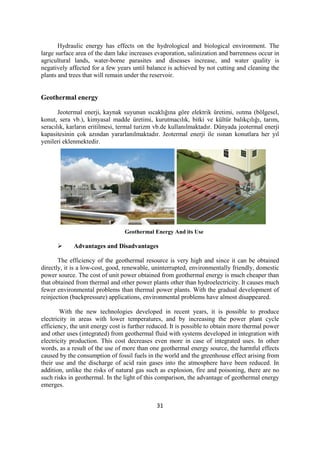
Geothermal Energy And its Use
 Advantages and Disadvantages
The efficiency of the geothermal resource is very high and since it can be obtained
directly, it is a low-cost, good, renewable, uninterrupted, environmentally friendly, domestic
power source. The cost of unit power obtained from geothermal energy is much cheaper than
that obtained from thermal and other power plants other than hydroelectricity. It causes much
fewer environmental problems than thermal power plants. With the gradual development of
reinjection (backpressure) applications, environmental problems have almost disappeared.
With the new technologies developed in recent years, it is possible to produce
electricity in areas with lower temperatures, and by increasing the power plant cycle
efficiency, the unit energy cost is further reduced. It is possible to obtain more thermal power
and other uses (integrated) from geothermal fluid with systems developed in integration with
electricity production. This cost decreases even more in case of integrated uses. In other
words, as a result of the use of more than one geothermal energy source, the harmful effects
caused by the consumption of fossil fuels in the world and the greenhouse effect arising from
their use and the discharge of acid rain gases into the atmosphere have been reduced. In
addition, unlike the risks of natural gas such as explosion, fire and poisoning, there are no
such risks in geothermal. In the light of this comparison, the advantage of geothermal energy
emerges.
32
Although geothermal energy is recognized as an environmentally friendly resource,
the fact that the fluid causes rust, decay, calcification (scaling), pollutes the surface waters
where it will be discharged due to the boron it contains, and contains substances such as
CO2, H2S and boron, requires some technological measures to be taken in practice.
In order to prevent the geothermal fluid used from creating environmental problems,
the practice of returning it underground (reinjection) has been developed and has become
legally mandatory in various countries. In this case, geothermal energy does not pollute the
environment and can be used instead of oil, natural gas and coal.
Geothermal energy is an energy source that can be used on-site and its transportation
over long distances is limited (around 100 km at most). In terms of temperature and noise,
the fact that geothermal areas are generally far from residential areas ensures that there are
no problems in these matters. In addition, since the switchboards take up little space, they do
not spoil the image. Other advantages of geothermal energy are that it can produce
continuous power (uninterrupted) and is not affected by weather changes (an indication that
it is a reliable source)..
Solar energy
It is a renewable energy source that comes from the sun and has a constant intensity of
1370 W/m² outside the earth's atmosphere and varies between 0-1100 W/m² on the earth's
surface. It can be used in a controlled manner for heating, cooling and electricity generation.
Solar collectors, which can collect solar energy and convert it into factors such as heat and
electricity, are the intermediary element in the use of solar energy. The average annual
sunshine duration of our country is 2640 hours. The maximum sunshine duration was
observed in July with 362 hours, and the minimum sunshine duration was observed in
December with 98 hours.
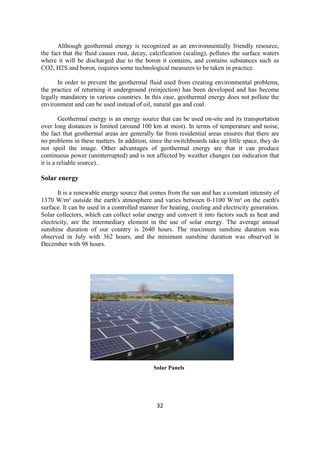
Solar Panels
33
 Advantages and Disadvantages
Solar energy is a clean, renewable and continuous energy source. Systems powered by solar
energy can be easily transported and installed.
They are systems that do not pollute the environment, are environmentally friendly, and can
be easily changed when necessary, depending on energy needs.
Solar energy; It has advantages such as no fuel problems, ease of operation, no mechanical
wear, being modular (changeable) and working without problems for many years.
The solar cell is durable, reliable and long-lasting.
The use of solar cells may be more economical in rural areas where there is no electricity grid
line or where installing the grid line is expensive.
Every house can provide its own energy with solar cells installed on its roof. Thus,
transmission and energy transportation costs and losses are eliminated.
In addition to all these advantages of solar energy, it has some disadvantages.
These:
The efficiency of solar cells is low (around 15%).
The production-related initial and consumption costs of photovoltaic cells are high,
but with technological developments, energy is becoming increasingly widespread and the
cost is decreasing.
It is expected that costs will decrease further as use becomes widespread.
The storage possibilities of solar energy, which is an intermittent resource, are
limited. Disadvantages such as maintenance and lifespan of storage units reduce the
efficiency of the system and increase the cost of energy.
The negativities we mentioned above are due to the use of the sun in the form of
hydrogen gas production through the electrolysis of water.
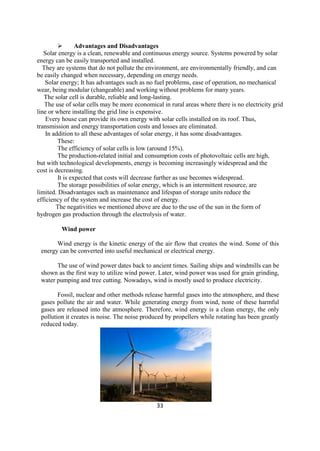
Wind power
Wind energy is the kinetic energy of the air flow that creates the wind. Some of this
energy can be converted into useful mechanical or electrical energy.
The use of wind power dates back to ancient times. Sailing ships and windmills can be
shown as the first way to utilize wind power. Later, wind power was used for grain grinding,
water pumping and tree cutting. Nowadays, wind is mostly used to produce electricity.
Fossil, nuclear and other methods release harmful gases into the atmosphere, and these
gases pollute the air and water. While generating energy from wind, none of these harmful
gases are released into the atmosphere. Therefore, wind energy is a clean energy, the only
pollution it creates is noise. The noise produced by propellers while rotating has been greatly
reduced today.
34
 Wind Energy Usage Areas
 Houses
 Businesses
 Park, garden and street lighting
 Signaling
 Irrigation systems
 Caravan, boat and mobile stations
 Anywhere that may need electrical energyEvler
 Advantages and Disadvantages
The wind power plant has no fuel costs during its production life and operating costs
are almost non-existent. Since it is a domestic resource, it reduces dependence on foreign
energy. Wind turbines are modular (part-changeable) and can be manufactured in any size
and used individually or in groups. Wind is a renewable energy source that does not create
pollution and causes almost no harm to the environment. It is a good alternative energy
source for domestic uses of energy.
The fact that wind farms require large areas may seem like a problem, but the actual
area occupied by the turbines in the wind power plant is 1-1.2% of the total area of the power
plant. Since agriculture and animal husbandry can be done between the turbines, there is no
loss of land. It does not hinder farming activities in agricultural areas.
Wind turbines, which are used in wind energy production and do not harm the nature,
do not take up much space and create jobs for people living in the area where they are
installed. Another important feature is that wind turbines can also be installed at sea. Wind
farms can be easily dismantled and the land on which they are located can be easily restored.
Negative environmental effects of wind power plants can be mentioned, such as visual
and aesthetic pollution, making noise, causing bird deaths, causing birds to change their
migration routes, and causing interference in both radio and television receivers (within an
area of 2-3 km).
The noise emitted from wind turbines affects the human ear to a small extent in close
proximity. One of these noises is aerodynamic or broadband noise. This noise is created
when air passes over the blades of the machine. The other noise is tonal or single frequency
noise, which is created by rotating mechanical and electrical elements such as gearboxes and
generators.
In addition, since wind power plants are installed in rural areas, they carry the risk of
damaging archaeologically important areas. For this reason, since detailed archaeological
research needs to be carried out on the land where the power plant will be built, the start of
construction takes longer or cannot be done at all.
35
Nuclear Energy
A huge amount of energy is released as a result of the splitting of heavy radioactive
atoms (such as uranium) into smaller atoms (fission) by the impact of a neutron or the
combination of light radioactive atoms to form heavier atoms (fusion). This energy is called
nuclear energy. In nuclear reactors, the energy obtained by the fission reaction is converted
into electricity.
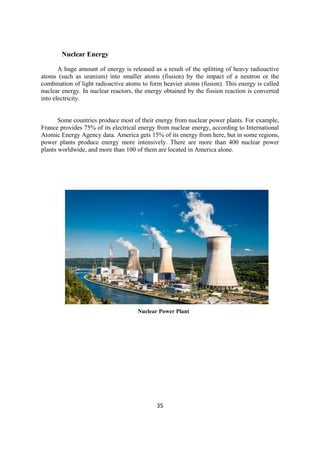
Some countries produce most of their energy from nuclear power plants. For example,
France provides 75% of its electrical energy from nuclear energy, according to International
Atomic Energy Agency data. America gets 15% of its energy from here, but in some regions,
power plants produce energy more intensively. There are more than 400 nuclear power
plants worldwide, and more than 100 of them are located in America alone.
Nuclear Power Plant
36
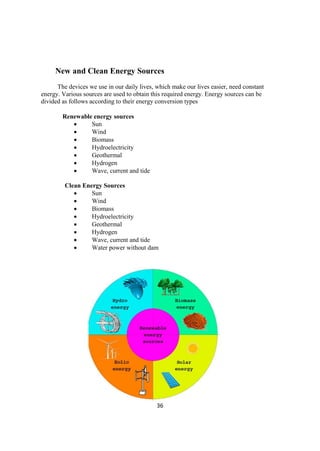
New and Clean Energy Sources
The devices we use in our daily lives, which make our lives easier, need constant
energy. Various sources are used to obtain this required energy. Energy sources can be
divided as follows according to their energy conversion types
Renewable energy sources
 Sun
 Wind
 Biomass
 Hydroelectricity
 Geothermal
 Hydrogen
 Wave, current and tide
Clean Energy Sources
 Sun
 Wind
 Biomass
 Hydroelectricity
 Geothermal
 Hydrogen
 Wave, current and tide
 Water power without dam
37
Read the following questions carefully and mark the correct option.
1. Which of the following is not one of the clean energy sources?
A) Geothermal energy
B) Biogas energy
C) Coal
D) Solar energy
E) Wind energy
2. Which of the following types of energy is not used in electricity production?
A) Coal power plants
B) Wood
C) Nuclear power plants
D) Biogas
E) Hydraulic power plants
3. Which of the following is the type of energy that causes acid rain?
A) Oil
B) Geothermal
C) Biogas
D) Solar energy
E) Wind energy
38
ANSWER Assessment and Evaluation-1
1 D
2 C
3 C
ANSWER Assessment and Evaluation-2
1 A
2 B
3 C
4 A
5 D
6 E
7 D
8 E
9 C
ANSWER Assessment and Evaluation-3
1 C
2 B
3 A
ANSWER KEYS
39
 Miller, G. T., & Spoolman, S. E. (2019). Environmental Science. Cengage Learning.
 Cunningham, W. P., Cunningham, M. A., & Saigo, B. W. (2019). Environmental
Science: A Global Concern. McGraw-Hill Education.
 Carson, R. (2002). Silent Spring. Houghton Mifflin.
 Kolbert, E. (2014). The Sixth Extinction: An Unnatural History. Henry Holt and
Company.
 Gore, A. (2006). An Inconvenient Truth: The Planetary Emergency of Global Warming
and What We Can Do About It. Rodale Books.
 AKPINAR Kemal, Sağlık Bakanlığı Temel Sağlık Hizmetleri Genel Müdürlüğü Hizmet
İçi Eğitimi Dokümanları ve Fotoğrafları, Yalova, Kasım 2005.
 BOZYİĞİT Recep, Tufan KARAASLAN, Çevre Bilgisi, Nobel Yayın Dağıtım,
Ankara,1998.
 GÜNEY Emrullah, Çevre Sorunları, Nobel Yayın Dağıtım, Ankara, 2004.
 KAHRAMAN Nüzhet, Oğuz TÜRKAY, Turizm ve Çevre, Detay Yayıncılık,
Ankara, 2004.
 KELEŞ Ruşen, Can HAMAMCI, Çevre Bilim, İmge Yayınevi, Ağustos 2002.
 ÜNAL Şemsettin, Turizm Çevre İlişkisi, Dokuz Eylül Üniversitesi SBE Turizm
Sosyolojisi Ders Araştırması, İzmir, 2004.
 Çevre Bakanlığı Çevre Eğitimi ve Yayım Dairesi Başkanlığı, Çevre Üzerine Notlar,
Ankara, 1993.
References

Praga - Environment Module-ErasmusFest.pdf

  • 1.
  • 2.
    iii Definition of theModule……………………………………………………………………….4 Learning Activity –1 ................................................................................................................. 5 ENVIRONMENT Environmental Issues………………………………………………………………………6 Definitions Related to the Environment ..................................................................... 6 Environmental Pollution…………………………………………………………… 7 Environmental Conservation Measures…………………………………………….. 8 Issues Arising from Sectoral Problems………………………………………………9 IMPLEMENTATION ACTIVITY.................................................................................... 10 Assessment and Evaluation................................................................................................ 11 LEARNING ACTIVITY-2..................................................................................................... 12 NATURE POLLUTION.................................................................................................. 12 Air, Water, and Soil Concepts…………………………………………………….. 13 Causes of Air Pollution…………………………………………………………… 13 Urbanization and Heating of Residential Buildings………………………………. 14 Şehirleşme ve Konutların Isıtılması.......................................................................... 14 Industrialization……………………………………………………………………. 14 Motor Vehicles......................................................................................................... 15 Atmospheric Characteristics...................................................................................... 16 Definition of Water Pollution and Causes of Water Pollution ................................. 17 Environmental Effects of Water Pollution ............................................................... 19 Prevention of Water Pollution.................................................................................. 19 Causes of Soil Pollution ........................................................................................... 21 Prevention of Soil Pollution ..................................................................................... 22 IMPLEMENTATION ACTIVITY................................................................................ 23 Assessment and Evaluation................................................................................................ 25 LEARNING ACTIVITY –3 ................................................................................................... 27 ENERGY…………………………………………………………………………………27 Energy Resources ………………………………………………………………………. 28 Non-Renewable Energy Sources .................................................................................. 28 Renewable energy sources............................................................................................. 29 Hydraulic (Hydroelectric) Energy………………………………………………….29 Geothermal energy………………………………………………………………… 31 Solar energy……………………………………………………………………….. 32 Wind power……………………………………………………………………….. 33 Nuclear Energy……………………………………………………………………. 35 New and Clean Energy Sources………………………………………………….. 36 Assessment and Evaluation……………………………………………………………….. 37 ANSWER KEYS…………………………………………………………………………… 38 References .............................................................................................................................. 39 Contents
  • 3.
    4 Definition of theModule It is a learning material where the necessary knowledge and skills to protect the environment and take measures against pollution and waste are provided." Objective of the Module Objectives: You will be able to explain the importance of pollution control, environmental conservation, and waste prevention using written, oral, and visual materials. You will be able to take preventive measures against air, water, and soil pollution originating from your environment. You will be able to take preventive measures against noise pollution originating from your environment. You will be able to prefer the use of energy sources that do not harm the environment. You will be able to explain concepts related to waste.
  • 4.
    5 Research "You will beable to explain the importance of pollution control, environmental conservation, and waste prevention using written and visual materials.".  "Research environmental issues and potential measures by conducting discussions with industry representatives, environmental engineering faculty members at universities, and utilizing resources such as the internet and libraries.  Prepare a presentation based on your research and present it in the classroom. Discuss the measures that can be taken to address environmental issues in the classroom.". ENVIRONMENT "The environment is the physical, biological, social, economic, and cultural context in which humans and other living organisms interact and sustain their lives throughout their lifetimes. In short, it refers to all external influences that affect living beings. The environment contributes significantly to our future. If we cannot control our environment, it can lead to regrettable consequences in the future. Life and the environment are two interconnected vital frameworks Objective Learning Activity –1
  • 5.
    6 Environmental Issues Environment: Theenvironment refers to the surroundings where living and non- living entities coexist, interact with each other, and influence one another. Research indicates that 50% of the current environmental pollution worldwide has occurred in the last 35 years. Rapid population growth is one of the significant sources of environmental issues. Rapid population growth leads to unplanned urbanization. Urban living spaces created to meet the housing needs of the increasing population result in urban problems. Especially in large cities, air pollution has reached significant levels due to the use of low-quality fuels. In recent years, the widespread use of natural gas has led to reductions in air pollution. Particularly, industrial-related air pollution is increasing. The lack of widespread recycling has led to issues in the disposal of solid waste materials such as plastics, glass products, and metallic substances that contribute to environmental pollution. Definitions Related to the Environment Waste Any substance left behind in the environment after any activity is referred to as waste.
  • 6.
    7 Recycling Recycling is theprocess of transforming waste materials such as iron, steel, copper, lead, paper, plastic, rubber, and glass into new materials such as bottles, cans, plastic, paper, and fertilizers, by using them as raw materials through various processes. Recycling Environmental Pollution Environmental pollution is defined as the alteration and disruption of the natural structure and composition of the environment, resulting in adverse effects on humans.
  • 7.
    8 Ecology Ecology is thescientific study that examines how various species sustain their lives in harmony with their environments, including how these living organisms obtain their food and meet their needs under specific conditions, and analyzes the types of functions carried out within different types of biological communities. Ecology investigates the relationships between organisms and their environments. Environmental Protection Environmental protection refers to the collective efforts aimed at preventing the destruction, degradation, and extinction of environmental values and ecological balance, remedying existing damages, and improving and enhancing the environment. Environmental Conservation Measures  An effective environmental inspection system should be established.  Ensuring that future generations are raised with good environmental education.  Increasing the number of non-governmental organizations (NGOs) for the resolution of environmental issues.  Collaboration between NGOs and public institutions should be encouraged.  Planned urban areas should be established instead of unplanned urbanization.  Increasing and protecting forests.  Establishing organized industrial zones that are both regular and environmentally friendly.  Efforts should be made for the separation of waste at the source.  Ensuring the use of quality fuels.  Effective laws should be enacted by the government to prevent environmental problems.  The primary duty of local governments should be the resolution of environmental issues.  Incentive programs should be initiated for investments in environmental matters.
  • 8.
    9 Issues Arising fromSectoral Problems  Hospital Waste: Medical effluents used in hospitals are pathogenic and pathological wastes  Radioactive Waste: Materials containing radioisotopes with activity and concentration levels above the levels determined correctly by the authorized organizations in accordance with the relevant legislation.  Industrial Waste: Waste generated as a result of technological advancements that pose a threat to the environment and human health.
  • 9.
    10 Processing Steps Recommendations List the businesses in your surroundings.  Try to conduct group work in different sectors.  If available, visit factories, industrial institutions, etc., in your surroundings to observe the environmental damage they cause and the measures they are trying to take.  List your observations and explain them sequentially on a board.  Discuss the information obtained from your observations in groups in class.  Divide these businesses into groups.  Have your group members present the issues identified in the selected businesses either in written or visual form.  Present the measures taken to address these issues in a report format.  Compile the measures obtained from your work into a presentation file.  Prepare your presentations electronically and show them to your teacher.  Conduct the presentation of your work in the classroom.  After watching the presentations, discuss them in groups in the classroom.  Discuss the outcome of the presentation.  Using the information you have learned, explain how the industry solves which problem on the boards.
  • 10.
    11 Read the followingquestions carefully and select the correct option. 1. "What is the term for the disruption, alteration, or degradation of the natural structure and composition of the environment, leading to negative impacts on humans?" A)Ecological balance B) Waste C) Ecosystem D) Environmental pollution E) Sustainable development 2. What is the term for the entirety of efforts aimed at preventing the destruction, disruption, and extinction of environmental values and ecological balance, as well as remedying existing degradation, improving, and enhancing the environment? A) Environmental right B) Sustainable development C) Environmental protection D) Environment E) Ecosystem 3. "The right to the environment is the protection and enhancement of the environment. Which of the following is not included among the elements covered by the right to the environment?" A) Humans B) Animals and plants C) Ecology regulating the relationships of inanimate objects D) Inanimate objects interacting with humans and other living beings E) Ecosystem regulating the relationships of living and non-living entities
  • 11.
    12 "RESEARCH" "You will beable to take preventive measures against air, water, and soil pollution originating from your environment.".  Investigate preventive measures against factors that cause or may cause air pollution in your environment.  Observe and research factors contributing to or potentially causing water pollution in your environment.  Observe and research factors contributing to or potentially causing soil pollution in your environment.  Research preventive measures against factors contributing to or potentially causing soil pollution in your environment.  Prepare documents and presentations based on your research to share in the classroom. Discuss the preventive measures in the classroom.  Evaluate your own environmental impact, prepare a presentation about this evaluation, and share it in the classroom.  Evaluate your school regarding the environmental damage and solutions. Prepare a presentation or poster about it and present it to your classmates. NATURE POLLUTION Nature pollution is the disruption of the environment in an unnatural way by human actions. These actions aimed at disrupting the ecosystem are referred to as "contamination." The actions aimed at disrupting the ecosystem are referred to as "pollution.". The environment is the external surroundings in which living organisms on Earth continue their relationships throughout their lives. In other words, the environment can be defined as an ecosystem. Air, water, and soil constitute the physical elements of this environment, while humans, animals, plants, and other microorganisms constitute its biological elements. AIM "LEARNING ACTIVITY-2"
  • 12.
    13 Air, Water, andSoil Concepts Air: It is a colorless, odorless, and tasteless mixture of gases that surrounds the Earth and forms the atmosphere layer.. Air: It is vital for the survival of humans and all living organisms. An individual requires approximately 2.5 liters of water, 1.5 kilograms of food, and 10-20 cubic meters of air per day.While a person can survive for days without food and water, they cannot survive without breathing for more than a few minutes. Therefore, air with its natural composition is an essential and fundamental right for all living beings. The specific weight of air increases closer to the Earth's surface and decreases as we move away from it. Water: It is a substance consisting of oxygen and hydrogen, in liquid form, colorless, odorless, and tasteless. It is the most important and often the only beverage that sustains both us humans and all other living beings without discrimination in their vital functions. Water plays numerous roles, including digestion, absorption, and transportation of nutrients, regular functioning of cells, organs, and tissues, elimination of waste from the body, regulation of body temperature, and many others. Soil: It is the uppermost layer of the Earth's surface where plants grow, formed by the breakdown and decomposition of rocks and stones. All living organisms are directly or indirectly dependent on soil for their survival. Causes of Air Pollution Air pollution generally occurs due to emissions (smoke and gases) from industrial establishments being released into the atmosphere without adequate measures, exhaust gases from transportation vehicles being released into the atmosphere, and particulate matter (dust, particles), smoke, soot, sulfur, nitrogen oxides, and hydrocarbons emitted from various industrial facilities and households, especially from burning fossil fuels.
  • 13.
    14 Urbanization and Heatingof Residential Buildings The most significant event that pollutes the air is combustion, which is used for heating by individuals. The gases emitted during the burning of fossil fuels such as oil, gas, and coal are one of the significant causes of air pollution. Especially when this combustion is not done properly, polluting gases are released into the environment more, becoming more harmful. In addition to artificial combustion events such as obtaining energy, heating homes, and operating motor vehicles, air pollution also occurs due to natural events such as wildfires. The population density, expressed as the number of people per square kilometer in urban areas, is indicative of the population density. In a place with limited natural resources that can serve a certain capacity, the population rapidly increases, becoming denser and straining the capacity. Increased distribution and consumption lead to excessive population, which is also seen as a cause of air pollution. Rapidly increasing population, increased housing, and more fuel consumption are cited as reasons for increased pollution. Additionally, the excessive concentration of population in certain areas exacerbates this pollution. The surface features of a settlement, the structure of the terrain, its productivity, the extent of green areas, and the preservation of natural life reduce or prevent air pollution in that area. Industrialization The rapid increase in urban population due to social and economic reasons brings along rapid industrialization, unplanned and irregular developments. Problems such as rapidly increasing multi-story concrete buildings, unplanned construction, lack of green areas, conversion of existing areas into construction zones, and unwise site selection for building and factory construction, along with other related issues, have become a common problem for humanity.Since development is associated with industrialization, industrialization has become an inevitable goal. However, it has been observed that industrialization also leads to environmental problems. Factors such as the incorrect selection of factory locations, the use of outdated technologies, and the release of untreated exhaust gases into the atmosphere have increased air pollution.
  • 14.
    15 Motor Vehicles Both gasolineand diesel used in internal combustion engines emit exhaust gases after combustion in the engine. Hydrocarbons (HC): Incomplete combustion of fuel and can occur during fueling. It has carcinogenic effects. Carbon monoxides (CO): It results from incomplete combustion of fuel, is colorless, odorless, and tasteless, and is lethal at 0.3% concentration in the air. Gasoline-powered vehicles emit carbon monoxide, especially at idle or in enclosed spaces. It spontaneously converts to carbon dioxide in the atmosphere. Nitrogen oxides (NOX): It is colorless, odorless, and tasteless, and is produced due to high temperatures in the engine. It converts to nitrogen dioxide in the air. Nitrogen dioxide has harmful effects on lung tissue and disrupts the blood structure. Lead oxides (PbOX): Lead oxides are emitted from gasoline-powered vehicles' exhausts. Excess lead accumulates in the body, causing damage to the blood, brain, nerves, and lungs. Sulfur dioxide (SO2): Sulfur dioxide is formed when sulfur in the fuel burns, turning into SO2. This SO2 combines with water vapor to form sulfuric acid and sulfur compounds, which are highly harmful to humans and the environment..
  • 15.
    16 Atmospheric Characteristics Atmospheric eventsare also one of the major factors influencing air pollution. The dispersion of pollutants into the atmosphere and their distribution or suspension in the air after being emitted from their sources are directly and closely related to meteorological events. These meteorological events include temperature, fog, inversion, wind, humidity, precipitation, and pressure factors. Additionally, topographic features also play a significant role in either exacerbating or mitigating pollution. The Effects of Air Pollution on Humans and the Environment Effects on Human Health The use of fuels results in the release of waste such as ash and toxic gases. The combination of toxic gases emitted from chimneys and exhausts leads to the formation of acid rain. Acid rain causes the depletion of plant cover upon contact and leads to skin and lung diseases in humans. To reduce environmental pollution, fuels with low ash and toxic gas emissions (such as natural gas and anthracite coal) should be used. The impact of air pollution on human health varies from coughing and bronchitis to heart disease and lung cancer. While the negative effects of pollution are observed even in healthy individuals, some sensitive groups are more easily affected and experience more serious problems. One of these groups is the elderly. Due to the decrease in physiological capacity and physiological defense mechanism functions, and the increase in chronic diseases, the elderly are more susceptible than the normal population. Children are also at higher risk due to incomplete development of defense mechanisms, higher ventilation rates per body mass, and frequent exposure to the outdoor environment. Diseases causing airway narrowing also increase sensitivity to pollutants. It has been observed that as pollution increases, there is an increase in exacerbations of diseases such as asthma and chronic obstructive pulmonary disease (COPD). Factors such as crowded living conditions, inadequate sanitation, and inadequate nutrition are also factors affecting sensitivity. The international "Kyoto Protocol" is an international agreement that sets various targets for developed countries to reduce emissions of greenhouse gases that cause the greenhouse effect. Greenhouse gases are considered partial contributors to global warming, which threatens life on Earth to some extent. However, countries such as the United States, China, and India, which are the biggest polluters of the atmosphere, are not signatories to the protocol.
  • 16.
    17 Effects on theEnvironment  Greenhouse: A structure that allows sunlight to enter but limits the escape of heat, resulting in a warmer interior compared to the outside environment.  Greenhouse effect: Gases called greenhouse gases, including water vapor, in the Earth's atmosphere prevent some of the solar energy absorbed from returning to space. As a result, the Earth's surface becomes warmer than it would be otherwise. This phenomenon is known as the greenhouse effect.  Greenhouse gas: Gases in the atmosphere that have the ability to transmit shortwave solar radiation while trapping longwave radiation emitted from the Earth's surface to the atmosphere are called greenhouse gases. Definition of Water Pollution and Causes of Water Pollution Water pollution can be defined as the disturbance of the natural balance of the aquatic environment, affecting parameters such as mineral content, taste, clarity, and the presence of suspended particles. Substances introduced into the water alter its physical, chemical, and biological properties, leading to the phenomenon known as water pollution. Pollution Caused by Agricultural Activities Pesticides (agricultural chemicals) and herbicides (chemicals used to control weeds) used in agricultural areas are compounds that naturally degrade poorly in water. Agricultural machinery used in intensive farming areas is often very durable, so their breakdown can take years. Indiscriminate fertilizer use pollutes groundwater and surface water, increases water hardness, and leads to the death of organisms in lakes and rivers. These practices contribute to both soil and water pollution.
  • 17.
    18 Another type ofpollution is erosion. Erosion results in the loss of large amounts of agriculturally suitable soil. The disappearance of fertile soil leads to a decrease in agricultural production, deterioration in quality, and deficiencies in the food chain. Additionally, soil transported by erosion can cause turbidity in seas and rivers, affecting the aquatic ecological balance. Pollution Caused by Industrial Activities As it is known, industrial waters are an important component of water consumption worldwide, and as countries advance technologically, the water requirement for industries increases. Each industrial process (production) generates waste that can be harmful to natural water systems. Depending on their usage areas, industrial wastewater discharged through industrial activities can be categorized into three main groups based on the types and loads of pollutants they carry: Production process waste: Each industry has its own specific wastewater. Wastewaters generated during production are categorized as process wastewater. Process wastewater includes various raw material wastes, intermediate product wastes, and finished product wastes. Process waters contain both inorganic and organic waste materials. Cooling waters: These waters are clean and only elevate the temperature of surface waters. Rising temperatures cause two problems: Decreased solubility of oxygen in water. Increased temperature accelerates biological activity, leading to a decrease in oxygen in wastewater. Workplace and personnel cleanliness and sanitation-related wastes: 10% of these waters come from floor washings and faucets, while 90% come from bathrooms and toilets. Industrial wastewater containing various chemical substances has adverse effects on surface waters. Therefore, it is not possible for these waters to be biologically treated on their own. It should not be forgotten that excessive use of detergents, soaps, and cleaning agents in homes, as well as waste such as medicines, batteries, burnt oil, and similar substances, contribute to the pollution of groundwater and surface waters along with rainwater." The Pollution Caused by Wastes in Residential Areas Wastewater refers to the total of human-related (anthropogenic) sources discharged into the sewage system. These are highly contaminated waters where various solid and liquid non- dissolved substances, suspensions, emulsions, and a wide range of harmful and harmless bacteria are found, along with some water-soluble acids.
  • 18.
    19 Environmental Effects ofWater Pollution Impact on Human Health Cholera, typhoid fever, paratyphoid fever, dysentery, hepatitis, diarrhea, polio, malaria, and other diseases unfortunately arise from unhealthy water sources. The pollution on these limited resources, parallel to the increasing demand for water sources worldwide and in our country, is steadily increasing. According to the World Health Organization (WHO), approximately 25,000 people die every day worldwide due to the use of unhealthy water. Fatal diseases such as typhoid fever, cholera, and dysentery are transmitted to humans through water, and both waste water and agricultural fertilizers contaminating well water can lead to chemical substances such as ammonia and nitrite affecting human health. Moreover, poisoning from agricultural chemicals reaching groundwater can also result in human The Impact on Nature Chemical substances and organic compounds in wastewater lead to a decrease in the amount of dissolved oxygen in water. This condition increases the mortality rates of plants and animals living in water. Such waters have a darker color and foul odor. In fact, in some lakes or rivers, excessive pollution has resulted in the cessation of aquatic life and the formation of islands made up of waste. Radioactive waste is also becoming increasingly hazardous over time. While these wastes are stored under specific conditions, in some cases, they may accidentally or irresponsibly mix with nature and groundwater. The radiation emitted by radioactive wastes causes cancer and mutations in living organisms. Prevention of Water Pollution Here are several strategies and practices for preventing water pollution: Regulations and Controls: Governments should establish various regulations and standards to control the discharge of industrial and agricultural wastewater. These regulations should include measures such as the establishment and operation of wastewater treatment plants. Wastewater Treatment Plants: Wastewater from industrial facilities, agricultural areas, and residential areas should be treated in wastewater treatment plants. These plants clean the water, preventing the spread of harmful substances into the environment. Environmental Education: Various education and awareness programs should be organized to increase awareness of water pollution in society. These programs help people become more aware of preserving water resources and properly disposing of their waste.
  • 19.
    20 Sustainable Agricultural Practices:Sustainable agricultural practices should be promoted to reduce the use of fertilizers and pesticides, prevent erosion, and preserve soil quality. Industrial Innovations: Industrial enterprises should develop innovative technologies to promote less water use in production processes and reduce the amount of wastewater generated. Waste Management: Proper management of waste generated in households, industrial facilities, and agricultural areas is essential. Proper disposal of wastewater and solid waste is an effective way to reduce water pollution. The implementation of these measures is vital for preserving water resources and providing clean water for future generations. Suyun yaşamın devamı açısından ne denli önemli bir kaynak olduğu bilinciyle bizden sonra gelecek kuşaklara sağlıklı içme suyu ve yaşanabilir bir çevre bırakmamız gerektiği konusunda büyük görev düşmektedir. "People should now realize: There is only one Earth, and it is humans who will protect it."
  • 20.
    21 Causes of SoilPollution Industrial Pollution Soil pollution has various causes, including: Industrial Activities: Industrial processes often release harmful chemicals and pollutants into the soil, such as heavy metals, solvents, and toxic substances, leading to contamination. Agricultural Practices: The use of chemical fertilizers, pesticides, and herbicides in agriculture can contaminate the soil with harmful chemicals. Soil erosion due to improper farming practices also contributes to soil pollution. Mining: Mining operations can release heavy metals and toxic chemicals into the soil, contaminating large areas of land and disrupting ecosystems. Improper Waste Disposal: Improper disposal of solid and hazardous waste, including household waste, industrial waste, and construction debris, can lead to soil pollution. Use of Chemical Substances: The use of chemicals in various sectors, such as manufacturing, construction, and transportation, can result in soil contamination if not managed properly. Oil Spills: Accidental spills of oil and petroleum products can result in soil contamination, affecting soil fertility and harming plant and animal life. Radioactive Waste: Improper disposal of radioactive waste from nuclear facilities and medical institutions can lead to soil contamination with radioactive materials, posing serious health risks. Acid Rain: Acid rain, which is caused by the release of sulfur dioxide and nitrogen oxides into the atmosphere from industrial activities and vehicle emissions, can lead to soil acidification and degradation. Urbanization: Urban development and expansion can result in soil compaction, loss of vegetative cover, and increased pollution from human activities, contributing to soil degradation and pollution. .
  • 21.
    22 Prevention of SoilPollution Soil pollution prevention involves various strategies and measures to minimize the release of pollutants into the soil and to mitigate existing contamination. Some key approaches include: Reducing Chemical Inputs: Encouraging the use of organic farming practices and minimizing the use of synthetic fertilizers, pesticides, and herbicides can help reduce chemical pollution in the soil. Proper Waste Management: Implementing effective waste management practices, such as recycling, composting, and safe disposal of hazardous waste, helps prevent soil contamination from solid and hazardous waste. Soil Conservation: Promoting soil conservation measures, such as erosion control, reforestation, and land restoration, helps protect soil integrity and prevent erosion- induced soil pollution. Contaminated Site Remediation: Implementing remediation techniques, such as soil washing, bioremediation, and phytoremediation, can help clean up contaminated sites and restore soil quality. Regulatory Measures: Enforcing regulations and standards for industrial activities, waste disposal, and land use planning helps prevent soil pollution by ensuring that businesses and individuals comply with environmental laws. Education and Awareness: Raising public awareness about the importance of soil conservation and pollution prevention through education campaigns, outreach programs, and community engagement initiatives can foster responsible behavior and practices. Sustainable Land Use Practices: Encouraging sustainable land use practices, such as sustainable agriculture, urban planning, and land development, helps minimize soil degradation and pollution while promoting long-term environmental sustainability. Monitoring and Assessment: Regular monitoring and assessment of soil quality and contamination levels are essential for identifying pollution sources, tracking changes in soil health, and implementing timely interventions to prevent further degradation. By adopting these preventive measures and implementing effective management practices, we can minimize soil pollution and protect this vital resource for future generations.
  • 22.
    23 Make a presentationabout the measures to be taken against air, water and soil pollution. Process Suggestions  List the harmful effects of air pollution on human health.  pollution on the respiratory system.  pollution on the digestive system.  air pollution on the nervous system.  pollution on animals.  are affected by air pollution.  animals exposed to air pollution.  Explain the harmful effects of air pollution on plants.  by air pollution.  vegetation in areas where air pollution is intense.  Explain the economic and other damages of air pollution.  pollution on the workforce.  n on agriculture.  pollution on climate change.  changes in recent years.  be taken against resident source pollution.  nsumed in the region you live.  buildings in the area you live.  buildings in the area you live. IMPLEMENTATION ACTIVITY
  • 23.
    24 Explain the precautionsthat can be taken against air pollution caused by motor vehicles.  Control of Exhaust Gas Emissions from Motor Land Vehicles Driving in Traffic.  motor vehicles in the area where you live.  soil pollution on human health..  and soil pollution on the respiratory system.  and soil pollution on the digestive system.  and soil pollution on the nervous system.  obtained into a presentation.  Discuss the presentations in class.  your friends in class.  documents you obtained at the end of the presentation with your friends.
  • 24.
    25 "Please carefully readthe following questions and select the correct option." 1. 1. What is the name of the system that allows the indoor environment to be warmer than the outdoor environment by allowing the sun's rays to enter and limiting the heat from escaping to the outside? A) Greenhouse B) Gas C) Compound D) Ecosystem E) Microorganism 2. After fuels such as gasoline and diesel fuel used in both internal and external combustion engines are burned in the engine, waste gases come out of the exhausts. Which of the following is not one of these gases? A) Hydrocarbons B) Argon C) Nitrogen oxides D) Lead oxides E) Sulfur dioxides 3. Which of the following is not one of the air pollution prevention activities? A) Education should be emphasized. B) The use of quality fuel should be encouraged. C) Only fossil fuels should be used. D) Filter mandatory for exhausts. E) Natural gas should be used for heating. 4. 4. Which of the following is not a cause of water pollution resulting from agricultural activities? A) Corrosion B) pesticide C) Herbicide D) Erosion E) Fertilizer and sewage sludge Assessment and Evaluation-2
  • 25.
    26 5. Every industrialprocess (production) produces wastes that can be harmful to the natural water system. Which of the following is not a water waste group according to its usage areas in industry? A) Wastes from production processes B) Cooling waters C) Wastes related to employee cleaning D) Hot waters E) Wastes related to sanitary 6. Which of the following is not among the measures to prevent water pollution? A) Filter and purification facilities should be installed in factories. B) Materials that will not harm nature should be used in production. C) As individuals, we should warn those around us to pollute less. D) The condition of the receiving environments should be improved. E) Dilution potentials of receiving water environments should not be used. 7. Which of the following is not among the effects of soil pollution on humans and the environment? A) Erosion B) Old age and barrenness C) Stony and rocky D) Organic substances E) Fertilizer and fertilization 8. . Which of the following is not among the causes of soil pollution? A) A) Chemical fertilizer B) B) Exhaust gases C) C) Erosion D) D) Industrial wastewater E) E) Artificial bait 9. Which of the following is not among the measures to prevent soil pollution? A) Forest areas should be protected. B) Agricultural lands should not be used for other purposes. C) Chemical solid and liquid wastes should be discharged into rivers in industrial areas. D) Municipalities should establish recycling units for city garbage. E) Chemical solid and liquid wastes should not be left on the ground in industrial areas.
  • 26.
    27 RESEARCH You will beable to choose to use energy sources that do not harm the environment.  Identify the types of energy that cause and do not cause pollution in the environment you live in by observing and researching.  Do research to determine the preventive measures that can be taken against energies that cause or may cause pollution in the environment you live in.  Research the relationship between energy and environment in terms of climate, land use, water use and waste.  Prepare documents and presentations regarding your research and present them in the classroom. Discuss the precautions that can be taken in the classroom environment. ENERGY Energy is the ability to do work. The energy of a system is the maximum work that system can do. Energy Resources Resources that provide the power necessary to perform various physical works in the economy. Traditional energy sources include coal, crude oil, water, natural gas and, to a lesser extent, wood. Batteries, batteries and electricity are considered human-made energy sources. Previously, the most important energy source was coal. Later, oil took over this task. After the Second World War, new energy sources such as nuclear energy and solar energy emerged. AIM LEARNING ACTIVITY –3
  • 27.
    28 Non-Renewable Energy Sources Theseresources run out as they are used and new ones are replaced over a very long period of time. Coal, oil, natural gas and boron mineral can be given as examples. Coal Coal is an organic rock containing 55% to 90-95% carbon, which can be burned directly with the free oxygen of the air. Coal, one of the main energy resources, is a substance that has many negative effects on human health and the environment in terms of environmental problems, as well as its beneficial properties. However, coal can maintain its importance due to its contribution to human life and because its harms can be reduced with some measures that can be taken. Oil Power Plants Oil falls into the group defined as fossil fuel. The reason for this is that fossils of animals that died approximately 300-400 million years ago constitute the main substance of petroleum. During this long period of time, animal fossils are exposed to extremely high heat and pressure. Thus, oil is formed. Today, oil is found stuck inside large blocks of rock. . Natural gas Natural gas, like oil, is a carbon-based fossil fuel. Its formation is the same as oil. The main ingredient of natural gas is methane, which is a colorless, odorless and tasteless substance. It is scented for safety during use.
  • 28.
    29 Renewable energy sources Theyare constantly ongoing energy sources. Hydroelectric energy, geothermal energy, wind energy, solar energy can be given as examples. Hydraulic (Hydroelectric) Energy Hydraulic energy is the energy source with the most advanced technological development among renewable energy sources. The source of hydraulic energy, one of the oldest energy sources in use, is water. Therefore, hydroelectric power plants must be on a water source. Hydraulic energy has become more widely used after the technology that transmits electricity over long distances was discovered. Hydroelectric power plants convert the power of flowing water into electricity. The amount of energy in flowing water is determined by the flow or fall speed of the water. Water flowing in a large river carries a large amount of energy, or when the water is dropped from a very high point, a large amount of energy is obtained. In both ways, water taken into channels or pipes flows towards the turbines. It enables the rotation of turbines with propeller-shaped arms to produce electricity. Turbines are connected to generators and convert mechanical energy into electrical energy. Hydroelectric power plants are the most important renewable energy sources and have the largest share in energy production. The potential energy of water carried to altitudes by rain and snow is converted into electrical energy through turbines and generators. Hydroelectricity is among the energy source group that is considered renewable because rainfall repeats every year. Hydroelectric power plants with an installed capacity of less than one megawatt are called small hydroelectric power plants (CHPP). These are turbine mechanisms that can be installed on small streams without requiring dams and provide electrical energy to small settlements. Hydroelectric Power Plant
  • 29.
    30  Advantages andDisadvantages Hydraulic power plants built as reservoir and river type do not emit any greenhouse gas emissions into the atmosphere during the production of electrical energy. In addition, it makes a versatile contribution to limiting and reducing emissions that cause global warming with its direct or indirect contribution to other mitigating and preventive (energy saving, terrestrial carbon sinks, flood prevention, development and protection of water and soil resources, etc.) sectors. If the interaction of hydroelectric power plants with the environment is examined, hydro projects have the advantage of not emitting greenhouse gases, SO2 and particles. The changes caused by dams in land use, the evacuation of people's lands, their effects on flora and fauna, filling of the dam area with subsidence and their effects on water use quality. There is a possibility of disruption of natural and geological balance as a result of soil loss resulting from the formation of large water reservoirs. The swamps formed in these reservoirs constitute a suitable environment for the formation of methane gas. The economic life of hydroelectric power plants is much longer than other types of power plants (approximately 100-200 years). Operating expenses are low and there are no fuel costs. It makes the biggest contribution to the formation of a competitive electricity market by producing cheap electricity. Ease of operation and flexibility is a very important feature. It has very important functions such as load balancing and frequency regulation in the interconnected system. Dams built for hydroelectric power plants play an important role in stopping erosion by slowing down the speed of water. Since they have energy storage capacity, they reduce external dependency and in this context contribute to ensuring security of supply. It also provides social and economic benefits to the local people such as employment, irrigated agriculture, transportation and water sports. Hydraulic power plants can be activated in case of failure and keep the system afloat. Hydraulic energy is a renewable energy source. Water is constantly moving in a closed cycle. Water that evaporates from seas, lakes and other water sources returns to the earth as snow and rain and flows back into rivers, seas and lakes. Generating energy from hydraulic power is a clean, efficient (90%) and effective way. Another advantage provided by hydroelectric power plants with dams is to ensure that renewable energy sources such as river power plants, wind power plants and solar energy provide more reliable service. Establishment costs of hydroelectric power plants with dams are high and construction times are long. Dams change the ecology of the surrounding area. The water collection part (dam) of a HEPP that starts production, not itself, creates environmental effects. In fact, this is the case for HEPPs with large dams rather than small HEPPs.
  • 30.
    31 Hydraulic energy haseffects on the hydrological and biological environment. The large surface area of the dam lake increases evaporation, salinization and barrenness occur in agricultural lands, water-borne parasites and diseases increase, and water quality is negatively affected for a few years until balance is achieved by not cutting and cleaning the plants and trees that will remain under the reservoir. Geothermal energy Jeotermal enerji, kaynak suyunun sıcaklığına göre elektrik üretimi, ısıtma (bölgesel, konut, sera vb.), kimyasal madde üretimi, kurutmacılık, bitki ve kültür balıkçılığı, tarım, seracılık, karların eritilmesi, termal turizm vb.de kullanılmaktadır. Dünyada jeotermal enerji kapasitesinin çok azından yararlanılmaktadır. Jeotermal enerji ile ısınan konutlara her yıl yenileri eklenmektedir. Geothermal Energy And its Use  Advantages and Disadvantages The efficiency of the geothermal resource is very high and since it can be obtained directly, it is a low-cost, good, renewable, uninterrupted, environmentally friendly, domestic power source. The cost of unit power obtained from geothermal energy is much cheaper than that obtained from thermal and other power plants other than hydroelectricity. It causes much fewer environmental problems than thermal power plants. With the gradual development of reinjection (backpressure) applications, environmental problems have almost disappeared. With the new technologies developed in recent years, it is possible to produce electricity in areas with lower temperatures, and by increasing the power plant cycle efficiency, the unit energy cost is further reduced. It is possible to obtain more thermal power and other uses (integrated) from geothermal fluid with systems developed in integration with electricity production. This cost decreases even more in case of integrated uses. In other words, as a result of the use of more than one geothermal energy source, the harmful effects caused by the consumption of fossil fuels in the world and the greenhouse effect arising from their use and the discharge of acid rain gases into the atmosphere have been reduced. In addition, unlike the risks of natural gas such as explosion, fire and poisoning, there are no such risks in geothermal. In the light of this comparison, the advantage of geothermal energy emerges.
  • 31.
    32 Although geothermal energyis recognized as an environmentally friendly resource, the fact that the fluid causes rust, decay, calcification (scaling), pollutes the surface waters where it will be discharged due to the boron it contains, and contains substances such as CO2, H2S and boron, requires some technological measures to be taken in practice. In order to prevent the geothermal fluid used from creating environmental problems, the practice of returning it underground (reinjection) has been developed and has become legally mandatory in various countries. In this case, geothermal energy does not pollute the environment and can be used instead of oil, natural gas and coal. Geothermal energy is an energy source that can be used on-site and its transportation over long distances is limited (around 100 km at most). In terms of temperature and noise, the fact that geothermal areas are generally far from residential areas ensures that there are no problems in these matters. In addition, since the switchboards take up little space, they do not spoil the image. Other advantages of geothermal energy are that it can produce continuous power (uninterrupted) and is not affected by weather changes (an indication that it is a reliable source).. Solar energy It is a renewable energy source that comes from the sun and has a constant intensity of 1370 W/m² outside the earth's atmosphere and varies between 0-1100 W/m² on the earth's surface. It can be used in a controlled manner for heating, cooling and electricity generation. Solar collectors, which can collect solar energy and convert it into factors such as heat and electricity, are the intermediary element in the use of solar energy. The average annual sunshine duration of our country is 2640 hours. The maximum sunshine duration was observed in July with 362 hours, and the minimum sunshine duration was observed in December with 98 hours. Solar Panels
  • 32.
    33  Advantages andDisadvantages Solar energy is a clean, renewable and continuous energy source. Systems powered by solar energy can be easily transported and installed. They are systems that do not pollute the environment, are environmentally friendly, and can be easily changed when necessary, depending on energy needs. Solar energy; It has advantages such as no fuel problems, ease of operation, no mechanical wear, being modular (changeable) and working without problems for many years. The solar cell is durable, reliable and long-lasting. The use of solar cells may be more economical in rural areas where there is no electricity grid line or where installing the grid line is expensive. Every house can provide its own energy with solar cells installed on its roof. Thus, transmission and energy transportation costs and losses are eliminated. In addition to all these advantages of solar energy, it has some disadvantages. These: The efficiency of solar cells is low (around 15%). The production-related initial and consumption costs of photovoltaic cells are high, but with technological developments, energy is becoming increasingly widespread and the cost is decreasing. It is expected that costs will decrease further as use becomes widespread. The storage possibilities of solar energy, which is an intermittent resource, are limited. Disadvantages such as maintenance and lifespan of storage units reduce the efficiency of the system and increase the cost of energy. The negativities we mentioned above are due to the use of the sun in the form of hydrogen gas production through the electrolysis of water. Wind power Wind energy is the kinetic energy of the air flow that creates the wind. Some of this energy can be converted into useful mechanical or electrical energy. The use of wind power dates back to ancient times. Sailing ships and windmills can be shown as the first way to utilize wind power. Later, wind power was used for grain grinding, water pumping and tree cutting. Nowadays, wind is mostly used to produce electricity. Fossil, nuclear and other methods release harmful gases into the atmosphere, and these gases pollute the air and water. While generating energy from wind, none of these harmful gases are released into the atmosphere. Therefore, wind energy is a clean energy, the only pollution it creates is noise. The noise produced by propellers while rotating has been greatly reduced today.
  • 33.
    34  Wind EnergyUsage Areas  Houses  Businesses  Park, garden and street lighting  Signaling  Irrigation systems  Caravan, boat and mobile stations  Anywhere that may need electrical energyEvler  Advantages and Disadvantages The wind power plant has no fuel costs during its production life and operating costs are almost non-existent. Since it is a domestic resource, it reduces dependence on foreign energy. Wind turbines are modular (part-changeable) and can be manufactured in any size and used individually or in groups. Wind is a renewable energy source that does not create pollution and causes almost no harm to the environment. It is a good alternative energy source for domestic uses of energy. The fact that wind farms require large areas may seem like a problem, but the actual area occupied by the turbines in the wind power plant is 1-1.2% of the total area of the power plant. Since agriculture and animal husbandry can be done between the turbines, there is no loss of land. It does not hinder farming activities in agricultural areas. Wind turbines, which are used in wind energy production and do not harm the nature, do not take up much space and create jobs for people living in the area where they are installed. Another important feature is that wind turbines can also be installed at sea. Wind farms can be easily dismantled and the land on which they are located can be easily restored. Negative environmental effects of wind power plants can be mentioned, such as visual and aesthetic pollution, making noise, causing bird deaths, causing birds to change their migration routes, and causing interference in both radio and television receivers (within an area of 2-3 km). The noise emitted from wind turbines affects the human ear to a small extent in close proximity. One of these noises is aerodynamic or broadband noise. This noise is created when air passes over the blades of the machine. The other noise is tonal or single frequency noise, which is created by rotating mechanical and electrical elements such as gearboxes and generators. In addition, since wind power plants are installed in rural areas, they carry the risk of damaging archaeologically important areas. For this reason, since detailed archaeological research needs to be carried out on the land where the power plant will be built, the start of construction takes longer or cannot be done at all.
  • 34.
    35 Nuclear Energy A hugeamount of energy is released as a result of the splitting of heavy radioactive atoms (such as uranium) into smaller atoms (fission) by the impact of a neutron or the combination of light radioactive atoms to form heavier atoms (fusion). This energy is called nuclear energy. In nuclear reactors, the energy obtained by the fission reaction is converted into electricity. Some countries produce most of their energy from nuclear power plants. For example, France provides 75% of its electrical energy from nuclear energy, according to International Atomic Energy Agency data. America gets 15% of its energy from here, but in some regions, power plants produce energy more intensively. There are more than 400 nuclear power plants worldwide, and more than 100 of them are located in America alone. Nuclear Power Plant
  • 35.
    36 New and CleanEnergy Sources The devices we use in our daily lives, which make our lives easier, need constant energy. Various sources are used to obtain this required energy. Energy sources can be divided as follows according to their energy conversion types Renewable energy sources  Sun  Wind  Biomass  Hydroelectricity  Geothermal  Hydrogen  Wave, current and tide Clean Energy Sources  Sun  Wind  Biomass  Hydroelectricity  Geothermal  Hydrogen  Wave, current and tide  Water power without dam
  • 36.
    37 Read the followingquestions carefully and mark the correct option. 1. Which of the following is not one of the clean energy sources? A) Geothermal energy B) Biogas energy C) Coal D) Solar energy E) Wind energy 2. Which of the following types of energy is not used in electricity production? A) Coal power plants B) Wood C) Nuclear power plants D) Biogas E) Hydraulic power plants 3. Which of the following is the type of energy that causes acid rain? A) Oil B) Geothermal C) Biogas D) Solar energy E) Wind energy
  • 37.
    38 ANSWER Assessment andEvaluation-1 1 D 2 C 3 C ANSWER Assessment and Evaluation-2 1 A 2 B 3 C 4 A 5 D 6 E 7 D 8 E 9 C ANSWER Assessment and Evaluation-3 1 C 2 B 3 A ANSWER KEYS
  • 38.
    39  Miller, G.T., & Spoolman, S. E. (2019). Environmental Science. Cengage Learning.  Cunningham, W. P., Cunningham, M. A., & Saigo, B. W. (2019). Environmental Science: A Global Concern. McGraw-Hill Education.  Carson, R. (2002). Silent Spring. Houghton Mifflin.  Kolbert, E. (2014). The Sixth Extinction: An Unnatural History. Henry Holt and Company.  Gore, A. (2006). An Inconvenient Truth: The Planetary Emergency of Global Warming and What We Can Do About It. Rodale Books.  AKPINAR Kemal, Sağlık Bakanlığı Temel Sağlık Hizmetleri Genel Müdürlüğü Hizmet İçi Eğitimi Dokümanları ve Fotoğrafları, Yalova, Kasım 2005.  BOZYİĞİT Recep, Tufan KARAASLAN, Çevre Bilgisi, Nobel Yayın Dağıtım, Ankara,1998.  GÜNEY Emrullah, Çevre Sorunları, Nobel Yayın Dağıtım, Ankara, 2004.  KAHRAMAN Nüzhet, Oğuz TÜRKAY, Turizm ve Çevre, Detay Yayıncılık, Ankara, 2004.  KELEŞ Ruşen, Can HAMAMCI, Çevre Bilim, İmge Yayınevi, Ağustos 2002.  ÜNAL Şemsettin, Turizm Çevre İlişkisi, Dokuz Eylül Üniversitesi SBE Turizm Sosyolojisi Ders Araştırması, İzmir, 2004.  Çevre Bakanlığı Çevre Eğitimi ve Yayım Dairesi Başkanlığı, Çevre Üzerine Notlar, Ankara, 1993. References