The document discusses the need for and importance of environmental education. It defines environmental education as establishing ecological equilibrium through proper use and conservation of resources. Environmental education should enable people to learn about issues like pollution, population growth, and resource depletion. It is best introduced through schools. The document outlines major environmental problems and the objectives of environmental education like awareness, knowledge, attitudes, skills and participation. It provides guiding principles for environmental education curriculum and pedagogy. Finally, it discusses the importance of environmental education for the northeast region of India given threats to its biodiversity, wetlands, and forests from issues like shifting cultivation, water pollution, and deforestation.
In this document
Powered by AI
Discusses the need for environmental education and defines it as a means to establish ecological balance.
Identifies major environmental problems, including soil erosion, deforestation, and crises related to water and energy.
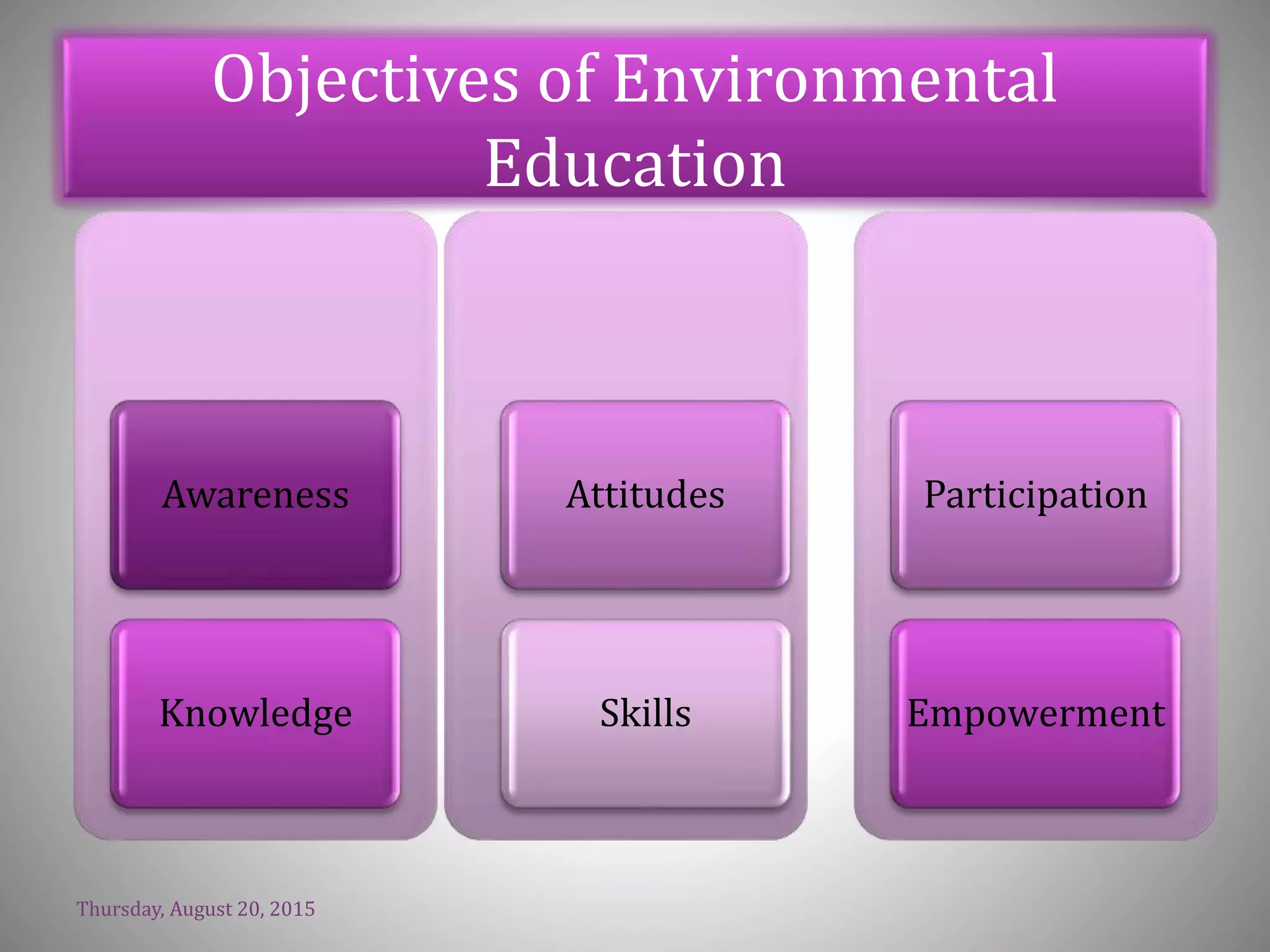
Highlights focal points, objectives, and guiding principles of environmental education that include developing skills and awareness.
Emphasizes the ethical responsibilities humans have towards the Earth, advocating for sustainable living and respect for nature.
Describes ecological threats in the North-East region, such as biodiversity loss, pollution, and deforestation.
Discusses the importance of integrating environmental education into curriculum and pedagogy for sustainability.
Lists references and further readings related to environmental education and studies.
NEED AND IMPORTANCEOF
ENVIRONMENTAL EDUCATION
PRESENTED BY-VELENTINA
DAS(MSc,B.Ed.)
2.
WHAT IS ENVIRONMENTALEDUCATION ?
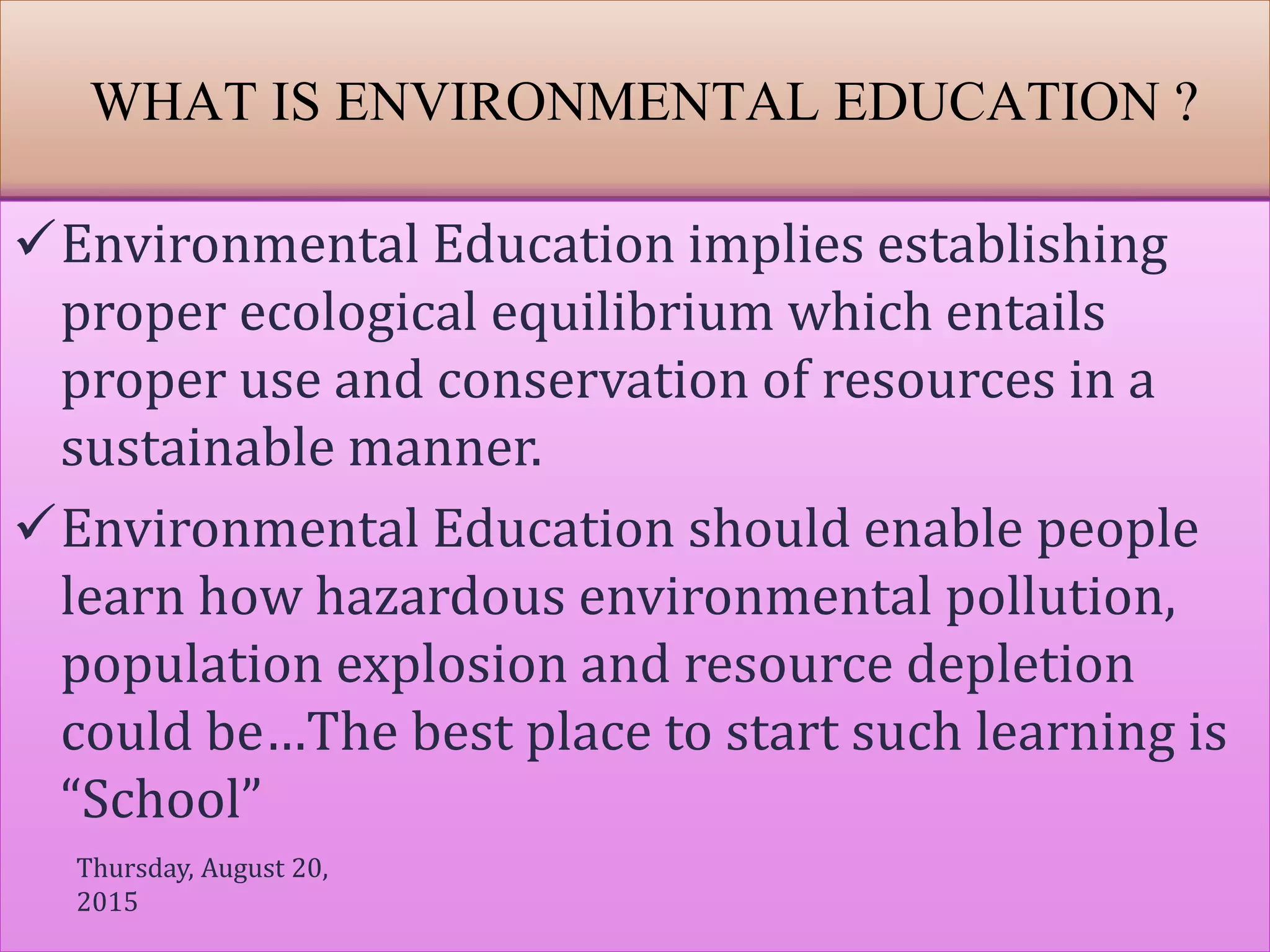
Environmental Education implies establishing
proper ecological equilibrium which entails
proper use and conservation of resources in a
sustainable manner.
Environmental Education should enable people
learn how hazardous environmental pollution,
population explosion and resource depletion
could be…The best place to start such learning is
“School”
Thursday, August 20,
2015
3.
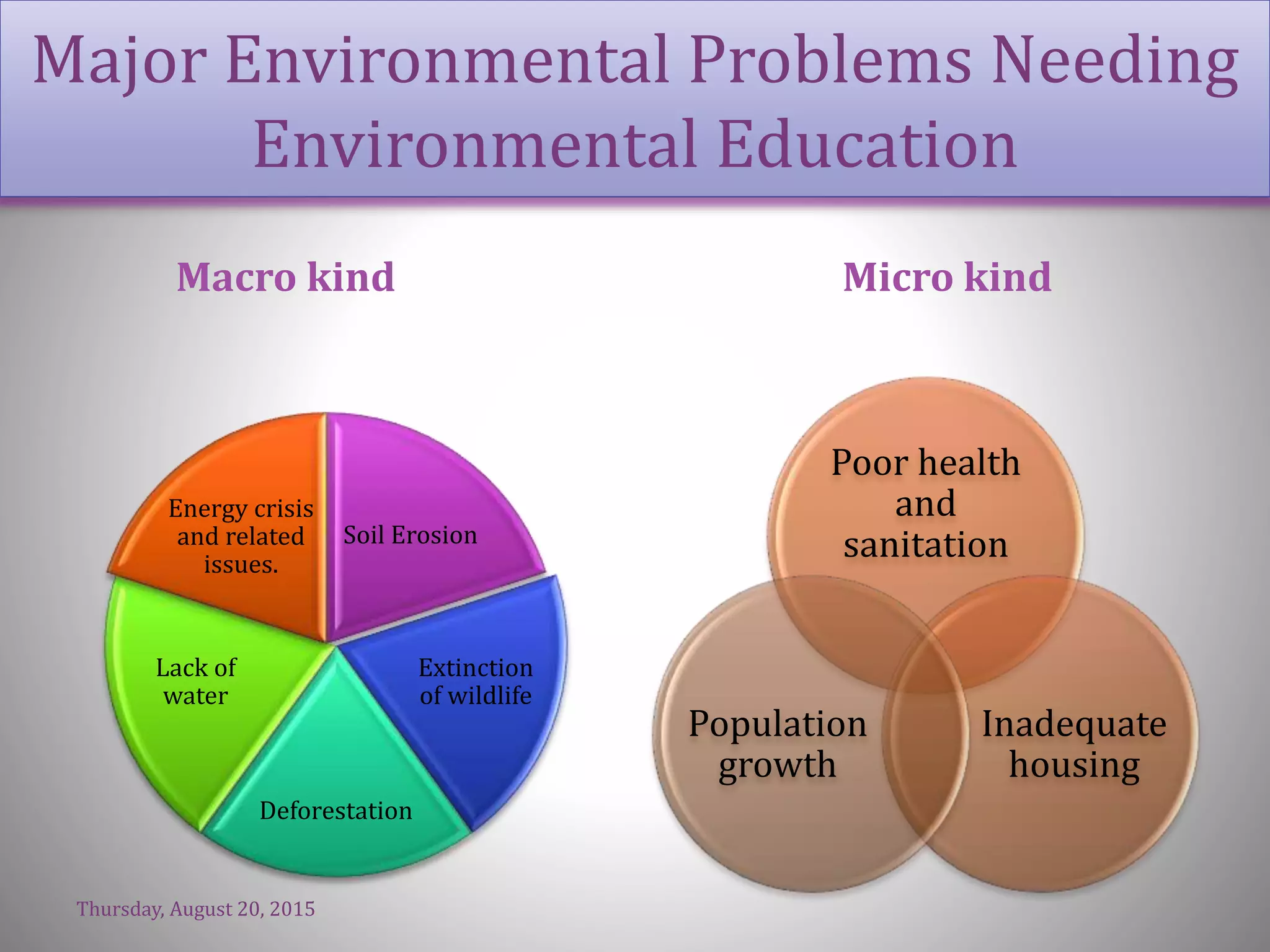
Major Environmental ProblemsNeeding
Environmental Education
Macro kind
Soil Erosion
Extinction
of wildlife
Deforestation
Lack of
water
Energy crisis
and related
issues.
Micro kind
Poor health
and
sanitation
Inadequate
housing
Population
growth
Thursday, August 20, 2015
Focal points ofEnvironmental Education
Concern for reality by exposing students to the real
life world, natural and social environment in which
they live.
Enable students to analyse,evaluate and draw
inferences about problems and issues related to
environment.
Enable students understand environment issues and
take positive environmental actions.
Develop skills of environmental actions among
students in order to facilitate the journey of mankind
towards sustainability.
Thursday, August 20, 2015
6.
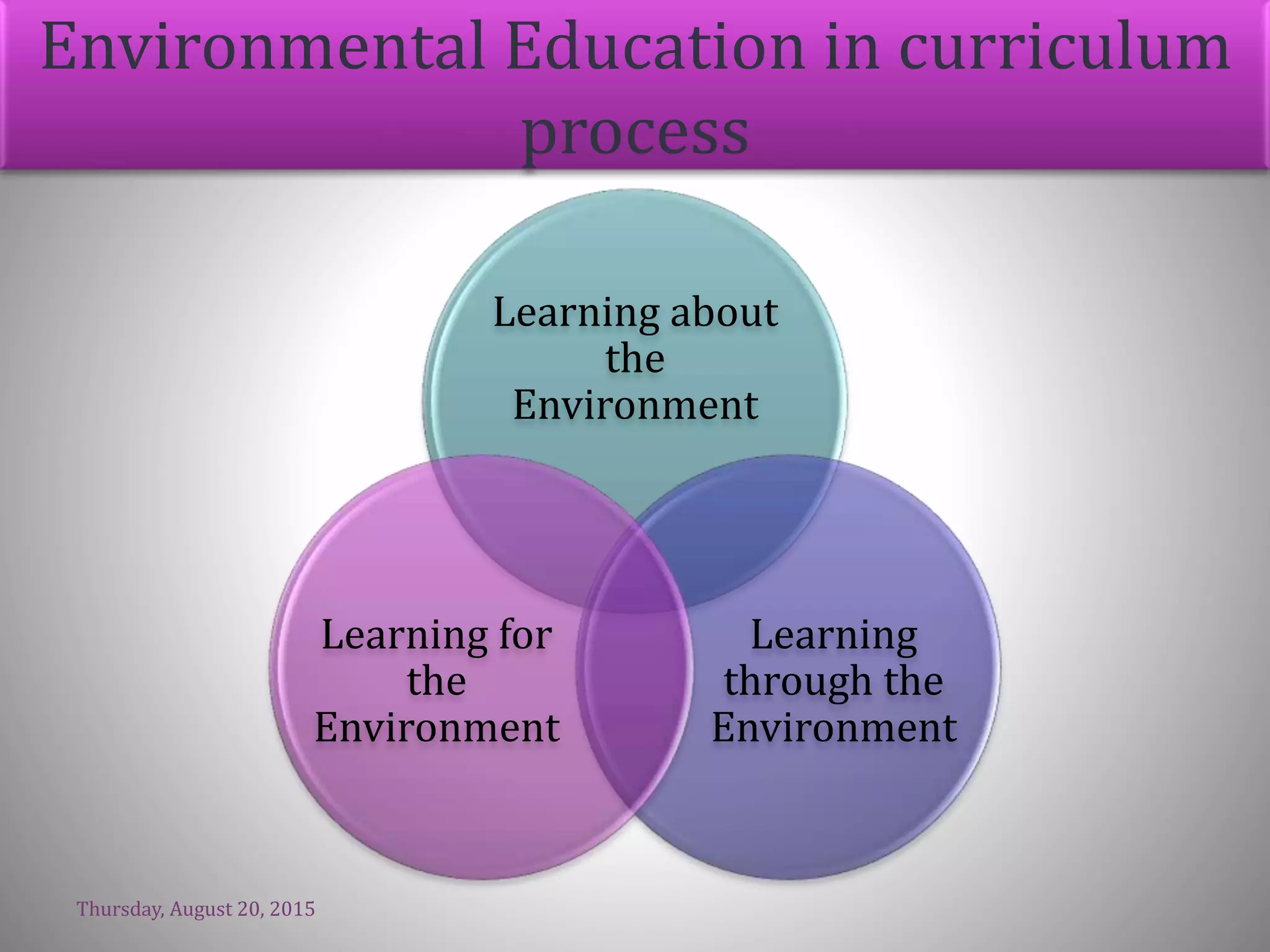
Environmental Education incurriculum
process
Learning about
the
Environment
Learning
through the
Environment
Learning for
the
Environment
Thursday, August 20, 2015
7.
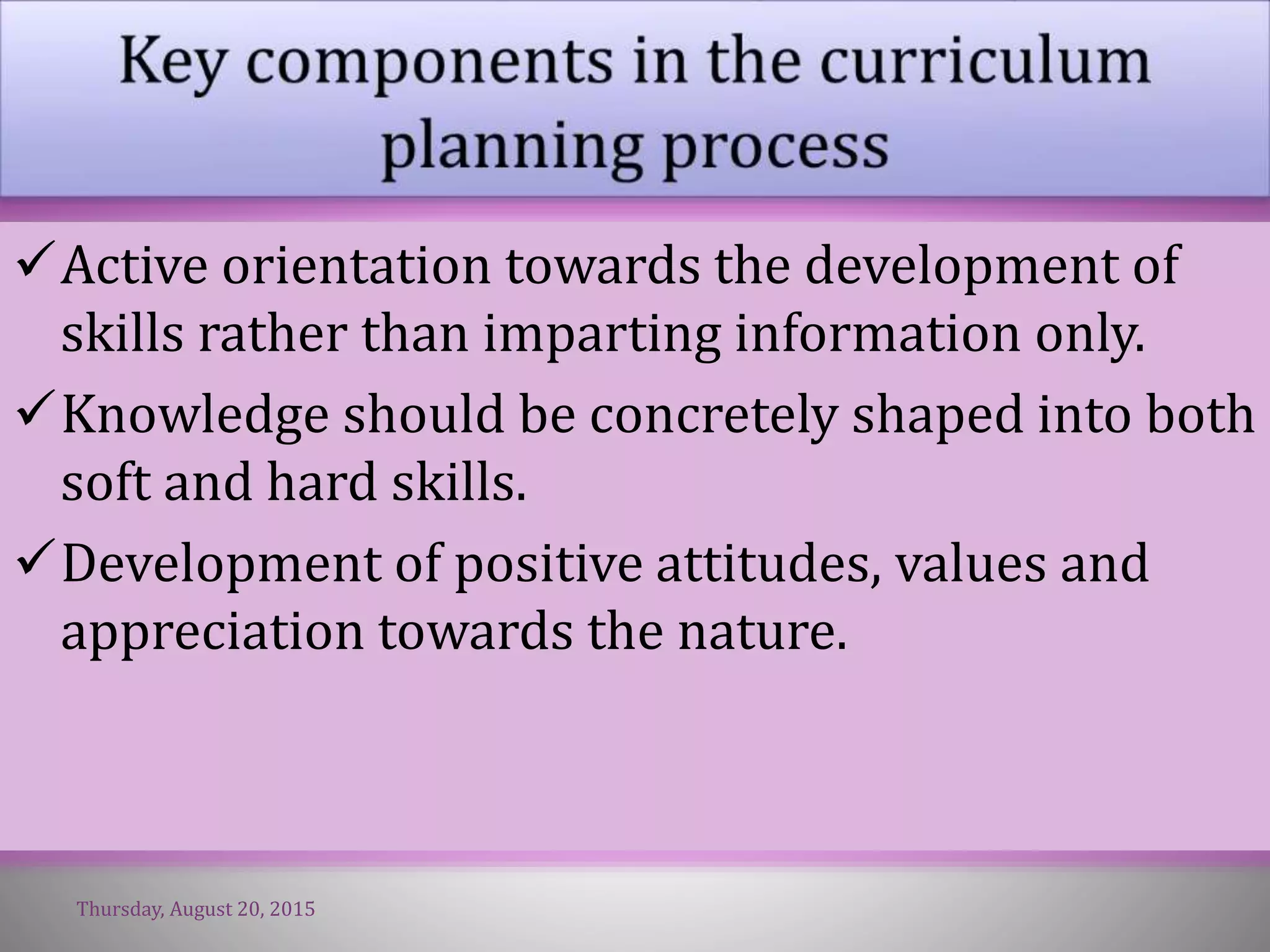
Active orientation towardsthe development of
skills rather than imparting information only.
Knowledge should be concretely shaped into both
soft and hard skills.
Development of positive attitudes, values and
appreciation towards the nature.
Thursday, August 20, 2015
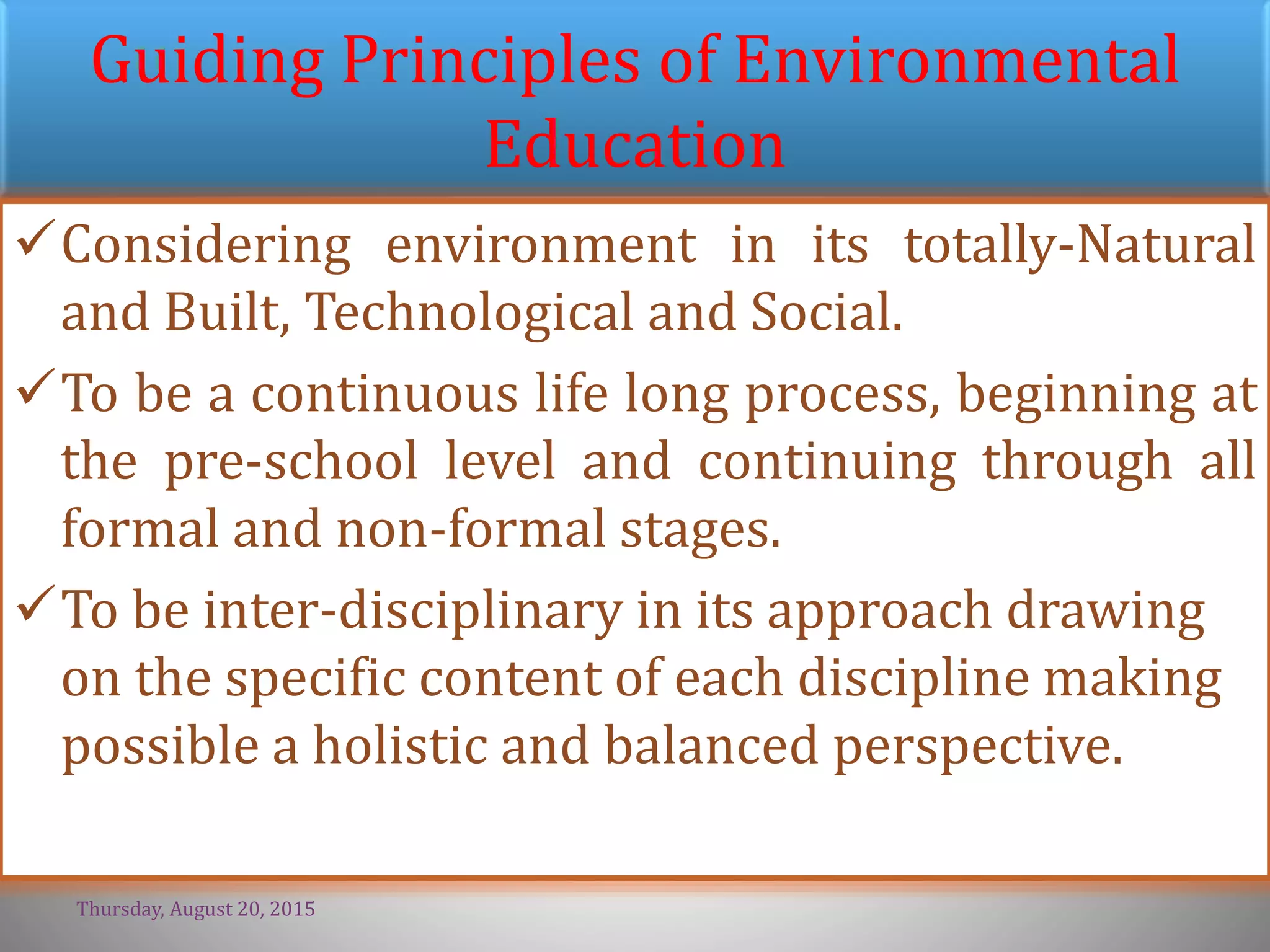
Guiding Principles ofEnvironmental
Education
Considering environment in its totally-Natural
and Built, Technological and Social.
To be a continuous life long process, beginning at
the pre-school level and continuing through all
formal and non-formal stages.
To be inter-disciplinary in its approach drawing
on the specific content of each discipline making
possible a holistic and balanced perspective.
Thursday, August 20, 2015
10.
To examine majorenvironmental issues from
local,national,regional and international point of
view so that students receive the insights into
environmental conditions in other geographical
areas.
To promote the value and necessity of local, national
cooperation in prevention and solutions of
environmental problems.
To focus on current and potential environmental
aspects for development and growth.
Enable learners to have a role in planning their
learning experiences and provide an opportunity for
making decisions and accepting their consequences.
Thursday, August 20, 2015
11.
Relate environmental
sensitivity,knowledge,problem-solving skillsand
values and clarification at every great level.
To help learners discover the symptoms and the
actual causes of environmental problems.
To emphasize the complexity of environmental
problems and has the need to develop critical
thinking and problem solving skills
To utilize diverse learning environment and a
broad array of educational approaches to
teaching.
Thursday, August 20, 2015
12.
Environmental Ethics
We shouldlove and honour the earth since it has
blessed us with life and governs our survival.
We should keep each day sacred to earth and
celebrate the turning of its seasons.
We should not hold ourselves above other living
things and have no right to drive them to
extinction.
We should be grateful to the plants and animals
which nourish us by giving food.
Thursday, August 20, 2015
13.
We should limitour offsprings because too many
people will overburden the earth.
We shouldn't waste our resources on destructive
weapons.
We shouldn't run after gains at the cost of nature,
rather should strive to restore its damaged majesty.
We shouldn't conceal from others the effects we have
caused by our actions on earth.
We shouldn't steal from future generations their
right to live in a clean and safe planet by
impoverishing or polluting it.
We should consume the material goods to moderate
amounts so that all may share the earth’s precious
treasure of resources.
Thursday, August 20, 2015
14.
Environmental Education-North-east
perspective
• Northeast region is nature’s paradise with
amalgamation of rivers and lands, and other
natural resources feature her physiography and
climatic regimes with grandeur of uniqueness
and exclusivity.
• Like other parts of the world, global climatic
changes have aversively affected this regions too.
Thursday, August 20, 2015
15.
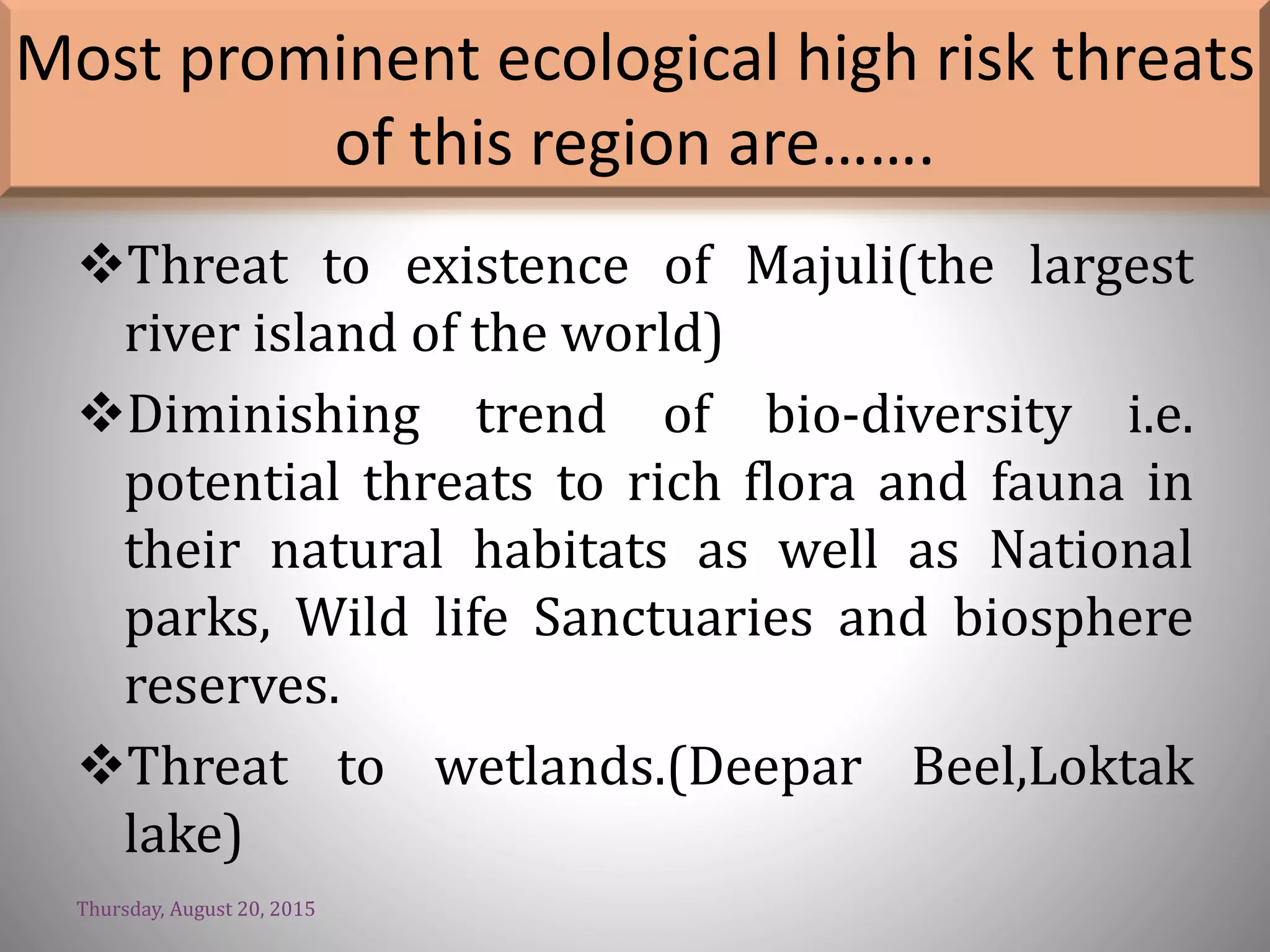
Most prominent ecologicalhigh risk threats
of this region are…….
Threat to existence of Majuli(the largest
river island of the world)
Diminishing trend of bio-diversity i.e.
potential threats to rich flora and fauna in
their natural habitats as well as National
parks, Wild life Sanctuaries and biosphere
reserves.
Threat to wetlands.(Deepar Beel,Loktak
lake)
Thursday, August 20, 2015
16.
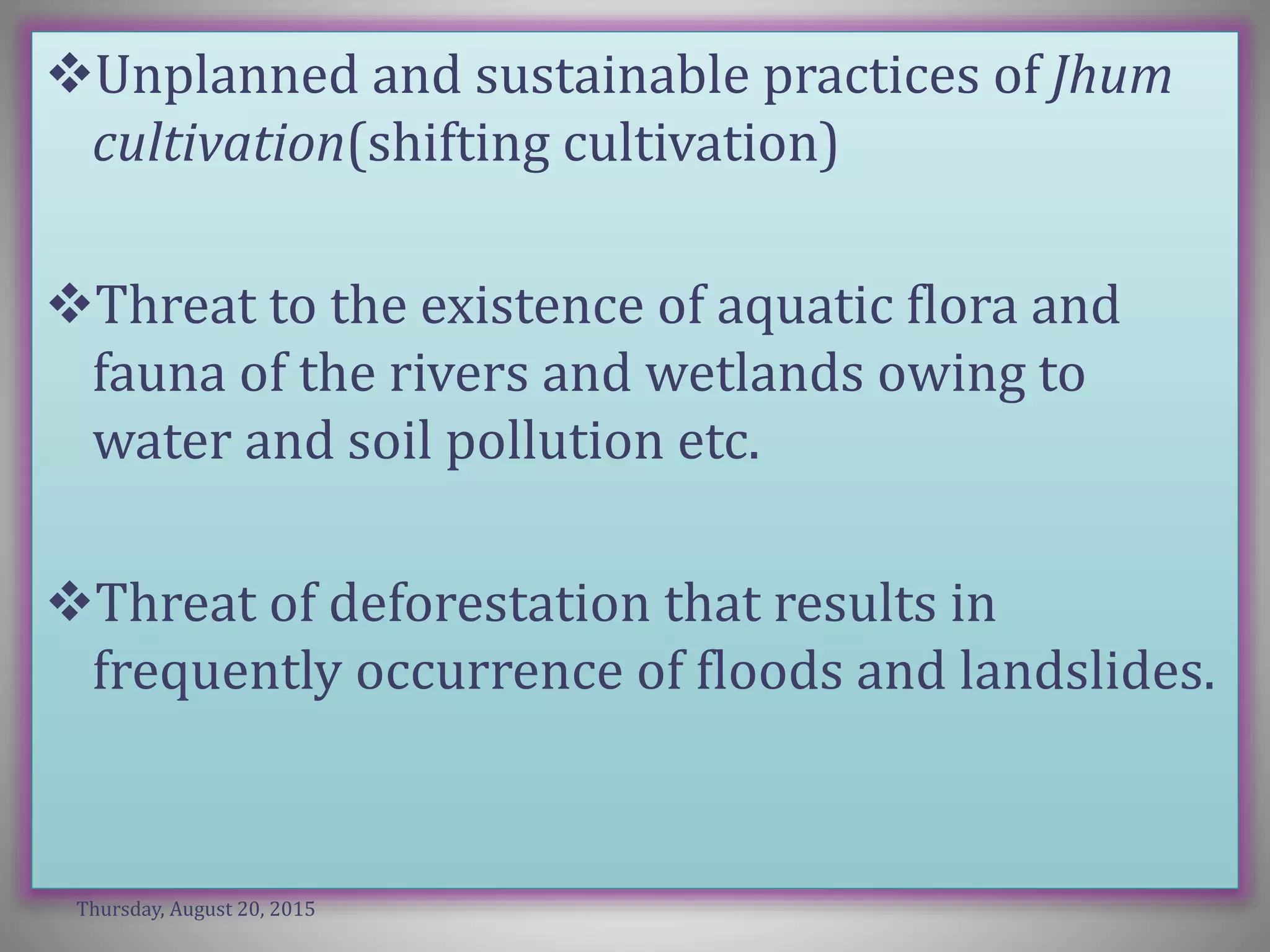
Unplanned and sustainablepractices of Jhum
cultivation(shifting cultivation)
Threat to the existence of aquatic flora and
fauna of the rivers and wetlands owing to
water and soil pollution etc.
Threat of deforestation that results in
frequently occurrence of floods and landslides.
Thursday, August 20, 2015
17.
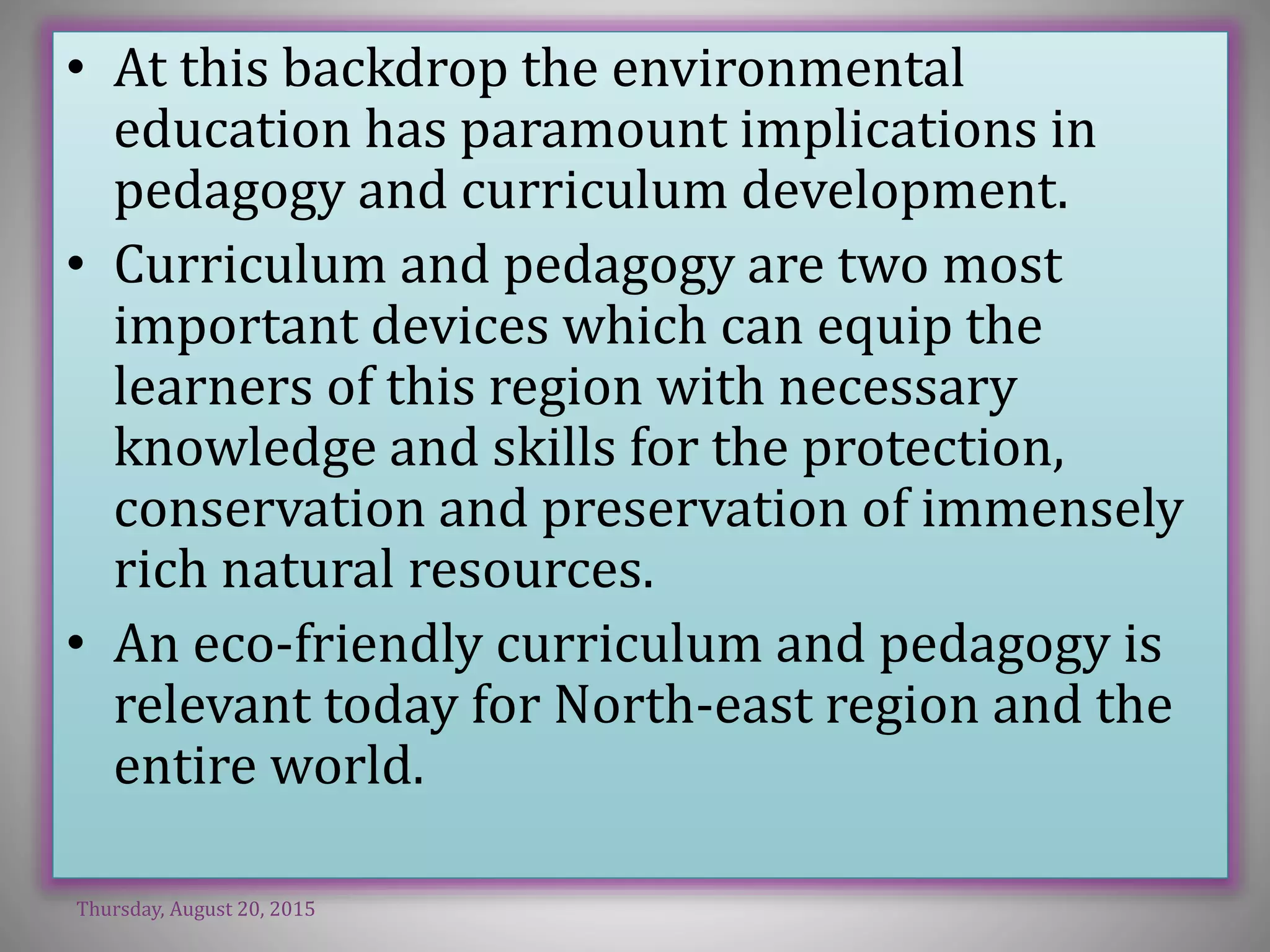
• At thisbackdrop the environmental
education has paramount implications in
pedagogy and curriculum development.
• Curriculum and pedagogy are two most
important devices which can equip the
learners of this region with necessary
knowledge and skills for the protection,
conservation and preservation of immensely
rich natural resources.
• An eco-friendly curriculum and pedagogy is
relevant today for North-east region and the
entire world.
Thursday, August 20, 2015
18.
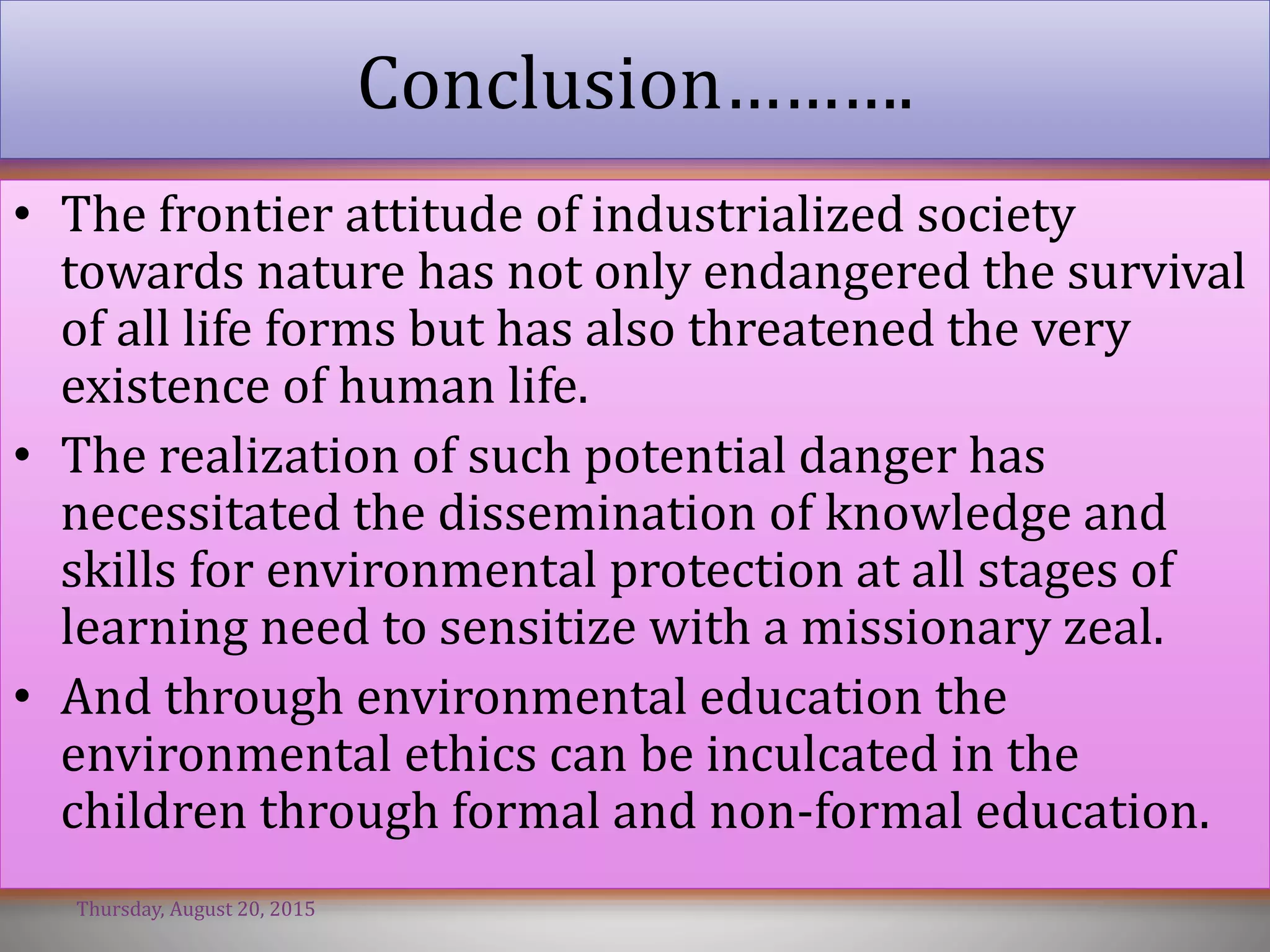
Conclusion……….
• The frontierattitude of industrialized society
towards nature has not only endangered the survival
of all life forms but has also threatened the very
existence of human life.
• The realization of such potential danger has
necessitated the dissemination of knowledge and
skills for environmental protection at all stages of
learning need to sensitize with a missionary zeal.
• And through environmental education the
environmental ethics can be inculcated in the
children through formal and non-formal education.
Thursday, August 20, 2015
19.
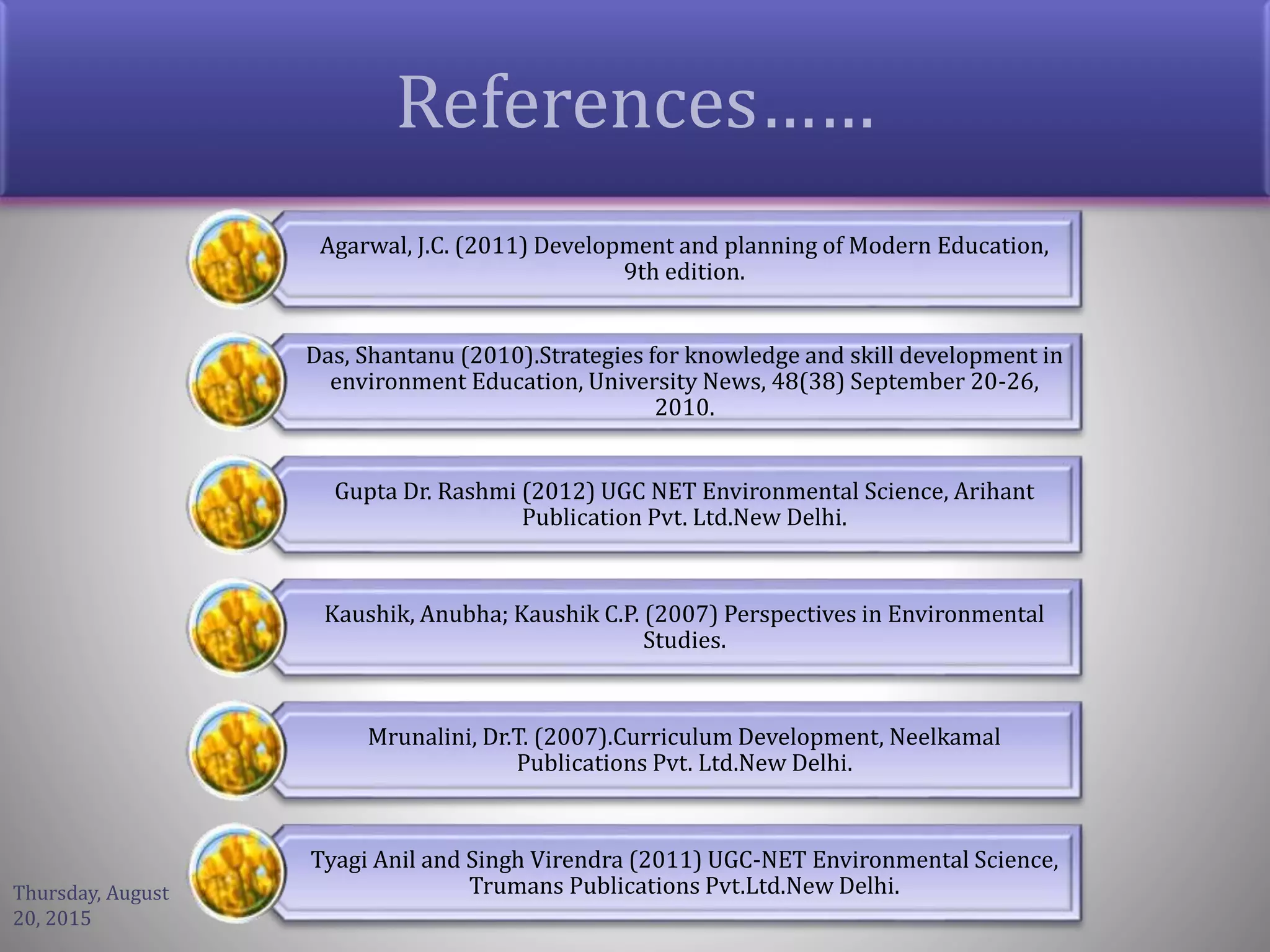
References……
Agarwal, J.C. (2011)Development and planning of Modern Education,
9th edition.
Das, Shantanu (2010).Strategies for knowledge and skill development in
environment Education, University News, 48(38) September 20-26,
2010.
Gupta Dr. Rashmi (2012) UGC NET Environmental Science, Arihant
Publication Pvt. Ltd.New Delhi.
Kaushik, Anubha; Kaushik C.P. (2007) Perspectives in Environmental
Studies.
Mrunalini, Dr.T. (2007).Curriculum Development, Neelkamal
Publications Pvt. Ltd.New Delhi.
Tyagi Anil and Singh Virendra (2011) UGC-NET Environmental Science,
Trumans Publications Pvt.Ltd.New Delhi.Thursday, August
20, 2015