 Pollution is the introduction of contaminant into
the natural environment that cause adverse
change.
 A pollutant is a waste material that pollutes air,
water or soil.
 Three factors determine the severity of a
pollutant:
i) Its chemical nature,
ii) The concentration
iii) Persistence.
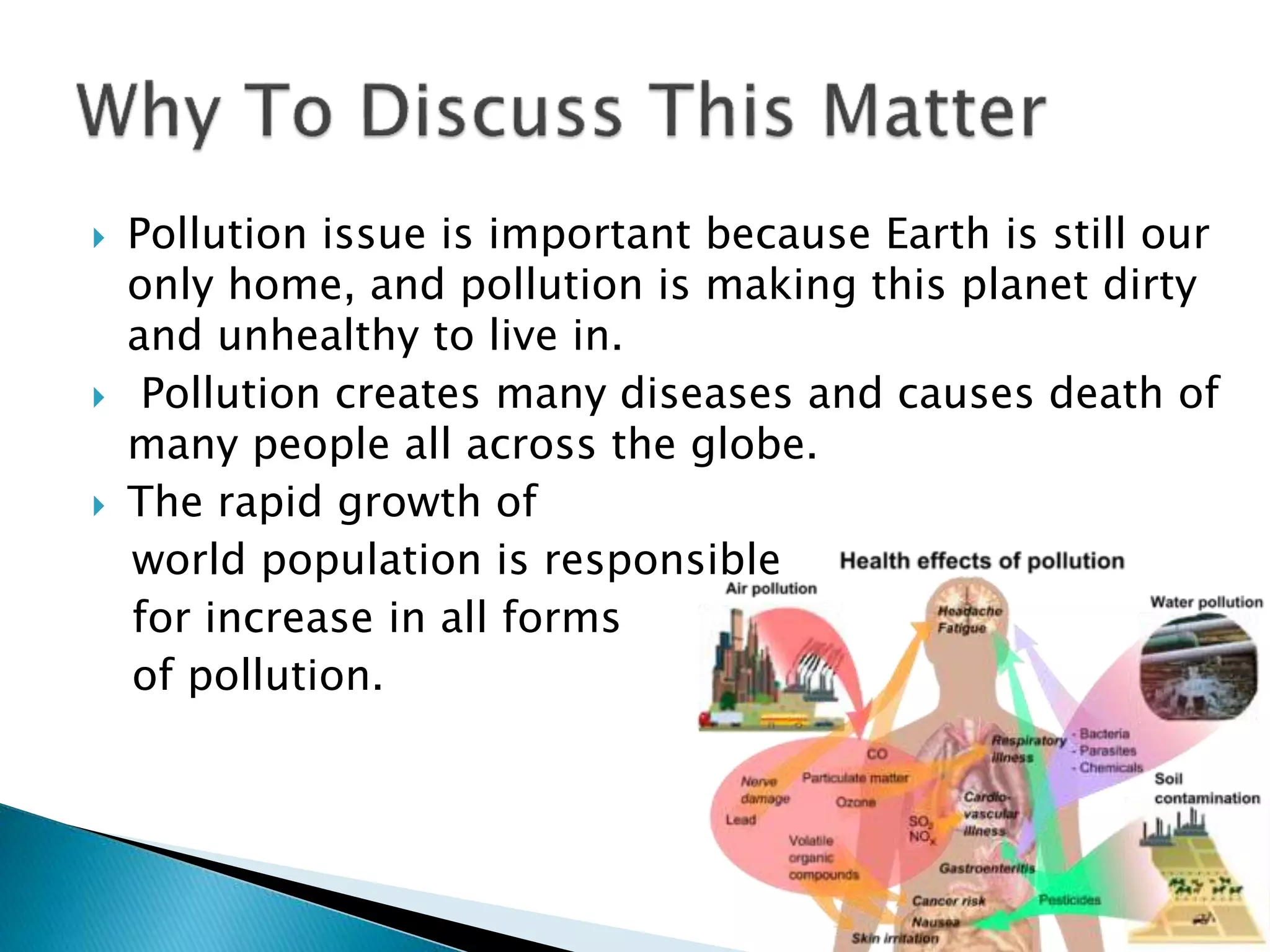
 Pollution issue is important because Earth is still our
only home, and pollution is making this planet dirty
and unhealthy to live in.
 Pollution creates many diseases and causes death of
many people all across the globe.
 The rapid growth of
world population is responsible
for increase in all forms
of pollution.
 Without air life would not be possible as seen
on other planets in our Solar system.
 Air maintains temperature on the earth
surface.
 Air supports water cycle.
 Air is medium for propagation of sound.
 The introduction of a substance into
the Earth’s atmosphere which have
harmful or poisonous effects is called Air
Pollution
 Air pollution is a significant risk factor for a
number of health conditions including
respiratory infections, heart disease, asthma,
coughing, etc.
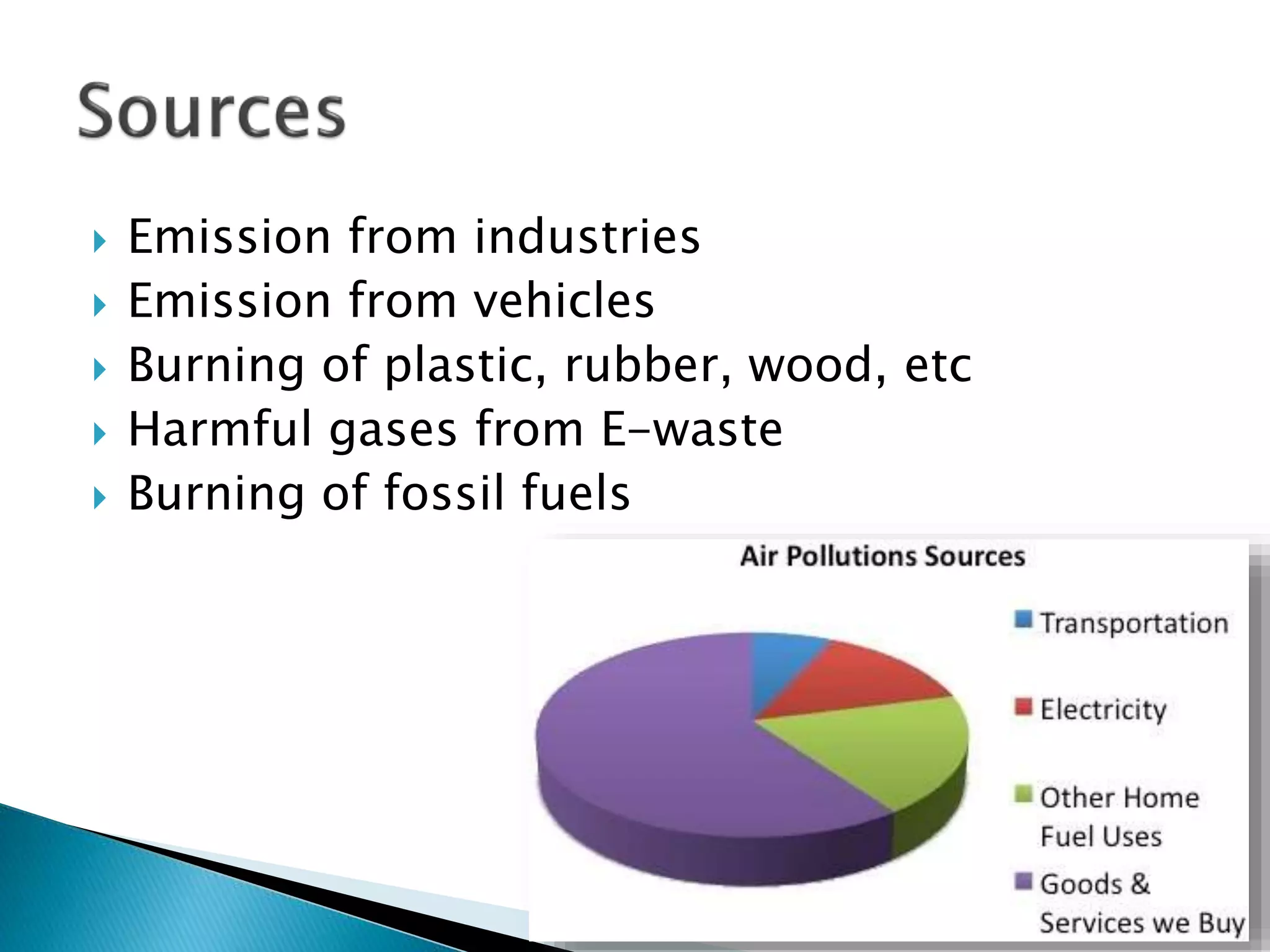
 Emission from industries
 Emission from vehicles
 Burning of plastic, rubber, wood, etc
 Harmful gases from E-waste
 Burning of fossil fuels
 It causes a number of diseases:-
 Brain and nervous system damage (esp. children)
 Respiratory diseases
 Harm to wildlife and livestock
 Reduction in efficiency of plants
 Damage crop, plants and other vegetation
 Buildings, statues and monuments deteriorate

=+
 Nitrogen Oxide
 Carbon Monoxide
 Volatile Organic Compound
 Sulphur Dioxide
 Lead
 Mercury
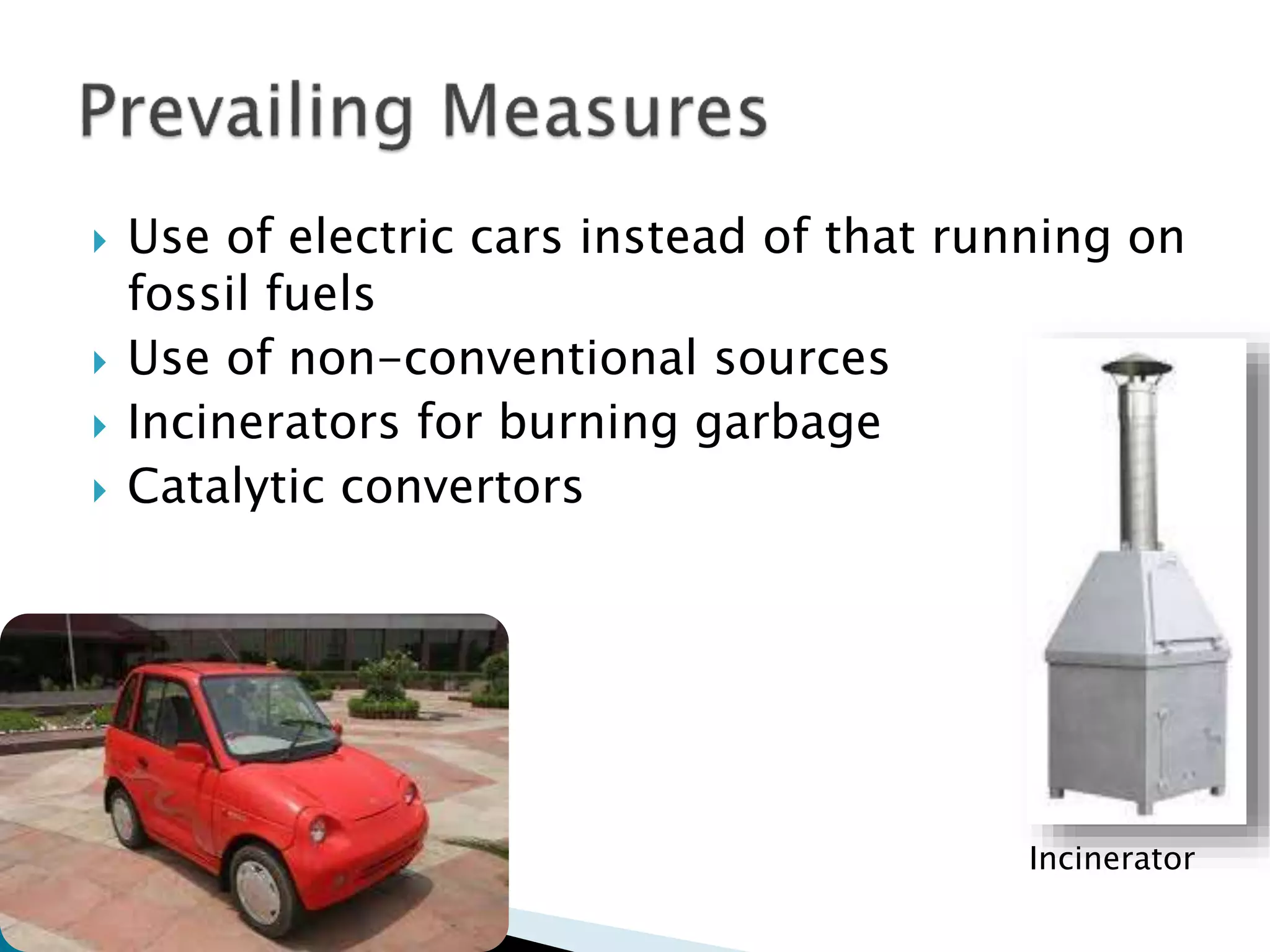
 Use of electric cars instead of that running on
fossil fuels
 Use of non-conventional sources
 Incinerators for burning garbage
 Catalytic convertors
Incinerator
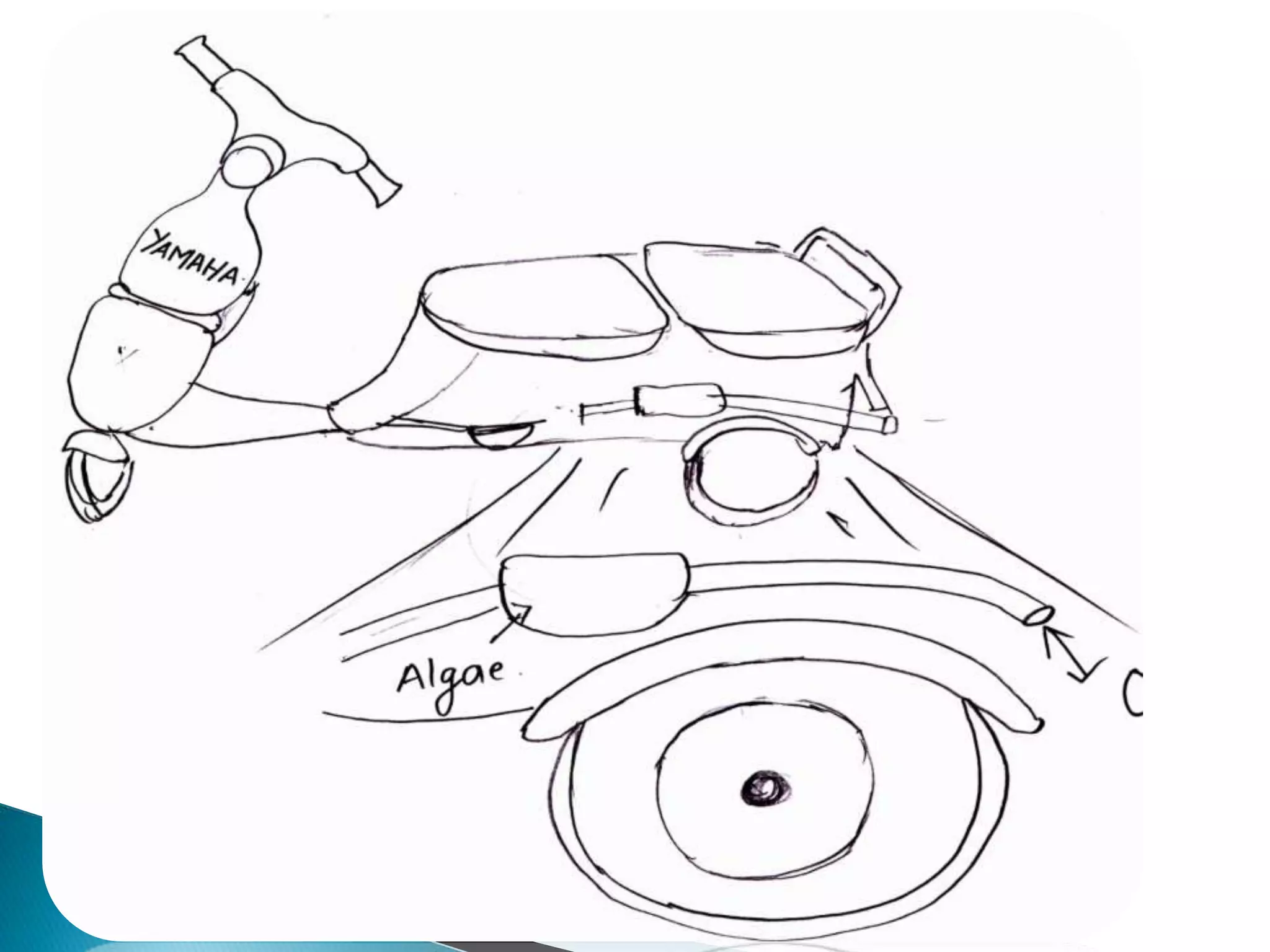
 The gases emitted from the
chimneys of industries are
collected in a tank.
 The tank contains Algae
which converts the harmful
gases into O2
 The Pipe contains catalysts
which reduces NO2 and SO2
gases that are harmful for the
Algae
 Catcon is attached in the pathway of the
silencer.
 In catcon, Algae is present which converts the
 emitted CO into O2.
 Aquatic life
 Agriculture
 For drinking
 Washing
 Transportation
 Fire extinction
 Cooking
 Industrial Applications
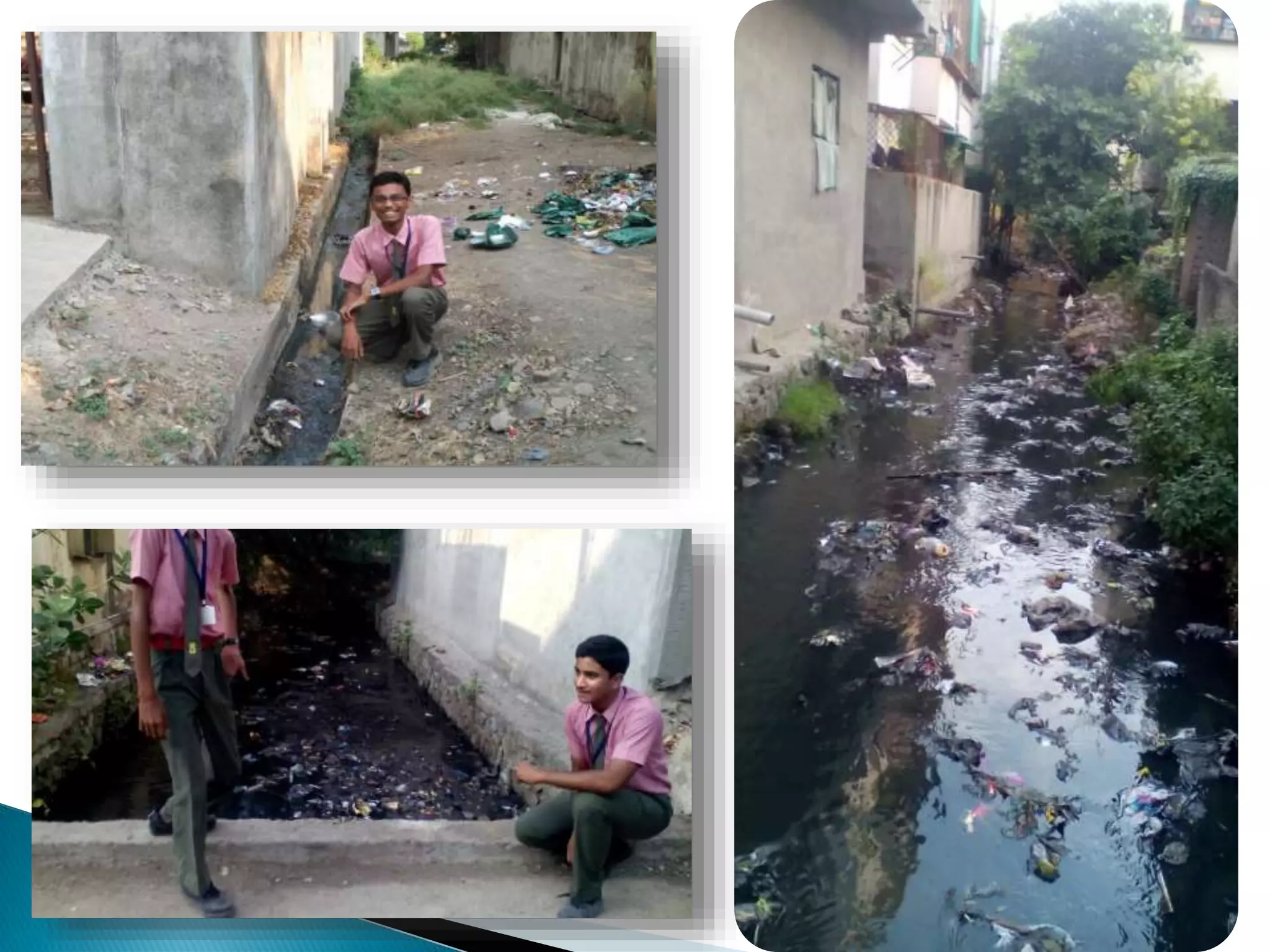
 Water Pollution is the
contamination of water
bodies (e.g. lakes, rivers,
oceans, aquifers and
groundwater).
 This form of environmental
degradation occurs when
pollutants are directly or
indirectly discharged into
water bodies without
adequate treatment to remove
harmful compounds.
 Ocean and marine
dumping
 Industrial waste
 Chemical fertilizer and pesticides
 Accidental oil leakage
 Sewage and waste water
 Detergents.
 Chemicals used for disinfecting water (e.g.
chlorine).
 Thermal heating.
 Solid waste such as glass, plastic, cardboard,
Styrofoam, aluminum, etc.
 Industrial waste from
factories, such as
asbestos, lead, mercury
and petrochemicals.
 Death of aquatic animals
 Reproductive damage
within wildlife in ecosystems.
 Skin rashes and health problems like cancer,
typhoid fever and stomach sickness in
humans.
 Water pollution causes flood due to the
accumulation of solid waste and soil erosion
in streams and rivers.
 Allstate roofing of houses.
 Reverse Osmosis.
 Rain water harvesting
 Alum
 Filter Paper
 KMnO4 Drops
 Bleaching Powder
 Sedimentation
Filter Paper
 Solid waste, substances of
more density than water,
other impurities will be
separated through sieve,
flapper mechanism and
rotating charcoal rod
respectively.
 Sieve:-
 These sieve like structures will be placed in the
passage of pipes.
 They will restrict solid waste from flowing.
 The waste collected can be removed through tray
like structure
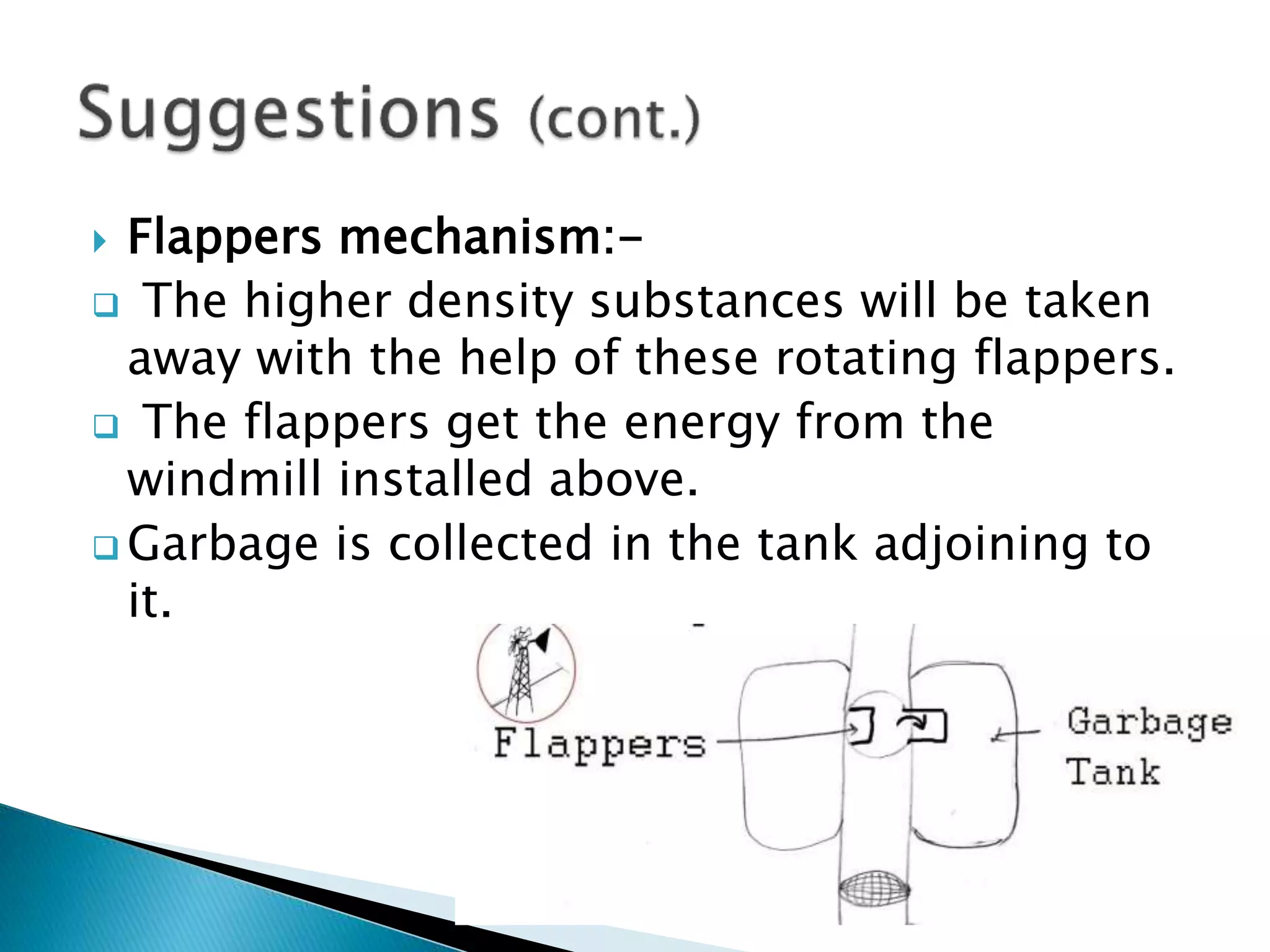
 Flappers mechanism:-
 The higher density substances will be taken
away with the help of these rotating flappers.
 The flappers get the energy from the
windmill installed above.
 Garbage is collected in the tank adjoining to
it.
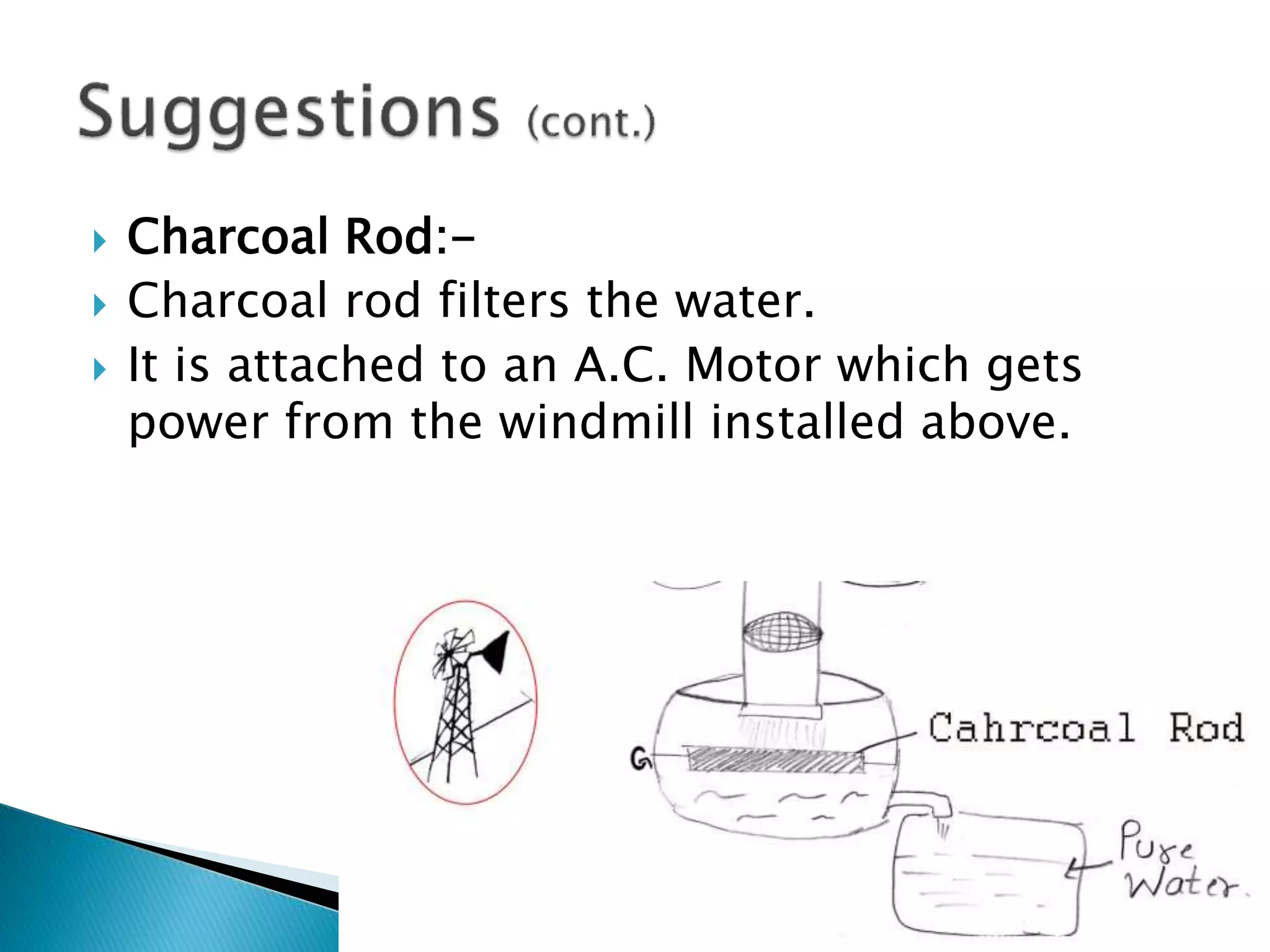
 Charcoal Rod:-
 Charcoal rod filters the water.
 It is attached to an A.C. Motor which gets
power from the windmill installed above.
 The following system is
similar to the previous one.
 It uses material and
hence is more economical.
 Water gets segregated
from the main pipe into
different tanks, hence the
efficiency is more.
 Soil fertility: Fertile soil supports growth of plants.
 Soil microbiology: It provides support for survival of
many bacteria, algae, fungi, etc.
 Top soil provides shelter for insects, reptiles, birds
and animals. Further top soil is necessary for even
other activities like nesting, reproduction, hatching of
eggs, breeding etc.
 Soil organic matter contains essential minerals and
elements like phosphates, sulphates, calcium, zinc,
magnesium and many more
 Soil - A source of minerals: Minerals and
mines present in soil are the source of many metals
like iron, bauxite, zinc etc .
 Soil is used for making utensils, tiles etc. The utensils like
cups, and plates of china clay, plaster of Paris etc. Tiles
used in home or building made of ceramic like soil
components.
 Soil contents like gravel, clay, sand, etc. are widely used
for construction of homes, buildings, roads etc
 Soil a source medicines: Soil gives us some important
mineral medicine like calcium (bones), iron (anemia)
bentonite (laxative) and other substance like petroleum
jelly, steatite for cosmetics, talcum powders etc.
 Soil keeps atmosphere cool: Soil absorbs water when there
is rain and so, when is there is heavy sun heat, this water
from soil evaporates making the air cooler.
 Soil pollution is defined as the build-up in
soils of persistent toxic compounds such as
chemicals, salts, radioactive materials, or
disease causing agents, which have adverse
effects on plant growth and animal health.
 Seepage from a landfill
 Discharge of industrial waste into the soil
 Percolation of contaminated water into the soil
 Rupture of underground storage tanks
 Excess application of pesticides, herbicides or fertilizer
 Solid waste seepage
 Petroleum hydrocarbons
 Pesticides
 Solvents
 Plastics
 Agro chemicals
 Fertilizers
 Heavy metals such as
1. Mercury
2. Lead
3. Chromium
4. Arsenic
5. Cadmium
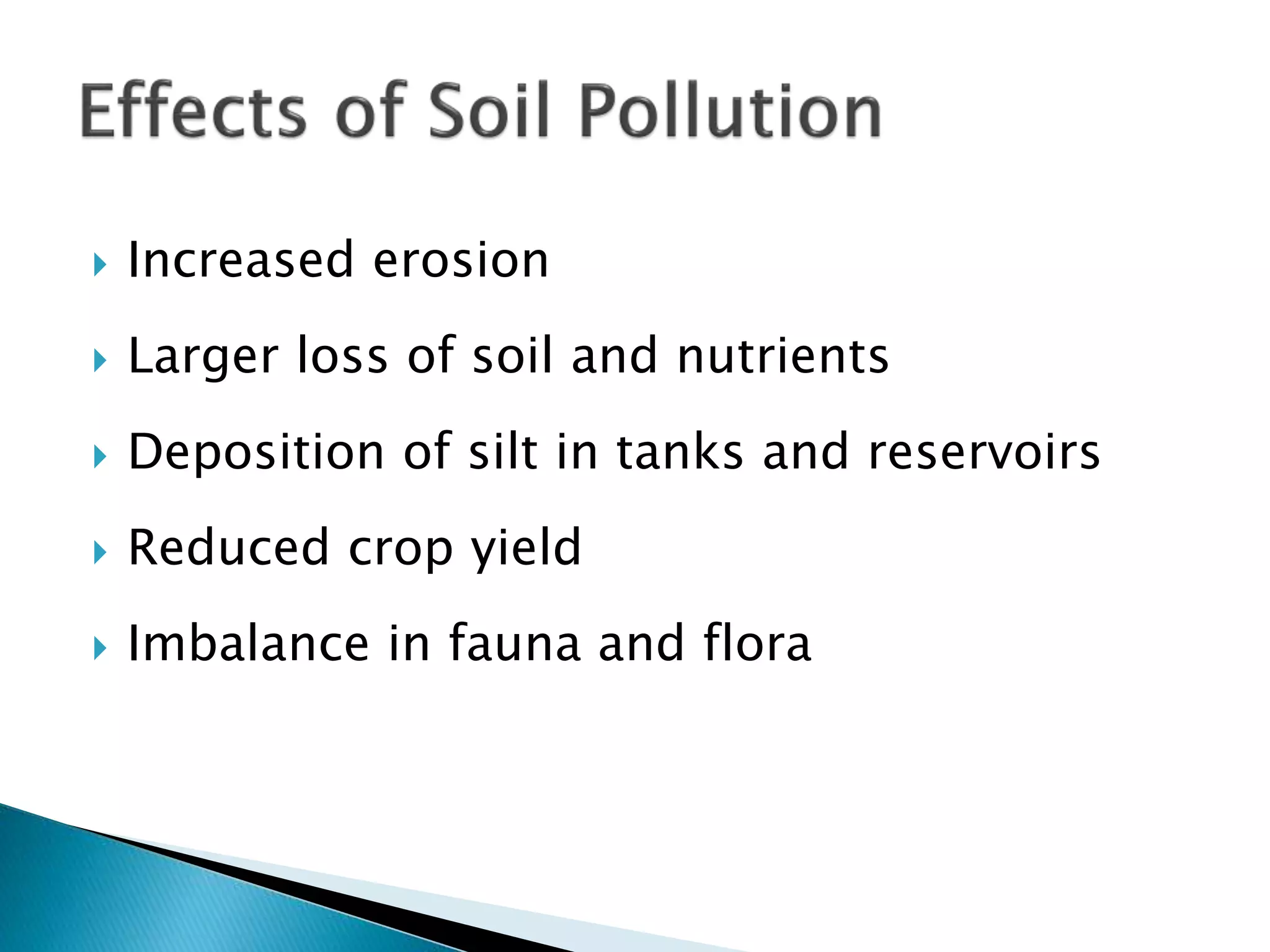
 Increased erosion
 Larger loss of soil and nutrients
 Deposition of silt in tanks and reservoirs
 Reduced crop yield
 Imbalance in fauna and flora
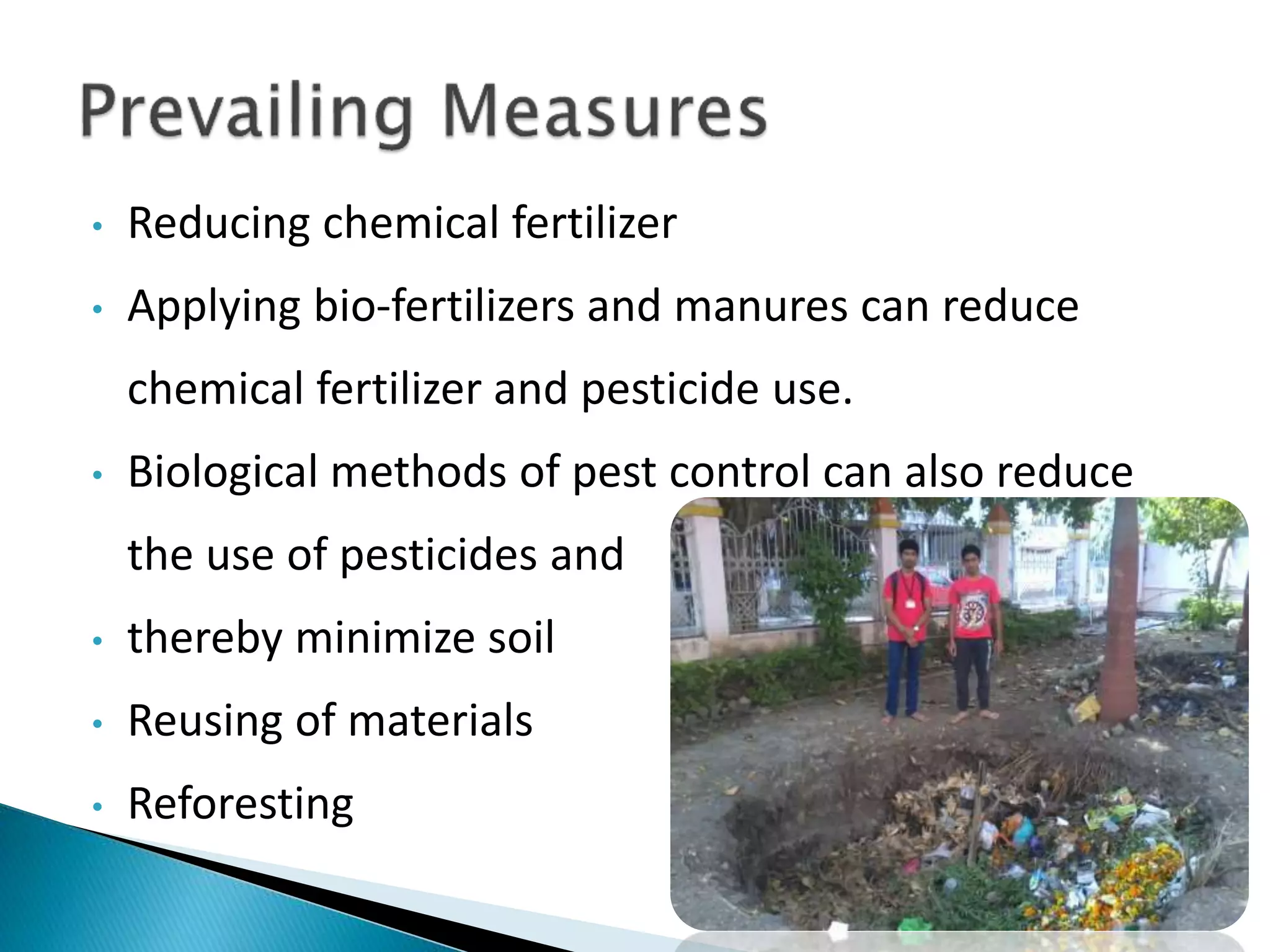
• Reducing chemical fertilizer
• Applying bio-fertilizers and manures can reduce
chemical fertilizer and pesticide use.
• Biological methods of pest control can also reduce
the use of pesticides and
• thereby minimize soil
• Reusing of materials
• Reforesting
 After one and half hour
of spraying acid
fertilizer, Spraying of
basic fertilizer will
neutralize the soil.
 Spraying in the form of
drip irrigation i.e.
directly in the soil will
be economic as well as
eco - friendly
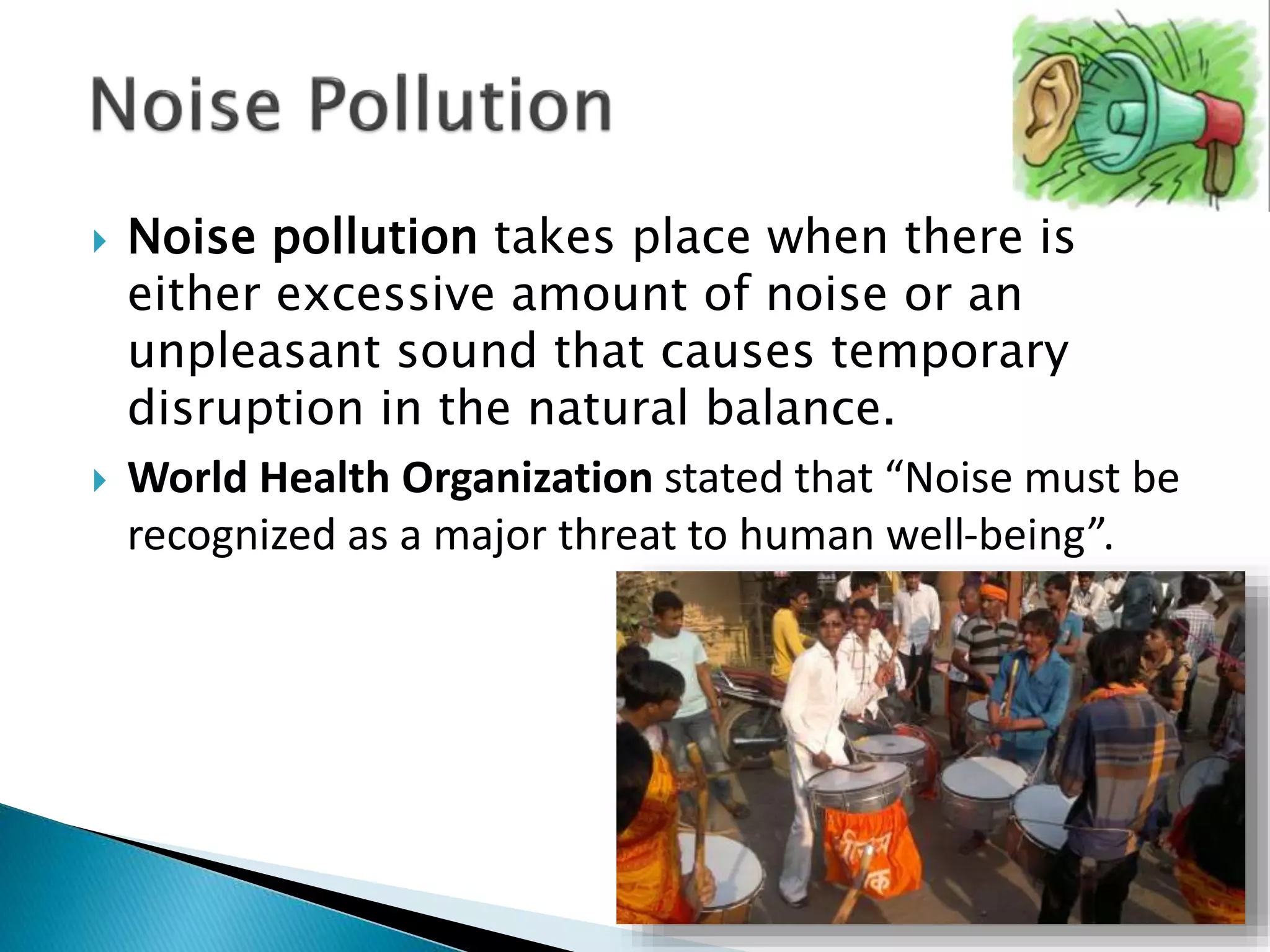
 Noise pollution takes place when there is
either excessive amount of noise or an
unpleasant sound that causes temporary
disruption in the natural balance.
 World Health Organization stated that “Noise must be
recognized as a major threat to human well-being”.
 Industrialization:
Various equipments like compressors, generators,
exhaust fans, grinding mills participate in
producing big noise.
 Poor Urban Planning: Congested houses, large
families sharing small space, fight over parking,
frequent fights over basic amenities leads to noise
pollution.
 Social Events: Noise is at its peak in most of the
social events.
 Transportation: Large number of vehicles on roads, aero planes lying
over houses, underground trains produce heavy noise.
 Construction Activities: Under construction activities like mining,
construction of bridges, dams, buildings, stations, roads, flyovers take
place in almost every part of the world.
 Household Chores: Gadgets like TV, mobile , mixer grinder, pressure
cooker, vacuum cleaners , washing machine and dryer, cooler, air
conditioners are minor contributors to the amount of noise that is
produced but it affects the quality of life of your neighbourhood in a bad
way.
 Hearing Problems: Constant
exposure to loud levels of noise
can easily result in the damage of
our ear drums and loss of hearing
 Health Issues: Excessive noise can influence psychological
health. Studies show that the occurrence of aggressive
behaviour, disturbance of sleep, constant stress, fatigue
and hypertension can be linked to excessive noise levels.
 Cardiovascular Issues: Blood pressure levels, cardio-vascular
diseases and stress related heart problems are on the rise. Studies
suggest that high intensity noise causes high blood pressure and
increases heart beat rate as it disrupts the normal blood flow.
 Trouble Communicating: Constant sharp noise can give you severe
headache and disturb your emotional balance.
 Effect on Wildlife: Wildlife faces far more problems than human
beings because of noise pollution as they are more dependent on
sound. Animals develop a better sense of hearing than us since their
survival depends on it.
 On individual level, everybody can help in
reducing the noise in their homes by lowering
the volume of the radio, music system and
the television.
 Removal of public loudspeakers.
 Controlling the sound levels in clubs, bars,
parties and functions.
 Creating ‘No-Noise’ zones or ‘Silent Zones’.
 The fuse is connected in the passage of the
live current of speaker.
 It will reduce the input current.
 Which will result in the reduction of sound.
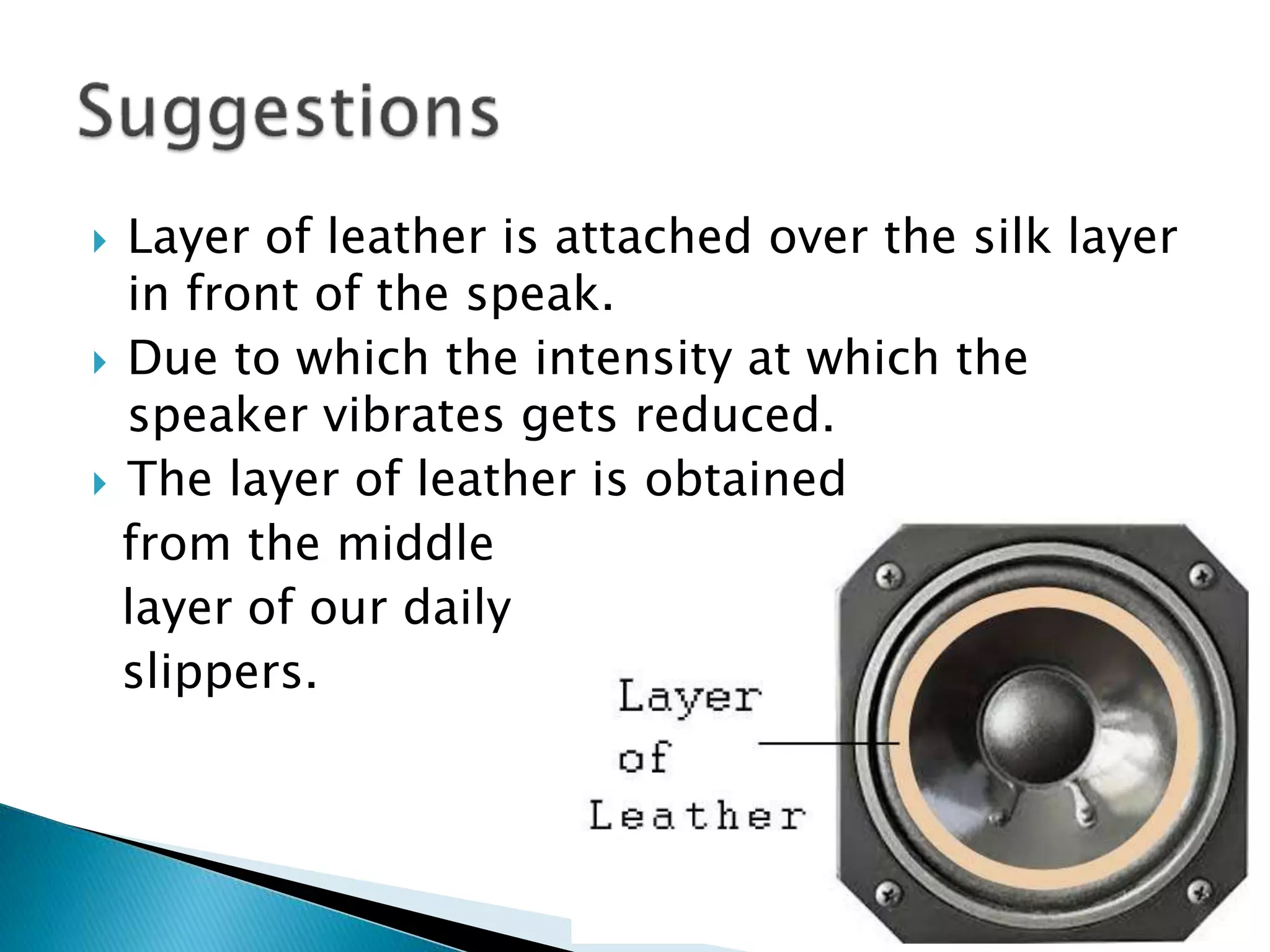
 Layer of leather is attached over the silk layer
in front of the speak.
 Due to which the intensity at which the
speaker vibrates gets reduced.
 The layer of leather is obtained
from the middle
layer of our daily
slippers.
 ‘Environment And Pollution’ by A.H.Hashmi.
 ‘Social Forestry’ by S.K.Manikandan.
 ‘Environment Problems And Solutions’ by
D.K.Asthana & Meera Asthana.
 ‘Basics of Agro –Environment’ by S. Prabhu.
Remedies for pollution

Remedies for pollution

  • 2.
     Pollution isthe introduction of contaminant into the natural environment that cause adverse change.  A pollutant is a waste material that pollutes air, water or soil.  Three factors determine the severity of a pollutant: i) Its chemical nature, ii) The concentration iii) Persistence.
  • 3.
     Pollution issueis important because Earth is still our only home, and pollution is making this planet dirty and unhealthy to live in.  Pollution creates many diseases and causes death of many people all across the globe.  The rapid growth of world population is responsible for increase in all forms of pollution.
  • 5.
     Without airlife would not be possible as seen on other planets in our Solar system.  Air maintains temperature on the earth surface.  Air supports water cycle.  Air is medium for propagation of sound.
  • 6.
     The introductionof a substance into the Earth’s atmosphere which have harmful or poisonous effects is called Air Pollution  Air pollution is a significant risk factor for a number of health conditions including respiratory infections, heart disease, asthma, coughing, etc.
  • 7.
     Emission fromindustries  Emission from vehicles  Burning of plastic, rubber, wood, etc  Harmful gases from E-waste  Burning of fossil fuels
  • 8.
     It causesa number of diseases:-  Brain and nervous system damage (esp. children)  Respiratory diseases  Harm to wildlife and livestock  Reduction in efficiency of plants  Damage crop, plants and other vegetation  Buildings, statues and monuments deteriorate
  • 9.
  • 10.
     Nitrogen Oxide Carbon Monoxide  Volatile Organic Compound  Sulphur Dioxide  Lead  Mercury
  • 11.
     Use ofelectric cars instead of that running on fossil fuels  Use of non-conventional sources  Incinerators for burning garbage  Catalytic convertors Incinerator
  • 12.
     The gasesemitted from the chimneys of industries are collected in a tank.  The tank contains Algae which converts the harmful gases into O2  The Pipe contains catalysts which reduces NO2 and SO2 gases that are harmful for the Algae
  • 13.
     Catcon isattached in the pathway of the silencer.  In catcon, Algae is present which converts the  emitted CO into O2.
  • 17.
     Aquatic life Agriculture  For drinking  Washing  Transportation  Fire extinction  Cooking  Industrial Applications
  • 18.
     Water Pollutionis the contamination of water bodies (e.g. lakes, rivers, oceans, aquifers and groundwater).  This form of environmental degradation occurs when pollutants are directly or indirectly discharged into water bodies without adequate treatment to remove harmful compounds.
  • 19.
     Ocean andmarine dumping  Industrial waste  Chemical fertilizer and pesticides  Accidental oil leakage  Sewage and waste water
  • 20.
     Detergents.  Chemicalsused for disinfecting water (e.g. chlorine).  Thermal heating.  Solid waste such as glass, plastic, cardboard, Styrofoam, aluminum, etc.  Industrial waste from factories, such as asbestos, lead, mercury and petrochemicals.
  • 21.
     Death ofaquatic animals  Reproductive damage within wildlife in ecosystems.  Skin rashes and health problems like cancer, typhoid fever and stomach sickness in humans.  Water pollution causes flood due to the accumulation of solid waste and soil erosion in streams and rivers.
  • 23.
     Allstate roofingof houses.  Reverse Osmosis.  Rain water harvesting  Alum  Filter Paper  KMnO4 Drops  Bleaching Powder  Sedimentation Filter Paper
  • 24.
     Solid waste,substances of more density than water, other impurities will be separated through sieve, flapper mechanism and rotating charcoal rod respectively.
  • 25.
     Sieve:-  Thesesieve like structures will be placed in the passage of pipes.  They will restrict solid waste from flowing.  The waste collected can be removed through tray like structure
  • 26.
     Flappers mechanism:- The higher density substances will be taken away with the help of these rotating flappers.  The flappers get the energy from the windmill installed above.  Garbage is collected in the tank adjoining to it.
  • 27.
     Charcoal Rod:- Charcoal rod filters the water.  It is attached to an A.C. Motor which gets power from the windmill installed above.
  • 28.
     The followingsystem is similar to the previous one.  It uses material and hence is more economical.  Water gets segregated from the main pipe into different tanks, hence the efficiency is more.
  • 30.
     Soil fertility:Fertile soil supports growth of plants.  Soil microbiology: It provides support for survival of many bacteria, algae, fungi, etc.  Top soil provides shelter for insects, reptiles, birds and animals. Further top soil is necessary for even other activities like nesting, reproduction, hatching of eggs, breeding etc.  Soil organic matter contains essential minerals and elements like phosphates, sulphates, calcium, zinc, magnesium and many more  Soil - A source of minerals: Minerals and mines present in soil are the source of many metals like iron, bauxite, zinc etc .
  • 31.
     Soil isused for making utensils, tiles etc. The utensils like cups, and plates of china clay, plaster of Paris etc. Tiles used in home or building made of ceramic like soil components.  Soil contents like gravel, clay, sand, etc. are widely used for construction of homes, buildings, roads etc  Soil a source medicines: Soil gives us some important mineral medicine like calcium (bones), iron (anemia) bentonite (laxative) and other substance like petroleum jelly, steatite for cosmetics, talcum powders etc.  Soil keeps atmosphere cool: Soil absorbs water when there is rain and so, when is there is heavy sun heat, this water from soil evaporates making the air cooler.
  • 32.
     Soil pollutionis defined as the build-up in soils of persistent toxic compounds such as chemicals, salts, radioactive materials, or disease causing agents, which have adverse effects on plant growth and animal health.
  • 33.
     Seepage froma landfill  Discharge of industrial waste into the soil  Percolation of contaminated water into the soil  Rupture of underground storage tanks  Excess application of pesticides, herbicides or fertilizer  Solid waste seepage  Petroleum hydrocarbons  Pesticides  Solvents
  • 34.
     Plastics  Agrochemicals  Fertilizers  Heavy metals such as 1. Mercury 2. Lead 3. Chromium 4. Arsenic 5. Cadmium
  • 35.
     Increased erosion Larger loss of soil and nutrients  Deposition of silt in tanks and reservoirs  Reduced crop yield  Imbalance in fauna and flora
  • 36.
    • Reducing chemicalfertilizer • Applying bio-fertilizers and manures can reduce chemical fertilizer and pesticide use. • Biological methods of pest control can also reduce the use of pesticides and • thereby minimize soil • Reusing of materials • Reforesting
  • 37.
     After oneand half hour of spraying acid fertilizer, Spraying of basic fertilizer will neutralize the soil.  Spraying in the form of drip irrigation i.e. directly in the soil will be economic as well as eco - friendly
  • 39.
     Noise pollutiontakes place when there is either excessive amount of noise or an unpleasant sound that causes temporary disruption in the natural balance.  World Health Organization stated that “Noise must be recognized as a major threat to human well-being”.
  • 40.
     Industrialization: Various equipmentslike compressors, generators, exhaust fans, grinding mills participate in producing big noise.  Poor Urban Planning: Congested houses, large families sharing small space, fight over parking, frequent fights over basic amenities leads to noise pollution.  Social Events: Noise is at its peak in most of the social events.
  • 41.
     Transportation: Largenumber of vehicles on roads, aero planes lying over houses, underground trains produce heavy noise.  Construction Activities: Under construction activities like mining, construction of bridges, dams, buildings, stations, roads, flyovers take place in almost every part of the world.  Household Chores: Gadgets like TV, mobile , mixer grinder, pressure cooker, vacuum cleaners , washing machine and dryer, cooler, air conditioners are minor contributors to the amount of noise that is produced but it affects the quality of life of your neighbourhood in a bad way.
  • 42.
     Hearing Problems:Constant exposure to loud levels of noise can easily result in the damage of our ear drums and loss of hearing  Health Issues: Excessive noise can influence psychological health. Studies show that the occurrence of aggressive behaviour, disturbance of sleep, constant stress, fatigue and hypertension can be linked to excessive noise levels.
  • 43.
     Cardiovascular Issues:Blood pressure levels, cardio-vascular diseases and stress related heart problems are on the rise. Studies suggest that high intensity noise causes high blood pressure and increases heart beat rate as it disrupts the normal blood flow.  Trouble Communicating: Constant sharp noise can give you severe headache and disturb your emotional balance.  Effect on Wildlife: Wildlife faces far more problems than human beings because of noise pollution as they are more dependent on sound. Animals develop a better sense of hearing than us since their survival depends on it.
  • 44.
     On individuallevel, everybody can help in reducing the noise in their homes by lowering the volume of the radio, music system and the television.  Removal of public loudspeakers.  Controlling the sound levels in clubs, bars, parties and functions.  Creating ‘No-Noise’ zones or ‘Silent Zones’.
  • 45.
     The fuseis connected in the passage of the live current of speaker.  It will reduce the input current.  Which will result in the reduction of sound.
  • 46.
     Layer ofleather is attached over the silk layer in front of the speak.  Due to which the intensity at which the speaker vibrates gets reduced.  The layer of leather is obtained from the middle layer of our daily slippers.
  • 47.
     ‘Environment AndPollution’ by A.H.Hashmi.  ‘Social Forestry’ by S.K.Manikandan.  ‘Environment Problems And Solutions’ by D.K.Asthana & Meera Asthana.  ‘Basics of Agro –Environment’ by S. Prabhu.