What Is Nuclear Scintigraphy?
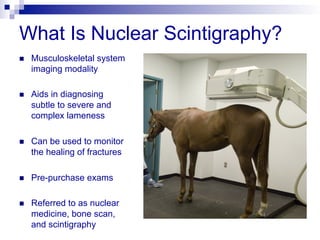
n  Musculoskeletal system
imaging modality
n  Aids in diagnosing
subtle to severe and
complex lameness
n  Can be used to monitor
the healing of fractures
n  Pre-purchase exams
n  Referred to as nuclear
medicine, bone scan,
and scintigraphy
n  Horse is injected with a radioactive isotope (Tc99m) that has an
affinity to localize in bone.
n  Areas of osteoblastic activity or accelerated metabolism of the bone
will result in a “hot spot”.
n  Gamma radiation is emitted by the horse and detected by the
camera creating an image.
How It Works
Phases of a Bone Scan…
n  Vascular Phase
¨  Not used readily in horses unless
a lack of blood supply is
suspected. Ie. iliac thrombosis
n  Soft Tissue or Pooling Phase
¨  Allows us to examine the soft
tissue structures of the lower limbs
(ie. tendons/suspensory)
n  Bone Phase
¨  Performed 2-3 hours after
injection to ensure the isotope has
been well distributed into the
bone.
n  Hospitalized for a
minimum of 48 hours
after injection.
n  Patients are confined to
a stall to allow for the
radioactive isotope to
decay.
n  Ensures both patient
and handler safety.
Horse Handling and Management
Why Scintigraphy?
n  Scintigraphy is an excellent
way to identify lameness
issues that are difficult to
diagnose.
¨  Pelvic, shoulder and back imaging
are all possible. These areas may
be inaccessible to other modalities
(x-ray or ultrasound).
n  Aids to rule out suspected
fractures or isolate the main
cause of a lameness if a “multi
focal” lameness is present.
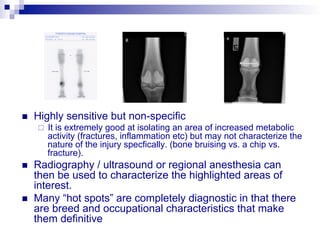
n  Highly sensitive but non-specific
¨  It is extremely good at isolating an area of increased metabolic
activity (fractures, inflammation etc) but may not characterize the
nature of the injury specfically. (bone bruising vs. a chip vs.
fracture).
n  Radiography / ultrasound or regional anesthesia can
then be used to characterize the highlighted areas of
interest.
n  Many “hot spots” are completely diagnostic in that there
are breed and occupational characteristics that make
them definitive
When would you consider
Scintigraphy?
n  A sudden onset lameness.
n  Failure to localize the
lameness by blocking.
n  Lameness involving one or
multiple limbs.
n  Persistent / intermittent
lameness.
n  History of poor performance.
n  Monitor the healing of an injury
or fracture.
TIBIAL STRESS FRACTURE
AFTER 4 MONTHS STRICT STALL REST
n  Front end, hind end,
or full body
n  With or without soft
tissue phase
n  It is important to
always compare left
and right sides of the
horse. Some “hot
spots” are normal for
certain breeds
BONE SCAN OF A FOAL –
NORMAL INCREASE UPTAKE
IN GROWTH PLATES
BONE SCAN OF A
WARMBLOOD – WITH
INCREASED UPTAKE
OF THE DORSAL P1
ORGIN OF SUSPENSORY
(Avulsion Fracture)
HUMERAL STRESS FRACTURE
Bilateral Pelvic Fractures
MULTI FOCAL KNEE
PATHOLOGY
MULTI FOCAL KNEE
PATHOLOGY
Osseous Cysts
LF - Normal
RF - Cyst
EXERTIONAL
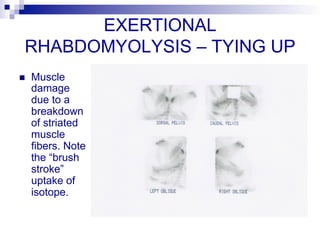
RHABDOMYOLYSIS – TYING UP
n  Muscle
damage
due to a
breakdown
of striated
muscle
fibers. Note
the “brush
stroke”
uptake of
isotope.
Case 6: “Mood”
n  2 Year Old Thoroughbred Racing Filly
n  Presented with acute right hind lameness
n  Suspected to have an injury to the
proximal right hind limb / pelvis
n  Scintigraphy elected
n  Giving – Pelvic Fracture

Scintigraphy

  • 2.
    What Is NuclearScintigraphy? n  Musculoskeletal system imaging modality n  Aids in diagnosing subtle to severe and complex lameness n  Can be used to monitor the healing of fractures n  Pre-purchase exams n  Referred to as nuclear medicine, bone scan, and scintigraphy
  • 3.
    n  Horse isinjected with a radioactive isotope (Tc99m) that has an affinity to localize in bone. n  Areas of osteoblastic activity or accelerated metabolism of the bone will result in a “hot spot”. n  Gamma radiation is emitted by the horse and detected by the camera creating an image. How It Works
  • 4.
    Phases of aBone Scan… n  Vascular Phase ¨  Not used readily in horses unless a lack of blood supply is suspected. Ie. iliac thrombosis n  Soft Tissue or Pooling Phase ¨  Allows us to examine the soft tissue structures of the lower limbs (ie. tendons/suspensory) n  Bone Phase ¨  Performed 2-3 hours after injection to ensure the isotope has been well distributed into the bone.
  • 5.
    n  Hospitalized fora minimum of 48 hours after injection. n  Patients are confined to a stall to allow for the radioactive isotope to decay. n  Ensures both patient and handler safety. Horse Handling and Management
  • 6.
    Why Scintigraphy? n  Scintigraphyis an excellent way to identify lameness issues that are difficult to diagnose. ¨  Pelvic, shoulder and back imaging are all possible. These areas may be inaccessible to other modalities (x-ray or ultrasound). n  Aids to rule out suspected fractures or isolate the main cause of a lameness if a “multi focal” lameness is present.
  • 7.
    n  Highly sensitivebut non-specific ¨  It is extremely good at isolating an area of increased metabolic activity (fractures, inflammation etc) but may not characterize the nature of the injury specfically. (bone bruising vs. a chip vs. fracture). n  Radiography / ultrasound or regional anesthesia can then be used to characterize the highlighted areas of interest. n  Many “hot spots” are completely diagnostic in that there are breed and occupational characteristics that make them definitive
  • 8.
    When would youconsider Scintigraphy? n  A sudden onset lameness. n  Failure to localize the lameness by blocking. n  Lameness involving one or multiple limbs. n  Persistent / intermittent lameness. n  History of poor performance. n  Monitor the healing of an injury or fracture. TIBIAL STRESS FRACTURE AFTER 4 MONTHS STRICT STALL REST
  • 9.
    n  Front end,hind end, or full body n  With or without soft tissue phase n  It is important to always compare left and right sides of the horse. Some “hot spots” are normal for certain breeds BONE SCAN OF A FOAL – NORMAL INCREASE UPTAKE IN GROWTH PLATES BONE SCAN OF A WARMBLOOD – WITH INCREASED UPTAKE OF THE DORSAL P1
  • 10.
  • 11.
  • 12.
  • 13.
  • 14.
  • 15.
    Osseous Cysts LF -Normal RF - Cyst
  • 16.
    EXERTIONAL RHABDOMYOLYSIS – TYINGUP n  Muscle damage due to a breakdown of striated muscle fibers. Note the “brush stroke” uptake of isotope.
  • 17.
    Case 6: “Mood” n 2 Year Old Thoroughbred Racing Filly n  Presented with acute right hind lameness n  Suspected to have an injury to the proximal right hind limb / pelvis n  Scintigraphy elected
  • 18.
    n  Giving –Pelvic Fracture